The Maine Department of Education (DOE) is seeking additional applicants to serve on the statewide Numeracy Advisory Council as part of Maine’s ongoing implementation of the Maine State Numeracy Action Plan. | More
The Maine Department of Education (DOE), in partnership with the University of Maine, officially launched Maine’s new interactive Literacy and Numeracy Playbooks during a statewide event held at the University of Maine’s Wells Conference Center in Orono on May 19, 2026. The Playbooks were developed as companion resources to the Maine State Literacy Action Plan and Maine State Numeracy Action Plan, announced last fall. They are designed to support schools and educators in translating a statewide vision for literacy and numeracy into meaningful classroom practice at the local level. | More
The Maine Department of Education (DOE) is pleased to join Volunteer Maine in celebrating the recipients of the 2026 Governor’s Awards for Service and Volunteerism, which, since 1987, have recognized the outstanding individuals, teams, and organizations making a meaningful impact through volunteer service. | More
Island Readers & Writers (IRW) has launched the Maine Storytime Finder, a new online resource developed as part of an initiative to support early childhood literacy. | More
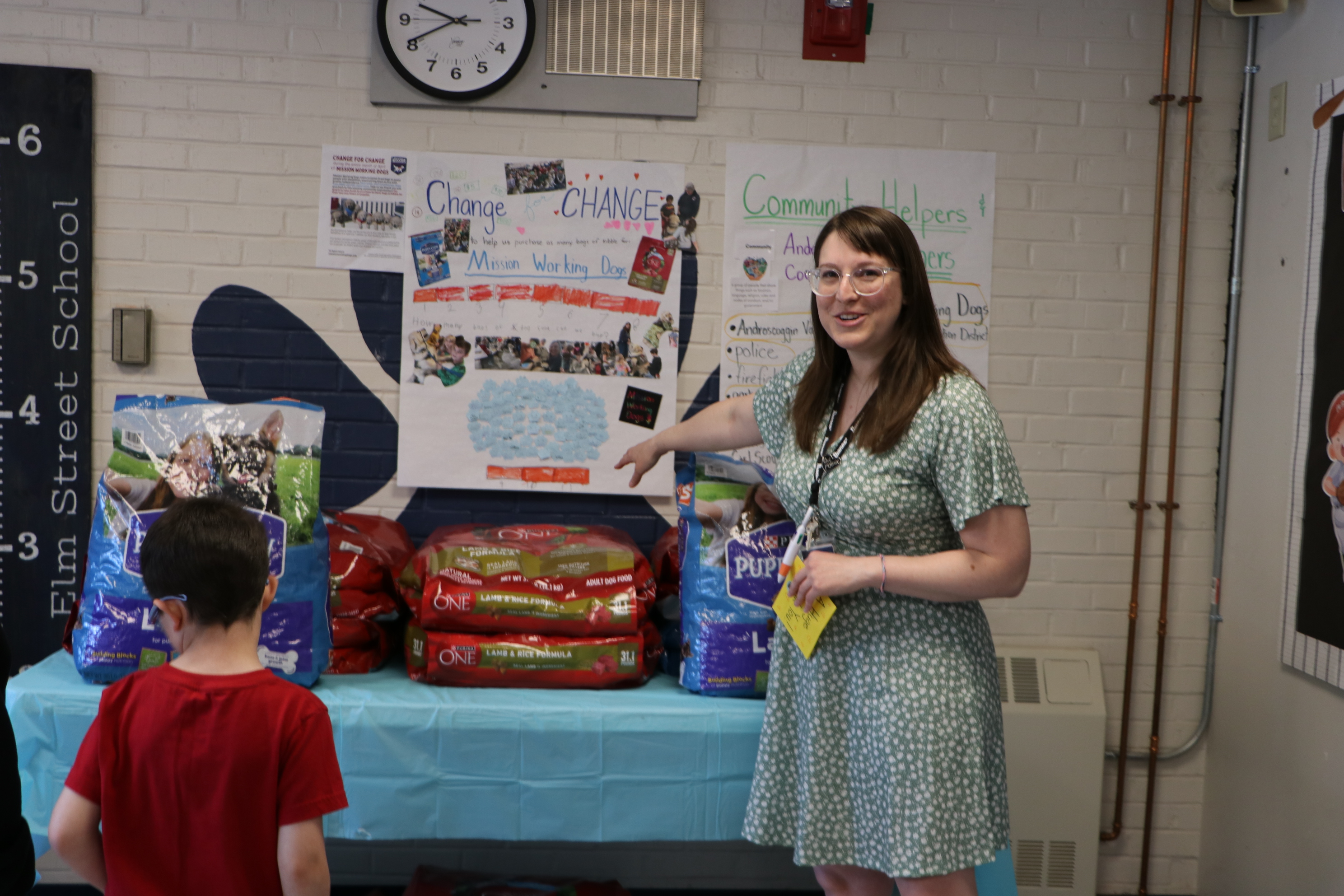
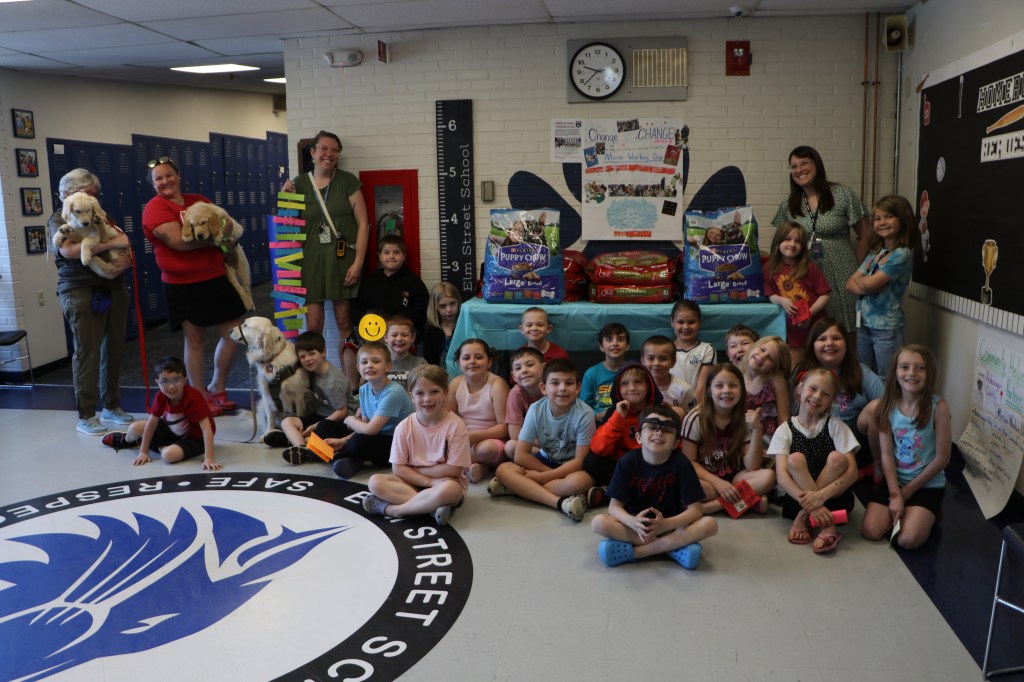
Students at Elm Street School in RSU 16 (Mechanic Falls) have spent the school year learning an important lesson about community, kindness, and helping others — all with the support of some four-legged friends. | More
At Mt. Ararat Middle School in MSAD 75, mornings in the Sheepscot Alternative Education Program begin not with a bell or worksheet but with music. On “Jazzy Tuesdays,” as students enter the classroom, the sounds of Herbie Hancock’s piano drift throughout the room, along with genuine and boisterous welcomes from alternative education teacher John Hawley and educational technician Huey Sheffler. As students find their seats, they settle into a “moment of chill” before the day begins. | More
The Maine Department of Education (DOE) along with several school and community-based organizations continue to advance high-quality, career-connected learning through extended learning opportunities (ELOs) that connect students with real-world experiences, local partners, and emerging career pathways. An example of this work is the Youth Doula Initiative, a three-day community-based ELO that recently engaged 15 South Portland High School students in hands-on learning focused on maternal health, pediatrics, and public health. | More
Registration is now open for ElevatED 2026, a dynamic summer professional learning experience designed to inspire, connect, and support Maine’s education workforce through meaningful collaboration and practical learning opportunities. | More
Educators across Maine are invited to deepen their connection to the outdoors and discover new ways to bring forest-based learning into their teaching during an upcoming Forest-Based Education Workshop hosted by Project Learning Tree (PLT) and the Forest Ecology Research Network (FERN). | More
The Maine Department of Education (DOE), in partnership with the University of Maine, officially launched Maine’s new interactive Literacy and Numeracy Playbooks during a statewide event held at the University of Maine’s Wells Conference Center in Orono on May 19, 2026. The Playbooks were developed as companion resources to the Maine State Literacy Action Plan and Maine State Numeracy Action Plan, announced last fall. They are designed to support schools and educators in translating a statewide vision for literacy and numeracy into meaningful classroom practice at the local level.
The launch event brought together educators, school and school administrative unit (SAU) leaders, higher education partners, and statewide collaborators to celebrate the culmination of collaborative planning, professional learning, and implementation work focused on strengthening literacy and numeracy learning across Maine. Justin Dimmel, Associate Dean for Academics and Student Engagement in the University of Maine College of Education and Human Development, provided welcome remarks, and closing remarks were delivered by University of Maine President Joan Ferrini-Mundy.
The day included interactive and hands-on Playbooks exploration sessions, a digital scavenger hunt, collaborative reflection and planning opportunities, and whole-group discussions focused on supporting meaningful literacy and numeracy implementation in Maine schools. Attendees had opportunities to engage with the interactive Playbooks, explore embedded resources, and connect with colleagues and partners from across the state. They were also introduced to “PIP,” the Playbook Integration Partner, a puffin-themed navigation and support feature embedded throughout the interactive platform to help users locate resources and move through the playbooks with ease.
“We have been hatching new possibilities for what literacy and numeracy can look like in Maine,” Beth Lambert, Maine DOE Chief Teaching and Learning Officer, said during opening remarks at the event. “This work has never been about creating documents to sit on a shelf. It has been about building coherent systems of support that help educators create meaningful, engaging learning experiences for all students.”
The Playbooks provide educators and school systems with practical implementation tools, research-based instructional strategies, professional learning resources, interdisciplinary connections, and navigation supports designed to make the resources accessible and usable. They were developed through extensive collaboration and feedback from educators and partners across Maine, including the Literacy and Numeracy Advisory Councils, the Maine Math Collaborative, representatives from higher education, and cross-office Maine DOE teams. A significant portion of the Playbook design, revision, and interactive platform development was led by the Maine DOE’s Interdisciplinary Instruction and Learning Through Technology teams, including Kathy Bertini, Emma Banks, Erik Wade, Heather Martin, and Michele Mailhot.
The launch event highlighted the Maine DOE’s broader statewide efforts to align funding, initiatives, and professional learning opportunities to the goals outlined in the Action Plans. Over the past year, the Maine DOE has expanded statewide professional learning aligned to the Action Plans through interdisciplinary literacy workshops, a numeracy learning series, statewide mathematics communities of practice, STEAM (Science, Technology, Engineering, Arts, Mathematics) integration cohorts, literacy modules, and place-based learning opportunities designed to support meaningful, research-based instruction across grade spans and content areas.
The Maine DOE partnered closely with the University of Maine throughout the development and launch process of the Playbooks. Special thanks go to Justin Dimmel, Mia Morrison, and the broader University of Maine team for their collaboration and support in hosting the statewide launch event.
The Literacy and Numeracy Playbooks reflect the Maine DOE’s ongoing commitment to interdisciplinary learning, supporting educators, and ensuring all learners have access to high-quality literacy and numeracy experiences that are meaningful, relevant, and connected to the world around them.
To learn more about Maine’s statewide literacy and numeracy initiatives, visit the Maine DOE’s Office of Teaching and Learning website.
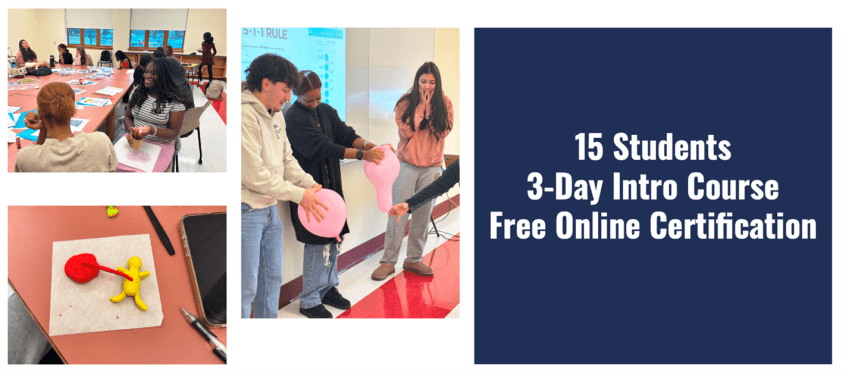
The Maine Department of Education (DOE) along with several school and community-based organizations continue to advance high-quality, career-connected learning through extended learning opportunities (ELOs) that connect students with real-world experiences, local partners, and emerging career pathways. An example of this work is the Youth Doula Initiative, a three-day community-based ELO that recently engaged 15 South Portland High School students in hands-on learning focused on maternal health, pediatrics, and public health.
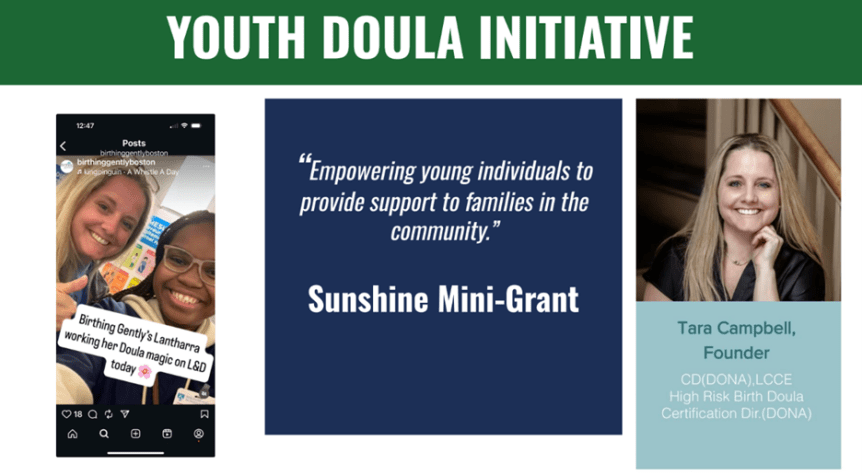
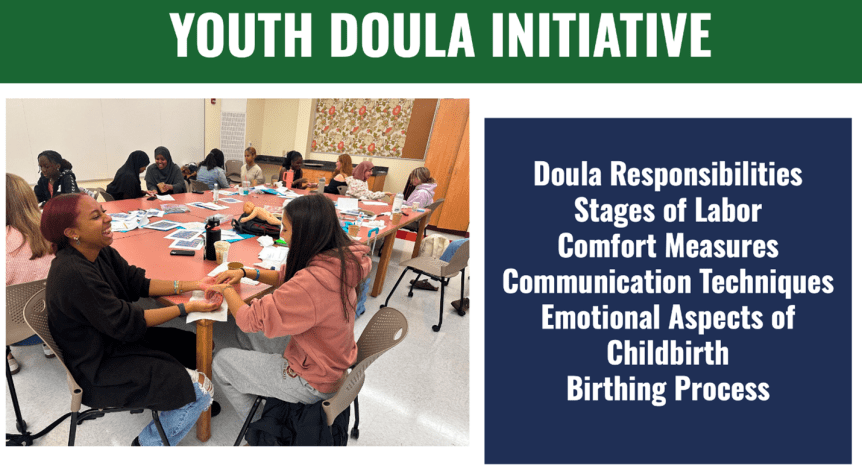
Slated for two more sessions this school year, the ongoing Youth Doula Initiative was developed through a partnership between Justine Carlisle, Jobs for Maine Graduates (JMG) ELO Navigator at South Portland High School, and Tara Campbell, founder of Birthing Doula and Birthing Gently. After researching opportunities that could provide authentic clinical exposure for students under 18 years old, Carlisle connected with Campbell, who has extensive experience in introducing young people to the doula profession. Carlisle described the initiative as one of the most meaningful programs she has facilitated, noting that childbirth touches nearly every family; yet, misconceptions and gaps in understanding are common. Through this experience, students gain accurate, practical knowledge about anatomy, medical options, and the social-emotional responsibilities of healthcare providers.
Campbell shared that the Youth Doula Initiative has “a significant positive impact on both students and their communities,” noting that participants gain essential healthcare knowledge while learning how trust-based, relatable support can improve outcomes for pregnant families. She also emphasized that the initiative opens ethical, paid pathways through Medicaid-supported doula work and continued no-cost training opportunities.
Youth Doula Initiative
Through the Youth Doula Initiative, students have not only the opportunity to explore an accessible healthcare career but also gain meaningful experience that deepens their understanding.
“I was super excited to learn about something I thought was years beyond me in school,” senior Esperanza Kunieki said. “We learned about different aspects of birthing—things I didn’t even know about—and it really excites me to learn more about this career.”
Another senior, Zeila Monteiro, shared, “The Youth Doula Initiative helped me understand what it truly means to be a doula and gave me a deeper understanding of each stage of pregnancy. It focuses on communication, support, and emotional reassurance, which are important skills for us as young adults.”
The Youth Doula Initiative reflects the broader impact of Maine’s ELO framework, empowering students through authentic learning, strengthening community partnerships, and preparing young people to make informed, confident decisions about their futures. The initiative was supported in part by the statewide Sunshine Mini Grant Program, which advances the mission of the Maine Community Coordinators Collaborative (C3). Since 2023, the Sunshine Mini Grant Program has awarded $88,000 across 18 grants, reaching approximately 300 students statewide. These grants help schools with limited resources to pilot innovative ELOs by addressing barriers such as transportation challenges, poverty, and limited access to professional mentors. Collectively, the program has expanded access to experiential learning that informs students’ career interests and post-secondary planning.
For further information about ELOs and Maine’s efforts to expand career exploration for Maine students, please visit the Maine DOE ELO webpage or contact Maine DOE Extended Learning Coordinator Lana Sawyer at Lana.Sawyer@maine.gov.
Youth Doula Initiative
This story was written in collaboration with South Portland High School. To submit a good news story to the Maine DOE, please fill out the good news submission form.
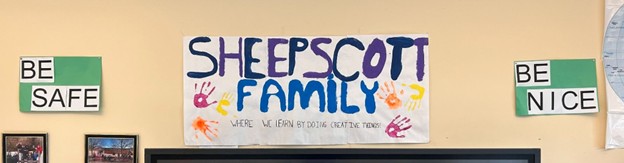
Sheepscot students created this poster. Teacher John Hawley shared, ‘This says it all. I know there’s only one T in Sheepscot, but the sign was too perfect, and I didn’t have the heart to tell the kids they spelled it wrong.
At Mt. Ararat Middle School in MSAD 75, mornings in the Sheepscot Alternative Education Program begin not with a bell or worksheet but with music. On “Jazzy Tuesdays,” as students enter the classroom, the sounds of Herbie Hancock’s piano drift throughout the room, along with genuine and boisterous welcomes from alternative education teacher John Hawley and educational technician Huey Sheffler. As students find their seats, they settle into a “moment of chill” before the day begins.
“That time is intentional,” Hawley said. “We’re asking students to be fully present, so we create space for them to arrive, reset, and feel grounded before the day begins.”
A Different Approach to Learning
The Sheepscot Team has been redesigned from a small population in an all-day, secluded model to a thriving, project-based learning alternative education environment. Today, it serves 32 seventh- and eighth-grade students—about 16 students per grade—with a focus on relationships, project-based learning, and social-emotional learning.
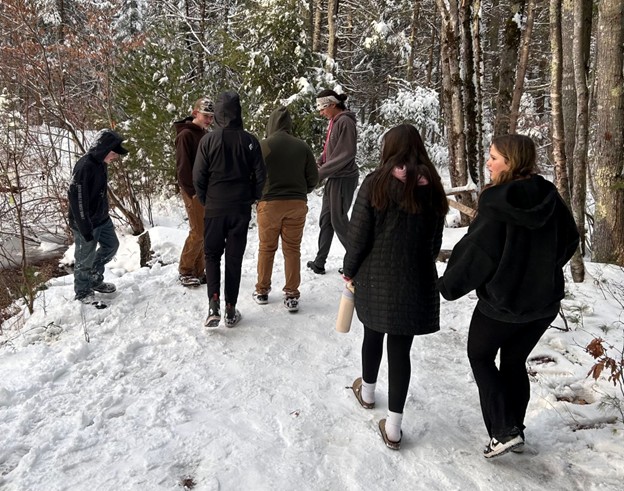
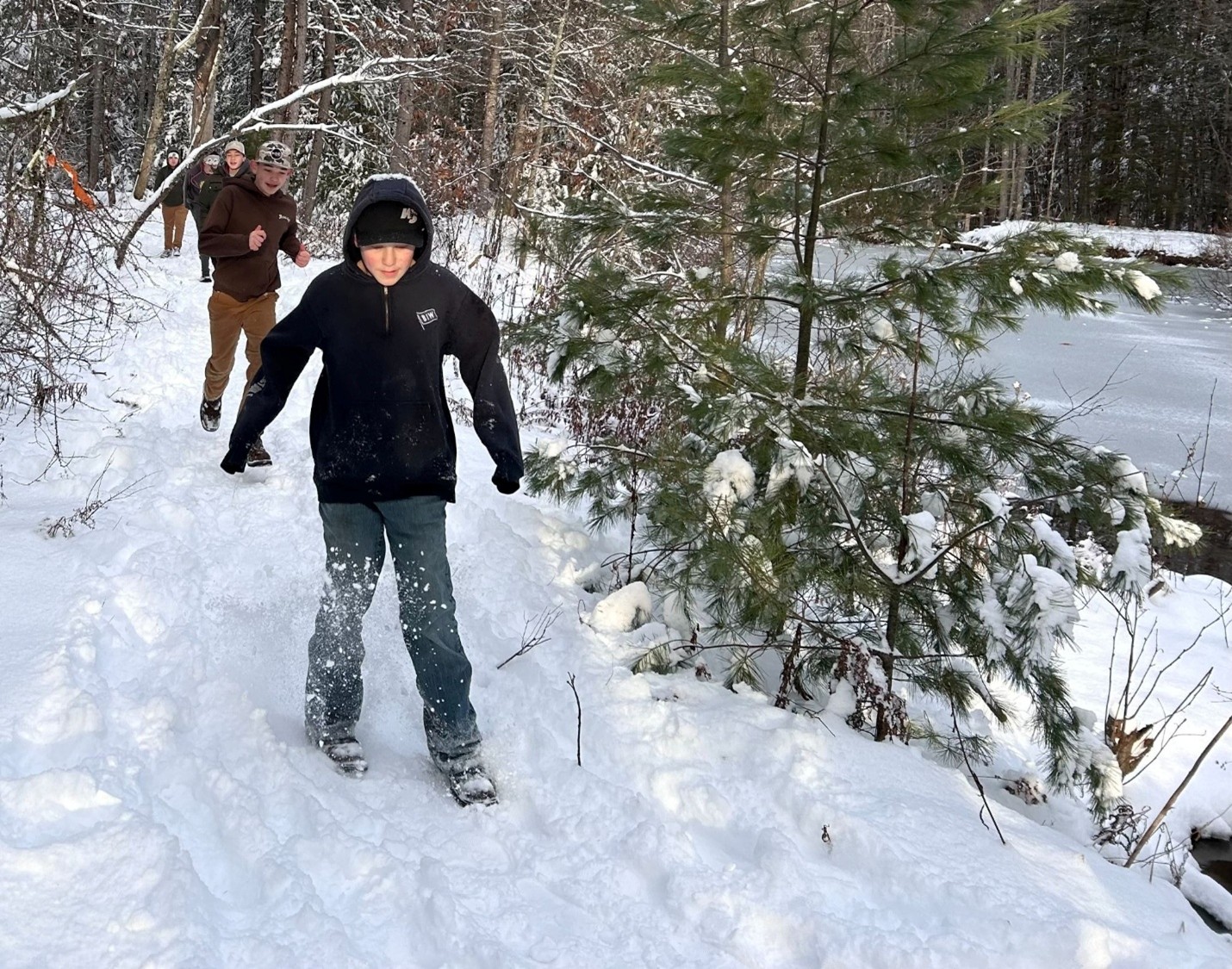
Each day follows a consistent but flexible structure. After the morning’s “moment of chill,” students and staff head outside for their daily pond loop walk, regardless of the weather. The walk takes about five minutes and allows students to ground themselves in nature and connect with their classmates and teachers in a non-scripted manner.
“We go outside every day, no matter what,” Hawley said. “It’s part of who we are. Movement and fresh air help students regulate and get ready to learn.”
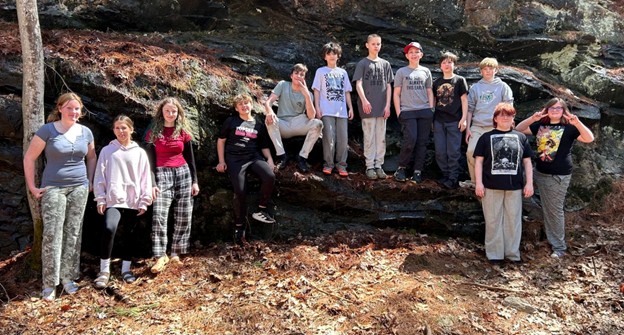
Sheepscot students on a pond loop walk following a fresh snow
Back in the classroom, students watch CNN 10 and generate questions about current events, which later fuel weekly review games and discussions.
From there, the day shifts into the heart of the program: project-based learning.
Learning That Feels Real
In Sheepscot, projects are not an add-on; they are the foundation of learning. Students explore rigorous academic projects through immersive, hands-on experiences that connect to real-world systems. Eighth graders are currently engaged in the “World Game,” where they design countries, manage resources, and navigate global relationships.
“You learn everything here, just in a different way,” one student shared. “It actually makes sense because you’re doing it. I feel smart in here.”
The seventh graders are currently working on a “Shark Tank”-style challenge to develop solutions to reduce plastic waste and address climate impacts. Each group approaches the problem differently, highlighting creativity, student voice, and healthy debate among students.
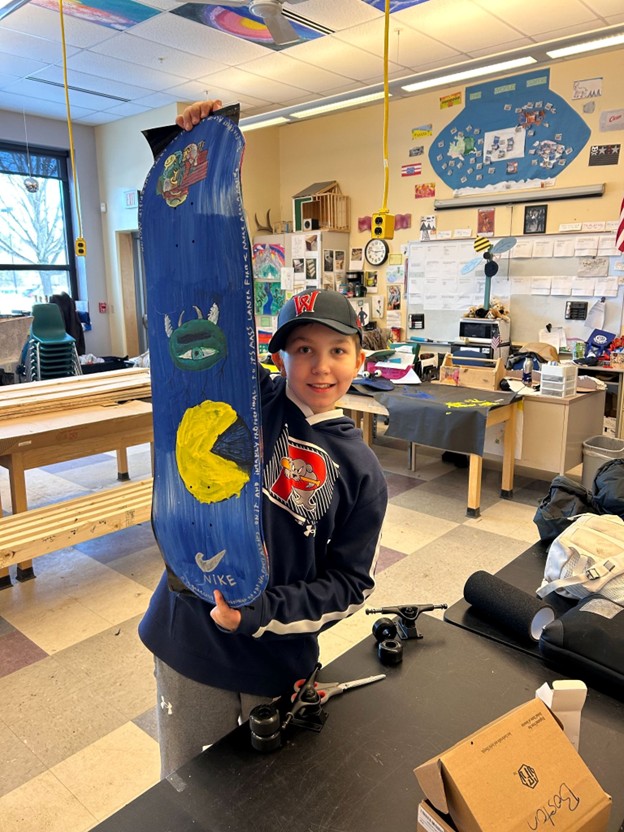
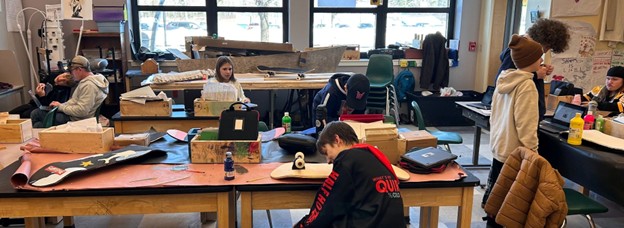
Other projects have included building skateboards to demonstrate Newton’s Laws of Motion and designing interdisciplinary units based on student interest, such as an exploration of ancient Pompeii.
Sheepscot students designing and building skateboards
“We give students choice through project menus,” Sheffler explained. “That ownership is what drives investment.”
An example of a project menu exploring the amendments to the US Constitution
Building Skills for Life
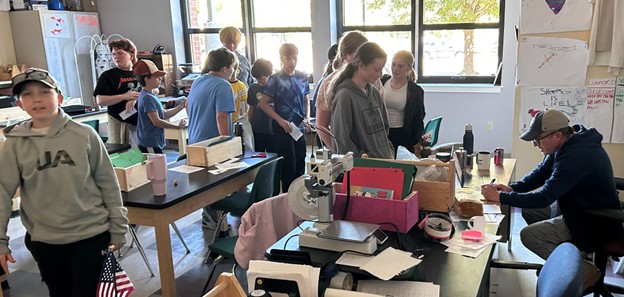
Beyond academics, the program integrates real-world skills into daily learning. Students participate in systems that simulate adult responsibilities, including personal finance and economic decision-making.
They earn paychecks based on attendance, work habits, and grades, allowing students to earn raises based on these behaviors. Students also learn about the stock market with investment profiles, credit scores, and stock market simulations. Students will soon experience a “bank run” that will wipe out their hard-earned savings.
A sample paycheck and Sheepscot students in line to deposit their weekly paychecks
“They feel the impact of their decisions, and that sticks with them,” Sheffler said.
Hawley and Sheffler intentionally include members of their school community in their learning. The Mt. Ararat Middle School office staff are invested members in the personal finance unit and have stock profiles. This approach teaches students that what they are learning in Sheepscot goes beyond their classroom walls.
Student Voice and Civic Engagement
Sheepscot students also engage deeply with civics and democratic processes. Through mock trials, elections, and student-led discussions, students explore topics like the presidency and Supreme Court.
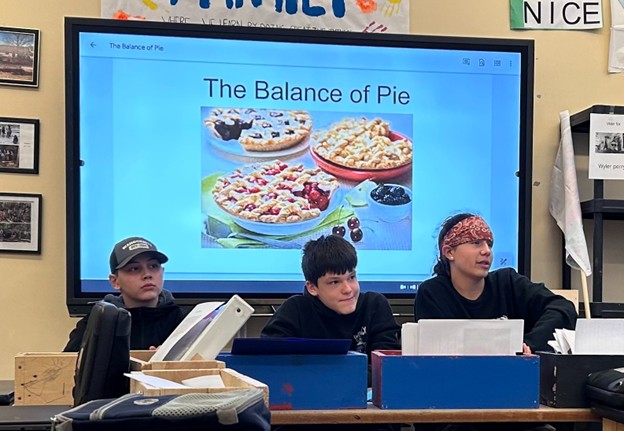
In one activity, Sheepscot students simulated the three branches of the U.S. government. They elected a president who wanted the class to bake apple pies. The rest of the team served as a divided legislature trying to pass a bill for either blueberry or cherry pie. Three students were confirmed by the legislature to serve on the Supreme Court to uphold the rules of the process. By using structured argument and legislative-style processes, the bill for blueberry pie was vetoed, and the team enjoyed baking and eating apple pie.
“It sounds simple, but they’re learning how to think, debate, and listen,” Sheffler noted. “Those are lifelong skills.”
Sheepscot students participating in a mock Supreme Court confirmation hearing
Pathways Into the Sheepscot Team
Enrollment in the Sheepscot Team is intentional and collaborative, with a clear, structured process. First, sixth-grade teachers recommend students for the Sheepscot Team. Next, the principal and counseling team review these recommendations with Hawley and Sheffler. They prioritize students based on need, school engagement, and overall fit for the program. They also work to ensure students will be positive and productive contributors.
Selected students then become candidates. Hawley contacts families to explain the program to them and obtain permission to move forward with the process. This step helps to establish an early foundation for positive relationships. Hawley and Sheffler then interview candidates to assess readiness for a project-based model of teaching and learning. Finally, candidates participate in a “Sheepscot experience.” This allows both staff and students to reflect on whether the program is the right fit for seventh grade.
“This only works if students want to be here,” Hawley emphasized. “It’s an opportunity, not a placement.”
Accepted students receive a “golden ticket” invitation. Hawley and Sheffler say they want students to know that it is a privilege to be part of this community.
An important piece to the enrollment process is how the Sheepscot Team begins building connections with prospective students early. All sixth graders participate in rotating five-week enrichment blocks that occur throughout the school year, introducing students to project-based learning and the program’s routines. Students work in teams and build team identities by creating team names, mottos, and handshakes. Then, they take on various challenges.
These enrichment blocks strengthen the Sheepscot Team’s connection with the school by including all students. They also allow Hawley and Sheffler to start to build relationships with future Sheepscot Team students, ensuring that the students entering the program are a good fit.
Connected to Community
While the program offers a distinct learning environment, it is not isolated. Students participate in mainstream classes and school activities, and staff across the school community engage with Sheepscot projects.
Families stay connected through regular updates and project sharing, and a new alumni initiative invites former students back to mentor and support current participants.
“We’re not an island,” Sheffler said. “This is part of a larger community that believes in these kids.”
A Model That’s Working
With a growing waitlist and strong student outcomes, the Sheepscot Team stands as a powerful example of what’s possible when education is designed around relationships, relevance, and student voice. Students, staff, and families all have stories of transformation, new friendships, and moments when a student who once dreaded school suddenly can’t wait to show up.
“There’s a sense of joy here,” Hawley reflected. “Students feel like they belong, and that makes all the difference.”
As Maine schools continue to explore innovative approaches to learning, programs like Sheepscot offer a compelling reminder: When students are engaged, supported, and seen, they thrive.
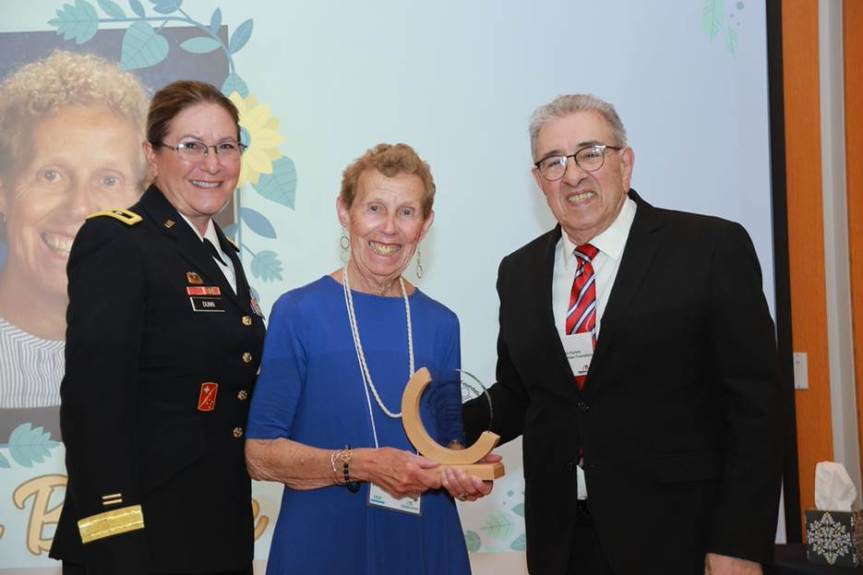
Anne Behnke receives the 2026 Maine Volunteer of the Year award.
The Maine Department of Education (DOE) is pleased to join Volunteer Maine in celebrating the recipients of the 2026 Governor’s Awards for Service and Volunteerism, which, since 1987, have recognized the outstanding individuals, teams, and organizations making a meaningful impact through volunteer service.
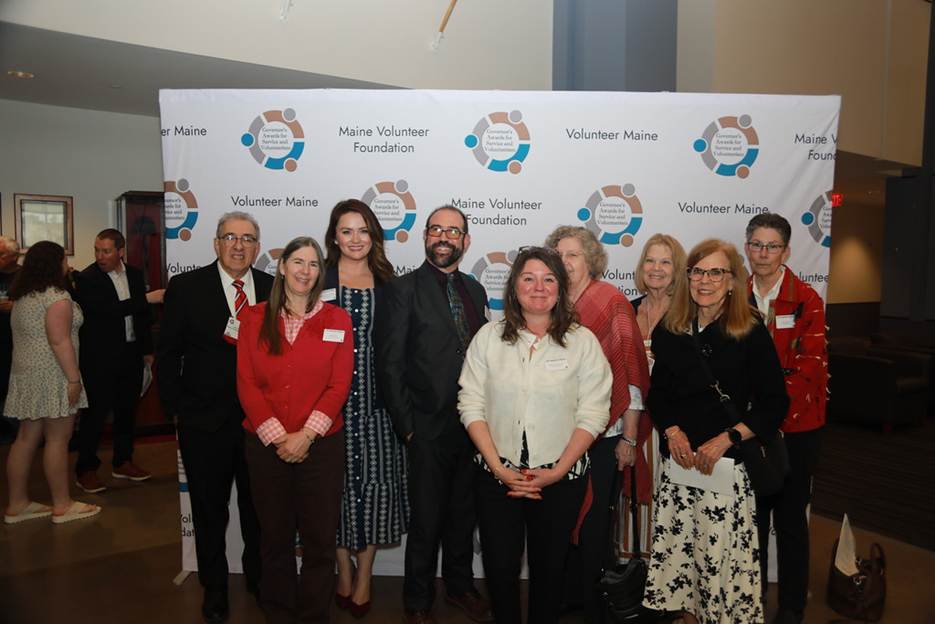
On May 9, 2026, at Camp Chamberlain in Augusta, Major General Diane Dunn joined members of the Maine Commission for Community Service—including Maine DOE Associate Commissioner of Policy and Programs Chelsey Fortin-Trimble—in celebrating the 2026 recipients at an annual awards ceremony.
Members of the Maine Commission for Community Service
This year, the recipient of the Maine Volunteer of the Year award is Anne Behnke, a long-time Lewiston Public Schools (LPS) educator. For 40 years, Behnke has provided steady and compassionate hospice care through Andwell Health Partners. Contributing approximately 300 hours of service each year, Behnke has demonstrated a willingness to take on deeply challenging assignments, the ability to provide comfort in moments of profound vulnerability, guidance and mentorship for other volunteers, and positive energy. Behnke remains an active member of the LPS community.
You can read more about Behnke and the other recipients of the 2026 Governor’s Awards for Service and Volunteerism here.
Educators across Maine are invited to deepen their connection to the outdoors and discover new ways to bring forest-based learning into their teaching during an upcoming Forest-Based Education Workshop hosted by Project Learning Tree (PLT) and the Forest Ecology Research Network (FERN).
Taking place on June 23, 2026, from 9 a.m. to 3 p.m. at Holt Research Forest in Arrowsic, this hands-on workshop will introduce participants to engaging, field-based approaches that use forests as a teaching tool across a variety of subject areas.
PLT, an initiative of the Sustainable Forestry Initiative, is an award-winning environmental education program that provides standards-aligned curriculum designed to “teach students how to think, not what to think.” Through interactive activities and outdoor exploration, educators will learn how to integrate environmental literacy and critical thinking into their classrooms and programs.
Participants will also explore the work of FERN, an experiential, field-based program that combines place-based environmental education with standard forest data-collection protocols. FERN encourages community scientists of all ages to investigate the Maine woods, ask meaningful questions, and engage in authentic scientific inquiry.
Formal and non-formal educators are encouraged to attend. Participants will receive:
A $100 support stipend.
A copy of PLT’s “Explore Your Environment Activity Guide.”
Hands-on experience with forest-based teaching strategies and data collection activities.
Organizers have expressed they hope the workshop will help educators discover how outdoor learning can support student engagement, curiosity, and cross-curricular learning opportunities.
Educators who may face barriers related to substitute teacher costs are encouraged to reach out for additional support options by emailing logan@mainetree.org.
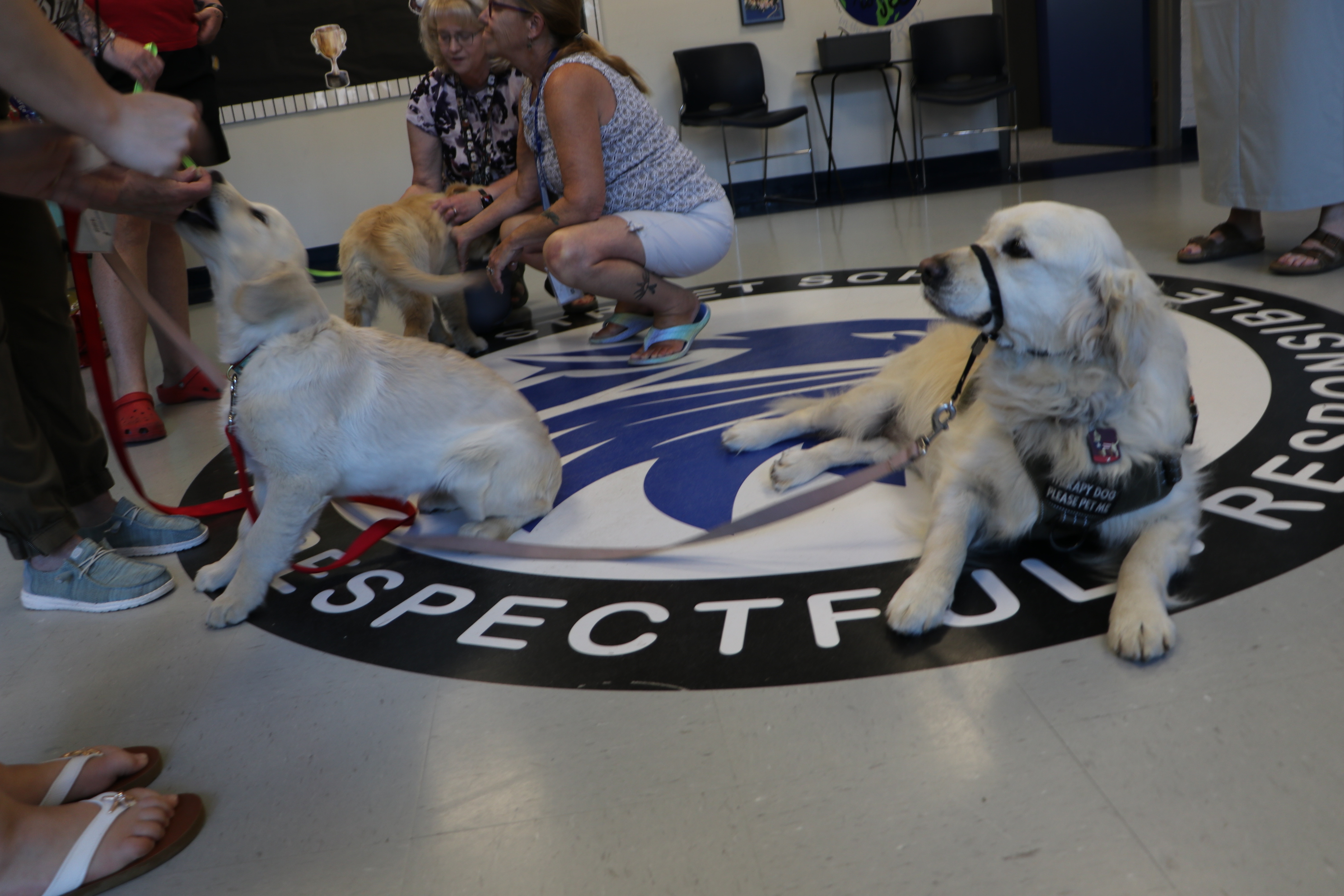
Students at Elm Street School in RSU 16 (Mechanic Falls) have spent the school year learning an important lesson about community, kindness, and helping others — all with the support of some four-legged friends.
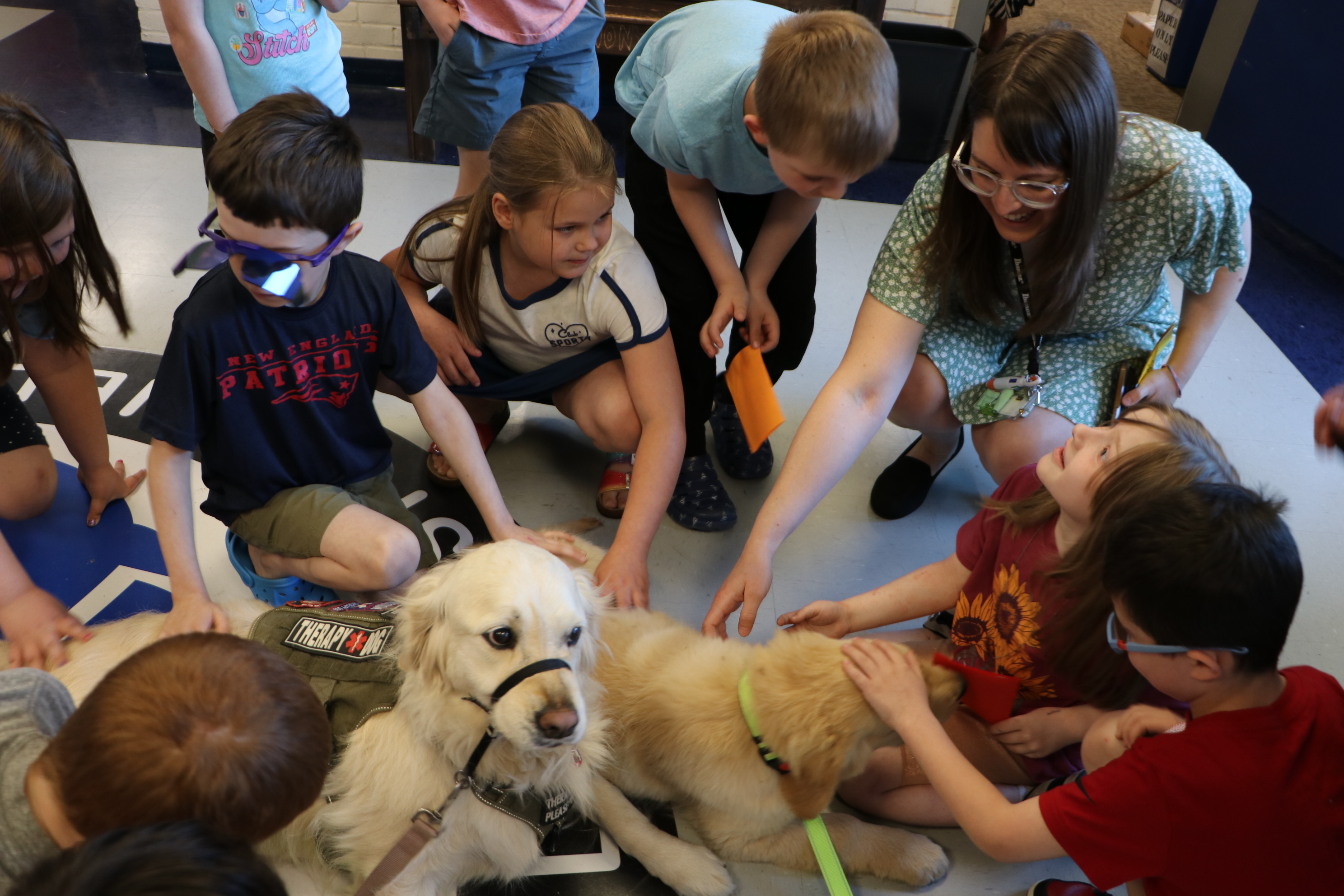
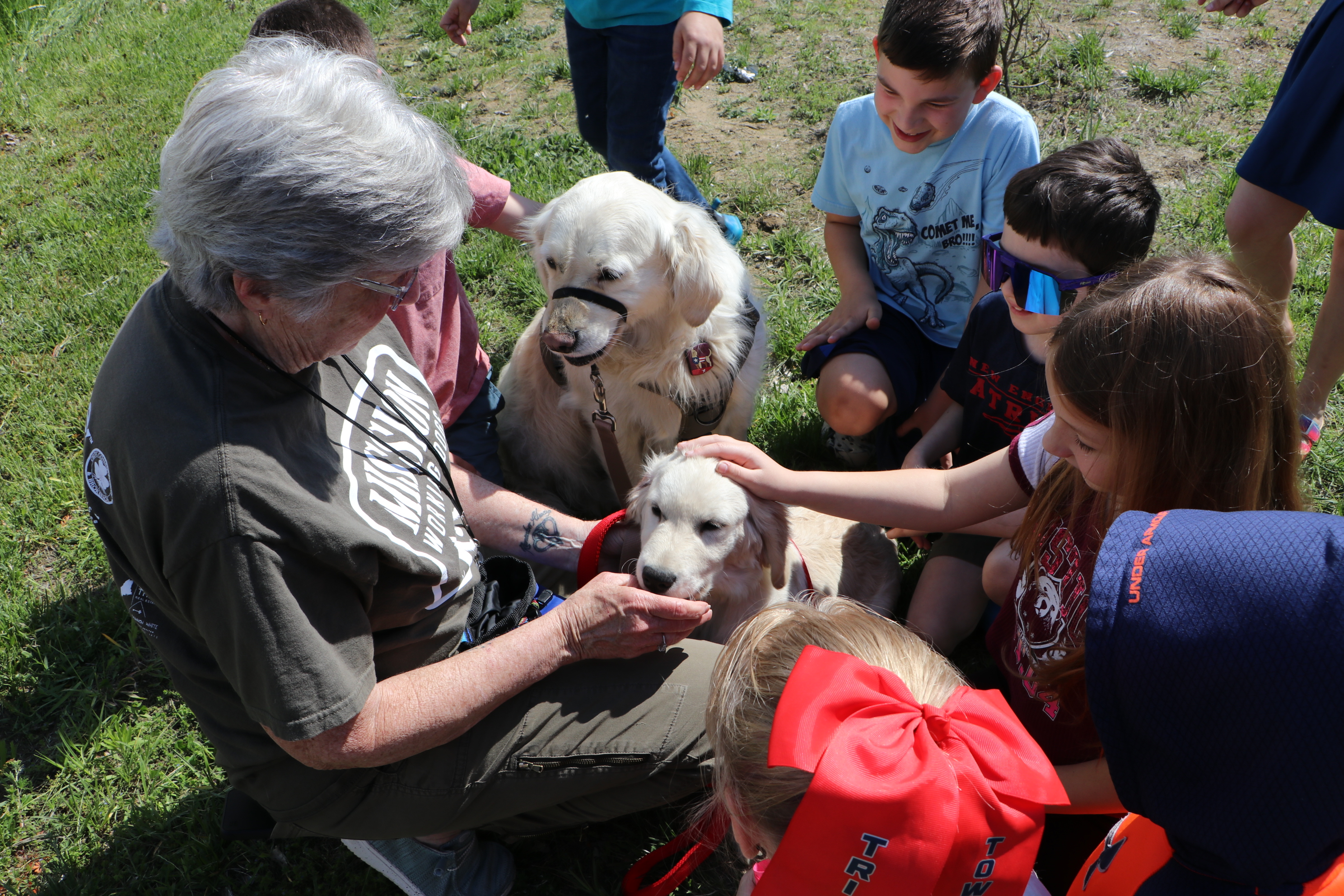
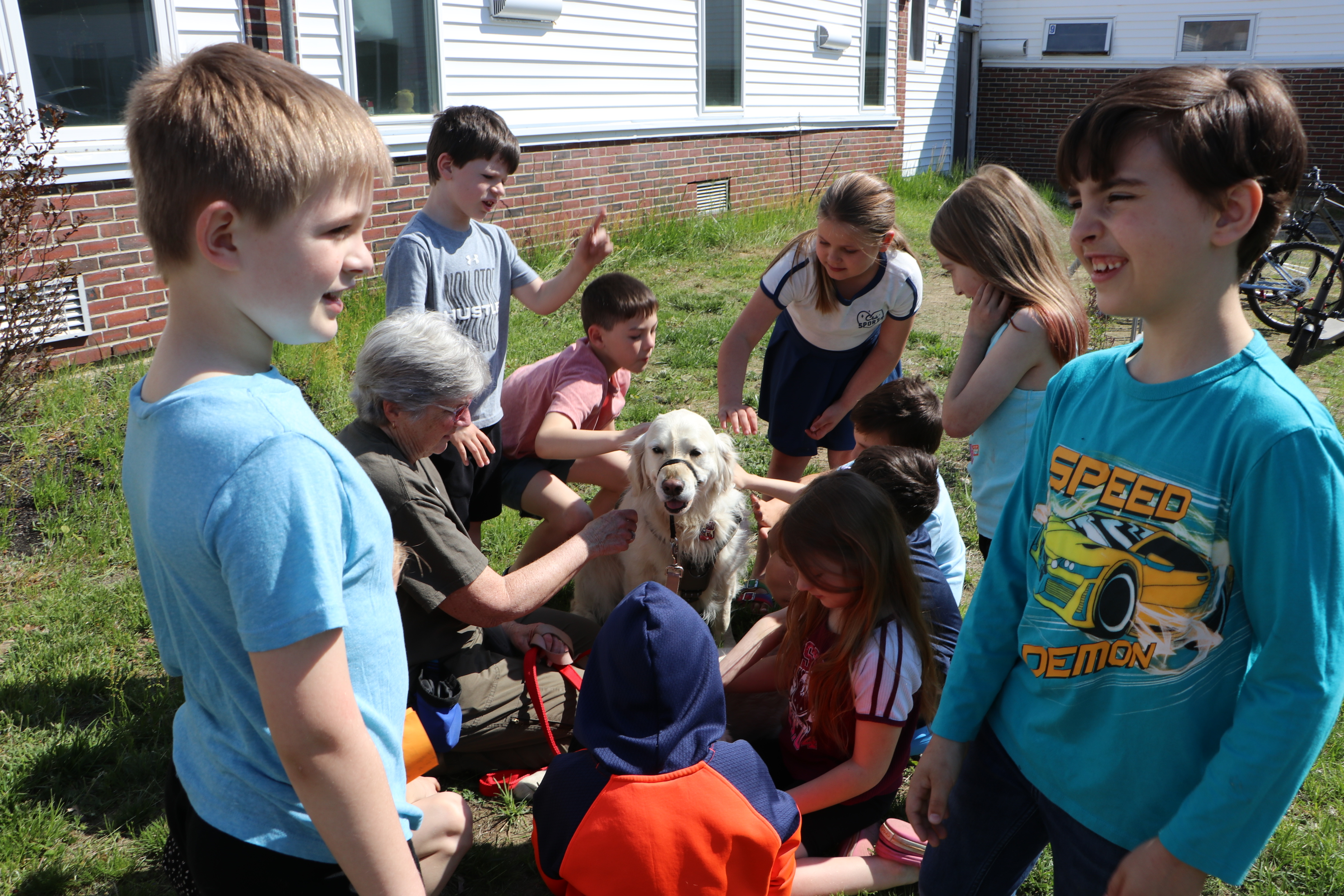
Through a special partnership with local nonprofit organization Mission Working Dogs, these students welcomed therapy dogs into their classrooms every Thursday throughout the school year for activities that supported both student learning and the dogs’ training.
This partnership grew from an already strong relationship between the school and the nonprofit. It expanded this year when retired teacher and current dog handler Debbi Conley reached out to Elm Street School Principal Jessica Madsen about getting volunteers and dogs into classrooms.
Mission Working Dogs trains therapy and service dogs to support people with disabilities, veterans, and others who benefit from trained working dogs. These weekly visits at the school gave the dogs valuable exposure to children while also providing students with opportunities to build literacy skills, strengthen social-emotional connections, and learn more about helping others in their community.
During the Thursday sessions, students and dogs participated in a variety of activities, including reading practice, Jeopardy-style games, sharing of jokes, and plenty of time for play and affection.
“It’s something that our students always look forward to,” Jessica Harvey, a second-grade teacher and the 2021 Androscoggin County Teacher of the Year, said. “It helps with attendance on those days when we have therapy dogs coming. Those were our well-attended days for sure.”
Harvey said students especially enjoyed reading aloud to the dogs, which helped make practicing literacy skills feel exciting and meaningful.
“Students are working on their reading fluency, and they get to practice that a lot in the classroom. Being able to read to a dog is just kind of a really special thing,” Harvey said. “We have a whole group of animal lovers and nature lovers, so having animals come into the classroom is just another way for kids to connect with living things.”
Beyond literacy development, this partnership also helped students better understand how organizations support people in need.
“I also think that learning about organizations that help people — veterans, individuals with disabilities — is important. That’s primarily what their work is about,” Harvey explained of the nonprofit. “[Students] having that awareness that there are people in the world who benefit from this type of support is really nice.”
This partnership became even more meaningful through a classroom project focused on community helpers. As students learned about the role of citizens in the community during a recent social studies unit on civics and government, they brainstormed ways they could make a difference themselves through a “Change for Change” fundraising effort.
After voting on a project, students in Harvey and Sophia Stone’s second-grade classrooms chose to raise money for Mission Working Dogs as a way to thank the nonprofit for including them in the dogs’ training and building relationships with the students throughout the year.
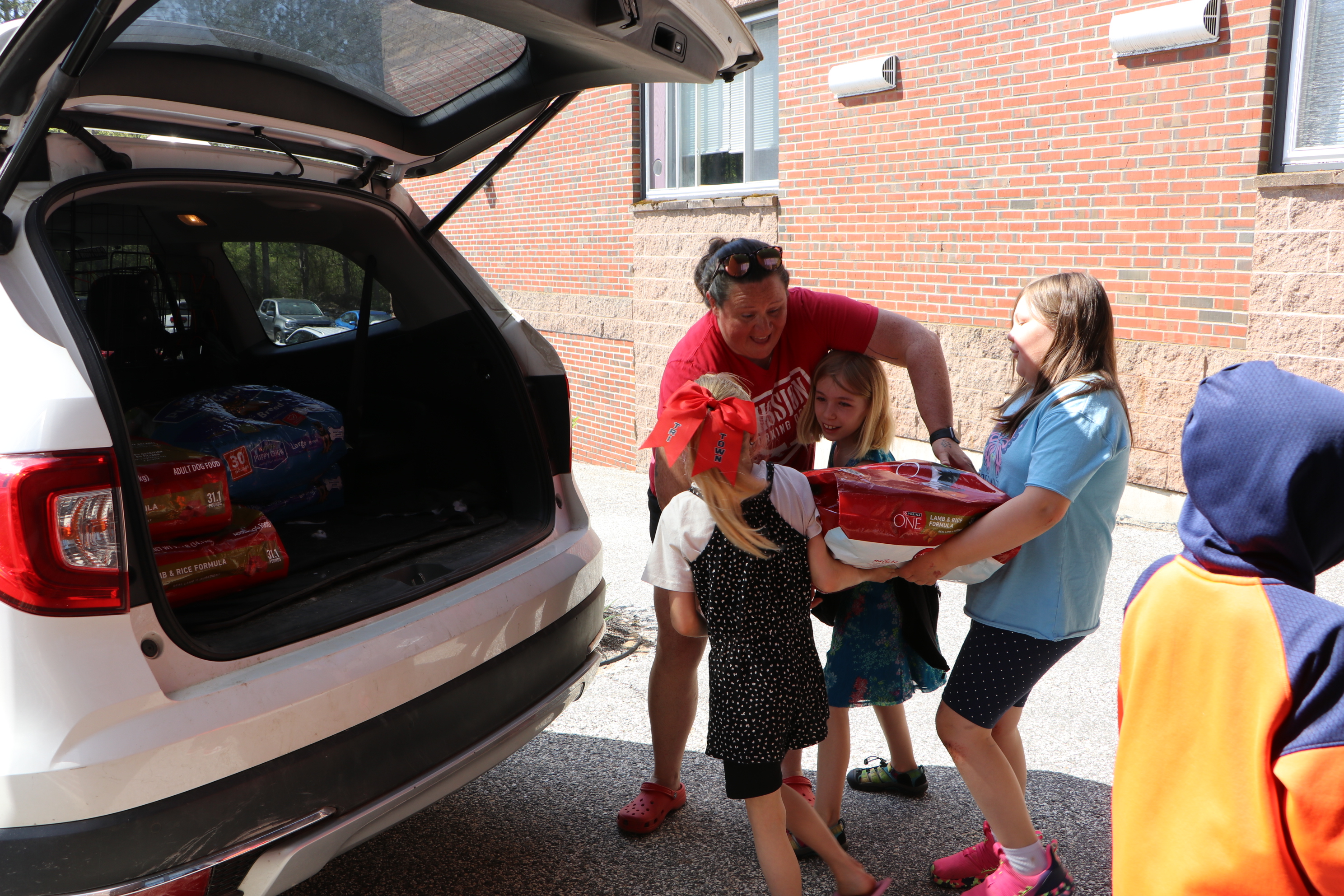
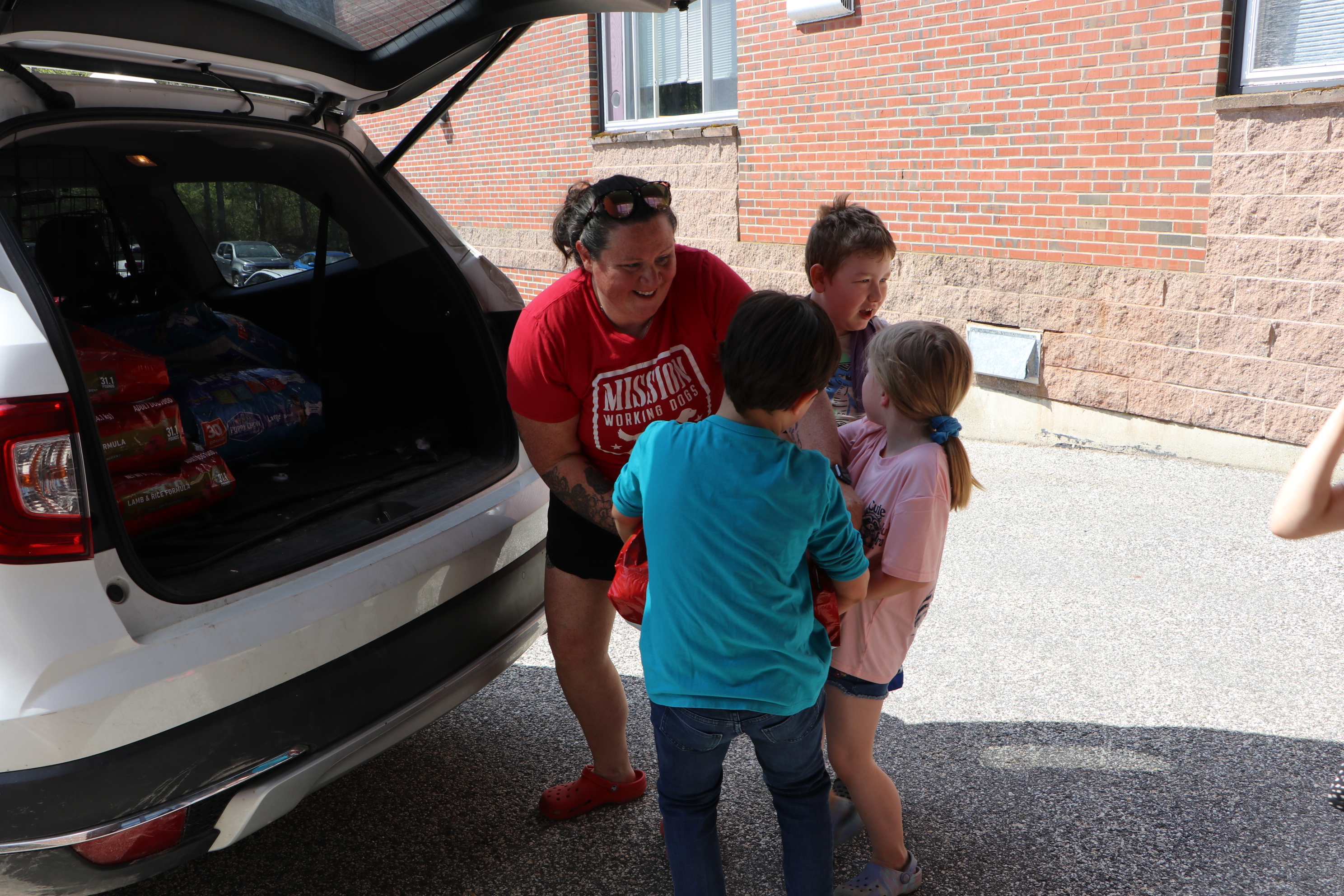
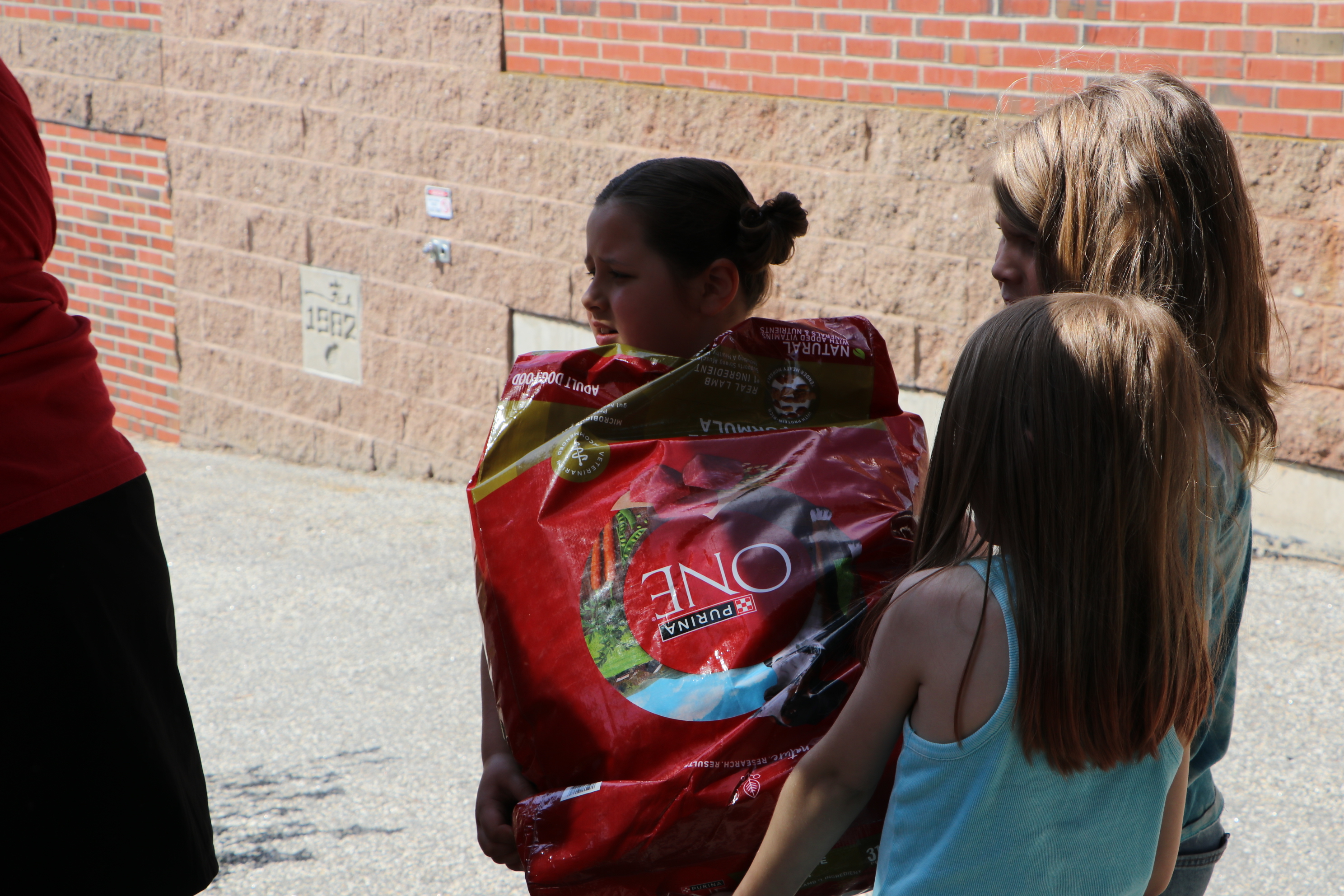
Together, the second graders raised $500.03 by collecting donations from students and staff across the school — enough to purchase 11 large bags of dog food for Mission Working Dogs.
Staff at Mission Working Dogs shared that they go through approximately 167 cups of puppy kibble each day, making the donation incredibly meaningful for the nonprofit, which relies on donations and sponsorships to support its mission of providing trained service dogs to individuals living with disabilities.
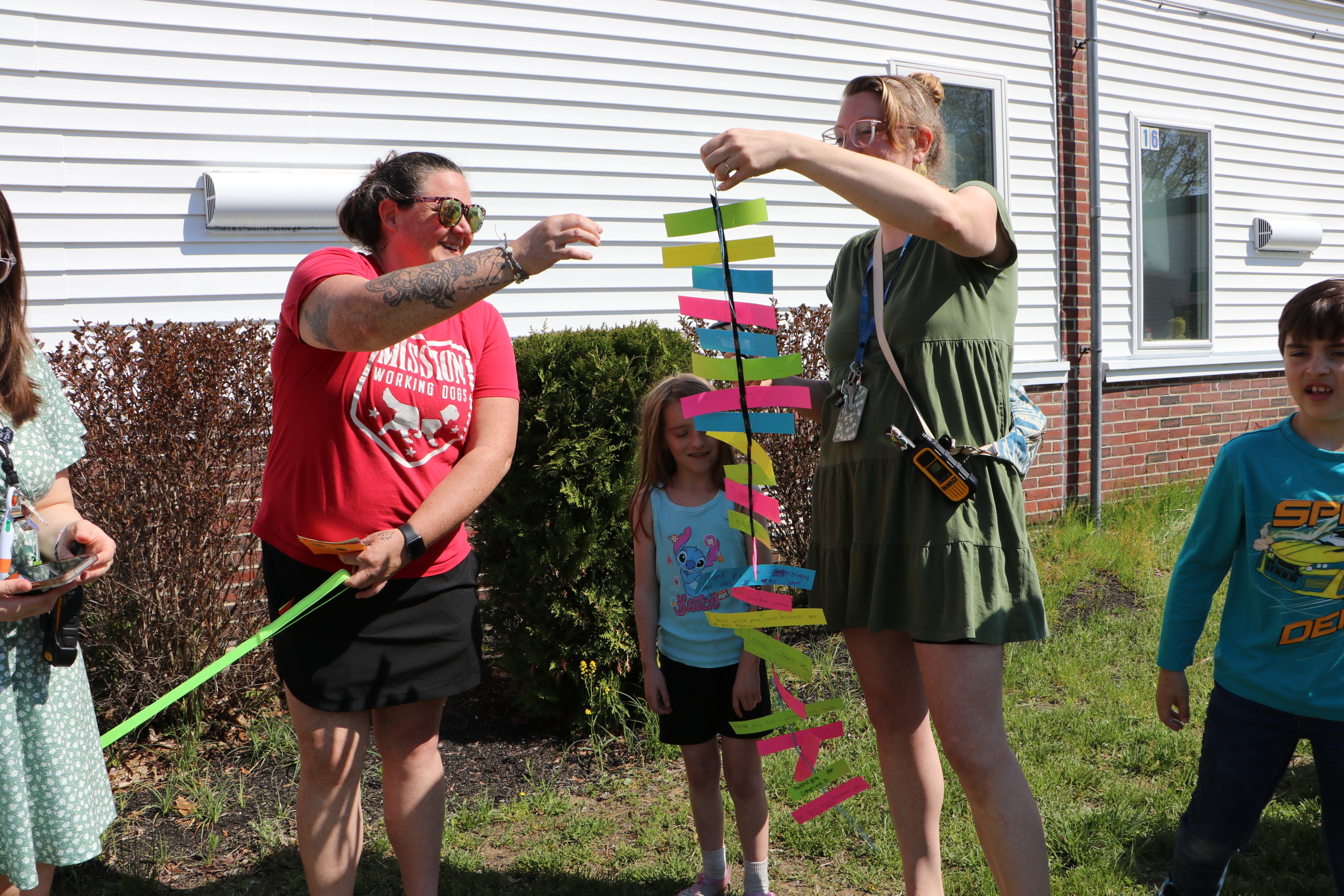
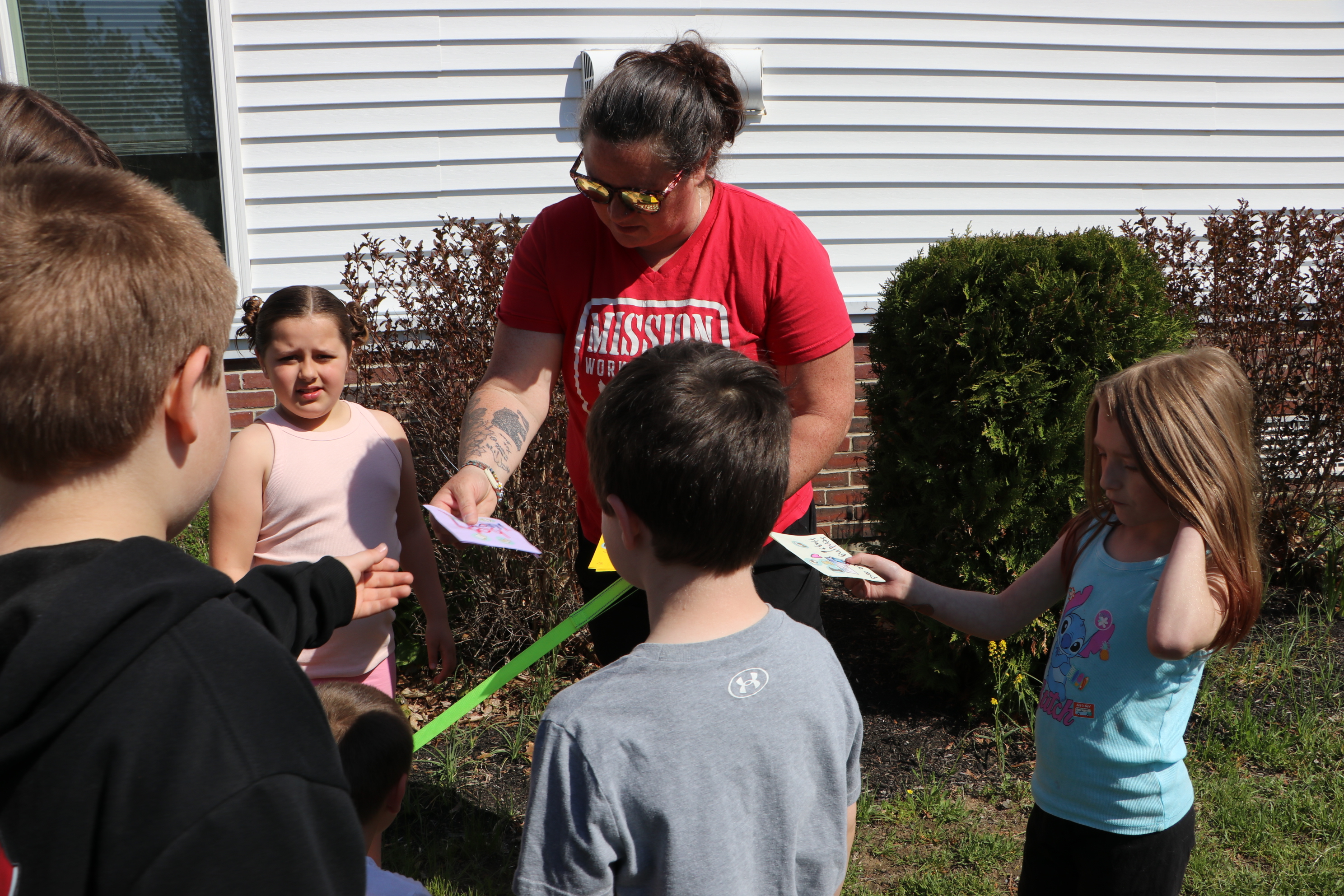
During a recent school visit, students proudly presented the bags of dog food to dog handlers Lauren King and Moria Case — both former classroom teachers — along with three of the therapy dogs. Students also created handwritten thank-you notes expressing their appreciation for the visits and friendships formed throughout the year.
Students were eager to share what they loved most about the weekly visits.
“They are adorable,” one student said. “They help people, and they are fun to play with.”
Another student added, “They are cute. I like playing Jeopardy with them.”
Harvey said the experience has shown the value of strong community partnerships and the lasting impact they can have on students.
“I think it’s great to have a partnership like this, having someone from the community in our classrooms,” Harvey said. “I think those community partnerships are some of the most valuable things that we can give our kids.”
This story was written in collaboration with Elm Street School (RSU 16).To submit a good news story to the Maine DOE, please fill out the good news submission form.
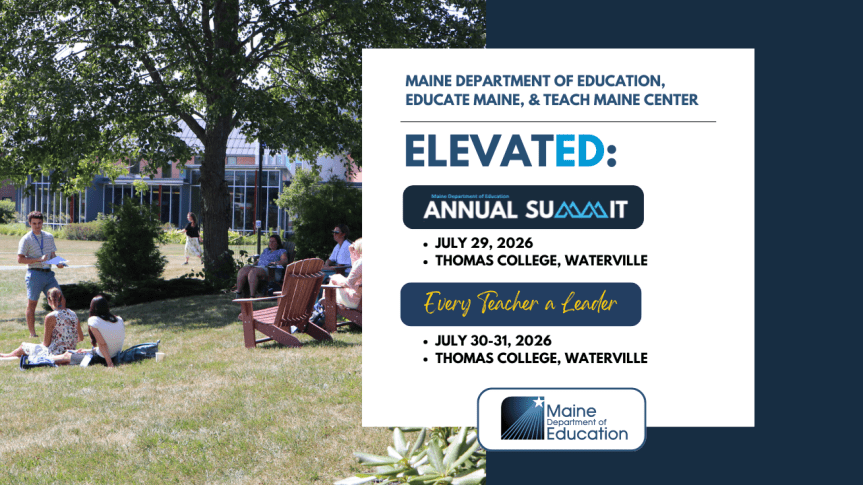
Registration is now open for ElevatED 2026, a dynamic summer professional learning experience designed to inspire, connect, and support Maine’s education workforce through meaningful collaboration and practical learning opportunities.
Hosted through a partnership between the Maine Department of Education (DOE) and Educate Maine/the Teach Maine Center, ElevatED combines two familiar and impactful conferences into one engaging three-day event: the 2026 Maine DOE Annual Summit and the second annual Every Teacher a Leader Conference. ElevatED will take place from July 29-31, 2026, at Thomas College in Waterville, bringing together educators, school staff, instructional leaders, and education advocates from across the state for high-quality professional learning, networking, and inspiration.
Attendees may choose to register for one or both conference experiences. Those interested in attending are encouraged to register early as spots are limited and available only on a first-come, first-served basis.
Maine DOE Annual Summit
The Maine DOE Annual Summit on July 29, 2026, is tailored to Maine’s broad education workforce. It offers attendees the opportunity to engage in timely, relevant, and solution-focused sessions led by educators, experts in the field, and partners from across the state and beyond.
This year’s Summit keynote speaker is internationally recognized educator and neuroscientist Dr. Jared Cooney Horvath, who will present “From the Laboratory to the Classroom – Principles of Learning,” exploring the science of how students learn and what that means for classroom practice and school leadership. Dr. Horvath will also lead two in-depth follow-up sessions titled “Your Brain Your Life – Foundations of Thinking and Learning.”
The Summit agenda reflects the wide-ranging priorities and interests of Maine schools, offering sessions focused on instructional practice, school climate, student engagement, family partnerships, career pathways, inclusion, policy, wellness, and more.
Attendees can look forward to sessions including:
Reducing Bias-Motivated Harassment in School
Early Learning in Nature: A Standards-Aligned Outdoor Curriculum Framework
Belonging Matters: Retaining Diverse Educators Through Connection and Community
The Power of Storytelling: Sharing the Good News of Public Education
Connecting Youth to Community-Based Career Pathways
Using Forests as a Teaching Tool
Building Bridges: A Framework for Family Engagement in Maine
Cultivating Resilient Schools Through the Practice of Mattering
Introduction to School-Based Behavioral Threat Assessment and Management
Maine Seal of Climate Literacy
Inclusive by Design: Leveraging Universal Design for Learning (UDL) and Responsive Interactions to Support Inclusive Practices in Pre-K-2 Classrooms
What’s Changing in Essential Programs and Services (EPS) School Funding – and Why It Matters
In addition to sessions, attendees will also have access to informational tables, resources, and on-site support. Attendees will be able to connect with Maine DOE staff, including members of the Maine DOE Certification Team, who will be available to answer certification questions and provide guidance and support.
The Maine DOE Annual Summit registration cost is $120, which includes a light breakfast and lunch. Those interested in attending the Summit may register here.
The Maine DOE is pleased to share that registration costs for the Summit will be waived for eligible staff members working directly with students in schools identified as TSI (Targeted Support and Improvement), ATSI (Additional Targeted Support and Improvement), or CSI (Comprehensive Support and Improvement) under Maine’s Model of School Supports (MMSS). Eligible school administrative units (SAUs) may receive coverage for up to $1,200 in registration costs (the equivalent of 10 staff members).
To avoid upfront registration costs, eligible participants should:
Select “pay by invoice” during registration.
Enter the promotional code “MMSS.”
Provide the name of the identified school.
MMSS participants should not pay using procurement or credit cards. The Maine DOE will process invoices once attendance is confirmed.
Please note that schools identified for CSI support that receive School Improvement Grant (SIG) funding may also use those funds for travel and lodging expenses (in accordance with local SAU travel policies).
Every Teacher a Leader Conference
The Every Teacher a Leader Conference will take place July 30-31, 2026, and is designed specifically for classroom teachers, featuring teacher-led sessions that elevate educator voice, leadership, innovation, and collaboration.
The conference includes breakfast and lunch on both days, along with an optional educator dinner on July 30, 2026, from 6-8 p.m.
The cost to register is $120. Those interested in attending the conference may register here.
Lodging Information
ElevatED attendees are responsible for booking their own lodging accommodations, if they plan to stay overnight. There are options available on the Thomas College campus:
The mission of the Maine Storytime Finder is to connect families to free library programming, encouraging a positive culture of reading throughout Maine. The Finder allows users to search by location, age group, and date to find storytime opportunities at libraries across the state. At the time of the Finder’s launch, more than 50 libraries had already participated, with more than 100 recurring programs for babies and children of all ages. Additional libraries and events will be added on an ongoing basis.
Established in 2006, IRW is an educational nonprofit based in Southwest Harbor that brings book-based experiences—including author and illustrator visits—to its partner schools, offers professional development for educators, and hosts community programs.
This content was submitted by Island Readers & Writers (IRW). To submit a good news story to the Maine DOE, please fill out the good news submission form.
The Maine Department of Education (DOE) is seeking additional applicants to serve on the statewide Numeracy Advisory Council as part of Maine’s ongoing implementation of the Maine State Numeracy Action Plan.
The Numeracy Advisory Council was launched during the 2025-2026 school year to support the state’s renewed focus on strengthening math and numeracy instruction and improving student learning outcomes across Maine schools. The council is composed primarily of practitioners—including classroom educators, instructional coaches, school and school administrative unit (SAU) leaders, special educators, and higher education partners—who work directly with Maine learners and bring firsthand expertise to this work.
Due to some members needing to step away from the Numeracy Advisory Council, the Maine DOE is currently seeking additional educators to ensure broad statewide representation and continued practitioner voice in this important work.
The Maine DOE is specifically seeking applicants serving as special educators in grades 4 and above and classroom teachers serving grades kindergarten through grade 8 in the following counties:
Androscoggin
Aroostook
Hancock
Knox
Lincoln
Oxford
Piscataquis
Washington
The Numeracy Advisory Council is chaired by Victoria Cohen, former math teacher and current Maine State Board of Education member. Council members participate in regularly scheduled meetings, review resources and materials, provide feedback on statewide initiatives, and share perspectives from their local contexts.
Educators interested in applying can access the application here: Numeracy Advisory Council Membership Application. Applicants will be asked to describe their current role, interest in serving, and relevant experience.
Completed applications and letters of recommendation are due by June 26, 2026. Newly selected members will begin participation with the council in August 2026.
Questions about the Numeracy Advisory Council or application process may be directed to Maine DOE Chief Teaching and Learning Officer Beth Lambert at beth.lambert@maine.gov.
The Maine State Numeracy Action Plan is part of Maine’s broader effort to support evidence-based instruction, educator professional learning, and high-quality teaching and learning opportunities for all students across the public preschool-grade 12 continuum.







 Maine DOE Newsroom