Webinar Opportunity for Maine School Leaders: Preparation Saves Lives – Strengthening Your School’s Suicide Prevention, Intervention, and Postvention Protocols

In recognition of May as Mental Health Awareness Month, the Maine School Superintendents Association (MSSA), the Maine Center for Disease Control and Prevention (Maine CDC), the Maine Department of Education (DOE), and NAMI (National Alliance on Mental Illness) Maine have collaborated to provide a webinar, “Preparation Saves Lives – Strengthening Your School’s Suicide Prevention, Intervention, and Postvention Protocols,” scheduled for Thursday, May 21, 2026, from 9-10 a.m. This webinar is intended for school leaders, including superintendents, principals, and members of comprehensive health and safety planning teams (sometimes referred to as crisis management teams).

Recognizing that many school leaders have had to navigate leadership following crises—particularly those involving the death of a student due to suicide—this webinar will provide the tools needed for summer reflection and planning for suicide prevention, response, and recovery. Mary Gagnon, Senior Director of Prevention and Workplace Well-Being for NAMI Maine, will share her experiences over the past two years in supporting school administrative units (SAUs) with this work. She will provide resources and lessons learned to help school leaders prepare for and respond to crises, including the death of a student or other school community member following a suicide.

The following tools will be shared with participants throughout this webinar:

  • A checklist to help participants review their school’s suicide prevention, intervention, and postvention protocols, ensuring alignment with national best practices
  • Sample protocols for suicide prevention, intervention, or postvention, which participants are welcome to use within their SAU
  • A sample calendar with month-by-month suggestions for how suicide prevention, intervention, and postvention can be sustained

Those interested in attending may register for the webinar here.

In a show of support for those living with mental illness, and in an effort to fight stigma, the planning team from MSSA, Maine CDC, Maine DOE, and NAMI Maine, will wear green in recognition of Mental Health Awareness Month.  Please consider participating.

From Ideas to Impact: Early Learning Solutions Lab CoP Expands Through 2026

The Maine Department of Education (DOE), in partnership with the Maine Department of Health and Human Services (DHHS) Office of Child and Family Services, is continuing a monthly Early Learning Solutions Lab Community of Practice (CoP) as part of an ongoing effort to strengthen Maine’s mixed delivery system for early childhood education.

The landscape of early childhood education in Maine is evolving. The expansion of public preschool programs and recent legislation transitioning special education services for children ages three to five from Child Development Services (CDS) to public schools underscore the growing need for a strong, coordinated mixed delivery system. Such a system—one that intentionally integrates public schools and community-based early care and education (ECE) providers—is essential to ensuring all children have equitable access to high-quality early learning opportunities from birth through the early elementary years.

Building and sustaining a robust mixed delivery system requires communities and educational institutions to move beyond siloed approaches and embrace collaborative, inclusive strategies that respond to the diverse needs of children, families, and educators in their communities. As such, early childhood administrators and educators from both public schools and community-based programs are invited to join the Early Learning Solutions Lab CoP, which focuses on strengthening mixed delivery from a community-centered approach. By creating consistent opportunities for collaboration, reflection, and shared learning, this work helps ensure that all children and families have access to coordinated, high-quality early childhood experiences.

Building on the strong engagement and success from earlier sessions, the Early Learning Solutions Lab CoP will meet monthly from May through December 2026. The CoP will be held on the fourth Tuesday of each month from 1:30-2:45 p.m. Those interested in participating may register here.

Each month will focus on a key topic, with opportunities for participants to learn from subject matter experts, explore practical tools, and engage in meaningful discussion. Participation in all CoP sessions is not required but is highly encouraged.

A tentative schedule is as follows:

MonthTopicResources
May 26The BasicsInfant-Toddler and Preschool Maine Early Learning and Development Standards (MELDS)
June 23Sustainability PlanningHelp Me Grow
July 28Nature-Based ApproachesMaine Prevention Councils
August 25K Transition as a Whole-Year ApproachEarly Childhood Education Consultation for ME
September 22Community Partner Panel DiscussionEarly Childhood Special Education website
October 27Whole Family Partnership/EngagementAges and Stages Questionnaire
*November 17Data Sharing and PartnershipEarly Intervention health resource
*December 15Early Learning Solutions Lab Celebrations and HighlightsMaine Roads To Quality/Maine DOE supports

*scheduled for the third Tuesday of the month, due to a holiday

With questions, please contact Maine DOE Early Learning Team members Michelle Belanger at  Michelle.Belanger@maine.gov or Sue Gallant at Sue.Gallant@maine.gov.

Maine DOE to Offer School Finance Regional Trainings in the Summer of 2026

The Maine Department of Education (DOE) School Finance Team is pleased to announce a series of in-person regional training sessions to be offered throughout the summer of 2026. School and school administrative unit (SAU) staff engaged in financial operations, compliance, and program administration are encouraged to attend. This includes, but is not limited to, superintendents, business managers, finance staff, and special education administrators.

 The topics to be covered in all training sessions include:

  • The Essential Programs and Services (EPS) funding formula, including changes from LD 2226
  • Account coding
  • MaineCare
  • Early Childhood Special Education (ECSE) funding
  • Education Service Centers (ESC)
  • School closure cost analysis

Each training session will begin at 8:30 a.m. and run until about 3 p.m. Plans for specific venues are still being finalized, but the general locations and training dates are as follows:

  • Portland area—Tuesday, July 21, 2026
  • Farmington area—Wednesday, July 22, 2026
  • Augusta area—Thursday, July 23, 2026
  • Aroostook area—Tuesday, August 4, 2026
  • Bangor area—Wednesday, August 5, 2026

To register for a training session, please complete this form. Further information about training sessions will be available via the Maine DOE Event Calendar as the training dates approach. Please note that individual registrations are required for each person planning to attend a training session.

With questions, please contact Charlotte Ellis at charlotte.ellis@maine.gov.

Leading Early Learning Fellowship: A Professional Learning Series for Elementary School Administrators

The Maine Department of Education (DOE) is pleased to announce that applications are now open for the fifth cohort of the Leading Early Learning Fellowship, which will launch during the 2026-2027 school year. Applications will be accepted through July 10, 2026.

As more Maine elementary schools expand their preschool offerings and implement whole-student approaches across the pre-K through grade 3 span, elementary administrators have expressed a need for professional learning tailored to early learning leadership. In response, the Maine DOE, in collaboration with two statewide early childhood organizations—the Maine Roads to Quality Professional Development Network and the Maine Association for the Education of Young Children—created the Leading Early Learning Fellowship, a dynamic professional learning series designed to meet these needs and support leadership development. Since its launch in 2021, the Fellowship has served five cohorts of elementary school leaders.

“Participating in the series has helped me to look at the decisions we make about our instructional programming and school community through the lens of early learning and what is developmentally appropriate for our youngest learners,” a participant from the first cohort said.

The Fellowship offers rich opportunities for participants to deepen their understanding of early learning pedagogy and best practices for supporting students and educators across pre-K through grade 3. The experience includes a blend of asynchronous learning modules, facilitated online professional learning communities, and in-person gatherings, which support participants in achieving the following outcomes:

  • Increasing their knowledge of early childhood development and pedagogy.
  • Strengthening early childhood leadership abilities within their school administrative units (SAUs) and communities.
  • Identifying resources and key components of high-quality early childhood programming.
  • Engaging with a network of colleagues to grow their understanding of early childhood.

“I really enjoyed the variety of materials and activities in which we were engaged—videos, utilizing the observation and reflection tools, and the readings. Also, it was a great group of people to interact with, both online and in-person,” a participant from the third cohort said.

To learn more, please review the informational guide, which includes full program details and the application link. The 2026-2027 cohort will include up to 30 participants. Again, applications will be accepted through July 10, 2026. Once capacity is reached, a waiting list will be created.

For additional information, please contact Maine DOE Director of Early Learning Lee Anne Larsen at leeann.larsen@maine.gov.

Limited Seats Available for Educators at No Cost for “Navigating Grief in the Classroom” Series

The Maine Center for Disease Control and Prevention (CDC) is sponsoring a limited number of seats for Maine educators to attend The Kita Center’s “Navigating Grief in the Classroom” series at no cost through the upcoming learning cohort, which begins on May 6, 2026, and ends on  June 10. This series of weekly, virtual sessions equips educators, counselors, and school staff with the skills to support grieving students with dignity, connection, and emotional literacy.

Participants will learn to understand grief in the school setting, strengthen self-care practices, foster belonging, practice dignity-centered communication, and create emotionally safe spaces for students. Workshops include hands-on reflection activities, practical strategies to use immediately, and opportunities to connect with a supportive learning community. Developed by a psychologist and former educator specializing in grief, loss, and suicide prevention, this series helps staff respond to grief in the classroom with confidence, compassion, and skill.

Steven Karaiskos, PhD, will facilitate this six-part, virtual series. Workshops run on Wednesdays from 4-5:30 p.m. between May 6 and June 10, 2026.

Maine educators interested in this professional development opportunity are encouraged to apply using this form. Please contact mary.c.caron@maine.gov with any questions.

Applications Open for 2026 Maine DOE Literacy and Numeracy Summer Institute

The Maine Department of Education (DOE) Office of Teaching and Learning invites educators from across the state to apply for the 2026 Literacy and Numeracy Summer Institute, entitled “The Science of Learning: Building Literate & Numerate Minds.” This three-day, in-person professional learning experience will take place June 29–July 1 at the College of the Atlantic (COA) in Bar Harbor. Applications close May 6.

Designed for public school teachers, instructional coaches, administrators, and specialists across all grade levels and content areas, this immersive institute brings together educators committed to strengthening interdisciplinary approaches to literacy and numeracy. Participants will engage in deep content learning, collaborative inquiry, and the design of practical, classroom-ready instructional experiences.

Participants will learn within and from local environments, including community gardens, the iconic Beatrix Farrand Gardens, the Dorr Museum of Natural History, Allied Whale, COA’s greenhouses and learning labs, the intertidal zone, and the broader Bar Harbor community. Through these experiences, educators will explore high-impact instructional practices, examine ways to connect content to students’ lives and communities, and contribute to a statewide effort to advance meaningful, integrated learning across Maine classrooms.

Expectations of Participants

Educators selected for the institute will:

  • Attend the full three-day, in-person experience
  • Engage in keynote sessions and interactive workshops led by experts in literacy and numeracy education
  • Collaborate with peers to deepen their understanding of evidence-informed, interdisciplinary literacy and numeracy practices

Apply Now

Applications are open until May 6 at 5:00 p.m. All applicants will be notified by Thursday, May 14. Space is limited, and the Maine DOE will prioritize a cohort representing a diverse range of grade levels, geographic regions, and content areas across the state.

Please use this link to apply.

For more information or questions, please contact Interdisciplinary Instruction Specialist Heather Martin at heather.martin@maine.gov.

Title II funds received from the U.S. Department of Education (ED) support the implementation of this project. The project has an award totaling 156,494.00, of which 52% is federally funded and directly attributed to project implementation. The contents are those of the author(s) and do not necessarily represent the official views of, nor an endorsement by, ED or the U.S. government.

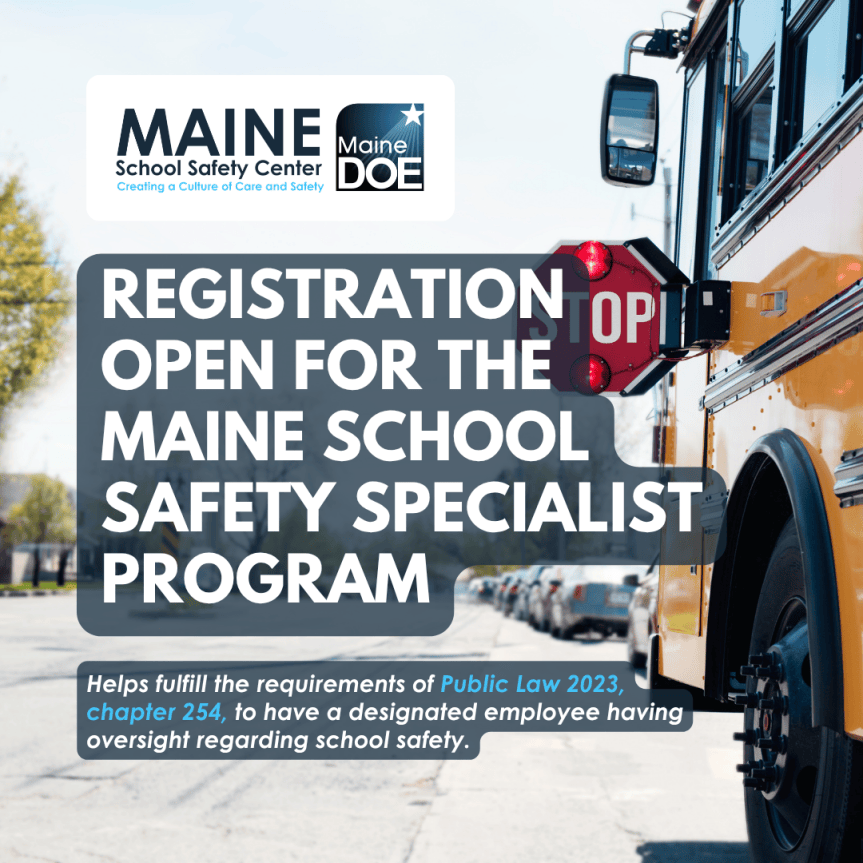
Professional Learning Opportunity: Crisis Management for School-Based Incidents

The Maine Department of Education (DOE) Maine School Safety Center (MSSC) is partnering with the Rural Domestic Preparedness Consortium (RDPC) to bring free incident response training to Maine schools.

“Crisis Management for School-Based Incidents: Partnering Rural Law Enforcement, First Responders, and Local School Systems” is an eight-hour Department of Homeland Security (DHS) and Federal Emergency Management Agency (FEMA) certified course that is designed to educate rural law enforcement personnel as well as school administrators and staff on the elements that would allow for an effective response to school-based emergencies. This course covers how affected parties collaborate on planning, preparing, communicating, responding, and recovering from a school-based incident.

The course will be offered three times in different locations across Maine. Registration is required through the RDPC website; links are provided below. Please register by midnight on the registration deadline listed for each course. Each in-person course runs from 8 a.m. to 5 p.m.

Please note: A FEMA student identification number is required for registration of these courses. You may register for your FEMA student identification number by visiting the FEMA website.

Course DateLocationRegistration DeadlineSponsoring Agency AddressRegister
May 11, 2026Caribou (PDF flyer)April 27, 2026Caribou High School
Performing Arts Center
308 Sweden Street, Caribou, ME 04736
Register.
May 13, 2026Augusta (PDF flyer)April 29, 2026University of Maine at Augusta
Classroom Capital Center 46 University Drive, Augusta, ME 04330
Register.
May 15, 2026Alfred (PDF flyer)May 1, 2026York County Regional Training Center Room 201 79 First County Way, Alfred, ME 04002Register.

For more information, please contact the Maine School Safety Center.

Registration Open for Summer 2026 “ElevatED” Experience: Maine DOE Annual Summit and Every Teacher a Leader Conference

Registration is now open for the summer 2026 “ElevatED” professional learning experience! Through a partnership between the Maine Department of Education (DOE) and Educate Maine/the Teach Maine Center, this event is bringing together the 2026 Maine DOE Annual Summit and the second annual Every Teacher a Leader Conference for three days of collaboration, inspiration, and high-quality professional learning for Maine’s education workforce.

ElevatED will take place at Thomas College (180 West River Road, Waterville, ME 04901) from July 29-31, 2026. The Maine DOE Annual Summit on Day 1 (July 29) is tailored to meet the needs of Maine’s education workforce, including school staff, educators, school safety professionals, and building and instructional leaders. The Every Teacher a Leader Conference on Days 2 and 3 (July 30 and 31) features teacher-led sessions designed specifically for classroom teachers.

Individuals interested in attending may register for one or both ElevatED opportunities. Please note that spots are limited and will be granted on a first-come, first-served basis.

Maine DOE Annual Summit

Every Teacher a Leader Conference

  • Cost: Those who register by May 15, 2026, will get early-bird pricing of $90. After that, the cost is $120.
    • Breakfast and lunch are included on both days.
    • An optional dinner for educators will also be included the evening of July 30, 2026, from 6-8 p.m.
  • Registration Link: https://etalmaine2026.sched.com/registration

Attendees are responsible for booking their own lodging accommodations if they plan to stay overnight. Learn more and book here.

Maine DOE Invites Educators to Participate in ‘Roots and Stories: Storytelling through Maine Artifacts,’ Professional Learning Opportunity

As spring arrives across Maine, bringing longer days and renewed energy to classrooms, the Maine Department of Education (DOE) Office of Teaching and Learning is inviting educators to participate in a new professional learning opportunity focused on multi-genre storytelling, literacy, and the rich histories of local communities.

Roots and Stories: Storytelling through Maine Artifacts is designed to support teachers in transforming local artifacts, such as photographs, tools, letters, works of art, and everyday objects, into powerful learning experiences for students. By engaging with these artifacts, students can uncover the stories of their communities while strengthening literacy and making meaningful interdisciplinary connections.

During this six-week cohort experience, up to 50 Maine educators will collaborate with experts from the Maine Humanities Council and the Maine DOE Interdisciplinary Instruction Team to explore how artifacts can spark inquiry, storytelling, and creativity in the classroom. Participants will engage in strategies that support literacy across content areas, research and listening skills, and the role of storytelling in learning. They will also examine artistic approaches to narrative expression through the visual and performing arts. Educators will be supported in designing classroom experiences in which students create multi-genre products that bring community stories to life through creative expression.

This professional learning opportunity will begin with a one-day, in-person kickoff event on Monday, May 4, from 8 a.m. to 4 p.m. at the Deering Building in Augusta. That session will be followed by five virtual sessions, during which educators will continue developing and refining their classroom projects. That schedule is as follows:

  • May 5, 2026, from 3:30-4:30 p.m.: How to Select an Artifact/Helping Students Select an Artifact that Has Meaning OR Using VPA Models as Anchor Tests (via Zoom)
  • May 12, 2026, from 3:30-4:30 p.m.: Handling When History Gets Hard (via Zoom)
  • May 19, 2026, from 3:30-4:30 p.m.: Tuning Protocols – Working with Humanities Experts to Understand and Relate the Stories of Our Communities (via Zoom)
  • May 26, 2026, from 3:30-4:30 p.m.: Tuning Protocols – Working with Humanities Experts to Explore Various Ways of Presenting Creative Student Outcomes (via Zoom)
  • Date TBD – Wrap-Up and Celebration of Creative Work in the Humanities

Sessions will be recorded and made available on the Maine DOE learning management system EnGiNE.

Participation is free, but enrollment is limited to 50 educators statewide. Educators who complete this experience will receive 20 contact hours. Those interested in participating should please register using this link.

With questions or for additional information, please contact Maine DOE Interdisciplinary Instruction Specialist Geoff Wingard at Geoffrey.Wingard@maine.gov.

This project is supported through Title IV, Part A funds from the U.S. Department of Education. The total award for this project is $33,780.40 ,of which 30% is federally funded and directly attributed to project implementation. The contents of this program are those of the author(s) and do not necessarily represent the official views of, nor an endorsement by, the U.S. Department of Education or the U.S. Government.

Reminder: Register Now for the Maine DOE 2026 ‘For ME’ Instructional Programs Summer Training Opportunities

During the summer of 2026, the Maine Department of Education (DOE) will once again offer comprehensive training on the use of its For ME instructional programs. The Maine DOE has adapted and piloted these programs for early elementary grades (pre-K through grade 2), based on the Boston Public Schools’ evidence-based Focus Curriculum. These open-source, developmentally appropriate programs are interdisciplinary and align with Maine’s learning standards.

While schools are responsible for purchasing the materials necessary to implement the For ME instructional programs, lesson plans and additional instructional resources are available at no cost through the Maine DOE website. The Maine DOE also provides initial professional learning to support effective implementation.

An informational overview of the For ME instructional programs was shared earlier this winter, and a recording is available here.

The session introduces the program structure, reviews required materials for implementation and outlines available training opportunities. Educators and school leaders who are unfamiliar with the For ME instructional programs are strongly encouraged to view the recording.

Summer Training Opportunities

Educators, administrators, and early learning program staff interested in implementing the For ME instructional programs during the 2026-2027 school year, at any grade level from pre-K through grade 2, are encouraged to participate in the initial implementation trainings offered in the summer of 2026.

These trainings are designed to deepen participants’ understanding of program design and support successful implementation. School administrators are strongly encouraged to attend alongside their pre-K, kindergarten, first-grade, and/or second-grade teachers. Special education educators, education technicians, instructional coaches, and curriculum leaders who support pre-K through grade 2 educators are also encouraged to participate.

There is no cost to attend these trainings.

Training Format and Schedule

All trainings will be held in person from approximately 8:30 a.m. to 3:30 p.m. Participants should plan to attend all required days for their respective grade-level training.

  • Pre-K for ME: Two-day training at a location still to be determined (week of July 27-30, 2026; specific dates forthcoming)
  • K for ME: Three-day training at Randall Student Center, University of Maine at Augusta (June 24, July 27, and July 28, 2026)
  • 1st and 2nd Grades for ME: Three-day training at Randall Student Center, University of Maine at Augusta (June 24, July 29, and July 30, 2026)

Registration Information

Schools interested in registering educators for these trainings should have a principal or instructional leader complete the training registration form on behalf of all participants from their school(s) by May 11, 2026. The form allows schools to enroll educators in the Pre-K, Kindergarten, 1st Grade, and/or 2nd Grade For ME trainings.

Following the close of registration, participants will receive registration confirmation, as well as final training locations and preparation details.

For additional information, please contact:

State Activities funds received from the U.S. Department of Education (ED) support the implementation of this project. The project has an award totaling $50,000 of which 50% is federally funded and directly attributed to project implementation. The contents are those of the author(s) and do not necessarily represent the official views of, nor an endorsement by, ED or the U.S. government.