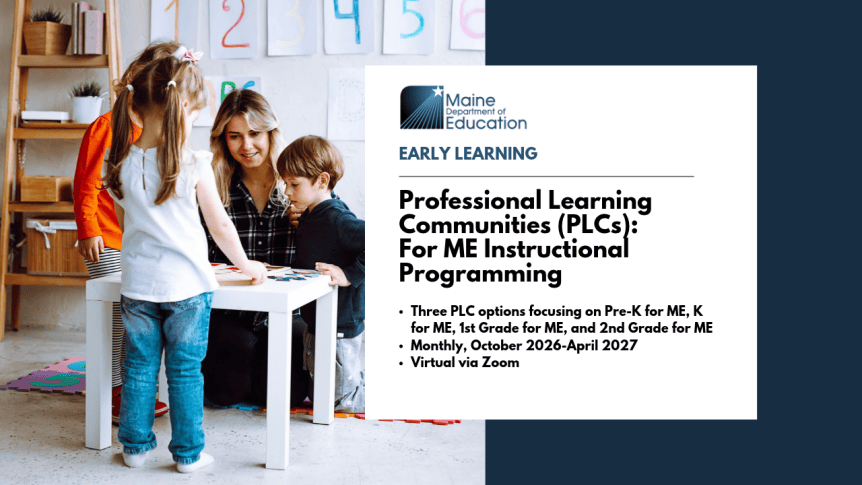
The Maine Department of Education (DOE), in collaboration with teacher leaders from across the state, is once again offering professional learning communities (PLCs) for educators and caregivers implementing the For Me Instructional Programming, which include Pre-K for ME, K for ME, 1st Grade for ME, and 2nd Grade for ME.
These monthly virtual PLCs are designed to deepen participants’ understanding of program design and implementation. Participants will explore units and program components in greater depth through real-world examples, shared practices, open discussion, and student work. Whether you are new to a program or have been using it for several years, these PLCs offer valuable support for teachers, educational technicians, instructional coaches, and other staff.
Pre-K for ME PLCs 2026-2027 Participants may choose from two meeting times: 3:30-4:30 p.m. or 6:00-7:00 p.m., on the first Monday of each month. The same content will be offered during both sessions.
October 5, 2026
November 2, 2026
December 7, 2026
January 4, 2027
February 1, 2027
March 1, 2027
April 5, 2027
May 3, 2027
K for ME, 1st Grade for ME, and 2nd Grade for ME PLCs 2026-2027 Sessions will be held virtually from 3:30-4:30 p.m. on the second Tuesday of each month:
October 13, 2026
November 10, 2026
December 8, 2026
January 12, 2027
February 9, 2027
March 9, 2027
April 13, 2027
Registration
While regular attendance is encouraged, participants do not need to commit to every session. Access details will be provided after registration.
Please register by Friday, September 25, 2026. You may do so using the following links:
For Pre-K for ME PLCs, contact Marcy Whitcomb, Maine DOE Public Pre-K Consultant, at marcy.r.whitcomb@maine.gov.
For K for ME, 1st Grade for ME, and 2nd Grade for ME PLCs, contact Nicole Madore, Maine DOE Early Childhood Specialist, at nicole.madore@maine.gov, or Maine DOE Director of Early Learning Lee Anne Larsen at leeann.larsen@maine.gov
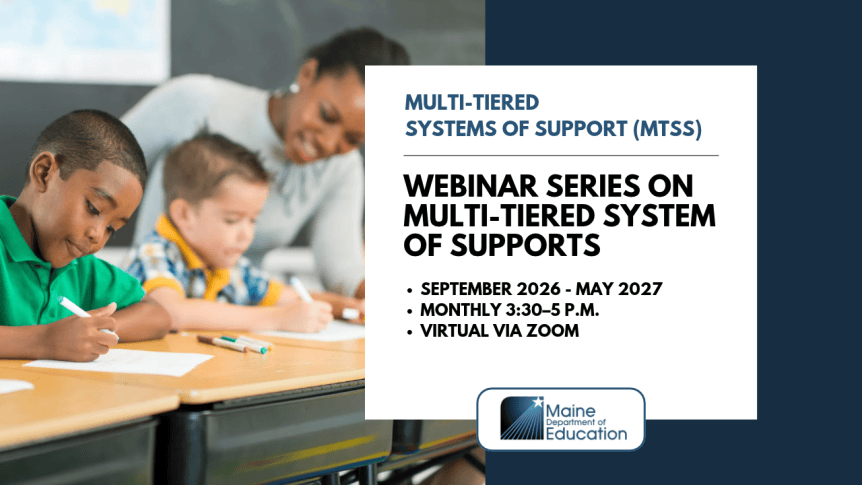
The Maine Department of Education (DOE) will offer a virtual professional learning series focused on school-level implementation of a Multi-Tiered System of Supports (MTSS) beginning September 29, 2026. The series will provide school teams with opportunities to deepen their understanding, reflect on their current implementation, consider how to begin, and/or identify action steps to strengthen their system.
The learning series will center on the Maine Multi-Tiered System of Supports Fidelity of Implementation Rubric (MTSS-FIR), which will be piloted during the 2026–2027 school year through this series and other Maine DOE professional learning opportunities. The MTSS-FIR is designed to support MTSS Leadership Teams in assessing school-level implementation, establishing goals, and engaging in continuous improvement. The series will begin with a focus on Tier 1 and later transition to considerations for Tier 2 and Tier 3 implementation.
Sessions will emphasize practical application, providing participants with opportunities to deepen their understanding of effective MTSS implementation, reflect on their learning, and apply it within their school contexts.
MTSS Professional Learning Webinar Series
The MTSS Professional Learning Webinar Series will be held from 3:30–5 p.m. on the fourth Monday of each month, with exceptions in September, December, and May:
Tuesday, September 29, 2026*
Monday, October 26, 2026
Monday, November 23, 2026
Monday, December 21, 2026*
Monday, January 25, 2027
Monday, February 22, 2027
Monday, March 22, 2027
Monday, April 26, 2027
Monday, May 17, 2027*
*September 29 is the fifth Tuesday; December 21 and May 17 are the third Monday of their respective months.
Registration is required, and participation as a school team is encouraged. Teams may include administrators and educators from both general and special education. MTSS Leadership Team composition will be addressed early in the series, including guidance on whom to invite to participate.
To get the most from the series, each participating school team should include at least one administrator and at least one educator who plan to participate in every session. Participants will receive 1.5 contact hours for each session they attend for which they complete an exit survey.
Why Participate in This Series?
Implementing MTSS provides schools with a coherent framework for organizing and optimizing resources to support all learners. By aligning high-quality instruction, differentiated supports, data-based decision making, and collaboration within one connected system, schools can move from separate or disconnected efforts toward a more coordinated approach to meeting student needs.
Effective MTSS implementation strengthens universal foundations for belonging and learning. Through ongoing use of implementation and outcome data, schools can identify strengths, address areas for growth, and make informed decisions about how to use their resources. The result is a more equitable and inclusive continuum of support, and a stronger, more responsive system for helping every student succeed.
Maine DOE will also offer two types of virtual MTSS office hours beginning in September. These sessions will provide participants with additional opportunities to ask questions, seek support, and engage in conversation about MTSS implementation.
Walk-In Office Hours: Beginning Wednesday, September 23 from 3–4 p.m., participants may bring questions or topics for discussion. Please see the Maine DOE Event Calendar for more information, including additional dates, times, and registration links for MTSS Walk-In Office Hours.
Topic-Based Office Hours: Beginning Wednesday, September 16 from 2–3 p.m., each session will include 20–30 minutes of focused professional learning on a specific MTSS topic, followed by an opportunity for discussion. Please see the Maine DOE Event Calendar for more information, including additional dates, times, and registration links for MTSS Topic-Based Office Hours.
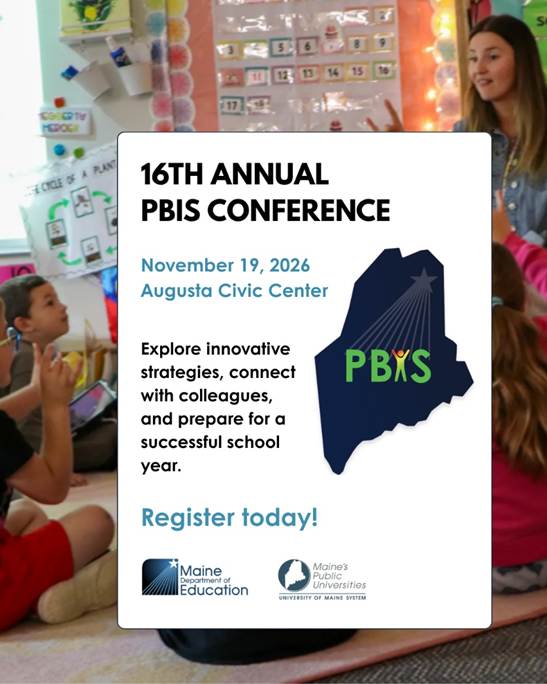
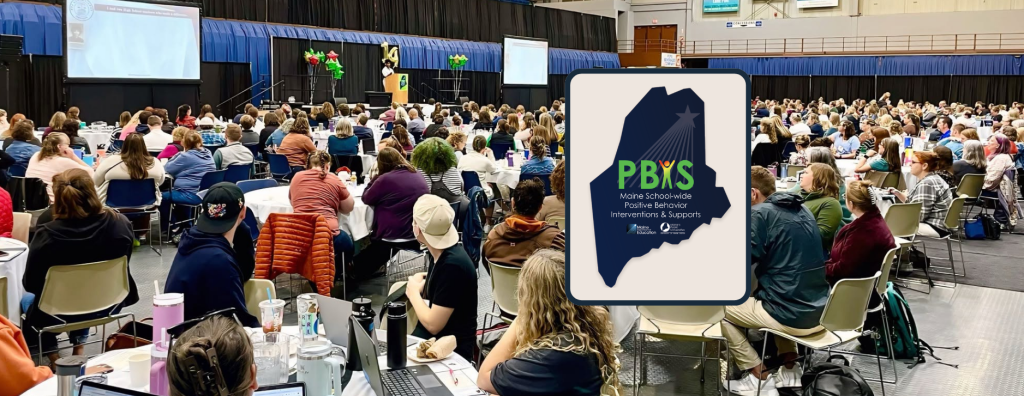
Maine’s Positive Behavioral Interventions and Supports (Maine PBIS) program, a collaboration between the Maine Department of Education (DOE) and the University of Maine System (UMS), will host its annual conference on November 19, 2026, from 8:30 a.m. to 4 p.m. at the Augusta Civic Center.
In its 16th year, the conference theme will be, “The Fabric of Maine Schools: Braiding Academics, Behavior and Belonging.” The conference will feature a captivating keynote presented by Kathleen Lynne Lane, Ph.D., BCAB-D, CF-L2 from the University of Kansas, “Creating Positive, Productive School Environments: Data-informed Instruction in Integrated Tiered Systems to Meet Students’ Multiple Needs.”
Following the keynote will be a choice of over 30 breakout sessions that will allow participants to walk away with new ideas and a renewed sense of connection with students and their teaching methods. Breakout sessions include integrating academics and behavior within the Multi-tiered Systems of Support (MTSS) model, behavior supports and strategies for preschool, elementary, middle, and high school, implementing and sustaining PBIS, and family engagement.
Conference pricing:
After October 15: $210.00
Complimentary registration will be provided (up to 3 educators per school) for educators who work in schools identified as part of Maine’s Model of School Support.
School culture does not transform by accident, it happens when we connect, collaborate, and celebrate together. That is exactly what is happening at this year’s Maine PBIS Conference. Join us for a day to rejuvenate your teaching practices, braiding instructional applications, positive student interactions, and educator well-being into a strong educational experience for all!
For more information, please contact Maine DOE Special Projects & Educator Supports Program staff, Anne-Marie Adamson at anne-marie.adamson@maine.gov.
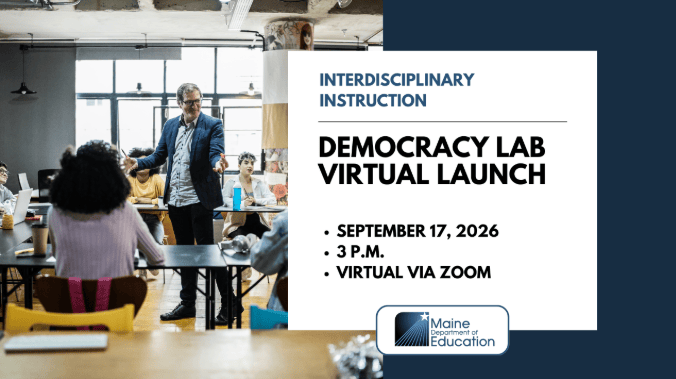
In recognition of Constitution Day on September 17, the Maine Department of Education is pleased to announce Democracy Lab, a new facilitator’s guide designed to support educators and students in exploring the nation’s founding ideals. This interactive resource examines principles expressed in the Declaration of Independence, including natural, unalienable rights, equity, the consent of the governed, and the belief that governmental authority rests with the people. While Constitution Day commemorates the signing of the U.S. Constitution, the Democracy Lab helps participants explore the ideas that influenced the nation’s system of government.
Educators are invited to join the Maine Department of Education for a virtual launch of the Democracy Lab at 3 p.m. on September 17. During the event, educators will explore the guide and learn how its activities can support active, engaging civics learning throughout the school year.
The Democracy Lab features activities that have been tested with students in Maine schools. The guide includes interactive simulations, debates, creative visual activities, and historical inquiry using primary sources. These experiences help students move beyond learning about democracy and begin examining democratic ideas through inquiry, action, and exploration.
The virtual launch offers educators an opportunity to mark Constitution Day while discovering resources to support meaningful civic learning throughout the year.
Extend Constitution Day Learning Throughout the Year
Constitution Day can be more than a single lesson or activity. It can be a starting point for conversations about how government works, how rights are protected, how laws are interpreted, and how young people can participate in civic life.
The Maine Department of Education’s Civics page provides additional information and resources for educators seeking to strengthen civics instruction throughout the school year.
The United States Federal Bureau of Investigation (FBI) Boston Field Office, in collaboration with the Maine Department of Education, Maine School Safety Center, will offer a 90-minute virtual training on September 17, 2026, from 9:00 a.m. and 1:00 p.m.
The training will focus on responding to and investigating bomb threats and swatting hoaxes, providing participants with an overview of these types of incidents, including statistics and current trends seen across the country.
Participants will learn about the characteristics of hoax calls, law enforcement best practices for assessing and responding to threats, and the decision-making process surrounding evacuation or sheltering in place.
The training is intended for public safety dispatchers, law enforcement personnel, and school personnel, including administrators and front office staff.
To attend this training, please register here in advance. Registered participants will receive a link to join the training via Microsoft Teams on the morning of the training.
For further questions or information about this training, please reach out to the FBI Field Office at fbibostonjttf@fbi.gov.
A new chapter in Maine’s literacy and numeracy journey begins with action, collaboration, and celebration.
Maine administrators, educators, coaches, and community partners are invited to celebrate a major milestone in advancing teaching and learning statewide at the Maine Department of Education (DOE) fall launch events for the Literacy and Numeracy Playbooks, an initiative focused on turning vision into action for schools across the state. These interactive events will focus on turning Maine’s statewide vision into action in schools and communities.
Maine’s Literacy and Numeracy Fall Launch events will take place at the following locations:
University of Maine in Orono on September 15 from 10 a.m. to 2:30 p.m.
University of Southern Maine on September 21 from 10 a.m. to 2 p.m.
Rose M. Gaffney Elementary School in Machias on September 25 from 12:30 p.m. to 3:30 p.m.
University of Maine Farmington on September 28 from 10 a.m. to 2:30 p.m.
As Maine continues to implement its statewide Literacy and Numeracy Action Plans, educators have identified a need for practical, accessible tools to support that work. The newly developed playbooks serve as companion resources that translate strategy into practice by offering actionable tools, real-world examples, and tiered guidance to support educators, school administrative unit (SAU) teams, and school leaders as they move from planning to implementation.
Developed through a collaborative and inclusive process with input from educators across the state, the playbooks reflect a shared commitment to practices grounded in evidence and continuous improvement. Designed for flexible use, they can support SAU planning, strengthen classroom instruction, and help align local systems with statewide action plans.
Participants will take part in a highly interactive and collaborative experience designed to bring the playbooks to life. Each launch event will include:
Opportunities to explore the Literacy and Numeracy Playbooks in depth
Interactive exploration of the Genially resource, with content aligned to participants’ roles and supports featured in the playbooks
Time to collaborate with educators and partners from across Maine
Dedicated planning time to identify actionable next steps for the school year
A preview of resources and ongoing available after the launch.
Please review the registration information carefully before selecting a location. Space is limited and participants will not be able to change locations after registering.
University of Maine in Orono on September 15 from 10 a.m. to 2:30 p.m. Lunch will be provided for all participants. Space is limited to 50 literacy and 50 numeracy participants. Early registration is encouraged. Register here.
University of Southern Maine in Portland on September 21 from 10 a.m. to 2 p.m. Lunch will be provided for all participants. Space is limited to 50 literacy and 50 numeracy participants. Parking costs $9.00. Early registration is encouraged. Register here.
Rose M. Gaffney Elementary School in Machias on September 25 from 12:30 p.m. to 3:30 p.m. Space is limited to 20 literacy and 20 numeracy participants. Early registration is encouraged. Register here.
University of Maine Farmington on September 28 from 10 a.m. to 2:30 p.m. Lunch will be provided for all participants. Space is limited to 40 literacy and 40 numeracy participants. Early registration is encouraged. Register here.
By creating space for connection, exploration, and planning, the fall launches underscore Maine’s commitment to ensuring that all educators have the tools and support they need to advance literacy and numeracy for every student.
If you have any questions, please contact Kathy Bertini, Interdisciplinary Instruction Team Coordinator, at Kathy.bertini@maine.gov
When educators experience belonging, they are better equipped to create learning environments where students also experience belonging. That simple but powerful idea is guiding the next chapter of Maine’s Black, Indigenous, and People of Color (BIPOC) Educator Network—an independent, educator-led community that creates opportunities for Black, Indigenous, and other educators of color to connect, grow, and thrive together.
Supported through a collaboration between The Third Place (through its SHIFTMaine program) and the Maine Department of Education (DOE), the BIPOC Educator Network reflects a shared commitment to strengthening educator well-being, fostering authentic belonging, and building a more diverse and sustainable educator workforce across Maine.
As the Network enters this new chapter, Mae Applegate has joined as the BIPOC Educator Network Organizer. Through her relationship-centered approach to leadership, Applegate will cultivate spaces where educators can build meaningful connections, share experiences, and support one another while helping shape the future of the Network.
This collaborative vision will be introduced at the 2026 Maine DOE Annual Summit on July 29 at Thomas College, where Applegate and Ayesha Hall, Maine DOE Director of Strategic Partnerships, will co-facilitate a session called “Belonging Matters: Cultivating Community to Advance a Diverse Educator Workforce.” This interactive session will introduce participants to the concept of a Gathering Place—an intentionally designed space where educators experience connection, psychological safety, and authentic dialogue. Participants will experience facilitated protocols they can adapt within their own schools to cultivate belonging among colleagues and students. Ultimately, the learning is designed to help all participants strengthen the conditions that support educator well-being, retention, and student success.
This session is designed for school and school administrative unit (SAU) leaders, principals, assistant principals, instructional coaches, educator preparation program faculty, professional learning coordinators, and BIPOC educators who are committed to strengthening educator belonging and retention. Through a combination of guided reflection, affinity-based conversations, and collaborative learning, participants will explore how intentional relationships, inclusive leadership, and community-centered practices contribute to healthier school cultures where educators and students can thrive.
While the BIPOC Educator Network centers the experiences of Black, Indigenous, and other educators of color, this session reflects a broader belief that strengthening belonging for educators who have historically faced the greatest barriers ultimately strengthens school communities for everyone. By intentionally creating conditions where those educators can thrive, schools become stronger, more inclusive places for all educators and students.
The BIPOC Educator Network remains an independent affinity space where educators can connect, share experiences, access professional learning opportunities, and inform the future of educator support across Maine. The Maine DOE is honored to support this work through strategic partnerships that strengthen educators’ sense of belonging and advance a more inclusive, connected, and sustainable educator workforce.
Educators who identify as Black, Indigenous, or as people of color are invited to connect with the BIPOC Educator Network to learn more about upcoming gatherings, professional learning opportunities, and opportunities to engage with this growing community.
For more information about the BIPOC Educator Network or the Maine DOE’s educator workforce initiatives, please contact Ayesha Hall, Maine DOE Director of Strategic Partnerships, at Ayesha.Hall@maine.gov.
The Transformational Leaders’ Network (TLN) is a practical, relationship-centered professional learning opportunity for principals to enhance their leadership practice and strengthen outcomes for schools and communities. The TLN occurs through a series of in-person and remote/regional meetings offered across the state during the school year. All principals, from the novice to the veteran, from large suburban schools to small rural schools, are invited to participate.
The 2026-2027 TLN theme is “The Principal Effect and the Power of Mattering.” This opportunity will reflect current research regarding principal effectiveness, professional learning, leadership sustainability, emotional intelligence, systems thinking, and school climate, while honoring the realities of increasingly complex school leadership.
Principals who participate can expect:
Continuous job-embedded professional development for an increasingly complex role.
A collaborative learning community, as participants tackle authentic leadership challenges together.
To learn about what emotional intelligence, mattering, and leadership presence look like in practice.
Strategies for strengthening school climate and culture by building trust, establishing stronger connections, communicating openly, and supporting and engaging staff more effectively.
To learn about creating steadier school environments during periods of challenge and change through sustainable and systems-oriented leadership.
To learn about navigating conflict, pressure, and complexity.
To learn about staff ownership, increasing collective efficacy, supporting leadership succession, and strengthening the workforce.
The 2026-2027 TLN schedule is as follows (specific locations to be determined):
A virtual extension session will also be offered the week after each in-person meeting as an opportunity for a deeper dive into discussion topics or for those unable to attend the in-person session.
Former TLN participants have shared the following testimonials:
“It (TLN) really changed how I support teachers, how I build a more positive school culture.” – TLN Principal, 2024-2025
“It’s easier to stay and fight the daily battles, but leaving for this (TLN) makes me better when I come back.” – TLN Principal, 2025-2026
“I see it (TLN) as kind of a ‘boots on the ground’ experience that you don’t get until you’re in it. … It’s about recognizing the leader as a whole person, understanding that emotional well-being is a key component of strong leadership.” – TLN Principal, 2024-2025
“Every time I leave, I have something I can use right away.” – TLN Principal, 2025-2026
“We dream together about what education can be and walk out the door refreshed and ready to take on the next day.” – TLN Principal, 2023-2024
The cost of the TLN remains at $295 per participant for the full year of professional learning. This includes all TLN content, materials, and meals for in-person meetings. Participants will be responsible for covering their own travel. Please note that if you are the leader of an identified school under Maine’s Model of School Supports (MMSS) (TSI-Targeted School Improvement, ATSI-Additional Targeted School Improvement, CSI-Comprehensive School Improvement), you are eligible to have registration fees covered.
The Maine Department of Education (DOE) will share information about registration and further details in July.
With questions, please contact Christina O’Neal, Maine DOE Educator Excellence Coordinator, at christina.l.oneal@maine.gov.
ESEA Title IIA funds received from the U.S. Department of Education (ED) support the implementation of this project. The project has an award totaling $136,809.40, of which 80% is federally funded and directly attributed to project implementation. The contents are those of the author(s) and do not necessarily represent the official views of, nor an endorsement by, ED or the U.S. government.
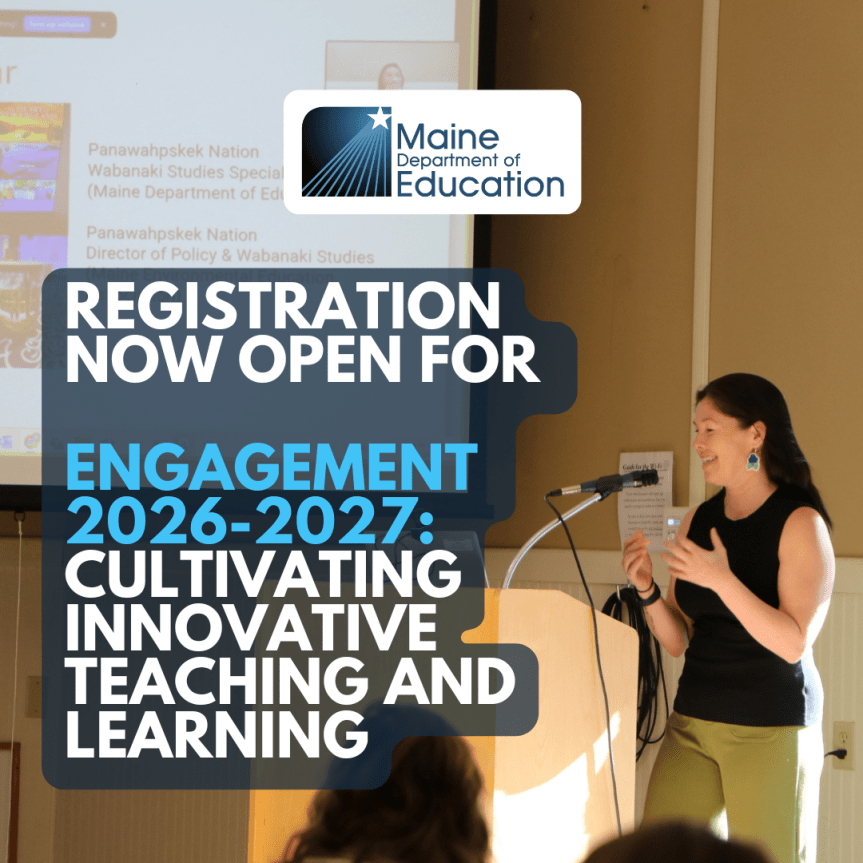
The Maine Department of Education (DOE) Offices of Teaching and Learning and Innovation are pleased to announce that registration is now open for EngageMEnt 2026-2027, a statewide professional learning opportunity designed to support educators in exploring innovative, engaging, and impactful practices for teaching and learning.
Offered in partnership with the University of Maine and University of Southern Maine, EngageMEnt creates opportunities for educators from across the state to learn, collaborate, reflect, and apply new ideas in their classrooms, schools, and communities. The initiative also provides opportunities for practicing educators and pre-service educators to learn alongside one another while exploring current educational priorities and practices.
Building on the success of last year’s implementation and participant feedback, EngageMEnt 2026-2027 has been designed as a year-long learning experience that supports both professional growth and implementation. Rather than attending a single workshop, participants will join a cohort of educators who will continue learning together throughout the school year. The Maine DOE is hopeful that this model will support meaningful changes in practice that ultimately benefit Maine students.
What’s New for 2026-2027?
This year’s model includes:
An in-person fall session on October 9, 2026
A virtual winter follow-up experience
An in-person spring session on March 19, 2027
On both the fall and spring dates:
Morning cohorts meet from 9-11:30 a.m.
Afternoon cohorts meet from 12:30-3 p.m.
This structure is designed to provide educators with opportunities to learn, implement new ideas in practice, reflect on their experiences, and reconnect with colleagues to deepen their learning.
Explore a Wide Range of Learning Opportunities
This year’s cohort offerings include topics such as:
Early literacy and numeracy
Literacy and numeracy across content areas
Outdoor and place-based learning
Climate education
Technology and learning
Multilingual learner supports
Community partnerships
Civic engagement and student advocacy
Arts integration and creative learning
Wabanaki Studies
Participants may register for one cohort or, if desired, one morning cohort and one afternoon cohort.
Cohorts will begin at either the the University of Maine at Orono or University of Southern Maine in October and continue at the partner campus in March, providing opportunities for educators to connect with colleagues from across the state while experiencing both university settings.
A complete guide to cohort offerings, facilitator information, and session descriptions is below.
Registration Information
Registration for EngageMEnt 2026-2027 is now open.
Participants registering for two cohorts should select one morning cohort and one afternoon cohort. Participants are encouraged to review the cohort descriptions carefully before registering.
Questions regarding EngageMEnt 2026-2027 may be directed to Beth Lambert, Maine DOE Chief Teaching and Learning Officer, at Beth.Lambert@maine.gov.
The following cohorts begin at the University of Southern Maine on October 9, 2026, and will continue at the University of Maine at Orono on March 19, 2027:
Morning Cohorts (9-11:30 a.m.):
Cohort
Facilitator(s)
Description
Playful Literacy Strategies for Early Learning, Preschool-Grade 2
Maine DOE Early Learning Team
Explore literacy-rich, play-based practices that support joyful and purposeful learning in early childhood settings.
Applied Learning Lab
Cee Belolan, Maine DOE Interdisciplinary Instruction Specialist
Experience practical approaches to designing engaging, student-centered learning through active application and reflection.
Numeracy Opportunities Within and Across Content Areas
Michele Mailhot, Maine DOE Interdisciplinary Instruction Specialist
Learn how to identify and intentionally incorporate numeracy opportunities across disciplines using Maine’s Numeracy Playbook resources.
Inquiry, Advocacy, Authentic Learning: Leading Students from Apathy to Activism
Geoff Wingard, Maine DOE Interdisciplinary Instruction Specialist
Support student voice, inquiry, and civic engagement through meaningful and authentic learning experiences.
Afternoon Cohorts (12:30-3 p.m.):
Cohort
Facilitator(s)
Description
The Importance of Numeracy Foundations, Preschool-Grade 2
Maine DOE Early Learning Team
Explore foundational numeracy development, learning trajectories, and play-based strategies that support mathematical thinking in young learners.
From Data to Art: Visualizing, Performing, and Creating with Information
Cee Belolan, Maine DOE Interdisciplinary Instruction Specialist
Learn creative ways to help students communicate information through the visual and performing arts.
Diving into Indigenous Literature with Book Kits
Brianne Lolar, Maine DOE Wabanaki Studies Specialist
Explore Indigenous literature resources and instructional strategies that deepen engagement and understanding.
Beyond the Classroom: Community Partnerships that Enrich Student Learning
Ayesha Hall, Maine DOE Director of Strategic Partnerships
Explore strategies to build community partnerships that enhance student learning and foster authentic connections.
The following cohorts begin at the University of Maine at Orono on October 9, 2026, and continue at the University of Southern Maine on March 19, 2027:
Morning Cohorts (9-11:30 a.m.):
Cohort
Facilitator(s)
Description
Digging Deep into Literacy
Erik Wade, Maine DOE Interdisciplinary Instruction Specialist
Explore how outdoor and authentic learning experiences can strengthen literacy development and interdisciplinary connections.
From Standards to Solutions: Engaging Students in Climate Action Through Maine’s Learning Results
Glenn Cummings, Maine DOE Director of Green Schools, and Teddy Lyman, Maine DOE Climate Education Specialist
Connect climate education, civic engagement, and standards-based learning through authentic student action.
Wonder Is a Literacy Practice
Heather Martin, Maine DOE Interdisciplinary Instruction Specialist, and Kathy Bertini, Coordinator of the Maine DOE Interdisciplinary Instruction Team
Discover literacy strategies that foster curiosity, inquiry, discussion, and meaningful student engagement.
Less Noise, More Learning: Reframing Technology Use in Schools
Maine DOE Learning Through Technology Team
Examine thoughtful approaches to technology use that support student learning, engagement, and well-being.
Afternoon Cohorts (12:30-3 p.m.):
Cohort
Facilitator(s)
Description
Digging Deep into Numeracy
Erik Wade, Maine DOE Interdisciplinary Instruction Specialist
Experience hands-on approaches to numeracy through outdoor learning, observation, measurement, and authentic problem-solving.
Trail Guides: Helping Create a Cultural Shift to Place-Based Learning
Sharon Gallant, Maine DOE RREV coach; Elaine Bartley, Maine DOE Innovative Research and Design Director; and Teddy Lyman, Maine DOE Climate Education Specialist
Explore strategies for integrating place-based and outdoor learning into everyday instructional practice.
Got Skills? Literacy in Every Direction
Heather Martin, Maine DOE Interdisciplinary Instruction Specialist, and Kathy Bertini, Coordinator of the Maine DOE Interdisciplinary Instruction Team
Explore practical literacy strategies that can be applied across content areas and learning environments.
Cultivating Brilliance: Maximizing Multilingual Assets and Accelerating Literacy Outcomes in an Integrated MTSS Framework
Jane Armstrong, ESOL State Specialist, and Bryan Lescord, MTSS State Specialist
Learn asset-based approaches that support multilingual learners within an integrated MTSS framework.
The Maine Department of Education (DOE) is offering a free professional learning opportunity for educators interested in becoming trained facilitators of professional learning communities (PLCs) focused on emergent literacy for children aged 3 to 6.
The Professional Learning Community: Emergent Literacy from the Institute of Education Sciences supports preschool and kindergarten educators in implementing evidence-based language and literacy practices. Designed to foster collaboration, the four included modules engage participants in discussion, hands-on learning, and reflective practice with support from peers and trained facilitators.
The modules in this PLC are Print Knowledge, Phonological Awareness, Vocabulary, and Oral Language. Each module consists of three sessions (12 sessions total), with flexible scheduling options. Facilitators will receive a complete set of implementation materials, including participant guides, facilitator guides, PowerPoint presentations, and supporting videos. Facilitator training will familiarize participants with the design of the modules and effective strategies for facilitating adult learning.
Once trained, facilitators will be expected to facilitate at least one PLC module with a cohort of at least six Maine educators. They will be compensated $500 for each module they facilitate and complete by November 27, 2026. If facilitators wish to facilitate more than one module for compensation, they must seek prior approval.
The ideal facilitator is an educator with a strong understanding of emergent literacy, effective communication skills, and the ability to relate well to adult learners. Prior experience facilitating professional learning or leading groups of educators will be useful to the facilitator’s success.
To apply, please complete this applicationby July 17, 2026. Applications will be reviewed by a selection team, and applicants will be notified of their selection status by July 24, 2026.
For additional information, please contact Renee Reilly, Maine DOE PDG Manager, at Renee.A.Reilly@maine.gov.
This professional learning opportunity is sponsored by Maine’s Preschool Development Grant (PDG) Birth through Five (B-5) initiative, a collaboration between the Maine DOE and the Maine Department of Health and Human Services (DHHS).
Funding provided through the U.S. Department of Education (ED) supports implementation of this project. The project award totals $30,000, all of which is federally funded and directly attributed to project implementation. The contents of this announcement are those of the author(s) and do not necessarily represent the official views of, nor an endorsement by, ED or the U.S. government.