Maine DOE Seeking Educators to Pilot MOOSE Modules and Wabanaki Studies Educator Guides

The Maine Department of Education (DOE) is currently seeking educators to pilot Maine’s Online Open-Source Education (MOOSE) modules, as well as new Wabanaki Studies Educator Guides, with their classrooms this spring.

The MOOSE platform provides free, interdisciplinary, project-based learning materials, created by Maine teachers for Maine pre-K—12 students. Feedback from educators on these modules and their usability is vitally important, as the Maine DOE  continuously works to improve existing modules and apply lessons learned when creating new ones. Additionally, the Maine DOE recently developed extensive Wabanaki Studies Educator Guides that are now ready to be piloted for feedback.

Educators interested in participating may apply here to use these materials in their classroom with  five or more students and provide feedback about their experience. Educators must choose a module(s)/guide(s) to pilot and justify that decision in their application. Stipends will be provided for feedback on up to two modules and/or guides ($500 per module/guide) that have been piloted, with additional funds provided for de-identified student work and/or reflections ($50 per module/guide). All required elements must be completed by June 26, 2026.

Applications for the spring 2026 session are due by Sunday, April 5, 2026. Applicants will be notified of their acceptance for the program on Monday, April 6, 2026.

For further information or with questions, please contact Maine DOE MOOSE Project Manager Jennifer Page at jennifer.page@maine.gov and/or Maine DOE Wabanaki Studies Specialist Brianne Lolar at brianne.lolar@maine.gov.

Educators Invited to “Dawnland” Documentary Screenings and Guided Dinner Discussions

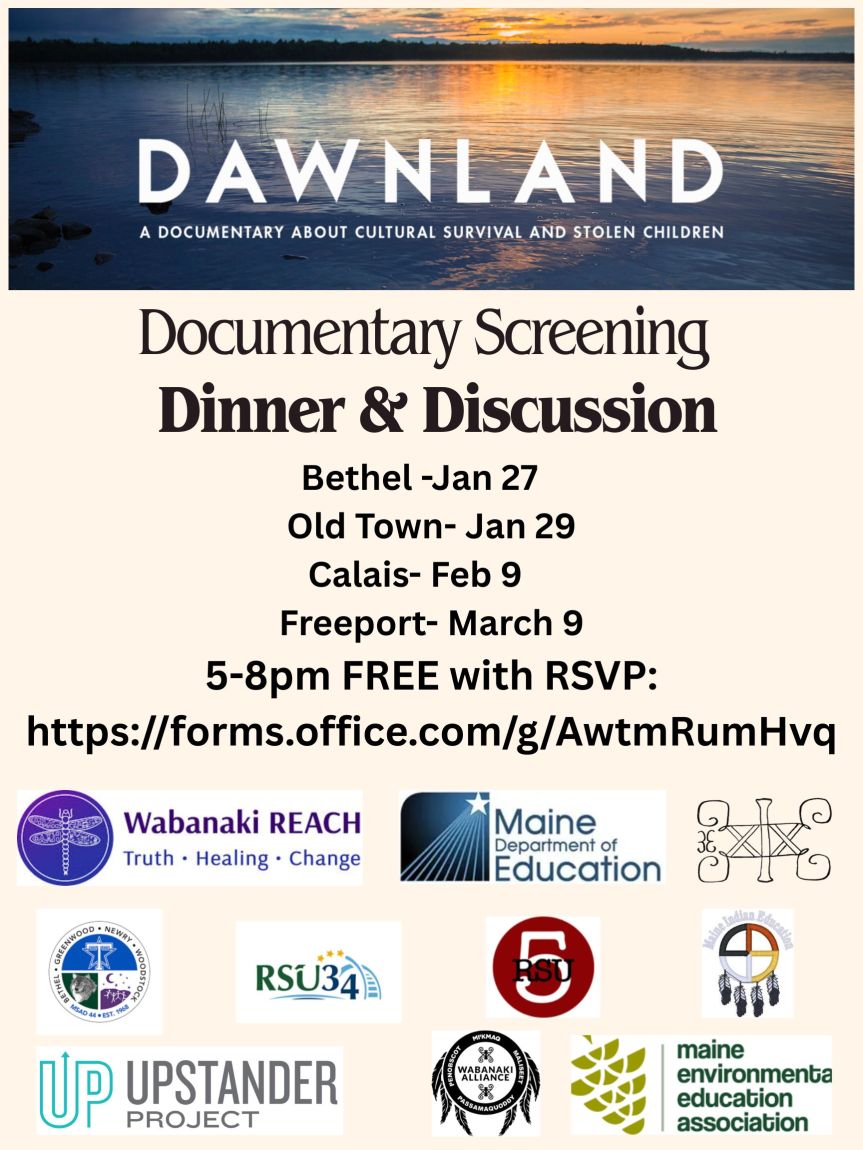
The Maine Department of Education (DOE), in partnership with Wabanaki REACH, the Maine Environmental Education Association (MEEA), Wabanaki Alliance, the Upstander Project, Wabanaki Culture Center, Maine Indian Education, RSU 34, RSU 5, and MSAD 44, invites Maine educators, school leaders, and parents to a series of free, in-person events across the state to view the award-winning documentary, Dawnland. These screenings, beginning in January 2026, will be followed by dinner and a discussion.

About the Film

For decades, child welfare authorities removed Indigenous children from their homes to “save them from being Indian.” In the place now called Maine, the first official Truth and Reconciliation Commission began a historic investigation. Dawnland goes behind the scenes, as this historic body grapples with difficult truths, redefines reconciliation, and charts a new course for state and tribal relations.

Dawnland aired on Independent Lens on PBS in November 2018 and 2021, reaching more than 2 million viewers. The film won a national Emmy® Award for Outstanding Research in 2019 and was included on the American Library Association’s list of 2020 Notable Videos for Adults.

Event Details

Dates/Locations:

  • January 27, 2026: Bethel (Telster High School, 284 Walkers Mills Road, Bethel, ME 04217)
  • January 29, 2026: Old Town (Old Town High School, 203 Stillwater Avenue, Old Town, ME 04468)
  • February 9, 2026: Calais (Wabanaki Culture Center, 39 Union Street, Calais, ME 04619)
  • March 9, 2026: Freeport (Freeport Performing Arts Center, 30 Holbrook Street, Freeport, ME 04032)

Time: 5 to 8 p.m.

Audience: Maine educators, school leaders, and parents

Contact Hours: Three hours awarded

Cost: Free (dinner included)

An RSVP is required! Space is limited at each site, so please register here.

To learn more about Wabanaki Studies and ways to engage, please visit the Maine DOE Wabanaki Studies webpage, or contact Brianne Lolar, Maine DOE Wabanaki Studies Specialist, at brianne.lolar@maine.gov.
Wabanaki Studies Resource Guide for Indigenous Heritage Month

As the new school year begins and Native American Heritage Month arrives, the Maine Department of Education (DOE) invites educators and communities to engage students in learning about the enduring presence, contributions, and rich cultures of the Wabanaki Nations, who have lived in the place we now call Maine for more than 13,000 years.

The Maine DOE Wabanaki Studies Indigenous Heritage Month Guide is now available to download and share from the Maine DOE website. Developed by the Maine DOE Wabanaki Studies Specialist, in collaboration with contracted Wabanaki advisors and educators, this guide offers practical tools to support meaningful, accurate, and engaging Wabanaki Studies instruction across grade levels.

The guide includes:

  • Adaptable, year-round curriculum for all grade levels.
  • Guidance and materials for teaching about Thanksgiving.
  • Links to online learning modules.
  • Printable bulletin board resources.
  • Micro-courses for continued learning and contact hours.

This work, informed and shaped by Wabanaki advisors and educators statewide, has been intentionally designed for use throughout the year. Effective Wabanaki Studies instruction reflects its interdisciplinary nature, connecting to existing units and helping students to make deeper meaning across content areas. Educators are encouraged to explore the full collection of resources and integrate Wabanaki Studies learning opportunities throughout the school year.

All resources are free to use and share across schools and educational programs. The Maine DOE welcomes examples of how Wabanaki Studies is being implemented, as this collective learning journey continues.

You may download the Wabanaki Studies Indigenous Heritage Month Guide here: Maine DOE Wabanaki Studies Indigenous Heritage Month Guide.

To learn more about Wabanaki Studies and ways to engage, please visit the Maine DOE Wabanaki Studies webpage, or contact Brianne Lolar, Maine DOE Wabanaki Studies Specialist, at brianne.lolar@maine.gov.