
At Ellsworth High School, the alternative education program known as “4th Door” is built on a simple but powerful belief: Students succeed when they feel seen, supported, and connected. Through a personalized and flexible approach, this program helps students reach their unique potential while contributing to their learning community.
The 4th Door serves approximately 30 students in grades 11 and 12 each year. Teacher Christopher Betts has led the program for the past eight years.
“This program works because I am working with students—not just the material,” Betts said.
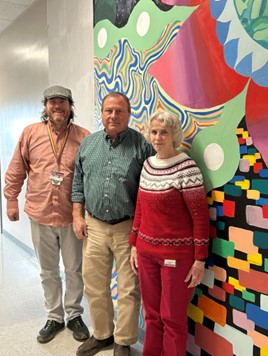
From left to right: Alternative educator Chris Betts, and ed techs Greg Lounder and Kristi Alexander.
Student Agency at the Center
A defining feature of the 4th Door is its emphasis on student agency. Entry into the program is intentional. Students are referred into the program by school staff, counselors, families, or they may self-refer. From there, students complete a reflective application that considers their goals, strengths, and readiness for an alternative learning environment.
Students and families meet with Betts, observe the program in action, and determine if it is the right fit. Once accepted, students sign a contract outlining shared expectations for success. The contract includes:
- Attending classes, making progress, and completing assignments.
- Passing both alternative and mainstream classes.
- Limiting distractions that impact learning.
- Giving back to the learning community.
These expectations create a foundation of accountability while reinforcing students’ ownership of their learning.
Personalized Pathways to Success
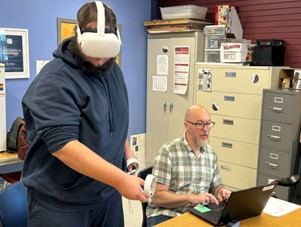
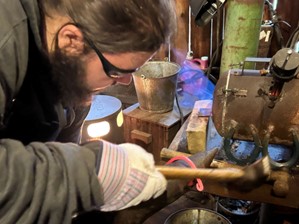
Each student in 4th Door follows a personalized learning pathway supported by clear structures and consistent guidance. The program emphasizes hands-on, project-based, and individualized approaches to meet diverse learning needs. Betts has developed a comprehensive Google Classroom, dedicating countless hours to curating a wide range of curriculum resources, scaffolded assignments, and instructional videos. He noted that alternative education teachers often act as “hoarders” of curriculum, collecting and organizing materials, so they can effectively meet students where they are.
Most of Betts’ students are enrolled in both mainstream and alternative classes. To support them in managing their coursework, he maintains individualized checklists that track progress across all classes. He works closely with students to set weekly goals, breaking larger assignments into manageable steps. This approach helps students build momentum, reduce overwhelm, and gain confidence.
The program’s flexibility allows students to:
- Work at their own pace.
- Explore topics aligned with their interests.
- Engage in meaningful discussions about real-world issues.
- Contribute to the development of learning materials.
This model places students firmly in the driver’s seat while ensuring they are supported every step of the way.
The program is also adaptable to individual postsecondary goals. For example, one of Betts’ seniors has been accepted to Eastern Maine Community College (EMCC) and the University of Maine (UMaine) to study mechanical engineering. He plans to attend EMCC for two years and then UMaine. Students in the program say it allows them to reconnect with their education and work toward their goals.
Accountability with Support
The 4th Door maintains clear expectations while also providing a highly supportive setting. Participation is viewed as a privilege, and students are expected to demonstrate effort and consistent progress.
When challenges arise, the program uses restorative practices to help students reflect, repair, and move forward. A structured system outlines expectations, consequences, and opportunities for students to regain good standing, and the system reinforces both responsibility and growth.
“This system allows for checks and balances. Students know I have their backs and that I will advocate for them, but they have to demonstrate they want to be here,” Betts said. “They do that by engaging in the program and contributing positively to our learning community.”
Connecting Learning to the Real World
Betts has recognized that many of his students balance full-time school with employment. In response, he has incorporated a work-based learning component into 4th Door by partnering with local employers to support students who need to work while attending school.
“Some students need to work. It is not a choice. They are showing up to school exhausted,” Betts explained.
Through the work-study component, students can earn up to two academic credits while developing essential career-readiness skills. Betts tracks progress by collecting pay stubs and employer evaluations, which focus on areas such as punctuality, professionalism, and communication.
Relationships at Its Core
At the heart of the 4th Door are authentic relationships. Social-emotional learning is not a separate initiative but something embedded in daily interactions and experiences.
Students consistently describe the program as a safe and inclusive space where they can be themselves without fear of judgment. For many, this sense of belonging is transformative. One student, for example, who struggled to engage in a traditional setting due to an undiagnosed chronic illness credits the program with helping them stay on track and ultimately graduate.
Betts explained that the classroom serves as a “home base,” especially for students who are experiencing anxiety. In this environment, students can show up authentically, build meaningful connections, and learn alongside peers with diverse experiences and learning styles.
A Dedicated Team
The program is supported by a dedicated team consisting of one teacher and two educational technicians. Together, they create a structured yet flexible environment that prioritizes responsiveness, relationships, and student success.
With eight years of experience leading the program, Betts emphasizes a guiding philosophy that this work is not just about delivering content; it is about supporting students as individuals and helping them build a path forward.
This story was written in collaboration with Ellsworth High School (Ellsworth School Department) as part of an ongoing series to highlight alternative education programs across Maine. For more information about alternative education, please visit the Maine DOE Alternative Education webpage or contact Aubrie Howard, Maine DOE Student Success and Wellbeing Specialist, at aubrie.howard@maine.gov. To submit a good news story to the Maine DOE, please fill out the good news submission form.

