Sanford High School Hosts the Maine Supreme Court 

Submitted by Liz Dudgeon, Executive Assistant to the Superintendent, Sanford School Department.

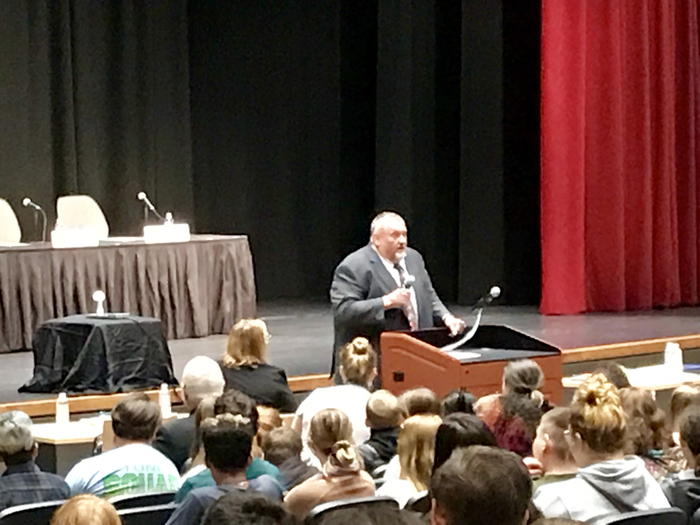
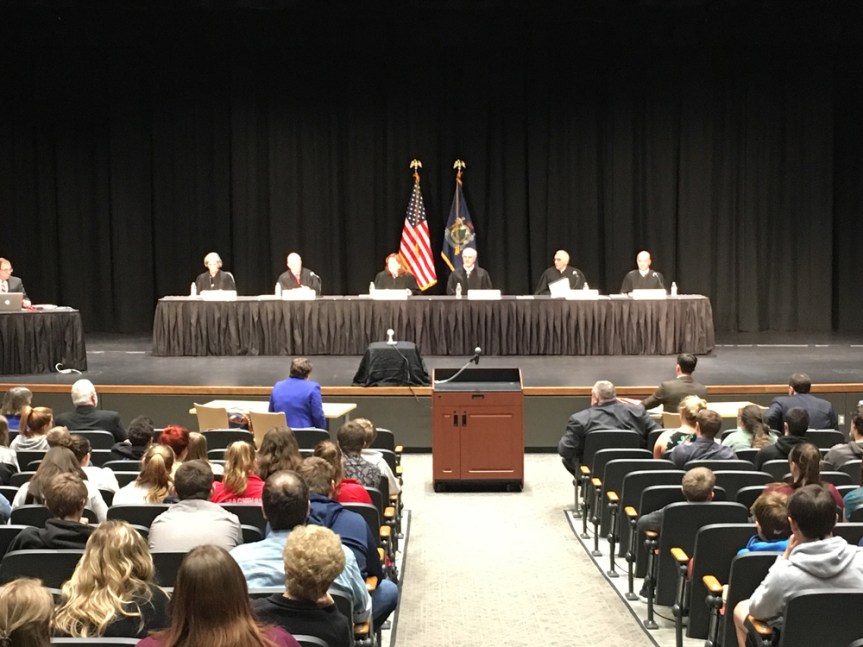
The Sanford Performing Arts Center was transformed into a real appeals court when the Maine Supreme Court Justices heard three cases on Tuesday, May 7, 2019. Over 600 students sat in on at least one of the cases throughout the morning.

Following the formal court proceedings, students enrolled in the Advanced Placement (AP) Government program had the opportunity to sit down to lunch with the six justices which was prepared and served by the Sanford Regional Technical Center (SRTC) Culinary Arts program.

Below is a news article about the day:

Journal Tribune – Class Action: Justices Interact with Sanford High Students
Maine Supreme Judicial Court hears cases at school

Attorney John Webb
Attorney John Webb

Technology Learning Lab Hosted at Bucksport Middle School

Submitted by Evelyn Beaulieu, Director of Curriculum and Academic Achievement at RSU 25. 

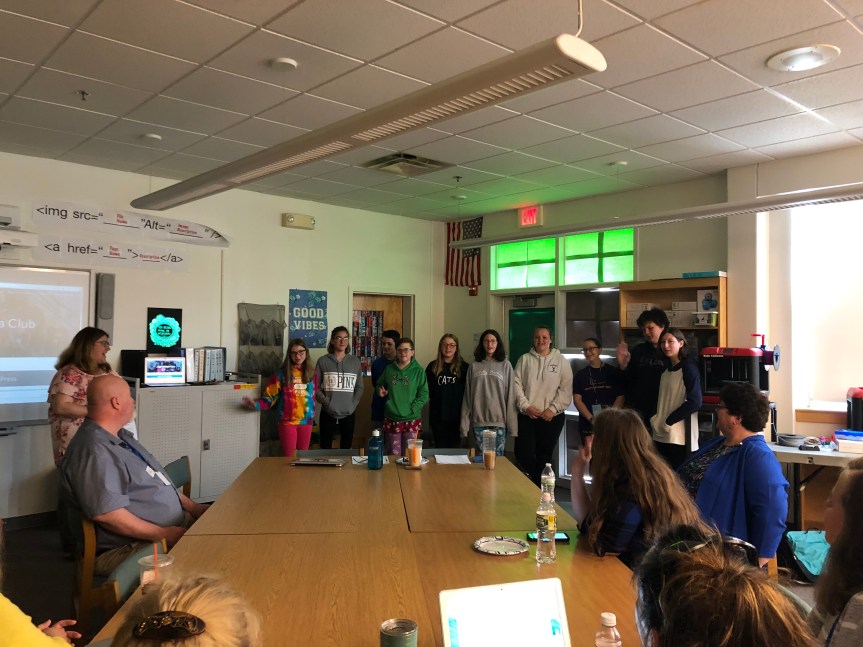
On Wednesday, June 5, 2019, Bucksport Middle School (BSM) hosted teachers from around the state in a Learning Lab, sponsored by the Maine Department of Education. The Learning Lab’s purpose was to demonstrate how BMS uses technology to enhance learning, and for the visiting educators to take new ideas and skills back to their community.

One of the day’s main focuses was to have students and their experiences be front and center. Members of the school’s Digital Media Club discussed the process of establishing, then writing and distributing the school’s first Digital newspaper. Members J-Lynn Farren, Abbigail Farricker, Kasey Findley, Dylan Wombacher, Emily West, Brianna Grass, Hannah Varnum, Kelsea Gaff, Wynn Therrien and Ella Orcutt also answered guest questions regarding the success and struggles they had experienced establishing the newspaper, and what the group’s long term goals were for the upcoming years, and plans for video announcements and more.

IMG_8027

“My favorite part was teachers asking us questions and us being able to teach them how to do stuff,” said Kasey Findley, writer of the paper’s Kasey’s Korny Korner. “I think they gained a lot of resources that they will be able to bring to future classes.”

The school’s GT Art Program had students Ella Hosford, Ayden Maguire, and Diego Harvey working with GT Coordinator Amanda Hoffert doing photo manipulation. They were able to show examples of their photos, and go over the process and technology they used to manipulate the photos.

IMG_6671

8th graders Alyx Frazell and Wynn Therrien were on hand to show the amazing work they did with 8th Grade Social Studies teacher Donna Short’s Greek Mythology Research project. Mrs. Short used project based learning to have her student’s demonstrate their understanding of the research process. Through student voice and choice 8th graders used a variety of genres to express new learning, from posters and slide shows to Ms. Frazell’s pottery and Mr. Therrien’s computer program written in Scratch. Guests were able to see the various types of technology that were used, and how Mrs. Short integrated them into project based learning in her classroom.

The final group, were students Wynn Therrien, Dylan Courtney, Andrew Braley, Bo Provencher and Kasey Findley to demonstrate BMS’s 3D printing program. All BMS students take Information Technology class with Mrs. Braley and learn coding, and 3D printing engineering and design. Mr. Provencher and Mr. Courtney showed the boats they had designed in 6th grade, Mr. Findley discussed the bubble wands they had made in 5th grade, and Mr. Therrien and Mr. Braley demonstrated Tinkercad, the program the students use to create their 3D projects. The students went over the design process, the engineering skills that were taught, and how they used problem solving to fix issues that arose when designing their projects.

“I was incredibly proud of all of our students.” Mrs Braley stated. “It was important to us to have the students be front and center, so that instead of teachers listening to just Donna, Mandy and I, they were getting first hand testimonies and examples from the students that we are teaching, and they were able to ask them what they thought was successful and what needed improvement. Having our students be able to demonstrate their learning in such a positive way was incredibly rewarding for us.”


Employee of the Week: Scott Brown

Scott Brown, Maine DOE Director of School Construction, School Security, and Student Transportation is being highlighted this week as the Maine DOE’s Employee of the Week! Learn a little more about Scott in this brief question and answer:

What are your roles with DOE?

I am the Director of a team that includes School Construction, Safety and Security, and Student Transportation.  Within those program areas our team strives to align and support the values stated in the Mission, Vision, and Goals of the Department.  I also serve on the Department’s Leadership Team.

What do you like best about your job?

The planning and construction processes for a new Major Capital school project can easily take five or more years and watching the excitement of students, district staff, and community members when the facility is finally complete is always rewarding.  I also have thoroughly enjoyed working with the superintendents, principals, teachers, and community members in the process of planning and constructing over 100 Major Capital school projects across Maine.  I feel very fortunate to have had this opportunity to develop so many relationships with people dedicated to education both at the state and local level and for the experiences that have come with every project.

How or why did you decide on this career?

My education and training background is in architecture, engineering, and business.  After receiving my architect’s license I worked for a number of firms specifically on school and other larger public improvement projects in Maine and New Hampshire.  When an architect position was created in the Department in 1996 I knew that it was a position that I had a lot of interest in.  Since then I have been impressed and motivated by so many people committed to education here at the state level and I have thoroughly enjoyed my years here at the Department.

Maine DOE Update – June 13, 2019

From the Maine Department of Education


Reporting Items

MaineCare Seed Adjustments to be Made, Review Q3’19 Reports by July 8, 2019

The recovery of Q3’19 MaineCare Seed will occur in the July 2019 subsidy payment, and the Maine Department of Education is asking SAUs to review their reports by July 8, 2019 to ensure accurate adjustments to subsidy. | More

| Visit the DC&R Reporting Calendar |


News & Updates

Maine Department of Education Shares Vision, Mission, and Strategic Goals

During the transition of a new leadership team to the Department of Education, Commissioner Makin has actively sought input and guidance from the expert staff at the department, and from education professionals and other stakeholder groups, to inform our Vision, Mission and Strategic Priorities. In hearing the hopes and dreams of so many, and understanding the immensely important work that is being done in classrooms across our state, our Vision, Mission and Strategic Priorities will serve as a continually evolving guide for the work of the Department of Education.  | More

ADMINISTRATIVE LETTER: Amendments to Educator Evaluation Requirements

On April 11, 2019, Governor Mills signed a law that makes important changes to Performance  Evaluation and Professional Growth (PEPG) systems. The new law will go into effect 90 days after the current legislative session ends. Chapter 27, An Act to Amend Educator Evaluation Requirements, includes a number of changes.  | More

Certification Update- Are YOU Due July 1, 2019?

Maine Department of Education is proud to share that our certification team continues to process a number of new certificates for those joining the education profession or who are seeking new endorsements. | More

Still Time to Register for 4th Annual Read to Ride Summer Reading Challenge

Summer vacation is a welcome break from the daily school routine for children and parents alike, but the summer months can be detrimental to students’ learning if young minds do not remain active. Summer learning loss is a well-documented phenomenon, particularly with respect to reading achievement. | More

Successes Shared by Districts at Closing Event of 4-Year Preschool Expansion Grant

The Maine Department of Education hosted a closing event of the 4-year Preschool Expansion Grant (PEG) that was awarded to Maine DOE in December 2014 by the US Department of Education.  Eighteen states were awarded grants to support local school districts in the development of new preschool classrooms, and to expand access to high-quality, full-day pre-k programs for children whose families were at or below 200%  Federal Poverty Level. | More  

Julie Meltzer Named 2019 Curriculum Leader of the Year

Julie Meltzer, Director of Curriculum, Assessment, and Instruction for the Mount Desert Island Regional School System (AOS #91) is Maine’s 2019 Curriculum Leader of the Year. | More

School Safety Bulletin-June: Preparation and Response for Bomb Threats

Throughout the 2018- 2019 school year, the Maine Department of Education, State Fire Marshal’s Office, Department of Health and Human Services, Maine State Police, Maine Sheriffs Association, Maine Chiefs of Police Association, and the Maine Emergency Management Agency will provide tips and resource information to Maine schools to help provide some guidance for identifying signs and preventing school violence. | More

Maine DOE Employee of the Week: Michele Bisbee

Maine DOE Child Nutrition Consultant, Michele Bisbee is being highlighted this week as the Maine DOE’s Employee of the Week! Learn a little more about Michele | More


Maine Schools Sharing Success Stories

| Submit your Maine School Success Story |


Professional Development & Training Opportunities

| Visit the Professional Development Calendar |


Latest DOE Career/Project Opportunities

Lincoln Academy Takes New Approach to Vaping

Submitted by Jake Abbott, Dean of Students and Director of Residential Life, Lincoln Academy. Link to original article.

Vaping among teens has been called an epidemic by the US Surgeon General. Lincoln Academy’s new policies respond with education rather than just punishment.

E-cigarette use among teens has skyrocketed nationwide over the last two years. In December of 2018 US Surgeon General Jerome Adams declared it an “epidemic” and the 2018 Monitoring the Future study funded by the National Institute of Health found the 2017-18 e-cigarette use increase to be the “largest ever single-year increase in the use of a substance.”

In response to the epidemic in teen e-cigarette use, also known as vaping, high schools have scrambled to keep policies current with student habits.

Lincoln Academy has made several policy changes in 2019 to address the use of e-cigarettes in school. The new policy has shifted from a punishment model to one focused on education, according to LA Dean of Students and Director of Resident Life Jake Abbott. After their first vaping violation, students are now assigned a “learning detention” where they research the health effects and risks of vaping as well as the truth behind deceptive e-cigarette marketing. After their research is complete, students write a letter about what they have learned to a parent, a teacher, or a local newspaper.

“The focus of this work is to educate and spread information to both the student and the broader community,” said Abbott. “So far students have taken this research to heart… the policy seems to make a difference in how students feel about vaping.”

One student wrote in an essay written during detention, “Learning about the propensity toward addiction that Juuling [Juul is a popular brand of e-cigarettes marketed to teens] and other vaping products bring to the table has completely and utterly disgusted me. I have no desire to consume any products similar to Juul ever again. Knowing the amount of people, minors included, that have become addicted to nicotine is terrifying, especially since a recent census has shown that ‘10.7 million youth aged 12-17 are at risk for using e-cigarettes.’”

Another essay reads, “going forward, I plan to completely cut vaping out of my life. Not only will I stop doing it myself, but I will also try to educate my friends on the dangers of Juul and other vaping products. I never want to vape again. These reports have driven me into utter hatred for the companies behind the propaganda and brainwash of young children and teens.”

A third student wrote, “I do not want to cause myself health problems later in life that are easily avoidable. I do not want to lose the respect of adults and my peers for such an idiotic move. I think when I really put my mind to something I have very strong will power, and I think the combination of knowing I want to quit, and avoiding associating with people I know use nicotine can help me quit. I do not want to be a slave to nicotines grasp any longer and I am ready to quit.”

“The vaping epidemic took us by surprise,” said Abbott. “The adults didn’t have enough information, and the products are marketed directly to young people. They came on the market as smoking cessation devices, but instead of helping people quit smoking, they caused students who previously didn’t smoke cigarettes to get addicted. Often when students start using these devices they believe they contain only flavoring, but most e-cigarettes actually contain high doses of nicotine–one of the most addictive substances we know of.

“We hope our new policy will not just punish a behavior, but help students stop and think about the harm that vaping causes to themselves and others. This restorative philosophy works well for other offenses, and we are hoping it will make a difference with vaping, too.”

“It is impossible to know with certainty whether this consequence actually deters vaping over time, but at least we know students are learning something; are educating themselves about the real consequences,” said Abbott. “We are fighting an information war: the corporations that produce these devices are telling teens they are harmless. At least our policy can help students and their parents learn the facts so they can make informed choices in the future.”

 

Lewiston Adult Education Graduate Shares Story of Perseverance

(Pictured: Nasra Houssein, who served as the student speaker on Tuesday night, pauses after receiving her diploma.)

Submitted by Mike Reagan, Education and Marketing Coordinator, Lewiston Adult Education.

Nasra Houssein praised the people who convinced her to return to her studies during Lewiston Adult Education’s graduation on Tuesday night in the Lewiston High School gymnasium.

The native of Djibouti dropped out of her classes last year because she could not fit them in with her work schedule. She credited Lewiston Adult Education teachers Don Roux and Amy Hatch for their encouragement along with coworkers at Trinity Jubilee Center in Lewiston.

She returned to her classes after a three-month absence. On Tuesday, served as the student speaker at graduation.

“Without all your help, it would have been difficult for me or anybody else. So thank you all for giving us your time to help us succeed,” Houssein said.

The 30 Lewiston Adult Education graduates at the ceremony received their high school credential by taking the High School Equivalency Test. The HiSET exam has replaced the GED for high school equivalency.

Beth Derenberger received the Lifelong Learner Award for her commitment as a teacher and for exemplifying the sharing of knowledge at Lewiston Adult Education. She learned rug braiding from an adult education course in Oxford Hills. After a few years of practice, Derenberger ended up teaching in Oxford Hills and at Lewiston Adult Education.

She taught rug braiding at Lewiston since 2004 and retired at the end of the Winter-Spring 2019 semester.

“I have made so many friends from my teaching. It’s awesome. Students come because they want to come. People come because they’re interested. And that’s half the battle,” she said before the ceremony.

Adult Ed Graduate and Teacher
Student speaker Nasra Houssein celebrates after the graduation with Barabara McAllister of the Lewiston Adult Education’s Adult Learning Center on Tuesday night.

Outgoing Superintendent of Schools Bill Webster served as the keynote speaker at graduation and received a round of applause for his support of adult education. Lewiston Adult Education Director Bill Grant gave retiring teacher Diane Whiting a bouquet of flowers during the ceremony to thank her for her service of more than 25 years.

Maine Adult Education Programs Featured on PBS News Hour

Maine and its Adult Education programs, including Spruce Mountain Adult Education, Portland Adult Education, and Turner Adult Education have been featured on PBS News Hour for a story about adult education programming and why it is so important.

Click the link or image below to view the 8 minute story.

Why 36 million American adults can’t read enough to work — and how to help them

PBS News Hour Screen Shot

School Safety Bulletin-June: Preparation and Response for Bomb Threats

Throughout the 2018- 2019 school year, the Maine Department of Education, State Fire Marshal’s Office, Department of Health and Human Services, Maine State Police, Maine Sheriffs Association, Maine Chiefs of Police Association, and the Maine Emergency Management Agency will provide tips and resource information to Maine schools to help provide some guidance for identifying signs and preventing school violence.

Further questions and inquiries can be send to Pat Hinckley, Maine DOE Transportation and Facilities Administrator at 207-624-6886 or pat.hinckley@maine.gov. 

ADMINISTRATIVE LETTER: Amendments to Educator Evaluation Requirements

Administrative Letter:  #25
Policy Code:   BGE
To: Public School Administrators, Teachers
From: Pender Makin, Commissioner
Date:  11 June 2019
Subject: Amendments to Title 20-A, Chapter 508, Educator Effectiveness

On April 11, 2019, Governor Mills signed a law that makes important changes to Performance  Evaluation and Professional Growth (PEPG) systems. The new law will go into effect 90 days after the current legislative session ends. Chapter 27, An Act to Amend Educator Evaluation Requirements, includes a number of changes.

  1. Under the new law, school administrative units may choose to identify and include student learning and growth measures that they deem valuable in summative effectiveness ratings, but they are no longer required to do so.
  2. SAUs must ensure or reconfigure their steering committee membership, such that a majority are teachers who are chosen by a representative of the applicable collective bargaining unit.
  3. The law states that, “revisions to the performance evaluation and professional growth system made by the steering committee must be reached by consensus.”

Implementation Guidance

  • The steering committee composition required in Chapter 27 will go into effect 90 days after the current legislative session comes to an end, likely near the start of the 2019-2020 school year.
  • The Department of Education is committed to a transparent and inclusive rule-making process for Chapter 180 that will begin in early fall of 2019, in preparation for the submission of the draft rules for consideration to the Committee for Education and Cultural Affairs in January, 2020.
  • Current law requires that student learning and growth measures must be a factor in a summative effectiveness rating until September 1, 2021.  PEPG steering committees are encouraged to review their current PEPG systems, and the vision, mission, and goals of the district, to determine the measures of effectiveness they will implement beginning with the 2021-2022 school year. In addition, the committee should develop reasonable transition plans and timelines for any changes to the PEPG system, as determined by the steering committee, taking into consideration the existing evaluation cycle, and when summative evaluations will be completed.

For more information, please contact Emily Gribben at Emily.gribben@maine.gov.

Saco’s Young School Loves to Walk

Submitted by Peter Harrison, Principal at Young School, Saco Schools. Text Written by Ken Studtmann, Wokka Wokka Coordinator. Photos by Dr. Peter Harrison and Ken Studtmann.

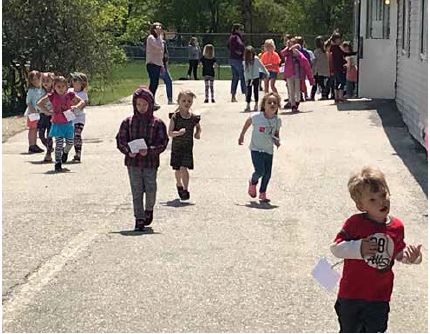
For several years the Young School students have participated in a much beloved walking program during their Wednesday’s lunch time recess. The students fondly named it “Walking Wednesday”.

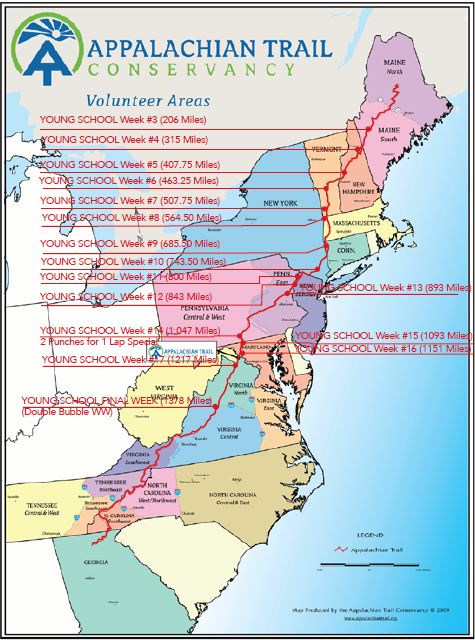
Appalachian Trail Comparison Map
Appalachian Trail Comparison

During Walking Wednesday, the students walk, skip, hop or move in creative movements 1/8-mile laps around the school while parent and adult volunteers track and tally the number of laps each student completes. The number of laps completed are recorded for individual students and collectively tallied for  classroom, and the entire school. For every 2.5 miles the student walks they receive an incentivizing award of a “toe token”. At the end of the year, the classroom from each grade level with the highest number of laps receives an extra recess.

Geography Lesson

For the past two years, a lesson in geography has been integrated into the program. Last year, the laps walked by the students represented a unit of distance along the Appalachian Trail. The students successfully completed 1,378 miles of the Appalachian Trail; Maine to Virginia. The student’s progress was tracked on a large map displayed in the school’s front entry hallway for students, teachers and staff, and visitors to watch the progress. This year the laps represented the number of times the students crossed the Penobscot bridge; 3,541 times and growing.

Language

As a means to further enhance the program, a language component was introduced in the beginning of this current school year with the reading of “HOW DO YOU WOKKA-WOKKA”, c 2009 by Elizabeth Bluemle, art by Randy Cecil. The book was a great inspiration to the students, staff, and adult volunteers of the program. The book’s premise of finding your own walking style was embraced by the students with lots of styles emerging. The students even changed the program’s name into “Wokka Wokka Wednesday”. The Wokka Wokka Wednesday is a much-loved program at Young School.

Fun Fact #1: The Appalachian Trail is among the longest continuously marked trails through 14 states; Maine to Georgia. The trail is marked with approximately 165,000 white blazes along the trail guiding hikers all 2,186 miles.

Penobscot bridge
Penobscot bridge

Fun Fact #2: The Penobscot bridge spans 2,120 feet from the east shore to the west shore of the Penobscot river. The design of the bridge’s two towers was inspired by the Washington Monument.

Fun Fact #3: Young School Students love to Walk! Last year, the Young School students collectively walked fictitiously from Maine to Virginia on the Appalachian Trail and this year they walked 3,541 times across the Penobscot the bridge.

For additional information to learn how to implement a walking program at your school, please contact Dr. Peter Harrison, Young School Principal.