Educator Forum: Building Trauma-Sensitive Schools

Thursday, December 5, 2019, 4:30-6:00 pm
301 Bailey Hall, University of Southern Maine
16 University Way, Gorham, ME

Explore the impact of trauma on the social, emotional, and academic growth of students in this interactive workshop. Topics to be covered include Adverse Childhood Experiences (ACEs), trauma-sensitive schools, restorative practices, and the importance of establishing a culture of self-care. Attendees will be grouped by grade level and engage in dialogue geared towards making their own classrooms and schools more trauma sensitive. The intended audience for this Forum is all school employees who work with students in grades pre-K through 8.

Registration: Register here (https://forms.gle/UkE2Ft1f3qPzpjdW9) OR Download a PDF registration form (PDF)

Cost for attendance is $15 per person, and includes certificate for 1.5 contact hours. Light refreshments will be provided.

NOTE: If you do not end up attending, payment is still due, as your registration holds a spot for you and is figured into the head count for refreshments. If you cancel your registration by November 27, your fee will be waived/refunded.

Facilitators:

  • Jeanna Carver, Pre-K Teacher, 2019 Washington County Teacher of the Year, Jonesport Elementary School
  • Heather Whitaker, Alternative Education Teacher, 2019 Cumberland County Teacher of the Year, 2020 Maine State Teacher of the Year, Gorham Middle School
  • Jen Baker, Licensed Clinical Professional Counselor, Village Elementary School, Gorham
  • Meghan O’Neil, Grade 4 Teacher, Village Elementary School, Gorham

Educator Forums are professional development events for educators of similar positions or responsibilities to explore new or best practices in their field. Forums provide an opportunity for educators to engage with peers, build new understandings from prior knowledge, and reflect on past practices.

Contact the PDC with any questions:

Julie Marsh, Program Coordinator
Professional Development Center
University of Southern Maine
pdc@maine.edu
207-780-5400

Green Ribbon Schools

The Maine Department of Education is pleased to announce that Maine is joining the U.S. Department of Education Green Ribbon Schools initiative to inspire and promote effective school sustainability and collaboration. The award highlights sustainability practices undertaken at the school, district, or post-secondary institution level that are cost-saving and health promoting.
The U.S. Department of Education developed three Pillars of a green school:

  1. Reducing environmental impacts, e.g. waste, energy, transportation, etc.
  2. Improving health and wellness of schools, students and staff through consideration of school food, air quality, physical activity, etc.
  3. Offering environmental and sustainability education that is authentic, civically engaging and green career preparing.

More information regarding Green Ribbon Schools can be found on the USDOE website, and Maine’s Green Ribbon Schools application should be submitted to shari.templeton@maine.gov.

PRIORITY NOTICE: Proposed Reinstatement of Rule Chapter 115 (The Credentialing of Education Personnel Rules) Part II Requirements for Specific Certificates and Endorsements

The State Board is proposing the reinstatement of Chapter 115 Part II: Requirements for Specific Certificates and Endorsements, which was in effect May 14, 2014. This rule, following the emergency adoption of the same version of Chapter 115, maintains the status quo for credentialing at this time, and will be in effect until such time as the State Board develops new Chapter 115 rules.

Find the details for proposed changes for Rule Chapter 115 on the Maine DOE Proposed Rule & Rule Changes webpage (proposed rules are listed in order by rule number).

Public Hearing Information for Rule Chapter 115:

  • December 16, 2019 from 9:30am- 11:00am
  • Room 500 in the Cross State Office Building, 111 Sewall Street, Augusta, Maine
  • All are welcome to attend, and no RSVP is required.  Anyone unable to attend the public hearing may send written comments via email to jaci.holmes@maine.gov or by mailing comments to:

Maine Department of Education
attention: Jaci Holmes
23 State House Station
Augusta, ME  04333-0023

Comment Period Deadline: December 27, 2019


Maine DOE Update – November 14, 2019

From the Maine Department of Education


Reporting Items

Open Comment Period for Required Civil Rights Data Collection Revisions: Closes November 18!

The Maine Department of Education has just learned that the United States Department of Education (USED) has released proposed revisions to the data required as part of the Civil Rights Data Collection (CRDC), and that the comment period for the proposed revisions closes on Monday, November 18.  We wanted all school administrative unit (SAU) and school leaders, and any other interested parties, to be aware of this open comment period, and to have the opportunity to review the proposed revisions and provide feedback directly to the  USED.| More

| Visit the DC&R Reporting Calendar |


News & Updates

Maine Forest Collaborative Brings Together Rural Students for Resource-Based Educational Opportunity

Maine students from rural communities came to the Maine State Capitol last week as part of a unique learning opportunity offered by The Maine Forest Collaborative. The collaborative, created and administered by the Rural Aspirations Project, | More

Students Learn What it is Like to be an Educator at Thomas College Teacher Academy

With a steep teacher shortage facing many communities in Maine, Thomas College and the Maine Department of Education teamed up to offer a daylong experimental teaching environment to further engage Maine students who are interested in teaching as a profession. | More

Nominate an Educator or School Employee for “Life Changer of the Year”

Life Changer of the Year is an annual program recognizing K-12 educators and school employees across the country. This includes teachers, para educators, custodians, secretaries, principals, lunch personnel, school nurses, guidance counselors, anyone who is employed by a K-12 school district. It is easy to nominate someone. Anyone can nominate up to 3 employees. Our program celebrates those who are making a significant difference in the lives of students by exemplifying excellence, positive influence and leadership. Nominations are now being accepted for the 2019-2020 Program. | More

Hannaford Donates $1M to Support “Fuel Kids at School” Hunger Relief Efforts

Hannaford Supermarkets announced a $1 million donation as part of its new “Fuel Kids at School” initiative that is designed to directly address food insecurity and improve access to fresh and healthy food for children. | More

Get to know the Maine DOE Team: Meet Debbie Violette

Maine DOE team member Debbie Violette is being highlighted this week as the part of a Get to know the DOE Team campaign! Learn a little more about Debbie. | More


Maine Schools Sharing Success Stories

| Submit your Maine School Success Story |


Professional Development & Training Opportunities

Symposium: Unpacking the Maine-Wabanaki Studies Law (LD 291) Past, Present and Future

Sponsored by Native American Programs and The Wabanaki Center. | More

| Visit the Professional Development Calendar |


Latest DOE Career/Project Opportunities

Students Learn What it is Like to be an Educator at Thomas College Teacher Academy

With a steep teacher shortage facing many communities in Maine, Thomas College and the Maine Department of Education teamed up to offer a daylong experimental teaching environment to further engage Maine students who are interested in teaching as a profession.

Students from all over Maine spent the day at Thomas College to learn more about what it’s like to be a teacher. The aspiring educators were able to participate in college level education courses offered by Thomas College professors Richard Biffle, Katie Rybakova, and by Lawrence High School teacher, Eric Brown.

The courses covered lessons in social emotional learning, inclusion, STEAM (Science, Technology, Engineering, Art, Mathematics education, and an overview of lesson planning and implementation – what to expect (or not expect), how to think on your feet, and how make the content relevant to students. The event aimed to give students a better understanding of education as a career path, by providing hands-on experiences that can help solidify their career aspirations, and at the same time give them a taste of post-secondary education.

The unique event drew coverage from WABI and Central Maine among others who were eager to report on a collaborative effort that aims to tackle the workforce shortage of teachers in the state of Maine.


Reaching for the Stars Starts with a Strong Ground Crew

Jessica Meir declared in first grade that she wanted to be an astronaut – and she meant it. Meir made history with the first all-female space walk from the International Space Station nearly 25 years after graduating from Caribou High School. While it may seem to have been a certainty in the rear view, getting to the ISS wasn’t always a sure thing. Meir was denied acceptance to the space program on her first application. Perseverance paid off and Meir eventually became the astronaut she had always envisioned.

When Caribou High School principal Travis Barnes learned in January that Meir was likely to be going to space, he wanted his students to get involved. No one knew then that Dr. Meir would be making history as a member of the first all-female spacewalk, but Barnes knew his students had a rare opportunity to participate in a space talk. He began the monumental work required to secure a NASA “uplink” to provide students in RSU 39 the opportunity to speak to Meir in real time.

Being an astronaut’s alma mater is not reason enough to be accepted. The application had to demonstrate extensive support and involvement of the whole community and significant impact on student learning and aspirations. Developing the application for NAS meant Barnes and his teachers had to develop a myriad of opportunities to both inspire and support RSU 39 students to dream big in a small town. The RSU 39 ground crew had to include staff, students, and community to meet the rigorous requirements set by NASA. The space talk was only part of the big day.

Assembling the Ground Crew: Staff

Middle school teachers Kim Barnes, Susan Keaton, Arik Jepson, Twyla Learnard, Cheryl Pelletier, Jennifer Crawford and high school teachers Shannon Sleeper, Jessica Bell, Kayla Brown, Peg Conologue, Jessica Doucette worked with students through an inquiry process to develop a deeper understanding of the International Space Station, the current mission and tasks, issues facing the space program, and Jessica Meir’s personal journey into space. Motivated by the opportunity to speak to Meir, students worked to review and revise the questions forwarded to NASA. See those questions here.

Assembling the Ground Crew: Community

CHS Alum

CHS alum visited the school and provided students other lenses into career development and goal setting. While Jessica Meir stayed focused on her goal throughout her life, many others meandered to find their pathways and develop careers, some never considered or even known. Dustin Damboise and Jamie Corrigan created a trivia game with facts about their high school, college, and work experiences, asking students to match the facts with the person. With more than two majors listed and neither matching either job title provided, Damboise and Corrigan demonstrated to students how exploration and an open mind can lead to identifying a gratifying career. CHS alums Dan McCormack (’91), CEO of InterMed, and Darcie McElwee (’91), Assistant United States Attorney, also shared their “space walks,” encouraging students to take advantage of different opportunities, such as an internship or the military. McCormack and McElwee stressed how perseverance learned at Caribou High School shaped their journeys to career success. In total, more than a dozen graduates of CHS returned to the launch pad to support student aspirations.

Caribou and All of Maine

Other activities during the day demonstrated the importance of staying healthy despite rigorous work, sessions that focused on health and wellness, and sessions to explore potential career paths in the medical field. Denis St. Peter, PE President and CEO of CES, Inc. as well as a 1986 CHS graduate, brought three engineers with him to expose students to new experiences in the engineering world including: Game of Drones with Josh Maker (Survey Technician, Surveying Division); Watershed Down with Justine Drake (Engineer, Engineering Division); Go with the Flow with Andrea Dickinson (EI, Senior Project Engineer, Environmental Division). Students learned about the science behind protective gear, research about creating jet fuel from wood, coding, outdoor survival and much more thanks to support from agencies such as the Caribou Fire Department, Maine Emergency Management, and the Maine Forest Service. [insert photo here?] See a complete list of all the companies, agencies, organizations who were part of the RSU 39 Ground Crew.

Blast Off: Uplink with the International Space Station

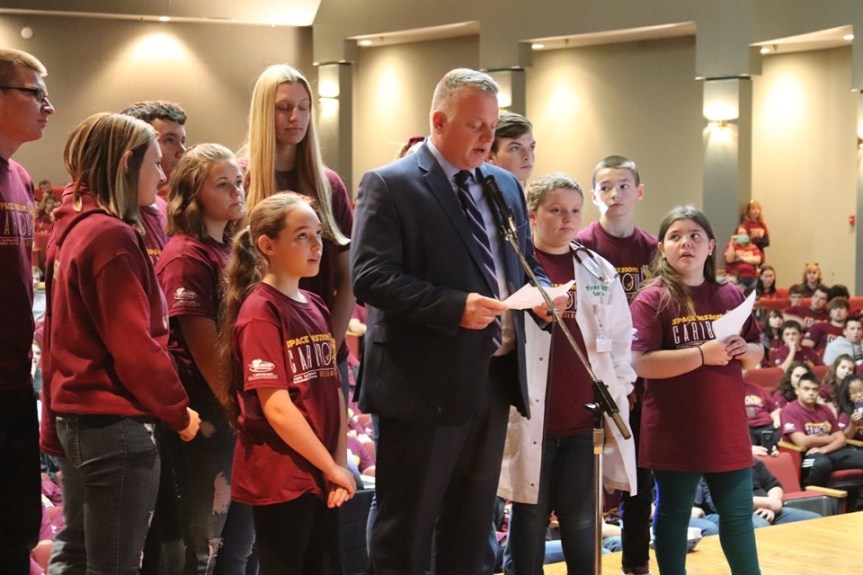
Middle and high school students assembled in the auditorium of the Caribou Performing Arts Center as NASA prepared the uplink. Selected students presented questions directly to Dr. Meir. Dr. Meir was appropriately impressed by the demonstration of understanding of her work on the ISS and of other issues regarding technology and the environment as well as Dr. Meir’s personal journey to the ISS.

Students in grades K-5 remained in their respective buildings, remotely watching Jessica Meir talk to students at Caribou High School. Their day included student choice STEM activities led by classroom teachers designed to develop student creativity and problem-solving skills. Some of the sessions included Sphero rockets, designing space helmets, virtual reality, catapult execution, launching straw rockets, and trying astronaut ice cream.

A tremendous amount of time and planning was involved in making this day such an overwhelming success.  The “ground crews” ensured everyone who participated had a blast!

This article was written by Maine DOE English Language Arts Specialist, Morgan Dunton in collaboration with school staff from Caribou schools. The article is part of the Maine Schools Sharing Success Campaign. For ideas or submissions for Maine Schools Sharing Success, email Rachel at rachel.paling@maine.gov.

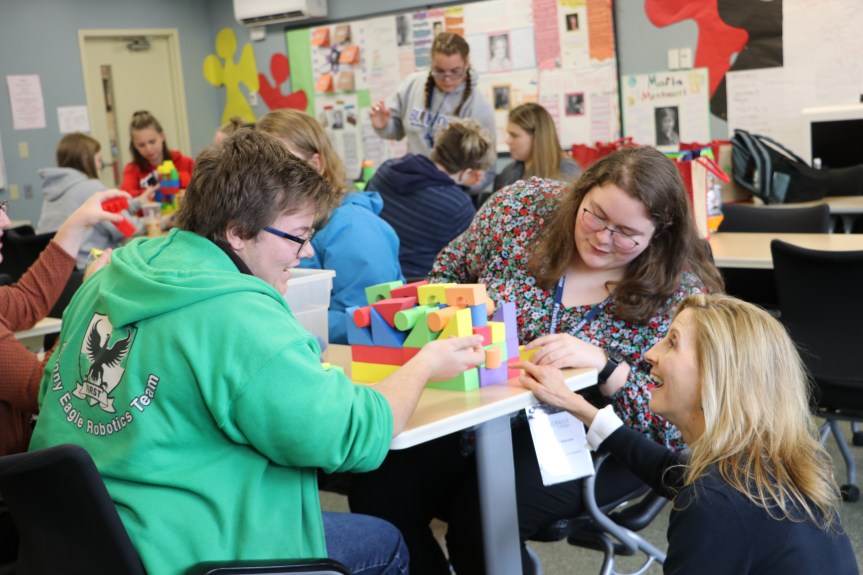


Maine Forest Collaborative Brings Together Rural Students for Resource-Based Educational Opportunity

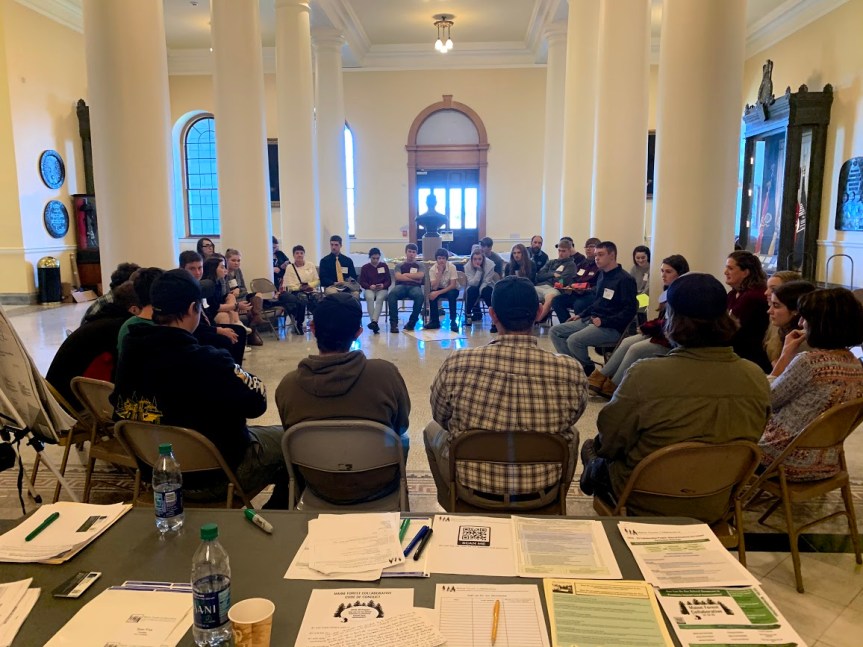
Maine students from rural communities came to the Maine State Capitol last week as part of a unique learning opportunity offered by The Maine Forest Collaborative. The collaborative, created and administered by the Rural Aspirations Project, is a cooperative of rural schools embedded in forest industry communities in rural Maine, which aims to give students in rural communities the opportunity to develop deeper connections to their community through participating and contributing in ways that make it stronger.

In its first cohort, with around 30 students participating last week, there were students from Buckfield, Forest Hills, Jackman, and Greenville, and more on deck to start in the next semester. The learning opportunity provides students with a three-unit curriculum: Identifying Challenges, Rapid Prototyping Solutions, and Investigating Solutions. Grounded on the question, “How can we use natural resources to positively impact local communities,” the lesson invites students to work together to identify challenges that their community is facing, and then find solutions to those challenges by using resources available within the community.

The second unit, Rapid Prototyping Solutions, is what students were working on last week at the Maine State Capitol’s Fall of Flags. The location was chosen as a way to raise awareness about the project, but also to show participating students the impact they have on decision making at the State level, as they work among lawmakers and politicians who grapple with many of the same challenges and problem solving, whether they are rural and community-based or State level.

Students started the day by presenting the story of their community, with posters they made ahead of time. Their presentations included information about the geography of their community, the natural resources present, who they are, what is amazing about their community, their hopes and dreams, and questions they still have. After the presentations, they began working in groups to identify challenges, pick a challenge to work on, and brainstorm a solution to that challenge. Maine forest industry professionals were also present to help facilitate the group work and lend a helping-hand.  lending their years of work experience in Maine’s forest industry with Maine’s many natural resources.

Students left the State House last week with a deep appreciation for not only their own community, but for their rural neighbors was well. They also got to participate in an interdisciplinary, project-based learning experience that strengthens their connection to their own community and the State as a whole, and aims to tackle a community challenge that they care deeply about.

Following last week’s lesson, students will embark on unit three, which will identify the economic, environmental, and social impacts of the solution they came up with, and they will also make a plan to communicate the solution to the public.

For more information about the Maine Forest Collaborative, the curriculum, or how to participate in this unique learning opportunity, please contact the Rural Aspirations Project.

Open Comment Period for Required Civil Rights Data Collection Revisions: Closes November 18!

The Maine Department of Education has just learned that the United States Department of Education (USED) has released proposed revisions to the data required as part of the Civil Rights Data Collection (CRDC), and that the comment period for the proposed revisions closes on Monday, November 18.  We wanted all school administrative unit (SAU) and school leaders, and any other interested parties, to be aware of this open comment period, and to have the opportunity to review the proposed revisions and provide feedback directly to the  USED.

The most clear documentation of changes we could find are located at the following link or by entering:

https://www.regulations.gov/document?D=ED-2019-ICCD-0119-0003

In particular, the files titled Data Groups, Data Categories and Directional Categories provide references to the proposed changes and new expectations for data submission by SAUs and schools.

Get to know the Maine DOE Team: Meet Debbie Violette

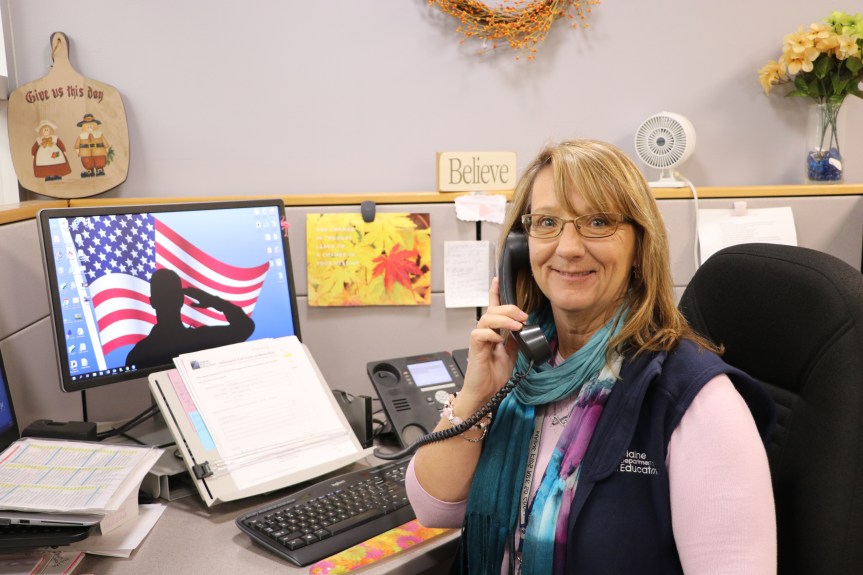
Maine DOE team member Debbie Violette is being highlighted this week as the part of a Get to know the DOE Team campaign! Learn a little more about Debbie in the brief question and answer below.

What are your roles with DOE? 

My job is to greet the public with a smile and gratitude, provide customer service to the public, scan home school applications, collect daily education news clips for Department staff, answer the Department’s 4-line switchboard, and direct our customers to the specialists that will best answer their questions. I also receive shipping and deliveries, maintain conference rooms, and have served as MSECCA (Maine State Employee’s Combined Charitable Appeal) Team leader for the past 15 years.

What do you like best about your job?

Decorating our lobby to make it a warm and inviting place for our public and the best place to work in Maine.  I’m a people person and love the days that are super busy, learning more and more about myself and the confidence that I have when answering questions after being here almost 32 years.

How or why did you decide on this career?

My mom was an educator in the Augusta School Dept. for 25 years and taught 2nd grade.  She held a regular education degree, but taught several levels of reading to the individuals with disabilities, too. I was always in her classroom during school summer breaks helping her get ready for the next group of young children to enter her door. I never realized that I had chosen this career in my early years of high school when I took all 4 years of business classes for secretarial work.  So here I am doing what my high school prepared me for: an administrative assistant for the Maine DOE, the way learning should be.

What do you like to do outside of work for fun? 

I like gardening, decorating my home, camping, knitting, swimming, bowling, and cooking.  I like to take a recipe and make it my own and I like knitting for charity events such as the Alfond cancer center for chemo patients. I am also deacon and greeter of the Manchester Community Church.

WCC Washington County Educator Profile: Mary Anne Spearin

Submitted by Sarah Woog, Executive Director at Washington County Consortium.

Meet Mary Anne Spearin, Principal of Calais High School

I first met Mary Anne when we were Middle School teachers together at Indian Township School. We connected pretty quickly, and would often share our books, our ideas, our practices, and our struggles. It was clear the way Mary Anne engaged with me as her colleague was not accidental or incidental. Mary Anne, then and now, has professional habits learned and practiced over time. Life-long learning and commitment to personal and professional growth are essential values that define how she teaches, how she leads, and how she engages with colleagues. I asked Mary Anne if I could interview her for a profile because I wanted to understand how she developed these habits, and how they impacted her steep trek up the professional ladder, from Ed. Tech, to teacher, to principal. 

Mary Anne began her career in education as an Ed. Tech I at Charlotte Elementary School. She had previously substituted in schools and had about 2.5 to 3 years of coursework behind her. Once an Ed. Tech at Charlotte Elementary, she gained two invaluable mentors, who served to push her, help her expand her vision of what is possible, and to understand professional growth as a welcome and wonderful professional responsibility. These mentors, Principal Peggy White, and Teacher Ann Luginbuhl supported Mary Anne in deciding to go back to school and she began accessing coursework at the Washington County Community College. They also encouraged her to learn and grow outside of the coursework and fostered a supportive community of educators who learned and grew together. Mary Anne soon went from Ed Tech I to Ed Tech III and began to believe she could become a teacher. When a teacher was out for medical leave, Mary Anne stepped in as a long term substitute, and realized that not only could she be a teacher, but that she loved it too. She enrolled at the University of Maine at Machias and finished her Bachelor’s degree in 2007, ten years after she first stepped into the classroom as an Ed Tech.

Mary Anne caught the learning and growing bug. Charlotte Elementary Principal Peggy White tapped her to start a Master’s cohort together immediately after Mary Anne finished her Bachelor’s degree, which they completed two years later, in 2009. Soon thereafter, Mary Anne was at it again, and completed a Certificate in Advanced Graduate Study (CAGS) from the University of New England. With this degree, Mary Anne also became a certified principal in 2011. She didn’t stop there, and she hasn’t stopped yet. Mary Anne participated in Educate Maine’s Education Leadership Experience Beta Class  in 2012/2013, and achieved her Superintendent’s certification in 2017. To this day, Mary Anne continues to engage in educational learning communities and still lends me books (and advice and support, too).

I admire Mary Anne. She is clearly admirable. I’m grateful she is my friend and colleague and I know a lot of other educators and students who are grateful for her too. She is a model of ambition and growth, collegiality and camaraderie. But Mary Anne’s career trajectory also imparts some important lessons we can all stand to gain from. I asked her what she attributes her trajectory and success to. First, she said, she attributes it to her colleagues, supervisors and administrators who supported her professional growth. Let’s be those colleagues. Second, she attributes it to the lesson she learned from Peggy and Ann, “that there is no finish line.” Let’s share that lesson with our students and in our professional communities. And, last, to an understanding she’s developed over time: “If we are going to work in education, we need to support education.” Let’s be those supporters. Let’s also take moments to express gratitude to those who have supported us along our paths, too. Thank you, Mary Anne, for giving me what others gave to you.