Get to Know the Maine DOE Team: Meet Emily Doughty

Maine DOE Team member Emily Doughty is being highlighted this week as part of the Get to Know the Maine DOE Team. Learn a little more about Emily in the brief question and answer below.

What are your roles with DOE?

As the Educator Effectiveness Coordinator, I work closely the Higher Education and Educator Support Services Team on initiatives related to educator recruitment, retention, and recognition.  This includes overseeing Rule Chapter 180, collaborating with Higher Education partners, fostering opportunities for leadership development, strengthening mentor programs, and acting as a Department liaison for a variety of educator recognition programs (Maine Teacher of the Year, Milken Educator Award, RISE Award, and Educator Talent Pool).

What do you like best about your job?

While there are many aspects of my work that I love, my favorite has been the opportunity to meet so many educators and educational advocates over the past few years.  It has been an absolute pleasure learning from colleagues, teachers, support staff, school leaders, higher education faculty, and community partners.  I firmly believe that education should not happen in a silo and that the best outcomes for students come when everyone is working toward a common goal. I have a deep appreciation for the work that those in the field do each day to support Maine students.

What do you like to do outside of work for fun?

In a normal year, I would spend my spare time being a tourist in my own state.  As someone who moved to Maine from “away”, I still have so much of the state that I have yet to see!

While I have remained closer to home this year, I enjoy spending time with my husband, tending to our garden, hiking new trails, frequenting farmer’s markets, playing backyard volleyball, and visiting my grandparents on Damariscotta Lake.

MEDIA RELEASE: Maine FrontLine WarmLine Now Available to Support Maine School Staff

To support Maine school staff, Mills Administration announces expansion of support line for Maine’s frontline workers on World Teacher’s Day.

The “Maine FrontLine WarmLine” is now expanding its services to include Maine’s educators and school staff. The Maine FrontLine WarmLine is a phone support service that provides Maine’s essential health care workers, first responders, and now school staff with help in managing the stress of providing essential services during our fight against the COVID-19 pandemic.  The volunteers help callers address concerns with anxiety, irritability, poor sleep, grief or worry and, if needed, connect them with additional supports.

The FrontLine WarmLine is staffed by volunteer professionals activated through Maine Responds, which includes licensed psychiatrists, psychologists, clinical counselors, social workers, and nurse practitioners, and has now been expanded to include retired teachers and educators. It launched in April as a joint effort of the Maine Department of Health and Human Services (DHHS), Maine Department of Public Safety’s Emergency Medical Services (EMS), Maine Association of Psychiatric Physicians, Opportunity Alliance, Maine Psychological Association, and the Maine Chapter of the National Association of Social Workers. The Maine Department of Education, the Maine Education Association (MEA), and MEA Retired now join the collaboration to expand the service to school staff, including educators, school administrators, and school staff in facilities, transportation, and food services, among many others.

“As the daughter of a school teacher, I have seen firsthand the hard work and dedication that this profession requires,” said Governor Janet Mills. “While our educators deserve thanks and support every day, it is fitting that on World Teachers Day we expand Maine’s FrontLine WarmLine to provide an additional resource to the school staff who are serving Maine students.”

The FrontLine WarmLine is available from 8 AM to 8 PM, 7 days a week by calling (207) 221-8196 or Text the word “frontline” to 898-211 for support.

“On World Teachers Day, we recognize the heroic efforts and daily miracles that are occurring in our schools” said Commissioner Pender Makin.  “The faculty and staff who are serving the students of Maine are facing unprecedented challenges, and the warmline can offer a listening ear and support to those heroes in the classrooms, the cafeterias and on the buses. We cannot thank you enough for all you are doing.”

As Maine’s schools have returned to serve our children, families, and communities, they also have faced multiple challenges during the COVID-19 pandemic. Teachers and school staff are working tirelessly to provide education and support services to children across Maine.  The work of providing these services during the COVID-19 pandemic can take an emotional toll on those who are juggling their own families, the creation of multiple curricula, nutrition programming, providing social emotional support, cleaning and other facilities needs, and transportation to and from school, among the multiple other support services that students receive at school. It is equally imperative that they are provided with support and resources to continue in their professions. Starting today educators and school staff are encouraged to call the Maine FrontLine WarmLine at (207) 221-8196 Text the word “frontline” to 898-211 between 8 AM to 8 PM, 7 days a week.

“Maine’s first responders, health care providers and school staff face significant stress as they serve on the front lines of this pandemic,” said Dr. Jessica Pollard, director of the DHHS Office of Behavioral Health. “The FrontLine WarmLine is here to support them in taking care of themselves as they care for so many others.”

“Our educators are rising up to deal with the many difficulties our schools are facing now,” said Grace Leavitt, President of the Maine Education Association. “They are working even harder than ever before to support Maine’s students in their continued learning.  This program can go a long way in helping to support our educators as they confront the ongoing challenges that COVID-19 has caused.”

The FrontLine WarmLine is a central component of the Office of Behavioral Health’s StrengthenME program, which supports mental health and resiliency in response to the COVID-19 pandemic.

For those who are not health care workers, first responders or school staff but are experiencing emotional distress, several other 24/7 resources are available:

  • Statewide Crisis Line: 888-568-1112
  • Intentional Peer Support Warmline to speak with staff who have lived experience with mental health conditions: 866-771-9276
  • Suicide Hotline: 800-273-TALK (800-273-8255)
  • 211 and 211maine.org can provide general COVID-19 information, including how to access behavioral health and social service resources
  • Maine DHHS Office of Behavioral Health resources guide

Resources for Celebrating Indigenous People in Schools

In recognition of Indigenous People and the upcoming Indigenous Peoples’ Day holiday, the Maine Department of Education (DOE) is sharing resources and information that educators and schools can use to integrate Native American history and culture into classrooms and school activities to celebrate Indigenous Peoples’ Day and to teach and honor our native culture year round.

Indigenous Peoples’ Day is celebrated across the United States on the second Monday in October, this year the holiday will be celebrated on October 12th.

The Maine DOE has continued to expand a collection of Maine Native American Resources that are available on its website including robust historical and cultural information that honor Native Americans, as well as resources that will help guide discussions about Indigenous Peoples and Native American Culture, including how to celebrate Indigenous Peoples’ Day in and outside of the classroom.

Maine DOE Update – October 2, 2020

From the Maine Department of Education


Reporting Items

Webinar to Assist with October Student Data Submission

To assist those who are responsible for the important task of reporting October student data to the Department of Education, the DOE Data Team will be holding a webinar on Tuesday, October 6th from 1 pm to 2 pm. | More

| Visit the DC&R Reporting Calendar |

News & Updates

Priority Notice: Maine DOE seeks public comment on waiving requirement that 21st CCLC programs operate only during non-school hours

In response to the unprecedented obstacles schools, teachers, students, and their families are facing amid the COVID-19 pandemic, the U.S. Department of Education (USDOE) has offered an additional waiver to state education agencies, pursuant to section 4201(b)(1)(A) of the Elementary and Secondary Education Act of 1965 (ESEA). | More

Mills Administration Updates COVID-19 School Health Advisory System

The Mills Administration today released a special update to its color-coded Health Advisory System that classifies counties’ relative risk of COVID-19 transmission by color, and is provided to assist schools as they continue with their plans to deliver instruction and support students safely this fall. | More

iCivics STUDENT Webinar to Discuss the 2020 Election (For Students/Classrooms Grades 3-12)

This 30-minute session is intended for your students to watch on YouTube live and submit questions as iCivics will talk about the importance of voting (even for students who are not old enough to vote) and how students can be involved. The iCivics panel will then answer questions submitted by your students. You and your students can join in and watch here  | More

Totally Trades Virtual Career Week 10/19 – 10/23

Totally Trades Virtual Career Week provides informational sessions for girls* in 8th – 12th grade who are enrolled in or interested in enrolling in a Career and Technical (CTE) program or seriously interested in the trades. Interested students can register for one or more of sessions as part of the first virtual Totally Trades! | More

Get to Know the Maine DOE Team: Meet Emily Poland

Maine DOE team member Emily Poland is being highlighted this week as part of the Get to Know the Maine DOE  Team Campaign. Learn a little more about Emily. | More

Maine Schools Sharing Success Stories

| Submit your Maine School Success Story |

Professional Development & Training Opportunities

Fulbright Forum Celebrating Global Education: Focus on K-12 Teachers, Higher Education, and Teacher Exchanges

October 24, 2020 is the 75th anniversary of the founding of the United Nations, and 2021 will also be the 75th anniversary of the Fulbright Program! What a perfect opportunity to focus on a segment of our alumni and friends who have been recipients of awards that target support of global education, distinguished achievement in the realm of teaching, and international teacher exchange, such as Distinguished Awards in Teaching (DAT), Teachers for Global Classrooms, and English Teaching Assistant (ETA). | More

| Visit the Professional Development Calendar |


Latest DOE Career/Project Opportunities

View current Maine Department of Education employment opportunities here

RSU 16 Gets Creative to Offer In-Person Adult Ed Graduation

Maine Adult Education programs are working hard through the COVID-19 Pandemic to help students meet their goals. That’s why RSU 16 planned an end of summer graduation ceremony to celebrate the accomplishments of their Adult Education students. In a short, in-person, socially distanced graduation on August 6th the program was able to honor 8 out of 13 of their graduates.

While a group picture is not necessarily easy to accomplish, the staff at RSU 16 made a picture collage to memorialize the event for years to come.

This story was submitted by Jenny Rose, RSU 16 Adult Education Director and McKinney Vento Homeless Liaison as part of the Maine Schools Sharing Success Campaign. To submit a story or an idea please email Rachel rachel.paling@maine.gov.

MEDIA RELEASE: Mills Administration Updates COVID-19 School Health Advisory System

Oxford and York counties remain yellow, all other counties remain green

AUGUSTA — The Mills Administration today released a special update to its color-coded Health Advisory System that classifies counties’ relative risk of COVID-19 transmission by color, and is provided to assist schools as they continue with their plans to deliver instruction and support students safely this fall.

As previously announced, the Maine Department of Health and Human Services (DHHS) and Center for Disease Control and Prevention (CDC) reassessed York, Oxford and Androscoggin counties one week early due to recent, concerning trends. Based on this assessment, York and Oxford counties remain yellow, and Androscoggin County remains green. All sixteen counties will be reassessed in one week.

While still elevated compared to other counties, both the two-week positivity rates and case rates in York and Oxford counties were slightly lower this week, compared to last week.

Androscoggin County will continue to be monitored closely. Cases continue to rise but the county’s positivity rate is relatively low at 0.9%.

Maine’s other 13 counties remain green.

Under the “yellow” designation, which indicates an increased (moderate) level of community risk, schools may consider additional precautions, such as limiting numbers of people in school buildings at the same time, suspending extracurricular or co-curricular activities including competitions between schools, limiting interaction through cohorting, or other measures based on the unique needs of each school community.

These designations are made out of an abundance of caution and for the consideration of school administrative units in their decisions to deliver instruction.

It is essential that school districts across the State of Maine continue to implement plans that adhere to the six requirements for returning to in-person instruction, regardless of their county’s red, yellow, or green designation:

Symptom Screening at Home Before Coming to School (for all Staff and Students) – Students (parents/caregivers) and staff members must conduct self-checks for symptoms prior to boarding buses or entering school buildings each day.  Schools should provide information to families in their primary language to support them in conducting this check.   Any person showing symptoms must report their symptoms and not be present at school.  Schools must provide clear and accessible directions to parents/caregivers and students for reporting symptoms and absences.

Physical Distancing and Facilities – Adults must maintain 6 feet of distance from others to the extent possible. Maintaining 3 feet of distance is acceptable between and among students when combined with the other measures outlined in this list of safety requirements.  6 feet of physical distancing is required for students while eating breakfast and lunch, as students will be unable to wear masks at that time.   A “medical isolation space” (separate from the nurse’s office) must be designated for students/staff who exhibit COVID-19 symptoms during the school day. Adequate ventilation is required for classrooms, with schools having flexibility in implementation such as using properly working ventilation systems or outdoor air exchange using fans in open windows or doors. Groups in any one area, room, or classroom must not exceed the Governor’s gathering size limits.

Masks/Face Coverings – Adults, including educators and staff, are required to wear a mask/face covering. Students age five and above are required to wear a mask/face covering that covers their nose and mouth.  Masks are recommended for children ages two to four, when developmentally appropriate. Masks/face coverings must be worn by all students on the bus. Face shields may be an alternative for those students with documented medical or behavioral challenges who are unable to wear masks/face coverings. (Updated 8/12/20). The same applies to staff with medical or other health reasons for being unable to wear face coverings. Face shields worn in place of a face covering must extend below the chin and back to the ears. An exception for wearing a mask or face shield applies only to an individual participating in voluntary school sports during vigorous physical exercise. (Updated 09/09/20). Nothing in this framework’s mask/face covering requirements should be interpreted as preventing a school from making accommodations on an individualized basis as required by state or federal disabilities laws.(Updated 9/15/20)

Hand Hygiene – All students and staff in a school must receive training in proper hand hygiene. All students and staff must wash hands or use sanitizing gel upon entering the school, before and after eating, before and after donning or removing a face mask, after using the restroom, before and after use of playgrounds and shared equipment, and before and after riding school transportation.

Personal Protective Equipment – Additional safety precautions are required for school nurses and/or any staff supporting students in close proximity, when distance is not possible, or when student require physical assistance. These precautions must at a minimum include eye protection (e.g., face shield or goggles) and a mask/face covering. Classrooms and/or areas that have been used by an individual diagnosed with Covid-19 must be closed off until thorough cleaning and sanitization takes place.

Return to School after Illness – Sick staff members and students must use home isolation until they meet criteria for returning to school.

The Health Advisory System categorizations are defined as follows:

  • RED: Categorization as “red” suggests that the county has a high risk of COVID-19 spread and that in-person instruction is not advisable.
  • YELLOW: Categorization as “yellow” suggests that that the county has an elevated risk of COVID-19 spread and that schools may consider additional precautions and/or hybrid instructional models as a way to reduce the number of people in schools and classrooms at any one time.
  • GREEN: Categorization as “green” suggests that the county has a relatively low risk of COVID-19 spread and that schools may consider in-person instruction, as long as they are able to implement the required health and safety measures.  Schools in a “green” county may need to use hybrid instruction models if there is insufficient capacity or other factors (facilities, staffing, geography/transportation, etc.) that may prevent full implementation of the health and safety requirements.

The county-level assessments are based on both quantitative and qualitative data, including but not limited to recent case rates, positivity rates, and syndromic data (e.g., symptoms of influenza or COVID-19). Those data are publicly posted every week on the Maine CDC website. DHHS and Maine CDC also consider qualitative factors, such as the presence of outbreaks that may potentially affect school-age children.

The Health Advisory System reflects ongoing analysis of evolving data, and serves as one piece of information that school and district leaders can use to make decisions about how to deliver education this fall. The qualitative and quantitative considerations and data used by the CDC in determining community transmission risk levels for schools can be located here: How County Risk Levels for Maine Schools are Determined

The Health Advisory System can be found on the Maine DOE website in Part I of the Framework for Reopening Schools and Returning to In-Person Classroom Instructionhttps://www.maine.gov/doe/framework/part-I.

The next update is scheduled for Friday, October 9, 2020.

###

Totally Trades Virtual Career Week 10/19 – 10/23

Totally Trades Virtual Career Week provides informational sessions for girls* in 8th – 12th grade who are enrolled in or interested in enrolling in a Career and Technical (CTE) program or seriously interested in the trades. Interested students can register for one or more of sessions as part of the first virtual Totally Trades! Career Week. Students that are learning in-person at a school and want to attend a morning session, should ask a Guidance Counselor, CTE, or other school staff person about taking time from their schedule and accessing a computer to attend. There are no fees to attend!

*workshops are for self-identifying girls and gender expansive youth

Bridge and Highway Building

Monday, October 19

This session will focus on trades such as carpenters, laborers, and heavy equipment operators.  The Maine Department of Transportation and others will be on hand to provide information about growing jobs, apprenticeships, and careers.

9:00 – 10:30 AM REGISTER HERE

6:00 – 7:30 PM REGISTER HERE

Communications Technology

Tuesday, October 20

This workshop will focus on career opportunities in the technology field, from cable installation to design. Local professionals will talk about their own experiences working in this sector, the training required for different types of technology-related jobs, and the steps you can take to pursue a career in the field.

9:00 – 10:30 AM REGISTER HERE

6:00 – 7:30 PM REGISTER HERE

Automotive Trades

Wednesday, October 21

Explore the typical workday of a female Certified Auto Technician. Learn about the many types of work in the Automotive Trades.

9:00 – 10:30 AM REGISTER HERE

6:00 – 7:30 PM REGISTER HERE

Public Safety Careers

Thursday, October 22

From Police Officers and Firefighters to EMTs and Paramedics the Public Safety field is vast with a number of career paths available to those looking to serve and protect. Join us as we explore the work, life, and experiences of a Police Officer, Firefighter, and Paramedic.

9:00 – 10:30 AM REGISTER HERE

6:00 – 7:30 PM REGISTER HERE

Building Trades

Friday, October 23

There is more to building trades than construction. In this workshop, you will learn about several factors that go into a build project – from engineering principles to electrical wiring, project management and so much more!

9:00 – 10:30 AM REGISTER HERE

4:00 – 5:30 PM REGISTER HERE

FMI contact Suzanne at 768-9635 or senechal@maine.edu OR visit our website. We are also on Facebook and Instagram @totallytrades.

Thank you to our Major Sponsors:

Maine Department of Transportation
Maine Department of Education

Get to Know the Maine DOE Team: Meet Emily Poland

Maine DOE team member Emily Poland is being highlighted this week as part of the Get to Know the Maine DOE  Team Campaign. Learn a little more about Emily in this brief question and answer.

What are your roles with DOE?

Officially my role as School Nurse Consultant is to provide state-level leadership and professional development to school nurses. I also liaison with organizations that are involved with Comprehensive School Health and Nursing, and inform the public of rules and statutes related to school health services.

What do you like best about your job?

What I love most about my job is working directly with nurses from all over the state. School nurses can sometimes feel pretty isolated as they are frequently the only healthcare professional in a school. Being able to connect with them and connect them to each other is very rewarding as they support all of our Maine students.

How or why did you decide on this career?

I started working in a hospital setting as an RN many years ago and gave school nursing a try because I wanted a change. School nursing is such a unique profession and I haven’t looked back since. Having the opportunity to work at the state level to promote best practices, plan professional development, advocate for safe and competent care for all students has been an amazing challenge.

What do you like to do outside of work for fun?

I enjoy  time with my family, knitting, reading, gardening, and spending outside in our beautiful state.

How Ashland District School has Adapted to Make Music Education a Priority

By Jonathan Simonoff, Visual and Performing Arts Chair for Ashland Community School

The Ashland District School (MSAD 32) music program tried really hard to keep a positive outlook during these difficult times. Instead of thinking “It’s too bad we can’t do this,” we tried to frame it as, “How great is it that we get to do this now?” We looked at our goals for each part of our Pre-K – 12 curriculum and tried to identify ways to still reach these goals in a safe but engaging environment. For some classes those changes were minimal but other parts of the program had a drastic overhaul.

For example, the youngest elementary grades have not changed much but some parts of instruction are being recorded so that vocal and instrumental songs can still be shown to the students. Those classes are also being taught in each grade’s homeroom now.

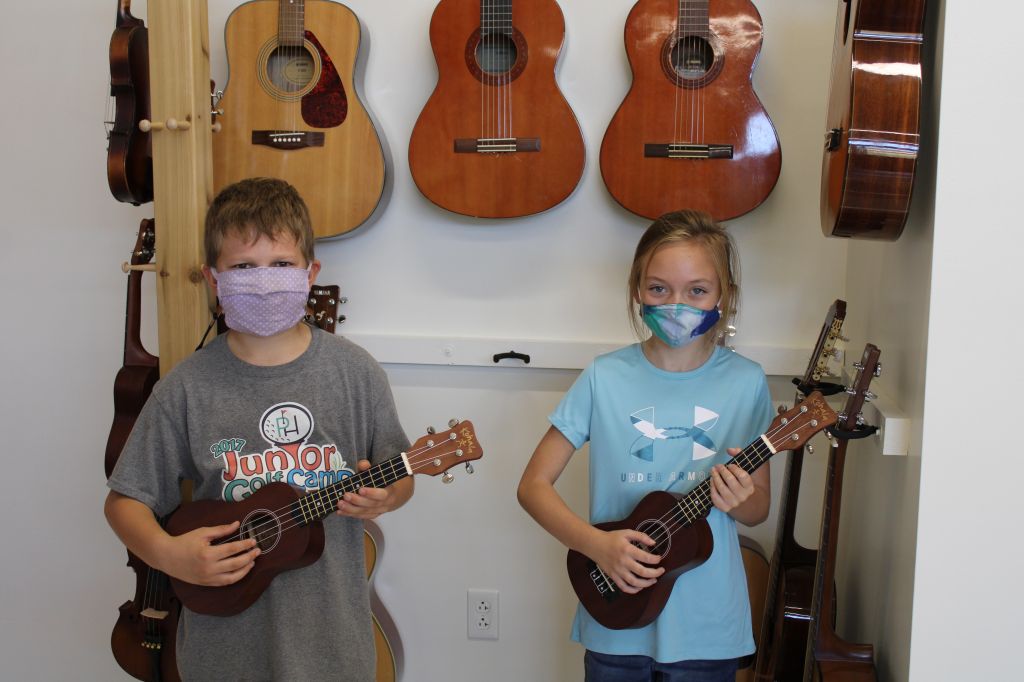
In the past, 4th grade students would use recorders as part of pre-band lessons. This year we are using ukuleles to try to hit upon these concepts. Each student has a ukulele they get to use in class that is sanitized after.

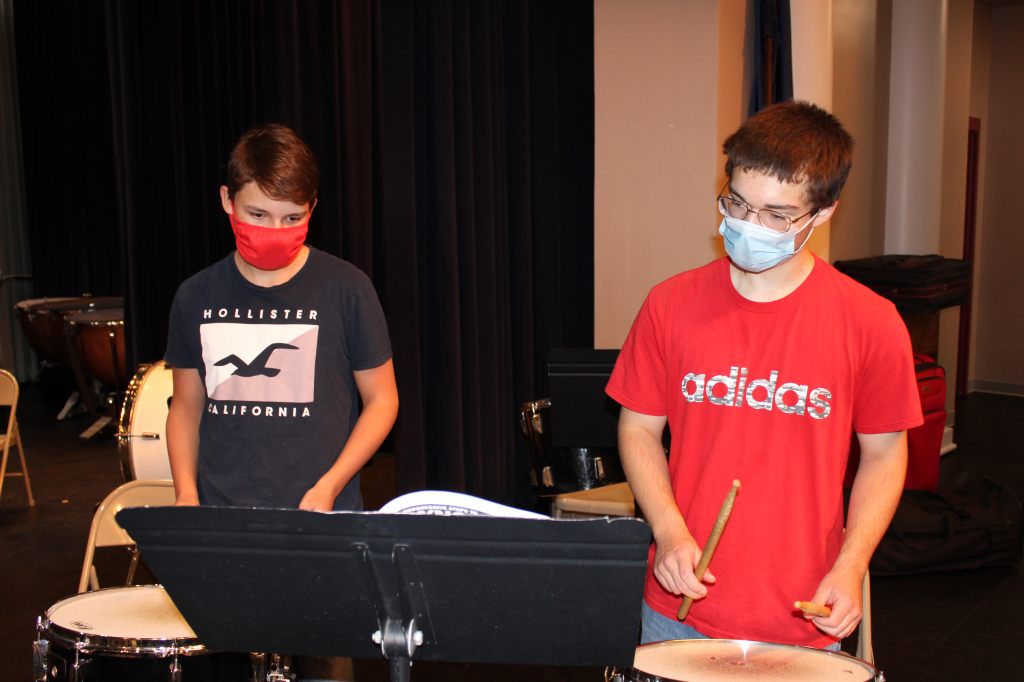
Our beginning band students have also seen a significant change. Since we are not starting any students on traditional band instruments, we have made use of keyboards and drum pads. The class has been put into groups and each student in 5th grade gets a weekly small group lesson on keyboards for note reading skills and drum pads for extra rhythm reinforcement. We are in week 3 of these lessons and so far, every kid is reading and playing very well. I do remind them that they will get a chance to try the band instrument they want but these skills will help them later.

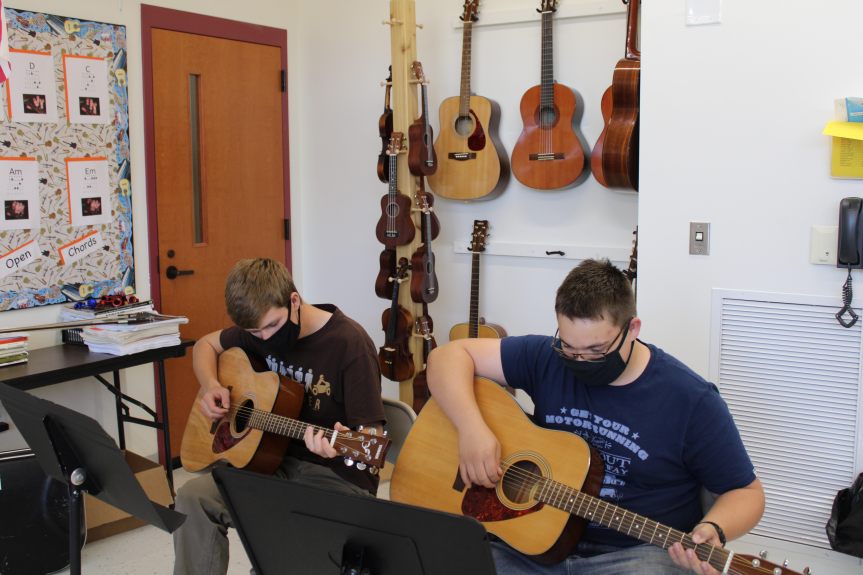
Last year our middle school students usually would have the option of signing up for middle school guitar class or middle school band. This year the guitar class is still an option and the other class they can sign up for is middle school percussion, which focuses on reading and playing rhythms on a variety of traditional and non-traditional percussion instruments.

Perhaps the groups that have changed the most this year are my high school classes. Normally high school students would have the option of taking guitar class or high school band. The guitar class is still running as normal but high school band has changed significantly.

My ed. tech and I have developed an alternating multi-course option for my high school students. We rotate courses every other day and students were able to sign up for one course each day. The courses offered as follows – Piano Class, Percussion Class, Strings Class, Rock Band, Independent Study, or 1 study hall. For example, a student could take piano one day and strings the other day and they follow that schedule for at least a semester before potentially changing their courses.

The classes are pretty self-explanatory.  Piano class (a very popular choice) is like a group piano lab. Percussion class has students spending time practicing rhythms and working on drum set techniques. Strings class is teaching students violin. Rock band (another popular choice) has students working with guitar, bass guitar, piano, and drum set to play modern music and independent study allows students to set up and achieve their own musical goals with check-ins with me to track their progress and give advice. For example, I have a few students working on playing the ukulele and using online guides to help them. I also have some students working on creating their own compositions. Study hall is a chance for students catch up on their other academics.

This set up comes with the understanding that students need to be self-motivated and disciplined since some of the time in class they are expected to work independently while myself or my ed. tech are working with other students. It has been very rewarding both for students and teachers to see progress being made and finding new ways to connect with and learn about music.

It also has been a lot of work to set up in terms of making sure we have enough keyboards and violins. We also are writing some of the music out by ear for students (particularly the Rock Band) to perform. But now that we are a month into school, things seem to be moving along nicely and I am very happy with how this year is shaping up!

This story was submitted by Jonathan Simonoff, Visual and Performing Arts Chair for Ashland Community School in collaboration with Jason Anderson, Visual and Performing Arts Specialist for the Maine DOE as part of the Maine Schools Sharing Success Campaign. To submit a story or an idea email it to Rachel at rachel.paling@maine.gov.

iCivics STUDENT Webinar to Discuss the 2020 Election (For Students/Classrooms Grades 3-12)

On Friday, October 2 at 10am join Joe Schmidt (Social Studies Specialist MDOE) as he hosts an iCivics panel to discuss Getting from “Can’t Vote. Don’t Care” to “Count Me In”: Youth Engagement in a Presidential Election.

This 30-minute session is intended for your students to watch on YouTube live and submit questions as iCivics will talk about the importance of voting (even for students who are not old enough to vote) and how students can be involved. The iCivics panel will then answer questions submitted by your students. You and your students can join in and watch here – https://youtu.be/Kx-85ZlJqPg. The comments section will be turned off so questions will be collected ahead of the webinar.

This form can be shared with your students or collect your student questions and submit on their behalf. This session will be recorded and available for asynchronous viewing at a later time.

Contact Joe Schmidt (joe.schmidt@maine.gov) with any of your questions.