The Alternative Education Association (AEA) of Maine is excited to announce a Fall Conference on November 9th at the University of Maine Augusta from 9:30 am – 1:30 am with the theme, “Circle Up!”
The AEA Fall Conference will be based on circle discussions at tables with different themes, where you can sit and have conversations with your colleagues about those topics you are most interested in. This is an excellent opportunity for you to network with others who do the unique work we all do in alternative education in Maine.
Details –
Cost: The Fall Conference is $50 and the Spring Conference will once again be $125. You can register for them separately or you can register for both at the discounted cost of $150. (If for some reason you cannot attend the Spring Conference we will reimburse you the $100)
Date and Time: November 9th, 9:30-1:30 (Lunch will be provided and is included in the cost)
Location: University Maine Augusta, Fireside Lounge in Randall Hall
The AEA of Maine recognizes there is frequent turnover in teachers. If you have an Alternative Educator in your district who would like to be included in Alternative Education news and updates, please forward their name and email address to Lenny Holmes at lholmes@bonnyeagle.org
As part of the scheduled periodic review of the Maine Learning Results, the Maine Department of Education is seeking public comments regarding the proposed revisions to the social studies standards and the science standard in Rule Chapter 132. These comments will inform the continued work of the standards revision teams and are an integral part of the rulemaking process.
This proposed rule revision is part of a periodic review of the Maine Learning Results as required under 6209, subsection 4. The science and social studies standards were last reviewed and revised in 2018.
The rulemaking process began in the summer of 2023 with the science and social studies standards steering committees, which are composed of content area experts who represent the cultural diversity found in Maine and a range of viewpoints as to the content of the standards. These groups met and reviewed all the comments submitted and developed a blueprint for the revision of the state science and social studies standards. Following that process, groups of writing teams, representing prek-12 teachers, met and revised the current standards.
The proposed revisions focus on elements outlined in the Science and Social Studies content areas. No other aspects of the Learning Results were modified in any way.
This process was completed according to Title 5, Section 8051-B regarding consensus-based rule development process.
As required by law, a period of public comment will be open October 11, 2023 through November 14, 2023. Written comments may be submitted to DOE Rulemaking Liaison Laura Cyr, State House Station #23, Augusta, Maine 04333; 207-446-8791 or laura.cyr@maine.gov until 5:00 pm November 14, 2023. For documentation purposes, written comments are preferred.
In addition, a public hearing for the revised social studies and science standards in Rule Chapter 132 will be held in person and virtually on October 30, 2023, from 3:00 pm to 5 pm at the Burton Cross Office Building, located at 111 Sewall Street, Augusta, Maine 04333, Room 600. As space will be limited, participants are encouraged to attend virtually through Zoom, using this link:
Topic: Rule Chapter 132 Public Hearing
Time: Oct 30, 2023 3:00 pm Eastern Time (US and Canada)
The Maine Department of Education (DOE) invites students, friends, families, community members, educational organizations or associations, co-workers, and supervisors to nominate school employees for the Recognizing Inspirational School Employees (RISE) Award. Nominate today by clicking here.
The RISE Award is a federal award, passed by Congress and overseen by the U.S. Department of Education, intended to honor and promote classified school employees who provide exemplary service. Nominees must demonstrate excellence in: work performance; school and community involvement; leadership and commitment; local support (from co-workers, school administrators, community members, etc. who speak to the nominee’s exemplary work); and enhancement of classified school employees’ image in the community and in schools.
A classified school employee is defined as an employee who works in any of the following school roles: ed tech, clerical and administrative services, transportation services, food and nutrition services, custodial and maintenance services, security services, health and student services, technical services, and skilled trades (pre-kindergarten through high school).
The Maine DOE will put forth up to two finalists to the U.S. Department of Education which will select one finalist from across the nation to inspire excellence among classified school employees around the nation.
Last school year’s state finalist was Southern Aroostook Community School Administrative Assistant Elaine Small for the extraordinary contributions she has made to students, educators, and the community. Whether it’s spearheading fundraisers to support students’ post-secondary aspirations, participating in community events, providing support to a variety of staff, or working alongside colleagues to coordinate bus routes, Small makes a huge impact each day on the students and staff around her. Read more about Small here.
The deadline to submit a nomination is October 20, 2023. Nominate today by clicking here. Anyone can nominate!
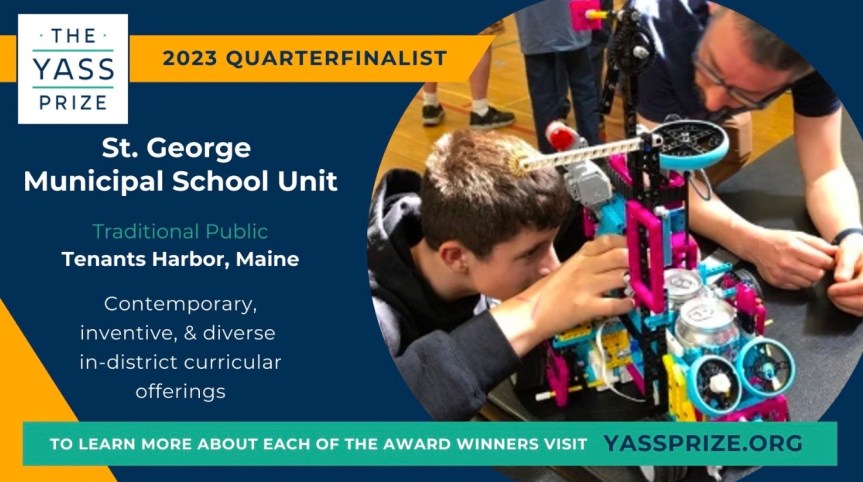
St. George Municipal School Unit (MSU) was recently selected as one of the 32 national semifinalists for the national Yass Prize, recognizing the “contemporary, inventive, and diverse in-district offerings” provided by St. George School. The small, rural St. George School was chosen among nearly 2,000 applicants representing 27 million students from every sector in education and every grade across all 50 states. Other applicants for the prize included private schools, education technology companies, national school networks, and educator recruitment programs.
The Yass Prize is a national competition with a mission “to identify and support more best-in-class education providers who can tackle the big education challenges of the day and deliver an education for students that is Sustainable, Transformational, Outstanding and Permissionless.” As a semifinalist, the school receives $200,000, and the grand prize is $1,000,000.
The school was selected first as a quarterfinalist and now as a semifinalist because of its innovative CTE/Makerspace Project, a partnership between St. George MSU and Mid-Coast School of Technology (MCST) to construct a PreK–8th grade Career Technical Education (CTE)/Makerspace building. The new building will include a shop space for boatbuilding, woodworking, and metalwork as well as a Makerspace with 3D printers, laser cutters, CNC routers, robotics, and sewing machines.
“The CTE/Makerspace Project grew from the requests of teachers, parents, and community members in 2016 to bring shop back to St. George School. It connects to the legacy of the Grace Institute, a local nonprofit that provided culinary arts and shop classes to St. George students from 1936-2011,” said Superintendent Mike Felton. “It took shape as the Makerspace Initiative in 2016. And it’s rooted in the generations of St. George educators, staff, families, and community members who prioritized hands-on/minds-on learning that engaged students and connected them to their community.”
St George has also received funding from the Maine Department of Education (DOE) to support the CTE/Makerspace efforts through a Rethinking Responsive Education Ventures (RREV) grant. RREV funding is provided through the US Department of Education and has allowed Maine to invest in education innovation across the state. You can read more about RREV here.
Governor Janet Mills and Maine DOE Deputy Commissioner Dan Chuhta visited the school last spring to learn more about the project and Congresswoman Chellie Pingree selected the CTE/Makerspace Project as one of only fifteen projects her office submitted for Community Project Funding in the federal budget.
Down the road in Port Clyde, Herring Gut Science Center was chosen as a Yass Prize quarterfinalist. This year, Herring Gut received funding through the Maine DOE’s Maine Outdoor Learning Initiative, a statewide initiative created by Governor Mills to offer immersive, hands-on, outdoor learning to middle and high school students across Maine during the summer. Read more about the Maine Outdoor Learning Initiative here. Maine DOE Commissioner Pender Makin joined students at Herring Gut over the summer as they learned about coastal habitats and species.
The Maine Department of Education (DOE) is opening applications for the 2023/2024 Student Cabinet, a group of students that meet regularly with the Maine DOE and each other to discuss educational opportunities, improvements, and policy.
Facilitated by student representatives from the Maine State Board of Education, the purpose of the Student Cabinet is to provide a forum for Maine students’ voices to be heard. This is the fourth year the Maine DOE has appointed students to a Student Cabinet with the goal of integrating student voices into decision-making on education issues that impact their journey through Maine’s education system.
The Maine DOE is especially interested in having perspectives from students with diverse experiences, interests, cultures, and backgrounds represented on the Student Cabinet. It is important that the student cabinet include members from all geographical locations across Maine, and who are able to represent and advocate for underrepresented groups of students throughout Maine.
There are 12-24 seats that are open for students in grades 4 – 12 and the first year of college. The newly appointed members will serve for a term of two years starting this November. All 16 counties in Maine will be represented on the Student Cabinet.
Selected cabinet members will be expected to attend scheduled meetings, prepare for each meeting as needed, work in a collaborative manner with one another and with Department staff as needed, and express views and opinions openly, constructively, and respectfully.
Scheduled meetings:
There will be two in-person, all-day meetings scheduled in Augusta in December 2023 and Spring 2024, accompanied by monthly virtual meetings held on the fourth Thursday of the month from December 2023 through the spring of 2024 from 3:00 – 4:00 pm via Zoom. For in-person meetings, travel reimbursement will be provided and travel arrangements can also be made for students if needed.
Instructions for applying:
Students interested in serving on the Maine DOE Student Cabinet will need to submit the electronic application by November 15, 2023. Applications can be submitted electronically here.
For more information contact Rachel Paling, Communications & Outreach Manager, Maine Department of Education at rachel.paling@maine.gov.
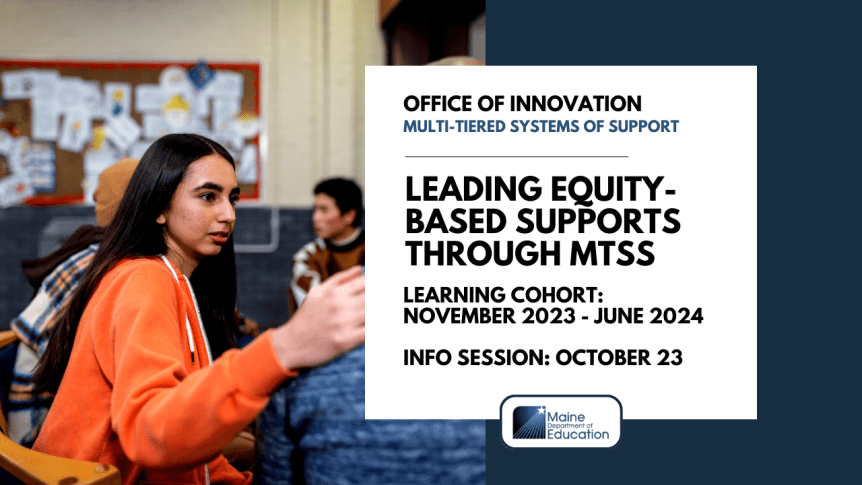
The Maine Department of Education (DOE) is thrilled to announce the launch of an innovative training program aimed at empowering school principals to champion equity-based Multi-Tiered Systems of Support (MTSS) for comprehensive student success.
Implementation of a Multi-Tiered System of Support is a requirement in Maine schools. The purpose of this learning cohort is to provide training and support to Maine school principals and related personnel with design and implementation of MTSS frameworks that provide them with the knowledge and tools necessary for addressing the diverse needs of students and to promote school and student success effectively. By adopting a schoolwide MTSS, schools can foster a culture of academic, behavior, social/mental health, and attendance support, early intervention, and data-driven decision-making, ultimately leading to improved growth and achievement rates and better outcomes for all students.
Participants in this cohort will:
Build capacity to design and effectively lead schoolwide MTSS across grades PK-12
Develop knowledge and skills to make MTSS a part of the school culture to ensure valuable work in high-leverage student supports can be blended and braided into a cohesive system of school supports that leads to long-time positive impact
Convene relevant stakeholders into MTSS leadership teams that are prepared to utilize research-based strategies for identifying areas of concern/need, assessing identified problems, selecting solutions, create targeted plans, and monitor outcomes that crosses all school domains (reading, mathematics, behavior, social and emotional/mental health, and attendance)
Explore and learn how to use a variety of MTSS implementation tools and resources that are used to assess and build readiness for MTSS implementation, assist principals in aligning initiatives and layering support for maximum impact and long-term sustainability, and facilitate the identification of existing or future barriers that may have a negative impact on the implementation of MTSS and provide action steps for removing barriers to aid in successful MTSS implementation
The MTSS cohort will take place through a hybrid of synchronous and asynchronous learning sessions from November 2023 through June 2024 utilizing both live in-person and virtual sessions including (3) in- person team-based workshop events at a centralized location to be determined and taking place on the approximate timeline of end of November 2023, mid-January 2024, and mid-March 2024. Weekly 1-hour online learning sessions will begin November 12.
For more detailed information regarding the timeline, commitment requirements, and in-person meeting location(s), please attend an online information session on Monday, October 23rd from 3:30 to 4:30.
Applications for participation will open following the informational session and will be reviewed on a rolling basis through November 1st until all slots are filled. All schools will be notified of their application status no later than November 3rd with virtual learning sessions to begin the week of November 12.
For further questions, you can reach out to Andrea Logan, MTSS Specialist, via email (andrea.logan@maine.gov) or by phone (207-592-2011) Monday through Friday from 8:00 AM through 4:30 PM.
The following is a piece from The State Education Standard, a journal of the National State Boards of Education, written by Maine State Board of Education Student Representative Ryan Hafner. Ryan is a Senior at Hampton Academy and co-chairs the Maine DOE Student Cabinet.
In the September 2022 issue of the Standard, students from the District of Columbia State Board of Education offered three ways to boost the state board’s engagement with students: including a student member seat on the board, creating a space specifically for student voice, and requiring student consultation on policy in bylaws. Inspired by what I have seen in my community, state, and state board, I want to provide a few more recommendations to encourage state leaders to support student members in their development as leaders.
Supporting student members from the start of their term leads to an environment where they feel comfortable engaging with adults when tough policy topics arise. Helping student members grow as leaders helps them better represent their peers. Programs like NASBE’s Student Engagement Collaborative and organizations like the National Student Board Member Association have provided me with spaces to build relationships with other student members, engage with subject-matter experts, and learn strategies to be more effective.
It is important to encourage students to engage with a wide variety of policymakers. I co-chair the Maine Department of Education Student Cabinet, a student-led body that regularly interacts with department staff, legislators, and other policymakers. Student involvement is a two-way street: Just as students benefit from having their voices heard and having opportunities to grow as leaders, adults benefit as well. This spring, the Student Cabinet presented on student mental health needs to Maine’s Education and Cultural Affairs Committee. They provided the legislators with a diverse set of perspectives they rarely hear in the State House.
To make sure that policymakers hear from students, it is important to break down barriers to student engagement and ensure a diverse range of voices at the table. A barrier as simple as a lack of access to transportation can make the difference between a student who is able to share a perspective and one who is not. Other barriers are more systemic, such as application processes that prioritize GPA or adult recommendations, which can leave out important and underrepresented voices. Considering whether an applicant has experienced hardship in their educational experience, is coming from a nontraditional educational model, or is a member of an underrepresented or marginalized community can also expand the number of student perspectives that policymakers can access.
While student voice has often been missing from policy discussions, the movement to engage students in education policymaking has made significant headway, with 33 states now involving more than 400 students. My experience as a board member and as the chair of a student advisory group has shown me just how important engaging students is in creating a more effective, equitable, and just education system for all. Whether it be a student-led presentation to legislators on the mental health needs of students or a conversation with policymakers on the need for a more diverse, inclusive curriculum, students can provide invaluable insights to those making the decisions that impact students the most.
The Maine Department of Education is requesting an approval by the U.S. Department of Education (USDOE) to revise its approved consolidated ESSA State Plan under the Elementary and Secondary Education Act of 1965 (ESEA). In this first phase, Maine is requesting the amendment to account for the transition to Maine’s new state general assessment, the Maine Through Year Assessment.
As part of the statutory requirements for seeking an amendment, the Maine DOE must solicit and respond to public comment as well as provide evidence of the available comment period. The Maine DOE is accepting public comment on the amendment to Maine’s Model of School Support beginning on October 12, 2023 and will conclude on October 20, 2023. Public comments regarding the amendment may be sent to ESSA.DOE@maine.gov. Any additional questions should be directed to Janette Kirk, Chief of the Office of Federal Programs at janette.kirk@maine.gov.
The key updates to the amendment to Maine’s Model of School Support includes:
The academic achievement will be measured by the annual statewide assessments in ELA/reading and mathematics using MTYA for grades 3-8 and 2nd year of high school. There is no change to Maine’s Alternate Assessment.
The academic progress will be measured by the annual statewide assessments in ELA/reading and mathematics using MTYA for grades 3-8. The fall to spring growth targets, which are grade-level and content specific, align with the 2020 NWEA MAP Growth Normative Data.
School Quality and Student Success (SQSS) indicator: Chronic Absenteeism
Maine plans to submit a second phase of amendment to its ESSA State Plan in February 2023. This submission phase will include additional revisions and changes to the SQSS indicator utilizing feedback from ESSA Stakeholder workgroup convenings.
The Maine DOE convened ESSA stakeholder workgroups after “all calls” for participants, most recently in the spring of 2021, with the specific goal of providing feedback regarding the development of updates to Maine’s ESSA Plan. Those opportunities were communicated and solicited through the DOE newsroom and priority notices (2020, 2021, 2023). Over the past 3 years, the ESSA stakeholder workgroups have continued to review and provide feedback as accountability and school support models evolve and as Maine has implemented the ESSA.
The group is geographically diverse with representation from key stakeholder groups including but not limited to Superintendents, Parents, School Teaching staff, Central Office staff, Principals, and Board Members. Each member of the workgroup advised, recommended, and provided input on elements included in Maine’s Consolidated ESSA Plan including Accountability, School Improvement, and the ESEA Consolidated Application. This group met monthly May – August 2021, and again in June and July 2023. Further opportunities for engagement will be forthcoming.
After spending the school day teaching math and sustainable agriculture at Madison Area Memorial High School, Joshua Bishop works after hours to run the school’s Extended Learning Opportunities (ELO) program. The ELO program at Madison focuses primarily on agriculture with the goal of teaching students valuable work skills while also helping to fight food insecurity in Somerset County.
One of the program’s main projects is its ELO Summer Garden which consists of multiple gardens all built from the ground up. Bishop’s students have gained agricultural work experience by maintaining these gardens and have also given back to their community. The garden’s pumpkin patch provided over 70 pumpkins for the local elementary school. Bishop and his students are also creating Bulldog Salsa and Pickles from the garden. This project builds upon their agricultural knowledge while also incorporating marketing and business skills, as they are creating a full business model for these foods.
“We are teaching students how to be employable while also giving them the ability to help them and their families’ lives by teaching them how to grow their own food,” said Bishop.
Beyond group ELOs, such as the garden, the program also offers students individual opportunities where they can earn credits through the Jobs for Maine Graduates (JMG) virtual platform called LMS. This opportunity has allowed students who need extra credits in order to graduate on time to recover those credits in a meaningful way related to their career interests. Through LMS, one of Bishop’s students was able to earn credits in geography and sustainability to complete her graduation requirements on time and also gain experience doing research in those fields.
“I love making an impact on my students’ lives,” said Bishop. “Whether it be helping them with curriculum-based skills or building transferrable skills for the real world, I aim to make an impact for each and every student.”
Bishop would like to thank Kennebec Valley Farms and Kathy Bertini from the Maine Department of Education.
Extended Learning Opportunities (ELOs) are hands-on, credit-bearing courses outside of the traditional classroom with an emphasis on community-based career exploration. These opportunities are personalized for students and help them explore options for their professional lives. They help students engage in learning through instruction, assignments, and experiential learning. The Maine Department of Education (DOE), along with state-wide partner Jobs for Maine Graduates (JMG), have made a concerted effort to provide working models, support, and funding opportunities for Maine schools to set up ELO programs within their school communities. To learn more about Maine’s initiatives with extended learning opportunities, visit: https://www.maine.gov/doe/index.php/learning/elo or reach out to Maine DOE ELO Coordinator Rick Wilson at rick.wilson@maine.gov.
Chard Teaches 3rd Grade at East End Community School in Portland and is the 2023 Cumberland County Teacher of the Year
The Maine Department of Education (DOE) and Educate Maine named East End Community School third-grade teacher Joshua Chard as Maine’s 2024 Teacher of the Year. The announcement was made during a surprise ceremony with students and educators at Chard’s school in Portland.
“Joshua Chard embodies the qualities that make Maine teachers amazing, and we’re thrilled to honor him as Maine’s 2024 Teacher of the Year. Today we celebrate Joshua’s passion for teaching, his love for his students and public education, and his ability to make each and every person feel welcome and like they belong,” said Maine Education Commissioner Pender Makin. “Colleagues, parents, and community members describe Joshua as kind, loving, passionate, generous, and someone who finds joy in the uniqueness of each human.”
Chard’s Teacher of the Year journey began in May, when he was named the 2023 Cumberland County Teacher of the Year. Along with 15 other County Teachers of the Year, Chard was selected from a pool of hundreds of teachers who were nominated. In August, he was named one of four state finalists before being selected as the 2024 Maine Teacher of the Year.
Chard is a second and third-grade looping teacher at East End Community School and the drama director at Deering High School in Portland. His approach to designing and implementing curriculum for young learners always starts through a culturally responsive lens. Joyful relationships are at the heart of everything Chard does in his classroom and he is inspired every day by the honor of lifting up and celebrating his diverse learners. During his 31-year career, he has been an educational technician, has taught fourth and fifth grade, and has been an instructional coach with a focus on mathematics. Chard is proud to teach in two of the most culturally diverse schools north of Boston, having passionately dedicated his entire career to working in high-need, urban schools, and he is excited to have a platform to share the amazing work that is happening there. Outside of school, Chard can be found participating in local theater as an actor and director and exploring Maine’s beaches and lighthouses with his husband and their grandsons.
Full Teacher of the Year Announcement Ceremony
“This recognition is about my amazing students as much as it is about me. How lucky am I to get to be inspired by these hilarious, insightful, motivated, and empathetic humans every day? They make me want to be the best teacher I can be because they deserve it, and they demand it of me. I am feeling so blessed and so seen today,” said 2024 Maine Teacher of the Year Joshua Chard.
The Teacher of the Year Program is a year-long process that involves educator portfolio and resume submissions, interviews, oral presentations, and classroom visits made by a selection panel comprised of State Board of Education members, school administrators, Maine Department of Education staff, legacy Teachers of the Year, and other Maine business partners. Chard was nominated for the honor by his principal and assistant principal.
“Educate Maine proudly administers the Maine Teacher of the Year Program, reinforcing our commitment to developing and supporting educators and uplifting the teaching profession in our state. Joshua Chard is a thoughtful and passionate educator who has dedicated his thirty-one-year career to supporting the students and colleagues in his school community. He is representative of the excellence that exists across our educator workforce, and we look forward to working with Joshua throughout this year as he serves as an ambassador for the teaching profession in Maine,” said Educate Maine Executive Director Jason Judd.
As the 2024 Maine Teacher of the Year, Chard will spend his year of service advocating for students and teachers and speaking to the importance of education in preparing Maine students for the future. He will also represent Maine in the National Teacher of the Year program.
“Joshua Chard is a phenomenal, passionate, and dedicated teacher who inspires those around him – both students and colleagues. He masterfully blends high expectations for students with the creation of warm and joyous classroom environments so that all students are supported to learn, grow, and thrive. I am beyond excited that more folks will have the opportunity to hear from Joshua moving forward and I am tremendously grateful to him for representing Maine as the 2024 Maine Teacher of the Year,” said 2023 Maine Teacher of the Year Matt Bernstein.
“East End Community School is proud of Joshua Chard. He is an example of the excellent teaching and learning that happens every day at EECS, in the Portland Public Schools, and across Maine,” said East End Community School Principal Boyd Marley, one of the people who nominated Chard.
“Joshua Chard’s selection as the 2024 Maine Teacher of the Year is a testament not only to him as a remarkable educator but also is continued evidence of the high caliber of the educators we are fortunate to have at the Portland Public Schools. We are incredibly proud of Joshua and very grateful for his dedication to student success, which he demonstrates daily in his teaching,” said Portland Public Schools Superintendent Ryan Scallon.
The Maine Teacher of the Year program is administered by Educate Maine, a business-led advocacy organization, in partnership with the Maine Department of Education, the Maine State Board of Education, and the Maine County and State Teachers and County of the Year Association (MCSTOYA). Funding for the program is generously provided by Bangor Savings Bank, Dead River, Geiger, Hannaford, Maine Lottery, Pratt and Whitney, the Silvernail Family, and Unum.
Read about a day with Mr. Chard and his class here.
For more information about the Maine Teacher of the Year program, visit http://www.mainetoy.org.


 Governor Janet Mills and Maine DOE Deputy Commissioner Dan Chuhta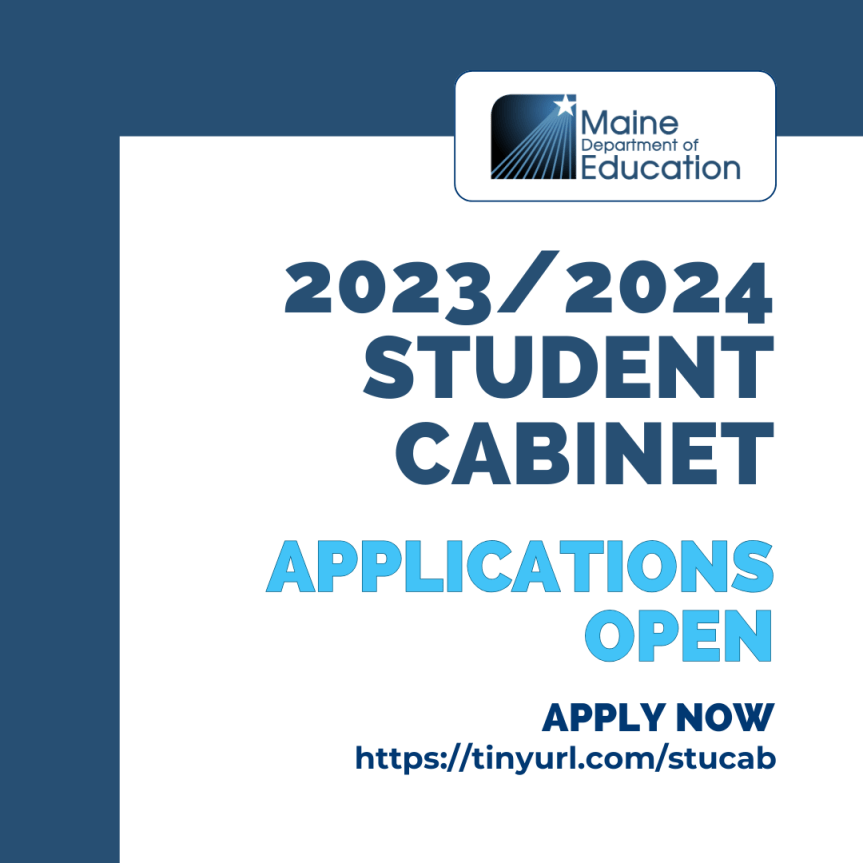


 Maine DOE Newsroom