MEDIA RELEASE: Application Process Open for Student Position on Maine State Board of Education

The Maine State Board of Education is currently seeking applications for the newest student member to join the Board. Applications are being accepted February 1, 2023 – March 1, 2023.

“Student voice is critically important to the State Board of Education’s decision-making process,” said Fern Desjardins, State Board of Education Chair. “We are pleased to open applications to public high school sophomores in Maine’s First Congressional District and look forward to hearing from the incredible student leaders in Maine schools.”

The Maine State Board of Education has two nonvoting student members who join the Board as high school juniors and serve for two years, one enrolled in a school in Maine’s First Congressional District; the other enrolled in a school in the Second Congressional District. At all times, the State Board has one high school junior and one senior as members, with staggered appointment.

Applications are currently being accepted from students who attend public school in the First Congressional District (Cumberland, Knox, Lincoln, Sagadahoc, York, and part of Kennebec County) and are currently a high school sophomore.  Application materials are available on the State Board of Education web page. The Board has also mailed application materials to all First Congressional District high school principals and school counselors. Completed applications, both hard copy and digital copy,  should be sent to:

Sandra Bourget
Office Specialist
Maine State Board of Education
23 State House Station
Augusta, Maine 04333-0023
Phone: (207) 624-6616
Sandra.A.Bourget@maine.gov

After applications close on March 1, 2023, they will be reviewed according to the process described in Maine Education and School Statutes, Title 20-A, Chapter 5, State Board of Education. Semifinalists will be interviewed in March 2023,  after which three finalists will be chosen. The names and application materials of the finalists will be sent to the Governor’s office for final selection. The Joint Standing Committee on Education and Cultural Affairs of the Maine State Legislature interviews the nominee in a public hearing and makes a recommendation about the nominee to the Maine Senate.  The Maine Senate is charged with confirming the appointment.

This is an extraordinary opportunity for Maine students to practice civic engagement while serving as both a representative of Maine students and an active education leader in our state.

For further information please visit the Maine State Board of Education web page or contact Sandra Bourget, Office Specialist, at 207-624-6616 or via email at Sandra.A.Bourget@maine.gov.

‘Casco Teaches’ Introduces High School Students to the Teaching Profession

This article was contributed by Matt Bernstein, a ninth grade Humanities and Social Studies teacher at Casco Bay High School in Portland and Maine’s 2023 Teach of the Year.

“The key to productive and equitable teaching is consistent patience and understanding, which creates a welcoming environment that encourages a growth mindset that carries on outside of the classroom.” I wish I could write that those wise words are mine, but they are, rather, the teaching philosophy statement of Sophia Chouinard, a junior at Casco Bay High School (CBHS) who spent the first week of January, along with 17 of her peers, learning about becoming a teacher in the Casco Teaches intensive.

The school I teach at, Casco Bay High School, is part of the EL Education national network. EL Education is a national nonprofit that partners with K-12 districts and schools across the country to offer resources and professional development in the work to create equitable schools of opportunity for all students. One EL practice is intensives. At Casco Bay High School, every January and April, we pause our classes to engage in intensives. Intensives, which happen at a number of different schools in the EL Education national network, are one week, elective courses that ask students to engage in in-depth study, all day, for five days. Intensives offer students an opportunity to learn deeply about a compelling and important topic that may not otherwise appear in the curriculum. Intensives are designed and co-run by teachers. Since students select their intensive, the courses are open to anyone in 9th through 12th grade and offer a unique opportunity for students to work across grade levels. Intensives, as you might guess from the name, are intense for both teachers and students, but through this intensity come some of the most impactful and joyous learning experiences of the entire school year.

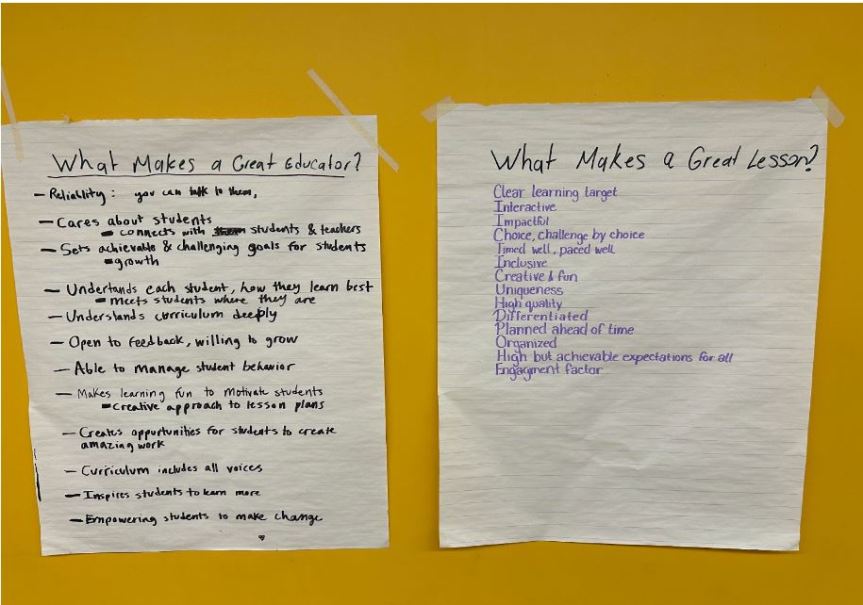
This January, I had the great opportunity to co-lead, alongside our inspiring principal, Derek Pierce, a new intensive called Casco Teaches, which sought to introduce students to the world of teaching and to the concept of teaching as a future profession. We began our week asking students to reflect on the inspirational educators that have taught them and memorable lessons they have experienced throughout their education. Using these stories to guide us, the cohort began answering two of our guiding questions: What makes a great educator? And, what makes a great lesson? Students identified a host of qualities that impact them positively, ranging from educators that they can tell really care about their students and are passionate about their subject matter to the importance of making learning joyous and creative. Students then paired their personal reflections with a variety of texts – in article and video format – about core practices that support high quality teaching and learning and that create supportive and transformational school communities.

After a day of “Education 101”, our students took to the field, observing in local classrooms. In total, we had 18 students, in 10 different schools, volunteering, learning, and helping out across the district. Students were participating in classes with students from pre-K to high school. We were tremendously fortunate to have wonderful teachers who opened their classrooms to our students and gave their time to share wisdom about teaching. 

CBHS senior, Molly Neuner, working with a student in a 1st and 2nd grade ESOL classroom as part of her participant observation during the intensiv

After two days in the field, our students returned to CBHS ready to put their learning into action. We introduced students to lesson planning and reflected on all the ways that we, as educators, can support student engagement and learning. After this, it was time for students to dive in and start planning their own lessons. Each student wrote a lesson plan on a topic of their choice for a 50-85 minute block. Then, students selected a 20 minute chunk of their lesson to teach to their peers on our final day. The range of topics covered was astounding. One student led a lesson about kindness and empathy while another introduced the anatomy of hammerhead sharks. One lesson led us through an analysis of the poetry of Mary Oliver, another showed how to change a tire, and a third pushed us to discuss how we can reduce bias in education. The lessons not only showed how much the students had learned in a brief period of time, but also opened up a beautiful window into their personal passions and interests.

All in all, the Casco Teaches intensive was a tremendous experience and we were thrilled to learn that it made many students consider teaching in the future. Indeed, 75% of students in the intensive reported that the experience made them more interested in being an educator some day. Jo Ellis, a sophomore, captured this when she said, “The intensive definitely showed me how rewarding a job in education can be and made me really want to pursue that.” Students wrapped the week by sharing their teaching philosophy statements with the rest of the school community. Lucinda Viola, a junior, wrote, “The key to great teaching is creating a safe space for students to make mistakes, build relationships, and better themselves while feeling safe, seen and understood.” As can be seen, there is a lot we can learn about great teaching from our students and, after spending a week with the future generation of teaching, I am filled with hope.

View more about what the week of Casco Teaches looks like here. 

Q&A With Maine’s 2023 Teacher of the Year Matt Bernstein

Get to know Matt Bernstein, Maine’s 2023 Teacher of the Year and a 9th grade Social Studies teacher at Casco Bay High School in Portland. Matt sat down for this Q&A as he begins his year of service.

How long have you been a teacher and how long have you taught at Casco Bay High School?
This is my 10th year teaching. I did my student teaching at Casco Bay, which I don’t count in those years. I taught in Rhode Island for my first year of teaching and then came to Casco Bay.

What made you want to enter the teaching profession?
Students made me want to enter the profession. I went to a 4th grade classroom in Brunswick during an Ed 101 class my freshman year in college and I was hooked. I remember thinking, “this is unbelievable, I can do this every day?” I love being around kids and working with them and seeing them grow.

How did you end up becoming a high school social studies teacher?
I knew I loved the kids, so then I thought about what content I’m most fired up about. What do I love? And it’s history. I have a fascination with connecting bullet points from the past that seem to be different and unrelated, and understanding the through line that goes between them.

I have a passion for working with young people and a passion for history, and that almost naturally steered me towards secondary school. I love connecting with teenagers. It’s both super exciting and super challenging to be a teenager, and I like sitting down with them and really getting to the core of who they are, who they want to be, and what they need from us to get there.
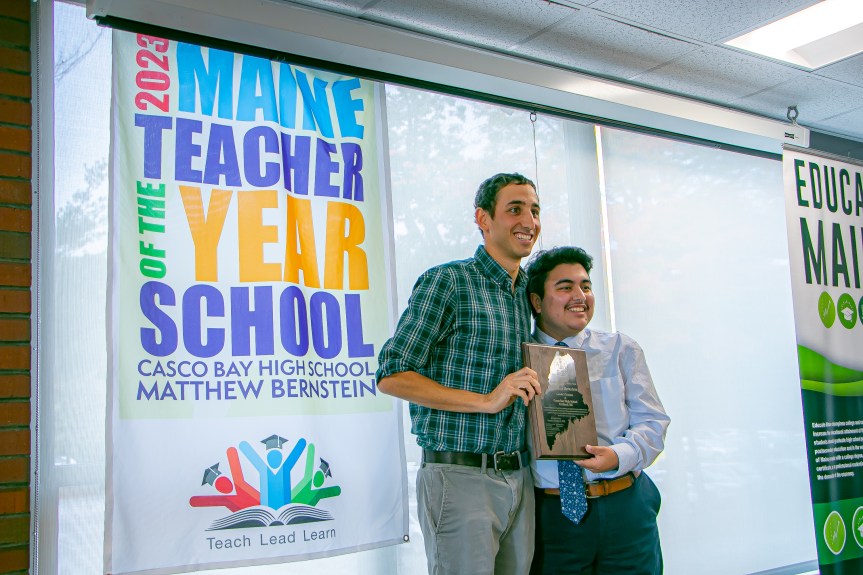
Matt Bernstein with the student who nominated himWhat does it mean to you that a student nominated you for Teacher of the Year?
It’s hard to put words to it because it means everything to me. It validates what I believe about education and what I prioritize about education, which is human connection and building relationships. It’s about seeing students for who they are as young people and being a support for young people.

In that nomination, the student talked about learning things, and I valued that, but for the most part they talked about me being someone who they felt they could go to. I believe that all young people deserve to know that there are people in their school who they feel they can turn to. To hear that I was that for one kid is everything. And it’s been motivating to me to know that this is something as a school that we are capable of, so we need to do it for everyone.

What do you love about Casco Bay High School and what makes your school special?
How community driven it is. It genuinely feels like family here—with my colleagues, with the school leaders, and with the students. It really is such a supportive place and place where everyone seems invested in one another. Everyone is bought into and building upon the idea that one’s success is a collective success and collective win. And when one person is having a hard time, it’s all of our responsibility to help them out. And it comes from the top, with school leaders setting the tone and establishing a culture of community, collaboration, support, and teamwork.

There are good days and bad days. There are things that are really difficult and tough for kids and families and us, so it’s helpful to fall back on the feeling that we are all on the same team. We may be having a moment, but we’re in this together.

Your crew has come up a lot in your nominating process. What is your crew and why is your crew meaningful?
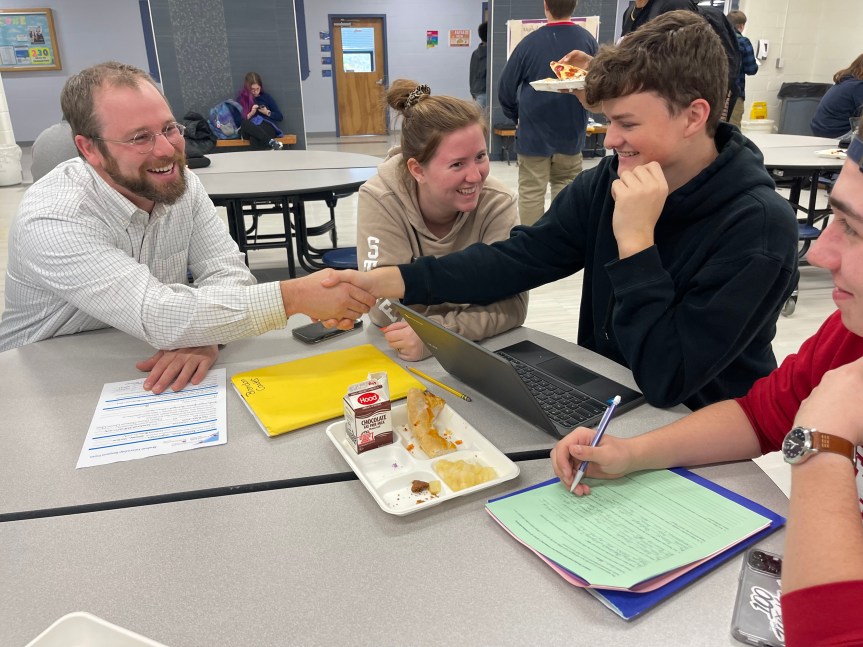
My crew is meaningful because I love them so much. Crew is basically our equivalent of what others might call advisory. But it’s on steroids. I have a crew of 13 ninth grade students. I see them every day and we eat lunch together on Wednesdays.

The idea of it is that we want every student to feel that there is at least one adult in the building who knows them and who can be a resource for them. It’s beyond knowing how they are doing in Social Studies, but how they are, who they are, and who they want to be. It’s helpful for families too because I become the point person for them in the school. The crew is establishing connections, and they stay together through all four years with a new advisor each year. When they graduate, they graduate not by alphabetical order but by crew.

Crew is like family in school and that’s where I get fired up. The place that speaks to me the most and gets to my heart as a teacher is: who are you? how are you doing? where are you going? how can I help you get there? And I feel like crew enables that connection.

What are you planning to focus on as Maine’s 2023 Teacher of the Year?
The first thing is telling positive stories about teachers and students. We all as humans need positivity and there’s a lot of challenge right now. The challenges are real and I’m not advocating for toxic positivity or pretending that everything is perfect. But it’s so important long term to highlight the amazing work that is happening and the greatness that exists in each school in the state.

Students for sure are impacted by a whole variety of factors, and the pandemic was really challenging for students and continues to be difficult for students and teachers. But they’re not irreparably harmed and broken. Students are super resilient and doing amazing things. We need to tell the world that and tell them that so that they hear that we really believe in them.

The second thing is about building relationships. How can we use the positive stories and the great work going on to highlight opportunities where students, teachers, and families can build relationships?

I also want to just listen to people. It’s so important to listen to each other, and in particular listening to students. Engaging with students, getting their feedback, and inviting them to have a seat at the table and shape their educational experience is really valuable.

What is your message to someone thinking about becoming a teacher?
My message would be that being a teacher is the greatest gift that has happened to me. I can’t imagine not being a teacher. The experiences I’ve had and the connections I’ve been able to make and the personal growth I’ve been able to make has been invaluable.

Spend enough time in classrooms with kids before deciding if teaching is or is not for you. Try not to make a snap judgement because every single day has not been amazing, but the whole journey has been. I want people to sit with it for some time and engage. The beauty of teaching is when you start to form these connections with kids, and they take time to form.

So my message would be to get in the classroom, keep working at it, commit to trying it for a good amount of time, and practice a lot of self-compassion. Understand that it’s going to take you time to get better at it as you go along. I believe that the more people spend time with young folks, and the more they engage with the practice of teaching the more they’ll fall in love with it.

What are the biggest misperceptions people have about teachers and schools right now?
There are two. The first one is this concept that teachers are interested in indoctrinating students and that teachers are interested in telling students what to think. What we’re trying to do is teach students how to think and how to be critical thinkers and be open minded. We want to empower students with information, but at no point are we telling students this is what you need to think, and this is what you need to believe. That’s counterintuitive to our entire goal.

What we’re trying to do is activate students’ minds. And also, what we know about kids is that they don’t want to be told what to do and they’re not going to respond to that. We’re just trying to create opportunities for kids. And by teaching kids how to read, write, analyze images, engage in scientific experiments, and understand math, all of these are unlocking doors for them so they can access the world around them. I want my students to leave this building and feel like they have enough agency in their life because they are educated enough to know how to make their own choices.

The second misperception is that students are worse than ever before. Of course there are students who exhibit big behaviors. I believe students have always exhibited big behaviors. Before the pandemic students exhibited big behaviors. Kids have always pushed against authority and tested boundaries, its almost what they’re supposed to do. I don’t think that things are different from the way things were before.

Students are not getting credit for the work they are doing, for the resilience they show, and for being the youngest generations of activists we’ve ever seen. I see 9th graders out there taking action for things they care about and being incredibly caring. I think they are very empathetic and very community oriented. I think students are doing a lot better than we give them credit for.

Anything else you want to share?
I’m super grateful for this opportunity. I never in my wildest dreams expected this. I wish every teacher was being recognized because they deserve it. What I’m hoping is that this year is an opportunity for me to share that I’m not some super teacher and I’m not a superhero. I’m just someone who loves it, is trying to get better every day, and trying to do right by kids every day. I want to highlight how awesome it is to be a teacher, how fortunate I am to be one, and how much I love doing it.

WEBINAR: Multi-Tiered Systems of Support: Timely Instruction for All Students

Join MAIER (Maine Access to Inclusive Education Resources) and the Maine Department of Education Office of Special Services and Inclusive Education (OSSIE) for a webinar with host Dr. Rachel Brown Chidsey on multi-tiered systems of support (MTSS). This session will provide an overview of the components in a multi-tiered system of support (MTSS) and how students with disabilities can and should participate within all tiers.  Participants will learn the importance of a strong Tier 1 core instruction foundation for all students as well as how targeted (Tier 2) and intensive (Tier 3) supports are provided for students regardless of dis/ability. The session will conclude with action steps that special educators can take to ensure that their students are included within all tiers of support, as appropriate.

When: February 9 @ 3:00 pm – 5:00 pm
Audience: For all educators and administrators
Contact Hours: 2 contact hours will be provided to participants
Register here

Rachel Brown Chidsey, Ph.D. Is a nationally renowned expert in multi-tiered systems of support for academics, and inclusive teaching practices. She has more than 25 years of experience in education and has authored dozens of articles, and many books on supporting struggling learners and students with disabilities. She is currently the president of the Maine State Council for Exceptional Children.

This session will be recorded and available on the MAIER after the event. For additional information please contact MAIER director, Dr. Sarah Howorth at sarah.howorth@maine.edu

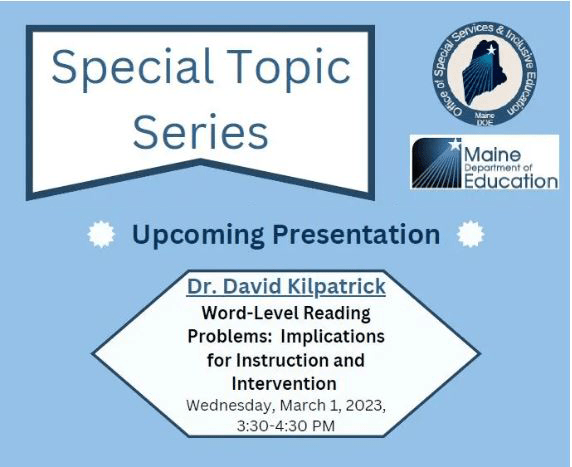
Special Topic Series: Word-Level Reading Problems – Implications for Instruction and Intervention 

The Maine Department of Education’s Office of Special Services & Inclusive Education is hosting a Special Topic Series around inclusivity and multi-tiered systems of support through the winter and spring months. The upcoming speaker is David A. Kilpatrick, PhD

Date: March 1, 2023
Time: 3:30-4:30 pm
Where: Zoom
Cost: FREE Register for Zoom Link Here

This presentation from David A. Kilpatrick, PhD will focus on how children learn to read words and why some children struggle. Including: 

  • The nature of word-level reading development and how word-level reading problems can guide instruction and intervention.  
  • Understanding how reading works and why some students struggle, illustrating other approaches to intervention that can yield very large reading gains for such students. 
  • Examples of studies that consistently show that the most used intervention approaches provide limited benefits for at-risk and struggling readers. 
  • Establishing a knowledge base for educators to choose the most effective instructional and intervention practices. 

Audience: General & Special Educators, Administrators, Parents, Caregivers and Community Members Interested in Literacy, Dyslexia & Reading Disabilities and Interventions 

Contact Hours: Each attendee will be awarded a certificate for 1 contact hour 

About the Presenter:  

David A. Kilpatrick, PhD is a professor of psychology for the State University of New York College at Cortland. He is a New York State certified school psychologist with 28 years’ experience in schools. He has been teaching courses in learning disabilities and educational psychology since 1994. David is a reading researcher and the author of two books on reading, Essentials of Assessing, Preventing, and Overcoming Reading Difficulties, and Equipped for Reading Success, and is a co-editor of a third, Reading Development and Difficulties: Bridging the Gap Between Research and Practice. David Kilpatrick’s website Equipped for Reading Success can be found at https://www.equippedforreadingsuccess.com/ . 

David Kilpatrick is also the developer of the PAST (Phonemic Awareness Screener Test) which is included in his book Equipped for Reading Success and is used to monitor student progress. The Phonological Awareness Screening Test (PAST) is a valid and reliable assessment of phonological awareness that takes 5-8 minutes to administer. You can download the PAST for free at http://thepasttest.com/ . 

Belfast Area High School ELO Program Sparks Student Interest in Community Jobs

Belfast Area High School in RSU 71 began implementing an Extended Learning Opportunities (ELO) program at the beginning of the school year, and so far, they already have 15 students starting out at a variety of places throughout the community – a veterinary hospital, the fire department, a hair salon, the police department, and the county District Attorney’s office to name a few.

For ELO Coordinator Solomon Heifets, this feat has been one of the biggest success stories in and of itself – just getting the program up and running and getting students connected out into the community.

More recently, Heifets and one of his students experienced one of the best things yet when it comes to extended learning opportunities. As part of an internship set up with the local veterinary hospital, Heifets, the student intern, one of the doctors, and the office manager had a check-in meeting.

“I could hardly imagine a more glowing review,” said Heifets. “The doctor and office manager are thrilled about their intern and are going out of their way to provide her with the best learning experiences they can – teaching her surgical techniques, how to do lab work, how to explain things to the pet owners, and how to manage an office. They are even coaching our student as she works on her college applications,” he added. This type of day-to-day work with students and community members is one of the best parts of the job for Heifets.

Another component of Belfast’s ELO Program is a final project that every student completes. The final project applies what students have learned in an authentic way.

“I feel like this is actually helping me figure out what I want to do with my life, and showing me that I have a lot of options,” said ELO student Kara Richards.        

Looking toward, Belfast Area High School is planning a college and career fair and expects to have more than 30 presenters attend. Heifets says that many of the career presenters are also interested in recruiting interns and employees, and he is looking forward to the many ways in which the event will help expand their ELO program.

“As more and more students and community members get engaged with this program, I can already see some big project ideas emerging, and I look forward to the positive impact we will make in our community,” said Heifets.     

Belfast Area High School and RSU 71 extend a huge thank you to the following local businesses and organizations: Little River Vet, Belfast Fire Department, Belfast Water District, Waldo County District Attorney’s Office, The Penobscot Marine Museum, and all of the people who have opened their doors and hearts to their students.   

Anyone interested in hosting a student intern can contact Solomon Heifets at sheifets@rsu71.org or (207)213-7932.

Extended Learning Opportunities (ELOs) are hands-on, credit-bearing courses outside of the traditional classroom with an emphasis on community-based career exploration. These opportunities are personalized for students and help them explore options for their professional lives. They help students engage in learning through instruction, assignments, and experiential learning. The Maine Department of Education (DOE), along with state-wide partner Jobs for Maine Graduates (JMG), have made a concerted effort to provide working models, support, and funding opportunities for Maine schools to set up ELO programs within their school communities. To learn more about Maine’s initiatives with extended learning opportunities, visit: https://www.maine.gov/doe/index.php/learning/elo or reach out to Maine DOE ELO Coordinator Rick Wilson at rick.wilson@maine.gov.

Get to Know the Maine DOE Team: Meet Alissa Mank

Maine DOE Team Member Alissa Mank is being highlighted this week as part of the Get to Know the Maine DOE Team Campaign. Learn a little more about Alissa in the question and answer below.

What are your roles with DOE?

I am a Nutrition Consultant for the Child and Adult Care Food Program (CACFP). CACFP is a USDA food program that provides reimbursement for healthy meals and snacks served to children and adults in qualifying programs. CACFP serves At-Risk Afterschool Programs, Adult Care Centers, Child Care Centers, Family Daycare Homes, and Emergency Shelters. My role is to support institutions as they operate CACFP in their programs.

What do you like best about your job?

I love going out into the field and seeing the food program in action! Some of the best experiences are seeing little kids try new foods that they might not have the opportunity to try at home, and learning to serve themselves through family style dining. I also love visiting the Adult Care facilities and seeing the passion the staff have for serving their participants comforting and healthy meals. The genuine passion and care that goes into the food programs are phenomenal. Maine has the best Child/Adult Care Providers!!

How or why did you decide on this career?

I graduated college and could not find a position within my degree field. I took a position working in the Child Nutrition Team as an Office Associate and knew immediately I was where I was meant to be. With the encouragement of my supervisor and family I went back to school and got a Bachelors Degree in Nutrition Science! The Nutrition field is fun and always evolving, there is always something new to learn!

What do you like to do outside of work for fun?

My husband and I stay busy with our girls (ages 7 and 10) and all their fun extracurricular activities. We have a garden house and love to process our own vegetables and salsa in the summer months, and I love to snowshoe in the winter with my golden doodle Maggie.

Maine DOE Update: February 3, 2023

From the Maine Department of Education


Reporting Items

NEO and Synergy – State Reporting Training

End-of-year reporting is just around the corner. If you would like to brush up on reporting requirements and/or Synergy and NEO navigation before reporting periods open, now is the best time of year! |  More

| Visit the DC&R Reporting Calendar |


News & Updates

Education Commissioner Pender Makin Kicks Off Annual Read to ME Challenge by Reading to Sanford Pre-K Students

Maine Education Commissioner Pender Makin kicked off the state’s Read to ME Challenge at Sanford Regional Technical Center by reading If Only… to a group of spirited pre-k students. This is the eighth year that the Maine Department of Education is collaborating with schools, parents and communities on this month-long public awareness campaign to promote the importance of literacy for all of Maine’s students, regardless of age. |  More

Seeking Presenters for 2nd Annual Educator Summit; Theme is Inspiration, Innovation, and Inclusion

The Maine Department of Education is excited to announce that the 2nd Annual Educator Summit is scheduled for August 7 through August 10, 2023, at the Augusta Civic Center. We are currently seeking presenters from Maine’s education field. |  More

Save the Date for the 20TH Annual MLTI Student Conference!

The Maine Learning Technology Initiative (MLTI) is excited to announce the dates and locations for the 20th annual MLTI Student Conference! In our continued effort to engage all MLTI students in our annual conference, we’re offering three different options for participation this year. We’re partnering with the University of Maine System, to host two in-person MLTI Student Conferences! |  More

Warming Center Locations and Resources Available in Response to Extreme Temperatures

Given the frigid and dangerous temperatures expected in the coming days, the Maine Department of Education is sharing information from the Maine Emergency Management Agency (MEMA) on Warming Centers and other resources for families and communities. |  More

Organizations Needed to Provide Complimentary Meals to Children This Summer

With the assistance of the U.S. Department of Agriculture, Maine public schools have long offered a nutritious breakfast and lunch meal program to thousands of income eligible children in Maine during the school year. To extend this program, Maine Department of Education Child Nutrition (Maine DOE) is seeking organizations that would like to participate in the federally funded Summer Food Service Program (SFSP), which provides children healthy, free meals when school is not in session. |  More

Maine’s National Board Certified Teachers Honored in Virtual Pinning Ceremony

“National Board taught and reminded me of the importance of being a beginner. At first, I thought it was about achievement, but it became very apparent not too long into the process that being a beginner is something to embrace,” said keynote speaker Sarah Brown Wessling, National Board Certified Teacher and 2010 National Teacher of the Year. She added, “National Board puts the focus on the process of learning, we learn how our students learn. That is the thing that is so beautiful about this process. Once we understand the how and the why, it makes us stronger teachers and colleagues.” |  More

Approval of FY 2023 School Revolving Renovation Fund Applications

The Maine Department of Education (DOE) has awarded $15 million in School Revolving Renovation Fund (SRRF) loans to 16 school administrative units (SAUs). The loans will be used to complete 34 health, safety, and compliance projects at 33 schools. The projects include structural roof repairs, indoor air quality improvements, ADA upgrades, hazardous material removal, life safety renovations, and security enhancements. A portion of each loan is considered a grant and is forgiven while the remaining balance of the loan is paid back at a zero percent interest rate. |  More

Seeking Writing Teams and Targeted Reviewers for Update of the Maine Early Learning and Development Standards

The Maine Early Learning and Development Standards (MELDS) are the state’s learning standards for children ages three-five. Building from the Infant Toddler MELDS (IT MELDS) and bridging developmental expectations to the Maine Learning Results (MLRs), the MELDS inform all early childhood professionals about the typically developing expectations of young children as well as curriculum and assessment practices. |  More

2023 Mitchell Scholarship Application Open

The 2023 Mitchell Scholarship online application is now open until April 1. You can find the application link, requirements, and a few additional college and scholarship resources on the Mitchell Institute’s web site. |  More


Maine Schools Sharing Success Stories

Warsaw Middle Schoolers Put Courage to the Test with SpiritCorps

“I learned that I could face my fears if I put my mind to it,” one Warsaw 7th grader concluded as ELA teacher, Jake Marcoux, took his classes on a journey of self-discovery during their 3-week personal narrative writing and storytelling project celebrating Courage with SpiritCorps. |  More

Building Community Through Extended School Programming at Georgetown School

Small rural schools are often faced with the challenges of how to support working families who may need before and after care for their children. Before and after care sometimes provided through the YMCA, or other organizations, are not always accessible to families, making drop off and pick up times difficult. In some cases, rural schools lose students to other schools who have consistent care programs. In Georgetown we heard this challenge presented many times from multiple families. The goal was to find a solution that made sense for families. |  More

| Submit your Maine School Success Story |


Professional Development & Training Opportunities

Virtual Tuesday Power Hour Series by TransitionME: 1/31 Session – Teaching Skills that Matter

The Maine Department of Education, Office of Special Services & Inclusive Education presents TransitionME Virtual Tuesday Power Hour Series, a best practices forum to provide opportunities for our State educators and transition leaders to grapple with and actuate strategies and support for our scholars’ diverse needs and pathways to post-secondary opportunities. Upcoming session: What central skills do students, including students with exceptionalities, need to find success in life and work? |  More

MaineHealth Virtual Workshop: MindUP – A School and Community-Based Mental Health Resource

The following virtual workshop is being hosted by MaineHealth to Maine schools. We are facing an unprecedented mental health crisis across the country, especially in the wake of the acute pandemic. The literature indicates it will take many strategies across community and clinical settings to address this. |  More

Maine Alternative Education Association Spring Conference to Be Held March 10 at Thomas

The 2023 Alternative Education Association (AEA) of Maine’s Spring Conference will take place at Thomas College on March 10th from 8:30-2:30. AEA will offer six contact hours for participants of this conference. |  More

| Visit the Professional Development Calendar |


Latest DOE Career/Project Opportunities:

View current Maine Department of Education employment opportunities here


Seeking Presenters for 2nd Annual Educator Summit; Theme is Inspiration, Innovation, and Inclusion

The Maine Department of Education is excited to announce that the 2nd Annual Educator Summit is scheduled for August 7 through August 10, 2023, at the Augusta Civic Center. We are currently seeking presenters from Maine’s education field.

This year’s theme is Inspiration, Innovation, and Inclusion. Knowing that there are many inspirational, innovative, and inclusive practices being performed in our public schools, we have opened the applications to the entire Maine public education workforce.  Our intent is to showcase the inspirational, innovative, and inclusive practices being used every day in our schools and use this to inspire other schools.

We will also be accepting applications from the Maine Department of Education staff that are providing support for our Maine teachers and students, and to provide a launching point for continuing support throughout the 2023-2024 school year.

Presenter Application Portal (Applications close on March 3, 2023)

For more information regarding this event please contact Teri Peaslee, 2023 Summit Coordinator at Teri.peaslee@maine.gov or 207-530-7672.

Approval of FY 2023 School Revolving Renovation Fund applications

The Maine Department of Education (DOE) has awarded $15 million in School Revolving Renovation Fund (SRRF) loans to 16 school administrative units (SAUs). The loans will be used to complete 34 health, safety, and compliance projects at 33 schools.  The projects include structural roof repairs, indoor air quality improvements, ADA upgrades, hazardous material removal, life safety renovations, and security enhancements.  A portion of each loan is considered a grant and is forgiven while the remaining balance of the loan is paid back at a zero percent interest rate.

The complete list of approved projects can be viewed at https://www.maine.gov/doe/schools/facilities/srrf.

For additional information about the SRRF program please contact Ann Pinnette at 215-3809 or ann.pinnette@maine.gov.