
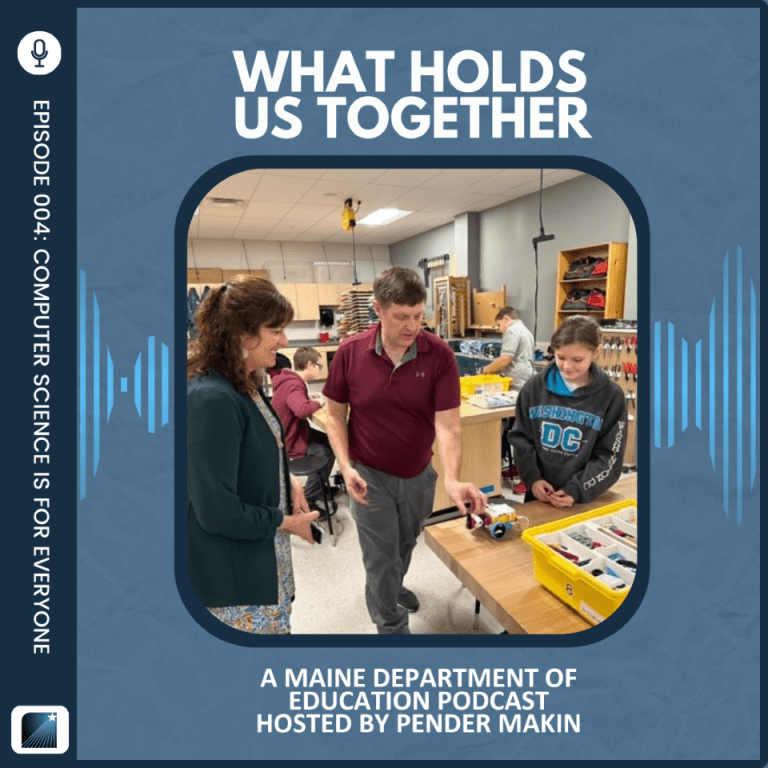
Commissioner Makin Speaks With Kern and Keith Kelley About How They Integrate Hands-On Computer Science Education Across Grade Levels and Content Areas
In the latest episode of her What Holds Us Together podcast, Maine Education Commissioner Pender Makin speaks with Keith and Kern Kelley, brothers and computer science teachers at Nokomis Regional Middle and High School, about Maine’s efforts to integrate computer science education at all grade levels and with all content areas. They talk about how hands-on, real-world computer science education teaches students about technology and computer science as well as strengthening their ability to work in teams, troubleshoot, communicate effectively, lead, and pursue creative passions. You can listen here.
“These are two brothers who are educators integrating really exciting hands-on, real-world computer science education, innovation, and technology with their students. I’ve been to visit their classrooms and have seen the work that they’ve been doing with their students and how much engagement there is. I was so impressed, I wanted to share some of what they’re doing with all of you,” said Makin in the podcast opening.
The three discussed how computer science education has real-world applications across all content areas and areas of life.
“I was a librarian and a language arts teacher, so I’ve come from a different way to get to this. It’s not separate, it’s part of. Language arts teachers are doing coding. When you’re teaching kids you have to use a period, you have to use a comma, you have to be grammatical, and there’s a reason and structure to it, then you get into building a game or a sequence of coding and there’s structure, it’s the same thing. If you’re doing computer science and learning coding, you’re learning a language,” said Keith Kelley, Innovative Technology Teacher at Nokomis Regional Middle School.
He continued, “We do asynchronous grouping, so one kid is building code and he or she has 2 other groupmates and they have to communicate digitally with each other through screen captures and stuff like that. That’s what you do in the real world, we’re virtually meeting all the time. When my kids are doing basic coding they’re learning pre-algebra, they’re learning sequencing, but also they’re learning troubleshooting which translates to everything. It’s not a separate thing, it’s part of what’s already out there. If you’re in math you’re doing numbers, but you are doing language. You’re in science and doing labs and troubleshooting, but you’re doing language.”
Kern Kelley, Director of Technology Integration for the district, described how he began integrating computer science education with different content areas across the high school.
“I’d ask the kids what they’re doing [for a specific teacher] and say ok, for me you’re going to do that same project but you’re going to do it this way—we’re going to do a virtual reality world for that book project you have to do. The kids would do it and bring it to the teachers and almost 100 percent of the time [the teachers] say that’s great, next time let’s make that as an offering,” said Kern Kelley.
Makin described how that approach is setting Maine apart as a computer science education leader.
“That really sets this apart from what I see across the nation in terms of really rote programmatic learning coding for the sake of learning coding. You both take it to that next level where it’s really learning coding to do an important thing that is relevant, whatever that might be,” said Makin.
“There’s elegant coding. Just like in writing you have basic writing then you get to the point where now I’m not writing for writing sake or to get information across I’m trying to make something prose or poetry. The same thing happens with technology and the coding. You go from writing basic coding to make it function to making it function efficiently or elegantly through elegant design,” said Keith Kelley.
They also discussed how this continuum of computer science education that students experience through their school careers develops the leadership and teaching skills of students. High school students can participate in SLAM, developing weekly live shows to teach other students how to create something using a free online tool. Once a month the students also go on the road for a SLAM Show and teach sessions to younger students to get them engaged and excited about computer science.
“As much as we can have students as part of the solution and include them in that process of learning and get opportunities to teach and learn from that experience…and then the idea is those kids get so excited about learning from high school kids about these cool tech topics, that’s usually enough impetus where we can now talk to the teachers afterward [about doing more]. Now we’ve broken the ice and they know how to use these things and have all these ideas,” said Kern Kelley.
Through the Governor’s Emergency Education Relief Fund, the Maine Department of Education (DOE) provided every Maine public school with a free mobile computer science lab to ensure that every student, pre-K through grade 12, has access to interdisciplinary, project-based computer science education with real-world applications.
The DOE has a comprehensive computer science education plan guided by seven key principles: authentic and project-based instruction, computer science as a prek-12 learning continuum, equitable and inclusive access, educator-produced professional learning and statewide sharing, integrated applied learning, educator-informed policy and state planning, and computational thinking as a foundation. You can read more about Maine’s computer science education framework here.
What Holds Us Together is a monthly podcast produced by the Maine DOE and hosted by Makin to highlight the voices of educators, students, and school employees across Maine. Listen to this and all the episodes of What Holds Us Together on Apple and Spotify.
 Maine DOE Newsroom