Funded by the Maine Department of Education (DOE) Teach With Tech Grant, Cony Middle and High School has embraced a new approach to education through virtual reality (VR) technology. The school’s acquisition of VR headsets and software from Class VR, a London-based company, is reshaping the learning experience for both students and educators.
Katelyn Rodriguez, Director of Technology Integration for the Augusta School Department, applied for the Teach With Tech Grant last school year with the goals of bringing the world into the classroom and fostering experiential learning.
By leveraging VR technology, students at Cony are exploring artifacts and places beyond their geographical and economic reach, and opening their minds to new possibilities.
Recently, 7th-grade science classes utilized VR/AR content to expand on their human anatomy unit. Students were able to visualize AR objects of the human skeletal system, muscular system, and nervous system. They looked at the human heart and digestive system using the Merge Cubes acquired during COVID-19. Students enjoyed being able to look around and even go inside the human heart and digestive system. The real breakthrough occurred as students made observations and asked questions about what they were experiencing, promoting engaging discussions and a deeper understanding of the complex anatomy concepts. Megan Allen and Allison Hunt, with the assistance of Katelyn Rodriguez, took the lesson one step further by allowing students to play in a VR simulation of the digestive system. They became a piece of pizza that traveled down the esophagus, into the small intestine, then the large intestine, and beyond.
The Teach With Tech Grant has propelled Cony Middle and High School into a new era of learning. VR technology has not only enhanced students’ understanding of complex subjects, but has also inspired educators to rethink traditional teaching methods. The immersive learning experiences enabled by VR are set to shape the educational landscape at Cony for years to come.
For Cony students, the classroom is no longer confined by walls but extends to virtual realms, providing an enriched and dynamic educational experience.
Part of the Maine DOE Maine Learning Technology Initiative (MLTI), the Teach With Tech Grant was awarded to MLTI schools in the spring of 2023 and is available again this spring. This grant provides supplemental technology and related professional learning to support innovative teaching and learning with technology. Learn more here.
This story was submitted to the Maine Department of Education by Cony Middle/High School. To submit a story from your school, fill out our good news submission form.
Governor Mills’ Office launched a Maine Flood Resources and Assistance Hub website to help Maine people find information, resources, and assistance to stay safe and recover from interior and coastal flooding caused by recent storms. You can access the Hub here.
The Hub includes resources on federal disaster assistance, insurance, unemployment support, cleanup and safety, food assistance, shelters, mental health supports, and more. The site will continue to be updated regularly.
The Maine Department of Education (DOE) is sharing these resources in the event that your school sustained damage during recent storms and for schools to share with staff, students, and families who may have been impacted.
The Maine Emergency Management Agency (MEMA) has worked with the Maine DOE to create a flier with QR codes for easy access to information and resources that can be included in school newsletters or provided to families in your school community. You can download the flier here.
The Maine Department of Education (DOE) is excited to share information on the 4th annual International Social Emotional Learning (SEL) Day, Friday, March 8th. The theme of this year’s event is Today’s Students, Tomorrow’s Leaders. Want to join in the celebration? Start making your plans now!
Compete against other teams. Maine DOE’s SEL4ME team expects to be at the top of the leaderboard that day. Is anyone up for the challenge? Learn more about the badges here: Badges | SEL Day
In addition to these national efforts, Maine DOE is encouraging educators to connect the SEL theme to Youth Art Month, being celebrated throughout March. Consider how to showcase student artwork, music, dance, poetry, videos, essays, or more by encouraging participation. Showcase your selections on district media and tag us @mainedoe or #SELDay.
As you consider your SEL Day participation, please be mindful of inclusivity for all students, families, and educators. Some questions for your planning team to consider:
How can activities be framed to support inclusion for all?
What is needed to ensure that timely and accurate translations are available for multilingual families?
How can activities be designed to provide access for all reading abilities?
What barriers might there be to participation, and can those barriers be proactively addressed?
Please join the Maine DOE for SEL Day Toolkit Office Hours.
We will use this time for Maine educators to collectively explore the #SELday Toolkit and to share ideas, activities, and events for SEL Day celebration.
The Alternative Education Association of Maine is looking for nominations for the Alternative Educators of the Year. The Association is looking to recognize one or more individuals for their outstanding work in Alternative Education.
Please consider someone who has:
Demonstrated a positive impact on the academic programming for Alternative Education students or at-risk students.
Been an advocate for Alternative Education at local or state levels.
Helped develop and/or maintain an effective Alternative Education program.
Shown a dedication to Alternative Education through a commitment to professional growth and development.
If you know of someone who fits any of these criteria and would like to nominate them, please take a moment and fill out the form below and help us recognize those deserving educators whose work helps some of our most in-need students.
The Maine Department of Education (DOE) recognizes the importance of supporting student mental health. Data from the U.S Center for Disease Control and the Maine Integrated Youth Health Survey reflect increased student mental health needs.
In 2023, Maine DOE received a five-year Expanding Access in School Environments (EASE) grant to increase school-based mental health staff and services in Maine schools. The Maine DOE will spend the next year providing opportunities to the current workforce of school counselors and school social workers to build upon their expertise and to promote evidence-based practices in Maine schools. This emphasis on school-based mental health workforce development strengthens the quality of mental health services in schools.
The following scholarship opportunities are being presented to school counselors and school social workers working in Maine schools:
With the goal of increasing the number of school counselors benefiting from access to their professional communities, Maine school counselors (up to 31) will be given scholarship opportunities to obtain full membership in the American School Counselor Association (ASCA). This membership opportunity will connect more Maine school counselors with their professional community, providing access to additional networking, training, evidence-based practice resources, and research. Eligible ASCA members will also be able to pursue national school counselor certification through ASCA. Once the application is created, it will be distributed through a Maine DOE school-based mental health listserv.
With the goal of increasing the number of nationally certified school counselors (ASCA) supporting Maine schools, the Maine DOE will provide scholarships to qualified school counselors (up to 10) to participate in the ASCA national certification process. At this time, ASCA has reported that Maine does not have any ASCA national certified school counselors working in Maine schools. Once the application is created, it will be distributed through a Maine DOE school-based mental health listserv.
With the goal of increasing the number of school social workers benefiting from access to their professional communities, Maine school social workers (up to 31) will be given scholarship opportunities to obtain full membership in the School Social Work Association of America (SSWAA). This membership opportunity will connect Maine school social workers with their professional community, providing access to additional professional networking, training, evidence-based practice resources, and research. Eligible members will also be able to pursue advanced national certification through the SSWAA National Certified School Social Work process. Once the application is created, it will be distributed through a Maine DOE school-based mental health listserv.
With the goal of increasing the number of nationally certified school social workers (SSWAA) supporting Maine schools, the Maine DOE will provide scholarships to qualified school social workers (up to 10) to participate in the SSWAA National Certified School Social Work process. This advanced national certification process requires applicants to link their school practices with the national school social work practice model. This funding support may result in a 1000% increase in National Certified School Social Workers in Maine schools and place Maine among the national leaders in national school social work certification. Once the application is created, it will be distributed through a Maine DOE school-based mental health listserv.
To be eligible for these opportunities, school counselors and school social workers must meet the eligibility requirements for each individual activity, be employed as a school counselor or school social worker in a Maine school, hold 075 certification from the Maine Department of Education (school counselors), or hold a valid social work license from the Maine Social Work Licensing Board (school social workers). Interested school counselors and school social workers must use the forthcoming application to request access to these scholarship opportunities. Each of these opportunities will be provided on a first come, first serve basis.
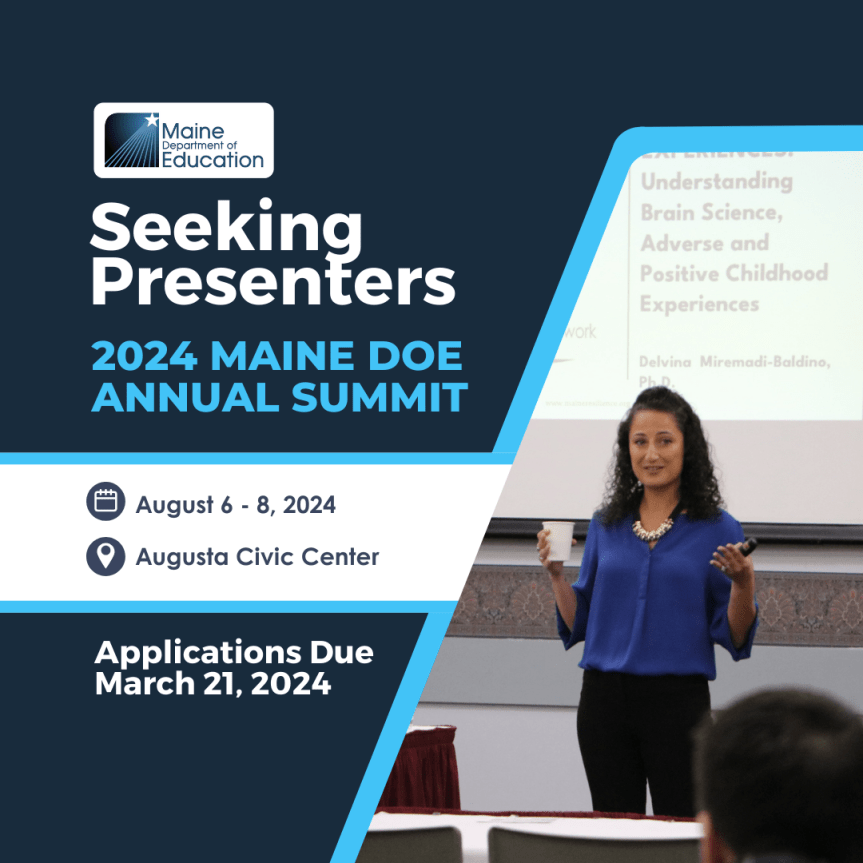
The Maine Department of Education is excited to announce that the 3rd Annual Maine DOE Summit is scheduled for August 6 through August 8, 2024, at the Augusta Civic Center.
We are currently seeking presenters from Maine’s educators, school safety personnel, first responders, and other agencies that are involved with supporting students.
This year’s theme isSupporting the Whole Student and School Community. Knowing that there are many inspirational, innovative, and inclusive practices being performed in our public schools, we have opened the applications to the entire Maine public education workforce. We encourage schools that have shared their stories through the Maine Department of Education to apply as well. We intend to showcase practices being used every day in our schools and use this to inspire other schools.
We are also excited to be able to offer an honorarium to eligible presenters. More information regarding this is contained within the application linked below.
Maine Department of Education staff providing support for Maine teachers and students will also be presenting at the Maine DOE Annual Summit to provide a launching point for continuing support throughout the 2024-2025 school year.
Volunteer Maine (Maine Commissioner for Community Service) shares that AmeriCorps NCCC has announced that its “Summer of Service” program is returning this year. This shorter summer session returns with projects focused on climate mitigation, affordable housing, and the option to serve where the need is greatest.
Deploy to Aurora, Colo., or Vinton, Iowa, for three months of training and service. Program benefits include food, lodging, a modest living allowance, uniforms, and program-related travel expenses are all covered by AmeriCorps NCCC. In addition, members will receive a post-service education award.
The Maine Department of Education, in collaboration with Career and Technical Education (CTE) schools throughout Maine, is celebrating CTE month this February by highlighting some of the amazing women who have found their path in life through career and technical education. We hope their stories inspire you the way they have inspired us.
“I had no idea life would take me in this direction. It wasn’t too many years before I changed careers when I said to a friend, ‘There is no way I would want to be a cop in my own hometown!’ and that’s exactly what I became, and I loved it!” said Amanda Baker as she looked back on her journey to becoming a police officer and eventually the Criminal Justice Instructor a Caribou Tech Center.
Baker began her journey studying Education and Recreation at the University of Maine at Presque Isle (UMPI). After working at Chewonki Foundation as an outdoor educator and wilderness trip leader, and then at UMPI’s fitness center while teaching courses in recreation, Baker eventually got married and had her daughter Zoey.
“It was motherhood that shifted my perspective; I felt like I had work to do in our community,” said Baker. “I left my job at the University and took the law enforcement 200-hour course. I was hired by Washburn Police and began working as a police officer. I loved it, but it scared me every day!”
After moving to the Caribou Police Department, she quickly realized she had a lot to learn about being a police officer. It was then that she went to the Maine Criminal Justice Academy to earn a Basic Law Enforcement Training Program certificate.
“I was more confident and grateful for the military-style training I received during those 18 weeks at the Academy,” said Baker. However, the journey to finding confidence in her career as a police officer and starting a family was not always easy.
Amanda Baker and a fellow student at the Academy.
Amanda Baker and her daughter Zoey at South Branch Pond
“In 2020 God took my daughter’s father, and I was left to raise Zoey as a single mom,” she said. “I was only able to remain on my law enforcement path because of my parents and sister’s family who filled in many gaps.”
It was in 2023 that Baker saw the Criminal Justice Instructor position open at the Caribou Tech Center, and she knew it was the job that offered the perfect combination of her prior work experiences plus the flexibility to give more time to her daughter.
“My position at the Caribou Tech Center provides me with all that I find most valuable; time with my daughter and family, and an opportunity to influence young adults all while earning a comfortable salary with great benefits like health insurance and a retirement plan,” Baker added.
“I feel incredibly fortunate to have Amanda Baker on our staff at Caribou Technology Center,” said Amy White, Caribou Tech Center Director. “Her boundless creativity, unwavering emphasis on school safety, genuine care for students, and vast skillset and background make her an invaluable asset to our team.”
Since joining the team, Baker has started the year off strong by spending the first 4 months of the school year having her students work on a school safety assessment identifying strengths and weaknesses for all of the RSU39 schools and offering strategies for improvement.
“The culmination of this project featured a slide show presentation to the RSU39 School Board in December,” said Baker. “I sat back and watched as my students presented thoughtful, organized, and important information to a captivated audience.”
Right now, Baker’s Criminal Justice students are working on an ethics project and planning an “epic” end-of-the-year celebration featuring a Community First Responder Run hosted by the Caribou Tech Center and a Touch-A-Truck event at the Caribou Community School.
“I am honored to be a part of our student’s journey through civic engagement and service learning,” she added. Baker has also been offering “Power Hour” sessions for Caribou Community School students. The sessions are focused on law enforcement and hope to spark interest in civic service at a young age.
Looking forward Baker is excited about a new Outdoor Recreation program for Northern Maine High School students that is in the works. Baker attributes this new and exciting pathway to Caribou Tech Center’s new and highly driven Director, Amy White.
“I was thrilled to accept the position as instructor for that program as well (while continuing to maintain and build a more robust Criminal Justice program) starting fall 2024,” said Baker.
“With Ms. Baker, we not only benefit from her innovative ideas but also from her dedication to creating a secure and nurturing environment for our students,” added White. “Her passion for education and commitment to excellence truly set her apart, enriching our community in countless ways. I look forward to continually watching her grow in her new role as a CTE Instructor.”
When asked what advice she would give to students thinking about pursuing education in CTE, this is what Baker had to say, “Experiences, people, and mindset will all influence your path. It can be difficult to remain focused on something when your family and friends tell you you’re crazy (what I heard when I started talking about law enforcement). It’s important to acknowledge their protection of you, but even more important to know why you are pursuing something so radical. I wanted to be a police officer because I was scared of what my daughter was going to be exposed to. I knew I was physically capable of the job but wasn’t sure I had the skills to take down bad guys. Certain aspects of any job can be learned through training and practice, like taking down bad guys, but mental toughness, grit, and determination are all inside. Ask yourself, why am I doing this? If your heart and soul back you up on your “why,” and you know this is what you’re meant to do, go for it! No regrets!”
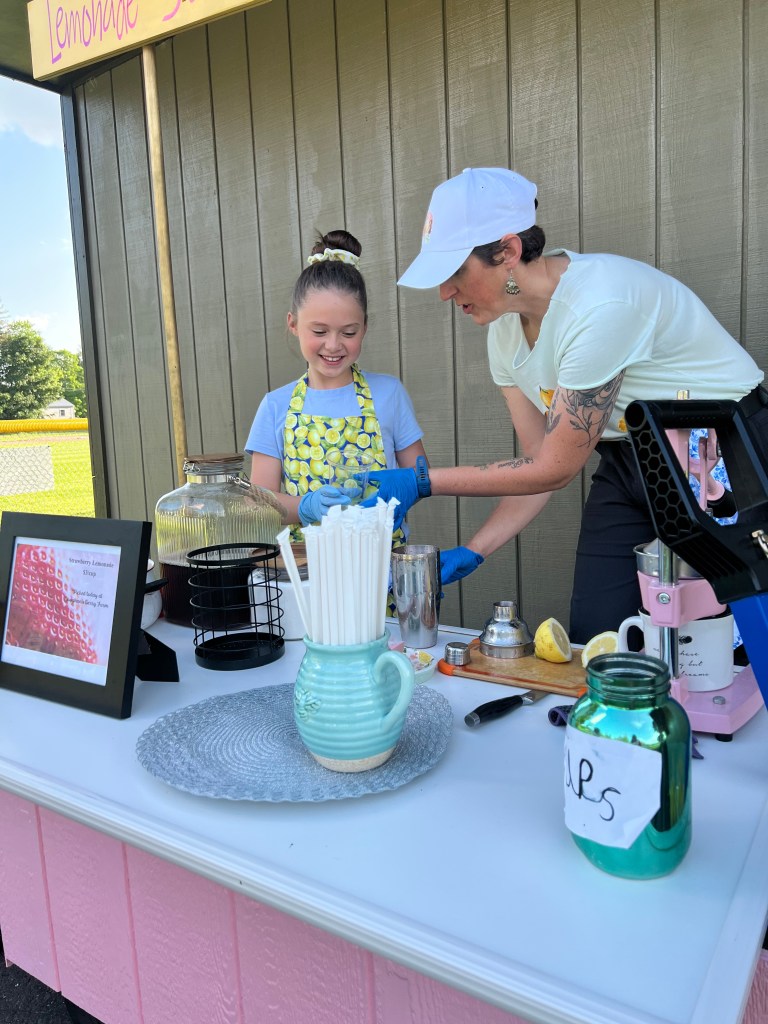
Amanda Baker and her daughter running a lemonade stand.
The Maine Department of Education (DOE) Interdisciplinary Instruction team has curated resources of content and instructional approaches to help educators include and highlight the important contributions of Black and African-American Mainers in authentic ways. These project-based strategies include finding local historical figures and guest speakers, researching local history, and bridging content areas.
Project-based learning begins with a question that connects students to real-world explorations. This approach can lead to a deeper, richer understanding of content, including Black and African-American histories. Some examples of using questioning in your classroom are:
The Question Formulation Technique, a questioning strategy, begins with a Question Focus, which is a word, statement, or primary source that sparks questions.
The Question Focus can guide students toward thoughtful inquiries regarding Black and African American studies in Maine. An example could be showing an image of Malaga Island or a statement like African Americans have made important contributions to Maine.
Students can generate questions about the QFocus.
Students can categorize and prioritize their questions for further inquiry.
From there, students can form inquiry circles of similar questions to investigate Black and African American studies in Maine.
Older students could engage in Socratic seminars, find and analyze primary sources.
Using questions to guide a unit of study on both historical and current figures and events
Invite students to research a historical or current figure who interests them or guide your class through a whole-group project.
Invite a guest speaker to your class and have your students develop questions to guide the conversation. Use the discussion to create a presentation, like a Slideshow, art exhibition, or performance.
Use student-developed questions when visiting historic places. This approach provides a purpose for the trip and keeps students engaged in the visit. The questions can be used to develop presentations and projects after the trip.
Using questions to promote civic engagement in students’ communities
Questions could lead students to investigate important topics in their community, both historical and current. These investigations could spur students to take informed actions in their community.
To support questioning in the classroom, the Maine DOE has collaborated with the Right Question Institute on a three-week asynchronous course on the Question Formulation Technique (QFT). Developed by The Right Question Institute, the QFT is a simple strategy for teaching students, educators, and community members to ask their own questions. The QFT integrates into the existing curriculum and enhances many other kinds of learning, including project- and concept-based learning. It is a wonderful strategy to begin researching local Black and African-American people and history.
For more resources on an interdisciplinary approach to teaching Black History click on this link.
For more information about interdisciplinary instruction, please contact Kathy Bertini, Interdisciplinary Instruction Coordinator at kathy.bertini@maine.gov
The Maine Department of Education (DOE) MOOSE team and the Interdisciplinary Instruction team are excited to announce a FREE virtual workshop day with John Spencer, Katie Novak, and Lynn Cuccaro on March 28th. This day-long workshop will feature morning keynotes from all three speakers and your choice of a two-hour afternoon breakout session with either John, Katie, or Lynn.
Sign up here to be part of the virtual workshop. Limited spots may become available for in-person workshops at the Senator Inn in Augusta. If you are interested in this, sign up for the virtual workshop and indicate whether you would be interested in participating in person in Augusta if the opportunity were available.
Descriptions of keynotes and workshops are available on the workshop web page. For further information reach out to
This opportunity is a collaboration between the Maine Online Open-Source Education (MOOSE) project and the Interdisciplinary Instruction Team. The MOOSE project is funded entirely (100%) through Federal money under the Coronavirus Response and Relief Supplemental Appropriations Act (CRRSA) and American Rescue Plan (ARP) totaling $4,598,000 for the current 2023-2024 funding cycle.









 Maine DOE Newsroom