
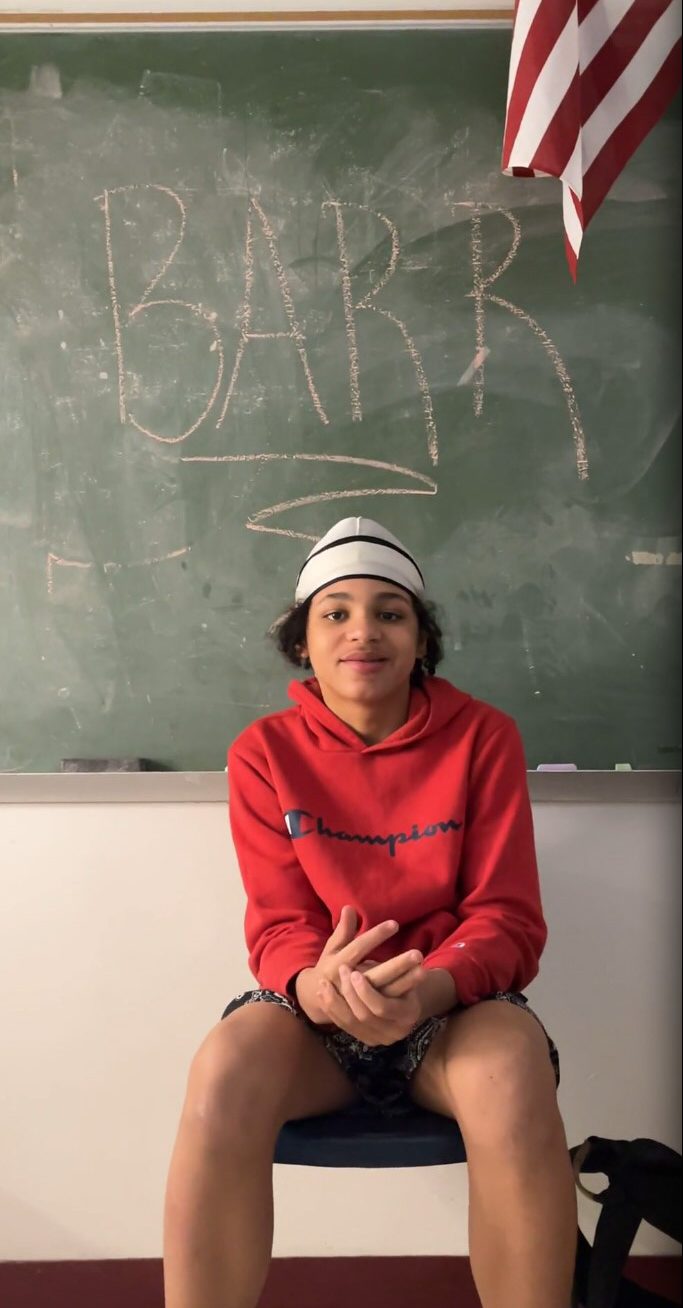
(Seventh grader Chase, above, told us he liked his teachers because they were kind and cared about him.)
Noble Middle School has created a community of students who genuinely respect and trust their teachers and each other through the Building Assets Reducing Risks (BARR) model. “The teachers, the students, and everyone just support you. There’s really no negativity,” Chase, a Noble seventh grader, says of his school.
“It’s a really great school,” says James, a sixth grader at Noble who has attended five different schools, traveling from Texas for his father’s job in the Navy. “There are amazing teachers and students, and the classes are really fun,” continued James, sharing that Noble was his favorite school he has attended yet.
Walking down the hall, it is easy to see why Chase and James love their school. One is struck by the way students brighten up when they speak to educators, calling out to them in the halls and even asking how their days are going. Noble’s method to success is its dedication to building positive relationships across the school community through BARR. BARR is an education model that combines relationship building (staff to staff, staff to student, and student to student) and real-time data to strengthen student engagement and well-being. In 2016, BARR and Intervention Coordinator Kristen Hobbs implemented the program at Noble.
“We were one of the first middle schools in the country to use BARR,” remembers Hobbs. “there was a double-blind study with BARR at Noble High School, then we fully implemented the program here the year after.”
In BARR’s block meetings, educators discuss students’ strengths and needs, analyze data, and deepen relationships within the school. At Noble Middle, these meetings alternate between sixth and seventh-grade teams.
Principal Michael Archambault details how BARR works at Noble as such: “Every kid is on a team, and they have four regular education or core subject teachers that make up the team. Every other week, the team, plus a school counselor, administrator, BARR coordinator, and potentially some interventionists, attend [a block meeting]. At the meetings, students are leveled zero, one, two, or three based on several indicators. It could be grades, at-risk behavior, or attendance. And then we go through and we talk about some of the kids that have come up that we need to sort of share information on and make sure we’re on the same page.”
As he continues, Principal Archambault shares how the team stays constructive during the meetings: “We start with a spark, like a positive about a kid, like they’re on the basketball team or they really like skateboarding. So, we try to start off with a strength and then talk about the student.”
Sitting in on Noble’s block meeting, one can’t help but note the affection these educators have for their students.
“Before BARR, teams would meet, but it was more about the nuts and bolts of how their team ran” said Hobbs. “BARR makes it so that you have to come up with intervention plans.”
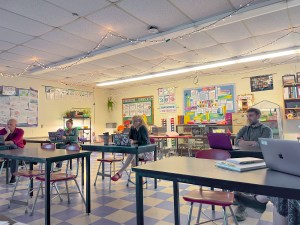
During Monday morning’s block meeting, seventh-grade social studies teacher Mark Lafond brought up a student struggling to complete work and come to class. He noted that the student has trouble seeing and that the parents might be unable to afford glasses. As a solution, he offered to bring in frames he had at home and have the lenses replaced with the student’s prescription. “My wife used to work for Warby Parker,” Lafond explained, “so we have a ton of [glasses] at home.” The way these educators will go the extra mile to help a child promotes trust and, in turn, creates positive teacher-student relationships, which is precisely what BARR is working to accomplish.
As the year progresses, each student is discussed in a block meeting at least once by their team, with the purpose of acknowledging and seeing every student. When block meeting interventions, such as Lafond’s plan to find his student glasses, are insufficient, they are moved up the risk scale. Students with continuously high-risk ratings are escalated to community connect meetings, which they refer to as “risk reviews” at Noble.
“We have risk reviews Monday and Friday mornings,” said Principal Archambault. “In that meeting, there would be a special education case manager, a social worker, counselors, administrators, and a school psychologist. The idea is to find community intervention.”
Principal Archambault also shared one of the most powerful parts of Noble’s BARR strategy, their mentorship program.
Hobbs created the mentorship early into Noble’s BARR journey to support students with high-risk ratings.
“It is definitely one of the stronger interventions that you can implement,” says Assistant Principal Melinda Luders. Since Noble started the program, Hobbs has personally created more than 200 mentor matches, with some mentors, including Hobbs, working with their mentees well into high school.
“It just continues to support the idea of kids knowing that they have an adult that is going to check in on them,” said Principal Archambault. “It doesn’t have to be like an agenda driven situation or anything like that. It’s about ‘we have a one-on-one relationship where you’re accountable to say hello to me, and I will make time for you.’”
Noble’s success with BARR is well known, which is why Loranger Memorial School Principal Matthew Foster drove from Old Orchard Beach to observe how the school implements the program.
“The goal for teachers is to get to know the kids in different ways,” said Foster, “That’s what we are looking at BARR for right now.”
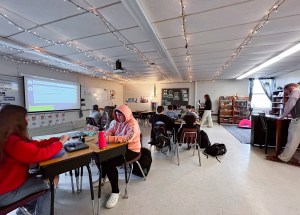
While at Noble, Foster observed a sixth-grade I-Time. I-Time is an activity taught by block teachers to their assigned group of students. It is a structured time for BARR educators to build those student-to-student and student-to-teacher relationships. This particular I-Time was a true masterclass taught by English Language Arts teacher Melanie Stevens. The respect and adoration Stevens evokes in her students shows how truly she has honed her craft.
As a teacher, Stephens is a big fan of BARR, especially the opportunity to build stronger relationships with her students: “I-Time is used to help these kids identify that they’re not alone in the things that they struggle with. It’s not like your typical SEL-type activities. It’s a little bit different in that some of them do get a little bit deeper because students don’t always have the outlets for the kind of conversation at home.”
Stevens used I-Time to discuss grief and how even the smallest everyday loss can change a person.
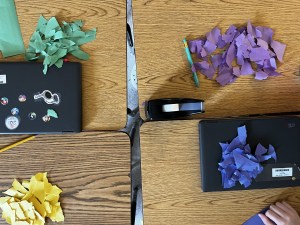
“There are so many things that happen in the day to day. [Grief] doesn’t have to be this huge, huge thing. It can be these little things as well,” said Stevens. She illustrated this by reading students a story about a young girl’s attempt to join a prestigious dancing school and having the students rip off a piece of their colored paper sheet whenever they heard something that made them feel bad. In the end, she gave the students tape and had them attempt to put the piece of paper back together again.
“What’s the point? Is it back to normal? Were you able to get it back to the way it was? What are we trying to get you to think about?” Stevens asked her class.
“Even if something happened a while ago, you could still remember it,” responded a student named Jackson. Another student, Sumner, from across the room, answered, “Mean things people say can change you.”
To round out the lesson, Stevens explained to her students the Japanese Art of Kintsugi, a method of repairing broken pottery with gold. Foster showed them an image of a blue bowl, cracks filled with gold, and asked, “It’s broken, but doesn’t it look better this way?”
Noble is one of more than 70 schools across Maine implementing BARR. Read more about BARR at Mt. Blue High School and Calais Elementary School and listen to Maine Education Commissioner Pender Makin’s podcast episode talking with educators who have implemented BARR at their schools.
If you are inspired by Noble’s story and think BARR would be the right fit for your school, the DOE is offering additional BARR funding for the 2024-2025 school year.
Applications are now open to all willing and qualified public schools that want to become BARR schools. Click here to apply. Applications are due by March 22, 2024, at 5:00 p.m. EST.
The Maine DOE will cover all costs of implementing the program for schools new to BARR for the 2024-2025 school year. (Note: if you are already a BARR school with an existing contract, your costs will also be covered for the 2024-2025 school year, and you do not need to reapply.)
The Maine DOE used American Rescue Plan funding to create a competitive BARR grant to help schools invest in the model.
 Maine DOE Newsroom