Reminder: Regional School Calendar Coordination Between SAUs and CTEs

As a reminder, Regional School Calendars are due by June 1, 2024 for school administrative units (SAU) and private schools, approved for tuition purposes, in coordination with their local secondary career and technical education (CTE) school. This requirement is part of Public Law 2011, Chapter 686 to promote collaboration among local school administrative units that may benefit from inter-administrative unit collaboration beyond CTE.

For school year 2024-25, both regional school calendars and individual calendars for each school administrative unit must be submitted by the director of the local CTE Center/Region to the Maine Department of Education (DOE) no later than June 1, 2024, for a decision on approval by July 12, 2024.

Guidance and templates or Regional School Calendars can be accessed electronically on the Maine DOE website.

Given the coordination required to fulfill this law, the Maine DOE recommends that SAUs initiate discussions as soon as possible, including representatives from all affected secondary schools and their associated career and technical education center or region.

Please visit the Maine DOE Website for more information, including guidance, instructions, templates, a waiver process, and a link to the complete law.

Further questions should be directed to Emily Doughty emily.doughty@maine.gov at 207-592-0314 or Dwight Littlefield dwight.a.littlefield@maine.gov at 207- 441-8927.

Inclusive Education Webinar Series Available: Inclusion for Students with IDD and Complex Needs & Assistive Technology (AT)

The Maine Department of Education (DOE) Office of Special Services & Inclusive Education has three upcoming Inclusive Education Webinars Series planned.

Two-Part Inclusive Education Webinar Series: High Leverage Practice to Promote Inclusion for Students with IDD and Complex Needs

This two-part series, hosted by MAIER and the Office of Special Services & Inclusive Education, will provide well-structured content on different pedagogies and how high-leverage practice to promote inclusion can be conducted by developing strategies that promote inclusiveness and principles for students with IDD and Complex Needs.

Part 1 Wednesday, March 20th, 4:00 pm – Register here 

In this session, presenters describe a practical approach for orienting our teaching practices toward ensuring students with IDD and Complex Needs can construct enviable lives within their self-selected communities. This practical session will meet teachers where they are on their inclusive practice journey and provide simple strategies for taking that next step.

Part 2 Thursday, April 4th, 4:00 pm –  Register here.

In the second session, participants will learn new strategies and inclusive approaches necessary for assisting students with IDD and Complex Needs and how to provide intensive supports for students regardless of dis/ability. The session will help the participant to develop action points and strategies necessary for incorporating cultural practices into teaching and learning process.

Presenters (moved up presenter info)

Robert C. Pennington has served as the Assistant Director of Training and Executive Director for the Kentucky Autism Training Center (KATC) and currently is an Instructor in the Department of Special Education at the University of Louisville. He earned his PhD at the University of Kentucky and has over 20 years of experience in working with individuals with disabilities and their families in school and communities’ contexts. He has served as a classroom teacher and district technical assistance provider, and piloted Jefferson County Public Schools’ first autism inclusion model (AIM). His research interests include autism spectrum disorders, applied behavior analysis, writing instruction, and teacher preparation.

Monique Pinczynski is a first generation doctoral student at the University of North Carolina Charlotte in Special Education. She was previously a classroom teacher in Henderson, NV where she taught students with autism and extensive support needs as well as students with learning disabilities. Monique earned her B.S. and M.Ed. in Special Education at the University of Nevada Las Vegas, where she also attained her Board Certified Behavior Analyst certification. Her research interests include implementing evidence-based practices with students with autism and extensive support needs with a focus on communication as well as supporting teachers in this area.

Inclusive Education Webinar Series: Dispelling Myths about Assistive Technology (AT) Devices and Services

Want to learn more about assistive technology use in the classroom to benefit all learners? Recent guidance on the myths and facts surrounding assistive technology was released from the federal government which supports reducing barriers that often lead to a lack of utilization of AT. This webinar, hosted by Maine CITE and the Office of Special Services & Inclusive Education, and led by Maine CITE director, Jessi Wright, will guide educators, administrators and ed techs through the latest AT information and provide insights on moving toward a more inclusive education environment.

This will be a two session event – March 12th from 4-5pm will include the overview of the myths and March 19th from 4-5pm will be an open forum for the public to come for conversations about the use of assistive technology in schools.  Register here.

For more information or questions on either of these opportunities, contact Tracy Whitlock at tracy.w.whitlock@maine.gov

Photography and Poetry Gallery at Lyseth Elementary School

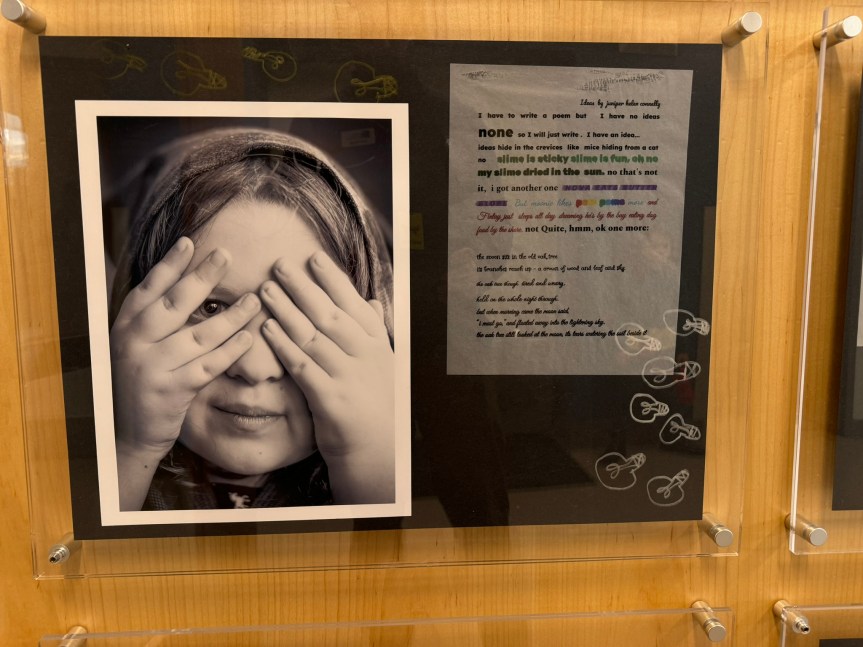
Walking into the bright atrium of Lyseth Elementary School in Portland, you are met by giant black-and-white photographs of the 20 students in Leigh Quigley’s 4th-grade class. Hanging from the skylight are even more pictures, pictures that students took after learning photography elements like composition, light, and focal point from professional photographer Liz Bieber. Proud adults gather around, taking pictures of student work. As you walk to the end of the atrium, framed images of students and the poetry they wrote, the conclusion to a poetry unit designed to build empathy, understanding, and community within the classroom, hang on the wall in neat rows.

The unit began as a single-focus poetry unit where students were exposed to classic and modern poets and forms and then transferred their learning to create original poetry that captured their voices. After a visit to the Bowdoin Museum of Art, student’s curiosity and excitement transformed the single focus into a multidisciplinary unit that included original photography. Students added knowledge and skills around photography to their poetry knowledge and applied those skills by taking candid and studio pictures of their peers that would accompany their poetry. Once photos were taken and poetry was written, students created frames, chose pictures, and typed their poems, which included different fonts and effects that emphasized certain words and phrases.

4th-grade student Patrick explained his choice of purposely using lowercase letters to “make it different than the others.”

The final products were mounted in the atrium, where they would be a prominent addition and visible to every member of the school community.

“I really like taking pictures and writing poetry,” 4th grade student Grace shared. “The hardest part was figuring out what to write, but I used a poem we read before for inspiration.”

Mrs. Quigley noticed an increase in student engagement but also grew professionally herself. “Working with them every day opened my eyes to new ways of thinking. They provided a fresh take on the subject matter through their unique interpretations.”

This project gave students an opportunity to share their voices, but it also has had ripple effects throughout the school. Lyseth principal Sara Goodall shared that “kids, families, and staff are asking and excited to learn more” and that “less than a week after it opened, Lyseth is exploring a photography club.”

The student voice in their poetry, the choice of which photos to use to illustrate their poetry, the community gathering to celebrate,  and the ripple effects it has caused throughout the school are concrete examples of the school’s core value of “we all belong here at Lyseth.”

This story was a collaboration between the Maine Department of Education’s Interdisciplinary Instruction (II) Team and Lyseth Elementary School. If you are interested in collaborating with the Maine DOE’s II Team to showcase your school’s interdisciplinary instructional work, reach out to Kathy Bertini at kathy.bertini@maine.gov. You can also submit Maine school highlights to Maine DOE’s Good News Submission Form.

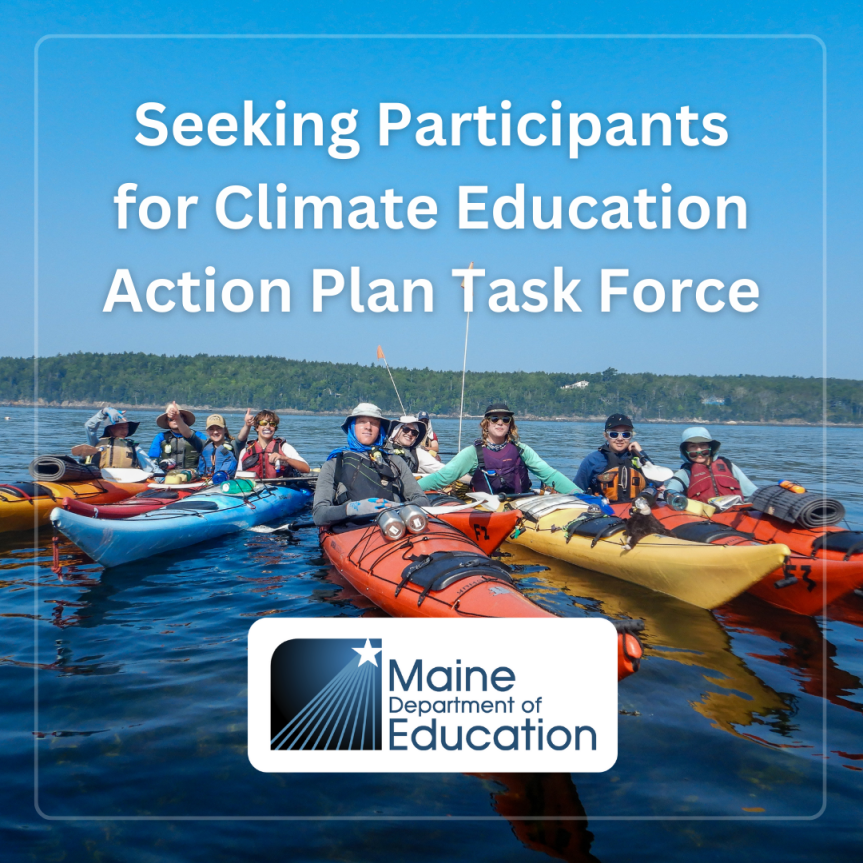
Maine DOE Seeks Participants for Climate Education Action Plan Task Force

The Maine Department of Education (DOE) wants your help designing the future of climate education in Maine. If you are a teacher, student or young adult (under 30), school administrator, or education partner, consider filling out the interest form below to be a part of the Maine DOE Climate Education Action Plan Task Force.

Based on a recommendation from the Maine Climate Council, this task force will bring together stakeholders from across the state with a wide range of perspectives. The task force will discuss the challenges facing climate education in public pre-K – 12 schools and develop an action-oriented plan for stakeholders to address those challenges. The action plan will focus on curriculum, resources, plans, and policies that might be restructured, supported, or built.

This work will build upon the work of the Maine Climate Council, the Maine Environmental Literacy Plan, and other state work throughout the country. This process will be public, and there will be several opportunities for comment and feedback for anyone not on the taskforce to contribute to the work.

The Basics:

  • The task force will be comprised of 20-25 stakeholders from throughout the state of Maine and serving in a variety of roles: teacher, school/district leadership, partner organizations such as community-based nonprofits, workforce development, and youth. Stakeholders will be selected based on a breadth of perspectives including region and role.
  • This task force will meet seven times from early April to early June. The schedule is detailed below.

Outcomes:

  • 4-6 defined and detailed challenges/goals with 2-5 action steps for each goal for stakeholders to undertake within a defined timeline.
  • Published as the Maine Climate Education Action Plan (3-5 pages)
  • 4-year timeline for climate education action for a variety of stakeholders.

Timeline:

Date Time Location
Tuesday, April 9th 3:30 – 5:00 pm Virtual
Tuesday, April 23rd 9:00 am – 3:00 pm In Person – Augusta
Monday, May 6th 3:30 – 5:00 pm Virtual
Monday, May 20th 3:30 – 5:00 pm Virtual
Tuesday, May 28th 3:30 – 5:00 pm Virtual
Tuesday, June 4th 9:00 am – 3:00 pm In Person – Augusta
To be determined 3:30 – 5:00 pm Virtual

For more information as well as updates before and during this process, please visit this link: Climate Education Action Taskforce and Plan | Department of Education (maine.gov)


Maine DOE Update – March 1, 2024

From the Maine Department of Education


Reporting Items

| Visit the DC&R Reporting Calendar |


News & Updates

Maine DOE Podcast Highlights Hands-On Career and Technical Education Experiences

Career and Technical Education (CTE) programs provide Maine students with hands-on experiences in programs like culinary arts, welding, auto, law enforcement, early childhood education, and so much more. On this month’s What Holds Us Together podcast, Maine Education Commissioner Pender Makin talks with three CTE leaders about this engaging learning pathway, Randy Crockett from Oxford Hills Technical School, Bobby Deetjen from Mid-Coast School of Technology, and Bill Tracy from Hancock County Technical Center. They share how CTEs help students build the skills, knowledge, and real-world experiences they need to thrive.  |  More

Celebrate #SELday 2024 by Sharing Your School Highlights!

We know that Maine schools are doing amazing things to cultivate the social and emotional learning of all of their students and we want to share that collective success with the nation. With that in mind, this year we are asking you to participate in this national effort by sharing your SEL highlights during the school year and beyond and/or share your school’s 2024 SEL Day activities and initiatives by filling out this form. |  More

Solar Eclipse Resources for Educators

On April 8th, a scientific phenomenon that hasn’t occurred since 1963 will darken the skies. A total solar eclipse will pass over central and northern Maine! To support educators across the state, the Maine Department of Education (DOE) has created a website with solar eclipse resources for the classroom. Don’t be left in the dark; check out these engaging Maine DOE resources for this exciting celestial event. |  More

A Celebration of Outdoor Learning

The Maine Department of Education (DOE) joined Maine environmental education organizations at the State House’s Hall of Flags in celebration of outdoor learning and the release of the 2022 Census of Community-Based Outdoor and Environmental Learning. |  More

Register Now for Alternative Education Association of Maine Spring Conference

Information about the Alternative Education Association of Maine’s Spring Conference is now available. The theme of this year’s conference is Better Understanding the Alternative Education Learner. |  More


Maine Schools Sharing Success Stories

Celebrating Women in CTE: Meet Welding Student Emma Koch from Rumford

Emma Koch is currently in her senior year at Mountain Valley High School in Rumford, Maine, and in her second year at Region 9 School of Applied Technology where she participates in the metal trades program. The two-year program combines the hands-on use of machine tools and equipment with different types of welding and fabrication of metals through lab exercises and a variety of projects. |  More

Step Inside Hancock County Technical Center

Hancock County Technical Center (HCTC) opened its doors to the Maine Department of Education (DOE) on Valentine’s Day to provide a glimpse of what a day looks like within its walls. Upon arrival, the smell of baked scallops drifted down the hallway from the culinary program at work preparing a special meal for staff. The office was buzzing with the anticipation of another day of learning, with students and staff discussing college plans, transportation routes, and what they are looking forward to as the season changes. |  More

Extended-Day Enrichment Program Boosts Math Skills and Attendance in Dexter, Maine

When Ridge View Community School (RVCS) in Dexter, Maine, utilized Emergency Relief Funds to establish an extended-day enrichment program for students in grades 3-8, they couldn’t anticipate the immediate positive impact it would bring. |  More

Celebrating Women in CTE: Meet Auto Collision Instructor Danica Wooster

Danica Wooster has taught the Auto Collision program at the Mid-Coast School of Technology (MCST) for the last 13 years. The program offers a diverse look into the automotive collision industry, including working with the most up-to-date tools and equipment and learning skills in welding, paint preparation, dent repair, and detailing. |  More

| Submit your Maine School Success Story |


Professional Development, Training, and Events

Paid Professional Learning Opportunity Provided by Maine DOE

The Maine Department of Education (DOE) is accepting applications from individuals interested in learning more about the competitive grant process. Selected applicants will be trained to serve as peer reviewers who assist the Maine DOE in reviewing, assessing, and scoring competitive grant proposals for the 21st Century Community Learning Centers (21st CCLC) Program. |  More

Pre-K for ME, K for ME, and 1st Grade for ME Program Overviews and Summer Training Opportunities

Since 2018, the Maine Department of Education (DOE) has adapted and piloted open-source instructional programs for early elementary grades based on the Boston Public School’s evidence-based Focus Curricula. Pre-K for ME was launched in 2019, K for ME was launched in 2021, and 1st Grade for ME was launched in 2023. 2nd Grade for ME is being piloted in Maine classrooms next year and will be made available for the 2025-2026 school year. |  More

Learning Series for Supporting Children, Families, and Communities to Thrive: Promoting Positive Childhood Experiences and Resilience

The Maine Department of Education’s (DOE) Early Learning Team and Maine Department of Health and Human Services (DHHS) Office of Child and Family Services, in partnership with The Maine Resilience Building Network, are excited to announce a professional learning opportunity for childcare and public-school educators working with children from birth to 8 years old. |  More

Register for InnovatED: Igniting Innovation in Education

The Maine Department of Education DOE’s MOOSE and Interdisciplinary Instruction teams are hosting a FREE virtual workshop day with John Spencer, Katie Novak, and Lynn Cuccaro on March 28th. This day-long workshop features morning keynotes from all three speakers and your choice of a two-hour afternoon breakout session with either John, Katie, or Lynn.  |  More

Inclusive Education Webinar Series: Dispelling Myths about Assistive Technology (AT) Devices and Services

Want to learn more about assistive technology use in the classroom to benefit all learners? Recent guidance on the myths and facts surrounding assistive technology was released from the federal government which supports reducing barriers that often lead to a lack of utilization of AT. This webinar, hosted by Maine CITE and the Maine Department of Education’s Office of Special Services & Inclusive Education, will guide educators, administrators, and ed techs through the latest AT information and provide insights on moving toward a more inclusive education environment. |  More

| Visit the Professional Development Calendar |


Latest DOE Career/Project Opportunities:

View current Maine Department of Education employment opportunities here