Get to Know the Maine DOE Team: Meet Emily Poland

Maine DOE team member Emily Poland is being highlighted this week as part of the Get to Know the Maine DOE  Team Campaign. Learn a little more about Emily in this brief question and answer.

What are your roles with DOE?

Officially my role as School Nurse Consultant is to provide state-level leadership and professional development to school nurses. I also liaison with organizations that are involved with Comprehensive School Health and Nursing, and inform the public of rules and statutes related to school health services.

What do you like best about your job?

What I love most about my job is working directly with nurses from all over the state. School nurses can sometimes feel pretty isolated as they are frequently the only healthcare professional in a school. Being able to connect with them and connect them to each other is very rewarding as they support all of our Maine students.

How or why did you decide on this career?

I started working in a hospital setting as an RN many years ago and gave school nursing a try because I wanted a change. School nursing is such a unique profession and I haven’t looked back since. Having the opportunity to work at the state level to promote best practices, plan professional development, advocate for safe and competent care for all students has been an amazing challenge.

What do you like to do outside of work for fun?

I enjoy  time with my family, knitting, reading, gardening, and spending outside in our beautiful state.

How Ashland District School has Adapted to Make Music Education a Priority

By Jonathan Simonoff, Visual and Performing Arts Chair for Ashland Community School

The Ashland District School (MSAD 32) music program tried really hard to keep a positive outlook during these difficult times. Instead of thinking “It’s too bad we can’t do this,” we tried to frame it as, “How great is it that we get to do this now?” We looked at our goals for each part of our Pre-K – 12 curriculum and tried to identify ways to still reach these goals in a safe but engaging environment. For some classes those changes were minimal but other parts of the program had a drastic overhaul.

For example, the youngest elementary grades have not changed much but some parts of instruction are being recorded so that vocal and instrumental songs can still be shown to the students. Those classes are also being taught in each grade’s homeroom now.

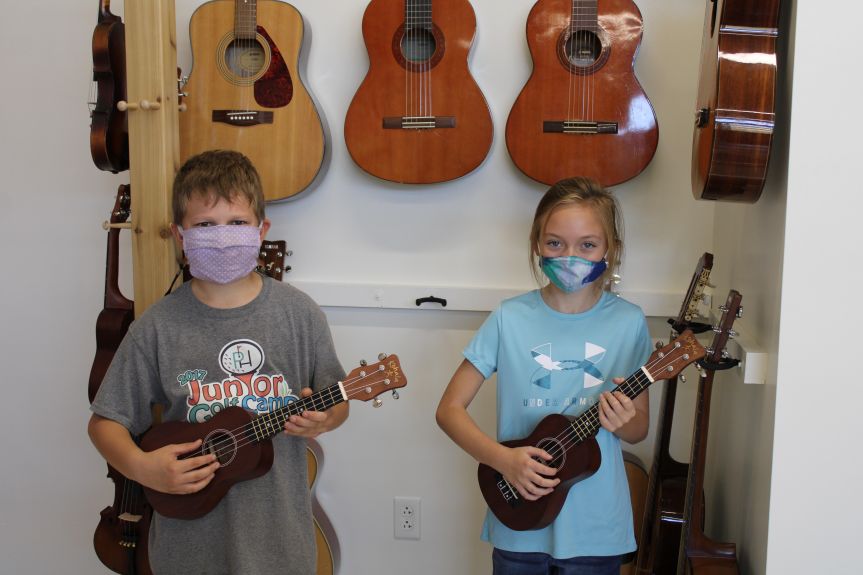
In the past, 4th grade students would use recorders as part of pre-band lessons. This year we are using ukuleles to try to hit upon these concepts. Each student has a ukulele they get to use in class that is sanitized after.
Our beginning band students have also seen a significant change. Since we are not starting any students on traditional band instruments, we have made use of keyboards and drum pads. The class has been put into groups and each student in 5th grade gets a weekly small group lesson on keyboards for note reading skills and drum pads for extra rhythm reinforcement. We are in week 3 of these lessons and so far, every kid is reading and playing very well. I do remind them that they will get a chance to try the band instrument they want but these skills will help them later.

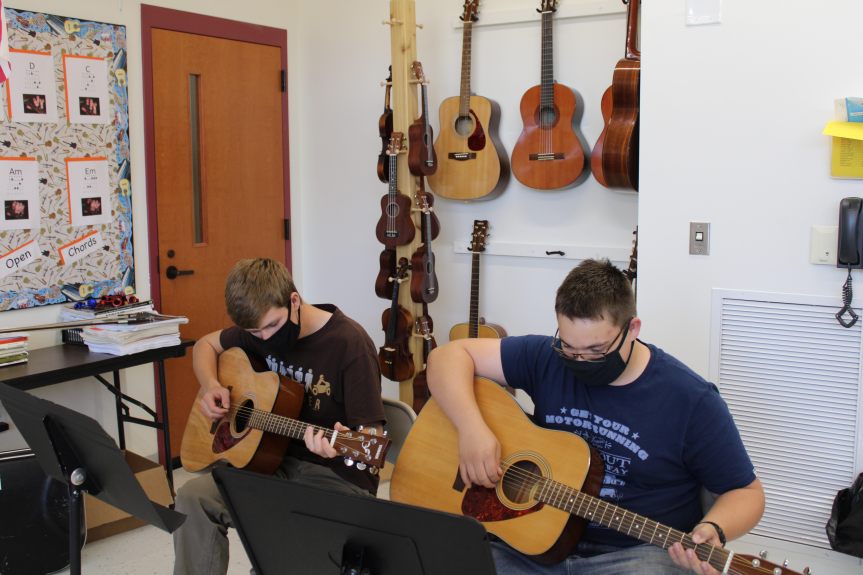
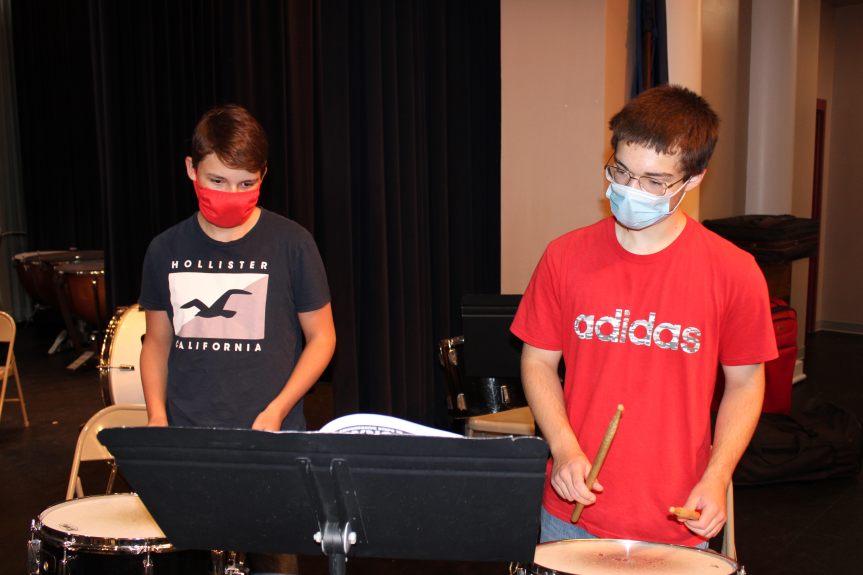
Last year our middle school students usually would have the option of signing up for middle school guitar class or middle school band. This year the guitar class is still an option and the other class they can sign up for is middle school percussion, which focuses on reading and playing rhythms on a variety of traditional and non-traditional percussion instruments.
Perhaps the groups that have changed the most this year are my high school classes. Normally high school students would have the option of taking guitar class or high school band. The guitar class is still running as normal but high school band has changed significantly.

My ed. tech and I have developed an alternating multi-course option for my high school students. We rotate courses every other day and students were able to sign up for one course each day. The courses offered as follows – Piano Class, Percussion Class, Strings Class, Rock Band, Independent Study, or 1 study hall. For example, a student could take piano one day and strings the other day and they follow that schedule for at least a semester before potentially changing their courses.

The classes are pretty self-explanatory.  Piano class (a very popular choice) is like a group piano lab. Percussion class has students spending time practicing rhythms and working on drum set techniques. Strings class is teaching students violin. Rock band (another popular choice) has students working with guitar, bass guitar, piano, and drum set to play modern music and independent study allows students to set up and achieve their own musical goals with check-ins with me to track their progress and give advice. For example, I have a few students working on playing the ukulele and using online guides to help them. I also have some students working on creating their own compositions. Study hall is a chance for students catch up on their other academics.

This set up comes with the understanding that students need to be self-motivated and disciplined since some of the time in class they are expected to work independently while myself or my ed. tech are working with other students. It has been very rewarding both for students and teachers to see progress being made and finding new ways to connect with and learn about music.

It also has been a lot of work to set up in terms of making sure we have enough keyboards and violins. We also are writing some of the music out by ear for students (particularly the Rock Band) to perform. But now that we are a month into school, things seem to be moving along nicely and I am very happy with how this year is shaping up!

This story was submitted by Jonathan Simonoff, Visual and Performing Arts Chair for Ashland Community School in collaboration with Jason Anderson, Visual and Performing Arts Specialist for the Maine DOE as part of the Maine Schools Sharing Success Campaign. To submit a story or an idea email it to Rachel at rachel.paling@maine.gov.

iCivics STUDENT Webinar to Discuss the 2020 Election (For Students/Classrooms Grades 3-12)

On Friday, October 2 at 10am join Joe Schmidt (Social Studies Specialist MDOE) as he hosts an iCivics panel to discuss Getting from “Can’t Vote. Don’t Care” to “Count Me In”: Youth Engagement in a Presidential Election.

This 30-minute session is intended for your students to watch on YouTube live and submit questions as iCivics will talk about the importance of voting (even for students who are not old enough to vote) and how students can be involved. The iCivics panel will then answer questions submitted by your students. You and your students can join in and watch here – https://youtu.be/Kx-85ZlJqPg. The comments section will be turned off so questions will be collected ahead of the webinar.

This form can be shared with your students or collect your student questions and submit on their behalf. This session will be recorded and available for asynchronous viewing at a later time.

Contact Joe Schmidt (joe.schmidt@maine.gov) with any of your questions.

Webinar to Assist with October Student Data Submission

To assist those who are responsible for the important task of reporting October student data to the Department of Education, the DOE Data Team will be holding a webinar on Tuesday, October 6th from 1 pm to 2 pm.

This webinar will focus on how to complete, validate, and certify the October Student Data Reports. If you are tasked with editing, validating or certifying the any of the following October Student Data Reports for your School Administrative Unit (SAU) or school, you are encouraged to attend.

  • October 1st Student Enrollment Count (formerly titled EPS Enrollment)
  • Special Education Child Count EF S 05 Part 1
  • CTE October Student Count

All of these reports and their subsequent counts are used to allocate and distribute state and federal funding to school districts.  It is vital that these counts are correct, and the reports are submitted accurately and on time.

Please click here to register.

If you have any questions, comments or concerns in regards to this webinar, please do not hesitate to contact us at the MEDMS helpdesk at MEDMS.Helpdesk@Maine.gov or (207) 624-6896.

Fulbright Forum Celebrating Global Education: Focus on K-12 Teachers, Higher Education, and Teacher Exchanges

October 24, 2020 is the 75th anniversary of the founding of the United Nations, and 2021 will also be the 75th anniversary of the Fulbright Program! What a perfect opportunity to focus on a segment of our alumni and friends who have been recipients of awards that target support of global education, distinguished achievement in the realm of teaching, and international teacher exchange, such as Distinguished Awards in Teaching (DAT)Teachers for Global Classrooms, and English Teaching Assistant (ETA).

The Oct. 24 virtual event will feature an informational session and overview provided by Outreach & Recruitment of the Institute of International Education (IIE) and the International Research and Exchanges Board (IREX), Washington, DC, of the types of Fulbright awards that are available to U.S. teachers of early, secondary, and higher education. A panel of recently returned alumni will address the value and impact of their awards. Additionally, a panel of representatives from area colleges will discuss global teacher exchange programs at their respective institutions.

Saturday, October 24, 2020 • 9:30-11:30 a.m. • On Zoom

  • 9:30 a.m. • Music Introduction with Fulbright Alumni Timothy Burris & Lauren Crosby
  • 10:00-11:30 a.m. • Speakers and Panelists
  • Introduction by Elaine Potoker, President, Maine Fulbright Chapter
  • Kirsten Brewer, Panel Moderator, Chair of Marketing Committee

Speakers:

  • Emily Dudley, Deputy Project Director for Fulbright Teacher Exchange Programs at IREX
  • Lee RiversOutreach and Recruitment Specialist at the Institute of International Education

Panelists:

  • Lillian Eckstein, English Teaching Assistant, Spain 2018-19
  • Guy Hamlin, Fulbright Teachers for Global Classrooms, Indonesia 2018
  • Miranda Richman, English Teaching Assistant, South Korea 2019-20
  • Erin Towns, Fulbright Teachers for Global Classrooms, Kazakhstan 2012-13 
  • Dr. Linda Beck, Fulbright Hays Scholar, Senegal 1992
  • Dr. William Lindblad, Husson University
  • Dr. Joanne Williams, University of Southern Maine

Reserve Your Seat Online. This event is free and open to the public. 

The Maine Chapter of the Fulbright Association gratefully acknowledges the support of Bangor Savings Bank in sponsoring this event. This event is also brought to you in part by the Bureau of Educational and Cultural Affairs of the U.S. Dept. of State.

For more information, contact the Maine Fulbright Association, maine@fulbright.org.

Priority Notice: Maine DOE seeks public comment on waiving requirement that 21st CCLC programs operate only during non-school hours

In response to the unprecedented obstacles schools, teachers, students, and their families are facing amid the COVID-19 pandemic, the U.S. Department of Education (USDOE) has offered an additional waiver to state education agencies, pursuant to section 4201(b)(1)(A) of the Elementary and Secondary Education Act of 1965 (ESEA).  Under Title IV, Part B of the ESEA, section 4201(b)(1)(A) requiring that 21st Century Community Learning Centers (21st CCLC) programs operate only during non-school hours or periods when school is not in session.  If granted, this waiver would allow 21st CCLC program providers in Maine to temporarily operate with greater flexibilities to better meet the needs to students and families during the 2020-2021 school year.

This waiver would grant the Maine Department of Education (DOE) temporary authority to permit its 21st CCLC programs to provide supplemental services when school is in session, but students are not receiving in-person instruction.  For example, it would be permitted that a teacher provides additional 21st CCLC-funded academic supports for a group of students during a remote learning day when those students are not otherwise engaged in facilitated instruction with their classroom teacher.

The Maine DOE continues to work diligently to support Maine’s schools and educational communities as the 2020-2021 school year begins.  Given the hybrid instructional approaches many schools have adopted this year, students may benefit from dedicated staff and enhanced resources to help with remote lessons, independent work, and other enrichment opportunities during the portion of the week when remote lessons learning is occurring.  It is for reasons such as these that the Maine DOE has chosen to pursue this waiver.

As part of the statutory requirements for seeking this waiver, the Maine DOE must solicit and respond to public comment on its waiver request as well as provide evidence of the available comment period.  This 15-day public comment period shall begin on September 29, 2020 and conclude on October 14, 2020.

Comments may be submitted to: travis.w.doughty@maine.gov

Maine DOE Update – September 25, 2020

From the Maine Department of Education


Reporting Items

MaineCare Seed Adjustments, Q4’20 Reports Due by October 15, 2020

The recovery of Q4’20 MaineCare Seed will occur in the October 2020 subsidy payment and the Maine DOE is asking school administrative units (SAU) to review their reports by October 15, 2020 to ensure accurate adjustments to subsidy. SAU staff must review student by student claims on both the public and private MaineCare reports for Q4’20 by October 15, 2020. | More

| Visit the DC&R Reporting Calendar |

News & Updates

Mills Administration Updates COVID-19 School Health Advisory System

The Mills Administration today released its updated color-coded Health Advisory System that classifies counties’ relative risk of COVID-19 transmission by color and is provided to assist schools as they continue with their plans to deliver instruction and support students safely this fall. | More

Applications Open for United State Senate Youth Program

The United States Senate Youth Program (USSYP) is pleased to announce that the state departments of education nationwide have begun their annual selection processes. Two Maine students will be selected to attend the online Washington Week program March 14-18, 2021 and each will receive a $10,000 undergraduate college scholarship. This year the application process will be completely online with each high school principal able to nominate one student from their high school to be considered.  | More

Applications Open for Yale Young Global Scholars Summer Program

The  Yale Young Global Scholars (YYGS) application is now open. Students in grades 10 or 11 (or international equivalent) from all around the world are encouraged to apply! | More

Foster Center for Student Innovation to Host Virtual Film Screening and Conversation About Women in Entrepreneurship

To shine a light on women in entrepreneurship, the University of Maine’s Foster Center for Student Innovation will be hosting a virtual screening of “SHE STARTED IT” on October 1st at 4PM for high school aged students state-wide. | More

Application Deadline Extended for Maine’s Leadership Development Program 

The Maine Department of Education (DOE) is pleased to announce the opportunity for Maine leaders to participate in the 2020-2021 Maine Leadership Development Program (LDP) cohort!  The Maine LDP is an initiative designed to build and strengthen instructional leadership skills among Maine’s educational leaders at the school, district, and state levels. In our ongoing efforts to support and foster the educational expertise in Maine, educators who aspire to do the same are invited to take advantage of this high impact opportunity! | More

Three Maine Schools Receive National Blue Ribbon School Honors

United States Department of Education (DOE) has recognized three Maine schools as National Blue Ribbon Schools for 2020. The recognition is based on a school’s overall academic performance or progress in closing achievement gaps among student subgroups. | More

Maine Schools Sharing Success Stories

| Submit your Maine School Success Story |

Professional Development & Training Opportunities

| Visit the Professional Development Calendar |


Latest DOE Career/Project Opportunities

View current Maine Department of Education employment opportunities here

MEDIA RELEASE: Mills Administration Updates COVID-19 School Health Advisory System

Oxford and York counties categorized as yellow, Androscoggin closely monitored

AUGUSTA — The Mills Administration today released its updated color-coded Health Advisory System that classifies counties’ relative risk of COVID-19 transmission by color and is provided to assist schools as they continue with their plans to deliver instruction and support students safely this fall.

The Health Advisory System is a collaboration among the Maine Department of Health and Human Services (DHHS), Maine Center for Disease Control and Prevention (CDC), and Maine Department of Education (DOE)This week’s designations include the following:

  • Oxford County is recategorized from green to yellow as a result of rapid and significant increases in COVID-19 prevalence. The rate of new cases per 10,000 residents over the last two weeks jumped from 4.66 cases to 10.69 cases, exceeding the rate of new cases in York County. Its two-week positivity rate increased from 1.6 to 2.1 percent.
  • York County remains yellow and is still an area of concern. Its rate of new cases per 10,000 residents over the last two weeks increased from 7.66 to 9.44. Its positivity rate remains at 2 percent and Maine CDC has opened 8 outbreak investigations in the last two weeks. Most of the outbreak activity remains concentrated in the Sanford and Springvale area, but a number of new cases in York County are not readily traced to known outbreaks, suggesting increasing community transmission.
  • Androscoggin County remains green but will be closely monitored. Its rate of new cases per 10,000 residents over the last two weeks increased from 3.79 to 6.37. The positivity rate increased slightly from 0.6 to 0.7 percent.

Androscoggin County, now noted with an asterisk in the advisory system, as well as counties designated as yellow, are being monitored closely and will be reassessed weekly. These changes are made out of an abundance of caution and for the consideration of school administrative units in their decisions to deliver instruction.

Under the “yellow” designation, which indicates an increased (moderate) level of community risk, schools may consider additional precautions, such as limiting numbers of people in school buildings at the same time, suspending all extracurricular or co-curricular activities including competitions between schools, limiting interaction through cohorting, or other measures based on the unique needs of each school community.

Maine’s other 13 counties remain green and will be reassessed every two weeks.

It is essential that school districts across the State of Maine continue to implement plans that adhere to the six requirements for returning to in-person instruction, regardless of their county’s red, yellow, or green designation:

  1. Symptom Screening at Home Before Coming to School (for all Staff and Students) – Students (parents/caregivers) and staff members must conduct self-checks for symptoms prior to boarding buses or entering school buildings each day.  Schools should provide information to families in their primary language to support them in conducting this check.   Any person showing symptoms must report their symptoms and not be present at school.  Schools must provide clear and accessible directions to parents/caregivers and students for reporting symptoms and absences.
  2. Physical Distancing and Facilities– Adults must maintain 6 feet of distance from others to the extent possible. Maintaining 3 feet of distance is acceptable between and among students when combined with the other measures outlined in this list of safety requirements.  6 feet of physical distancing is required for students while eating breakfast and lunch, as students will be unable to wear masks at that time.   A “medical isolation space” (separate from the nurse’s office) must be designated for students/staff who exhibit COVID-19 symptoms during the school day. Adequate ventilation is required for classrooms, with schools having flexibility in implementation such as using properly working ventilation systems or outdoor air exchange using fans in open windows or doors. Groups in any one area, room, or classroom must not exceed the Governor’s gathering size limits.
  3. Masks/Face Coverings– Adults, including educators and staff, are required to wear a mask/face covering. Students age five and above are required to wear a mask/face covering that covers their nose and mouth.  Masks are recommended for children ages two to four, when developmentally appropriate. Masks/face coverings must be worn by all students on the bus. Face shields may be an alternative for those students with documented medical or behavioral challenges who are unable to wear masks/face coverings. (Updated 8/12/20). The same applies to staff with medical or other health reasons for being unable to wear face coverings. Face shields worn in place of a face covering must extend below the chin and back to the ears. An exception for wearing a mask or face shield applies only to an individual participating in voluntary school sports during vigorous physical exercise. (Updated 09/09/20). Nothing in this framework’s mask/face covering requirements should be interpreted as preventing a school from making accommodations on an individualized basis as required by state or federal disabilities laws.(Updated 9/15/20)
  4. Hand Hygiene– All students and staff in a school must receive training in proper hand hygiene. All students and staff must wash hands or use sanitizing gel upon entering the school, before and after eating, before and after donning or removing a face mask, after using the restroom, before and after use of playgrounds and shared equipment, and before and after riding school transportation.
  5. Personal Protective Equipment– Additional safety precautions are required for school nurses and/or any staff supporting students in close proximity, when distance is not possible, or when student require physical assistance. These precautions must at a minimum include eye protection (e.g., face shield or goggles) and a mask/face covering. Classrooms and/or areas that have been used by an individual diagnosed with Covid-19 must be closed off until thorough cleaning and sanitization takes place.
  6. Return to School after Illness– Sick staff members and students must use home isolation until they meet criteria for returning to school.

The Health Advisory System categorizations are defined as follows:

  • RED: Categorization as “red” suggests that the county has a high risk of COVID-19 spread and that in-person instruction is not advisable.
  • YELLOW: Categorization as “yellow” suggests that that the county has an elevated risk of COVID-19 spread and that schools may consider additional precautions and/or hybrid instructional models as a way to reduce the number of people in schools and classrooms at any one time.
  • GREEN: Categorization as “green” suggests that the county has a relatively low risk of COVID-19 spread and that schools may consider in-person instruction, as long as they are able to implement the required health and safety measures.  Schools in a “green” county may need to use hybrid instruction models if there is insufficient capacity or other factors (facilities, staffing, geography/transportation, etc.) that may prevent full implementation of the health and safety requirements.

The county-level assessments are based on both quantitative and qualitative data, including but not limited to recent case rates, positivity rates, and syndromic data (e.g., symptoms of influenza or COVID-19). Those data are publicly posted every week on the Maine CDC website. DHHS and Maine CDC also consider qualitative factors, such as the presence of outbreaks that may potentially affect school-age children.

The Health Advisory System reflects ongoing analysis of evolving data, and serves as one piece of information that school and district leaders can use to make decisions about how to deliver education this fall. The qualitative and quantitative considerations and data used by the CDC in determining community transmission risk levels for schools can be located here: How County Risk Levels for Maine Schools are Determined

The Health Advisory System can be found on the Maine DOE website in Part I of the Framework for Reopening Schools and Returning to In-Person Classroom Instructionhttps://www.maine.gov/doe/framework/part-I.

The next update is scheduled for Friday, October 2, 2020.

MEDIA RELEASE: Three Maine Schools Receive National Blue Ribbon School Honors

United States Department of Education (DOE) has recognized three Maine schools as National Blue Ribbon Schools for 2020. The recognition is based on a school’s overall academic performance or progress in closing achievement gaps among student subgroups.

The following Maine schools were recognized:

Easton Elementary School, Easton School Department

Mary Snow Elementary School, Bangor School Department

Pond Cove Elementary School, Cape Elizabeth School Department

The National Blue Ribbon Schools award affirms the hard work of educators, families, and communities in creating safe and welcoming schools where students master challenging and engaging content. Now in its 38th year, the National Blue Ribbon Schools Program has recognized more than 9,000 schools.

U.S. DOE recognizes all schools in one of two performance categories, based on all student scores, student subgroup scores and graduation rates:

  • Exemplary High Performing Schools are among their state’s highest performing schools as measured by state assessments or nationally normed tests.
  • Exemplary Achievement Gap Closing Schools are among their state’s highest performing schools in closing achievement gaps between a school’s student groups and all students.

Up to 420 schools may be nominated each year. The Department invites National Blue Ribbon School nominations from the top education official in all states, the District of Columbia, Puerto Rico, the Virgin Islands, the Department of Defense Education Activity, and the Bureau of Indian Education. Private schools are nominated by The Council for American Private Education (CAPE).

The 2020 National Blue Ribbon Schools Awards Ceremony will be held virtually Nov. 12 and 13 and they will each receive their plaques and flags via mail.

Photographs and brief descriptions of all 2020 National Blue Ribbon Schools are available at https://www.ed.gov/nationalblueribbonschools.

Application Deadline Extended for Maine’s Leadership Development Program  

The Maine Department of Education (DOE) is pleased to announce the opportunity for Maine leaders to participate in the 2020-2021 Maine Leadership Development Program (LDP) cohort!  The Maine LDP is an initiative designed to build and strengthen instructional leadership skills among Maine’s educational leaders at the school, district, and state levels. In our ongoing efforts to support and foster the educational expertise in Maine, educators who aspire to do the same are invited to take advantage of this high impact opportunity!

The Department will re-open the application process for a limited time.  Applications will be due by September 28, 2020 in order to ensure that selected participants are prepared to participate in Unit 1 on October 19 and October 20. A link to access more information and application materials can be found below.

During the 2019-2020 school year, the Maine DOE partnered with the National Institute for School Leadership (NISL) to prepare the first cohort of candidates to become certified trainers and facilitators of future cohorts.  The 2020-2021 cohort will be led by Maine leaders committed to excellence in education.

Maine’s LDP is delivered through a blended learning model including case studies, inquiry, and hands-on activities with practical applications that meet the rigorous expectations for today’s educational leaders.  Successful completion of the LDP may contribute to credit hours for participants pursuing an advanced degree or contact hours for re-certification purposes.

Benefits for Maine Schools

  • Prepares educational leaders to lead for excellence and equity
  • Increases student achievement, and fosters a culture of high expectations
  • Enhances teacher recruitment, retention, and quality

Program Curriculum

  • Nationally researched, evidenced-based, and locally delivered in a cohort model
  • Improves the practice of leadership, transforms instruction and student achievement in schools
  • Consists of 12 two-day units, delivered in 12 months
  • Bridged with online coursework, readings, and job-embedded application of key concepts through action learning

Characteristics of Ideal Candidates

  • A belief in and commitment to improving instruction and increasing achievement for all students
  • Experience in a leadership role at the school, district, and/or state level with background as a classroom teacher. Ideal candidates include, but are not limited to, teachers, principals, assistant principals, instructional coaches, deans, Title I directors, department leaders, ESEA coordinators, special education directors, English Learner directors, assistant superintendents, instruction and curriculum directors, CTE instructors, CTE directors, and superintendents. Priority will be given to educational leaders from schools identified to receive Tier III support throughout Maine.
  • Excellent communications skills; able to effectively facilitate professional development for peers
  • Demonstrated skills in mentoring and coaching
  • Experience as a successful practitioner who is able to translate concepts to actions, theory to practice, and programs to craft
  • Able to participate in the entire Maine LDP Program and deeply engage in action learning
  • Likely to live and work in Maine for the next five years

Please visit http://www.maine.gov/doe/educators/maineldp to hear from participants and for more information.

To view the program schedule and download the application visit:  https://www.maine.gov/doe/educators/maineldp/application.

The Department encourages educational leaders to consider applying for this exciting opportunity!

For more information please email emily.doughty@maine.gov.