Professional Learning Opportunity: Reopening Maine School Libraries

The Maine Association of School Libraries (MASL)  is hosting a webinar on Tuesday, August 4, 2020 from 4:00 – 5:00 pm to explore the issues around the reopening of Maine school libraries.

With Janet McKenney, from the Maine State Library, Jennifer Alvino, Director of the Windham Public Library, along with representatives from Maine’s CDC and the DOE, the webinar will identify solutions to the problems librarians will face as they plan to safely reopen their facilities this fall while continuing to facilitate learning, support curriculum, and promote literacy.

To register for this free event, open to all Maine educators, visit this link: http://www.maslibraries.org/events

English Language Arts, Life and Career Ready, and Mathematics Standards Updated

Final adoption of Chapter 132 is effective July 18, 2020, following the submission of all required Administrative Procedures Act (APA) documentation with the Secretary of State’s Office. Chapter 132: Learning Results: Parameters for Essential Instruction revised the English Language Arts, Life and Career Ready (formerly Career and Education Development), and Mathematics standards.

The Maine DOE will be providing guidance and resources to SAUs in making the transition to the revised standards throughout the school year. There is no pre-determined date when SAUs must make the transition to the revised standards. It is the Department’s expectation that SAUs will use their own professional judgment and phase in the revised standards at a pace that makes sense for their students and for their educational practice. While, due to the COVID-19 pandemic, in-person events are not planned at this time, digital resources, virtual training, and “office hours” with content specialists are ongoing and will support professional learning about the updated standards.

The updated English Language Arts standards are streamlined, edited from the previous standards to clarify related or similar learning goals; the standards are slimmed to focus on the essential outcomes for literacy development; the updated standards are also reordered to emphasize that the language strand is central to the development of the other ELA strands. Visit English Language Arts/Literacy content standards here and contact Danielle “Dee” Saucier for K-5 and Morgan Dunton for 6-12 supports.

The Life and Career Ready content standards build from and update the 2007 Career and Education Development standards and include the braiding of social emotional learning with career development.  Visit the Life and Career Ready Standards here and contact Diana Doiron for K-12 supports.

The updated Mathematics standards are reformatted, edited and streamlined from the previous standards to better articulate the progression of learning within and across the grade spans. Visit Mathematics Standards here and contact Jennifer Robitaille for K-5 and Michele Mailhot for 6-12 supports.

MEDIA RELEASE: Mills Administration Releases Guidance to Assist Schools with Fall Plans

Health Advisory System reflects relative risk by county, updated requirements to safely reopen schools promote public health

AUGUSTA — The Mills Administration today released updated guidance to assist school communities in making their decisions about how to resume instruction this fall in the face of COVID-19.  This guidance includes the Health Advisory System that classifies counties’ relative risk by color as well as updated requirements for schools to reopen safely.

The Health Advisory System is a collaboration among the Maine Department of Education (DOE), the Maine Department of Health and Human Services (DHHS), and the Maine Center for Disease Control and Prevention (Maine CDC). The previously announced classifications were developed to categorize counties based on quantitative and qualitative data about COVID-19 including, but not limited to, recent data on case rates, positivity rates, and syndromic data (e.g., symptoms of influenza or COVID-19). This system categorizes counties by three-color based designations: red, yellow, and green.

The initial assessment released today showed that 16 Maine counties are currently categorized as “green,” suggesting a relatively low COVID-19 risk at this time and that in-person instruction can be adopted as long as schools can implement the six Requirements for Safely Opening Schools in the Fall. While COVID-19 remains more prevalent in Cumberland, York, Androscoggin, and Sagadahoc counties than in other Maine counties, the assessment pertains to the unique circumstances of schools and currently indicates relatively limited risk statewide. All counties, like the state as a whole, have COVID-19 prevalence below that of virtually all other states.

Circumstances could change between now and the official start of the school year. The Health Advisory System reflects ongoing analysis of evolving data. It will be updated every two weeks, serving as one piece of information that school and district leaders can use to make decisions about how to deliver education this fall.

“Today, we are providing additional guidance to school districts as they decide how to proceed with the school year,” said Maine DOE Commissioner Pender Makin. “While I’m grateful to know that our state continues to be relatively safe due to the vigilance of Maine people, this risk evaluation is intended to be, and should be, just one of several variables that local school districts take into consideration as they make decisions that are best for their communities. We anticipate that in many cases schools in low risk areas will open this fall using a hybrid learning model in order to best protect the healthy and safety of their students and provide them with the most effective education possible. It is our goal to support them through this challenging time.”

The Requirements for Safely Opening Schools in the fall are required by all schools if they decide to return to in-classroom instruction, regardless of their county’s red, yellow, or green designation to protect the safety and well-being of staff, students, and families. They fall into six categories:

  1. Symptom Screenings Before Coming to School
  2. Physical distancing and school facilities
  3. Masks/Face Coverings
  4. Hand Hygiene
  5. Personal Protective Equipment
  6. Return to School After Illness

A school administrative unit (SAU) may opt for hybrid instruction if its buildings or readiness make adhering to these requirements a challenge.

Maine DOE has updated the requirements based on further analysis and public feedback to its Framework for Returning to Classroom Instruction. This includes changing the requirement to wear face coverings to a recommendation for children ages 2 to 4, when developmentally appropriate. This reflects feedback provided by experts and aligns school and child care guidance. It also adds recommendations on school activities like music classes.

Governor Mills announced on July 17 that these science-based health and safety requirements, which follow national best practices, will be financially supported by up to $165 million in Federal CARES Act funding to be distributed to school systems across Maine. The Mills Administration views the funding as an important initial investment to help schools prepare for in-classroom instruction but recognizes that more funding is necessary for ongoing operations. The Administration is hopeful that Congress will provide greater aid to Maine school systems in the coming weeks and months.

“The dedication and diligence of Maine people have kept the state’s COVID-19 infection rates relatively low,” said DHHS Commissioner Jeanne Lambrew. “While today’s assessment reflects that, we continue to urge continued vigilance as we approach the fall.”

“These designations are a tool for local school communities to use as they prepare for the coming academic year,” said Dr. Nirav D. Shah, Director of the Maine CDC. “They’ll be updated every two weeks based on the latest Maine CDC data analysis and information from medical providers throughout the state.”

The Health Advisory System categorizations are defined as follows:

  • RED: Categorization as “red” suggests that the county has a high risk of COVID-19 spread and that in-person instruction is not advisable.
  • YELLOW: Categorization as “yellow” suggests that that the county has an elevated risk of COVID-19 spread and that schools may consider hybrid instructional models as a way to reduce the number of people in schools and classrooms at any one time.
  • GREEN: Categorization as “green” suggests that the county has a relatively low risk of COVID-19 spread and that schools may consider in-person instruction, as long as they are able to implement the required health and safety measures.  Schools in a “green” county may need to use hybrid instruction models if there is insufficient capacity or other factors (facilities, staffing, geography/transportation, etc.) that may prevent full implementation of the health and safety requirements.

Given the large and varied nature of counties in Maine, SAUs within a county or spread across multiple counties may adopt a reopening policy that differs from this county-based categorization of COVID-19 risk.  The Health Advisory System can be found on the Maine DOE website in Part I of the Framework for Returning to Classroom Instruction: https://www.maine.gov/doe/framework/part-I/#risk

While the county categorizations apply only to schools, Maine DHHS has also updated its guidance for licensed child care providers to align with the Requirements for Safely Reopening Schools. The DHHS Office of Child and Family Services is sharing this updated guidance with licensed child care providers throughout Maine and supporting their efforts to protect the health and safety of their staff and the children and families they serve.


Juniper Hill School to Provide Summer Educator Institute Focused on Outdoor Learning in August

Juniper Hill School will be running a Teaching with Nature, Summer Educator Institute this summer in person August 5-8th at Juniper Hill School (with safety measures in place). It will be an opportunity for anyone interested in establishing outdoor learning at their schools or programs this fall.

They will be focusing on the uniqueness of this coming year and especially the First Six Weeks outdoors–academics/curriculum, setting up an outdoor classroom, community learning, and risk management.

For more information or to register visit Juniper Hill School’s Website or contact info@juniperhillschool.org with questions.

MEDIA RELEASE: Maine Department of Education Awarded $16.9 Million for “Rethinking Remote Education Ventures” Project 

AUGUSTA – The Maine Department of Education (DOE) has been awarded $16.9 million from the U.S. Department of Education’s Rethink K-12 Education Models Funding. Maine is one of 11 States to receive funding. Maine’s project, Rethinking Remote Education Ventures (RREV) offers a multi-pronged solution with a primary goal of generating innovative remote learning models to provide equitable access to high quality remote learning opportunities for all students.

RREV will provide statewide resources and supports through professional development, coursework, and guided engagement in effective use of design processes to empower educators and school leaders as authentic research and development professionals. As new remote learning models are designed and piloted, they will be made widely available through an open-source community of practice platform to support collegial sharing, ongoing critical feedback, and continual revision and improvement to sustain a culture of innovation and to foster statewide access to exciting remote learning models.

“This has been a team effort on the part of our staff and our partners throughout the state,” said Maine DOE Commissioner Pender Makin. “I believe this project will place Maine at the forefront of innovation nationwide.”

The project design centers around the belief that by both building capacity for innovative mindsets in education and supporting the design and implementation of the innovative ideas that are generated, we can develop and support agile, effective, and resilient learning experiences that are responsive to local priorities and improve learning outcomes for all students.

In partnership with the University of Maine and other higher education organizations in Maine, courses in research and development, innovation engineering and design, and others will be made widely available to educators and school leaders. This project involves statewide professional development in innovation and innovative project design, financial support for school units to pilot and collect data on innovative projects designed, coaching and technical support for pilot districts, and an online hub that unites educators statewide as a community of practice to share innovative models, recommendations, tools, and resources.

“We think this project will further empower our educators to become designers, researchers and entrepreneurs,” said Page Nichols, DOE Chief Innovation Officer.

In the coming weeks, the DOE will be reaching out with opportunities to participate in this exciting work. We will invite those with experience in innovative project design to partner with us to design and deliver workshops.  There will be opportunities to enroll in coursework or trainings to build your own capacity in innovative project design, and there will be the chance for districts to receive funding to pilot one of the new models that are developed.  Educators who have taken courses or workshops in innovative project design can apply to become coaches, and we hope that everyone will participate in our online community of practice.

For more information contact Page Nichols at page.nichols@maine.gov.

Get to Know the DOE Team: Meet Julie Pelletier

Maine DOE team member Julie Pelletier is being highlighted this week as part of the Get to Know the Maine DOE Campaign. Learn a little more about Julie in the question and answer below.

What are your roles with DOE?

I am the administrative support for the Special Services Monitoring Team. I maintain all their schedules for Monitoring, Professional Development and travel as well as supporting them with the clerical aspects of the monitoring process.

What do you like best about your job?

I like that my days are never the same. From working with the team on monitoring, communicating with Special Ed Directors to facilitating meetings and trainings my day is never dull!

How or why did you decide on this career?

I didn’t chose a career in education, it pretty much chose me. After years in the Insurance world I started volunteering in my daughters elementary school while taking the time to decide what I wanted to do next. Before I knew it I was the Admin in a K-5 elementary school and loved it! I was there for 15 years before coming here to the Maine DOE!

What do you like to do outside of work for fun?

Be it by the fire or celebrating life events, I love spending time with family and friends. I also enjoy a good book, hiking, kayaking, snow shoeing and old movies!

Maine DOE Provides Complimentary 2020-2021 Law Books to Superintendents

The Maine Department of Education has acquired enough copies of the Maine Education and School Statutes 2020-2021 Edition law book from the publisher, Swan Island Press, to distribute one, at no charge, to each superintendent of schools in Maine.

The law books are in the mail and should be received soon. To purchase additional copies of this law book directly from Swan Island Press, please contact Aaron Chase of Swan Island Press at swanislandpress@gmail.com.


Maine DOE Update – July 24, 2020


From the Maine Department of Education


Reporting Items

Annual Audit Reminder: Key Dates and Important Information for District Admins

We know that superintendents are extremely busy this summer, preparing for a new school year in a climate full of unknowns. As there is much to organize, we are providing an annual audit reminder, with key dates so that you can mark your calendars and take any initial steps needed. | More

| Visit the DC&R Reporting Calendar |

News & Updates

COVID-19 Infographics Available for Schools, Families, and Youth 

The Maine Department of Education (DOE) and the Maine Center for Disease Control (CDC) have collaborated on two COVID-19 graphic tools to aid school staff in screening a child for COVID-19 if the child appears or feels unwellAn additional pre-screening tool with a list of COVID-19 symptoms has been created for schools to distribute to families to help them determine if a child is well enough to attend school. | More

Get to Know the DOE Team: Meet Paula Nadeau

Maine DOE Team member Paula Nadeau is being highlighted this week as part of the Get to Know the Maine DOE Campaign. Learn a little more about Paula | More

Maine Schools Sharing Success Stories

| Submit your Maine School Success Story |

Professional Development & Training Opportunities

| Visit the Professional Development Calendar |


Latest DOE Career/Project Opportunities

View current Maine Department of Education employment opportunities here
 

Annual Audit Reminder: Key Dates and Important Information for District Admins

We know that superintendents are extremely busy this summer, preparing for a new school year in a climate full of unknowns. As there is much to organize, we are providing an annual audit reminder, with key dates so that you can mark your calendars and take any initial steps needed.

Initial Report to the Commissioner Due November 1st:

As is required by Title 20-A MRSA 6051 §4, statements of assurance and Maine Education Financial System reconciliations are due to the Department by November 1, 2020. Please submit via email to DOE.audit@maine.gov .

  • Any adjustments identified by these reconciliations should be uploaded to the Maine Education Financial System in NEO by November 30, 2020.

Annual Audit Reports Due December 30th

Annual audit reports are due within six months after the end of the audit period (e.g., reports for the fiscal year ending June 30th are due on or before December 30th).

  • Per statute, the auditor is required to review the audit with the school board.
  • Per statute, it is the school board’s responsibility to submit the annual audit document unless it is stated in the engagement letter that the audit firm will submit the audit to the Department on behalf of the school board.
  • Municipal school units are required to submit either a combined annual audit or a school department audit and a municipal audit to the Department. The municipal annual report (a.k.a. town report) cannot be accepted in lieu of the complete municipal annual audit.
  • Per statute, Maine DOE must receive a Schedule of Expenditure of Federal Awards (SEFA), which includes federal award expenditures for all reporting entities, even if a Single Audit (formerly A-133 audit) is not required to be conducted. The SEFA provides information needed by Maine DOE to conduct sub-recipient monitoring as required by the US Department of Education and is due at the time of the annual audit.
    • Municipal school units, please note: where a combined audit is not conducted, Maine DOE should receive two audits: an audit with a SEFA for the school department, and an audit for the city/town including a SEFA.
  • If a management letter is prepared by the auditor, a copy must be submitted to Maine DOE with the annual audit, as this letter provides us with information needed to conduct sub-recipient monitoring, as required by US DOE.

Extensions and Subsidy Payments

If an extension or exception is needed for the deadline to submit either the municipal or school department audit, the superintendent must contact us to request the extension.

The forms are available on the Fiscal Review and Compliance webpage, under forms on the menu bar.

  • Extensions will expire no less than 30 days from the date the extension was submitted.
  • Extension requests will be considered until June 30th (six months after due date); extensions will not be valid after June 30th and all municipalities and school administrative units with overdue audits that have not submitted an extension request before May 31th may have a delay in subsidy release. Those who have not submitted an extension request will have subsidy withheld until addressed.

Exception for a Municipal School Audit

  • Municipalities that do not operate a school and have different fiscal year end than the school may request an exception for the school audit. The exception form and more information may be found on the  Fiscal Review and Compliance webpage.

Please submit all annual audit documents, reports, information requests, questions and other audit correspondence via email to DOE.Audit@Maine.gov or via the direct link provided on the Fiscal Review and Compliance webpage.


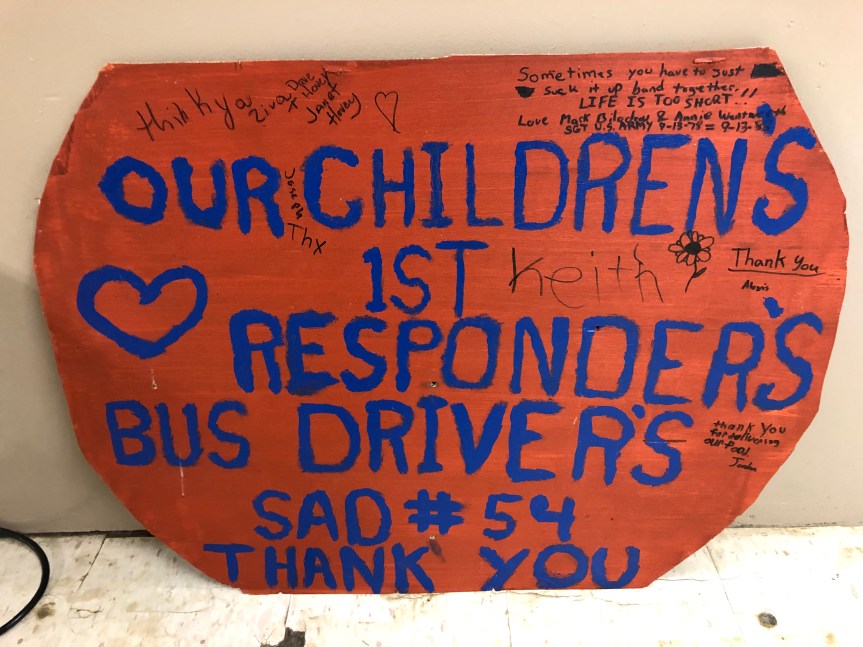
MSAD 54 Serves 500k Meals, Travels 48k Miles to Feed Kids During Pandemic

Our MSAD 54 family has had great success in feeding our students during the COVID-19 pandemic. With the help of our transportation department, administration, ed techs and of course or school nutrition team we were able to serve close to 500k meals and traveled 48k miles between the months of March-June.

We received many words of appreciation, cards, photos of the children, and signs around the towns thanking us for all that we have done. It has been a great and humbling experience for all of us that have been involved over the last couple of months.

This story was submitted by Jana Wacome, Director – School Nutrition, RSU 54/MSAD 54 as part of the Maine Schools Sharing Success Campaign. To submit a story or an idea, email it to Rachel Paling at rachel.paling@maine.gov.