Resources to Support the Observance of Alcohol Awareness Day

Alcohol is the most frequently used substance by adolescents in Maine. Almost one of every four Maine high school students used alcohol in the past 30 days, and more than one third of those students reported binge drinking (2017 Maine Integrated Youth Health Survey). Alcohol consumption by students is impacted by factors such as low perception of harm, low perception of getting caught, and ease of access.

Schools and community organizations are encouraged to work together to address alcohol issues. In alignment with Maine statute, schools across Maine can raise awareness about alcohol use and abuse by observing Alcohol Awareness Day on Monday, December 3 (or another designated day in December). The statute indicates Alcohol Awareness Day shall be observed by studying for at least 45 minutes, a constructive approach toward the use of alcohol and the problems and dangers of alcohol abuse upon the individual, the family and society.

Consider using one or more of the following resources to prepare a message or lesson to enhance your existing health education curriculum:

It is important for Maine students to receive education and awareness about alcohol, tobacco and other drug use as part of comprehensive school health education, Pre-K through High School, and in alignment with the Maine Learning Results: Parameters for Essential Instruction, Health Education StandardsSelecting Evidence-Based Substance Use Prevention Programs: A Guide for Maine Schools Grades K-12 may help determine the most appropriate program for a school community.

There is also a guide to help schools create, update, and enforce a substance use policy. The guide, “Substance Use Policy: A Comprehensive Guide for School Policy Development provides practical suggestions for a complete policy, based on research and best practices.

For assistance or additional resources, contact the Maine Center for Disease Control and Prevention, Tobacco and Substance Use Prevention and Control Program at 287-8901, TTY 711 or email: TSUP.DHHS@maine.gov.  You can order a limited quantity of free alcohol use prevention pamphlets through the Prevention Store http://www.mainepreventionstore.org./

Maine DOE Update – November 29, 2018

From the Maine Department of Education


Reporting Items

| Visit the DC&R Reporting Calendar |


News & Updates

What Does Accountability Mean for a School?

Maine’s Model of School Support includes five indicators that focus on key areas of school and student success, adhere to the requirements of the Every Student Succeeds Act (ESSA), and directly align to Maine’s Priorities and Goals. | More


Professional Development & Training Opportunities

Webinar: Adverse Childhood Experiences, Education and the Workforce

The Maine School Councilor Association (MESCA) is sponsoring a free professional development webinar called, Adverse Childhood Experiences, Education And The Workforce: Building Resilience In Students. | More

Visit the Professional Development Calendar |


Latest DOE Career/Project Opportunities

Webinar: Adverse Childhood Experiences, Education and the Workforce

The Maine School Councilor Association (MESCA) is sponsoring a free professional development webinar called, Adverse Childhood Experiences, Education And The Workforce: Building Resilience In Students. Please find the details below.

Description: National statistics tell us that if a child has experienced 4 or more adverse life events, they are 32 times more likely to have behavior problems in school. There is increasing evidence that early life stressors, such as abuse and/or witnessing intimate partner violence, cause enduring brain dysfunction that, in turn, affects health and quality of life throughout the lifespan. The “stress response” can cause the areas of a student’s brain that control fear to become over developed, overpowering other areas of the brain that are required for positive academic learning. Adverse experiences have the power to undermine the development of language skills, attention to classroom tasks, and the ability to remember new information.

The good news is the presence of a supportive adult or environment provides a powerful buffer to students from the intense stress or anxiety that may occur when they are exposed to violence and trauma. This workshop will introduce participants to the impacts of exposure to adverse experiences, will offer examples of how and why this impact manifests itself as behaviors, and will share resilience building strategies.

Presenter: Allegra Hirsh-Wright, LCSW, RYT, Training Manager/Project Coordinator for Department of Clinical Innovation, Maine Behavioral Healthcare

Webinar Date & Time: December  20, 2018 at 12:00 PM

Register here: https://bit.ly/2PXK5nU

This free professional development webinar sponsored by the Maine School Councilor Association (MESCA) will be recorded and stored on the Reach Higher Maine Google Classroom.

What Does Accountability Mean for a School?

Maine’s Model of School Support includes five indicators that focus on key areas of school and student success, adhere to the requirements of the Every Student Succeeds Act (ESSA), and directly align to Maine’s Priorities and Goals. Below is the list of indicators of school success:

  1. Chronic Absenteeism (K-12)
  2. Academic Progress (Grades 3-8 Only)
  3. Progress in English Language Proficiency (ELP) for English Learners (K-12)
  4. Academic Achievement (Grades 3-8, High School)
  5. Graduation Rate (High School Only)

Eligible individual student populations (where there are ten or more students of a specific student population) are also measured to identify where targeted support is needed. Student populations include: economically disadvantaged, students with disabilities, English learners, and students who are white, black, Asian, Native Hawaiian/Other Pacific Islander, Native American, Hispanic, or two or more races.

To determine each school’s performance on the indicators listed above, Maine uses data collected from public schools on an annual basis to provide each school with a performance rating on each applicable indicator.

School Indicators & Performance Levels

The chart below summarizes the indicators used in Maine’s Model of School Support for Maine’s public elementary, middle, and/or high schools. In addition, the criteria surrounding the performance levels for each indicator has been provided.

Indicators Performance Level
Emerging Developing Meeting Excelling
Chronic Absenteeism All eligible student group populations have a chronic absenteeism rate of 10% or higher. At least one eligible student group has a chronic absenteeism rate of less than 10%. All eligible student groups have a chronic absenteeism rate of less than 10%. All eligible student groups have a chronic absenteeism rate of 5% or less.
Academic Progress – English Language Arts All eligible student groups have score of less than 100. At least one eligible student group has a score of at least 100. All eligible student groups have a score of at least 100. All eligible student groups have a score of at least 150.
Academic Progress – Math All eligible student groups have a score of less than 100. At least one eligible student group has a score of at least 100. A scores of at least 100 for all eligible student group A scores of at least 150 for all eligible student group
Progress in English Language Proficiency  The average progress towards the student’s annual target is less than 65% The average progress towards the student’s annual target is between 65% and 80% The average progress towards the student’s annual target is between 80% and 95% The average progress towards the student’s annual target is greater than 95%
Academic Achievement – Math All eligible student groups did not make annual targets At least one eligible student group made its annual target All eligible student groups made their annual targets All eligible student groups exceeded their annual targets by at least 10%
Academic Achievement – English Language Arts All eligible student groups did not make annual targets At least one eligible student group made its annual target All eligible student groups made their annual targets All eligible student groups exceeded their annual targets by at least 10%
Graduation Rate – 4YR All eligible student groups did not make annual targets At least one eligible student group made its annual graduation target All eligible student groups made their annual graduation targets All eligible student groups have met or exceeded the long-term goal of 90%
Graduation Rate – 5/6YR All eligible student groups did not make annual targets At least one eligible student group made its annual graduation target All eligible student groups made their annual graduation targets All eligible student groups have met or exceeded the long-term goal of 92%

Based on student population performance within the school, each school will achieve performance level for each indicator that is applicable to the grade span (elementary/middle or high school). An example of performance levels for indicators is provided below:

report card

A school’s performance in the above indicators will determine the level of support available to the school.
tiers of supportTiers of Support

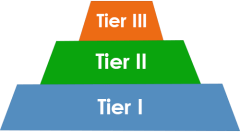
Maine has developed three Tiers of Support designed to direct various levels of assistance from the Maine DOE.

Tier III supports are designated specifically for schools experiencing the most significant challenges across all eligible student groups, and who also receive Title I funding.

Tiers I and II are designed to support both Title I and non-Title I schools.

Support levels are determined based on eligible student groups (individual student populations with at least ten [10] students). Tier III supports are determined based on the performance of all eligible student groups while Tiers I and II are based on individual student groups. Student populations with fewer than 10 students are not included as part of the indicators for the school, this is consistent with federal FERPA regulations.

Below is a detailed summary that describes how a school’s level of support is determined, and the various supports that are available at each Tier.

Tier I
Additional Targeted Supports and Intervention
Tier II
Targeted Supports and Intervention
Tier III
Comprehensive Supports and Intervention
Any school with one or more eligible student group/s not meeting state expectations across all indicators in one or more content areas Any school with one or more eligible student group/s not meeting state expectations in the same indicator for three (3) consecutive years Schools that receive Title I funding and where all eligible student groups are not meeting state expectations in all indicators in one or more content areas.
Professional development will be available regionally and statewide at no cost. With access to a regional school leadership coach, schools will be responsible for developing and implementing a school level plan, in partnership with stakeholders, to include at least one evidence-based intervention.   Professional development will be available at no cost and driven by the needs of school staff and students. Tier II supports will be available during the 2019-2020 school year. With the support of a school leadership coach, schools will be responsible for developing and implementing a school level plan, in partnership with stakeholders, to include at least one evidence-based intervention. Schools will also have access to additional federal funds to support the implementation of a school leadership team and a school plan. Professional development will be available at no cost and driven by the needs of school staff and students.

Example scenarios demonstrating how a school is identified to receive support will be provided in the next room article.

Further questions should be directed to Janette Kirk, Acting Director, Office of Learning Systems at janette.kirk@maine.gov.

Maine DOE Update – November 21, 2018

From the Maine Department of Education


Reporting Items

Dropout Reporting Opens November 26, 2018

This is a reminder that Dropout reporting begins the Monday following Thanksgiving weekend. The report will be open from November 26, 2018 to December 14, 2018. This report is located in the “Graduation Data” module in NEO, along with the Graduation reports from the 2017/18 school year. The module is located here: | More

| Visit the DC&R Reporting Calendar |


News & Updates

What Is Progress in English Language Proficiency? #success4ME

Maine defines English language proficiency (ELP) as sufficient skill in English necessary to meaningfully access the curriculum. As part of Maine’s Model of School Support, part of Maine’s rollout of the Every Student Succeeds Act (ESSA), this indicator of school success focuses on English learners and measures the progress they make toward English language proficiency each school year. ESSA requires that each state include an indicator that gauges, “progress in achieving English language proficiency as defined by the State and measured by the assessments within a State-determined timeline for all English learners.” | More

Question and Answer About New IEP Form

As per the newsroom notice dated September 26, 2018, the implementation of the new IEP form that incorporates Behavioral Health Day Treatment was delayed until January 1, 2019 to allow time to provide answers to questions received from the field.| More

Information and Resources About Maine’s New Tobacco Retail Sales Law

The Maine CDC Tobacco Prevention Program has released information and resources about on Tobacco 21 (T21), Maine’s new tobacco retail sales law. | More

National Assessment Governing Board Makes Small Changes to NAEP Achievement Level Descriptors

In an effort to reduce the confusion regarding the National Assessment of Educational Progress (NAEP) achievement levels and the misuse of NAEP data, the National Assessment Governing Board (NAGB) slightly modified the names of the performance levels. In the November 18, 2019 posting on the “Curriculum Matters” blog on Education Week’s, there is an update on the small changes made to the achievement levels for the NAEP. | More

More Dispatches | Press Releases | Priority Notices


Professional Development & Training Opportunities

Visit the Professional Development Calendar |


Latest DOE Career/Project Opportunities

Information and Resources About Maine’s New Tobacco Retail Sales Law

The Maine CDC Tobacco Prevention Program has released information and resources about on Tobacco 21 (T21), Maine’s new tobacco retail sales law.

Tobacco 21 is Maine’s new retail tobacco sales law that went into effect July 1, 2018. A person may not sell, offer to sell, furnish, or give away a tobacco product to any person under 21 years of age unless the person had turned 18 years of age by July 1, 2018. People who were 18-year-olds as of July 1, 2018 can still buy tobacco products. With the passing of the law, it updated enforcement and compliance activities by the removal of all Minor In Possession or Possession Use and Purchase (MIP/PUP) language in state code. By eliminating the MIP/PUP language it concentrates enforcement and compliance activities on the source of tobacco rather than the youth purchasing.

Further questions should be directed to Emily Moores, Tobacco Prevention and Control Manager, Maine CDC at Emily.Moores@Maine.gov or 207-287-3268.

Dropout Reporting Opens November 26, 2018

This is a reminder that Dropout reporting begins the Monday following Thanksgiving weekend. The report will be open from November 26, 2018 to December 14, 2018. This report is located in the “Graduation Data” module in NEO, along with the Graduation reports from the 2017/18 school year. The module is located here: https://neo.maine.gov/doe/neo/graduation

The reporting process will follow the same structure as graduation reporting. Individual reports must be completed for each school in the district that has grades anywhere from 7 to 12. Once all the reports are completed, the reports need to be submitted to the Maine DOE. Maine DOE staff will then review/approve each report and submit them back to the School Administrative Unit for certification. Certification must be done by the Superintendent. Once the ‘Certify’ button is pressed on the summary screen, this will complete the dropout reporting process. Detailed instructions for this process can be found here.

Since dropouts could not be calculated until after the October 1 enrollments have been completed, it was necessary to remove the dropout rate reporting out of the graduation rate reporting process.

Some things to note for this process:

Dropouts are:

  • Students who are part of the 2017/18 Cohort that were enrolled in the 2017/18 school year and were exited with a code indicating that the student was expected to return in the 2018/19 school year, but for whom there have been no enrollments in the 2018/19 school year so far.
  • Students in grades 7 through 12 who exited in 2017/18 with a code that correlates to being a dropout.


Future Dropouts are:

  • Students in grades 7 through 12 who are part of a Cohort after the 2017/18 Cohort that were exited in the 2017/18 school year with a code indicating that the student was expected to return in the 2018/19 school year, but for whom there have been no enrollments in the 2018/19 school year. If no enrollments appear in the 2018/19 school year for them, they will receive a dropout count during the 2019 dropout reporting period.


If you have questions regarding the process for dropout reporting, contact Trevor Burns 207-624-6678

What Is Progress in English Language Proficiency? #success4ME

Maine defines English language proficiency (ELP) as sufficient skill in English necessary to meaningfully access the curriculum. As part of Maine’s Model of School Support, part of Maine’s rollout of the Every Student Succeeds Act (ESSA), this indicator of school success focuses on English learners and measures the progress they make toward English language proficiency each school year. ESSA requires that each state include an indicator that gauges, “progress in achieving English language proficiency as defined by the State and measured by the assessments within a State-determined timeline for all English learners.”

What does this look like in Maine?

English learners are students who have a primary or home language other than English and are in the process of learning English. Around 3% of Maine’s students are English learners and their schools support them in learning English to succeed academically. They may receive English language support services inside or outside of their regular classes, through programs specifically for English language development, or through a variety of other supports. It usually takes 4-7 years for an English learner to become proficient in English, but this can vary depending on many factors.

Each year, English learners are administered ACCESS for ELLs, an assessment that measures a student’s ability to listen, speak, read, and write in English. A student’s overall score ranges from 1.0-6.0. In Maine, English language proficiency is defined as level 4.5, so the progress in English language proficiency indicator measures how much progress a student makes each year toward reaching level 4.5. A school’s score for progress in English language proficiency is based on the average percentage made towards the annual target for each student, where there are at least ten (10) English learners.

School level descriptors for progress in ELP is as follows:

Emerging Developing Meeting Excelling
The average progress towards the students’ annual target is less than 65% The average progress towards the students’ annual target is between 65% and 80% The average progress towards the students’ annual target is between 80% and 95% The average progress towards the students’ annual target is greater than 95%

How progress in ELP will be presented on the report card:

ELPreportcard1.png

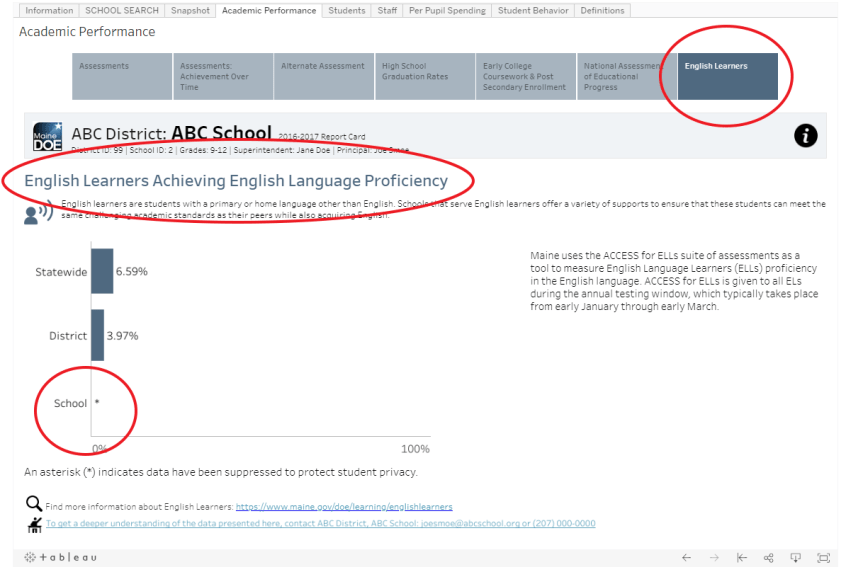
In the example provided below, there are less than 5 students who are English learners and therefore the data has been suppressed (notated by a *).

ELPreportcard2

ELPreportcard3


National Assessment Governing Board Makes Small Changes to NAEP Achievement Level Descriptors

In an effort to reduce the confusion regarding the National Assessment of Educational Progress (NAEP) achievement levels and the misuse of NAEP data, the National Assessment Governing Board (NAGB) slightly modified the names of the performance levels. In the November 18, 2018 posting on the “Curriculum Matters” blog on Education Week’s, there is an update on the small changes made to the achievement levels for the NAEP.

From this point forward, the NAEP achievement levels will contain the NAEP acronym such as “NAEP basic” and “NAEP proficient”.  With the current emphasis on the reporting of student performance in the form of achievement levels, NAGB made this change to reduce the direct comparison of the NAEP levels of proficiency with those used by the individual states.

After each state-level NAEP assessment report is completed, a mapping study is conducted that provides a guide for the examination of state proficiency standards in relation to the NAEP scales.  The publication of the “Mapping State Proficiency Standards Onto NAEP Scales” reports are released much later than the Nations Report Card report and the State Snapshot reports since the data and analyses from these reports is required to conduct the mapping study.

For further information about NAEP, contact Regina Lewis, Maine DOE Coordinator of NAEP & International Assessments at Regina.Lewis@maine.gov.


Question and Answer About New IEP Form

As per the newsroom notice dated September 26, 2018, the implementation of the new IEP form that incorporates Behavioral Health Day Treatment was delayed until January 1, 2019 to allow time to provide answers to questions received from the field.

The Department has compiled the following Frequently Asked Questions, in response to inquiries from the field for clarification regarding the new requirements for Individualized Education Programs (IEP) outlined in Administrative Letter # 17. The new requirements for IEPs outlined in Administrative Letter # 17 are based on a collaboration between the DOE Special Services Team and the Office of MaineCare Services Policy Division to ensure regulatory compliance for both agencies. For further information and guidance, refer to the Maine State Required Forms Procedural Manual.

BHDT- Behavioral Health Day Treatment
BHP- Behavioral Health Professional
DHHS- Department of Health & Human Services
DOE- Department of Education
ITP – Individual Treatment Plan
IEP- Individualized Education Plan
LRE – Least Restrictive Environment
MUSER- Maine Unified Special Education Regulations
OT – Occupational Therapy
PT- Physical Therapy
SAU- School Administrative Unit
SDI- Specially Designed Instruction

  1. What is MDOE’s definition of Day Treatment and Behavioral Health? ‘Day treatment’ and ‘behavioral health’ are not terms that are defined by Maine DOE or DHHS. ‘Behavioral Health Day Treatment’ services are medically necessary services implemented in an integrated manner to allow the child to access his/her special education program. Refer to page 30 of the MaineCare Benefits Manual for Chapter II Section 65: 65.06-13 Children’s Behavioral Health Day Treatment

    A covered service is a specific service determined to be medically necessary by qualified staff licensed to make such a determination and subsequently specified in the Individual Treatment Plan (ITP) and for which payment to a provider is permitted under the rules of this section. This qualified staff must assume clinical responsibility for medical necessity and the ITP development. The behavioral health day services described below are covered when (1) provided in an appropriate setting as specified in the ITP, (2) supervised by an appropriate professional as specified in the ITP, (3) performed by a qualified provider, and (4) billed by that provider. Behavioral health day treatment Services must be delivered in conjunction with an educational program in a School as defined in 65.03-4.

    Behavioral health day treatment services are structured therapeutic services designed to improve a member’s functioning in daily living and community living. Programs may include a mixture of individual, group, and activities therapy, and also include therapeutic treatment oriented toward developing a child’s emotional and physical capability in area of interpersonal functioning. This may include behavioral strategies and interventions. Services will be provided as prescribed in the ITP. Involvement of the member’s family will occur in treatment planning and provision. Behavioral health day treatment services may be provided in conjunction with a residential treatment program. Services are provided based on time designated in the ITP but may not exceed six (6) hours per day, Monday through Friday, up to five days per week. Medically necessary services must be identified in the ITP.

  2. Does Behavioral Health include Sections 28 and 65? •Behavioral health services are addressed in Sections 28 and 65 and are reflected in the term “Behavioral Health Day Treatment” in related services on section 8 of the IEP. •Do not list section 65 or 28 on the Behavioral health day treatment line. •Only use the term “Behavioral Health Day Treatment” in section 8 related services to document a child that requires services in a day treatment setting. •Refer to the MaineCare Benefits Manual for more information regarding Sections 28 and 65: https://www.maine.gov/sos/cec/rules/10/ch101.htm
  3. Under what conditions would behavioral health day treatment services be documented on the related services grid? •A child requiring behavioral health professional services (determined by the IEP team), regardless of the pay source, should be documented in the behavioral health day treatment section of the related services grid on section 8 of the IEP. •Note that behavioral health professional services are an accommodation, which still need to be documented in section 7 of the IEP (Ed Tech/BHP). Note – There have been no changes to Section 7 “Supplementary Aids, Services, Modifications, and/or Supports”.
  4. If a student becomes no longer eligible for MaineCare funding, does the cost for nursing services or behavioral health day treatment become the fiscal responsibility of the school? •A child requiring behavioral health day treatment or nursing services (determined by the IEP team), regardless of the pay source, should be documented in the related services grid on section 8 of the IEP. •If a child loses a third-party funding source or if the parent refuses/withdraws consent for MaineCare billing for a service necessary for the child to access his/her special education program, yes, the SAU is fiscally responsible for the services.
  5. Should we continue to list social work services, psychological services, nursing services, etc. separately in section 8? •Yes, each required individual related service should continue to be documented separately in section 8. •For further information and guidance, refer to the Maine State Required Forms Procedural Manual.
  6. Can we write a range for BHDT services in section 8, since the actual time for clinical support typically varies day to day for students? •Do not list a range (such as 1-3 hours) of BHDT in section 8. You can indicate that the services will be provided “up to” a maximum amount of time. This does not apply to other services and related services in section 8.
  7. Who is responsible for Specially Designed Instruction (SDI)? The Special Educator is always responsible for SDI, which is documented as a special education service. It is not factored as a related service, in the new behavioral health day treatment section on section 8 of the IEP.
  8. Who is responsible for nursing? If the IEP team determines that nursing services are required in order for the student to receive a FAPE, then the SAU is responsible for providing the services. School nurse services are provided by a qualified school nurse.
  9. Must the nurse providing school nursing services be certified as a school nurse? Yes, the services must be provided by a credentialed school nurse.
  10. If the school nurse, and appropriately trained special education staff and related services staff (OT, PT, Speech) can provide the school health services (G-Tube feeding, positioning, transferring, monitoring for skin integrity, personal care assistance, etc.) should the school list this as nursing services or school health services? •If someone other than a credentialed school nurse provides the service, it should be documented as school health services. •If a credentialed school nurse provides the service, it should be documented as nursing.
  11. If a student only requires intermittent nursing services (as needed monitoring for blood sugar levels, pulse and respiration, personal care assistance, etc.) but the family prefers a full-time nurse be available at all times, is the school required to list the family’s preference and secure a full-time nurse? No, the IEP Team determines the services necessary for the child to access his/her special education program. If there is a lack of consensus, the SAU makes the decision and the parent can challenge that decision through due process procedures.
  12. If the school believes that the school health services could be provided by the school nurse and school staff but the parent has a doctor’s prescription for a full time private nurse, is the school required to secure the full-time nurse? No, the IEP Team determines the services necessary for the child to access his/her special education program. The school must provide a qualified professional to implement the IEP.
  13. If a school has not elected to access MaineCare funding and the parent has contracted with a private nursing agency to provide private nursing within the school, is the school required to list nursing services on the IEP? The issue is not access to MaineCare – it is what is required for the student to receive a FAPE. The IEP must list the services determined by the IEP team as necessary for a FAPE. •Note – There have been no changes to Section 7 “Supplementary Aids, Services, Modifications, and/or Supports”.
  14. What positions can be listed as providers of behavioral health day treatment? •Although behavioral health professionals provide a major portion of day treatment services, the position responsible on the IEP should be documented as “appropriately credentialed personnel”. •Note that behavioral health professional services are an accommodation, which still need to be documented in section 7 of the IEP (Ed Tech/BHP). Related services providers, such as social workers should continue to be listed in the related services block in section 8.
  15. Why list behavioral health day treatment instead of the specific clinical person providing the ITP, counseling and supervision of the BHP? •Behavioral health day treatment integrates a variety of services that create a milieu to provide the services necessary for the child to access his/her special education program. •Continue to list social work services, psychological services, nursing services, and other related services separately in section 8. •In addition, please refer to question 14.
  16. Will the services reflected as behavioral health day treatment impact the calculation of least restrictive environment (LRE)? •No, behavioral health day treatment services are not calculated in the least restrictive environment percentage. •Behavioral health day treatment, as a related service, occurs concurrent to special education services. •Behavioral health day treatment does not reduce specially designed instruction.
  17. Should the BHP accommodation in section 7 match the BHDT related service in section 8? •The BHP accommodation in section 7 and the BHDT related service in section 8 will generally match. •The frequency of BHDT documented in section 8 should reflect the amount of time the child requires BHP support to allow the child access to his/her special education programming. •The frequency of BHDT cannot exceed the school day, or 6 hours. •Some examples of exceptions to the BHP accommodation in section 7 and the BHDT related service in section 8 matching include: when a child requires 2:1 or 3:1 support, after school support, and when working on a transition to a less restrictive environment.
  18. When a health plan is created for a child using evaluation data and reports required to determine eligibility for MaineCare, do the evaluation reports have to be included in the child’s educational record? •If the IEP team orders the evaluation or the parent submits an outside evaluation report and requests the evaluation data to be included in the development of the IEP, yes – include the evaluation report in the child’s educational record. •If the evaluation is not ordered by the IEP Team and the data are not used in the development of the child’s IEP, then the evaluation report does not need to be included in the child’s educational record. (This question applies to special purpose private schools.)
  19. If a child comes into a district with an IEP that says day treatment and the district doesn’t have a day treatment program, what happens? Districts should follow the procedures outlined in MUSER IX (3)(B)(5) for students who transfer and if needed, the IEP team would meet and determine the student’s needs. Then the team would decide on the placement, whether that be an in-district or an out-of-district placement.
  20. Will SAUs need to reconvene to amend all IEPs to reflect the “Behavioral Health Day Treatment” change or can they address this change beginning January 1, 2019; as IEP teams convene. SAU’s should reflect the “behavioral health day treatment” language change beginning January 1, 2019 as IEP team meetings are held; and are not expected to reconvene IEP meetings for all students and make amendments immediately.
  21. Will DHHS pay for services that exceed BHDT listed on the child’s IEP? •DOE does not interpret third-party funding policies and procedures. •Contact Trista Collins regarding MaineCare funding questions. Her contact information is Trista E Collins, State Medicaid Educational Liaison, e-mail: trista.collins@maine.gov, phone 207-624-4094.

For further information please contact the Office of Special Services at 624-6713.