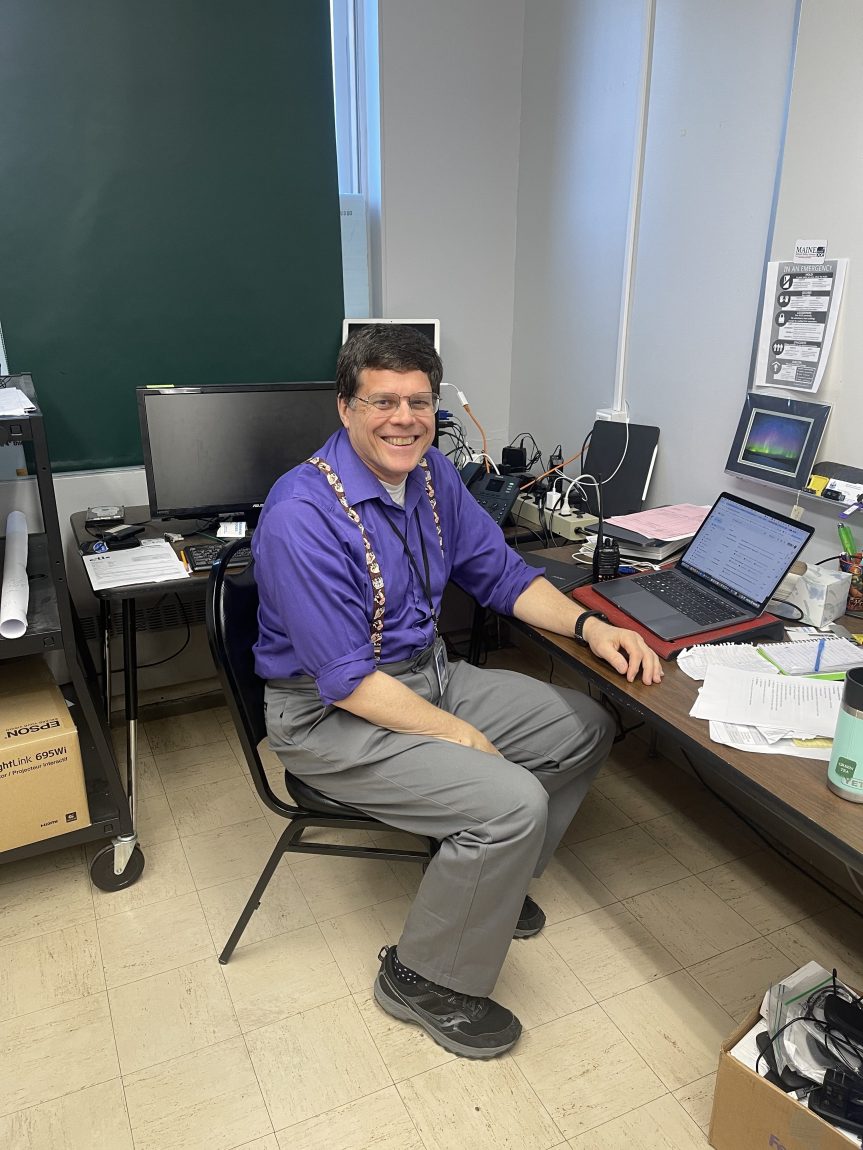
As IT Director, Dr. David Fournier leads a team of seven people in Regional School Unit (RSU) 71 in Belfast. Together, they manage all aspects of technology in the district, including everything from building and maintaining networks to laptop fleets and much more!
Although Fournier loves the techie part of his job, especially watching teachers and students use technology to increase learning, he knew that involvement in school-related technology could go far beyond the classroom.
“I came into the safety role by working on security cameras, keyless door entry systems, and radios/walkie-talkies,” explained Fournier. “Our district has a safety task force that meets monthly, and I joined to better understand how my role as IT director could help address safety issues in our schools.”
Fournier took the Maine Department of Education (DOE) School Safety Specialist course in January of 2023 to help him better understand school safety and its complexities. Maine DOE’s Maine School Safety Center offers an 8-week School Safety Specialist course, provided asynchronously through Eastern Maine Community College (EMCC) and the Federal Emergency Management Agency (FEMA).
“Taking the School Safety Specialist course gave me better insights into what could and should be done to keep our staff and students safe,” said Fournier.
The course is free to Maine schools and covers everything from the fundamentals of school safety to climate and culture, including behavioral threat assessment. It also incorporates emergency operations planning, which includes networking with appropriate stakeholders and incident command systems.
Following the training, Fournier’s role as IT Director expanded to include leading the RSU71 District Safety Task Force. Since becoming a school safety specialist, one of his biggest safety enhancements was guiding the district through purchasing and implementing the Share 911 program.
“Share 911 is an emergency notification system that addresses the communication issues we have experienced during emergency events over the past few years,” explained Fournier. “I have also instituted a standard debriefing protocol that is used after any safety event to capture the mistakes made and lessons learned during an event.”
In addition to these two significant changes, RSU 71 has a Parent Safety Page highlighting the district’s safety efforts. You can see the many other safety protocols RSU 71 has in place there.
Looking to the future, Fournier is working on plans to conduct more regularly scheduled tabletop safety exercises to enable school staff to react to an emergency as effectively as possible.
Knowing that a successful and safe school community is almost impossible without great community partners, Fournier has many people to thank.
“I would like to thank Erik Endress, the owner of Share 911 (share911.com), for the top-notch support and training he has personally provided to RSU71 this year,” he said. “I also want to thank Dale Rowley, the Waldo County Emergency Management Director, for his continued training, support, and difficult tabletop exercises to work through!”
Fournier also extended a very special shoutout to the RSU71 Safety Task Force members. They helped “tackle such a difficult, but important, aspect of schooling that goes unheralded,” said Fournier. “They are doing the hard (and scary) work, and I thank them for their continued efforts.”
The School Safety Specialist course is a program of the Maine DOE’s Maine School Safety Center and is available at no cost to Maine schools. Cohorts start at the beginning of every month and complete in 8 weeks. All work is done asynchronously through Eastern Maine Community College (EMCC) and the Federal Emergency Management Agency (FEMA) and takes approximately 20-25 hours to complete.
For more information, visit theMaine DOE website, fill out aninterest form, or reach out to Maine DOE School Safety Training Coordinator Wendy Robichaud at Wendy.Robichaud@maine.gov.
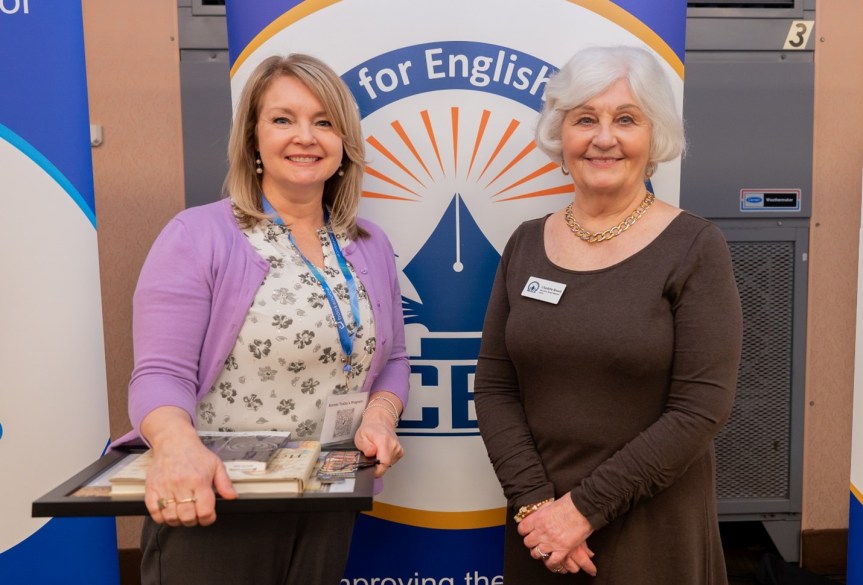
(Pictured L to R: Jennifer Babcock, John Bapst Memorial High School, 2024 Claudette & John Brassil Distinguished Educator Award Winner, with Claudette Brassil, retired educator and one of the inspirations for this award.)
The Maine Council for English Language Arts (MCELA) awarded its 6th annual Claudette & John Brassil Distinguished Educator Award to Jennifer Babcock, a 25-year educator at John Bapst who currently teaches American Literature and Composition, British Literature and Composition, AP Literature and Composition, and Creative Writing.
The Claudette & John Brassil Award is administered by the Maine Council for English Language Arts (MCELA) and recognizes exceptional English language arts and literacy teachers who have demonstrated excellence in teaching, contributed to the profession and are committed to the community.
The finalists for the Claudette and John Brassil Distinguished Educator Award for 2024 included Emily Rumble from Marshwood High School, Jake Joy from Lewiston Middle School, Angela Gilbert from Bruce Whittier Middle School, and Jennifer Babcock from John Bapst Memorial High School.
From left to right: finalist Jake Joy from Lewiston Middle School, finalist Angela Gilbert from Bruce Whittier Middle School, finalist Emily Rumble from Marshwood High School, winner Jennifer Babcock, award namesake Claudette Brassil, and MCELA Secretary and award committee head Bre Allard.
Babcock is the English Department Head and mentors new teachers. In addition, she has been a supervising teacher for student teachers from Husson and the University of Maine since 2011. Babcock has been involved in the school community by leading student tours in the United States and abroad, advising the school prom, choreographing the spring musical, serving as a varsity cheerleading coach, and advising the National Honor Society. Babcock is also the State Officer Advisor for the Maine National Honor Society and has been a judge for the Maine Principal’s Association state cheerleading competition.
“Jen’s commitment to her students, her passion for her craft, and her energy are unparalleled…Every student in Jen’s class knows that she cares about them,” said David Armistead, Head of School at John Bapst and Babcokc’s nominator. “They love her and they consistently rise to the high bar she sets for them. She knows her students are capable of great work and she lovingly keeps them growing from the first day to the last, every year.”
Babcock was honored at the Maine Council for English Language Arts state conference in Portland on March 29, 2024, where 350 ELA educators convened to ignite joy in learning.
The Claudette & John Brassil was created in honor of the contributions of two long-time educators who have inspired students and mentored teachers for over eighty combined years in Maine public schools.
In the past, this distinguished educator award has been given to English Language Arts educators Anthony Scott (2023) from Maine School of Science & Mathematics, Audrey Ennamorati (2022) from Medomak Valley High School, Margaret Adams (2022) from Kingsfield Elementary School, Patti Forster (2020) from Camden Hills Regional High School, Stephanie Hendrix (2019) from Bangor High School, and Johnna Stanton (2018) from Morse High school.
The Maine Council for English Language Arts accepts nominations for this award during the fall of each school year for their March in-person conference recognition. Nominees should be full-time English language arts or literacy teachers of students in grades 6-12 and have taught for at least five years in public or independent schools in Maine. Nominees do not have to be a Maine Council for English Language Arts member. ELA educators who demonstrate the same qualities as the Brassils themselves: a commitment to student-centered learning, the inspiration of all students, leadership at school, district, state, and/or national levels, development, and sharing of effective practices, and involvement in the community and school beyond the classroom. More information on nominations is available here.
Maine’s biggest city is home to one of the largest school administrative units in the state, which offers seventeen different schools covering its large and diverse population, ten of which are elementary level. One of these elementary schools, Gerald E. Talbot Community School, sits in the northwest of the city and offers a unique model to serve its high-need population. Recognized as a school that receives Title I support due to the socio-economic status of its students and families, Talbot serves around 370 students from PreK to 5th grade. Their student body comes from culturally and linguistically diverse backgrounds.
For these reasons and many more, Gerald E. Talbot applied for state funding and planning for the community school model, which began during the 2019-2020 school year. Eventually, while enduring the height of the COVID-19 pandemic, they hired Community School Coordinator Kristin Rogers, who started implementing strategies during the 2021-2022 school year and beyond.
A community school model, as defined by the Coalition for Community Schools, is both a place and a set of partnerships between the school and other community resources. Community schools exist in all regions of the United States, and their numbers are growing fast.
“We were pretty ideally suited to be a community school because we had a lot of the infrastructure that a lot of community schools have already existing. There’s a branch of the Portland Public Library that exists in our building; we have a dental clinic here, we have a public pool and playgrounds. We are pretty centrally located to our families. So, it’s kind of a natural place to be a hub for the community,” said Gerald E. Talbot Community School Coordinator Kristin Rogers. Principal Terry Young, who works closely with Rogers, adds that their high-needs population is another major reason for the shift.
In Maine, the community school model was first recognized by Maine Legislative Action of the First Regular Session of the 127th Legislature (2015-2016) in the budget bill Public Law 2015, chapter 267. At that time, the Maine Department of Education (DOE) was authorized to fund a limited number of community schools established under 20-A MRSA Chapter 333. Currently, three schools in Maine receive funding from the Maine DOE to support their community school strategies: Old Town Elementary School in Old Town, Cape Cod Hill Community School in New Sharon, and Gerald E. Talbot School in Portland.
Now in its 3rd year of implementation, Talbot has had time to try many different things after its initial needs assessment in 2019/20. They have a robust list of over 50 community partners that assist with everything from housing to physical and mental health, food security and nutrition, general assistance, academics, and enrichment. Their community school programs start before the first bell rings for the day and last long after the traditional school day ends.
Young explains that in addition to meeting students’ basic needs, enrichment opportunities also significantly impact their high-needs families.
“In a middle-class/upper-middle-class school, you have students who get a lot of enrichment opportunities because their parents can afford it. They can drive them to soccer practice, they can take them to basketball, they can take them to the library. Where you are working with a higher-needs population, students don’t have the same access. The difference is, you are bringing access to the children, to the families, into the school,” said Young.
Many of the enrichment (and extended academic) programming can be found in their extensive afterschool opportunities. Rotating on a 6- to 8-week schedule that offers something different each day, designated students stay after school for traditional academic programming like tutoring or language skills and for various enrichment opportunities like choir, yoga, student leadership, and even Nordic skiing, to name a few. Over 100 students participate in the community school afterschool programs and targeted outreach efforts by Rogers, Principal Young, and other staff members help ensure equitable access to these programs for students and families.
Pictures taken during Talbot Community School’s afterschool program, which includes the Nordic skiing club, a partnership with Portland Nordic:
In addition to its afterschool programs, one of its current language programs is a flourishing collaboration with Portland Adult Education, which aims to boost the English-speaking skills of students and their family members. Adult caregivers take language lessons in the mornings through Portland Adult Education, and their children are involved in an after-school program that combines enrichment with language immersion. The group of students and their family members will hopefully move through their respective programming year after year as a cohort, improving their English language skills together in school, at home, and in the community.
Another of the more recent and innovative programs Talbot has created is its walking school bus program, which aims to reduce chronic absenteeism and increase family engagement.
“We have a staff member as well as some community volunteers that go door to door in the morning for students who would benefit from support for their attendance or whose families could benefit from the support in getting kids to the bus stop. They knock on the door, walk them to the bus stop to make sure they get there safely and help improve attendance,” explains Rogers. “It’s both the transportation piece, as well as the mentorship of building that relationship with trusted adults in the community who are showing up every day, they care about you, know about you, and who can chat with parents and build that family connection to school as well.”
The school also hosts several community dinners throughout the school year, inviting families into the school for an educational element and, at the same time, offering a topic-related enrichment activity for students to engage in with their families. The dinners also include food for everyone to eat together and for families to take home. This year, they have hosted community dinners on the topics of internet safety, social-emotional learning, and have upcoming events for math and literacy. They aim to host at least five community dinners per year.
Looking ahead, Talbot hopes to build capacity with the staff to support and expand their community school strategies. They also hope to conduct a new needs assessment, which is something most schools do at the beginning of implementing a community school.
“Our population changes. We have different families and students than we had five or six years ago,” said Rogers. “That is a huge part of being a community school; it’s very dynamic, it’s always changing.”
Talbot is also analyzing all of its data to determine what is working and what new strategies it can incorporate in the future. One of the data points they are most excited about is a student leadership group, which they hope can help gauge how students like the different programs Talbot offers and what ideas they have for improvements.
The duo explains that over the past four years, their successes have also surfaced in the community’s excitement for the activities and programs they have offered. Instead of solely the school reaching out to make community connections on behalf of families and students, people (students, families, and community partners) approach the school.
Rogers details that not only are students approaching her to ask for different clubs and opportunities at school, but that parents are approaching her now looking for specific resources like daycare or other support. In addition, community partners who have caught on to the concept of their community school model have asked to partner with her on program ideas they have.
“When I see Talbot compared to other schools I have worked in, I feel like families see us as a resource, and they see us as a partner,” added Young.
To learn more about Gerald E. Talbot Community School, check out this video interview with Community Schools Coordinator Kristin Rogers and Principal Terry Young.
Maine DOE has welcomed Community Schools Consultant Ann Hanna (former principal of Gerald E. Talbot Community School), who is working on advancing community school strategies in interested schools across Maine by providing technical assistance and support as needed. The Maine DOE is also currently in the process of reviewing applications for community school funding for SY 24-25, and information on that will be shared via the DOE Newsroom in the coming days.
To learn more about community schools in Maine, please contact Ann Hanna, at ann.c.hanna@maine.gov.
Since 2018, the Maine Department of Education (DOE) has adopted and piloted open-source instructional programs for early elementary grades based on the Boston Public School’s evidence-based Focus Curricula. Pre-K for ME was launched in 2019, K for ME was launched in 2021, and 1st Grade for ME was launched in 2023. 2nd Grade for ME is being piloted in Maine classrooms next year and will be available for the 2025-2026 school year. These developmentally appropriate learning programs are interdisciplinary and align with Maine’s learning standards. While Maine schools are responsible for purchasing classroom materials that support these programs, lesson plans, outlines and other supporting documents can be accessed at no cost via the Maine DOE’s website.
An informational overview of the programs was provided on March 7. The overview session was recorded and is now posted here for anyone unable to attend the live session. The overview session shared the basic program structures and reviewed the materials needed to implement the programs. Watching the recording is highly recommended if you are unfamiliar with the programs.
Educators/schools/programs interested in utilizing Pre-K for ME, K for ME, and/or 1st Grade for ME in the coming year may take advantage of initial training scheduled this summer. These trainings are provided at no cost to promote understanding of program design and to support successful program implementation. School administrators are strongly encouraged to attend the training with their Pre-K, Kindergarten, and/or first-grade teachers. Special educators, education technicians, and instructional coaches/curriculum leaders who work with pre-k, kindergarten, and first-grade teachers are also encouraged to attend. This year’s training opportunities will be held in person from approximately 8:30 a.m. to 3:30 p.m. 2-day trainings are provided for each program.
Pre-K for ME– During the week of 7/29-8/2 (exact dates and locations TBD)
K for ME– July 29th and 30th in the Augusta/ (exact location TBD)
1st Grade for ME– July 31st and August 1st in the Augusta (exact location TBD)
For teachers learning the K for ME and 1st Grade for ME programs, an additional training day will occur on Wednesday, June 26th from 8:30 to 3:30 (Augusta Civic Center).
Registration for these trainings should be completed by principals/educators with one registration on behalf of their school/program per grade. Details about how to prepare for the trainings and the training locations will be provided via email after the registration period closes. Registrations for the trainings for each instructional program should be received by May 24, 2024.
The Summer Training Registration Link is now open. Please submit a separate response for each grade level in which you are registering educators: Pre-K for ME, K for ME, and/or 1st Grade for ME.
The Maine Department of Education (DOE) Office of Special Services and Inclusive Education invites you to attend the first two webinars in our “Inclusive Education Webinar Series,” presented by Dr. Kate Macleod, an innovative, inclusive educator, researcher, author, and assistant professor of special education at the University of Maine Farmington.
May 8th: The What, Why & How of Inclusive Schools
In this engaging webinar, Dr. Kate MacLeod will share “what” inclusion is, the many reasons “why” inclusion is critical to the success of our students and communities here in Maine (e.g., research, law, advocacy, social justice, and belonging), and will take participants through research-based key practices for “how” schools can achieve greater inclusion for all students. Participants will leave with access to resources and practical strategies to implement greater inclusion in their schools.
Stay tuned…our next webinar in the series, The Way to Inclusion: How We Create Schools Where Every Student Belongs, featuring Kate Macleod, will be broadcast on May 22nd!
In 2022, the Maine Department of Education (DOE), in partnership with the Maine Department of Health and Human Services (DHHS), was awarded the Preschool Development Renewal Grant B-5. This three year, $8,000,000/year grant supports early care and educational programming for our youngest students. The Maine DOE, in collaboration with Maine DHHS, is exploring strategies to help support transitions from early childhood settings into kindergarten settings.
One of the many projects included in the grant is the development of a Kindergarten Entry Inventory (KEI). A KEI is a tool administered in the beginning of kindergarten to help teachers gather information about children’s development across a range of domains so that teachers can be responsive to children’s learning. Additionally, data aggregated from KEIs can help strengthen Maine’s early care and education system by identifying areas of steady growth and continuous improvement.
If you are a Maine Kindergarten Teacher, Early Childhood Administrator, Curriculum Director or Instructional Specialist/Coach, the Maine DOE invites you to engage in the design of a Kindergarten Entry Inventory (KEI). Your expertise and perspective are needed in the following areas:
Consider applying for membership in the KEI Advisory Team. The goals of this group are to determine the key purposes of a KEI, review research and successful implementation practices, and identify constructs within each domain to assess. Services on this committee will include a stipend. Responsibilities include, but are not limited to, attendance at monthly virtual meetings as well as 2 in-person meetings per year. School administrative unit leaders and early childhood educators are welcome to complete the application linked below. Applications for this position are being accepted through May 10th.
Consider applying for a Kindergarten Entry Implementation Specialist position. The goal of these positions is to pilot various domain specific inventory strategies and to provide feedback to the Advisory Group. Services for this position will include a stipend. Responsibilities include, but are not limited to, testing inventory strategies with students, offering timely feedback and attendance at periodic in-person and virtual trainings/meetings. All Kindergarten teachers are welcome to complete the application linked below. Applications for these positions are being accepted through May 10th.
Communication about selections for the KEI Advisory Team and for the KEI Implementation Specialist positions will be made by May 24th. The KEI Advisory Team will begin meeting in early June and the Implementation Specialists will begin in the summer (date TBD).
Additionally, in the near future, School Administrators and Kindergarten Teachers will be invited to complete a survey regarding KEI implementation practices in their school administrative unit. The survey will gather information such as domains assessed, materials used, timelines, professional development and reporting.
For questions or additional information regarding the KEI design and pilot, please reach out to Karen Mathieu, Maine DOE Kindergarten Entry Inventory Specialist, at karen.mathieu@maine.gov.
The Maine Department of Education (DOE) ESEA team is pleased to provide FY25Preliminary Allocations for all Elementary and Secondary Education Act (ESEA) title programs. Preliminary allocations for each title are located on the ESEA Federal Programs webpage at the following location: Fiscal Allocations | Department of Education (maine.gov)
Title I, Part A
Maine’s Title I, Part A funding received a 2.5% decrease in FY25 for Preliminary Allocation Estimates from the US Department of Education (USDOE). This estimate represents an overall reduction of $1,497,180 in Title I, Part A funding for the State of Maine in FY25. Maine received $62,310,372 in Title I, Part A funds in FY24 and that amount is expected to decrease to $60,813,192 in FY25. Maine’s national poverty census data decreased and did not increase as much as other states, resulting in a lower national poverty share which usually generates a decrease in Maine’s overall Title I, Part A allocation. Please also recognize that the private school amounts are from FY24 and do not include the new data that will be used for FY25.
Title II, Part A
Maine’s preliminary FY25 allocation for the Title II, Part A program is $10,786,692, which represents level funding for the program to the previous fiscal year. Maine has traditionally accounted for student moves between the SAU they reside in and the SAU they attend as part of the Title IIA allocation process. Maine received a finding and subsequent technical assistance from the USDOE in its most recent federal review and may no longer implement this practice and must rely solely on census data when allocating Title IIA funds. This will result in some SAUs receiving more funding than they have in the past, and some receiving less. SAUs impacted by this recent change have received outreach from Title II Coordinator, Ryan Reed.
Title III, Part A
Maine’s preliminary FY25 allocation for the Title III, Part A program is $1,004,205.00 which represents a slight increase in funding for the program to the previous fiscal year. FY25 Title III, Part A allocations have been generated for all SAUs with at least one multilingual (ML) student for the purpose of allowing SAUs the option to form a consortium to reach the statutory required minimum award amount of $10,000. SAUs that wish to form a consortium for the purpose of a Title III, Part A allocation only, will need to submit a letter of intent (available April 30) to the Maine DOE by June 30, 2024. When final allocations are received, an SAU that is not part of a consortium or by itself generates less than an award of $10,000 will be removed and will not receive a Title III, Part A allocation. As a result, the dollar per student ratio will increase as will allocations. An informational webinar regarding Title III consortia will be scheduled for the week of May 13 – registration details to follow. Questions related to the forming of consortiums should be directed to Title III Coordinator, Daniel Weeks.
Title IV, Part A
Maine’s preliminary FY25 allocation for the Title IV, Part A program is $6,659,535.00, which represents level funding for the program to the previous fiscal year.
Title V, Part B
There have been no significant changes to the Title V, Part B program for the upcoming fiscal year.
Questions regarding allocations should be directed to the applicable Title Coordinator or by reaching out to Janette Kirk, Chief of Federal Programs at janette.kirk@maine.gov.
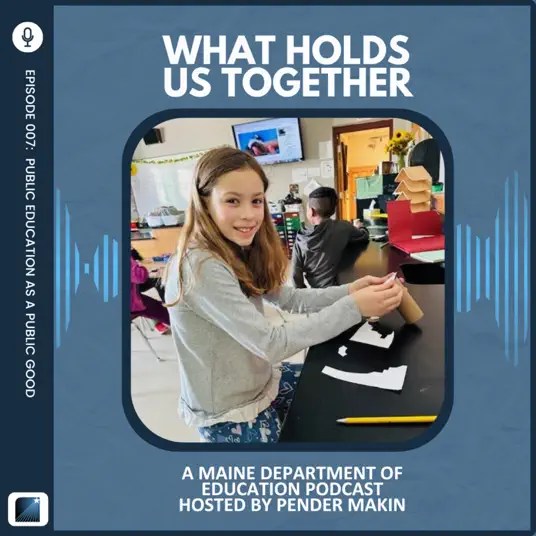
Public education is the cornerstone of our society and holds us together. On this month’s What Holds Us Together podcast, Maine Education Commissioner Pender Makin talks with Steve Bailey, Executive Director of the Maine School Boards Association and Miranda Engstrom, 2023 Hancock County Teacher of the Year and literacy specialist at Lamoine Consolidated School. These champions of education discuss the importance of lifting up the voices of educators and sharing the amazing things happening in schools across Maine through their Maine Loves Public Schools and #LoveMaineSchools campaigns. Listen on Apple or Spotify. | More
Schools, community-based organizations, and childcare providers can apply for the 2024 Maine Out-of-School Time (MOST) Career Exploration grants through the Maine Department of Education (DOE). These grants support meaningful career exploration opportunities for students in grades 4 – 6 that connect students with Maine businesses and career opportunities, which may include experiential learning trips, guest speakers, job shadows, and more! | More
Title I of the Every Student Succeeds Act (ESSA) requires each state educational agency that receives Title I funds to create a State Committee of Practitioners (CoP) to advise the State in carrying out its responsibilities under the Title I program. The purpose of this committee is to review any state rules and regulations relating to Title I and provide recommendations concerning processes and procedures related to its implementation. | More
State employees, including the Maine Department of Education (DOE), recently participated in the annual Take ME to Work Day by hosting their children and/or children they know for the day at the Maine Capitol Complex and at state-operated locations across Maine. | More
The following student opportunity was shared by the Secretary of State’s Office. It is nearly 250 years since the signing of the Declaration of Independence, and organizations across the country are gearing up to recognize this milestone and the history of our nation. | More
The Maine Department of Education (DOE) has awarded $28.6 million in School Revolving Renovation Fund (SRRF) loans to 12 school administrative units. | More
A reminder to those families who have opted for home instruction during the 2024-2025 School Year that, per Title 20-A: 5001-A , an annual assessment of academic progress is required. | More
Walk into any classroom at Maranacook Community Middle School and you’d be hard-pressed to identify a 6th grader from an 8th grader in the class. And that’s part of the magic at Maranacook. Instead of being separated by grade level, students are grouped into multiage teams. | More
RSU 40 staff are finding ways to use robotic technology, funded by the Maine Department of Education’s (DOE) Maine Teaches CS Initiative, to support interdisciplinary learning across grade levels. The school’s acquisition of Sphero Bolts and Indi cars is making learning experiences playful and engaging for both students and educators. | More
Educators for a Multilingual Maine (EMME) has announced that Bangor High School student Amanda Tomlinson will receive the EMME 2024 Student of the Year award. | More
As part of the Preschool Development Renewal Grant (PDG) Maine DOE and Maine DHHS are offering the opportunity for a summer summit series in 2024 and 2025 to support communities in their local system alignment and coordination for early childhood care and education programming from birth through the early elementary years. Teams accepted to participate in the summit will also be awarded $800 mini grants to support their efforts in developing and implementing action plans to address an identified early care and education need in their communities. | More
The Maine Department of Education (DOE) has partnered with Maine Roads to Quality Professional Development Network and the Maine Department of Health and Human Services (DHHS) Office of Child and Family Services to offer a no-cost book study for Maine early care and education professionals (serving children birth-Grade 3) interested in creating more inclusive classrooms. | More
Apply Now! Schools, community-based organizations, and childcare providers can apply for the 2024 Maine Out-of-School Time Career Exploration grants through the Maine Department of Education (DOE). These grants support meaningful career exploration opportunities for students in grades 4 – 6 that connect students with Maine businesses and career opportunities, which may include experiential learning trips, guest speakers, job shadows, and more! Underlying these experiences is critical to helping students build and strengthen relationships with caring adults and peers in their schools, childcare centers, and communities.
Funded through Governor Mills’ Maine Jobs and Recovery Plan, the 2022 Statewide Expansion of Extended Learning Programming has engaged hundreds of secondary students throughout the state in real-world career exploration experiences. The Maine DOE is excited to build on these successes to reach younger students in this expanded career exploration program. The 2024 Maine Out-of-School Career Exploration Request for Applications (RFA, also known as grants) is available here: Grant RFPs and RFAs | Division of Procurement Services (maine.gov).See RFA 202404087
Schools, nonprofit organizations, licensed or licensed-exempt child care providers, municipal parks and recreation departments that are current members of the Maine Recreation and Park Association, and public librariesmay apply. Please see the RFA for explicit information and definitions on eligibility and allowable uses of funding.
Grant awards will range in size, with $300,000 available. The 2024 Maine Out-of-School Time Career Exploration grant requires a marketing and outreach plan for reaching students from disadvantaged backgrounds as well as an emphasis on Maine DOE’s Whole Student Framework.
This funding can potentially facilitate career exploration for students in grades 4 – 6 before, during, or after school, on weekends, and/or during the summer. Applications will also be considered for schools and organizations that wish to use the funding to enhance or expand existing out-of-school programming. Grants are expected to be awarded at the beginning of June. All programming must be completed by September 1, 2024.
Public education is the cornerstone of our society and holds us together. On this month’s What Holds Us Together podcast, Maine Education Commissioner Pender Makin talks with Steve Bailey, Executive Director of the Maine School Boards Association and Miranda Engstrom, 2023 Hancock County Teacher of the Year and literacy specialist at Lamoine Consolidated School. These champions of education discuss the importance of lifting up the voices of educators and sharing the amazing things happening in schools across Maine through their Maine Loves Public Schools and #LoveMaineSchools campaigns. Listen on Apple or Spotify.
You can learn more about #LoveMaineSchools on their Facebook page and submit your great stories here.
You can learn more about Maine Loves Public Schools and get involved here.
The Maine Department of Education (DOE) would also love to highlight the amazing things happening in your school. Share your stories here or invite us to your school by emailing communications.doe@maine.gov.





 Maine DOE Newsroom