The Maine DOE Seeking Participants for Title I Committee of Practitioners

Title I of the Every Student Succeeds Act (ESSA) requires each state educational agency that receives Title I funds to create a State Committee of Practitioners (CoP) to advise the State in carrying out its responsibilities under the Title I program. The purpose of this committee is to review any state rules and regulations relating to Title I and provide recommendations concerning processes and procedures related to its implementation.

Committee members must be representatives from the following categories:

  • District and school administrators, including administrators of programs in Title I
  • Principals and other school leaders
  • Teachers in public and charter schools
  • Career and technical educators
  • Representatives of charter schools
  • School board members
  • Non-public school representatives
  • Specialized instructional support personnel (including school social workers, psychologists, nurses, speech-language pathologists, counselors, or other special education service providers
  • Paraprofessionals (Ed-Techs)
  • Parents

Meetings of the committee will be conducted on an ‘as needed’ basis via Zoom (most likely 3 times per year), with the term of membership commencing July 1, 2024, and expiring June 30, 2026. For those looking for more information on the Title I Committee of Practitioners, please see the FAQ.

Those interested in serving on Maine DOE’s Title I Committee of Practitioners Committee should fill out this form by Friday, June 7th, 2024. Questions related to the CoP can be sent to Rita Pello, at rita.pello@maine.gov.

Sphero Robots Support Playful Learning in RSU 40

RSU 40 staff are finding ways to use robotic technology, funded by the Maine Department of Education’s (DOE)  Maine Teaches CS Initiative, to support interdisciplinary learning across grade levels. The school’s acquisition of Sphero Bolts and Indi cars is making learning experiences playful and engaging for both students and educators.

Holly Doe, Director of Technology for RSU 40, applied for the grant last school year to foster experiential learning through technology for even the youngest students. Sphero Indi cars introduce coding at the simplest level using color tiles to tell the robot what to do. While this is an ideal tool for younger students, it is also great for older students when the goal is not coding itself but supporting other learning outcomes.

By leveraging robotic technology, students in RSU 40 are exploring new ways to retell—or tell—stories.

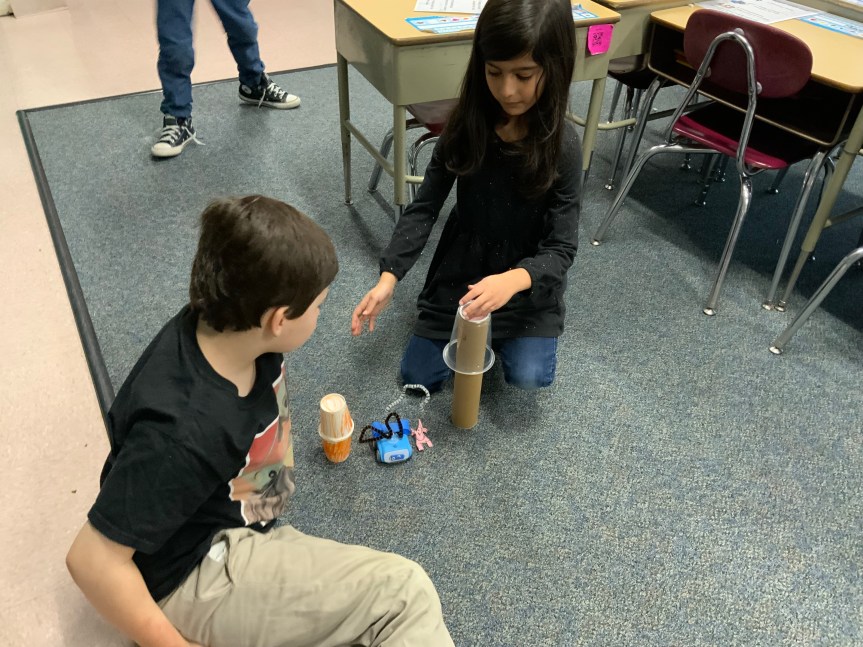
Students in grades 1-3 used Sphero Indi cars to retell stories they had read in class while seniors in Spanish IV wrote their own stories in the foreign language and crafted narrated films using the Indi cars.

In the elementary classrooms, the robots foster natural collaboration as pairs of students work together to plan a path of color tiles that represent their story summary. Crafting a simple costume for the Indi car and scenery or other characters to be placed along the car’s path engages students’ creativity and requires students to consider symbolic representations. The simple, flexible lesson quickly adapts to accommodate students’ and teachers’ needs.

At the high school, the ease of using the Indi cars allows students to combine story mapping with other technology. Students film the cars in front of a green screen and use Canva’s AI image generator to create backgrounds for their movies which they then narrate in Spanish.

Recently, Heather Webster, RSU 40’s technology instructional coach, shared her experiences using Sphero Indi robots in elementary ELA classrooms and high school Spanish classrooms at the Maine Council for English Language Arts spring conference. Participants were introduced to Indi cars, watched video clips of RSU 40 students engaging in the lessons, and then had the opportunity to try the activity themselves, working collaboratively with their tablemates to retell a familiar story. They left the conference session with a concrete example of how technology like the Sphero robots can support cross-curricular lessons and boost the playful spirit in a classroom.

(Maine Council for English Language Arts spring conference photos curtesy of Katie Kelley Photography)

The Computer Science Mobile Labs Grant has enabled RSU 40 to uniquely support playful learning. Robotic technology has enhanced students’ collaborative skills and their understanding of symbolic representation. Encouraging a playful approach to learning, this technology has increased student engagement and has inspired educators to rethink traditional teaching methods. The immersive learning experiences enabled by Sphero Indi and Bolt robots are set to shape the educational landscape at RSU 40 for years to come. Maine leads the nation in providing interdisciplinary computer science education to all Maine schools at all grade levels.

This story was provided by RSU 40. If you would like to submit good news from your school, fill out our good news submission form.)

Maine Students Enjoy ‘Take ME to Work Day’ at the State House During School Vacation

State employees, including the Maine Department of Education (DOE), recently participated in the annual Take ME to Work Day by hosting their children and/or children they know for the day at the Maine Capitol Complex and at state-operated locations across Maine.

The day offered a chance for state employees to give their kids the opportunity to learn more about what they do for the people of Maine and see first-hand the inner workings and importance of our government.

Take ME to Work Day started with tours of the Maine State House, followed by a visit from Governor Janet Mills in the Hall of Flags. She greeted the kids and employees and delivered a message about the meaningful and fulfilling work of state government and its many employees.

While the state had many other activities for kids participating in Take ME to Work Day, the Maine DOE once again took the opportunity to provide a jam-packed day full of fun experiences and learning opportunities for Maine DOE employees and their kids.

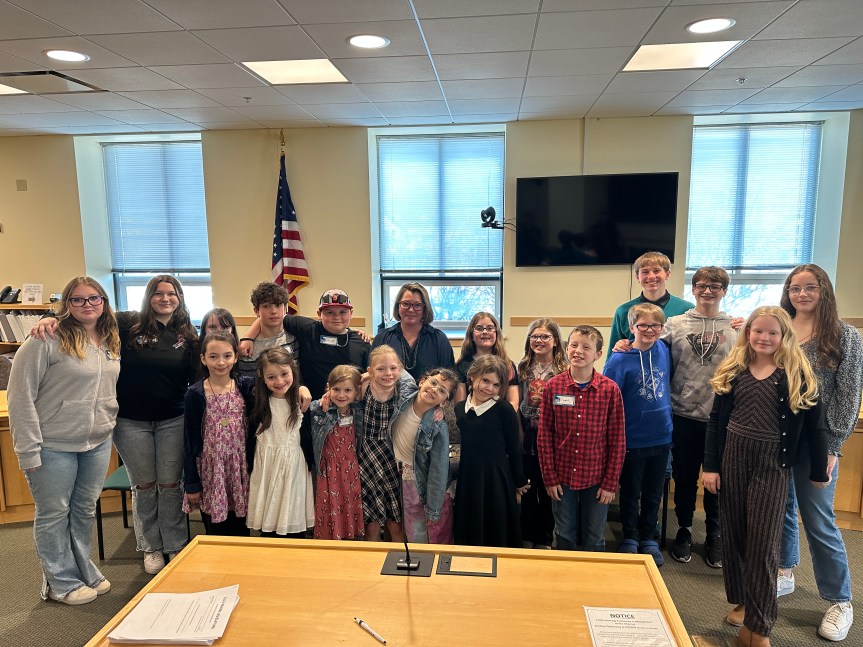
Following the State House tour, a mock legislative hearing was held with the help of Laura Cyr, a member of Maine DOE’s Legislative Team. Cyr explained to students about the Legislative Committee on Education and Cultural Affairs and the types of bills they oversee. Then, students volunteered to pretend to be senators and representatives on the committee and hear about a mock bill: An Act to Improve Education by Lowering the Driving Age (to 10 years old). After introducing the hypothetical bill, each student got the chance to speak about the bill, either in favor, against, or neither for nor against the bill.

Students brought up many important points, including that it would be convenient to be able to drive themselves to school if they missed the bus, that anyone young or old who has a driver’s license should have to take driving classes, and that kids are probably not ready to be driving at age ten. They also discussed the potential parking kerfuffle that would take place at school if, suddenly, everyone younger than ten years old was driving to school. Ultimately, the kids decided that the bill would need many changes if it were to proceed.

Following the mock hearing, students and adults got the opportunity to ride a Thomas Electric Bus from C.W. Cressy & Son. On the ride, which took everyone across Augusta’s Memorial Bridge to more State of Maine office buildings, students enjoyed the quiet bus ride and talked about the fact that there is no traditional engine when you open the hood. The group also learned that charging an electric bus takes about 3 hours and will ride for 150 miles on that charge.

Over across the bridge, the group’s destination was a visit with Maine DOE’s Child Nutrition Team to see the culinary classroom and participate in a make-your-own-pizza lunch. Led by Chef Michele Bisbee and her daughter, students learned about the different learning opportunities afforded to school nutrition staff across Maine, both in-person and remote, through the culinary classroom. They also washed up and made their own pizzas. While the group waited for lunch to cook, Chef Bisbee quizzed them on the different food groups and discussed the intricacies of serving nutritional food in Maine schools. Bisbee ended the discussion by asking kids to thank the school nutrition staff at their school next week when school is back in session.

After lunch, the group rode the electric bus back to the Capitol Complex and joined the Maine DOE Learning Through Technology Team’s  Jon Graham to learn about and have hands-on fun with computer devices as part of Maine DOE’s Maine Teaches Computer Science (CS) initiative.

Following a brief overview and history of the Maine Learning Through Technology Initiative (MLTI), Graham showed kids all of the older and newer MLTI devices and showcased some of the computer science tools available to Maine schools through Maine DOE-administered grants and opportunities, such as Sphero BOLTs, Sphero Indi Cars, and a Dash robot. These tools allowed students to play around with and try computer coding in real time. Maine leads the nation in offering universal computer science education.

The day was full of fun opportunities, laughs, learning, new friends, and possibly some budding future Maine State employees.

Maine’s Take ME to Work Day occurs annually in the spring; for more information about the program, visit Maine’s Bureau of Human Resources Page.

America’s Field Trip Opportunity for Youth through National America 250 Commission

The following student opportunity was shared by the Secretary of State’s Office. 

It is nearly 250 years since the signing of the Declaration of Independence, and organizations across the country are gearing up to recognize this milestone and the history of our nation.

A national commission was created in 2016 to begin preparation for the commemoration. This nonpartisan commission, America 250, seeks to create opportunities to reflect upon our nation’s past, and look ahead toward the future we want to create for the next generation and beyond.

The National America 250 Commission has announced one of their first initiatives, a nation-wide competition for students grades 3 thru 12,  in recognition of the importance of youth voices and their promise for our future.

Students are asked to submit artwork, videos, or essays in response to the contest’s prompt: “What does America mean to you?”

25 students from each grade span will win a three-day trip to tour historical sites. Other prizes include $500 for students, and teachers affiliated with the winning projects also receive a $1,000 cash prize. Rules, submission requirements for each grade span, scoring criteria, and further information can be found at: America’s Field Trip – America250

Deadline for submissions is May 17, 2024

We will continue to share any national opportunities from the America 250 Commission that might benefit your students over the next couple of years as we prepare for America’s 250th anniversary on July 4, 2026.

REMINDER: Register Now for Early Childhood Summer Regional Summit Events With Mini Grant Opportunity

The Maine Department of Health and Human Services (DHHS), in partnership with the Maine Department of Education (DOE), was awarded a Preschool Development Renewal Grant (PDG) from the US Department of Health and Human Services in December of 2022. With this three-year grant, the state is implementing initiatives to build greater infrastructure and capacity to create a more coordinated, efficient, and high-quality mixed delivery system for children ages birth to eight and their families. The plan builds upon successful cross-agency work to ensure that all children enter Kindergarten prepared to succeed and are well supported during the early elementary years.

Included in this grant is the opportunity for a summer summit series in 2024 and 2025 to support communities in their local system alignment and coordination for early childhood care and education programming from birth through the early elementary years.  Teams accepted to participate in the summit will also be awarded $800 mini grants to support their efforts in developing and implementing action plans to address an identified early care and education need in their communities.

The goals of the Early Childhood Summit include:

  • Fostering community level coordination and collaboration across the mixed-delivery early care and education system, which includes child care programs, head start and elementary schools, to improve alignment and transitions for children and families.
  • Strengthening understanding of evidence-based practices that are critical to leverage across the birth-grade 3 span in order to promote whole child development.
  • Supporting community-based planning and implementation efforts through mini-grants and ongoing technical assistance support.

What will the summit structure be like? 

The content of the summit will include a variety of keynote addresses and workshop sessions connected to the goals outlined previously.  Topics will include promoting inclusionary practices and addressing challenging behaviors, promoting play as a foundational learning strategy,  and promoting smooth transitions from early childhood education programs into public schools for children and families.  Time will also be provided for teams to work collaboratively on action planning.

When will the summits be held? 

The 1-day summits will be held in two regions (see dates/locations below).  Teams will apply to attend in one of the two locations.  The summits will run from 8:30 a.m.- 4:00 p.m.

  • Thursday, July 11, 2024, Keeley’s Banquet Center, 178 Warren Avenue, Portland, Maine
  • Tuesday, July 16, 2024, Jeff’s Catering & Event Center, 15 Event Center Way, Brewer, Maine

What are the requirements of participation for all team members?

All team members will be expected to participate in the professional development and technical assistance components outlined below.

The components include: Projected timeline:
One check in meeting prior to the July 2024 Summit   June 2024
Attendance and participation at Summer Summit July 2024   July 11 or 16, 2024
Bi-annual consult with the Departments (1/2)   Fall 2024
Bi-annual consult with the Departments (2/2)   Winter 2025
Attendance and participation at Summer Summit in July 2025   July 2025


What is the composition of teams?

Teams may have up to five members.  There must be at least:

  • one public early elementary school educator and
  • one child care provider/educator represented (family child care and/or child care center) on the team.

The additional three members may include but are not limited to:

  • Representative of the local business community
  • Parent of a child using early childhood services
  • School Administrator
  • Home Visitor
  • Mental health care provider
  • Head Start Representative
  • Health care provider
  • Community librarian
  • Representative of an organization that supports workforce development
  • Provider of services under the federal Individuals with Disabilities Education Act, Part B or Part C
  • Provider of professional development to early care and education professionals
  • A faculty member of a career and technical center or higher education institution specializing in early childhood, if available

How will the mini grants work?

Each team will receive an eight-hundred-dollar ($800) grant to support their action planning and implementation work over the first year. Another min-grant will be available following successful completion of the first year and participation in 2025 summit.

To apply: 

Complete the application found here (Word Doc) and return all documents electronically by April 30, 2024 to Andrea Faurot at Andrea.Faurot@maine.gov.

All team members must sign an agreement ensuring team participation.

For additional information, please reach out to Renee Reilly, Maine DOE PDG Manager at Renee.A.Reilly@maine.gov or Andrea Faurot, OCFS PDG Manager at Andrea.Faurot@maine.gov.

Inclusive Classroom Book Study for Maine Early Care and Education Professionals (serving Birth-Grade 3)

The Maine Department of Education (DOE) has partnered with Maine Roads to Quality Professional Development Network and the Maine Department of Health and Human Services (DHHS) Office of Child and Family Services to offer a no-cost book study for Maine early care and education professionals (serving children birth-Grade 3) interested in creating more inclusive classrooms.

In the early childhood classroom, inclusion means that all children, regardless of their individual characteristics, have equitable access to educational opportunities and environments where they are equally safe, valued, and respected.  Early care and education programs that prioritize inclusion benefit everyone, including children, teachers, parents, and communities.

This book study is one of the professional growth opportunities available at no cost to Maine early care and education professionals as part of the Maine Inclusion Initiative funded through Maine’s Preschool Development Renewal Grant. Participants in the book study will read and reflect on Inclusion Includes Us: Building Bridges and Removing Barriers in Early Childhood Classrooms (Huber, 2023). The book study will occur over a 6-week span, meeting weekly for 75 minutes. Three 6-week sessions are being offered as options (see schedule below).

This professional learning opportunity is open to all early care and education professionals from public and private preschool schools, early elementary schools, childcare centers, and family childcare providers.

Session Options

Session 1:
May 13 – June 24 (no session May 27th)
Mondays 5:45 – 7:00

Session 2:
Aug 13 – Sept 17
Tuesdays   3:45-5:00

Session 3:
October 16-Nov 20
Wednesdays 12-1

To apply to be part of one of the above book study sessions, please fill out the following form found at this link: Inclusion Book Club. Space is limited, so please complete the application by April 30, 2024.   Applications will be processed, and participants will be notified by May 3rd. Books will be shipped to participants and contact hours will be provided for the time in the book study.

If you have questions or need additional information, please reach out to Nicole Madore, Maine DOE Early Childhood Specialist at Nicole.Madore@maine.gov or Renee Reilly, Maine DOE PDG Manager at Renee.A.Reilly@maine.gov.

Upcoming Data Reporting Webinars

The Maine Department of Education (DOE) Data Team has scheduled  the following data reporting webinars for this spring.


Maine Schools Webinar – April 30th at 10:00 am – Register Here

Maine School Approval provides Maine DOE the attestation from districts that all Maine statutory requirements are being met by each LEA. This report offers an opportunity to update the LEA & school contact information to ensure that MDOE has the most current information. Student enrollments cannot be uploaded/entered into Synergy until Maine Schools is complete. This webinar will review the requirements for the Maine Schools process.


ESEA Demographics Report Webinar – May 14th at 10:00 am – Register Here

The ESEA Demographics Report is an aggregation of students enrolled on 05/27 for participation in state assessments during the current assessment administration. This report includes student demographic categories for assessment and accountability purposes. This webinar will review reporting requirements and navigation of the ESEA Demographics Report in NEO.


EOY Reporting Webinar – May 21st at 10:00 am – Register Here

Daily Attendance, Truancy, Behavior, and Bullying reports are due for final certification at the end of the school year. This data is aggregated for public reporting after certification and reported in multiple locations including the Maine Department of Education Data Warehouse, ESSA Dashboard, and federal reporting. This report will review requirements for each of these four (4) reports and navigation of the reports in NEO.


EOY Enrollment Exits Webinar – May 28th at 10:00 am – Register Here

All students, even those intending to return next year, must be exited from Synergy at the conclusion of the school year. This webinar will review recommendations for properly exiting students at the conclusion of the school year and the process for exiting students from State Synergy.


Special Education Exit Report Webinar – June 4th 10:00 am – Register Here

Students who have exited special education services during the reporting period (July 1, through June 30) must have special education exit information (a special ed exit date and exit reason) added to their Special Education enrollments in Synergy State Edition. School Administrative Units (SAUs) are required to certify the exit data using the Special Education Exit Report found in NEO. This webinar will review the requirements and process for Special Education Exit Reporting.


Questions about data reporting webinars can be sent to Alexandra.Cookson@maine.gov

Approval of FY 2024 School Revolving Renovation Fund Applications

The Maine Department of Education (DOE) has awarded $28.6 million in School Revolving Renovation Fund (SRRF) loans to 12 school administrative units.

The loans will be used to complete 23 health, safety, and compliance projects. The projects include structural roof repairs, indoor air quality improvements, ADA upgrades, and life safety renovations.  A portion of each loan is considered a grant and is forgiven while the remaining balance of the loan is paid back at a zero percent interest rate.

The complete list of approved projects can be viewed here (PDF).

For additional information about the SRRF program please visit the Maine DOE website or contact Ann Pinnette at 215-3809 or ann.pinnette@maine.gov.

Bangor High School Student Named ‘Educators for a Multilingual Maine’ Student of the Year

(Pictured L to R: Bangor High School (BHS) Chinese Teacher Lily Crane, BHS Senior and EMME Student of the Year Amanda Tomlinson, and BHS American Sign Language Teacher Kathy Rice.)

Educators for a Multilingual Maine (EMME) has announced that Bangor High School student Amanda Tomlinson will receive the EMME 2024 Student of the Year award.

EMMC said in a media release: “This recognition is a testament to Amanda’s exceptional dedication and achievements in her academic endeavors and extracurricular engagements. According to Bangor High School teacher Lily Crane, Amanda epitomizes the qualities of a well-rounded student who discovers immense joy and passion in her scholarly pursuits and outside activities.”

Amanda’s remarkable commitment to language studies is a shining example of her unwavering determination and perseverance. Throughout her educational journey, Amanda has demonstrated an outstanding aptitude for languages. She has completed an impressive four years of Chinese language study and two years of American Sign Language at Bangor High School. Her exceptional linguistic skills were further validated when she took the Avant test in Chinese last Spring and will be honored with the prestigious Maine Seal of Biliteracy in May 2024.

“Amanda’s exemplary performance in the World Language Department, coupled with her outstanding contributions to the school community, make her the unequivocal choice for the EMME 2024 Student of the Year,” said Fred Ravan, Vice President of EMME.

The State Seal of Biliteracy (SSB), which acknowledges students proficient in two more languages, is now available in all 50 states and D.C. Learn more about this award for multilingual students and check out OELA’s updated SSB infographic! To learn more about Maine’s Seal of Biliteracy, visit the Maine DOE dashboard.

From all of us at the Maine Department of Education, congratulations to Amanda!

Educators for a Multilingual Maine (EMME) is a non-profit organization whose purpose is to promote and improve the teaching and study of languages and cultures of the world. EMME also strives to further the common interests of teachers, students, and others in Maine, for whom languages play an important role. EMME was formerly known as FLAME, the Foreign Language Association of Maine.

Learn more about EMME or the Student of the Year award, please visit the EMMC website or reach out to EMMC at communications@emmaine.org.

A Reminder to Maine Home Instruction Parents and SAUs Regarding Annual Assessment Requirement

A reminder to those families who have opted for home instruction during the 2024-2025 School Year that, per Title 20-A: 5001-A , an annual assessment of academic progress is required.   

Notice and Assessment Requirement 

Parents providing home instruction are required to submit a Notice of Intent to Provide Home Instruction within 10 days of starting a home instruction program and then again, each year by September 1 for continuing/subsequent year students. This notice must contain, among other things, a “statement of assurance that indicates that the home instruction program will include an annual assessment of the student’s academic progress that includes at least one of the forms of assessment described [in statute].” The continuing/subsequent year home instruction notice submission deadline (September 1) occurs after the conclusion of the previous school year, which is defined as the period July 1 – June 30. Please note that parents of ongoing home instruction students may choose to deliver instruction on a schedule which does not coincide with the reporting period; however, the school year definition is always used for the purposes of counting the required 175 instructional days. Since the annual assessment is designed to assess academic progress, the assessment should be administered toward the end of the school year for which progress is being assessed. 

An annual assessment can be a teacher letter written by a Maine certified teacher who performs a home instruction student portfolio review and looks at items in the portfolio such as the attendance record, lesson plans and sample work, to ascertain whether adequate progress has been made by the student. A different, but equally acceptable, assessment method could be to administer a standardized achievement test such as the California Achievement Test, or the Stanford or Iowa Achievement Test, and submit a copy of the test summary page. Or the student could, with prior permission and according to established local unit policy and protocol, participate in school administrative unit testing. Please see the full range of assessment options as outlined in the attendance statute, Title 20-A: 5001-A.    

Assessment Submission for Students Discontinuing Home Instruction 

“If the home instruction program is discontinued, students of compulsory school age must be enrolled in a public school or an equivalent instruction alternative… The receiving school shall determine the placement of the student. At the secondary level, the principal of the receiving school shall determine the value of the prior educational experience toward meeting the standards of the system of learning results as established in section 6209.” 

For parents who discontinue the home instruction program and re-enroll a student in a public or equivalent instruction school before completing the school year, an assessment may not have been completed yet. The receiving school, according to their policy, may choose to review student assessments or portfolio materials that might aid them in determining placement and/or credit value for students transferring in from home instruction programs. Parents of students who will not be returning to home instruction (graduated or enrolling in school) may provide notification and submit final assessments to the superintendent’s office. 

Assessment Submission for Student Continuing Home Instruction 

For continuing/subsequent year students in home instruction, the completed home instruction assessment must be submitted together with the Notice of Intent/Subsequent Year Letter (they may not be submitted separately, or by anyone other than the parent submitting the Notice) via the Home Instruction Portal, or by submitting with the paper Notice of Intent to Provide Home Instruction to the Superintendent of their resident school administrative unit. Either method will serve as the single notification needed to both the resident Superintendent and the Maine Department of Education, as required by law, and will prompt an acknowledgment to parents who supply a valid email address. 

More information, Notice of Intent to Provide Home Instruction forms, and other resources regarding home instruction are available on the Maine Department of Education Home Instruction webpage. 

Please note that the State does not issue transcripts or diplomas for home instruction students.