Nominations Open 2024 Outstanding Biology Teacher Award

The National Association of Biology Teachers (NABT) has opened nominations for the 2024 Outstanding Biology Teacher Award! Every year, the Outstanding Biology Teacher Award (OBTA) program attempts to recognize an outstanding biology educator (grades 7-12 only) in each of the 50 states; Washington, DC; Puerto Rico, Canada; and overseas territories.

Candidates for this award do not have to be National Association of Biology Teachers members, but they must have at least three years of public, private, or parochial school teaching experience. A major portion of the nominee’s career must have been devoted to teaching biology/life science, and candidates are judged on their teaching ability and experience, cooperativeness in the school and community, and student-teacher relationships.

Outstanding Biology Teacher Award recipients are special guests of Carolina Biology Supply Company at the Honors Luncheon held at the National Association of Biology Teachers Professional Development Conference, receive gift certificates from Carolina Biological Supply Company, resources from other sponsors, award certificates, and complimentary one-year membership from the National Association of Biology Teachers.

Submit your nomination here. The deadline to submit nominations is March 1, 2024.

For more information about the Outstanding Biology Teacher Award, please contact Ken Vencile, Maine Outstanding Biology Teacher Award Director at ken.vencile@fivetowns.net.

Fostering the Future – Kicking Off CTE Month at the State House 

(Pictured: Emily Worcester a senior at United Technology Center [UTC] in Bangor.)

The Hall of Flags was abuzz Wednesday morning as representatives from across the state came to Maine’s Career and Technical Education (CTE) Month Kick Off at the State House. Students, instructors, and directors from 15  of Maine’s 27 CTE centers came with everything from canapes to holographic 3D fans, proudly sharing legislators and government officials the advanced skills CTE students are learning.

Biotechnology Tool from Foster Career and Technical Center

When you think of vocational learning, you might picture what Hancock County Technical Center director Bill Tracy describes as “hard trades” such as welding or mechanics. However, the CTE students of today are starting down a wide array of career paths, from graphic design to criminal justice.

“We’re really trying to give kids a broad breadth of what they can do at a CTE enter,” explained Tracy,  “I don’t want them to think it’s just hard trades. Even though the hard trades are really important, there are so many different things they can do.”

Chris Davis, the assistant director of Farmington’s Foster CTE Center, was excited to share what his students are learning in Foster’s biotechnology program.

“They’re learning how to isolate a virus, DNA splicing, and genetic engineering,” he said. “Students working with biotechnology are looking at the biomedical field or forensics. It really increases their ability to work in a lab.”

Many CTE instructors and directors see their work as a building block for Maine’s economy. Matt Peterman of Sanford Regional Technical Center explained, “Maine CTEs are important because we are trying to build the Maine economy, and we’re trying to develop young employees to replace an aging workforce.”

As an extension of this effort, CTE curriculums support their local economies. For example, Oxford Hills Tech School offers a popular hospitality and tourism program, which they are expanding to include outdoor recreation to prepare students to work in the growing ski and ride industry of Oxford County.

Instructor Jeremy Bourque of Somerset Creative Tech Center hopes to see his students prosper and return to Maine. “Our county has a pretty high poverty rate, so we’re pretty proud of the work we’ve done changing these kids’ lives, helping them go to school, find a really good job, and then come back to Somerset County to help the county grow and change,” he said.

Another positive change happening at CTE schools across the country is an uptake in young women working in trades. Maine is no exception regarding this trend. In fact, every instructor and director at the kick off reported an increase in “non-traditional students.”

“We’re trying to break some stereotypes,” Peterman explained. “Traditional roles don’t exist anymore. Anyone can do the job.”

Instructors have seen this trend most notably in welding programs, which continue to be one of the most popular CTE offerings in the state. Jorja Brown, a junior at the Somerset Career and Technical Center, came to the CTE Kick Off to share her experience as a young woman in welding. “I am the best in my class,” she declared, noting that “it’s really cool to experience a very male dominated trade.”

United Technology Center (UTC) senior Emily Worcester was also present, representing young women in mechanics. Worcester is a part of UTC’s small engines program, and loving every second of it. “My experience has been absolutely amazing,” said Worcester. “It’s a chance to expand my knowledge. I could expand my knowledge into a future career, or I could take this knowledge and do my own personal thing. It’s a good choice to have.”

Canapes Made by the Capitol CTE Culinary Team
Canapes made by the Capitol Area Technology Center (CATC) Culinary Team.

Having this kind of hands-on, real-world education is precisely what keeps many CTE students in school. Matthew Hamilton, the Student Services Coordinator at Bath Tech, came to CTE after working as a dean of students. As a dean, Hamilton saw many students who struggled in a traditional school setting. Hamilton shared that those same students now excel in their CTE programs. They are “coming to school early, they’re coming to school on a regular basis, and they’re jazzed up about learning.”

Students like those Hamilton described were the most excited to share their CTE experiences at the kick off. “I was going to drop out in December of my junior year,” remembers Brett Bretton, a senior in the Culinary Program at Capitol Area Technical Center. “But my guidance counselor suggested the culinary program for me, and now, instead of dropping out, I’m going to college for this.”

CTEs aren’t only keeping kids in school but giving them an early advantage for their post-graduate lives. “People think vocation or technology centers are for students that are not college bound, whereas we’re the total opposite. We catapult students so that they can go to college and go to college with a head start,” commented Michael Bouthilette of Biddeford Regional Technology.

Kaylie Trembly of Lewiston Regional Technical Center (LRTC) chose to enter the EMT program after speaking to past graduates. “The people I talked to who went through LRTC are doing really well,” said Trembly, “it helped them determine where they wanted to go.”

CTE programs work with post-secondary institutions across the state, like Southern Maine Community College, University of Maine Farmington, and trade schools like the Aveda Institute. However, these partnerships go beyond traditional higher education, partnering directly with local employers to place students in the field. At Region 9 School of Applied Technology, CNA students split their time between Rumford Hospital and local nursing homes. Meanwhile, in Ellsworth, students can intern with Jackson Laboratories.

“We know we’re small, we’re rural, but I’m definitely passionate about this work,” said Brenda Gammon, the director and superintendent of Region 9, “I’ll do anything I can to give students the best opportunities.”

CTE month continues through February, and it is the perfect time to dig into everything CTE has to offer. Check out a list of Maine’s CTE schools with links for you to explore.

Commissioner Makin Kicks Off Read to ME Challenge at Jameson Elementary School in Old Orchard Beach

The Read to ME Challenge Promotes Literacy by Encouraging Adults to Read to Children for At Least 15 Minutes, Challenge Others

Maine Education Commissioner Pender Makin kicked off Maine’s Read to ME Challenge today by reading Manolo & the Unicorn to second graders at Jameson Elementary School in Old Orchard Beach. The students enthusiastically responded to Makin’s call for them to join the Read to ME challenge themselves and read to an adult or younger child in their lives. They also discussed their favorite books and who the students plan to read to.

The Read to ME Challenge encourages adults to read to children for 15 minutes, capture that moment via a photo or a video, and then post it to social media and challenge others to do the same using the hashtag #ReadtoME. This is the ninth year that the Maine Department of Education (DOE) is collaborating with community organizations and schools on this month-long public awareness campaign to promote the importance of literacy for all of Maine’s students, regardless of age. The DOE will highlight Read to ME Challenge events throughout February through Read Across America Day.

“This is about sharing the love and joy of reading. When you’re able to read together, it creates shared human experiences that transcend everything else that is happening in our electronic world. When you hear the words, and those words create the colors and the shapes in your mind, you can create a whole different world and it’s a very magical and beautiful thing for kids. Reading just 15 minutes a day can help create a lifelong habit for children,” said Commissioner Makin.

The simple act of reading aloud to a child 15 minutes a day for five years results in 27,375 minutes of language exposure, which can put children on the path to high literacy achievement and helps them build knowledge and vocabulary. Research demonstrates a number of benefits to reading to children, from birth through their childhoods and even teenage years, including modeling reading as an enjoyable lifelong activity, stimulating brain development, reducing stress and anxiety, building knowledge of the world, and helping develop the skills necessary to succeed in their lives.

The Maine DOE recently launched $10 million in literacy grants for schools to build the capacity of year-long, core literacy instruction for all students and support core literacy instructional components based on the science of reading, including phonics, phonemic awareness, fluency, vocabulary, and comprehension.

Schools and community organizations can find a toolkit and resources on the Department of Education website and the Department will be sharing videos, photos, and updates from the challenge all month long on social media. Participants in the challenge are reminded to use the hashtag #ReadtoME and to tag the Maine DOE at @MaineDepartmentofEducation1 on Facebook, and @mainedepted on Instagram.

Celebrating Women in CTE: Meet Computer Tech Powerhouse Madison Jackson

The Maine Department of Education, in collaboration with Career and Technical Education (CTE) schools throughout Maine, is celebrating CTE month this February by highlighting some of the amazing women who have found their path in life through career and technical education. We hope their stories inspire you the way they have inspired us.

As a junior in high school, Madison Jackson had no idea what she wanted to do when she graduated.

“I was worried about it because everyone else already knew,” remembers Jackson as she one day decided to check out the list of class options at her local Career and Technical Education (CTE) center, Capital Area Tech Center (CATC) in Augusta.

Initially, Jackson wanted to be a Game Warden but remembers seeing computer technology on the list of pathways at CATC and thinking, “Oh, that’s like video games, that will be fine,” she recalled. “That’s not what it turned into at all,” she added.

As a 2023 graduate from Cony High School, Madison Jackson grew up around technology, but she never dreamed it would one day be her job.

“We had the old Windows 7 and I loved playing games on that,” she said. “I remember getting a new iPad and I thought it was the most glorious thing.”

Jackson was mesmerized by people who could build computers but when she first got started, she felt like she was picking up the hardware side of things slower than her all-male classmates. Eventually, she realized her true passion was software, cybersecurity, and networking. From there, her abilities and talent have grown into an exciting career path.

For Jackson, going to school at CATC was very different from traditional high school. It felt like she finally had a choice in the classes she took every day and for that reason, she looked forward to the school day. “We had stuff to get done, but we had the freedom to get it done, in our own time,” remembers Jackson as she explained how much better the learning environment was for her at CATC.

Jackson said one of the things she is most proud of during her time at CATC was making her original CTE teacher, Michael Fraser, proud.

“I didn’t know who he was, we started a bond, and we became buddies,” said Jackson. “He was really proud of me for succeeding to [Skills USA] nationals. I didn’t make it far, but it was just seeing him hug me and be proud of me and everything I do, even if I didn’t turn out on top. Of course, I’m proud of myself, but he was always there for the students.”

Fraser said he is proud of everything Jackson has accomplished, but that they are her accomplishments.

“I am just her biggest fan,” said Fraser. “I remember specifically the day she was hooked, it was the first time she placed on that SkillsUSA stage, at the state conference, a confidence switch flipped in her that diminished any of her doubts about success in cybersecurity. From that point on, there was no stopping her,” he added.

Jackson said that being the only girl in her classroom both years was another major factor in propelling her to succeed in computer technology.

“It gave me initiative, not to be better, but that if I can do this it will be amazing,” she said.

This year Jackson is enrolled in the Cybersecurity-Digital Forensics program at Central Maine Community College (CMCC). While she is currently working on completing her 2nd semester in college, she also has a job working in her school’s IT department. She says she is still one of just a few women in all her courses, but she is looking forward to seeing change in the coming years.

“I earned a semester’s worth of college credits at CATC,” she added. “I don’t think a lot of kids know that they are actual credit.” Jackson’s teacher showed her how to take advantage of dual enrollment at UMA and because of that, she will be able to graduate early from CMCC.

“Students are presented with many opportunities here at the technical center and Madison Jackson was the student to take advantage of everything she could,” said Fraser. “Seeing her continued growth in this industry is what makes my job worthwhile, knowing she found her career interest is what we strive for with all of our students.”

Jackson has big plans to continue pursuing her education right in central Maine before jumping into the workforce. “I hope to go to UMA [the University of Maine at Augusta] and get my bachelor’s and master’s degrees,” she said. Meanwhile, she is doubling down by applying for internships as well.

Jackson has the following advice for other high school students, especially young women, who may be thinking about enrolling in a CTE course.

“Take a chance on any single class. I’ve seen girls in firefighting, welding, and construction,” she said. Jackson shared that the key to finding a sense of belonging is trying to find someone to connect with. “It’s easy to be by yourself as the only girl. Find a connection. I still have friends from my classes. I just took a chance.”

Interdisciplinary Resource Highlight for Black History Month: Side x Side

The Maine Department of Education (DOE) Interdisciplinary Instruction team has curated resources of content and instructional approaches to help educators include and highlight the important contributions of Black and African-American Mainers in authentic ways.  These project-based strategies include finding local historical figures and guest speakers, researching local history, and bridging content areas.

Incorporating artistic approaches into the teaching of African American Studies of Maine can provide an authentic learning experience for all students. Here are specific instructional strategies using art integration practices:

  1. Visual Storytelling through Artifacts
    1. Strategy: Invite students to explore artifacts and primary sources related to African American history in Maine. Ask students to select or create visual representations of these artifacts, accompanied by short narratives or stories highlighting their historical significance.
    2. Implementation: Students can use a variety of artistic mediums such as drawings, paintings, 3D printing, or digital media to create visuals/artifacts. This approach helps students connect emotionally and intellectually with authentic African American historical artifacts.
  2. Historical Timeline Murals
    1. Strategy: Have students create a collaborative historical timeline mural that illustrates key events, figures, and milestones in African American history in Maine. Each student or group can contribute a section to the mural, incorporating visual elements and brief descriptions.
    2. Implementation: Students can use a large wall space or poster boards to construct the timeline mural. This hands-on project allows students to synthesize information and visually represent the chronological progression of African American history in Maine.
  3. Story Quilts
    1. Strategy: Students can explore the tradition of quilting in African American culture by having students create story quilts that represent different aspects of African American history of Maine. Each quilt square can depict a specific event or theme.
    2. Implementation: Combine the individual quilt squares to form a larger quilt that tells a comprehensive narrative. This tactile and collaborative approach allows students to express their creativity while delving into historical content.
  4. Digital Exhibitions
    1. Strategy: Task students with researching and curating a digital exhibition that showcases images related to African American artwork and exhibits in Maine. Students can provide an interactive tour that highlights African American art images and artist backgrounds.
    2. Implementation: Display the digital artifacts in your classroom or school. Encourage students to write reflections on their interactions with the digital experience.
  5. Interactive Digital Maps
    1. Strategy: Have students create interactive digital maps that highlight the important locations, events, and communities in the history of African Americans of Maine. Utilize multimedia elements such as images, audio recordings, interviews, or personal narratives at each map point.
    2. Implementation: Students can use digital platforms or physical maps to create an interactive project. This strategy encourages geographical awareness and helps students understand the spatial context of Maine’s historical events.
  6. Community Art Installations
    1. Strategy: Have students organize art installations that represent African American history in Maine. Collaborate with local artists and students to create public art pieces that reflect the diversity and contributions of the Maine African American community.
    2. Implementation: Students can participate in the planning, designing, and execution of the art installations that serve as public educational displays.

Side x Side is a Portland-based organization that ignites academic excellence in education through comprehensive integrated arts-based programs, bringing critical thinking, creativity, and innovation into the classroom. Through community partnerships with the University of Southern Maine, local school districts, organizations, artists, professionals, and colleges, Side x Side integrates science, technology, literacy, and the humanities with the arts to enhance the school curriculum.

Side x Side provides free monthly webinars for educators on the first Wednesday of the month from 7-8 pm.  These webinars offer innovative approaches to engage students in diverse modalities of expression, such as visual storytelling to interactive projects, after gaining insights into learned information.

For more resources on an interdisciplinary approach to teaching Black History click on this link.

For more information about interdisciplinary instruction, please contact Kathy Bertini, Interdisciplinary Instruction Coordinator at kathy.bertini@maine.gov


Maine DOE Update – February 9, 2024

From the Maine Department of Education


Reporting Items

| Visit the DC&R Reporting Calendar |


News & Updates

Seeking Presenters for 3rd Annual Maine DOE Summit. The Theme is Supporting the Whole Student and School Community

The Maine Department of Education is excited to announce that the 3rd Annual Maine DOE Summit is scheduled for August 6 through August 8, 2024, at the Augusta Civic Center. |  More

Scholarship Opportunities Available for Maine School Counselors and School Social Workers

The Maine Department of Education (DOE) recognizes the importance of supporting student mental health. Data from the U.S Center for Disease Control and the Maine Integrated Youth Health Survey reflect increased student mental health needs. |  More

Q&A With Maine’s 2024 Teacher of the Year Joshua Chard

Get to know Maine’s 2024 Teacher of the Year Joshua Chard, a second and third-grade looping teacher at East End Community School in Portland. Joshua sat down for this Q&A as he begins his year of service. |  More

Interdisciplinary Resource Highlight for Black History Month: Question Formulation Technique

The Maine Department of Education (DOE) Interdisciplinary Instruction team has curated resources of content and instructional approaches to help educators include and highlight the important contributions of Black and African-American Mainers in authentic ways. These project-based strategies include finding local historical figures and guest speakers, researching local history, and bridging content areas. |  More

Celebrate the 5th Annual International SEL DAY on March 8th: Today’s Students, Tomorrow’s Leaders

The Maine Department of Education (DOE) is excited to share information on the 5th annual International Social Emotional Learning (SEL) Day, Friday, March 8th. The theme of this year’s event is Today’s Students, Tomorrow’s Leaders. Want to join in the celebration? Start making your plans now! |  More

Maine Flood Resources and Assistance Hub

Governor Mills’ Office launched a Maine Flood Resources and Assistance Hub website to help Maine people find information, resources, and assistance to stay safe and recover from interior and coastal flooding caused by recent storms. |  More

Nominations Open for Alternative Educators of the Year

The Alternative Education Association of Maine is looking for nominations for the Alternative Educators of the Year. The Association is looking to recognize one or more individuals for their outstanding work in Alternative Education. |  More

National History Teacher of the Year Nominations Open

Nominate an outstanding teacher in your community for the 2024 National History Teacher of the Year! Each year, Gilder Lehrman recognizes first-rate K-12 teachers who find creative ways to bring history to life in their classrooms. |  More

AmeriCorps NCCC’s Summer of Service Program

Volunteer Maine (Maine Commissioner for Community Service) shares that AmeriCorps NCCC has announced that its “Summer of Service” program is returning this year. This shorter summer session returns with projects focused on climate mitigation, affordable housing, and the option to serve where the need is greatest. |  More


Maine Schools Sharing Success Stories

Celebrating Women in CTE: Meet Criminal Justice Instructor Amanda Baker

“I had no idea life would take me in this direction. It wasn’t too many years before I changed careers when I said to a friend, ‘There is no way I would want to be a cop in my own hometown!’ and that’s exactly what I became, and I loved it!” said Amanda Baker as she looked back on her journey to becoming a police officer and eventually the Criminal Justice Instructor a Caribou Tech Center. |  More

Virtual Reality Transforms Learning at Cony Middle and High School #TeachWithTech

Funded by the Maine Department of Education (DOE) Teach With Tech Grant, Cony Middle and High School has embraced a new approach to education through virtual reality (VR) technology. The school’s acquisition of VR headsets and software from Class VR, a London-based company, is reshaping the learning experience for both students and educators. |  More

| Submit your Maine School Success Story |


Professional Development, Training, and Events

Monthly School Facilities Office Hours Now Available

The Maine Department of Education (DOE) Office of School Facilities is pleased to offer Office Hours for those superintendents who are interested in submitting Major Capital School Construction applications. Sessions are intended to provide a time for questions and answers regarding the recently released application. |  More

InnovatED: Igniting Innovation in Education

The Maine Department of Education (DOE) MOOSE team and the Interdisciplinary Instruction team are excited to announce a FREE virtual workshop day with John Spencer, Katie Novak, and Lynn Cuccaro on March 28th. This day-long workshop will feature morning keynotes from all three speakers and your choice of a two-hour afternoon breakout session with either John, Katie, or Lynn. |  More

Save the Date: Math4ME Informational Session on March 20th

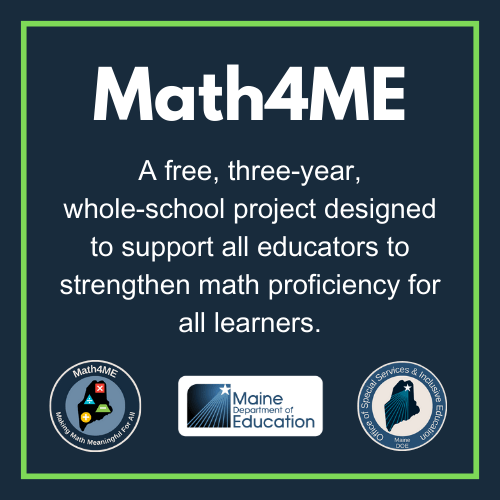
The Maine Department of Education’s (DOE) Office of Special Services and Inclusive Education is hosting a Math4ME Informational Session on Wednesday, March 20, 2024, from 4:00-5:00 PM virtually via Zoom. |  More

Webinar: Asking the Right Questions

The “Asking the Right Questions” webinar will review methods and resources focused on the art of framing questions for the best possible student growth. The webinar will offer practical classroom methods and approaches for all grades–from pre-K to high school–that are supported by current research and instructor experiences. It will also include a host of useful resources readily available for teacher use, and end with a Q&A session where participants can explore concepts further, offer their own experiences, and exchange ideas. |  More

Pilot Opportunity for ‘2nd Grade for ME’ Instructional Program

The “Asking the Right Questions” webinar will review methods and resources focused on the art of framing questions for the best possible student growth. The webinar will offer practical classroom methods and approaches for all grades–from pre-K to high school–that are supported by current research and instructor experiences. It will also include a host of useful resources readily available for teacher use, and end with a Q&A session where participants can explore concepts further, offer their own experiences, and exchange ideas. |  More

Seeking Educators to Join the Maine Solutionaries Project

The Maine Department of Education’s (DOE) Office of Innovative Teaching and Learning is collaborating with the Institute of Humane Education (IHE). Together, both teams are excited to offer Maine’s educators a unique opportunity to delve into professional learning centered around IHE’s Solutionary Framework and Solutionary Micro-credential Program, as well as access to other customized instructional resources. |  More

| Visit the Professional Development Calendar |


Latest DOE Career/Project Opportunities:

View current Maine Department of Education employment opportunities here


Seeking Educators to Join the Maine Solutionaries Project

Students currently in Maine classrooms will graduate into a world filled with complex, interrelated challenges. Maine educators need access to innovative tools to foster students’ critical thinking and problem-solving skills and equip learners with the skills needed to analyze and address multifaceted issues. To ensure that Maine educators have what they need, the Maine Department of Education’s (DOE) Office of Innovative Teaching and Learning is collaborating with the Institute of Humane Education (IHE). Together, both teams are excited to offer Maine’s educators a unique opportunity to delve into professional learning centered around IHE’s Solutionary Framework and Solutionary Micro-credential Program, as well as access to other customized instructional resources.  

The partnership between IHE and the Maine DOE seeks to inspire and support educators to cultivate a generation of Solutionaries, change makers capable of effectively addressing and resolving real-world problems. The expanded Maine Solutionaries Project will provide high quality cohort-based professional learning opportunities for teachers to learn how to facilitate inquiry-to-action projects with their students and make available resources to support real-world, transdisciplinary, project-based learning. 

“I am so delighted that we have this opportunity to partner with the Maine Department of Education to bring the Solutionary Framework to teachers and students throughout Maine” says Zoe Weil, IHE’s co-founder and president and author of the book used in the course, The World Becomes What We Teach.  

The Maine DOE believes it is important for students to develop the agency, optimism, and skills they need to address problems they care about in their schools and communities. Solutionary teaching and learning is a highly engaging flexible approach to improving students’ knowledge, skills, and confidence. 

Use this Maine Solutionaries Project registration link to sign up for this exciting project.

Interested in learning more? The Maine DOE and IHE are scheduling two informational webinars for educators. 

Wed March 6 3:30-4:30  https://mainestate.zoom.us/webinar/register/WN_jBR-2FQzRS6TchfaCdsEZQ 

Tuesday March 12 3:30-4:30  https://mainestate.zoom.us/webinar/register/WN_6zCY94ZNTGCjhBQBS6Tdjg 

 During the webinars you will be able to:

  • Learn more about the Maine Solutionaries Project 
  • Preview the Solutionary Framework, a flexible process to guide inquiry to action projects 
  • Find out how you can participate in one of the cohorts focused on topics like Climate Change, Food Waste, Plastics Pollution and Water Quality. 
  • Discover the ability to earn educator stipends and additional funding to support Solutionary student projects 

The Maine DOE utilized federal emergency relief funding to offer this program to Maine educators. 

For questions related to the Maine Solutionaries Project, please contact Kathy Bertini, Interdisciplinary Instruction Team Coordinator, Office of Teaching and Learning/Innovation, at kathy.bertini@maine.gov.  

Virtual Reality Transforms Learning at Cony Middle and High School #TeachWithTech

Funded by the Maine Department of Education (DOE) Teach With Tech Grant, Cony Middle and High School has embraced a new approach to education through virtual reality (VR) technology. The school’s acquisition of VR headsets and software from Class VR, a London-based company, is reshaping the learning experience for both students and educators.

Katelyn Rodriguez, Director of Technology Integration for the Augusta School Department, applied for the Teach With Tech Grant last school year with the goals of bringing the world into the classroom and fostering experiential learning.

By leveraging VR technology, students at Cony are exploring artifacts and places beyond their geographical and economic reach, and opening their minds to new possibilities.

Recently, 7th-grade science classes utilized VR/AR content to expand on their human anatomy unit. Students were able to visualize AR objects of the human skeletal system, muscular system, and nervous system. They looked at the human heart and digestive system using the Merge Cubes acquired during COVID-19. Students enjoyed being able to look around and even go inside the human heart and digestive system. The real breakthrough occurred as students made observations and asked questions about what they were experiencing, promoting engaging discussions and a deeper understanding of the complex anatomy concepts. Megan Allen and Allison Hunt, with the assistance of Katelyn Rodriguez, took the lesson one step further by allowing students to play in a VR simulation of the digestive system. They became a piece of pizza that traveled down the esophagus, into the small intestine, then the large intestine, and beyond.

The Teach With Tech Grant has propelled Cony Middle and High School into a new era of learning. VR technology has not only enhanced students’ understanding of complex subjects, but has also inspired educators to rethink traditional teaching methods. The immersive learning experiences enabled by VR are set to shape the educational landscape at Cony for years to come.

For Cony students, the classroom is no longer confined by walls but extends to virtual realms, providing an enriched and dynamic educational experience.

Part of the Maine DOE Maine Learning Technology Initiative (MLTI), the Teach With Tech Grant was awarded to MLTI schools in the spring of 2023 and is available again this spring. This grant provides supplemental technology and related professional learning to support innovative teaching and learning with technology. Learn more here.

This story was submitted to the Maine Department of Education by Cony Middle/High School. To submit a story from your school, fill out our good news submission form.

Maine Flood Resources and Assistance Hub 

Governor Mills’ Office launched a Maine Flood Resources and Assistance Hub website to help Maine people find information, resources, and assistance to stay safe and recover from interior and coastal flooding caused by recent storms. You can access the Hub here 

The Hub includes resources on federal disaster assistance, insurance, unemployment support, cleanup and safety, food assistance, shelters, mental health supports, and more. The site will continue to be updated regularly.  

The Maine Department of Education (DOE) is sharing these resources in the event that your school sustained damage during recent storms and for schools to share with staff, students, and families who may have been impacted. 

The Maine Emergency Management Agency (MEMA) has worked with the Maine DOE to create a flier with QR codes for easy access to information and resources that can be included in school newsletters or provided to families in your school community. You can download the flier here 

Celebrate the 4th Annual International SEL DAY on March 8th: Today’s Students, Tomorrow’s Leaders

(PDF version of this graphic).

The Maine Department of Education (DOE) is excited to share information on the 4th annual International Social Emotional Learning (SEL) Day, Friday, March 8th. The theme of this year’s event is Today’s Students, Tomorrow’s Leaders. Want to join in the celebration?  Start making your plans now!

Some ideas to consider:

In addition to these national efforts, Maine DOE is encouraging educators to connect the SEL theme to Youth Art Month, being celebrated throughout March.  Consider how to showcase student artwork, music, dance, poetry, videos, essays, or more by encouraging participation.  Showcase your selections on district media and tag us @mainedoe or #SELDay.

As you consider your SEL Day participation, please be mindful of inclusivity for all students, families, and educators. Some questions for your planning team to consider:

  • How can activities be framed to support inclusion for all?
  • What is needed to ensure that timely and accurate translations are available for multilingual families?
  • How can activities be designed to provide access for all reading abilities?
  • What barriers might there be to participation, and can those barriers be proactively addressed?

Please join the Maine DOE for SEL Day Toolkit Office Hours.

SEL Day Office Hours

We will use this time for Maine educators to collectively explore the #SELday Toolkit and to share ideas, activities, and events for SEL Day celebration.

More SEL Day Resources:

For more details on the day or on inclusive ideas, send questions to DOESchoolandStudentSupports@maine.gov.