As a result of the First Special Session of the 131st Maine Legislature, The State Board of Education is engaging in rulemaking in response to Public Law 2023, Chapter 462, “An Act to Expand Access to School Construction Funding” effective October 25, 2023 which directs the State Board to amend their rule regarding administering funding for integrated, consolidated 9-16 educational facilities.
As part of this update, The State Board of Education is opening Rule Chapter 61: State Board Of Education Rules For Major Capital School Construction Projects to complete the legislative changes required by law and is proposing several other changes.
As required by law, a period of public comment opens November 1, 2023 through December 1, 2023. Written comments may be submitted to DOE Rulemaking Liaison Laura Cyr, State House Station #23, Augusta, Maine 04333; 207-446-8791 or laura.cyr@maine.gov until 5:00 pm November 30, 2023. For documentation purposes, written comments are preferred.
In addition, a public hearing for the revised Rule Chapter 61 will be held in person and virtually on November 21, 2023, from 9:00-11:00 am pm at the Burton Cross Office Building, located at 111 Sewall Street, Augusta, Maine 04333, Room 103. As space will be limited, participants are encouraged to attend virtually through Zoom, using this link:
Topic: Rule Chapter 61 Public Hearing
Time: November 21, 2023 at 9:00 am Eastern Time (US and Canada)
Start your scope of work now! The Maine Department of Education (DOE) will soon be seeking applications for the next round of Maine Outdoor Learning Initiative grants. These grants support hands-on, engaging, interdisciplinary outdoor learning and career exploration opportunities that connect students with Maine’s amazing natural bounty. See a Newsroom story about 2023 Maine Outdoor Learning Initiative Grants.
With massive expansions in eligibility, this funding can potentially be used to facilitate outdoor learning programs before, during, or after school; on weekends; during school breaks and/or over the summer. The Request for Applications (RFA) is slated to be published December 1, 2023.
Join Maine DOE staff for a series of open office hours in November to learn more about the application process and how your organization can maximize this opportunity for students. Make sure you sign up for these Open Office Hours sessions. After the RFA is published on the State website, the Maine DOE will not be able to field questions outside of the formal Procurement process.
Join the Maine DOE Open Office Hours to brainstorm how your school or organization can take advantage of this one-time federal funding.
The significant expansion of the eligibility rules beyond non-profits to include most local education providers, makes many schools in Maine eligible for this funding. For 2024, schools, private and nonprofit organizations, municipal Parks and Recreation Departments that are current members of the Maine Recreation and Park Association, and public libraries can apply. In this sense, “schools” include charter schools, Career and Technical Education (CTE) Centers or Regions, Education in Unorganized Territories (EUTs), approved private schools located in Maine, and school administrative Units (SAU). Applications will also be considered for schools and organizations who wish to use the funding to enhance or expand existing outdoor programming.
The Maine DOE expects more than 60 applications. In 2023 our non-profit partners reached 1,500+ students. In expanding the eligibility and length of the 2024 grant, we expect to reach 2,500+ students with meaningful outdoor educational experiences.
The Maine Outdoor Learning Initiative was created by Governor Mills in 2022 to connect Maine’s young people to the outdoors through engaging summer learning opportunities. The initiative has grown each year in scope and the number of students served. Click here to learn about the 2022 and 2023 Maine Outdoor Learning Initiative programs. The initiative is supported through Federal Emergency Relief Funding.
Dr. Sally Shaywitz states in Overcoming Dyslexia, “The human brain is resilient, but there is no question that early intervention and treatment bring about more positive change at a faster pace than an intervention provided to an older child. The sooner a diagnosis is made, the quicker your child can get help, and the more likely you are to prevent secondary blows to her self-esteem.”
Dyslexia is a specific learning disability that is neurological in origin. It is characterized by difficulties with accurate and/or fluent word recognition and by poor spelling and decoding abilities. These difficulties typically result from a deficit in the phonological component of language that is often unexpected in relation to other cognitive abilities and the provision of effective classroom instruction. A secondary consequence may include problems in reading comprehension and reduced reading experience that can impede the growth of vocabulary and background knowledge.
In 2016 the Maine Dyslexia Screening Statute went into effect. In this statute it is stated that each school administrative unit shall screen for dyslexia all students from kindergarten to grade 2 who are identified as having difficulty in phonological awareness, phonemic awareness, sound-symbol relationships (phonics), alphabet knowledge, decoding, rapid naming or encoding. If a student in kindergarten through grade 2 has a weakness in any one of these areas the student screening must include an examination of the student’s:
Phonological and phonemic awareness
Sound-symbol recognition
Alphabet knowledge
Decoding skills
Rapid naming skills and
Encoding skills
To support the work of early screening and early intervention the Maine Department of Education Office of Special Services and Inclusive Education is pleased to announce a second year of the Maine Dyslexia Screening Project. This project is designed to support schools in a one-time reimbursement opportunity of up to $4,500 towards a high-quality screener for the 2023-2024 school year. For more information about the evidence needed for reimbursement and the video overview please visit the 2023-2024 screening page here.
As part of our expanded efforts to improve communication and deepen understanding about dyslexia screening and supporting struggling readers we are offering one free dyslexia awareness kit to each school in Maine. The kit includes a copy of Conquering Dyslexia: A Guide to Early Detection and Intervention for Teachers and Families by Dr. Jan Hasbrouck, IDA information sheets and informational articles and links.
Seventeen Presque Isle High School (PIHS) students, along with two University of Maine at Presque Isle (UMPI) students, recently had the opportunity to participate in a week-long educational experience at Hurricane Island. This exciting experience was made possible due to an anonymous donor who fully funded the adventure, and was open to any student with an interest in career exploration in the sciences through Presque Isle High School’s newly implemented ELO program.
Hurricane Island runs field-based education programs with an emphasis on inspiring future environmental leaders. Students were able to experience the scientific process first-hand with the guidance of the expert staff at Hurricane Island. The feedback from PIHS students has been overwhelmingly positive.
“Hurricane Island was a life-changing experience that allowed me to learn and grow outside of the confines of a classroom,” said PIHS senior Morgan House who will be pursuing a career in the medical field. “The environment on the island encouraged not only learning but personal growth. I left the island feeling connected with my peers and built relationships that wouldn’t have been otherwise possible here at PIHS. You truly cannot place a number on the value of a hands-on education. I will be forever grateful to the donor who made this trip possible”
Thanks to a two-year, $250,000 grant from the Maine Department of Education, Presque Isle High School has been able to partner with the University of Maine at Presque Isle and Caribou High School to implement programs offering extended learning opportunities (ELOs). ELOs are defined as hands-on opportunities outside of the traditional classroom with an emphasis on community-based career exploration. Allison Reed, Director of Guidance, is the ELO Coordinator for MSAD#1.
“The partnerships forged between schools and local businesses are proving to be mutually beneficial, with companies gaining fresh perspectives from the next generation of talent, and students gaining meaningful job shadowing experiences,” said Reed. “By providing students with opportunities to explore their passions, schools are nurturing a generation of informed, motivated, and inspired individuals poised to make a meaningful impact on the world.”
Extended Learning Opportunities (ELOs) are hands-on, credit-bearing courses outside of the traditional classroom with an emphasis on community-based career exploration. These opportunities are personalized for students and help them explore options for their professional lives. They help students engage in learning through instruction, assignments, and experiential learning. The Maine Department of Education (DOE), along with state-wide partner Jobs for Maine Graduates (JMG), have made a concerted effort to provide working models, support, and funding opportunities for Maine schools to set up ELO programs within their school communities. To learn more about Maine’s initiatives with extended learning opportunities, visit: https://www.maine.gov/doe/index.php/learning/elo or reach out to Maine DOE ELO Coordinator Rick Wilson at rick.wilson@maine.gov.
Please join Maine Department of Education’s (DOE) Humanities Teacher Leader Fellows James St. Pierre and Dorie Tripp for an in-depth discussion of Media Literacy in the Classroom.
There is no denying the significant presence media has in the lives of our students regardless of their age. This webinar is intended to discuss the many ways media permeates their lives and explore how we, as teachers, can help students understand its influence and determine what is true, what is useful, and what is important. We look forward to seeing you there.
James St. Pierre is a national board-certified English teacher with thirty years of teaching experience at Fryeburg Academy where he has taught courses in English and biology and served as English department chair. In addition to his work at the secondary level, he also holds the position of Lecturer at both Granite State College and White Mountains Community College, where he has taught as an adjunct for two decades, one of his specialties being Media Studies. He holds a master’s degree in English Literature from Middlebury College and has presented at state and regional conferences regarding the medium of comics. He is married with two sons and enjoys anything to do with comics, disc golf and soccer.
Dorie Tripp is a national board-certified music teacher with 14 years of experience teaching elementary music in Maine public schools. Over the years, it has been her mission to promote music instruction that is developmentally appropriate, inclusive, diverse, and engaging. In her quest to do this, she has taken on many roles as a learner and leader. Dorie spent two terms as Vice President of the Maine Music Educators Association, contributed to the Maine Arts Leadership Initiative as a Design Team member, was an active member of the Maine Learning Results writing team for the Visual and Performing Arts, and co-hosted a series of PD sessions for educators during the Covid 19 pandemic. In 2021, she was awarded the MMEA Music Educator of the Year Award. In this next step of her journey, Dorie is looking forward to working with the Maine DOE. She’s excited to practice, share, and support unique learning opportunities for Maine students and educators!
Maine’s Assistant Superintendent of the Year is a visionary systems thinker and a thoughtful leader. She is creative in her approach to problem-solving and has the unique ability to think big while simultaneously working out structures for successfully putting programs in place to meet the needs of the students in her district. She is incredibly hard-working and naturally models effective leadership. People gravitate to her for direction and for support because she is approachable and open-minded. Administrators view her as a mentor in addition to a supervisor because she advocates and supports growth.
Her primary focus is to support the children in her district through their mission and to provide educational opportunities that inspire students and adults to grow every day. Her goal is to ensure that all students experience personalized and relationship-based opportunities that accelerate learning and foster achievement. Academic excellence, rigor and acceleration for all students is her north star, her plan and purposeful focus. Known for being relentless about addressing student growth, guiding staff on the use of data to inform instruction has been her foundation to improving student achievement through focused conversations among teachers and administrators.
Understanding the need to address Bangor’s School Department’s youngest learners, Dr. Kathy Harris-Smedberg, Maine’s 2024 Assistant Superintendent of the Year took the lead on ensuring the district would provide full day PreK by 2025 with her eye on laying a foundation of learning and support the district’s youngest learners.
Involving community stakeholders, Kathy led the opening of the health clinic at Bangor Area High School by working directly with an area hospital which resulted in providing much-needed health services and emotional support to students.
In the fall of 2020, Kathy stepped in as the Interim Superintendent, while continuing in her role as Assistant Superintendent. She reached out to the Administrative Team and asked for assistance, delegating tasks, asking questions, and relying on the team to make sure she was able to keep the drive and focus of the district while bringing more of her personal leadership and management style to the position. The staff consistently said that Kathy was “the best of both worlds” meaning that she held true to the expectations of the Superintendency, but she also brought a humility and inter-personal approach that welcomed teachers and staff.
Kathy exemplifies the qualities of school leadership that we all value. She is a role model for what a leader should be: intelligent, humble, thoughtful, and caring. She is explicit in her expectations, but understandable in their achievement. She cares deeply about the mission and vision of the Bangor school department, and holds true to that in every conversation, interaction, and decision. She cares deeply about kids, and it guides every decision she makes.
Kathy getting the award from Pat Hopkins (president of MSSA) and Maria Libby (President-Elect of MSSA
According to ID Tech, research indicates that approximately two months of reading and math skills are lost over a single summer. Often referred to as ‘summer slide’ or ‘summer learning loss,’ the students most affected by this educational shortfall are in grades 1 through 8. Many elementary school teachers across the nation find that they need to re-teach basic math and reading skills when students return to classes in the fall.
However, that is not the case for many students at Windham Primary School (WPS) who have participated for the past three years in the free Summer Technology Program. The students not only gain learning targets once school begins in the fall but develop a love of learning and can easily engage in the regular classroom setting.
WPS Instructional Interventionist Debbie Greenlaw has led this summer program since its inception. She stated that students who participate in at least 35-60 minutes a week of reading and math exercises during the summer months continue to make great educational strides.
“Since starting this program, I have noticed that students are more inspired to stay engaged in the classroom and the overall testing scores have improved,” she said. “Students have also increased in phonemic awareness, meaning they can recognize and master the spoken parts of words, syllables, etc.”
Students can choose to participate from among one to three online summer curricula. Two include reading programs, one known as Lexia and the other as Raz-Kids, and one math program known as I-Ready.
“Part of the reason why the Summer Technology Program works so well is because the three online curricula promote fun learning adventures with computer-generated animation that young students love. They don’t even know they are learning, improving their math and literacy skills. Also, each program creates personalized learning paths for students with scaffolding activities to use at their own pace.”
There were several reasons parents encouraged their children to participate in the program. One parent, Beth Leighton had both of her daughters, WPS second-grade student Addison, and her sister Leah, a fourth-grade student at Manchester, join the summer program because they were receiving additional help during the school year and had made considerable progress.
“I didn’t want them to lose it over the summer and thought this would be the best way to keep them going since they both enjoy the online programs,” Leighton said.
Leighton believes the summer program prevented her daughters from summer learning loss.
“I do believe the program helped them when it comes to being excited and engaged at the start of the new school year,” she said. “In the past years there were a lot of anxious feelings about starting back up and struggles in getting back on track with the reading and math, and this year they were both excited to start school and so far, no emotions over school being ‘too hard’.”
WPS Principal Dr. Kyle Rhoads initiated the idea for promoting the Summer Technology Program and reached out to Greenlaw to lead it.
“We experienced that during the school year, the use of academic technology programs by many of our learners was a motivating learning tool,” he said. “Many of our learners were engaged by the gamified nature of the programs. We believed there was an opportunity to expand the use during the summer and at home. We felt strongly that we would need a staff member to oversee and facilitate the use by families and Mrs. Greenlaw was just right for leading this program.”
Greenlaw enjoys observing the feeling of triumph the students experience.
“Every student has their own unique way of learning, and it is my personal goal to figure a way to help the students become more confident with their reading,” she said.
Greenlaw is quick to point out that the success of the summer technology program is a team effort.
“I had a lot of support and assistance from the WPS Technology Department and teachers Matt Calder and Rebecca Miller. I couldn’t have done it without their assistance. I also want to give a big shout-out to Kellie Sampson at Central Office who helped me stuff all the envelopes with gifts for the students and mailed them out for me so efficiently. And of course, the parents who supported their children along the way. But most of all, it was the students themselves who worked so eagerly on their own literacy and math skills during the summer months that moved me most of all.”
This story was provided by Lorraine Glowczak, Director of Community Connections & Storytelling Ambassador for RSU 14. To submit a story or an idea, email Rachel Paling at rachel.paling@maine.gov.
As a reminder, Maine’s Department of Education’s (DOE) Early Learning Team and Maine’s Office of Child and Family Services are hosting a professional learning opportunity for child care and public-school educators working with children birth-8 years old. This opportunity is funded through Maine’s Preschool Development Renewal Grant.
The Maine Resilience Building Network will be hosting a series of free virtual (via ZOOM) professional development sessions. Supporting Children, Families, and Communities to Thrive: Promoting Positive Childhood Experiences and Resilience will bring together early childhood and PK-3 public-school educators to participate in sessions during the fall of 2023. These sessions will focus on:
How adverse and positive childhood experiences impact children’s development,
ideas for how to support a stronger focus on positive experiences and for building resilience for young children, and
strategies for how educators can address compassion fatigue and build their own resilience.
Maine’s 2024 Superintendent of the Year is a quiet, humble yet incredibly effective educational leader. The bedrock strategy of his leadership has been to foster a deep understanding of the district’s mission, vision, and core beliefs that are the cornerstone of every decision that is made in his district.
Known as a transformational change agent, he facilitates change by bringing together stakeholders around a common shared vision. Whether he is addressing the school mascot or the pandemic, working with staff to develop the district-wide tenants to combat poverty to using his students’ voices to understand the impact of trauma, this superintendent’s decisions are principled and built on a strong district vision.
Successful leaders communicate well, and Maine’s 2024 Superintendent of the Year, Jonathan Moody has a simple yet effective approach to communicating: He listens, he is involved, and he shares. He listens to school board members, community members, parents, students, and staff. He seeks ways to get feedback and requires others in his organization to do the same. He involves others, encourages engagement, and seeks representation from everyone in the room, making sure to bring in those groups not otherwise represented. He shares what is learned, he shares feedback, and he shares decisions.
Through the district’s partnership with KV-CAP, a local community action program, the district developed a vision of how early childhood education could move from the sidelines to become fully integrated into a public school. Jon’s leadership was paramount in bringing this vision to reality, as he led the design, development, and funding of a new 76-million-dollar school that will serve children starting at 6 weeks old. This school, which is being called the “First of its kind in Maine”, will provide early childhood programming for children ages 6 weeks old to three years old and will provide comprehensive programming to students who are 3 years old through grade 12.
Nicole Chapman from KVCAP who oversees the Early Childhood Collaborative in Somerset County defines Jon as a transformative partner and leader and states that he has been pivotal in the evolution of a model of education and wraparound support to children and families to increase student success.
Jon embraces parent and community voice, engagement, and involvement as a vehicle to nourish and create a school community and culture that embodies a multi-generational approach of inclusivity, continuity, education, and support to break the cycle of poverty and set children on the path to lifelong success.
Letters from town select board members, school board members, union presidents, and teachers overwhelmingly supported Jon’s nomination to become Maine’s 2024 Superintendent of the Year.
When asked about their Superintendent, staff members at MSAD 54 say that Jon is always available to talk with his employees even through the busiest of times. He is an active listener and a calm problem solver and treats everyone with dignity, empathy, fairness, and respect and genuinely cares about every employee and every student.
When Jon stepped in as Superintendent, he was faced with the tense debate about the school mascot. Jon listened and saw that the district didn’t just need a new mascot but needed a culture shift. Again, Jon led the way. He steered and empowered the school communities to become more trauma informed, and to explicitly state and reinforce that the District’s vision, “everyone comes to school feeling safe, welcome and respected for who they are,” was not just in ink, but also in action. Jon sought evidence-based solutions, brought speakers, trainers, and programs, and in some cases even infrastructure changes to help all schools become that vision of a safer and more inclusive space. His leadership helped the culture of the district to grow.
One Board member wrote: “I don’t know that Jon is even aware of it, but Jon inspires connection to projects, he instills purpose in actions, and keeps us all tethered to the driving force of every aspect that is vital to education. From the structures we build, to the policies we enact, to the day-to-day connections we make with kids; Jon embodies what it means to be ‘in it for the kids’ every single day”.
But it is what he does during and after listening that matters most – the actions that speak louder than words. Jon is a go-getter, change-agent, and is the solid, unwavering foundation of MSAD #54.
It is for these reasons and many more that the Maine School Superintendents Association is honored to name Jonathan Moody, MSAD 54, as Maine’s 2024 Superintendent of the Year.
Jon, named the 1999 Teacher of the Year for Dirigo High School, currently serves on the Board of Directors of Redington-Fairview Hospital and the United Way of Mid Maine; he is on the Early Childhood Advisory committee with Educate Maine and serves as an Adjunct Instructor at University of Maine at Farmington. Jon serves on MSSA’s funding committee and is also a member of the MSSA’s Ethic’s Committee. Jon holds a master’s degree in educational leadership from the University of Maine and a bachelor’s degree in Secondary Education from the University of Maine in Farmington.
Jon is married to his wife Shelly of 23 years, and is the proud father of Jacob, Grace and Olivia.
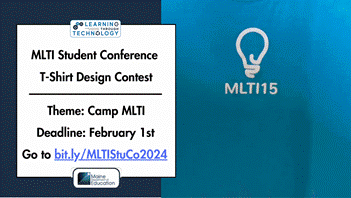
The Maine Department of Education’s (DOE) Learning Through Technology Team is excited to open the registration and t-shift design contest for the 21stannual MLTI Student Conference events!
Two separate events are being organized this year, each with a distinctive look and approach. We will be organizing another in-person event this year as well as a virtual event again this year, but we are shaking things up. And, for the first time ever, we are hosting two separate t-shirt design contests! See below for more information about these exciting updates.
MLTI Virtual Student Conference, March 7th, 2024
The Learning Through Technology Team is shaking things up with our MLTI Virtual Student Conference this year! We are excited to announce the MLTI Winter Classic, our fifth Virtual Student Conference. This event will be hosted in March this year to provide a unique and innovative opportunity that is better tailored to school schedules and allows for more flexibility than ever before. Join us in a game-based day of fun! Register now to ensure your team can participate in the MLTI “Winter Classic”!
This event is open to all school districts in the MLTI program. Registration is free and all materials will be provided. Register prior to January 8th to ensure that your team/classroom receives their materials and MLTI t-shirts before the big day!
Join us again this year for a day of learning through technology at the University of Maine in Orono. We are excited to invite you to “Camp MLTI” the 2024 MLTI In-Person Student Conference in May. This event brings together over a thousand students and educators from all across the state for a day of engaging sessions and activities at Maine’s largest university.
This event is open to all educators and students, grade 5-10 school districts in the MLTI program. Registration is free and all materials will be provided. Register prior to March 29th, to ensure that your team/classroom receives their materials and MLTI t-shirts before the big day!
For the first time ever, we are hosting two separate t-shirt design contests! This contest is open to all students in MLTI school districts, grades 5-10. Design the t-shirt that students around the state will wear during the MLTI Student Conferences! The winners will be recognized during the event they were selected for. Submissions for the Virtual Student Conference are due December 15th, and submissions for the In-Person Student Conference are due no later than February 1st. Winners will be announced within two weeks of submission.