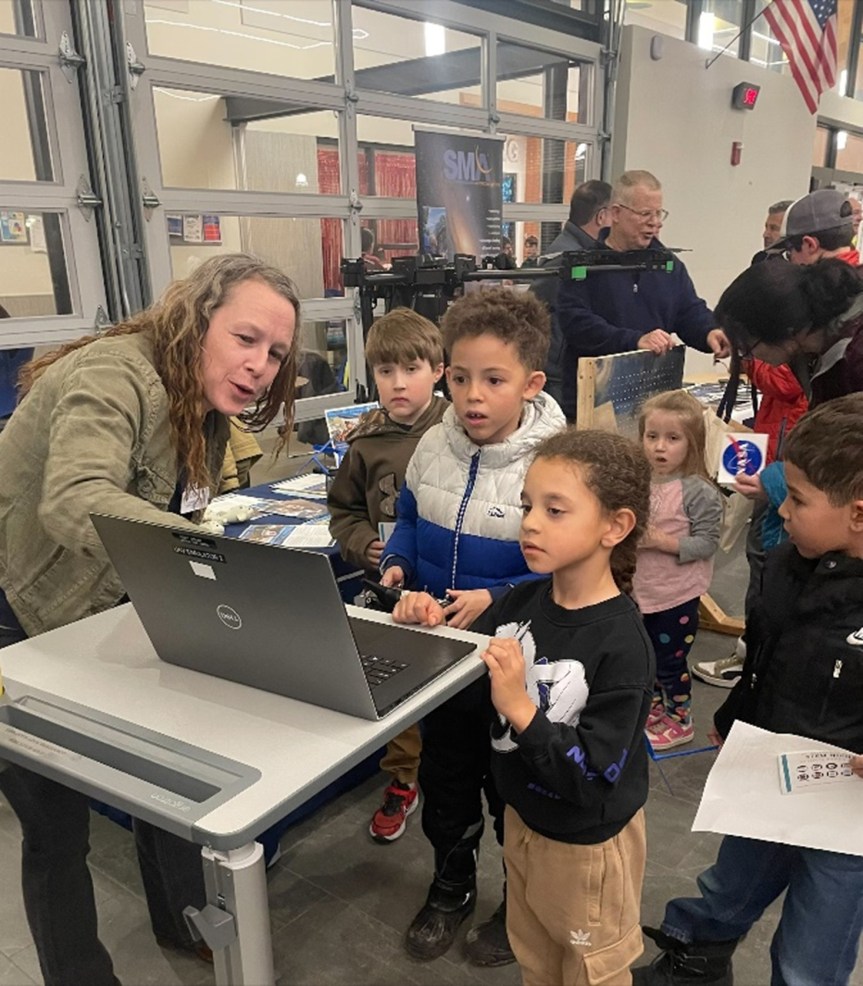
Pictured: Students practice landing a plane with an aviation simulator.
Community outreach and extended learning coordinators wear many hats inside a school. This role often sits at the intersection of academics, career readiness, partnerships, and student support, connecting what happens inside the building to real-world opportunities outside of it.
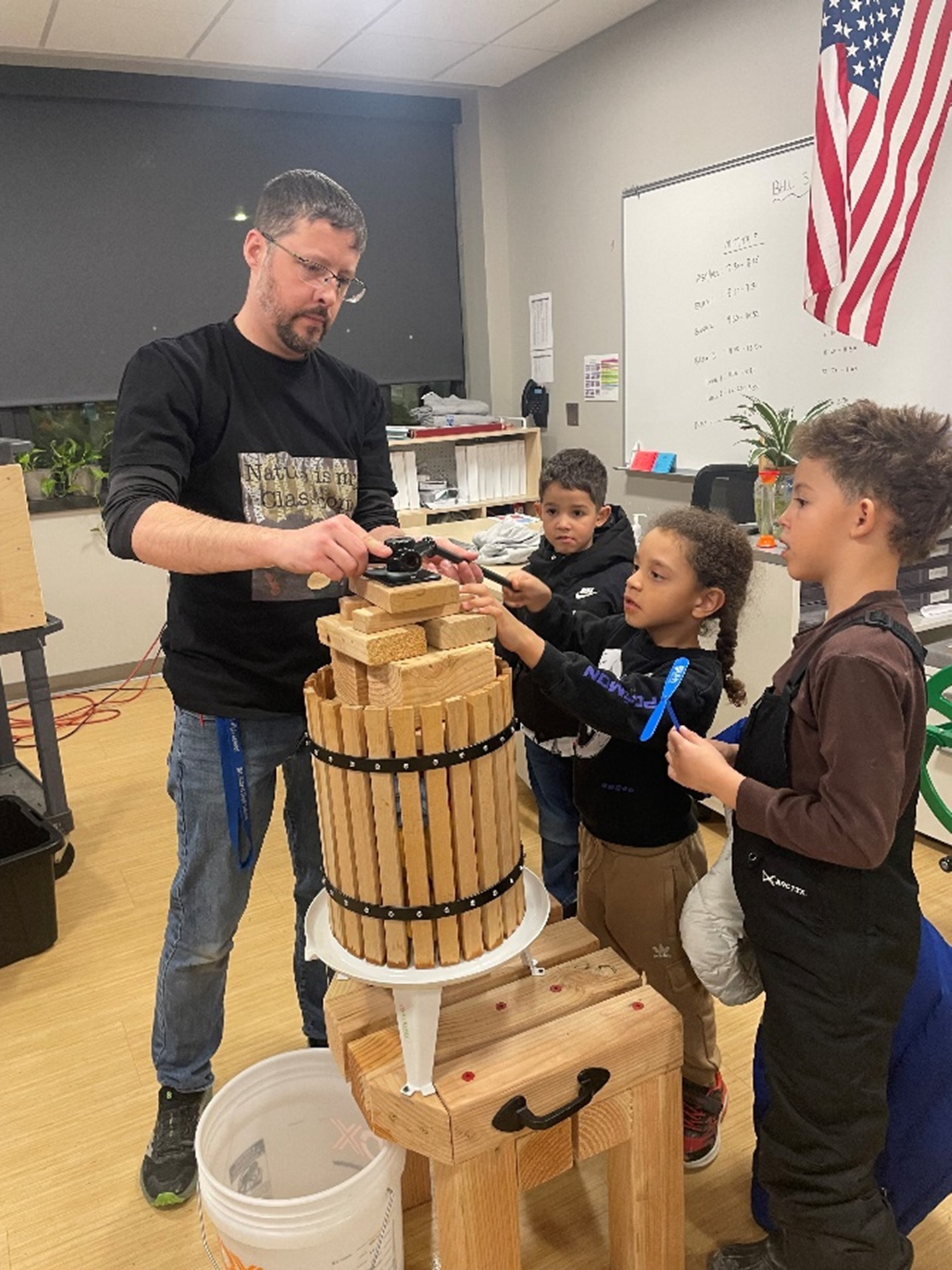
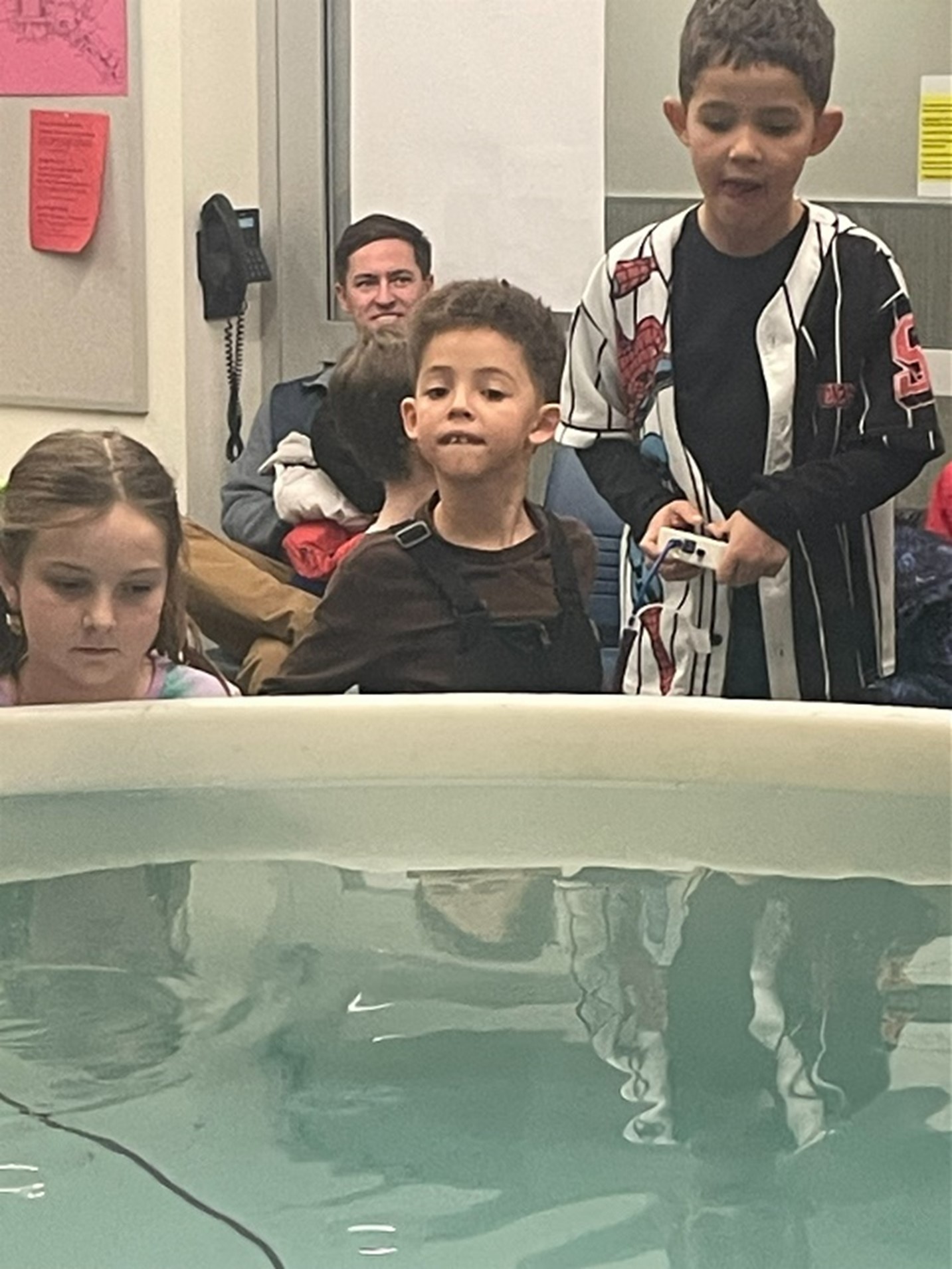
That work was on full display recently as Mt. Ararat High School in Topsham, under the co-leadership of Community Learning and Extended Learning Opportunities (ELO) Coordinator Doug Ware, hosted its second annual STEM (Science, Technology, Engineering, and Mathematics) Night on January 30, 2026. The event drew approximately 500 attendees and featured more than 40 vendors, transforming the school into a dynamic hub of innovation, collaboration, and hands-on discovery.
During this event, families and community members from MSAD 75 joined local businesses, industry leaders, and educators for a vibrant evening celebrating STEM. Participants of all ages engaged in activities ranging from virtual medical simulations and Lego robotics to tours of the Bath Iron Works virtual reality trailer and digital arts showcases.
For many attendees, the event highlighted the strength of Maine’s local STEM ecosystem. Paul McGuire, a local alum, entrepreneur, father, and veteran, attended with his family.
“Seeing employers represented from construction to aviation reminded me how strong our STEM community is,” McGuire said. “It’s great to know students can find those opportunities right in our backyard.”
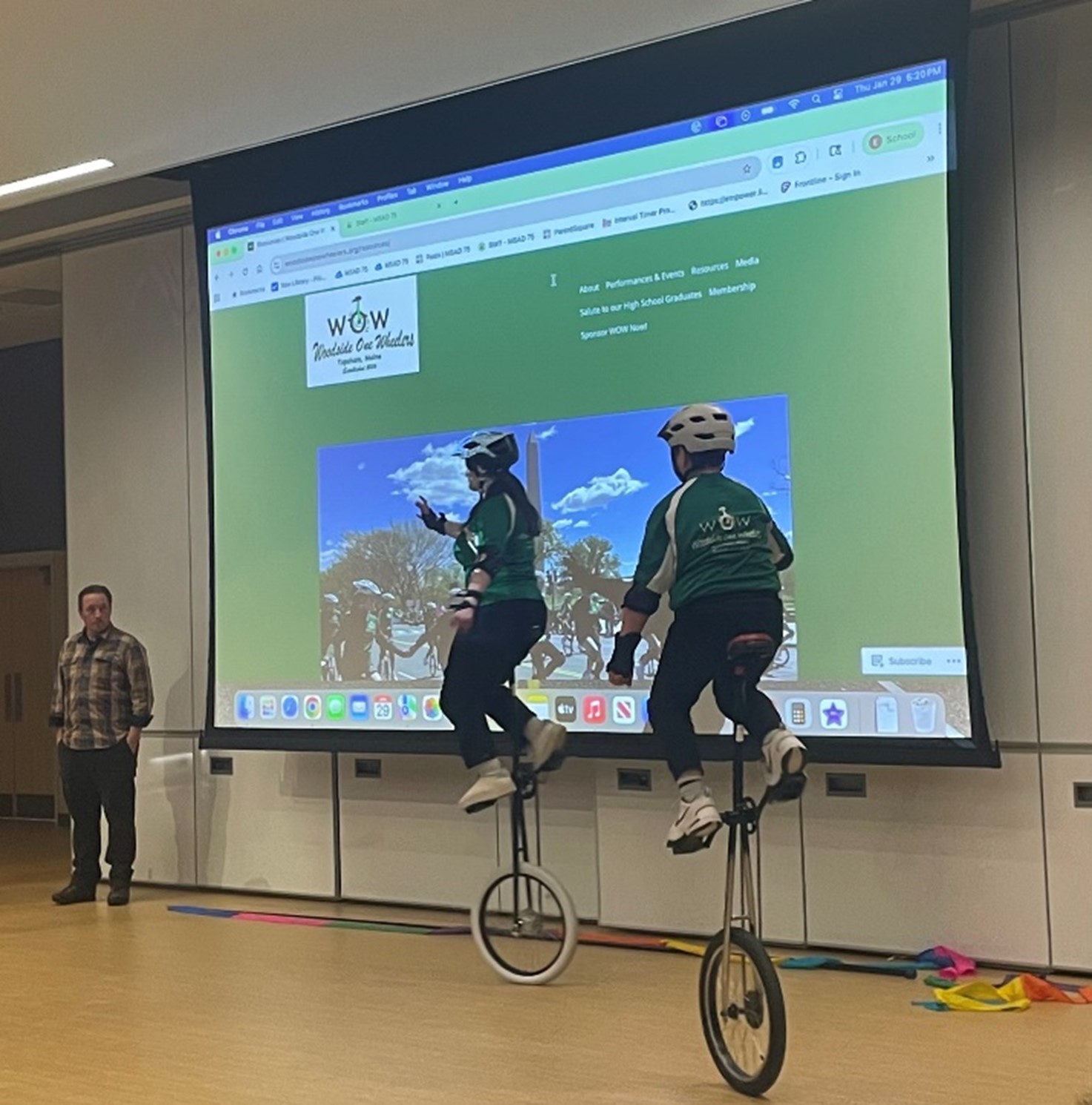
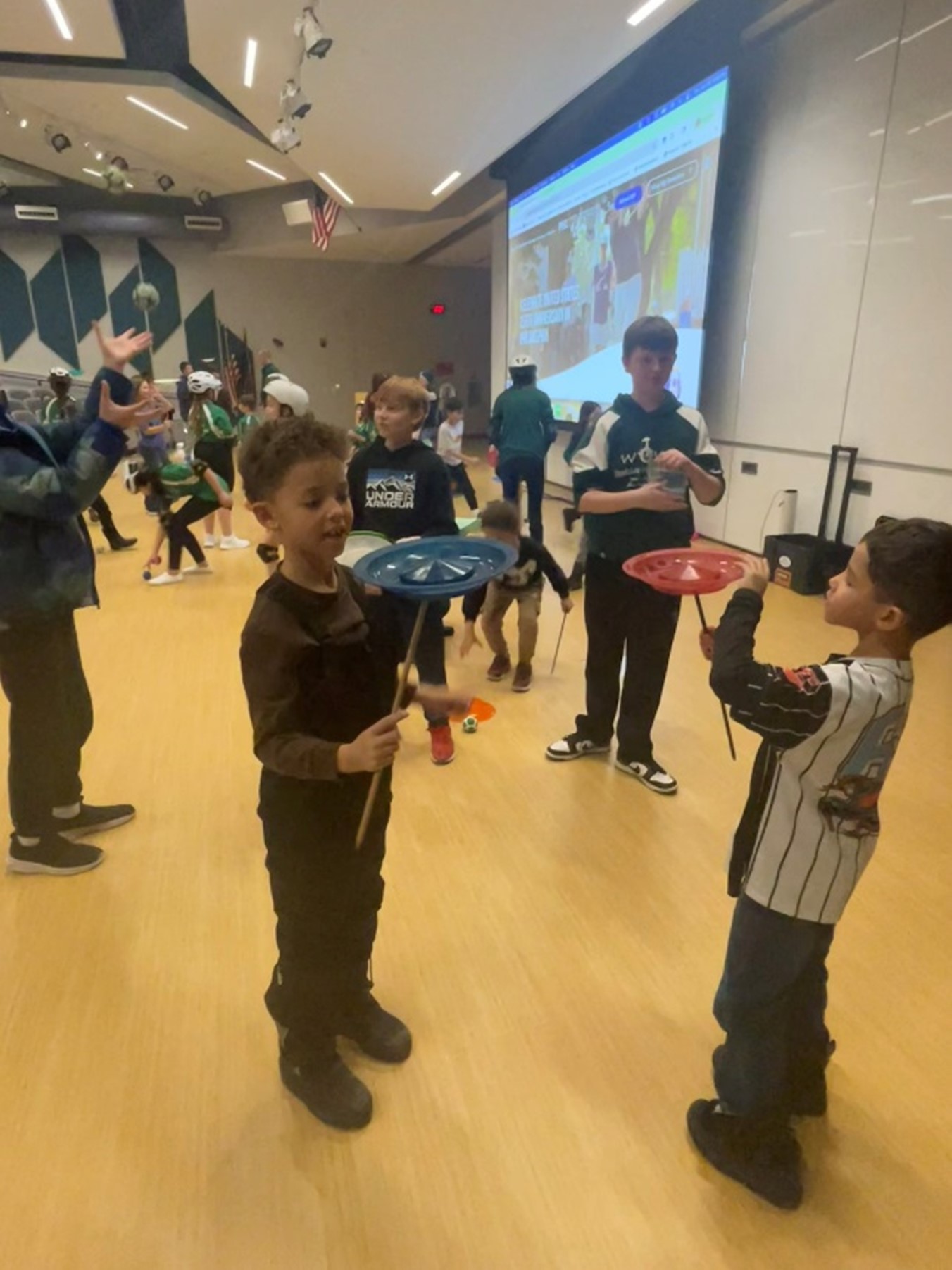
A highlight of the evening was a performance by the Woodside One Wheelers, a juggling and unicycling group from Woodside Elementary School. Students attached sensors to their unicycles to demonstrate how scientific data is gathered and how physics principles apply in motion, blending performance, engineering, and applied science in a way that captivated the audience. The group later performed at the halftime of a local girls’ basketball game, extending the celebration of learning beyond the STEM exhibits.
Events like STEM Night exemplify the multifaceted impact of community outreach and extended learning coordination. The role includes building community partnerships that bring businesses and civic organizations into the school experience; managing ELOs that allow students to earn credit through internships, job shadows, and real-world projects; supporting career and workforce development; encouraging student leadership and service; collaborating with faculty to connect curriculum with experiential learning; removing barriers to access; and telling the story of student success in ways that inspire continued investment and innovation.
Mt. Ararat High School has demonstrated exemplary leadership in advancing high-quality ELOs through its Maine DOE ELO Expansion grant. The school’s work demonstrates how innovative, community-connected learning deepens student engagement, supports informed postsecondary decisions, and helps students envision futures grounded in real experience, meaningful relationships, and opportunity.
STEM Night was an event that reflected what is possible when schools and communities work together. By bridging classroom learning with hands-on exploration and professional partnerships, Mt. Ararat High School continues to model how education can be both rigorous and relevant—preparing students not just for graduation but for life beyond it.
For further information about ELOs and Maine’s efforts to expand career exploration for Maine students, please visit the Maine DOE ELO webpage or contact Maine DOE Extended Learning Coordinator Lana Sawyer at Lana.Sawyer@maine.gov.
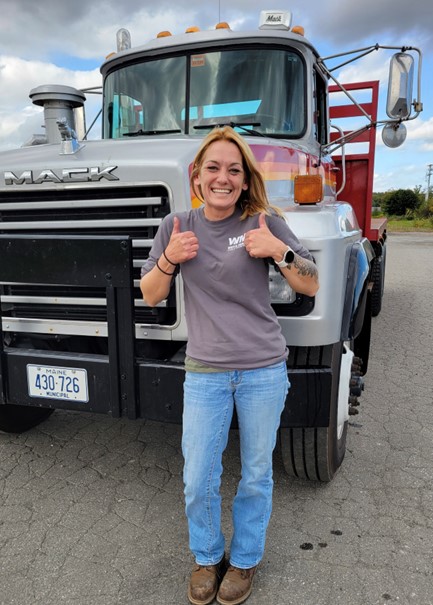
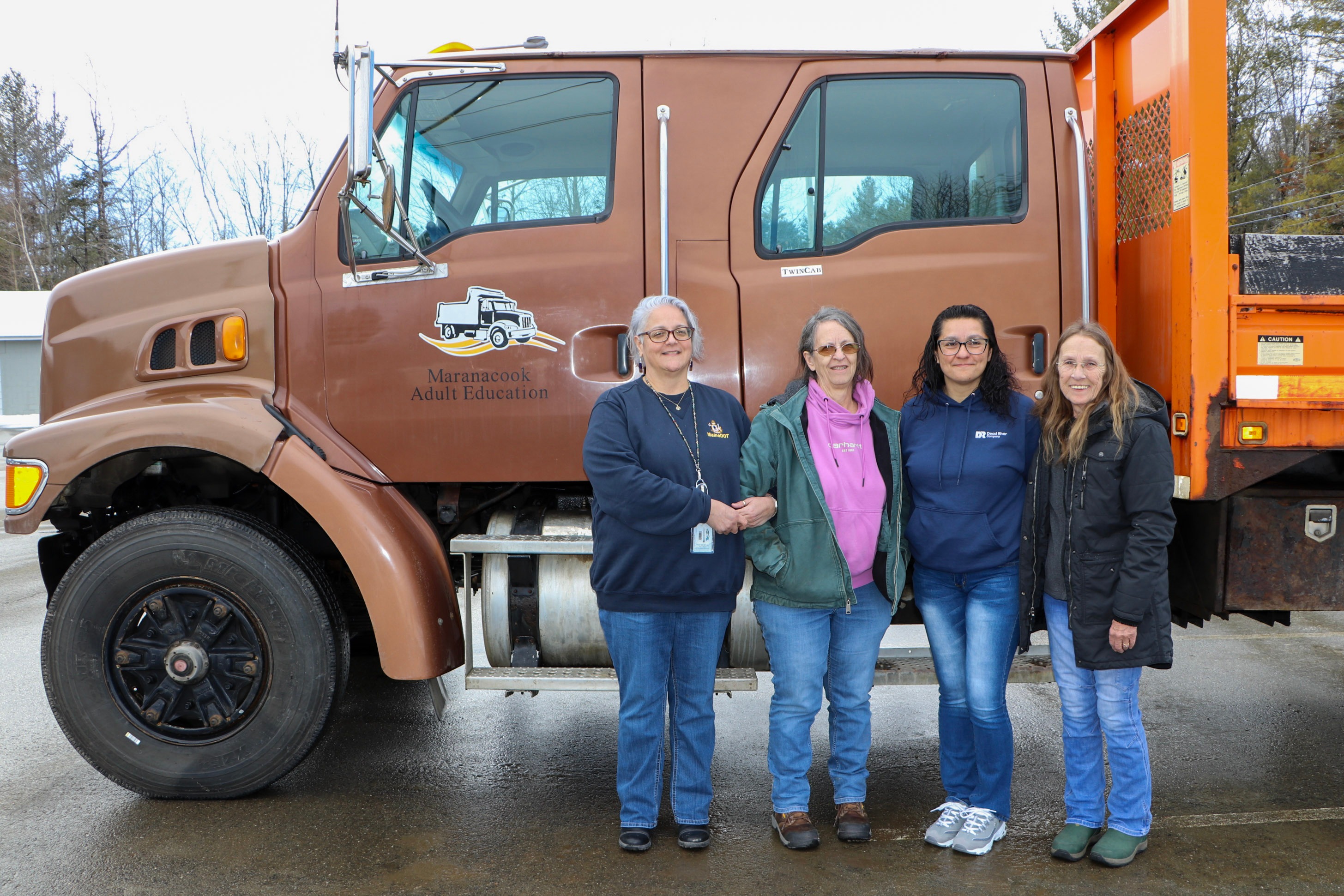
Pictured: Angela Mantha recently completed her CDL at Maranacook Adult Education.
In Maine, women from high school to adulthood are charting their paths into the state’s skilled trades workforce. By participating in hands-on experiences through career and technical education (CTE), Extended Learning Opportunities (ELO), and adult education, these students are mastering equipment, learning industry standards, and engaging in real-world problem-solving, gaining practical experience and marketable skills aligned with high-demand industries.
There is a greater trend at hand: More women are now entering career and technical programs with clear goals and a strong sense of direction, seeing the trades not as unconventional options but as viable, rewarding professions. The Maine Department of Education (DOE) is pleased to highlight some of stories from across the state for Women in the Trades Month in March.
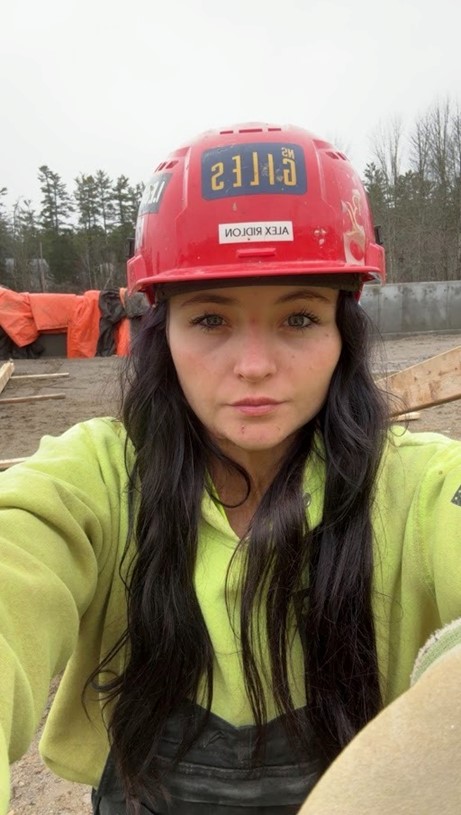
Alex Ridlon, Brewer High School
Back in 2020, when I was 12 years old, I was burned in a fire, and I lost my father; both are experiences that profoundly changed my perspective on life. Facing such a significant loss at a young age and the deforming of my skin forced me to mature quickly and shaped the direction I chose for my future.
From an early age, I enjoyed working outdoors and being active. As I entered Brewer High School, however, I often felt out of place.
My family was going through financial hardships, and I experienced bullying as a result. Rather than allow those challenges to define me, I made the decision to focus on building a future for myself. I chose to pursue a career in construction, both because I enjoy working outside and because it offered me a practical path toward independence and growth.
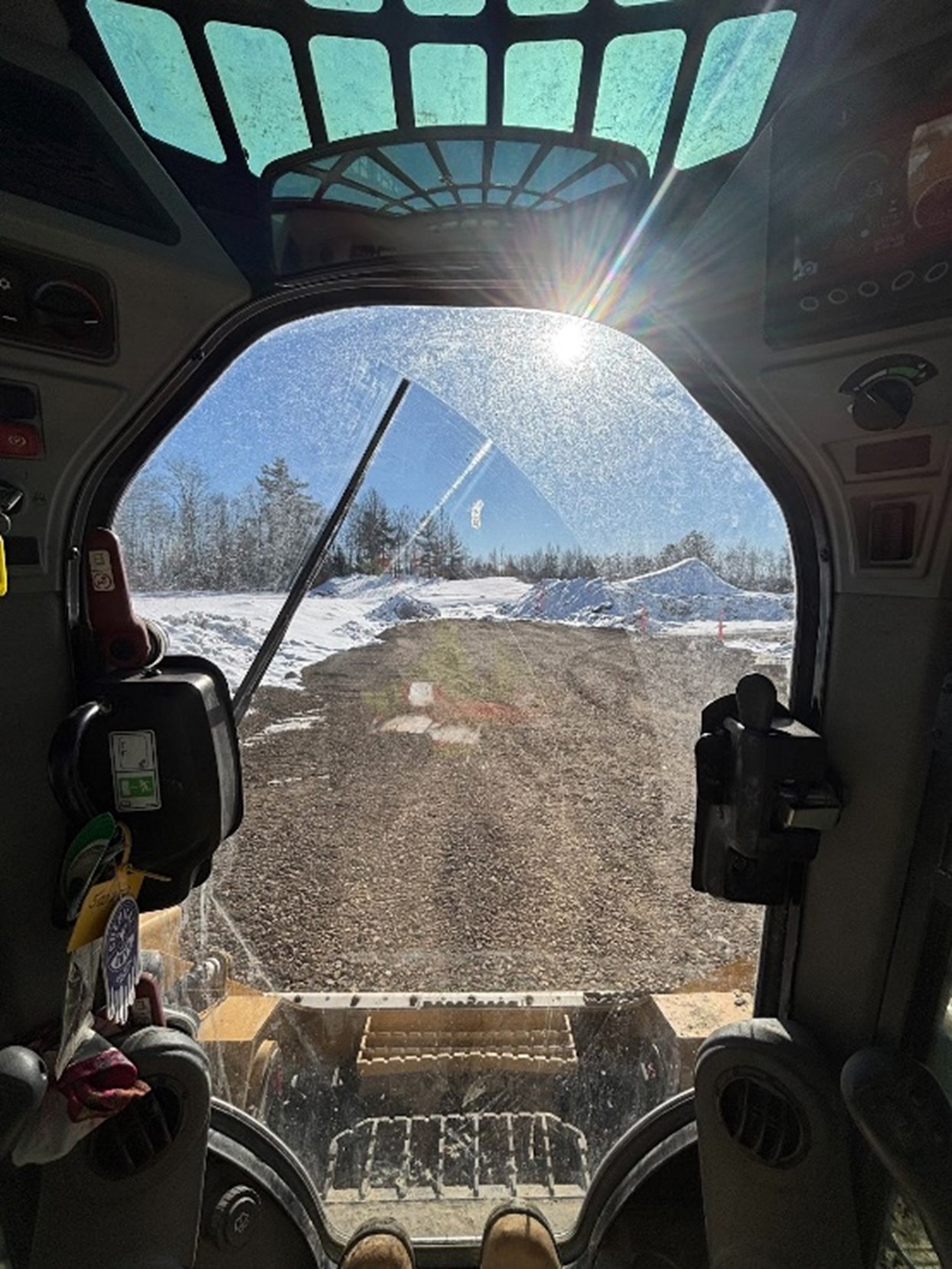
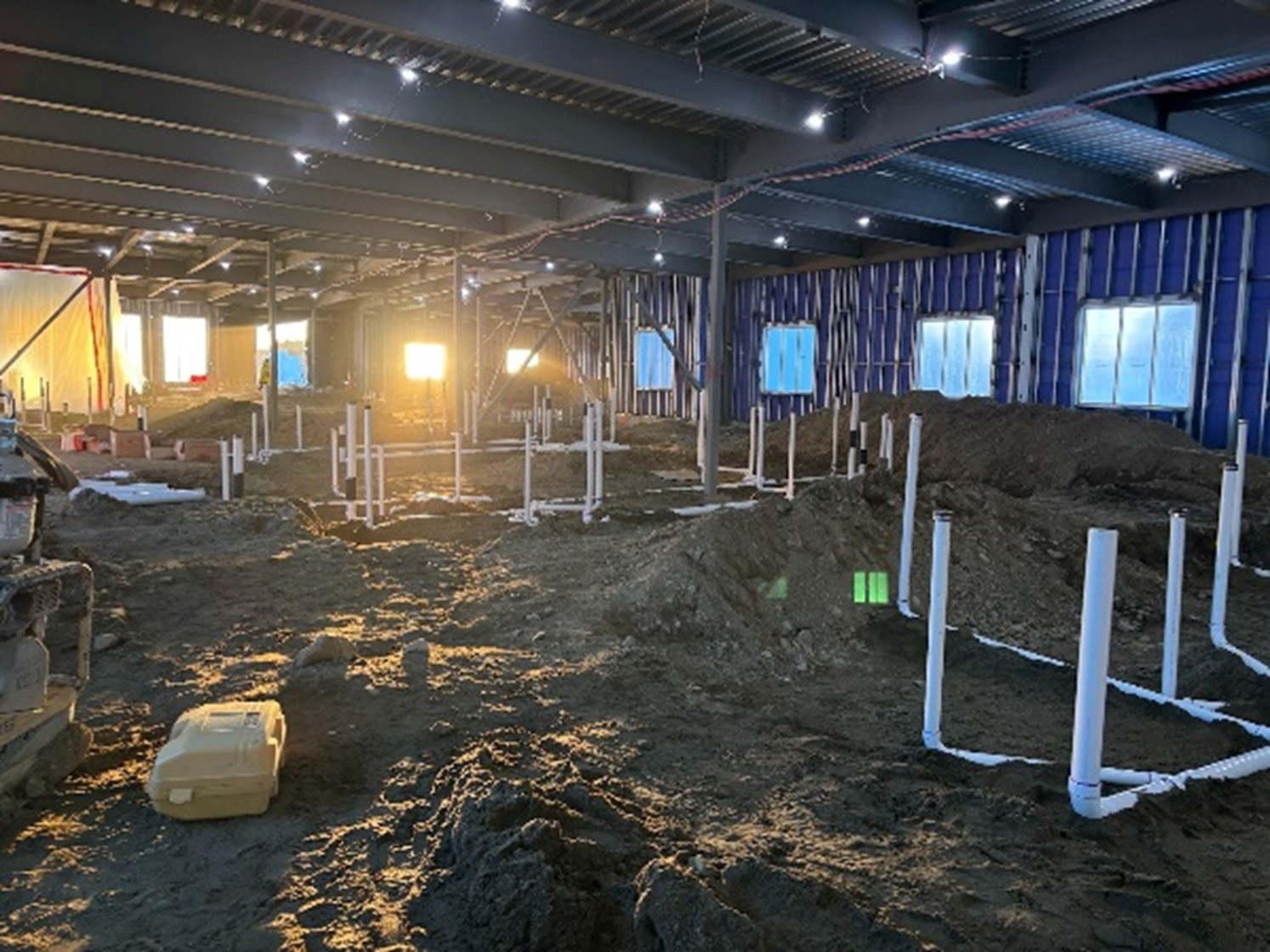
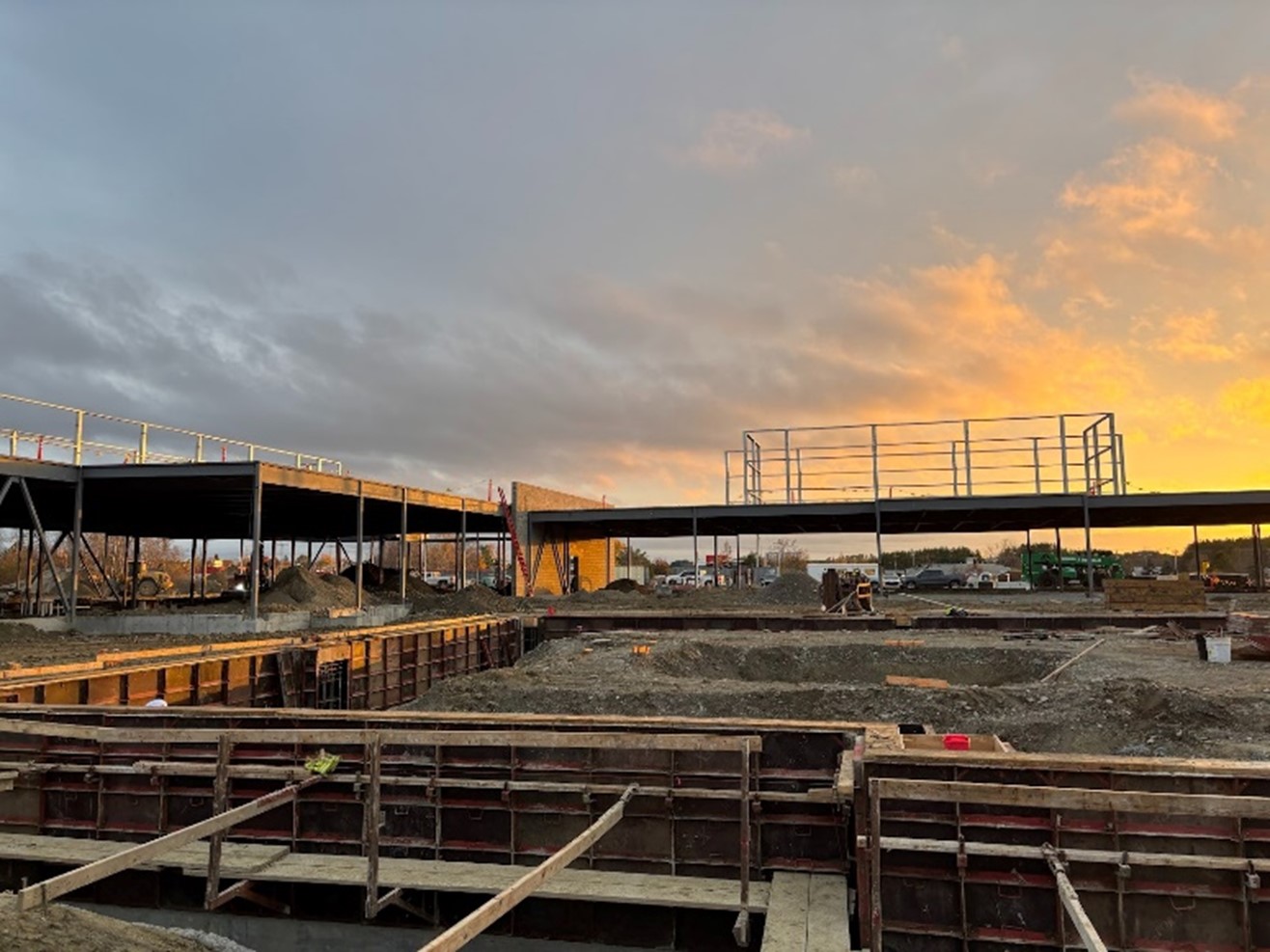
So far, I have primarily worked on medical facilities. It is especially meaningful to me to know that the buildings I help to construct will one day serve people in need. Contributing to projects that positively impact others gives my work a deeper purpose.
During that difficult time in high school, I sought guidance from one of the smartest, most helpful, easy-to-talk-to people, Mr. Kevin Napolillo, my ELO coordinator, who became an important source of support. He encouraged me to invest time in preparing for the real world. Over the course of four weeks during the summer, I dedicated myself to daily reading, learning, and hands-on preparation. That experience opened my eyes to what I was capable of achieving and helped me develop both confidence and direction.
I decided to begin working with concrete as a way to enter the field and start building toward my long-term goal of becoming a heavy-equipment operator. Throughout my journey, I have learned the importance of resilience and focus. I have found that the more determined you are to succeed, the more important it becomes to stay committed to your goals and not be discouraged by negativity.
As a young woman entering the construction industry at 17 and now 18 years old, I have gained valuable experience and perspective. I graduated earlier than the rest of my class—an accomplishment that strengthened my confidence and reaffirmed my determination. Working alongside experienced professionals has shown me the clear difference between classroom learning and real-world application. In many ways, I have learned more through hands-on experience in construction than I did in a traditional classroom setting. My journey has been shaped by hardship, perseverance, and a strong desire to build not only structures but also a meaningful and independent life for myself.
Isabella (Izzy) Moore, Brewer High School/Maine Construction Academy
During my junior year of high school, I knew it was nearly time to choose my career path post-graduation. I didn’t know what path I wanted to take, but I did know that I needed some hands-on work. I heard about the Maine Construction Academy, so I decided to check it out. I signed up and got approved for it but was still unsure; as it turns out, it was the best decision I ever made for myself, and I have no regrets.
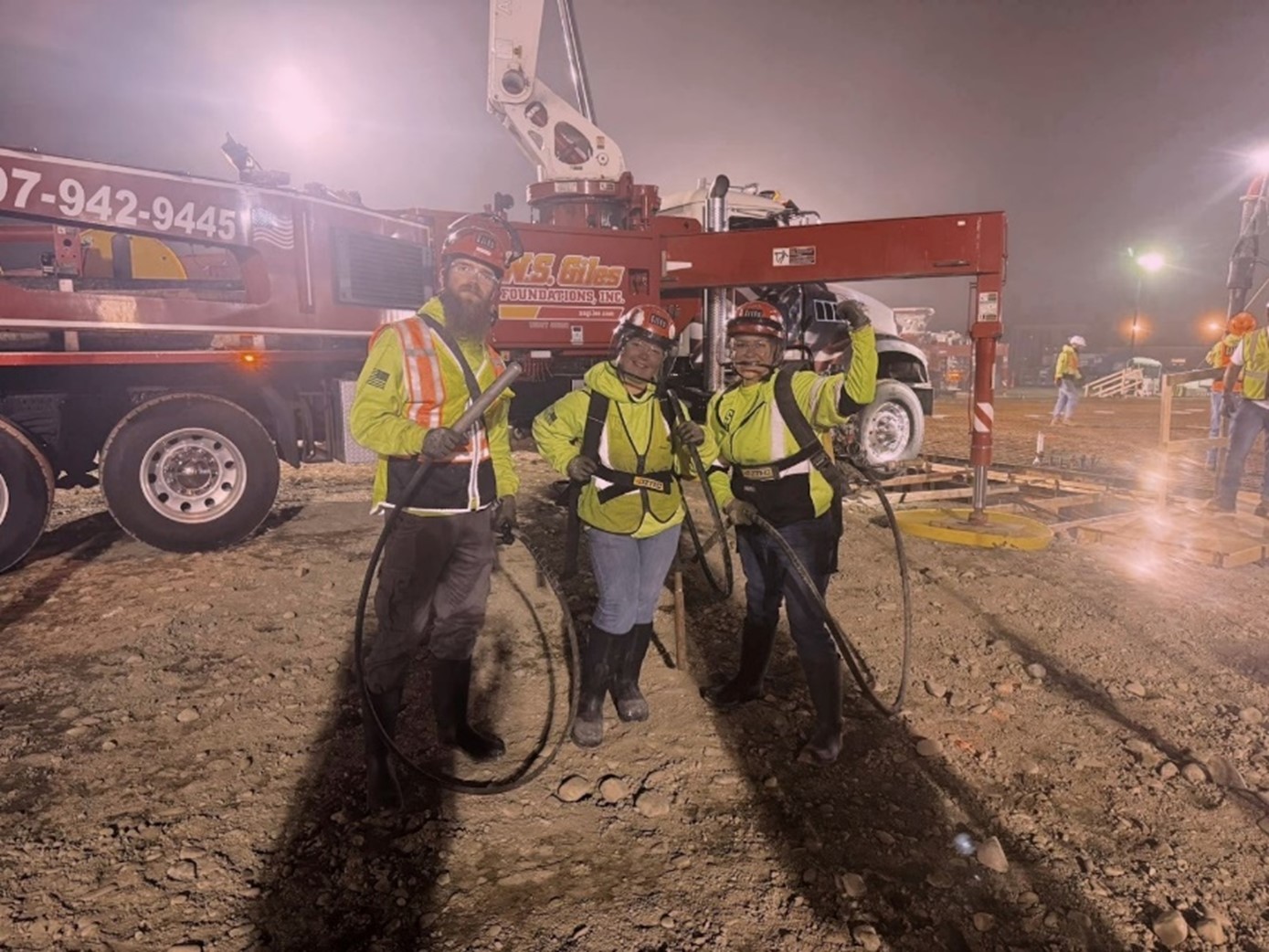
This program gave me the opportunity to do an apprenticeship during my senior year of high school through N.S. Giles Foundations, which transferred to Sargent, [my current place of employment], after graduation. It was here that I learned how to use heavy equipment. Both companies have welcomed me with open arms and given me amazing mentors and opportunities.
Without all of this, I would not be the woman I am today. I feel as though construction gave me more structure and discipline, along with a lot of confidence. I have been able to not only become more independent mentally but financially, as well. At just 19 years old, I have my own apartment, bought my first “big girl” car on my own, and have taken a few vacations. Now, that’s just the fun stuff—but you get what I’m saying. If it weren’t for this program, I wouldn’t be where I am today, nor would I have the life I have built for myself so far.
What started out as “I’m just going to test the waters and see what happens” turned into such a growing passion for this field. I can’t see myself doing anything else, and I look forward to doing this for the rest of my career. I am extremely grateful to all the people who have taken a chance on me during this path, along with all of the opportunities that have been given to me.
Lily Kick, Sacopee Valley High School
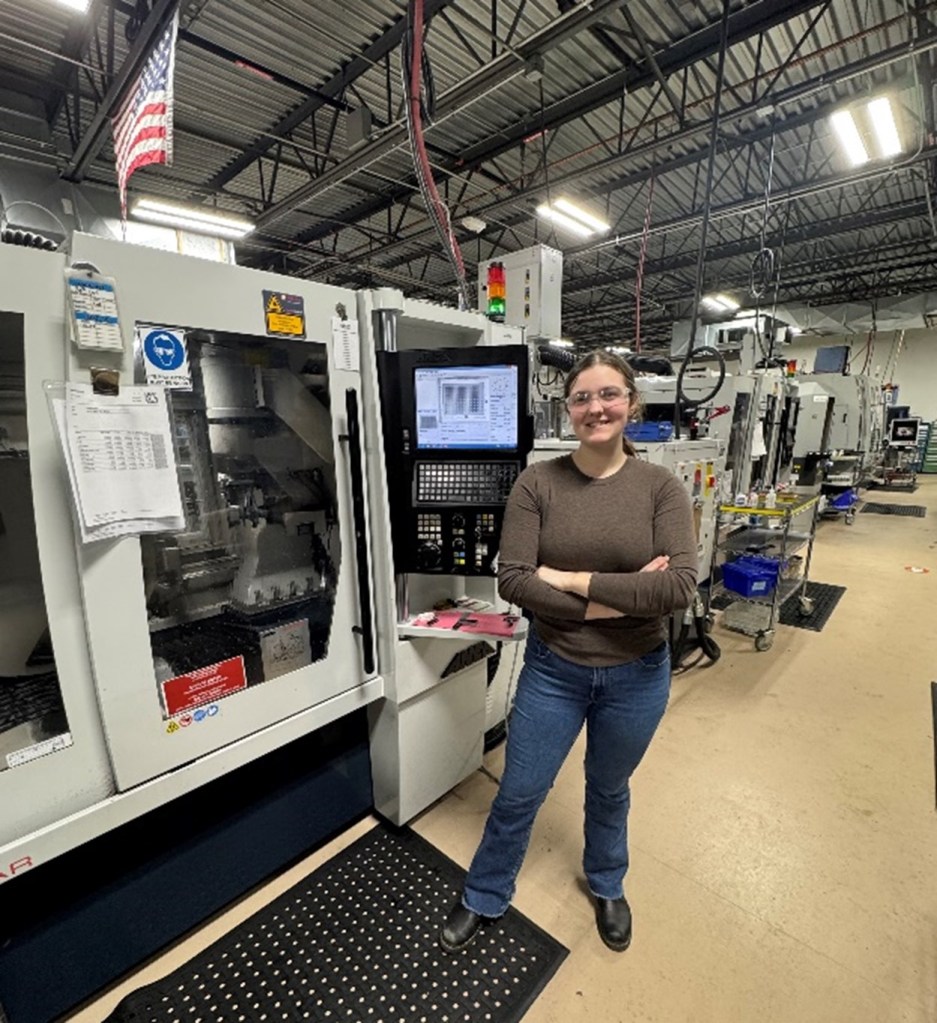
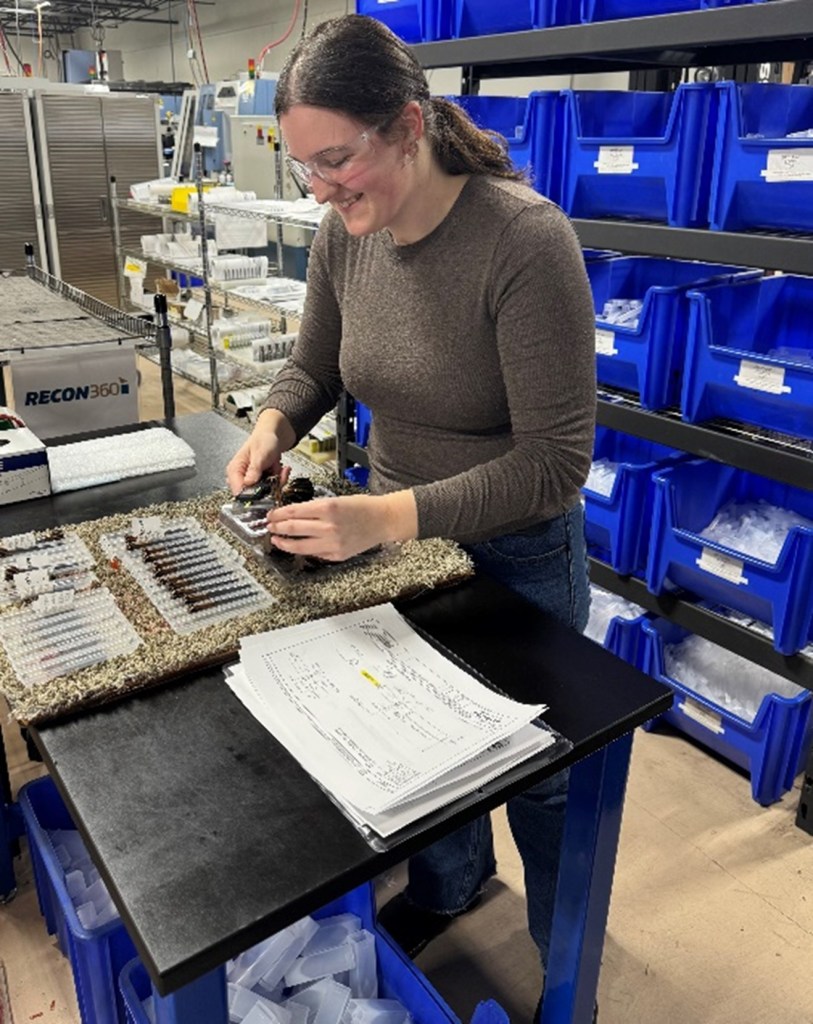
Lily Kick is a senior at Sacopee Valley High School who plans to pursue a career in the manufacturing industry.
“Manufacturing is a field full of innovation, and that is what I want to invest my future in,” Kick said. “Career surveys often pushed me toward architecture or actuary. Through some research and a few job shadows, I learned that these were not career pathways for me.”
As a junior, Kick interned at New England Castings in Standish, a local manufacturer of precision alloy castings using the lost-wax casting method. This year, she is participating in an internship at ARCH Cutting Tools in Cornish, a company that manufactures metal removal cutting tools for a variety of industries.
“My two internships have solidified my decision to obtain a mechanical engineering degree and hopefully contribute to the innovation in the manufacturing industry,” Kick said.
Kick explained that she does not think she would enjoy a predictable office job. Instead, she prefers the field’s constant new tasks and issues that require immediate attention, as well as its adaptability and unpredictability.
Kick credits the support of her ELO teacher, Dr. Elizabeth Sanborn, whom she says, “undoubtedly made the most impactful difference in my future pursuing engineering and manufacturing.”
Kick noted she also feels her ELO experiences have helped to strengthen her personally as a young woman.
“It is notorious that trades are a male-dominated field; however, my success has taught me there is always room for change,” Kick said.
Maranacook Adult Education
One of the programs offered at Maranacook Adult Education is aimed at addressing a critical need in the workforce: truck driving.
“Both nationally and here in Maine, we are facing a critical shortage of truck drivers. There simply are not enough qualified drivers to meet the needs of the industry,” Steve Vose, Director of Maranacook Adult Education, said.
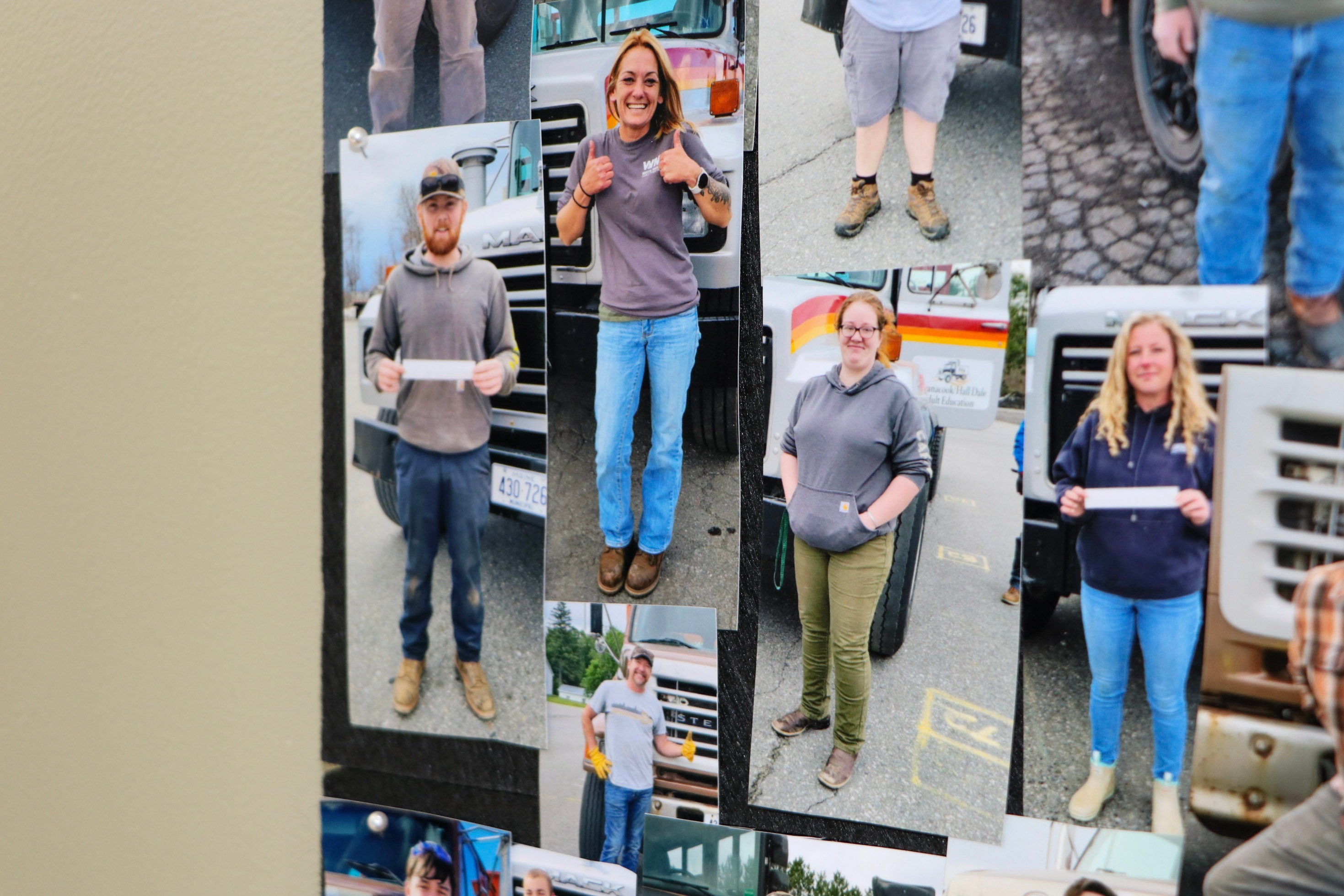
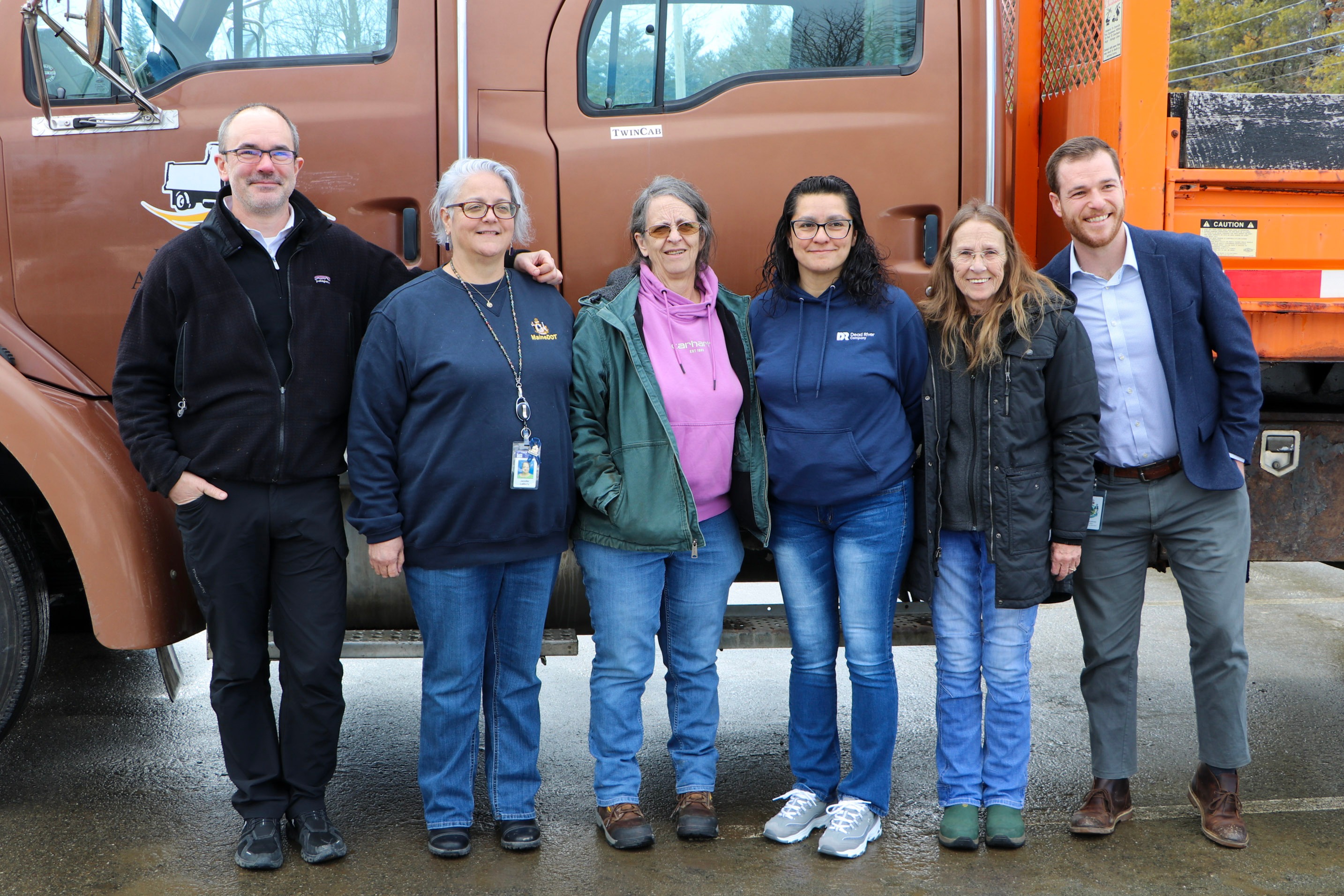
Vose said part of the solution entails getting more women involved by demonstrating that truck driving is a safe, viable career path with good pay—typically above minimum wage. He said he was pleased when the Maine Department of Labor and Maine Department of Transportation announced a $96,000 Women in Trucking grant for Maranacook Adult Education to help more women afford to get their Commercial Driver’s License (CDL).
“I am extremely encouraged to see state governments, employers, and nonprofit organizations recognizing this challenge and beginning to provide truck-driving schools with the financial support and resources necessary to help address these staffing shortages,” Vose said. “For far too long, the trucking industry has overlooked a vital resource: women drivers. Women are the future of trucking and deserve to be recognized and valued as such.”
Vanessa Mercado recently received her CDL from Maranacook Adult Education and is now driving for Dead River Company—an experience that she has called “life changing.” Mercado said the Maranacook Adult Education program helped her to gain confidence in her skills, allowing her to now do this job that she finds meaningful.
“I know that I’m providing to the community as a delivery driver,” Mercado said. “I’m able to do something that gives back.”
Nancy Frost, one of two female truck-driving instructors at Maranacook Adult Education, said that she is pleased to see more female representation in the truck-driving industry.
“I think it’s a lot easier for women now,” Frost said. “I think that this grant is going to be wonderful.”
Vose shared that all Women in Truck Driving scholarships are spoken for in the July program, but Maranacook Adult Education is currently accepting scholarship applications for November. Those interested should please contact Vose at 207-242-8795.
Please visit the Maine DOE website to learn more about ELOs, adult education, and CTE across the state.
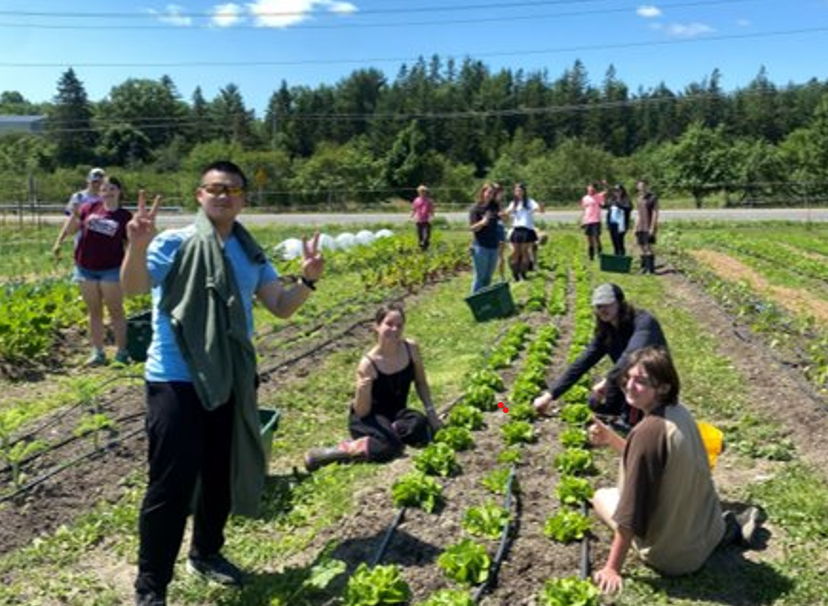
Pictured: Students in Washington County learn how to grow crops.
Since 2022, Maine has invested a historic $7.1 million to expand Extended Learning Opportunities (ELO) programming throughout the state. ELOs provide schools with opportunities to create meaningful connections with employers statewide. In turn, they help young people better understand career opportunities and acquire valuable foundational career skills, including initiative, adaptability, problem-solving, teamwork, and communication.
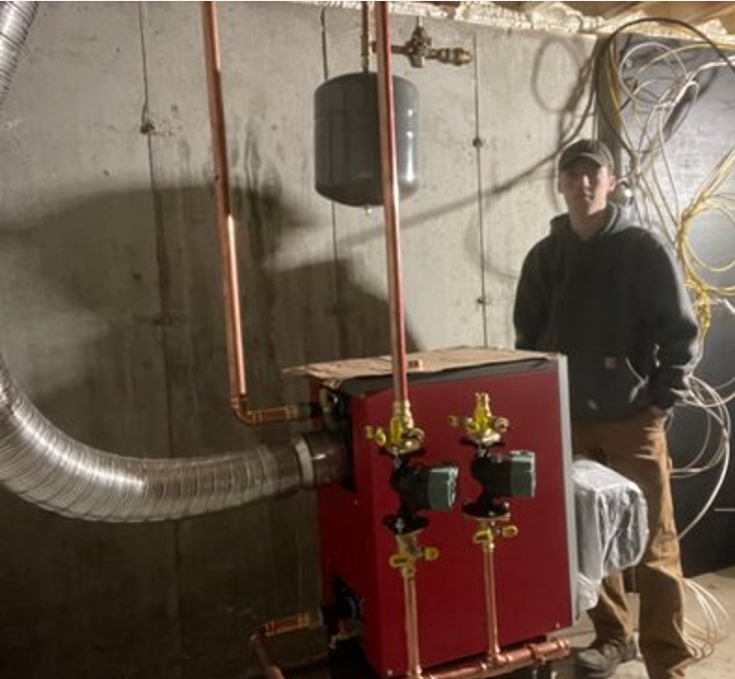
Through ELOs, Maine students are learning by doing. They are earning credentials, such as certified nursing assistant; installing boilers alongside skilled tradespeople; training to become future educators; participating in law-related ELOs; and engaging in countless other hands-on, career-connected experiences.
In 2024, the Maine State Legislature codified ELOs in statute as an approved education pathway. This statute, intentionally written with flexibility, empowers schools and communities to design ELO programs that meet local workforce needs, while honoring student interests and goals.
ELOs by the Number
There have been two rounds of Maine DOE ELO grants. The first round, $5.6 million of the Maine Jobs and Recovery Plan (MJRP), was awarded in 2022 to 26 schools and community-based organizations throughout the state, covering 13 counties. In 2025, the state invested a second round of $1.5 million to support ELO 2.0, which funded 12 ELO programs. These awardees included expansions of existing ELO programming and the launch of new programs.
Between the fall of 2022 and fall of 2025, the Maine DOE grant-funded ELO programs have seen:
3,000+ core and elective credits earned.
6,000+ student participants.
3,000+ new school-employer partnerships.
8,000+ community and business engagements.
These numbers represent more than participation; they reflect aspiration, engagement, and strengthened collaboration among educators and employers, as ELOs continue to become part of the fabric of Maine’s education landscape. (Please note that this data does not include the outcomes of other ELO programs in Maine, such as those that are supported locally or funded through other agencies.
Some examples of these recent investments include ELOs at:
Mountain Valley High School, focused on building local aspirations and local talent.
Brewer High School and Marshwood High School, embedding ELOs schoolwide.
A partnership between the Rural Aspirations Project and Healthy Acadia, expanding ELO access to all high school students in Washington County.
Together, these programs demonstrate that ELOs are not isolated efforts; they are becoming part of the fabric of Maine’s education landscape.
The ELO program at the Maine DOE also works closely with the Maine Career Exploration Program, housed within the Maine Department of Economic and Community Development. This program provides 75 hours of paid career exploration for youth ages 16-24, supporting job shadows, internships, mentorships, apprenticeships, digital learning, independent study, community service, and work-based learning experiences, including ELOs.
Regional Collaborations
Throughout Maine, the Community Coordinators Collaborative (C3) serves as an active educator-led network dedicated to building strong business partnerships that expand students’ access to meaningful career exploration experiences, including job shadows, career talks, workplace tours, and internships. By connecting students directly with employers, C3 helps Maine youth navigate future career pathways and strengthens efforts to retain talent and grow Maine’s workforce. Likewise, there are several regional collaborations, both newly formed and long established, such as the York County, Washington County, and Midcoast Collaboratives, all working to deepen partnerships and expand opportunities within their communities.
Current and Future ELO Opportunities
Career Exploration Survey: On February 6, 2026, a short survey was shared through the Maine DOE newsroom.This survey was designed to identify which school administrative units (SAUs) and Career and Technical Education (CTE) schools are currently engaged in career exploration activities—and to gather insights into what is working, what is needed, and where additional support could make the biggest impact. Responses will help inform statewide efforts related to resources, professional development, and technical assistance for pre-K–12 students and school staff.
Monthly, no-cost, virtual, synchronous professional development hosted by the Maine DOE ELO team: Professionals in the field will share their best practices and resources, and agency partners will present on their programs and how students and school ELO programs may access them. The Maine DOE ELO team will also host office hours for ELO grantees. Please see the Maine DOE ELO webpage for upcoming opportunities.
ELO celebration at the Hall of Flags: Join the Maine DOE ELO team and students/staff from ELO programs statewide on April 30, 2026, from 1-4 p.m. at the Hall of Flags in Augusta.This afternoon will be spent celebrating and raising awareness about ELOs in Maine by highlighting the impactful work of communities, students, staff, and partners. Students will display their ELO work through a student showcase of statewide ELO profiles.
Supporting younger learners in careerexploration: The Maine DOE ELO team will be launching a community of practice (COP) for educators who provide career exploration experiences for younger learners (preK-8). This COP builds on the successful summer pilot, Maine Out of School Time program. (MOST) which supported career exploration for students in grades 4–6. To learn more about MOST, please watch this short video and stay tuned for updates on how to join the community of practice. This expansion reflects the understanding that career exploration does not begin in high school; it begins with early exposure, curiosity, and possibilities!
For further information about ELOs and Maine’s efforts to expand career exploration for Maine students, please visit the Maine DOE ELO webpage or contact Maine DOE Extended Learning Coordinator Lana Sawyer at Lana.Sawyer@maine.gov.
Throughout Maine, schools and school administrative units (SAUs) are finding new and creative ways to help students explore careers, connect learning to real-world experiences, and prepare for life beyond the classroom. To better understand and strengthen these efforts, educators and education leaders are invited to participate in a brief Career Exploration Survey.
The Career Exploration Survey is designed to identify which SAUs and Career and Technical Education (CTE) schools are currently engaged in career exploration activities—and to gather insights into what is working, what is needed, and where additional support could make the biggest impact. Responses will help to inform statewide efforts related to resources, professional development, and technical assistance for pre-K–12 students and school staff.
Throughout the survey, participants will see the term “Extended Learning Opportunities (ELOs)”. ELOs refer to learning experiences that take place outside of the traditional classroom, with a strong emphasis on community-based career exploration. These experiences may be credit-bearing and serve as an umbrella for many types of career exploration activities and work-based learning experiences. Participation in the survey is especially encouraged for those coordinating ELO programs, transition programs, alternative education programs, and other programs impacting career exploration in Maine.
By sharing your perspective, you will be contributing to a clearer picture of career exploration in Maine and helping to shape future support that responds directly to the needs of schools, educators, and students. Whether your SAU is deeply engaged in this work or just beginning to explore possibilities, your voice matters.
With questions, please contact Maine DOE Extended Learning Opportunities Coordinator Lana Sawyer at lana.sawyer@maine.gov /or Maine DOE Social Emotional Learning Specialist Aubrie Howard at aubrie.howard@maine.gov.
(Students from the Winslow High School Cheerleading Team pose with Maine Secretary of State Shenna Bellows.)
The Maine Department of Education (DOE) Office of Special Services and Inclusive Education held its second annual “I Belong” Youth Summit at Central Maine Community College on Thursday, May 29. This event brought together students from across the state with individualized education plans (IEPs) for a day dedicated to empowerment, connection, and celebration of student voice. Student participants ranged in age from 10 to 22 years old.
The summit is an initiative that happens through the Transition Maine program, which was developed by the Office of Special Services and Inclusive Education to provide accessible and inclusive transition services for students moving from high school into adulthood. The Executive Student Transition Committee, a team of students who assist with the Transition Maine program, plays a large role in the organization of this event, designed to amplify the voices of youth with varying abilities.“To see our students meaningfully engage and included in hands-on activities to help them imagine their future makes me and our team very proud,” Executive Student Transition Committee Co-Chair Connor Archer said, reflecting on the success of the summit. “As someone who received special education services right here in Maine, I know how unique and powerful this experience is.”
Secretary of State Shenna Bellows kicked off the summit by speaking with students about Maine’s new accessible voting machines, known as the ExpressVote.
The system allows voters to mark their ballots using a touchscreen or keypad, and it includes audio instructions for those who are visually impaired. It then prints a paper ballot that can be scanned and counted. Bellows emphasized the importance of civic participation and ensuring that all Mainers, including those with disabilities, have full access to the process.
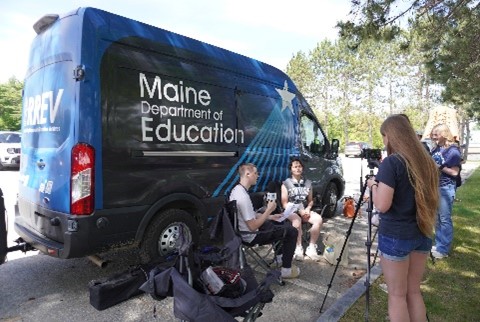
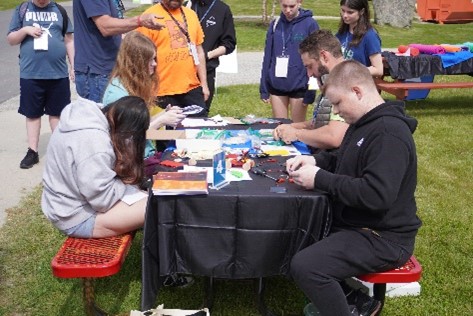
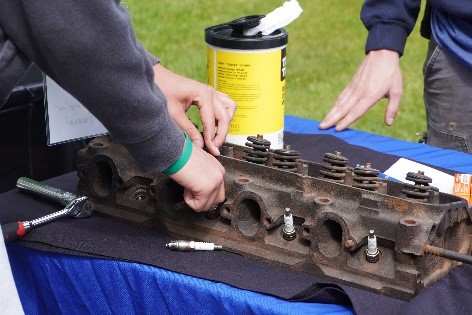
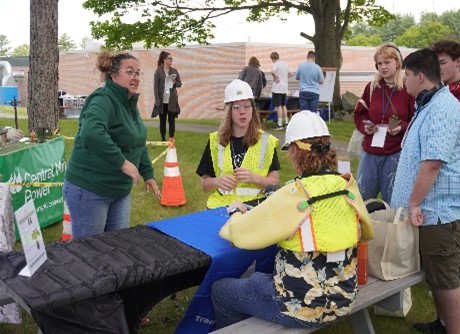
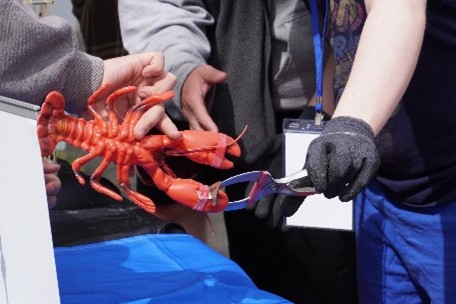
The daylong event allowed students to discover post-secondary opportunities through engaging, hands-on activities. Career paths in trades, culinary arts, agriculture, health care, media, and more were highlighted throughout the day. Students practiced knife skills with chefs, pulled lobsters from traps, and planted vegetables. They participated in Central Maine Power’s “Safety City” demonstration, regarding safety around power lines, and joined the Maine DOE Rethinking Responsive Education Ventures (RREV) team, along with the Student Leadership Ambassadors of Maine (SLAM) from Nokomis High School, for mock media interviews, designed for those interested in journalism and broadcasting.
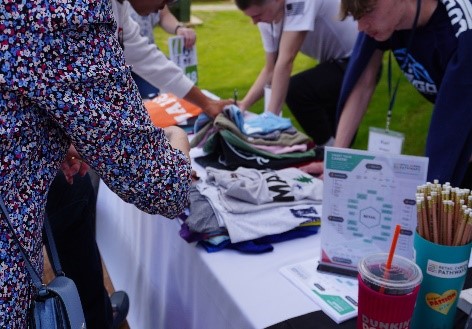
L.L. Bean introduced the students to the world of retail through an interactive clothing activity that focused on merchandising and apparel knowledge. The iconic “Bootmobile” was also on display, drawing students in and sparking conversations about careers in retail and outdoor recreation.
“I want to become an EMT. If that doesn’t work out, I want to work in a mortuary,” Abagail Giles, a student from Stearns High School, shared in an interview with NEWS CENTER Maine.
Educators and business partners at the summit emphasized the importance of creating inclusive pathways to employment.
“There is a ton of value, skill, brainpower, and I think it’s essential not to exclude a segment of the population,” Kim Cotta, Talent Development Manager at Darling’s Auto Group, said.
Titus O’Rourke, the Transition Specialist with the Maine DOE, emphasized the goal of the event in an interview with NEWS CENTER Maine: “[These students] belong in every single career pathway, and it’s important for students to understand what is available to them.”
By connecting students with real-world experiences and professional mentors, the “I Belong” Youth Summit helps to ensure that all Maine students with IEPs have the tools and confidence they need to shape their futures.
The third annual “I Belong” Youth Summit is set to take place in the Bangor area next spring. Due to the strong student participation from across the state for this event, Transition Maine and the Executive Student Transition Committee have plans to expand the “I Belong” Youth Summit.
For more information about the Maine DOE Transition Maine program, click here. Educators interested in connecting with someone about the Transition Maine program may contact her Titus O’Rourke at titus.orourke@maine.gov.
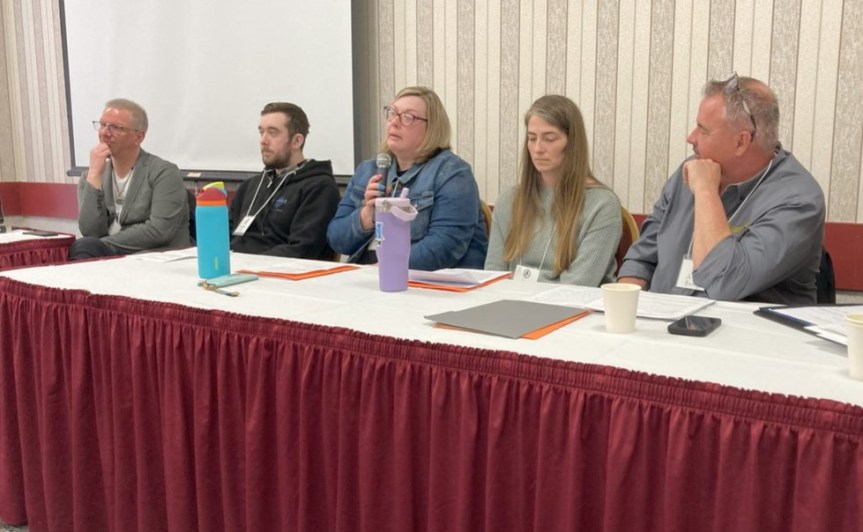
Pictured (left to right): John Post, Kameron King, Danica Wooster, Kay Fearon, and Arnold Bulley.
At the core of teaching is a central question: How can we ensure that every student gets the best education possible? This was the theme of the Maine Department of Education’s Inclusive Education Conference, focused on supporting students with disabilities throughout their pre-K-12 schooling and into meaningful adult lives.
Held at the Augusta Civic Center, the conference provided an opportunity for attendees to sit in on a variety of panels and workshops, centered around some key questions: How can we rethink classroom spaces to make them more accessible to students who are receiving special education services? How can we rework individualized education plans (IEPs) to ensure inclusion across all settings? How can we ensure that students with disabilities have the same opportunities in school as other students?
One such panel was on the topic of “Dignity of Risk for Students with Disabilities.” The panelists included a variety of people from different backgrounds, including educators, employers, employment specialists, and a young employee with lived experience, each offering valuable perspectives on how risk impacts the development and success of students with disabilities.
Liam Danaher, ELO Coordinator at Noble High School, discusses the dignity of risk and supporting students in their journey with career exploration.
Janet May, Coordinator of Transition and Adults at the University of Maine Center for Community Inclusion and Disability Studies, opened the discussion asking panelists, “What is dignity of risk?” Each panelist responded with varying perspectives on the discussion; however, a common thread emerged: Students should be allowed to take risks, make mistakes, and fail, because it is often in that moment of failure that people truly grow. Panelist John Post, a vocational rehabilitation counselor said, “It is okay to have a negative impact from a risk. What’s important is to learn how to come back from it.”
Each panelist shared their own experiences, encouraging students to embrace manageable risks. Kamron King, who works in an apprenticeship program for high-skilled labor jobs, shared that starting out in the program was tough, but being allowed to fail helped him to grow. Danica Wooster, a Student Support Specialist at the Mid-Coast School of Technology, is a woman working in a male-dominated field. She emphasized the importance of pushing yourself and learning from personal challenges; Arnold Bulley, a Human Resources and Safety Manager at Shiretown Solutions in Houlton, noted that he always sets goals for students to help them grow, letting them take risks. Liam Danaher, Extended Learning Opportunities Coordinator at Noble High School, recalled his six-year-old son learning how to mountain bike with the mantra, “No risk, no reward.”
The panel went on to address many other questions about the balance between growth and support. In the end, it was a productive conversation about how to tackle these delicate and necessary challenges.
Another panel question involved striking the right balance between providing necessary support, while still allowing for the dignity of risk and personal growth. As discussed by Wooster and Danaher, this balance is rooted in the belief that meaningful learning and growth happen through experience, especially through mistakes. The support should be individualized and dynamic, adapting to each student’s needs. King’s experience further emphasized this. He talked about how his vocational rehabilitation counselor supported him in his journey to becoming a welder at a shipyard, which, with many ups and downs, demonstrates how support helps individuals to flourish.
Bulley added, “To me, a balanced support means pulling back on those parents and job coaches and employment specialists in order to let a person learn and grow.”
Ultimately, balancing support with risk is about building a toolkit that, as Kay Fearon, Diversified Occupations Instructor at Portland Arts and Technology High School described, helps students to adapt and find their own ways of achieving success, even in the face of limitations and challenges.
Conference panelists emphasized that it’s not a one-size-fits-all approach; it’s about guiding students to recognize their strengths, confront their fears, and know that setbacks are part of the path to confidence, independence, and personal fulfillment.
For both employers and individuals alike, inclusive workplaces are essential. When people with disabilities and other diverse backgrounds are fully included, organizations across industries unlock greater potential—for their teams, individual employees, and the broader workforce.
This article was written by Vagni Das, a rising senior at Yarmouth High School. As part of her extended learning experience, she is working as an intern at the Maine DOE.
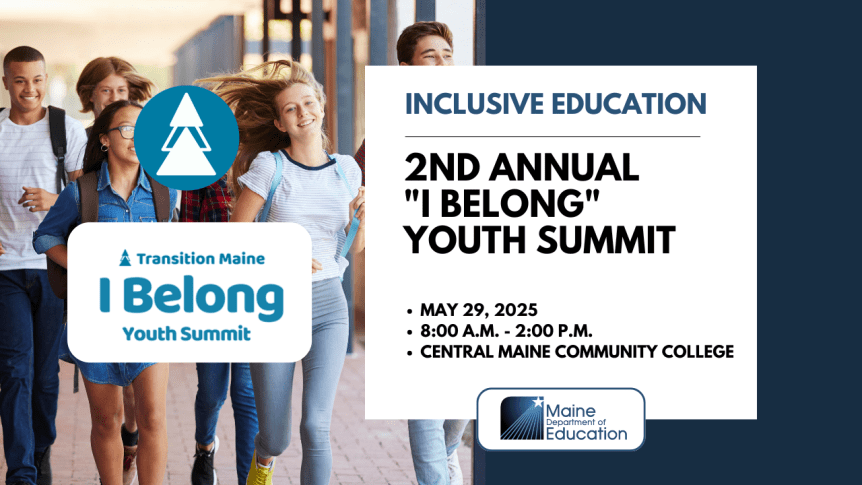
Are you ready to open doors to boundless possibilities for your students? Consider registering for the Maine Department of Education (DOE) Office of Special Services and Inclusive Education’s (OSSIE) second annual ‘I Belong’ Youth Summit, scheduled for Thursday, May 29, 2025, from 8 a.m. to 2 p.m. at Central Maine Community College.
This Summit invites schools across Maine to join a transformative initiative, designed specifically for students with disabilities who are at the age of transitioning from school to their future. This dynamic gathering goes beyond traditional career fairs to offer meaningful exploration, skill-building, and work-based learning opportunities, tailored to each student’s interests and abilities.
Making a Difference Together
By participating in this summit, you become part of a statewide movement to reshape post-secondary pathways for ALL Maine students with disabilities. Your involvement creates ripple effects of opportunity:
Students discover career paths they may never have considered, building confidence and practical skills for their future.
Educators gain valuable resources, evidence-based practices, and direct connections with industry partners.
Businesses develop tomorrow’s workforce, while fulfilling community engagement goals.
Join the Movement
Help your students find where they belong in Maine’s future workforce. The ‘I Belong’ Youth Summit provides a student-centered environment for youth to explore career pathways at their own pace, connect with potential employers, and envision new possibilities for their lives after school.
Don’t miss this opportunity to be a part of something extraordinary! Together, we can create a more inclusive, opportunity-rich future for Maine’s students with disabilities.
Maine middle and high schools may register their students here if they plan to bring them to the second annual ‘I Belong’ Youth Summit.
For more information, please contact Maine DOE Transition Specialist Titus O’Rourke at titus.orourke@maine.gov.
The two-day event, themed, “Plowing New Paths, Harvesting Dreams,” celebrated youth leadership in agriculture and natural resources.
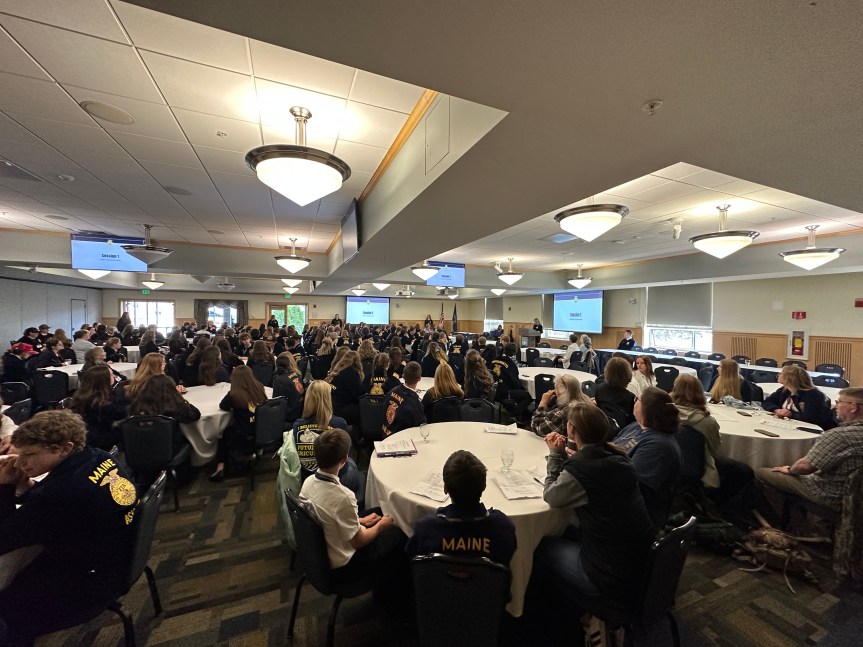
The Maine FFA Association proudly concluded its 95th annual State Convention on May 9, 2025, following two vibrant days of student-led events, competitions, and career development activities held in the Greater Bangor/Orono region. Hosted primarily at the University of Maine campus in Orono, the convention welcomed more than 300 FFA members, advisors, guests, and supporters from across the state.
This year’s convention theme, “Plowing New Paths, Harvesting Dreams,” guided a full schedule of programming that highlighted youth leadership, innovation in agriculture, and meaningful community engagement. The event featured career and leadership development opportunities in 19 unique areas, including, but not limited to, environmental science, veterinary science, public speaking, floriculture, and tractor driving. Students also participated in community service projects with Maine Harvest for Hunger, the Bangor Humane Society, and Good Shepherd Food Bank.
“This year’s convention theme couldn’t be more fitting, as these words capture both the hard work that defines agricultural life but also the hopeful vision that drives us forward,” Megan Welter, Maine DOE Associate Commissioner of Public Education, said to students during the convention’s opening ceremony. “Since last May, Maine proudly welcomed three new FFA chapters: Poland, Dexter, and Sanford. That expansion brings the State of Maine to 14 chapters, which is a 15% growth in one year. That’s not just a number; that is a testament to the enduring relevance and growing importance of agriculture education in our state.”
Also in attendance during the convention’s opening and closing ceremonies were Deputy Commissioner Nancy McBrady of the Maine Department of Agriculture, Conservation, and Forestry; Dean Diane Rowland of the University of Maine College of Earth, Life, and Health Sciences; and National FFA Secretary Luke Jennings, along with State Officers from FFA chapters across Maine. The convention celebrated the achievements of these FFA chapters and installed the 2025-2026 State Officer Team.
“FFA has been the best thing that has happened to me individually, but I also get to watch a lot of other students grow, as well,” Maine FFA State Vice President Haley Mayne said. “I am so proud of everyone, and I think that being in FFA will not only prepare you for things in agriculture but also for real-world experience. It’s such an awesome organization to be a part of.”
Additional highlights from the two-day event included livestock evaluation, an ag mechanics competition, the National FFA Officer workshop, and hands-on activities in aquaculture, horse evaluation, and floriculture.
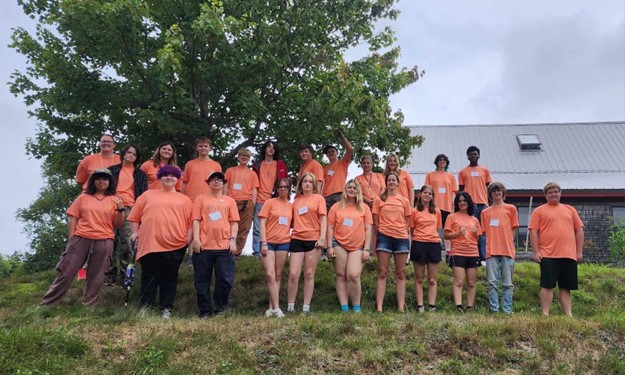
(Pictured: Youth at the DownEast Teen Leadership Camp.)
Thanks to an Extended Learning Opportunities (ELO) Expansion grant from the Maine Department of Education (DOE), Healthy Acadia is working to provide more ELO opportunities to young people in Washington County in a variety of ways.
Last July, forty-three teenagers from Downeast Maine enjoyed Healthy Acadia’s 2024 DownEast Teen Leadership Camp (DETLC), a weeklong overnight summer camp experience at the Cobscook Institute in Trescott. DETLC is primarily a camp for youth, led by youth. The program challenges and empowers youth by providing them with the skills necessary to be leaders and workers in their communities.
The program begins months before the actual summer camp experience in January, when a youth advisory team takes the lead in planning the camp’s activities, ensuring that campers have a say in shaping their own experiences. This unique approach allows for the camp to feel personalized, as activities and discussions are specifically designed to reflect the interests of the participants.
Throughout the week, campers engage in various activities to promote leadership, community bonding, and holding space for healthy discussions. Students participate in workshops sponsored by regional and statewide businesses and organizations, as well as other physical team-building exercises that further build self-confidence and community. These immersive activities help campers to explore new interests, push their comfort zones, and form lasting connections.
“One of my favorite parts of camp as a youth staff member is the family groups,” Naomi Eyerman, DETLC 2024 Student Staff Media and Arts Coordinator, shared. “It’s great to get to know campers on a more personal level. Family groups really foster connections and are safe spaces where campers can have fun, as well as open up and get deep. DETLC overall has so many unique experiences that make camp truly memorable.”
Family group time plays an important role in the overall philosophy and structure of DETLC. Through Community Sessions and Mini-Workshops, students begin to develop an awareness of relationships, coping skills and issues with substances and other sensitive topics. Family Group is a place to question, discuss, and put into practice what campers learn in the community sessions and mini-workshops. This can be done by questioning and discussing workshop content, relating issues to their personal lives, sharing thoughts and feelings, practicing life skills, and building on their self-esteem.
ELO coordinator Corrie Hunkler, who works for Healthy Acadia, spearheaded DETLC. In her recent endeavors, Hunkler has also worked with the Coastal Washington County Institute of Technology (CWCIT) and Maine Youth Action Network (MYAN) to further her work with ELOs in Washington County and the surrounding areas.
Hunkler is helping to create tangible pathways for students to explore their interests and career aspirations. This hands-on support is reflected in the 53 students she has helped to engage in meaningful work opportunities, such as coordinating the Washington County Leadership Challenge, which allows students, teachers, and civic leaders to collaborate to formulate plans and create goals to address relevant local civic issues; and group trips like the Maine Youth Leadership Conference, which brings eight students to Augusta, providing workshops and guest speakers to help participants learn valuable leadership skills.
Through programs like these, ELOs continue to open doors for young people in the region. The Early Childhood Education program at CWCIT has embedded ELOs into its Wednesday class time, for example, ensuring that even more students are introduced to these vital opportunities—and that those opportunities remain accessible to all students in the region.
Students at the Coastal Washington County Institute of Technology.
“We don’t have classes on gender studies; we don’t have classes on environmental science; and so it’s [ELOs] allowing kids who maybe have an interest or passion to be able to do what they’re interested in, and I think that’s so important,” Hunkler said. “This work is just so key in places that don’t have as much access to things.”
Corrie Hunkler presents on ELOs at the Youth Development Summit held at Washington County Community College on April 29, 2025.
These efforts are integral to broadening the horizons of students in Maine who may otherwise lack the resources and opportunities to explore their passions. Providing these pathways for personal and academic growth is vital for creating a more inclusive and empowered future generation, especially in rural communities like those in Washington County.
Students at Maine Youth Action Network.
To view a short clip of ELOs in Washington County and to learn more about Healthy Acadia and its ELO community support, contact Corrie Hunkler at corrie.hunkler@healthyacadia.org.
For more information about Extended Learning Opportunities, contact Lana Sawyer at lana.sawyer@maine.gov. Healthy Acadia was an awardee of Maine Jobs and Recovery Plan grants, starting in 2022, that supported 26 programs across Maine, covering 13 counties.
Are you ready to open doors to boundless possibilities for your students? Consider registering for the Maine Department of Education (DOE) Office of Special Services and Inclusive Education’s (OSSIE) second annual ‘I Belong’ Youth Summit, scheduled for Thursday, May 29, 2025, from 8 a.m. to 2 p.m. at Central Maine Community College.
This Summit invites schools across Maine to join a transformative initiative, designed specifically for students with disabilities who are at the age of transitioning from school to their future. This dynamic gathering goes beyond traditional career fairs to offer meaningful exploration, skill-building, and work-based learning opportunities, tailored to each student’s interests and abilities.
Making a Difference Together
By participating in this summit, you become part of a statewide movement to reshape post-secondary pathways for ALL Maine students with disabilities. Your involvement creates ripple effects of opportunity:
Students discover career paths they may never have considered, building confidence and practical skills for their future.
Educators gain valuable resources, evidence-based practices, and direct connections with industry partners.
Businesses develop tomorrow’s workforce, while fulfilling community engagement goals.
Join the Movement
Help your students find where they belong in Maine’s future workforce. The ‘I Belong’ Youth Summit provides a student-centered environment for youth to explore career pathways at their own pace, connect with potential employers, and envision new possibilities for their lives after school.
Don’t miss this opportunity to be a part of something extraordinary! Together, we can create a more inclusive, opportunity-rich future for Maine’s students with disabilities.
Maine middle and high schools are invited to fill out a school interest form, if they are planning to bring students to the second annual ‘I Belong’ Youth Summit. (Registrations for individual students will be sent directly to schools that complete the interest form.)
For more information, please contact Maine DOE Transition Specialist Titus O’Rourke at titus.orourke@maine.gov.








 Maine DOE Newsroom