As a reminder, the Maine Department of Education has scheduled a public hearing on November 13th, 2019 as part of the scheduled periodic review of the Maine Learning Results. The Department is seeking public comments regarding the proposed revisions to Rule Chapter 132, revised career and education development, English language arts, and mathematics standards until 5 pm on November 27th, 2019.
The public hearing will take place in room 103A of the Burton Cross Building in Augusta from 1-4 pm. Anyone present may speak at the public hearing. People that wish to speak will be asked to sign in and, preferably, provide two written copies of comments, as well as an electronic copy. The live broadcast is for viewing the hearing only. You will not be able to provide public comment via the live broadcast.
Anyone unable to attend the public hearing may send written comments by 5 pm on November 27th, 2019. Written comments may be emailed to sis.doe@maine.gov with the subject “Career and Education Development Standards Review,” or “English Language Arts Standards Review,” or “Mathematics Standards Review” or mailed to Maine Department of Education, attn: Beth Lambert, 23 State House Station, Augusta, ME 04333.
Below is a list of relevant links, as well as the hearing information including a link for the live broadcast:
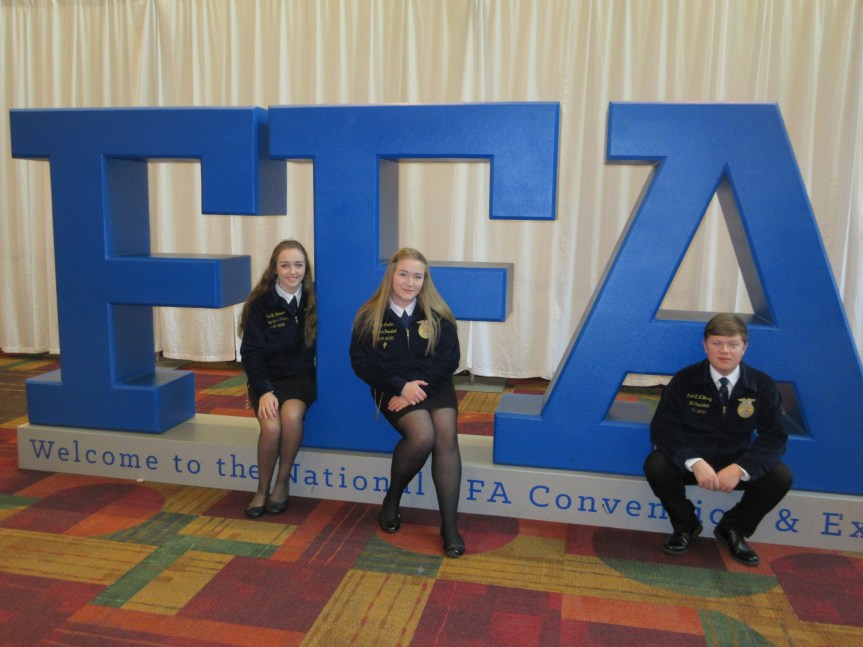
Maine school representatives and student State Officers participated in the 92nd National FFA (formerly known as “Future Farmers of America”) Convention on October 30-November 2, 2019 in Indianapolis, Indiana. Twelve FFA students from Ashland High School, Easton High School, and Presque Isle Regional Career & Technical Center competed in events including Dairy Cattle Evaluation, Employment Skills, Environment & Natural Resources, and Horse Evaluation.
State FFA Officers Graham Berry (President), Camryn Curtis (Vice President) and Ava Cameron (Secretary-Treasurer) participated alongside their fellow Maine competitors, teachers and chaperones, with Graham and Camryn serving as delegates to committees on Competitions and Member Experiences. State FFA Advisor Doug Robertson from the Maine Department of Education oversaw student State FFA Officers and participated in educational sessions with fellow staff from other states.
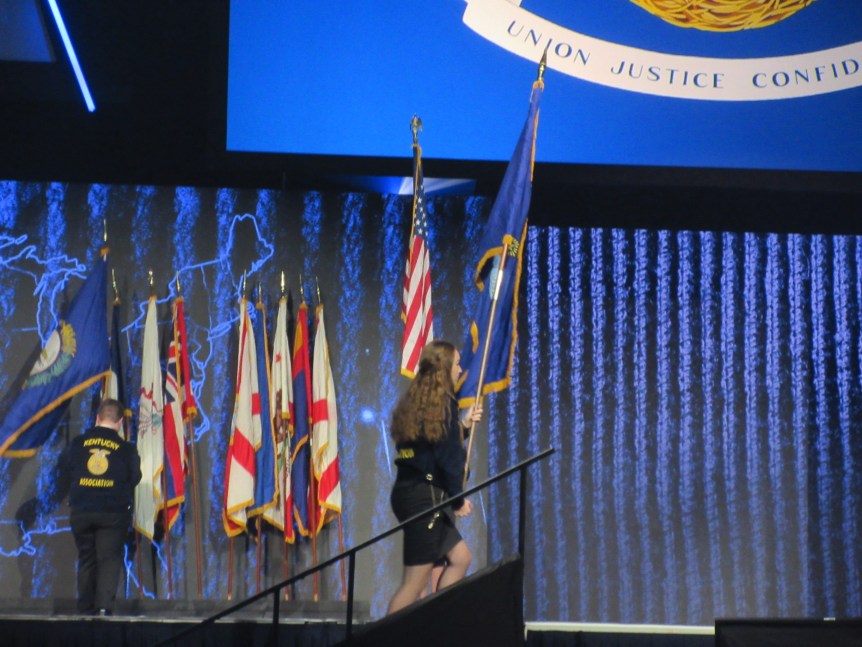
Maine FFA State Secretary-Treasurer Ava Cameron presents the Maine Flag at the Opening Session.
FFA is the largest student leadership organization in the United States, with over 700,000 members grades 7-12 enrolled in courses related to agriculture and natural resources. Of these members, nearly 70,000 attended the National Convention. Maine’s delegates helped develop recommendations for changes to the National FFA to benefit members.
The National FFA Convention provided competitions, motivational sessions, leadership workshops, awards and scholarships for student members, as well as the chance to meet peers from all 50 states, Puerto Rico and the U.S. Virgin Islands. In addition to competitions and motivational sessions, Maine participants had the opportunity to discover Indianapolis and many local attractions including the Indiana State Museum, the rodeo and the zoo, as well as enjoying a concert featuring Brett Young.
Maine FFA State Secretary-Treasurer Ava Cameron presents the Maine Flag at the Opening Session.
In Maine, secondary schools with technical programs in agriculture and natural resources as well as all schools for students grades 7-12 with relevant agriculture/natural resources courses, including science curriculum infused with agriculture and natural resource topics are eligible to charter FFA chapters.
For more information, please contact: Doug Robertson, State Advisor, Maine Department of Education, (207) 624-6744, doug.robertson@maine.gov
Photo: FFA Officers rise to the challenge of putting creative leadership into practice. Lane McCrum (right), grade 9, Mars Hill, models unusual headgear intended to promote recycling, with Mars Hill senior Brayden Bradbury on left.
State Officers of the Maine FFA Association (formerly known as “Future Farmers of America”) trained 35 leaders from 7 Aroostook County FFA Chapters on October 18, 2019 at the University of Maine, Presque Isle.
The one-day training, developed by State FFA Officers Graham Berry (President), Camryn Curtis (Vice President), and Ava Cameron (Secretary-Treasurer), with guidance from Maine Department of Education State FFA Advisor, Doug Robertson, was devoted to topics of FFA opportunities, Communication Strategies, and Exemplary Leadership. FFA student participants came from chapters including Presque Isle Regional Career & Technical Center, Ashland High School, Ashland Middle School, Easton High School, Hodgdon High School, Mars Hill High School, and Washburn High School.
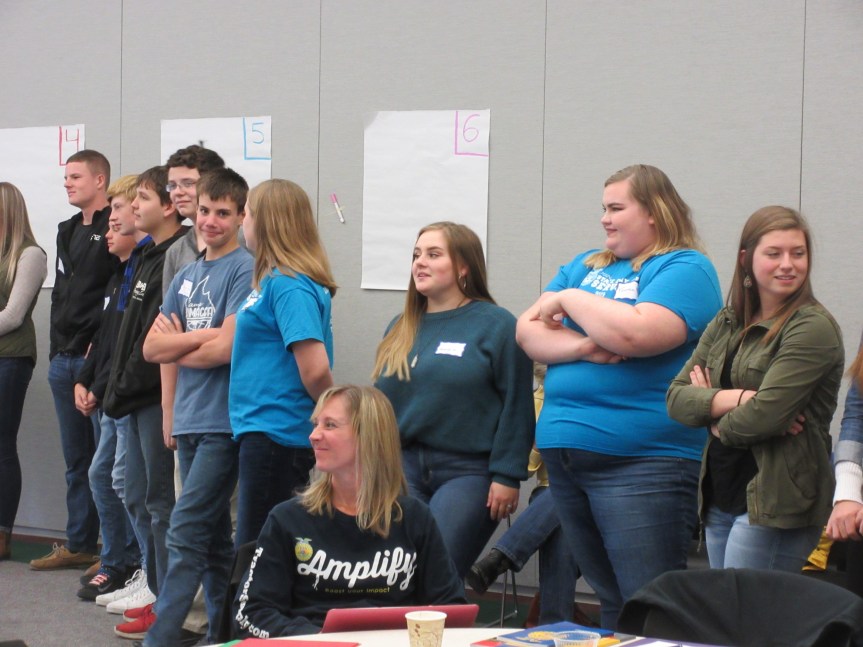
Students race to identify different methods of communicating in order to improve their own FFA chapter member communication.
The purpose of the workshop was to prepare participants to become successful leaders of their own local chapters. FFA chapters are involved in a variety of activities to provide recognition and enhanced skills to students grades 7-12 enrolled in courses related to agriculture and natural resources. FFA chapters are often very active as well in their local communities in projects ranging from addressing hunger issues to helping elementary students learn more about Maine agriculture. Chapter FFA Officers left the training with many ideas of organizational strategies to undertake at their schools, as well as a number of specific community projects to implement.
FFA leaders participate in an activity emphasizing the importance of high quality communication.
Maine schools with students grades 7-12 enrolled in courses related to agriculture and natural resources, including those with science curricula connected to learning strategies such as school gardens and greenhouses, are eligible for FFA chapter membership—along with associated opportunities related to trainings, competitions, recognition and scholarships—and may address any questions to: Doug Robertson, Maine FFA State Advisor, (207) 624-6744, doug.robertson@maine.gov
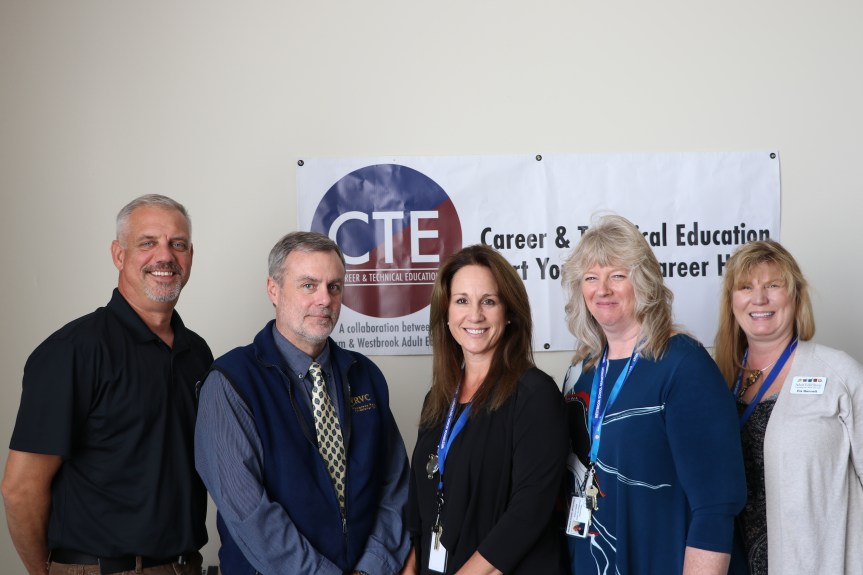
Pictured L to R: Adult Ed/CTE Coordinator Jeremy Kendall, WRVC Director Todd Fields, Assistant Superintendent Jodi Mezzanotte, Adult Ed Director Shelli Pride, and Administrative Assistant Elsbeth Bennett.
Westbrook School Department had a collective dream to one day have a robust Adult Education Program that not only helped New Mainers integrate into the community but also met the needs of adult learners in their community and the state as a whole. Three years ago, Gorham and Westbrook Adult Education programs applied for the Fund for the Efficient Delivery of Educational Services (FEDES) grant opportunity, one of three grant opportunities offered by the Maine DOE between 2017 and 2018 to provide districts with initial funding for local and regional initiatives to improve educational opportunities. In January 2018, Westbrook and their partner Gorham School District was awarded a grant to support the creation of the Gorham/Westbrook Career and Technical Education (CTE) Program, a regional adult education program that provides adult learners access to career and technical education that will prepare them for high-skill, high-demand occupations with defined pathways for advancement.
Jeremy Kendall Adult Education CTE Coordinator
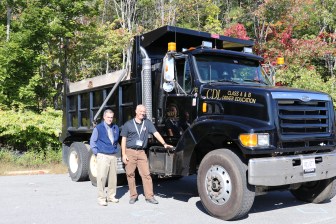
Building on the strong foundation of their neighbors in Gorham, Westbrook began creating career driven educational programs for adult learners. In addition to adding Jeremy Kendall to their team, as the Adult Education CTE Coordinator, they began expanding the Adult/CTE programs starting with the difficult task of building a Commercial Driving License (CDL) course, an area where the nation, including Maine, has seen a sharp shortage of workers in a very high demand occupation.
WRVC Director Todd Fields and Jeremy Kendall standing next to one of their CDL Driving Trucks.
Finding that there were only two driving instructors in the entire state of Maine, Jeremy was lucky enough to convince one of them, Buddy Spaulding who runs a driving school in Albion Maine, to come to Westbrook and teach a course that later successfully graduated 8 students. With Westbrook’s CDL course under their belt, these 8 students are suited to take a State exam and become instructors themselves. One year later the CDL program has shown enormous success and Jeremy was happy to share that they are in the process of hiring 3 additional instructors, expanding the program to even more learners.
CDL Driving course in session.
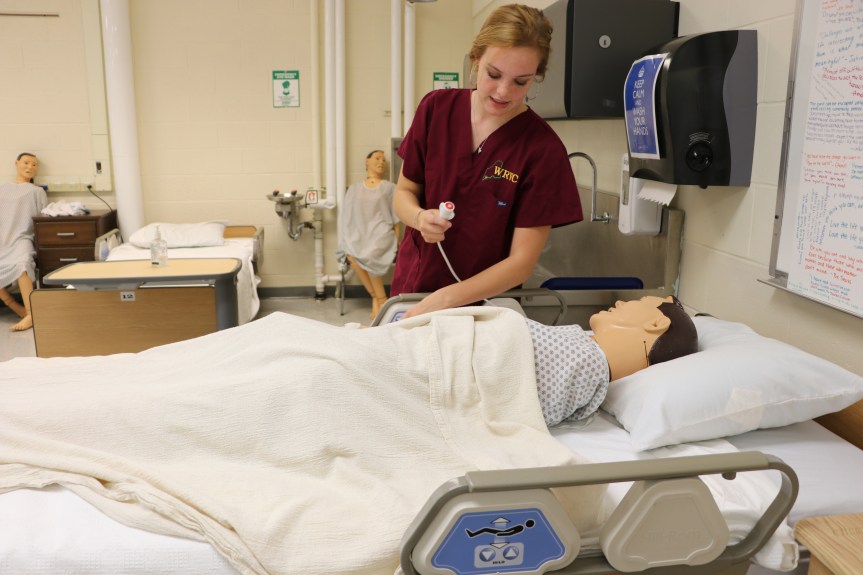
In addition to CDL, the CTE/Adult Ed program also offers a robust Certified Nursing Assistant (CNA) program and are gearing up for an expansion that will offer an automotive program, CompTIA (Information Technology skills), in addition to electrician training, building trade carpentry, and Automotive Service Excellence (ASE) certifications.
Building on the foundation that seeks to bring new opportunities to all learners, Westbrook also integrates a language acquisition component of the CTE/Adult Ed program that focuses on New Mainers who are in the process of learning English and culture in their new home here in Maine. In conjunction with their growing trades programs, they are also building out their capacity to offer these same services, with an added language skills component, to New Mainers by working closely with partner agencies to help get them work-ready.
A WRVC CNA student demonstrates a typical bedside routine, going through the steps of making a mock patient comfortable.
To distinguish themselves as a full-service program, they also go the extra mile to ensure the success of each and every learner that walks through the doors of the Westbrook Regional Vocational Center/Adult Education Program. “If they need their HiSET/high school diploma, academic or workready skills, we will help them. We will assist them with their job-hunting pursuits as well.” said Westbrook Adult Education Director Shelli Pride. “We put them in trade programs and we help them find jobs,” added Shelli.
In order to track their success, Westbrook aims to maintain relationships with their students by keeping up with their progress both in education and their professional careers. They also work with an advisory board, which is made up of local businesses that help to develop the programs and make sure they are on track to make a positive difference in the community and the State.
At a recent convening of local businesses at the WRVC, a local driving company approached Jeremy. “We are looking for drivers, do you have anyone in mind?” A question to which he was delighted to respond, “Yes, we are running a CDL-B course right now and there is a really great kid on the driving range, do you want to meet him?” The company was able to do an on-the-spot interview and they offered him a job right then and there. The student was not only a high school graduate of the WRVC program but was also enrolled in the Adult Ed CDL course at the time.
The CTE/Adult Education program recently celebrated the graduation of all 13 CNA students who sat for their state exams, which was a 100% pass rate for our CNA program.
The CTE/Adult Education program was a recent recipient of a very generous donation from the Associated General Contractors of Maine. This money will be used to support a scholarship fund for future CTE/Adult Education students.
It is outcomes like these that help solidify the need for the recently developed collaboration, and the projected success it will bring to the community.
Grateful to have the collaboration of their partners in Gorham who have a readymade adult education program that Westbrook was able to ride the coat tails of, they now have a long-term goal of offering each career-focused program to all high school students and adult learners in the region. They hope to help fill Maine’s high demand occupations by continuing to expand the opportunities they offer. Down the road, they will be looking into starting programs in both business and diesel mechanics and from there, the possibilities are endless.
This article was written by Maine DOE Staff Rachel Paling in collaboration with school leaders at Westbrook Regional Vocational Center and Westbrook Adult Education program as part of the Maine Schools Sharing Success Campaign. For more information or to submit an idea or a write-up, email Rachel at rachel.paling@maine.gov.
As part of the scheduled periodic review of the Maine Learning Results, the Maine Department of Education is seeking public comments regarding proposed revisions to the Career and Education Development, English Language Arts, and Mathematics Standards found in Rule Chapter 132 Learning Results: Parameters for Essential Instruction. Please note that the Department of Education is only seeking comments on the Career and Education Development, English Language Arts, and Mathematics Standards sections of Rule Chapter 132 at this time.
The standards review process for the Career and Education Development, English Language Arts, and Mathematics Standards began in 2018 with a public comment period and a public hearing on the current Career and Education Development, English Language Arts, and Mathematics Standards. After the public comment period, steering committees were convened who were charged with reviewing all submitted comments and with developing blueprints for the revision of the state standards in their assigned content area. Once the blueprints were created, writing teams, consisting of pk-12 teachers who represent Maine’s cultural and geographical diversity, assembled to draft the standards revisions. Now, as part of this review process, the Maine Department of Education has submitted the revisions as part of a proposed rule change to Chapter 132.
Find the details for proposed changes for Rule Chapter 132 on the Maine DOE Proposed Rule & Rule Changes webpage (proposed rules are listed in order by rule number).
Public Hearing Information for Rule Chapter 132:
November 13th from 1-4pm, room 103 at the Cross Building, 111 Sewell Street, Augusta.
Anyone may speak at the public hearing which will be live-streamed via Zoom. People wishing to speak will be the asked to sign in and, preferably, provide two written copies of comments, as well as an electronic copy. Anyone unable to attend the public hearing may send written comments.
Comment Period Deadline: 5 pm on November 27th, 2019 Written comments may be sent to Standards Review at sis.doe@maine.gov, or mailed to Beth Lambert, 23 SHS Station, Augusta, ME 04333.
Maine Administrators of Career and Technical Education (MACTE) held its annual conference last week at Lewiston Regional Technical Center (LRTC). The official organization for Maine’s network of 27 career and technical education (CTE) schools, MACTE plans the conference as a place for CTE educators to convene and share ideas, hear from industry professionals, and honor hard-working colleagues.
During the opening presentation of the conference, participants were welcomed by MACTE President and host Rob Callahan, who is also the Director of LRTC. Dr. Donald Cannan, Executive Director of MACTE also addressed the crowd remarking on the utmost importance of CTE educators in the training of Maine’s current and future workforce. Following the welcoming, Maine Department of Education Deputy Commissioner Dan Chuhta presented the CTE Teacher of the Year award to Greg Cushman, an electrical instructor and SkillsUSA advisor at LRTC.
An alumnus and former educator of Westbrook Regional Vocational Center, Greg has a successful 25-year career in electrical trade under his belt. He has since returned to his roots in Career and Technical Education in a different capacity, to serve as an educator to the students in his community. Known for his outstanding student outcomes and many accomplishments, both in his professional career and in education, his nominators, LRTC Director Rob Callahan along with students and colleagues from LRTC, had this to say about Greg:
“Perhaps the most compelling aspect of Greg’s nomination for this award is the quality of his character. He is a highly approachable, thoughtful and genuine person who always looks for the good in any situation. He approaches his responsibilities as an educator, electrician and community member with utmost importance. He sets an example for those around him which is based on hard work, integrity and service to others.”
After being named CTE Teacher of the year, Greg took the stage, while the excited crowd stood in applause and his family joined him to congratulate him for this well-deserved recognition. The CTE Teacher of the Year award is administered by MACTE as a way to recognize teachers who are providing outstanding career and technical education programs for youth and/or adults in their respective fields and communities.
After hearing from keynote speaker Shawn Moody, who spoke about the Blue Collar CTE scholarship opportunity, participants attended a morning filled with a variety of breakout sessions. In addition to sessions lead by Maine DOE Leaders who provided information about State level updates, data, and funding, there were also sessions led by CTE leaders and industry professionals about various topics including understanding and supporting LGBTQ+ individuals, early college opportunities through the Maine Bridge Academy program and the Community College System, as well as workforce and industry updates from Cianbro, Apple, Inc, and Maine Army National Guard to name a few.
Conference participants also had the opportunity to attend sessions led by Maine education colleagues such as Foster Tech’s Chris MeMarco and Jake Bogar who led a session about how to fit science into any CTE class, and Ruthanne Harrison, an Engineering Teacher from Bath Regional CTE, who led a session about design thinking and 3D Printing.
A delicious lunch was served at LRTC’s well-known Culinary Arts School, The Green Ladle followed by a final session that provided tech updates for CTE educators.
The annual conference came to a close with a positive response from participants, especially for the variety of breakout sessions that provided instructors with information about common best practices. MACTE Executive Director Donald Cannan says they “plan to continue this very successful practice” as they look toward planning future MACTE conferences and events.
In an effort to increase high quality CTE programs, Maine needs your input. The Maine Department of Education-Career and Technical Education Team has posted the proposed performance indicators for public comment as part of the Strengthening Career and Technical Education for the 21st Century Act(Perkins V). The performance indicators, referenced as Perkins V Accountability Measures, can be found on the DOE-CTE web site as well as a survey to allow for feedback. These will be posted for 60 days to allow for public comment, after which recommendations will be reviewed by the CTE Team. For more information, contact Dwight Littlefield at dwight.littlefield@maine.gov.
The Maine Department of Education hosted a group of local educators for a series of work sessions that will take place last month to review the Career and Educational Development (CED) standards.
The review is part of an established fourteen step review that rotates through the eight content areas of Chapter 132 (doc) over a 5 year period, during which educators from across the state consider and revise standards to reflect the rigorous expectations and provide guidance to schools.
The career and education development standards are divided into three subgroups of knowledge and skills (Learning About Self-Knowledge and Interpersonal Relationships; Learning About Exploring Education, Career, and Life Roles; and Learning to Make Decisions, Plan and Create Opportunities, and Make Meaningful Contributions). Within each of these subgroups are performance indicators and descriptors that describe what students should know and be able to do across four grade bands (K-2, 3-5, 6-8, 9-Diploma). The career and education development standards also include an introduction and a note regarding embedding career and education development instruction.
As part of the ongoing review process for content standards, revised standards for social studies and science have been adopted. In addition, writing teams for the career education and development, English, and math standards are drafting revisions that will be finalized by the end of September.
The Department of Education will then initiate the rulemaking process for Chapter 132 for final review and adoption of the revised career education and development, English, and math standards. This fall, the Maine DOE will begin a review of the health education and physical education, visual and performing arts, and world language standards. For more information about the standards or the standards review process, check out ourweb page.
Future Teachers Academy, an event for students who are interested in exploring the field of education, is being hosted by Thomas College and will be held on November 8th from 8:30 am to 1:30 pm on their campus at 180 West River Road in Waterville.
During the event students will be able to participate in a daylong, hands-on and experimental teaching environment, led by professional faculty from the Thomas College School of Education, as well as partners from the Maine Department of Education and Maine Teachers of the Year.
Future Teachers Academy
When: November 8, 2019, 8:00 am – 1:30 pm
Where: Thomas College
Who: Open to Maine high school sophomores, juniors, and seniors
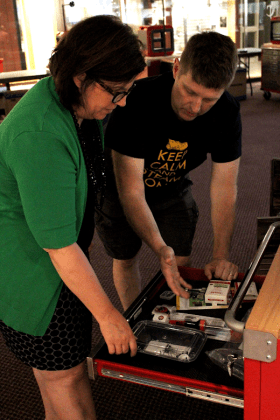
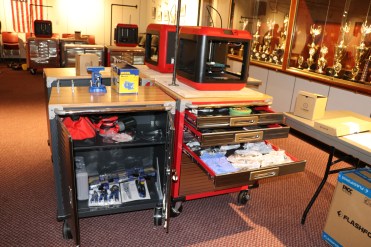
Course Instructor Keith Kelley and EMMC President Lisa Larson looking through a STEAMRoller cart that is included with the course.
In a four-day educator training that took place last month at the United Technology Center (UTC) in Bangor, 14 educators from across Maine gathered for a unique professional development opportunity offered through a partnership between two educators from RSU 19, Eastern Maine Community College (EMCC), and UTC that aims to help educators integrate advanced technology and experiential learning into every lesson plan, and to help fill the workforce gap in Maine.
Utilizing a $50,000 grant that EMCC President Lisa Larson obtained through the Maine Community College System, the 3 credit Introduction to Experiential Teaching through Technology course was offered as an opportunity for educators to “learn practical learning experiences to integrate traditional and newly advanced technologies into project biased lesions,” similar to the teaching methods found in career and technical education (CTE) settings throughout the state. The idea is to bring the experiential teaching philosophy to classrooms long before the high school CTE experience. The earlier integration of experiential learning gives students a taste for possible career paths but just as importantly, learning experiences that allow them to utilize and understand the advanced technological tools of their future and to utilize and exercise their own problem-solving and management skills.
The course was led by RSU 19 educators, Keith Kelley and Kern Kelley who are brothers, partners, and advocates for integrated experiential student learning. It provides classroom teachers, at any grade level and of any subject matter expertise, with not only the tools but also the mindset and methods to teach project based and integrated lessons to their students. This type of learning environment provides students with real-world, problem solving experiences with technology, bringing full circle the content areas that make up the very well-known acronym STEAM (science, technology, engineering, art, and math).
The STEAMRoller Cart includes: Seville Classics UltraHD 2-Door Rolling Cabinet and a 6-drawer Rolling Storage Cabinet, Vise, Portable Vise Table, Power Strips, Cordless Orbital Hand Sander, Corded Orbital Hand Sander, Power Drill, Impact Power Drill, Rotary Dremel Tool, Irwin Clamps, Kobalt 100-Piece Household Tool Set with Hard Case, Hand Tool Bag, Hammer, Locking Pliers, Tape Measure, Speed Square, Spade Bits, Flash Forge 3D Printer, 3D Printer Tool Set, Frog Tape, Duct Tape, Rocketbook, FriXion Pens, iPod Touch & Case, Tripod, Raspberry Pi, Soldering Iron, Scrappy Circuits, Safety Goggles, Disposable Gloves, Breakout of the Box DRAWER, and a Breakout EDU Kit.
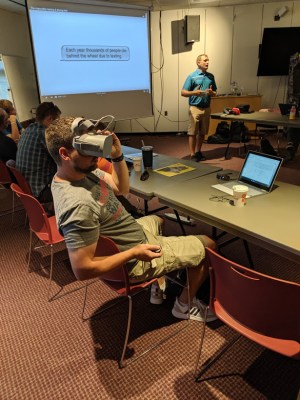
Each educator’s school paid $381 total for the four-day hybrid course that includes the four in-person sessions, bi-weekly reading and reflection assignments and online discussions and provides educators with contact hours plus 3 college credits, in addition to a “STEAMRoller” cart of hardware and equipment valued at over $2,000 each. They will also each have the opportunity to host a STEAMRoller bus for a day at their school, which includes an experiential student conference provided by course instructors and their partners. At the student conference, educators and students will be able to participate in a day filled with breakout sessions on various topics such as 3D printing, drones, and virtual reality to name a few.
Hermon High School Principal Brian Walsh is excited that one of his 9th grade science teachers is attending the course this summer so that he can share his knowledge and the tool kit with the other 9th grade science teacher so that they can integrate hands-on project-biased learning experiences, not just to 9th graders but throughout the high school as well. Walsh has felt a void where they were unable to fill an industrial arts position in prior years and hopes this will help bring new STEAM learning experiences, career pathways, and experiential opportunities to the students at Hermon High School.
Tonya Therrien, Benton Elementary 5th Grade teacher decided to take the course with the hopes of bringing back to her classroom, “a way to utilize technology more with the kiddos, beyond just using it for research.” She wants her students to know how to use technology as a tool. When asked what she thought of the training so far, she said, “this is probably the most worthwhile class I’ve ever taken, and I’ve taken a lot of classes.” She then added that she has two master’s degrees which both required a fair amount of coursework.
Aaron Pody, a high school Life Sciences teacher from RSU 18 came to the class to learn about ways to teach the content with more relevance to his students. He has been pleased to find that there are ways to bring technology into the classroom that are not cost prohibitive.
RSU 26 educator Karen Frye from Orono was excited to bring back what she has learned at the course to provide her gifted and talented students with the rare opportunity to do some hands-on problem solving, which will further enrich their learning experience and give them some problem-solving skills.
The 3-credit course and the STEAMRoller bus events are intended to give participating educators and schools a taste of experiential learning methods, along with emerging technologies, tools and resources. The course is expected to be followed up by an Experiential Education certificate program that EMCC is expected to launch in January of 2020. The new program aims to provide the state with educators that can help fill the growing workforce gap in technologically skilled workers.
The launch of the experiential training was deemed a success by organizers and participants alike. The innovative approach to an obvious need has the potential to further help Maine schools lead their students toward successful career choices, experience with problem-solving, and the ability to successfully navigate the technology of our future.
This article was written by Rachel Paling in collaboration with course instructors Keith and Kern Kelley, and staff at both UTC and EMMC. If you have story ideas for Maine DOE’s Maine School’s Sharing Success campaign, please contact Rachel Paling at rachel.paling@maine.gov.






 During the opening presentation of the conference, participants were welcomed by MACTE President and host Rob Callahan, who is also the Director of LRTC. Dr. Donald Cannan, Executive Director of MACTE also addressed the crowd remarking on the utmost importance of CTE educators in the training of Maine’s current and future workforce. Following the welcoming, Maine Department of Education Deputy Commissioner Dan Chuhta presented the CTE Teacher of the Year award to Greg Cushman, an electrical instructor and SkillsUSA advisor at LRTC.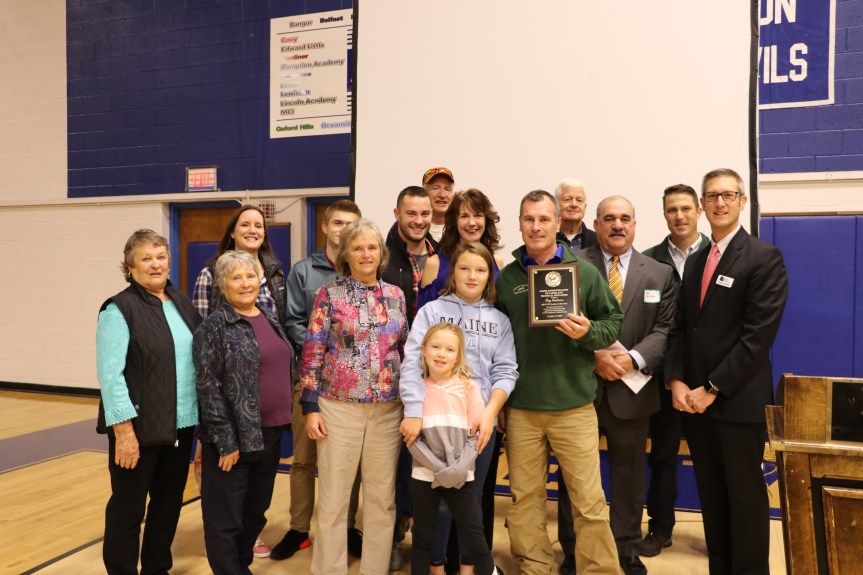


 Tonya Therrien, Benton Elementary 5th Grade teacher decided to take the course with the hopes of bringing back to her classroom, “a way to utilize technology more with the kiddos, beyond just using it for research.” She wants her students to know how to use technology as a tool. When asked what she thought of the training so far, she said, “this is probably the most worthwhile class I’ve ever taken, and I’ve taken a lot of classes.” She then added that she has two master’s degrees which both required a fair amount of coursework.
 RSU 26 educator Karen Frye from Orono was excited to bring back what she has learned at the course to provide her gifted and talented students with the rare opportunity to do some hands-on problem solving, which will further enrich their learning experience and give them some problem-solving skills.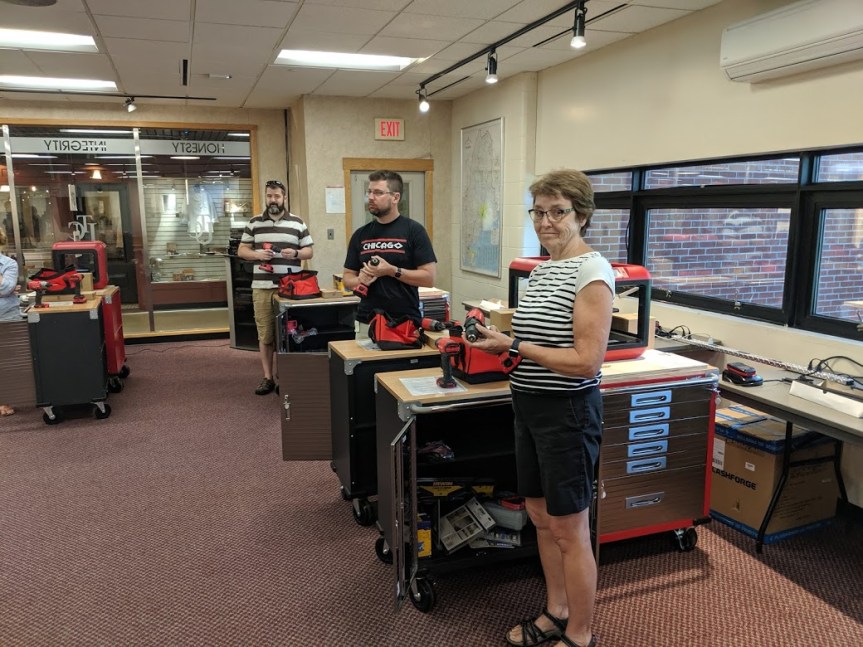
 Maine DOE Newsroom