Step Inside Hancock County Technical Center

Hancock County Technical Center (HCTC) opened its doors to the Maine Department of Education (DOE) on Valentine’s Day to provide a glimpse of what a day looks like within its walls. Upon arrival, the smell of baked scallops drifted down the hallway from the culinary program at work preparing a special meal for staff. The office was buzzing with the anticipation of another day of learning, with students and staff discussing college plans, transportation routes, and what they are looking forward to as the season changes. HCTC offers programs such as biomedical research, various types of automotive and technical specialties, early childhood education, health careers, hospitality and tourism, law enforcement, and more. Sophomores, juniors, and seniors from all over Hancock County have the opportunity to learn from specialists in their field of interest, with Director Bill Tracy and his dedicated staff there to oversee their endeavors.

Sabrina, a biomedical research support student, explained that she was drawn to the program after a 6th-grade field trip to HCTC opened her eyes to the possibilities available. After a 7th-grade STEM unit utilizing microscopes to investigate onion cells ignited her love for research, she knew that was the path she wanted to go on. HCTC’s biomedical program opened the doors for her to fully explore the field.

As a result of support from her HCTC educators and the Bridge Program, a dual enrollment opportunity that allows students to participate at HCTC while simultaneously taking college credits at their participating high school, Sabrina was accepted to the Aspirinaut High School Summer Internship Program at Vanderbilt University Medical Center in Tennessee. Sabrina is also participating in an ongoing collaboration with Jackson Labs to give her even more exposure to the worlds of scientific and medical research. Sabrina says she has learned a lot from her experience with HCTC and it helped fuel her passion. “This is what I was meant to do,” she said. She also observed from the professionals she interacts with that a career can be more than a job, realizing that, “your work can be your career and be emotionally satisfying.”

Hancock County Technical Center also boasts award-winning educators. Recent Milken Educator Award recipient Meghan Stubbs teaches early childhood education, working with students considering the classroom as their career. An in-house preschool started by Ms. Stubbs provides interactive, hands-on experience for her students while also providing a service to the community. The classroom boasts a full preschool room experience, complete with early childhood level tables and chairs, a “centers” area, and colorful student-created décor.

Her students are quick to point out what makes her an excellent role model and mentor. One of her third-year students, Isabell says, “She has a different way of teaching and gears it toward how we want to learn.”

She said if she could use one word to describe Ms. Stubbs it would be “passionate”. That passion was easy to see as Meghan led a class discussion about ADHD in children and adults.  Meghan led a class discussion on how to identify potential behaviors, as well as strategies for working with all learning types in the classroom. What stood out in this discussion was how open the dialogue was between Meghan and her students, with many sharing personal stories of their own experiences with students with ADHD.  Not only were her students learning the content, but they were able to articulate how that information would be relevant for them in their future classrooms. In Meghan’s classroom, everyone has a voice and is invested in how they can use that voice to impact their own lives and the lives of others.

It doesn’t take long to see what an impact CTE is making in Ellsworth. Instead of learning concepts in the abstract, students at HCTC are doing medical research, teaching children, preparing and serving meals, and so much more. Hancock County Technical Center is an important part of preparing Maine students with the skills needed to turn their passions into careers.
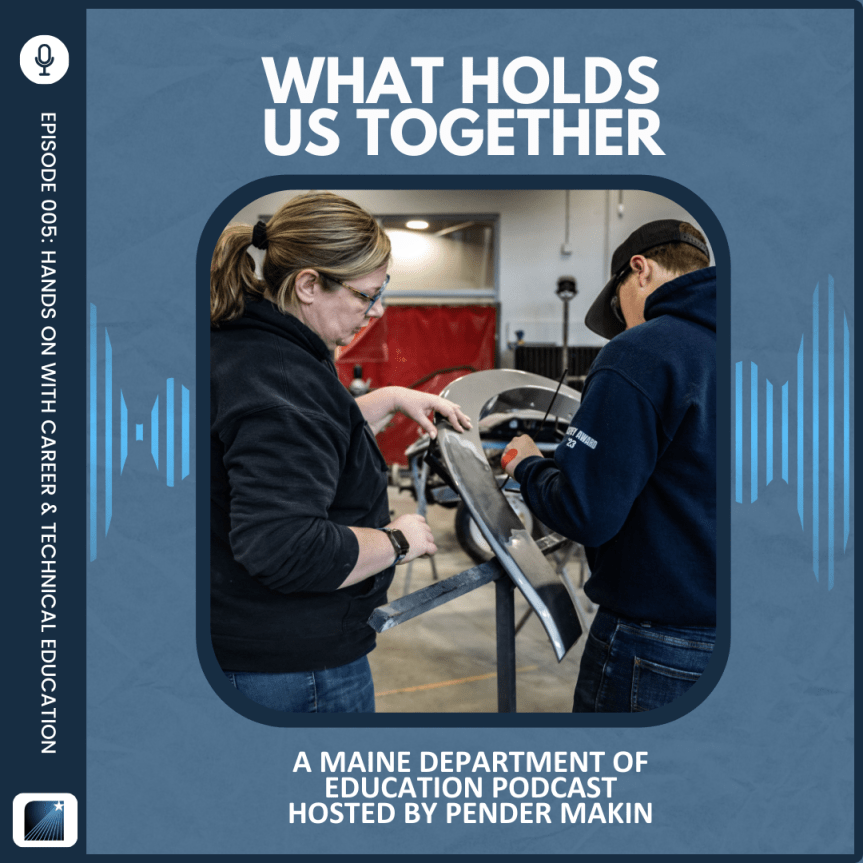

Maine DOE Podcast Highlights Hands-On Career and Technical Education Experiences

Commissioner Makin Talks with CTE Directors Randy Crockett from Oxford Hills Technical School, Bobby Deetjen from Mid-Coast School of Technology, and Bill Tracy from Hancock County Technical Center

Career and Technical Education (CTE) programs provide Maine students with hands-on experiences in programs like culinary arts, welding, auto, law enforcement, early childhood education, and so much more. On this month’s What Holds Us Together podcast, Maine Education Commissioner Pender Makin talks with three CTE leaders about this engaging learning pathway, Randy Crockett from Oxford Hills Technical School, Bobby Deetjen from Mid-Coast School of Technology, and Bill Tracy from Hancock County Technical Center. They share how CTEs help students build the skills, knowledge, and real-world experiences they need to thrive. Listen here.

“We’re big believers in the hands-on, real-world, interdisciplinary learning that’s happening at Maine’s Career and Technical Education schools. [Students are] learning skills, they’re learning academic content, they’re solving problems and using critical thinking, they’re developing teamwork skills and communication skills—it’s such a robust model of education,” said Education Commissioner Pender Makin on the podcast.

“What happens in our school is pretty magical on a daily basis. We’re dealing with students who are future doctors, engineers, electricians, welders, you name it. These are going to be contributing members of our communities and we get to watch them at 16 and 17 really grow and make decisions that are going to impact our communities as a whole,” said Mid-Coast School of Technology Director Bobby Deetjen.

“It’s nice to be able to offer things that students need and want in the community,” said Hancock County Technical Center Director Bill Tracy. “That model of being able to learn and then immediately apply and practice is something that our students talk a lot about and being able to have that hands-on opportunity.”

“Our spaces are intermingled with the academic areas as well, so a student can walk from engineering and architectural design to their calculus class. It really makes a big difference in terms of access,” said Oxford Hills Technical School Director Randy Crockett, who also talked about the importance of hands-on learning. “That actual application is going to deepen their learning. They have to problem-solve in real time instead of abstract thinking.”

The group also discussed how the CTE model encourages students to take risks and be confident in trying new things.

“We tell our students, if you don’t fail at something that means you are not going to learn to your fullest potential. That’s going to increase engagement right there where students are going to have that kind of opportunity to feel at ease and take a chance,” said Deetjen, who explained that when students are worried about the social pressures around them if they fail, they’ll never take that chance to begin with and CTE programs take that pressure away.

Tracy summed up the power and potential of what CTEs in Maine offer.

“You can walk down the hall and see welding going on, you can see a car being taken apart, you can see [students] looking at electrical systems, and then you can go up and see three-year-olds running around in a classroom, and then you can step over to another classroom where they’re turning cockroaches into cyborgs and learning to control them. Then you walk down the hall and they’re making this amazing meal. What is this world? It’s just an amazing thing,” he said. “That is the world, and we’re just this small-scale piece of what reality is.”

Maine CTE program enrollment surpassed 10,000 students this year, and communities and the State continue to invest in this transformational learning pathway. Maine’s 27 Career and Technical Education regions and centers enroll students in 85 programs. The Mills administration invested $20 million from the Governor’s Jobs Plan to expand CTEs in Maine. In addition to the Jobs Plan funding, the Governor and the Legislature have increased funding for CTEs by more than $10 million.

Celebrating Women in CTE: Meet Auto Collision Instructor Danica Wooster

The Maine Department of Education, in collaboration with Career and Technical Education (CTE) schools throughout Maine, is celebrating CTE month this February by highlighting some of the amazing women who have found their path in life through career and technical education. We hope their stories inspire you the way they have inspired us.

Danica Wooster has taught the Auto Collision program at the Mid-Coast School of Technology (MCST) for the last 13 years. The program offers a diverse look into the automotive collision industry, including working with the most up-to-date tools and equipment and learning skills in welding, paint preparation, dent repair, and detailing.

The program she now teaches is the same program that got Wooster started in auto collision when she was in high school.

“I had no idea what I wanted to do. My parents suggested I take the class and the rest is history,” said Wooster. Following high school, she attended WyoTech for Collision/Refinishing, and then started working as a technician in the auto collision industry, eventually earning a business degree and then transitioning to teaching the trade right here in Maine.

“Although I didn’t have a background in education specifically, I feel like I played that role many times in my life – from teaching horseback riding lessons in high school to working side-by-side with entry-level technicians in the shop,” said Wooster. “Both of my parents were also educators, and both were a huge support system for me as I started my career,” she added.

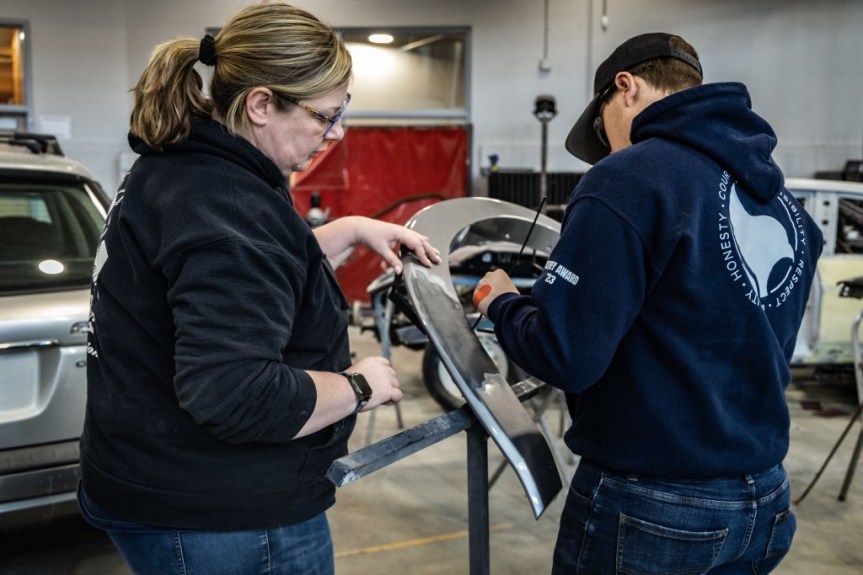
Danica Wooster working with a student
Danica Wooster working with MCST student Bryson Mattox plastic welding a wheel flare (Photo credit: Zoe Richardson, a student in MCST Design Technology program).

Wooster says there are a lot of things she loves about working in CTE but one of her favorites is introducing her trade to the students. “I love seeing a student’s face when all of a sudden something clicks – it’s truly special.”

Being able to teach something she is passionate about while experimenting and learning alongside the students is another huge perk for Wooster. Explaining that many people don’t understand that auto collision repair is an art in and of itself. “It’s making something new again, but every single job is different and handcrafted,” she said.

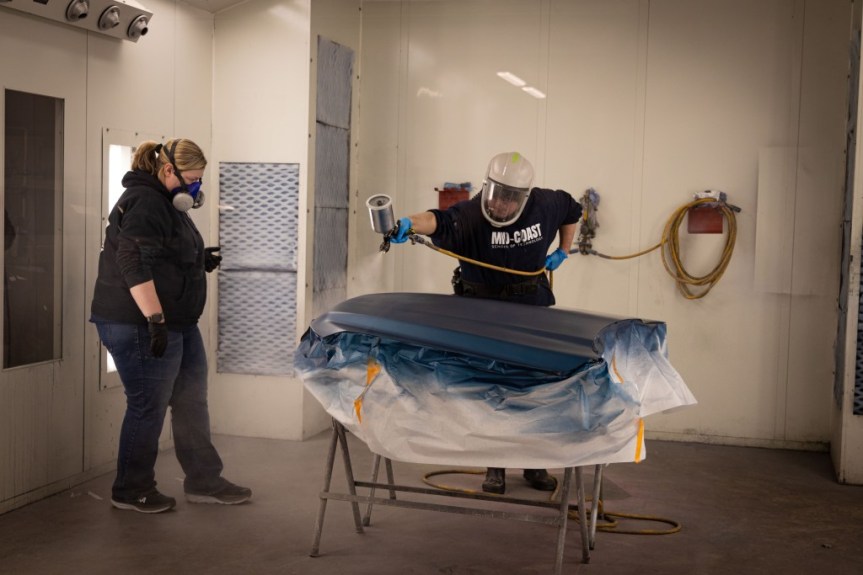
Danica Wooster working with MCST student Andrew Zuidema refinishing a hood in the paint booth (Photo credit: Zoe Richardson, a student in MCST Design Technology program).

During her time working in CTE, Wooster has had many opportunities to grow professionally as well, by earning a master’s degree and continuing to hone her craft by working in the collision repair field during her summers off from teaching.

“I get to make connections with other people in my trade and in education, and I get to work in a building that has so many other talented CTE teachers,” said Wooster. “It’s all an amazing experience, and I think it’s a very unique part of being a CTE teacher.”

One of the things Wooster is the proudest of is being an advocate for CTE, promoting how important it is for many students and industries but also the incredible opportunities it creates for students.

“Attending CTE when I was in high school had a much different, and often negative, connotation,” said Wooster. “We have come a long way from that.”

“Danica has inspired countless students to pursue non-traditional career pathways,” said Bobby Deetjen, Director of the Mid-Coast School of Technology. “Her students continue to break down barriers and succeed in shops all over Maine.”

Wooster shared her advice for students interested in CTE.

“Working my entire career in a non-traditional field has taught me that the only person I need to prove myself to is myself,” she said. “I’ve heard my fair share of ‘no,’ but I think having a little bit of grit is what makes the difference, what made me keep moving forward. I always encourage my students to have a little ‘grit’…to push through when things get tough and to not be afraid to make mistakes. My entire trade is based on mistakes…and that’s what helps us learn and get better at what we do!”

Fostering the Future – Kicking Off CTE Month at the State House 

(Pictured: Emily Worcester a senior at United Technology Center [UTC] in Bangor.)

The Hall of Flags was abuzz Wednesday morning as representatives from across the state came to Maine’s Career and Technical Education (CTE) Month Kick Off at the State House. Students, instructors, and directors from 15  of Maine’s 27 CTE centers came with everything from canapes to holographic 3D fans, proudly sharing legislators and government officials the advanced skills CTE students are learning.

Biotechnology Tool from Foster Career and Technical Center

When you think of vocational learning, you might picture what Hancock County Technical Center director Bill Tracy describes as “hard trades” such as welding or mechanics. However, the CTE students of today are starting down a wide array of career paths, from graphic design to criminal justice.

“We’re really trying to give kids a broad breadth of what they can do at a CTE enter,” explained Tracy,  “I don’t want them to think it’s just hard trades. Even though the hard trades are really important, there are so many different things they can do.”

Chris Davis, the assistant director of Farmington’s Foster CTE Center, was excited to share what his students are learning in Foster’s biotechnology program.

“They’re learning how to isolate a virus, DNA splicing, and genetic engineering,” he said. “Students working with biotechnology are looking at the biomedical field or forensics. It really increases their ability to work in a lab.”

Many CTE instructors and directors see their work as a building block for Maine’s economy. Matt Peterman of Sanford Regional Technical Center explained, “Maine CTEs are important because we are trying to build the Maine economy, and we’re trying to develop young employees to replace an aging workforce.”

As an extension of this effort, CTE curriculums support their local economies. For example, Oxford Hills Tech School offers a popular hospitality and tourism program, which they are expanding to include outdoor recreation to prepare students to work in the growing ski and ride industry of Oxford County.

Instructor Jeremy Bourque of Somerset Creative Tech Center hopes to see his students prosper and return to Maine. “Our county has a pretty high poverty rate, so we’re pretty proud of the work we’ve done changing these kids’ lives, helping them go to school, find a really good job, and then come back to Somerset County to help the county grow and change,” he said.

Another positive change happening at CTE schools across the country is an uptake in young women working in trades. Maine is no exception regarding this trend. In fact, every instructor and director at the kick off reported an increase in “non-traditional students.”

“We’re trying to break some stereotypes,” Peterman explained. “Traditional roles don’t exist anymore. Anyone can do the job.”

Instructors have seen this trend most notably in welding programs, which continue to be one of the most popular CTE offerings in the state. Jorja Brown, a junior at the Somerset Career and Technical Center, came to the CTE Kick Off to share her experience as a young woman in welding. “I am the best in my class,” she declared, noting that “it’s really cool to experience a very male dominated trade.”

United Technology Center (UTC) senior Emily Worcester was also present, representing young women in mechanics. Worcester is a part of UTC’s small engines program, and loving every second of it. “My experience has been absolutely amazing,” said Worcester. “It’s a chance to expand my knowledge. I could expand my knowledge into a future career, or I could take this knowledge and do my own personal thing. It’s a good choice to have.”

Canapes Made by the Capitol CTE Culinary Team
Canapes made by the Capitol Area Technology Center (CATC) Culinary Team.

Having this kind of hands-on, real-world education is precisely what keeps many CTE students in school. Matthew Hamilton, the Student Services Coordinator at Bath Tech, came to CTE after working as a dean of students. As a dean, Hamilton saw many students who struggled in a traditional school setting. Hamilton shared that those same students now excel in their CTE programs. They are “coming to school early, they’re coming to school on a regular basis, and they’re jazzed up about learning.”

Students like those Hamilton described were the most excited to share their CTE experiences at the kick off. “I was going to drop out in December of my junior year,” remembers Brett Bretton, a senior in the Culinary Program at Capitol Area Technical Center. “But my guidance counselor suggested the culinary program for me, and now, instead of dropping out, I’m going to college for this.”

CTEs aren’t only keeping kids in school but giving them an early advantage for their post-graduate lives. “People think vocation or technology centers are for students that are not college bound, whereas we’re the total opposite. We catapult students so that they can go to college and go to college with a head start,” commented Michael Bouthilette of Biddeford Regional Technology.

Kaylie Trembly of Lewiston Regional Technical Center (LRTC) chose to enter the EMT program after speaking to past graduates. “The people I talked to who went through LRTC are doing really well,” said Trembly, “it helped them determine where they wanted to go.”

CTE programs work with post-secondary institutions across the state, like Southern Maine Community College, University of Maine Farmington, and trade schools like the Aveda Institute. However, these partnerships go beyond traditional higher education, partnering directly with local employers to place students in the field. At Region 9 School of Applied Technology, CNA students split their time between Rumford Hospital and local nursing homes. Meanwhile, in Ellsworth, students can intern with Jackson Laboratories.

“We know we’re small, we’re rural, but I’m definitely passionate about this work,” said Brenda Gammon, the director and superintendent of Region 9, “I’ll do anything I can to give students the best opportunities.”

CTE month continues through February, and it is the perfect time to dig into everything CTE has to offer. Check out a list of Maine’s CTE schools with links for you to explore.

Celebrating Women in CTE: Meet Computer Tech Powerhouse Madison Jackson

The Maine Department of Education, in collaboration with Career and Technical Education (CTE) schools throughout Maine, is celebrating CTE month this February by highlighting some of the amazing women who have found their path in life through career and technical education. We hope their stories inspire you the way they have inspired us.

As a junior in high school, Madison Jackson had no idea what she wanted to do when she graduated.

“I was worried about it because everyone else already knew,” remembers Jackson as she one day decided to check out the list of class options at her local Career and Technical Education (CTE) center, Capital Area Tech Center (CATC) in Augusta.

Initially, Jackson wanted to be a Game Warden but remembers seeing computer technology on the list of pathways at CATC and thinking, “Oh, that’s like video games, that will be fine,” she recalled. “That’s not what it turned into at all,” she added.

As a 2023 graduate from Cony High School, Madison Jackson grew up around technology, but she never dreamed it would one day be her job.

“We had the old Windows 7 and I loved playing games on that,” she said. “I remember getting a new iPad and I thought it was the most glorious thing.”

Jackson was mesmerized by people who could build computers but when she first got started, she felt like she was picking up the hardware side of things slower than her all-male classmates. Eventually, she realized her true passion was software, cybersecurity, and networking. From there, her abilities and talent have grown into an exciting career path.

For Jackson, going to school at CATC was very different from traditional high school. It felt like she finally had a choice in the classes she took every day and for that reason, she looked forward to the school day. “We had stuff to get done, but we had the freedom to get it done, in our own time,” remembers Jackson as she explained how much better the learning environment was for her at CATC.

Jackson said one of the things she is most proud of during her time at CATC was making her original CTE teacher, Michael Fraser, proud.

“I didn’t know who he was, we started a bond, and we became buddies,” said Jackson. “He was really proud of me for succeeding to [Skills USA] nationals. I didn’t make it far, but it was just seeing him hug me and be proud of me and everything I do, even if I didn’t turn out on top. Of course, I’m proud of myself, but he was always there for the students.”

Fraser said he is proud of everything Jackson has accomplished, but that they are her accomplishments.

“I am just her biggest fan,” said Fraser. “I remember specifically the day she was hooked, it was the first time she placed on that SkillsUSA stage, at the state conference, a confidence switch flipped in her that diminished any of her doubts about success in cybersecurity. From that point on, there was no stopping her,” he added.

Jackson said that being the only girl in her classroom both years was another major factor in propelling her to succeed in computer technology.

“It gave me initiative, not to be better, but that if I can do this it will be amazing,” she said.

This year Jackson is enrolled in the Cybersecurity-Digital Forensics program at Central Maine Community College (CMCC). While she is currently working on completing her 2nd semester in college, she also has a job working in her school’s IT department. She says she is still one of just a few women in all her courses, but she is looking forward to seeing change in the coming years.

“I earned a semester’s worth of college credits at CATC,” she added. “I don’t think a lot of kids know that they are actual credit.” Jackson’s teacher showed her how to take advantage of dual enrollment at UMA and because of that, she will be able to graduate early from CMCC.

“Students are presented with many opportunities here at the technical center and Madison Jackson was the student to take advantage of everything she could,” said Fraser. “Seeing her continued growth in this industry is what makes my job worthwhile, knowing she found her career interest is what we strive for with all of our students.”

Jackson has big plans to continue pursuing her education right in central Maine before jumping into the workforce. “I hope to go to UMA [the University of Maine at Augusta] and get my bachelor’s and master’s degrees,” she said. Meanwhile, she is doubling down by applying for internships as well.

Jackson has the following advice for other high school students, especially young women, who may be thinking about enrolling in a CTE course.

“Take a chance on any single class. I’ve seen girls in firefighting, welding, and construction,” she said. Jackson shared that the key to finding a sense of belonging is trying to find someone to connect with. “It’s easy to be by yourself as the only girl. Find a connection. I still have friends from my classes. I just took a chance.”

Celebrating Women in CTE: Meet Criminal Justice Instructor Amanda Baker

The Maine Department of Education, in collaboration with Career and Technical Education (CTE) schools throughout Maine, is celebrating CTE month this February by highlighting some of the amazing women who have found their path in life through career and technical education. We hope their stories inspire you the way they have inspired us.

“I had no idea life would take me in this direction. It wasn’t too many years before I changed careers when I said to a friend, ‘There is no way I would want to be a cop in my own hometown!’ and that’s exactly what I became, and I loved it!” said Amanda Baker as she looked back on her journey to becoming a police officer and eventually the Criminal Justice Instructor a Caribou Tech Center.

Baker began her journey studying Education and Recreation at the University of Maine at Presque Isle (UMPI). After working at Chewonki Foundation as an outdoor educator and wilderness trip leader, and then at UMPI’s fitness center while teaching courses in recreation, Baker eventually got married and had her daughter Zoey.

“It was motherhood that shifted my perspective; I felt like I had work to do in our community,” said Baker. “I left my job at the University and took the law enforcement 200-hour course. I was hired by Washburn Police and began working as a police officer.  I loved it, but it scared me every day!”

After moving to the Caribou Police Department, she quickly realized she had a lot to learn about being a police officer. It was then that she went to the Maine Criminal Justice Academy to earn a Basic Law Enforcement Training Program certificate.

“I was more confident and grateful for the military-style training I received during those 18 weeks at the Academy,” said Baker. However, the journey to finding confidence in her career as a police officer and starting a family was not always easy.

“In 2020 God took my daughter’s father, and I was left to raise Zoey as a single mom,” she said. “I was only able to remain on my law enforcement path because of my parents and sister’s family who filled in many gaps.”

It was in 2023 that Baker saw the Criminal Justice Instructor position open at the Caribou Tech Center, and she knew it was the job that offered the perfect combination of her prior work experiences plus the flexibility to give more time to her daughter.

“My position at the Caribou Tech Center provides me with all that I find most valuable; time with my daughter and family, and an opportunity to influence young adults all while earning a comfortable salary with great benefits like health insurance and a retirement plan,” Baker added.

“I feel incredibly fortunate to have Amanda Baker on our staff at Caribou Technology Center,” said Amy White, Caribou Tech Center Director. “Her boundless creativity, unwavering emphasis on school safety, genuine care for students, and vast skillset and background make her an invaluable asset to our team.”

Since joining the team, Baker has started the year off strong by spending the first 4 months of the school year having her students work on a school safety assessment identifying strengths and weaknesses for all of the RSU39 schools and offering strategies for improvement.

“The culmination of this project featured a slide show presentation to the RSU39 School Board in December,” said Baker. “I sat back and watched as my students presented thoughtful, organized, and important information to a captivated audience.”

Right now, Baker’s Criminal Justice students are working on an ethics project and planning an “epic” end-of-the-year celebration featuring a Community First Responder Run hosted by the Caribou Tech Center and a Touch-A-Truck event at the Caribou Community School.

“I am honored to be a part of our student’s journey through civic engagement and service learning,” she added. Baker has also been offering “Power Hour” sessions for Caribou Community School students. The sessions are focused on law enforcement and hope to spark interest in civic service at a young age.

Looking forward Baker is excited about a new Outdoor Recreation program for Northern Maine High School students that is in the works. Baker attributes this new and exciting pathway to Caribou Tech Center’s new and highly driven Director, Amy White.

“I was thrilled to accept the position as instructor for that program as well (while continuing to maintain and build a more robust Criminal Justice program) starting fall 2024,” said Baker.

“With Ms. Baker, we not only benefit from her innovative ideas but also from her dedication to creating a secure and nurturing environment for our students,” added White. “Her passion for education and commitment to excellence truly set her apart, enriching our community in countless ways.  I look forward to continually watching her grow in her new role as a CTE Instructor.”

When asked what advice she would give to students thinking about pursuing education in CTE, this is what Baker had to say, “Experiences, people, and mindset will all influence your path. It can be difficult to remain focused on something when your family and friends tell you you’re crazy (what I heard when I started talking about law enforcement).  It’s important to acknowledge their protection of you, but even more important to know why you are pursuing something so radical. I wanted to be a police officer because I was scared of what my daughter was going to be exposed to. I knew I was physically capable of the job but wasn’t sure I had the skills to take down bad guys. Certain aspects of any job can be learned through training and practice, like taking down bad guys, but mental toughness, grit, and determination are all inside.  Ask yourself, why am I doing this?  If your heart and soul back you up on your “why,” and you know this is what you’re meant to do, go for it! No regrets!”

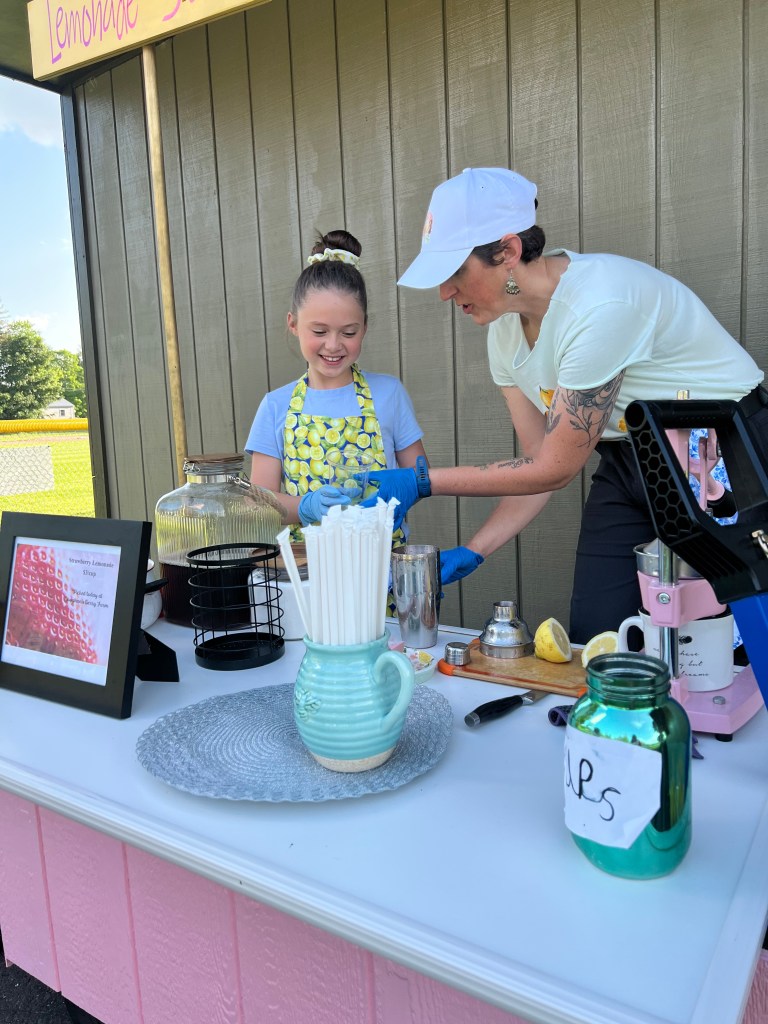
Amanda Baker and her daughter running a lemonade stand.


Major Capital School Construction Funding Opportunity 

Maine school administrative units (SAUs) may apply for major capital school construction projects through the application posted on the Office of School Facilities website. The application deadline is August 30, 2024.

This new rating cycle provides an opportunity for SAUs to apply for state support to undertake a major capital construction project. If a SAU applied during the last cycle in 2017-2018, they will need to reapply if they wish to be included in this rating cycle.

The Maine Department of Education (DOE) will review completed applications and create a needs-based priority list that will be used to designate projects for funding. The process is governed by Chapter 61 State Board of Education Rules for Major Capital School Construction Projects.

Questions regarding the application should be directed to Scott Brown, Maine DOE’s Director of School Construction, at scott.brown@maine.gov. Questions and answers will be posted here.

Regional School Calendar Coordination Between SAUs and CTEs

This notification is a reminder that Regional School Calendars are due by June 1, 2024 for school administrative units (SAU) and private schools, approved for tuition purposes, in coordination with their local secondary career and technical education (CTE) school. This requirement is part of Public Law 2011, Chapter 686 to promote collaboration among local school administrative units that may benefit from inter-administrative unit collaboration beyond CTE.

For school year 2024-25, both regional school calendars and individual calendars for each school administrative unit must be submitted by the director of the local CTE Center/Region to the Maine Department of Education (DOE) no later than June 1, 2024, for a decision on approval by July 12, 2024.

Guidance and templates or Regional School Calendars can be accessed electronically on the Maine DOE website.

Given the coordination required to fulfill this law, the Maine DOE recommends that SAUs initiate discussions as soon as possible, including representatives from all affected secondary schools and their associated career and technical education center or region.

Please visit the Maine DOE Website for more information, including guidance, instructions, templates, a waiver process, and a link to the complete law.

Further questions should be directed to Emily Doughty emily.doughty@maine.gov at 207-592-0314 or Dwight Littlefield dwight.a.littlefield@maine.gov at 207- 441-8927.

Career & Technical Education (CTE) Educators Honored for Excellence

Maine Administrators of Career and Technical Education (MACTE) and Maine Association for Career and Technical Education (ACTE-ME) recently announced the recipients of their 2023 Career and Technical Education (CTE) Excellence Awards at the annual CTE conference held in Lewiston.

The awards recognize outstanding work and dedication within the field of career and technical education. These educators are exceptional individuals contributing to the success of CTE through high-quality work, dedication to their students and their craft, and through their involvement within the CTE community.

2023 Career and Technical Education (CTE) Excellence Awardees:

Nora Wilson CTE TOYCareer and Technical Education (CTE) Teacher of the Year

Nora Wilson –
Mid Coast School of Technology

Nora Wilson of Friendship is the School and Career Coordinator at the Mid Coast School of Technology in Rockland and was named CTE Teacher of the Year.  She has taught at Mid Coast School of Technology for 4 years and has 10 years of experience as a CTE educator.

“Nora Wilson began her career as an architectural engineering prior to becoming a CTE instructor,” said MACTE Executive Director Dave Keaton. “Nora has fed her drive to further her personal quest for more learning by earning a master’s degree in CTE, and has worked tirelessly to become a top-notch educator by submerging herself in CTE pedological and content theory.  She is one of the most innovative teachers in Maine who has masterfully developed the much-needed CTE instruction that engaged ninth and tenth-grade students. Nora also serves as a mentor for new instructors. Nora consistantly gone above and beyond to ensure her students are successful inside and outside the classroom.”

Career and Technical Education (CTE) Lifetime Achievement Award

Paul Jones –
United Technology Center (UTC)

Paul Jones of Glenburn who teaches Automotive Education at United Technology (UTC) in Bangor was awarded the CTE Lifetime Achievement Award.  He has more than 18 years of teaching experience at UTC and Hancock County Technical Center.

“Paul Jones began his career in the automotive industry before dedicating himself to teaching the next generation of CTE students,” Keaton said. “During his time in this  industry, Paul served as an AYES mentor, providing invaluable guidance and support to all those he worked with and contributing to the development of aspiring automotive professionals. Paul has directed several CTE centers, sharing his extensive industry experience with students, facilitating their entry into entry-level positions and post-secondary programs in the automotive industry. Paul goes above and beyond to provide students with the necessary tools and resources to excel in their chosen paths. Paul’s  contributions to the field of CTE Automotive Education since 2005 have been exceptional. His strong work ethic, effective communication skills, continuous professional development, certifications in various automotive specialties, mentorship to students, participation in accreditation evaluations, and the sharing of industry experience have made a significant impact.”

Steve Reece - LRTC - CTE AwardsCareer and Technical Education (CTE) Post-Secondary Professional of the Year Award

Steve Reece – Lewiston Regional Technical Center

Steve Reece of Lewiston, who is retired from Portland Police Department, teaches Criminal Justice at the Lewiston Regional Technical Center and is an adjunct instructor at Southern Maine Community College, was awarded the CTE Post-Secondary Professional of the Year Award.  He has spent more than 25 years as an educator.

“Steve Reece is an exceptional instructor, whose dedication, expertise, and commitment to his students and Career and Technical Education (CTE) make him a deserving candidate for this prestigious recognition,” Keaton said.  “This is something of an unusual nomination as it originated from his faculty colleagues and students. Steve is a favorite around the building yet never seeks recognition. He is constantly involved and willing to contribute, yet never asks for thanks. He consistently credits the faculty or their student leadership for the exceptional teaching and learning which occurs in their classrooms.  One of Steve’s greatest strengths is his ability to connect with students on a personal level. Steve creates a welcoming and inclusive classroom environment that encourages open dialogue, critical thinking, and collaboration.  Beyond his impact on individual students, Steve also contributes significantly to the broader CTE community.”

Josh Murchie- region 2 CTE awardCareer and Technical Education (CTE) New Teacher of the Year
Josh Murchie –
Region Two School of Applied Technology

Josh Murchie of Linneus, who teaches Auto Collision at Region Two School of Applied Technology in Houlton, was named CTE New Teacher of the Year.  He has taught at the Houlton CTE for 5 years.

“Josh Murchie began his career as a CTE student, graduated and worked in his trained field prior to returning to his original CTE center as a staff member,” said Dave Keaton, Executive Director of  the Maine Administrators of Career and Technical Education (MACTE).   “He inherited the Auto Collision program from his own high school CTE instructor, and has preserved best practices while incorporating new and exciting opportunities for students.  Josh’s leadership skills and dedication to the field of career and technical education is core to who he is.  This year Josh and his co­advisor took 23 students to the SkillsUSA Maine State Championships where several gold and silver medals were earned. Amongst the medalists were two golds and a silver belonging to his auto collision students, further demonstrating the relevance and rigor of his curriculum.”

These awards are administered through Maine Administrators of Career and Technical Education (MACTE) and Maine Association for Career and Technical Education (ACTE-ME). Each recipient will go on to regional level for a chance to progress to the national level through the national Association of Career and Technical Education (ACTE). Find descriptions of these awards on ACTE’s website.

Lewiston Regional Tech Center Hosts 500 CTE Educators and Partners

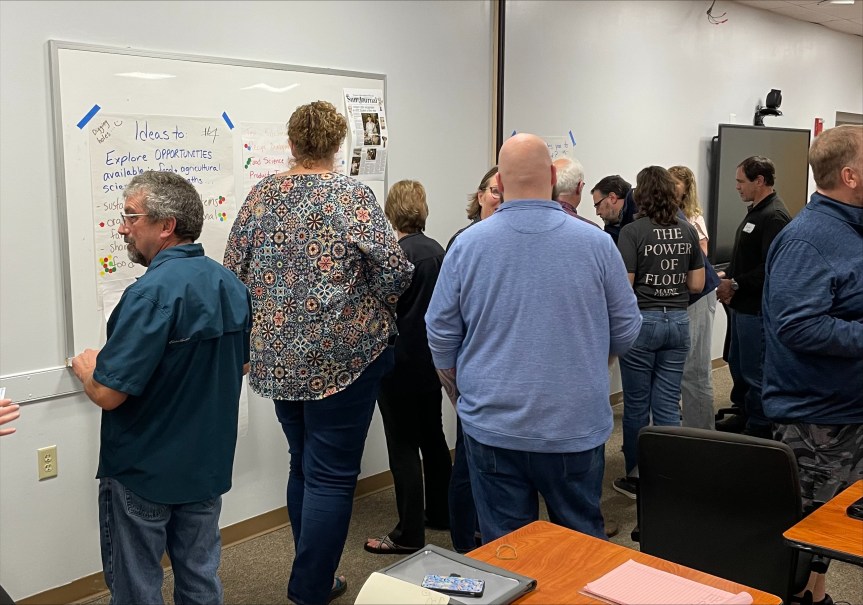
More than 500 CTE educators and CTE partners came together last Friday at the Lewiston Regional Tech Center to participate in more than 20 CTE and career pathways sessions.

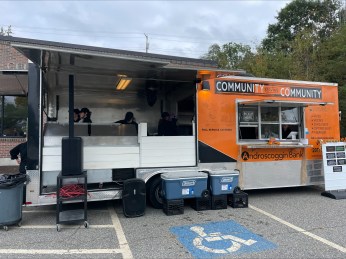
Conference participants were able to collaborate with colleagues from all over the state during these breakout sessions and over lunch. Participants enjoyed a variety of offerings from the culinary arts program’s food trucks.

Over lunch, Kelli Toole, from St. Croix Regional Technical Center, shared her experience as the Student Services Coordinator with Lucille Willey, the Director of Coastal Washington County Institute of Technology. Both agreed that they have found conferences like the MACTE conference immeasurably helpful, as they are able to collaborate, share ideas, and network with other professionals who work in CTEs.

More on the agenda here.