Massabesic Middle School Students Focus on Renewable Energy Through Interdisciplinary Class

Seventh-graders at Massabesic Middle School recently held a debate about renewable energy sources as part of an interdisciplinary class project. This is part of a new program after six teachers at the school—two at each grade level—transitioned from roles as content teachers in areas like science, math, and English Language Arts to Interdisciplinary Studies teachers. Now, they teach interdisciplinary, student-centered units based on the United Nations’ Sustainable Development Goals.

Erik Wade, Maine Department of Education (DOE) Interdisciplinary Instruction Specialist, has been serving as a resource to teachers who are trailblazing this new educational path in Maine.

“Massabesic has taken the idea of student-centered learning and run with it,” Wade said. “The school has restructured its teams, so that every student has a year-long opportunity to engage in authentic inquiry projects.”

As part of this new model, seventh-grade Interdisciplinary Studies teachers Michelle Turner and Christian (Bailey) Daigle created a teaching unit on sustainable energy sources, focused on practical ways that Massabesic Middle School itself could transition to using more of this kind of energy. Turner and Daigle divided each of their three classes into two groups per class and tasked them with choosing, researching, and building an argument about why a specific type of sustainable energy could be used to power the school.

While most groups chose solar panels or wind turbines, one group chose geothermal energy, and another chose biomass. They then presented their debates in front of an audience, including Maine DOE Director of Green Schools Glenn Cummings and co-founder of Maine-based ReVision Energy Phil Coupe. The pair listened to students’ opening arguments and provided feedback, giving them more information about the renewable energy sources they were researching and a few tidbits of information about renewable energy in general in Maine and its current use.

“Does anyone know of any schools in Maine that currently use solar panels?” Coupe asked after one of the opening arguments. That question led to a fruitful discussion, including some on-the-fly research about districts like Mt. Blue Regional School District (RSU 9), Camden Rockport Schools (Five Town CSD), and Gorham School District, which all currently use various sources of renewable energy to power their school buildings.

Cummings asked the students if they had considered how Massabesic in particular would use a renewable energy source. He asked where the school would put a wind turbine or solar panels, and whether the students had considered connecting to a local turbine farm in Maine. Again, this sparked conversation and further questions among students.

Following the debate, students had an opportunity to come back together to revisit their arguments and do some additional research to formulate rebuttals. They then presented and shared their rebuttals and closing statements with one another during class.

To close out the lesson, the teachers followed up with an end-of-unit discussion, during which students could discuss, after hearing the debates, what they think is the best option for Massabesic Middle School is and why.

“Much of their feedback revolved around the fact that they didn’t know where energy came from, how current practices can be harmful, and the abundance of alternative sources that are starting to be used both globally and locally,” Turner explained.

While these seventh graders have only just begun to scrape the surface with their research on renewable energy, they have been given an opportunity to engage in a real-world issue that will inevitably be a part of their future—a future in which their help and knowledge could bring solutions to our state and beyond.

A growing number of schools across Maine are embracing Interdisciplinary Instruction, including cross-content projects and restructuring of teacher roles, similar to Massabesic Middle School. The flexibility allows Massabesic students to drive their learning based on their interests and has enabled Interdisciplinary Studies teachers to develop projects and ideas that apply standards from multiple disciplines without a set curriculum.

“We feel incredibly fortunate that we get to engage our students in such a unique way, allowing for authentic learning experiences that align with both their interests and our own,” Turner said. “Designing and building our curriculum around relevant topics and real-life problems is truly a wonderful opportunity.”

Check out a short video about the project on Maine DOE social media sites:

To learn more about Interdisciplinary Instruction, visit the Maine DOE website. For further questions and resources, please contact Maine DOE Interdisciplinary Instruction Specialist Erik Wade at erik.wade@maine.gov.

Maine Department of Education Awards $750,000 in Climate Education Professional Development Grants

Grants Provide Opportunities for Maine Schools to Partner with Climate and Environmental Community Organizations to Strengthen Climate Education for Students

The Maine Department of Education (DOE) awarded $750,000 in climate education professional development grants to 10 programs throughout the state. These programs will support partnerships between school administrative units (SAUs), schools, and community organizations to strengthen climate education opportunities for students across Maine.

This grant funding increases access to climate education for students throughout Maine. The grant directly funds professional learning for educators to partner with climate science experts and organizations in their communities. These programs are instrumental in providing educators and schools the support needed to address climate and resiliency in the classroom.

Programs for SY24-25:

  • Brownville Elementary School along with Penquis Valley Middle School will partner with Appalachian Mountain Club and Piscataquis County Soil and Water Conservation District on a program for 4th, 6th and 10th grades, focused on wildlife and forest ecology and health.
  • Calais Public Schools will partner with Maine TREE Foundation to develop curriculum with Project Learning Tree tools including the Forest Ecology Research Network.
  • Cherryfield Public Schools, with a focus on PreK-8, will work with Rural Aspirations Project and Downeast Education Institute to design and implement new climate-based projects at every grade level in science and social studies classrooms.
  • Fiddlehead School will partner with Center for Ecology Based Economy to develop climate focused curriculum units in Grades 5 through 8. They will also work with Learning by Nature for ME to help PreK-4 teachers understand green school yards and incorporate their use into classroom work.
  • RSU 80/MSAD 4 in Guilford will have an Environmental Education Coordinator overseeing and working with teachers as a part of the staff throughout the school year. This coordinator will work with partners, Appalachian Mountain Club and Rural Aspirations Project in help develop curriculum and work with teachers.
  • RSU 17 in South Paris will partner with Gulf of Maine Research Institute, Center for Ecology Based Economy to review, plan, and introduce new units and lessons for teachers of 1st through 7th as well as 10th Additionally, MSAD 17 will work with Roberts Farm to develop and implement 5th grade curriculum and have a Food Corps Member create school garden team curriculum for 3rd and 4th grade.
  • Pembroke Elementary School will host a 1-day Professional Development Conference open to teachers throughout Washington County in partnership with Island Readers and Writers, along with additional partners and speakers.
  • RSU 12 Windsor Elementary will partner with Friends of Cobbossee Watershed to expand its Watershed Climate Professional Development workshop from Phase 1 on this grant program. Friends of Cobbossee will additionally provide several workshops throughout the year on the national curriculum Project Wet.
  • RSU 34 in Old Town will work with the Maine Center for Research in STEM Education (RiSE Center) and Wabanaki Science and Indigenous Knowledge to develop and implement curriculum that focuses on braiding Indigenous Knowledge and Western Science concepts with Cultural Knowledge Sharers and into units for 6th through 12th
  • Westbrook Public Schools will work with Wild Seed Project to design and implement outdoor learning and climate-focused plans into classroom units throughout the school year. Additionally, Maine TREE will partner with Westbrook to host climate education professional development and create a school-wide climate education plan.

“Teachers will deepen their knowledge, draw in peer partners, and develop/implement curriculum this school year in continued relationship with the CKS’s and Western researchers.  This fall a second cohort will initiate, as will a book study cohort, with an early-spring share-out date to share and reflect upon the journey in developing place-based, project-based learning.” said RSU 34 Assistant Superintendent Jon Doty

“Our work with the Climate Education grant perfectly aligns with our commitment to outdoor learning and creating place-based, relevant curricula for our students. We are working to help them to become knowledgeable stewards of both their local and global communities, and all of this is made possible through partnerships with local organizations and the grant funding.” said RSU 17 Curriculum Director Jill Bartash

“These grants provide Maine educators and schools with the tools, resources, and partnerships they need to provide students with engaging, hands-on climate and environmental education. From the mountains to the coast, Maine has an enormous amount of natural resources for students to explore and learn from so they can be effective environmental stewards and leaders,” said Maine Education Commissioner Pender Makin.

Maine continues to be a leader in outdoor learning and climate education. The Maine DOE’s Rethinking Responsive Education Ventures (RREV) initiative, funded through a $16.9 million federal grant, has supported the expansion of outdoor education classrooms, programs, professional learning, partnerships, and spaces across the state. Schools across Maine utilized federal relief funding to expand outdoor learning spaces and programs. Governor Mills’ Maine Outdoor Learning Initiative has provided thousands of Maine middle and high school students with coastal and inland forestry learning and career exploration opportunities during the summer. The Maine DOE recently hired a Climate Education Specialist to support and expand this work with educators, schools, and community partners across the state. You can learn more about the Maine DOE’s climate and outdoor education work here.

The grant initiative was designed out of LD 1902, which was passed by the Legislature in 2022 and signed by the Governor to establish a pilot program to provide support for climate education in Maine public schools. Priority was given to communities historically underserved by climate education, socioeconomically disadvantaged communities, and interdisciplinary, place-based, and project-based learning focused activities. In its second year now, the Climate Education Professional Development Pilot Grant Program has awarded over $1 million dollars to 16 programs which will serve 40+ schools in 10 counties and hundreds of teachers and thousands of students statewide. The program will accept applications for 2025-26 School Year programs this coming winter. More Details to follow.

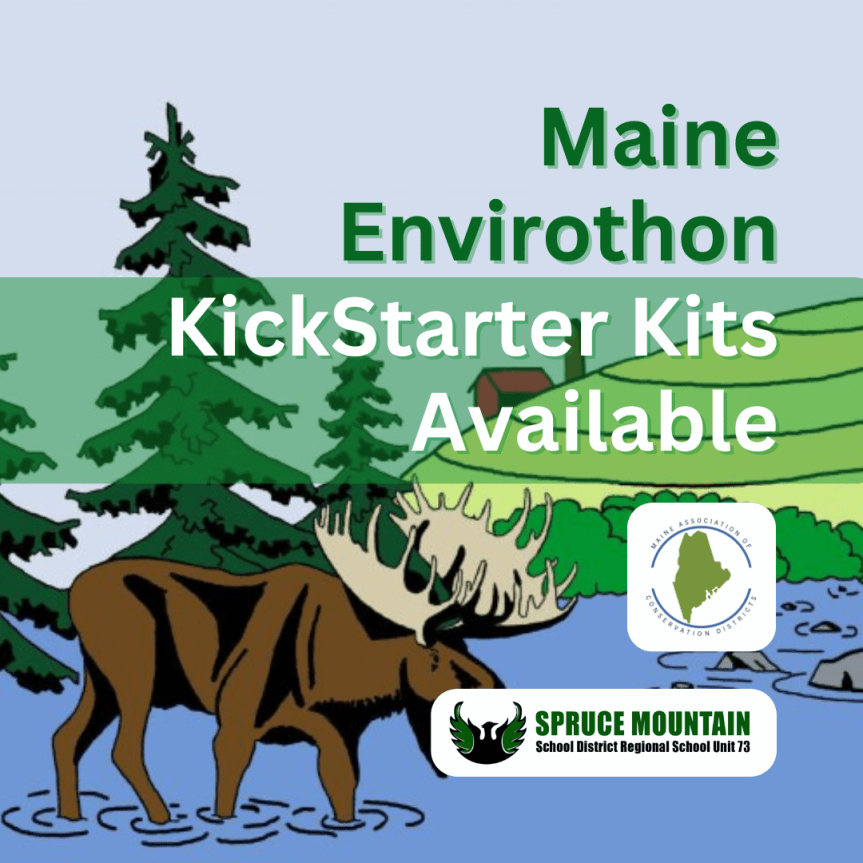
No Cost ‘Envirothon KickStarter Kits’ Available to Maine Educators/Schools

Do you want to engage students in learning about Maine’s Natural Resources? Do you want to promote outdoor education? Do you want access to environmental science equipment? Do you want to provide students with more opportunities to master the Maine Science and Technology Learning Results Standards? The Envirothon KickStarter Program may be for you.

Through a collaboration between the Maine Association of Conservations Districts and the Spruce Mountain High School Envirothon Team, an Envirothon KickStarter Program is available to organizations that have not had teams compete in the last 2 years.

Available through a Diversity Grant from the U.S. Forest Service, the National Conservation Foundation, and the NCF Envirothon, the KickStarter Kits are intended to provide resources to help new advisors teach students content and skills related to preparing for an Envirothon Competition.

The Kits will include materials such as a Biltmore Log Scale Stick, Trees of Maine book, soil testing materials, water data sampling materials, and other supplies for environmental science. It is expected that organizations receiving Envirothon Starter kits will organize a team to compete in the 2024 or 2025 Envirothon and the kits will be available this spring through 2025 or until the funds are depleted.

Additionally, as part of the Envirothon KickStarter program, there will be online training for any advisors and students to help them learn about Envirothon, including newly formed and veteran teams. Teachers may receive contact hours towards recertification for participation.

For more information about Envirothon or the Envirothon KickStarter Program, you may email Spruce Mountain High School Envirothon Advisor Rob Taylor at rtaylor@rsu73.com.

More information on the Envirothon and how to register:

Maine DOE Releases Professional Development Grant for 2024/2025 School Year to Promote Climate Education in Maine Schools

The Maine Department of Education (DOE) is excited to launch Phase 2 of the climate education professional development grant pilot program. The grant application is due on May 3rd, 2024. The program window runs from July 1st, 2024 until June 30th, 2025. There is $750,000.00 in funding available for local education providers to apply to partner with a community-based organization for climate-related, interdisciplinary professional development. This grant program was designed out of LD 1902 which passed in the spring of 2022.

There have been minor refinements from Phase 1 of this grant program in the fall of 2023. Overall clarity and simplicity of the application have been improved as well as a focus on applicants demonstrating increased access to historically underserved communities. The full RFA and application can be found by following the link below.

This program is overseen by Teddy Lyman, the Maine DOE’s Climate Education Specialist. Teddy will coordinate this program including the application, awards, and contracts. During the RFA application window, Teddy cannot communicate directly with anyone who might benefit from direct communication that is not publicly available.

Questions about the RFA should be emailed to Teddy at: Theodore.Lyman@maine.gov by 11:59 pm on March 29th, 2024. Questions and answers will be posted publicly at the link below.  The Climate Education Action Taskforce was also launched this spring to design the future of climate education (more information can be found below).

For more information and updates, check out the DOE climate education webpage.