Pursuant to Title 20-A, §15689-A, the Commissioner of the Maine Department of Education (DOE) may provide funding to school administrative units (SAUs) to support the establishment of community schools. As such, the Maine DOE is currently accepting applications for funding from SAUs whose school boards have designated an existing school or established a new school as a community school.
The Maine DOE recently held a virtual informational session on January 20, 2026, to share information about the community schools strategy, as well as details about this community schools grant opportunity. Please use this link to access the recording of the session.
Eligible SAUs interested in this grant opportunity may access the Request for Applications (RFA) via the State of Maine’s Vendor Self-Service System (VSS), where they should submit their applications. Applications must be submitted via VSS by 4 p.m. on February 12, 2026.
Pursuant to Title 20-A, §15689-A, the Commissioner of the Maine Department of Education (DOE) may provide funding to school administrative units (SAUs) to support the establishment of community school(s). As such, the Maine DOE is currently accepting applications for funding from SAUs whose school boards have designated an existing school or established a new school as a community school.
Eligible SAUs interested in this grant opportunity may access the Request for Applications (RFA) via the State of Maine’s Vendor Self Service (VSS) system where they should submit their applications and any questions. (Please see the priority notice issued on January 9, 2026, for more information and training materials related to VSS.) The Maine DOE strongly suggests that SAUs ensure that they are able to log into VSS ahead of the RFA due date.
The timeline for this RFA process is as follows:
January 20, 2026 – virtual informational session at 3 p.m. (details below)
January 27, 2026 – RFA questions must be submitted via VSS by 4 p.m.
February 12, 2026 – RFA applications must be submitted via VSS by 4 p.m.
To learn more about community schools and this grant opportunity, potential applicants are encouraged to attend the virtual informational session on Tuesday, January 20, 2026, at 3 p.m. Please use this link to join. Registration is not required in advance.
Additional information about community schools can be found on the Maine DOE Community Schools webpage. Again, all questions about this RFA should please be submitted through VSS.
Pine Tree Programming, a new initiative from the Maine Department of Education’s Office of Teaching and Learning, is expanding access to computer science education across the state. In just six weeks, this dynamic program has introduced more than 500 students—many from schools with limited or no prior computer science opportunities—to the world of coding. Partnering with 44 schools across 13 Maine counties, Pine Tree Programming is empowering a new generation of coders, creators, and problem-solvers.
Designed to make computer science fun, accessible, and engaging, Pine Tree Programming is proving that anyone can learn to code. In today’s digital world, computational thinking is more than just a technical skill; it’s a pathway to innovation, creativity, and future success. By introducing students and teachers to coding in an exciting and approachable way, this program is helping to close the digital divide and equip Maine’s youth with critical 21st-century skills.
So far, the response from the classroom has been overwhelmingly positive! Teachers are reporting a surge in student enthusiasm for technology and problem-solving, as students dive into coding, build projects, and explore the endless possibilities of computer science.
Building on this success, Pine Tree Programming is now looking ahead to expand its reach and bring even more Maine schools into the world of computer science.
Are you interested in to bringing Pine Tree Programming to your school? If so, please contact Allison Braley, Maine DOE Computer Science Specialist, at allison.braley@maine.gov for more information.
Since 2023, seven school administrative units (SAUs) across Maine have been awarded grants through the First 10 Community School Pilot, a project funded by Maine’s Preschool Development Grant. The First 10 model is a specialized community school approach that unites elementary schools, early childhood programs, businesses, community organizations, and social service agencies to support the well-being and academic success of children from birth through age 10.
Each First 10 participating school has established a dedicated First 10 team, comprised of school and community-based early childhood staff, community organizations, businesses, and family members. Three pilot sites launched their initiatives in the summer of 2023 and are actively building systems to ensure children and families benefit from a more coordinated early childhood network. You can learn more about the first round of grantees here.
A second cohort of SAUs was awarded grants in 2024. These SAUs began their First 10 journeys last July and have collaborated closely with those involved with the Education Development Center’s First 10 project to deepen their understanding of the model and develop detailed strategic plans tailored to their communities’ strengths and needs. These SAUs are now forging connections and actively working to strengthen the early childhood system within their regions.
Cape Cod Hill Community School, RSU 9 (New Sharon)
Serving pre-K through fifth grade, Cape Cod Hill Community School had already implemented a community school model and has since expanded its focus to include children from birth to age five through the First 10 program. Recognizing transportation as the most significant barrier for local families, the school’s First 10 team, led by First 10 School Outreach Coordinator Anita Stevens, took decisive action. Stevens convened a county-wide group of collaborators to explore solutions. The team has since connected with the Neighbors Driving Neighbors program, while working to establish a similar initiative in Franklin County. In addition to finalizing the team’s strategic plan, Stevens has actively engaged with community organizations and businesses and hosted activities at local events, such as the area Children’s Festival. A partnership with the local Masonic lodge and Eastern Star chapter resulted in the Angel Project, which provides winter clothing for children in need at the Cape Cod Hill Community School.
River Hawkes, Skowhegan (MSAD 54)
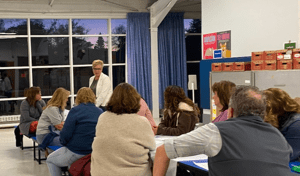
The River Hawkes First 10 team brings together the North and Bloomfield Elementary Schools in a strong partnership with the Kennebec Valley Community Action Corporation (KVCAP). Next year, these schools will merge into the new Margaret Chase Smith School, a facility that will consolidate three elementary schools and the KVCAP Head Start program, serving children from infancy through grade 5, along with their families. Preparing for this transition and fostering a cohesive early childhood landscape have been key priorities. This past fall, the team hosted a dinner with community childcare providers to share their First 10 goals and explore strategies for establishing a robust communication system between schools and community providers. First 10 Parent Outreach Coordinator Kasey Purington is also collaborating with MSAD 54 and KVCAP leadership to create opportunities for staff from both organizations to build relationships and develop a shared vision for the new school’s culture.
Wiscasset Elementary School, Wiscasset Public Schools
Wiscasset Elementary School, serving pre-K through fifth grade, boasts a First 10 team that includes staff from the local recreation department and Midcoast Community Action Corporation, working in close partnership with the Wiscasset parent-teacher organization and Partners in Education (PIE). Current efforts focus on family engagement events, caregiver education, and supporting transitions into pre-K and Kindergarten. First 10 Community School Outreach Coordinator Kim Watson, who is passionate about outdoor learning, has partnered with the Midcoast Forest Playgroup to launch “Wednesdays in the Woods” for the Wiscasset community. This initiative offers children and their caregivers a valuable opportunity to learn and play together in nature, with sessions designed to empower caregivers to eventually lead future nature-based playgroups.
Deer Isle-Stonington & Sedgwick Elementary Schools, Union 76 (Deer Isle)
Serving coastal communities from pre-K to grade 8, Deer Isle-Stonington and Sedgwick Elementary Schools have brought together school staff, adult education, Downeast Community Partners Head Start, Healthy Peninsula, and local community members to support their First 10 initiatives. This fall, the team focused on building relationships and ensuring access to essential resources. First 10 Community School Outreach Coordinator Melissa Jones-Bayley worked with Vanessa Hatch of Healthy Peninsula to expand the food backpack program through the Healthy Island Project. They are also finalizing plans for a partnership with Big Brothers Big Sisters that will engage high school students as mentors for elementary school students. Additionally, the team is planning family engagement initiatives and transition to pre-K and Kindergarten activities, with several events and strategies set to launch this winter.
The Maine DOE plans to continue to share good news about the important work being accomplished by Maine’s First 10 Community Schools. To learn more about the First 10 model and ongoing efforts in Maine, please visit the First 10 Community Schools website, or contact Sue Gallant, Maine DOE First 10 Community Schools Specialist, at Sue.Gallant@maine.gov.
The Maine Department of Education (DOE) is joining the Institute for Educational Leadership (IEL) Coalition for Community Schools to celebrate Community Schools Coordinator Appreciation Week from September 15 to 21, 2024.
Who are Community School Coordinators?
Community School Coordinators are the key to successful community schools. Coordinators create, strengthen, and maintain the bridge between the school and the community. Community School Coordinators facilitate and provide leadership for the collaborative process and development of a continuum of services for children, families and community members within a school neighborhood. A Coordinator is often the “liaison” and “connector” for many different areas. Some of these include parent and family engagement, community engagement, youth development, health, mental health, after-school programming, early childhood, and aligning partnerships with academics.
“We are going beyond our four walls,” said Amanda Clark from Mt Blue School District. “Maine schools are providing a lot of these things and they are doing amazing work. I think, for us, the community school initiative and model gave us that extra layer of support to be able to provide the things we felt like we were missing.” Clark, alongside Cape Cod Hill Community School Principal Carol Kiesman and (former) School Nurse Justine Meader, worked together to tackle the role of Community School Coordinator in the first few years of implementing the Community School Model at Cape Cod Hill.
Why is it Important to Recognize Community School Coordinators?
The Community School movement has grown across the country to include more than 5,000 schools. Community School Coordinators work diligently to create and manage the partnerships that allow students to learn and thrive, and their work is the key to successful implementation of the Community School Strategy. Community School Coordinators create a strong, purposeful bridge between schools and communities and it’s their hard work and advocacy that push this movement forward. They deserve recognition and appreciation for all the work they do.
“When you are looking at student support, you are not just looking at what the supports are that the student needs right now; you have to look bigger, at what they might need outside the school, and what their families might need, and how that affects the whole school environment and the whole community outside,” said Jennifer Goodwin, Old Town Elementary School Coordinator. Goodwin has served as the Community School Coordinator since Old Town Elementary School set in motion its plan to become a community school in 2017.
What is Community School Coordinators Appreciation Week?
Community School Coordinators Appreciation Week encourages schools and community partners to honor and celebrate their Community School Coordinators. On Monday, September 16th, Community School Coordinators from schools across the state of Maine will be recognized for their work at the Hall of Flags in Augusta at 10:00am. We encourage those who interact with Community School Coordinators at their schools to let their Coordinators know their work is seen and appreciated and to lift up the role of Coordinators.
Maine Community Schools
In Maine, the Community School model was first recognized by Maine Legislative Action of the First Regular Session of the 127th Legislature (2015-2016) in the budget bill Public Law 2015, chapter 267. At that time, the Maine Department of Education (DOE) was authorized to fund a limited number of community schools established under 20-A MRSA Chapter 333. Currently, six schools in Maine receive funding from the Maine DOE to support their community school strategies: Cape Cod Hill Community School in New Sharon, Deer Isle-Stonington High School, Gerald E. Talbot School in Portland, Old Town Elementary School, Shead High School in Eastport and South Portland Middle School. In addition, several schools in Maine are implementing First 10 Schools and Community programs, which focus on early childhood family and community supports with the help of a Family Partnership Coordinator. In addition, the Maine Indian Education schools are implementing community school strategies through the Tribal Community In Schools program.
“When I see Talbot compared to other schools I have worked in, I feel like families see us as a resource, and they see us as a partner,” said Terry Young, Principal of Gerald E. Talbot School in Portland. Young works closely with Talbot’s Community School Coordinator.
Learn more about Maine’s Community Schools:
About the Coalition for Community Schools
The Coalition for Community Schools, an initiative of the Institute for Educational Leadership, is an alliance of national, state and local organizations in education K–12, youth development, community planning and development, higher education, family support, health and human services, government, and philanthropy as well as national, state, and local community school networks. The Coalition advocates for community schools as a strategy to leverage local resources and programs, and to change the look and feel of the traditional school structure to best meet the needs of children and families in the 21st century.
“Education and support for our students goes way beyond the classroom,” said Principal Jeanna Tuell. As a long-time administrator for RSU 34, Tuell has been an integral part of Old Town Elementary School’s shift to the Community School Model.
Tuell explains that years ago, the school’s long-time school counselor raised concerns about the sheer amount of work it was taking to give their student population the support they truly needed to thrive at school. It was at that time that they had a collective realization they needed to seriously think outside the box to improve things not only for their students, families, and the community but for their teachers and staff as well.
A community school model, as defined by the Coalition for Community Schools, is both a place and a set of partnerships between the school and other community resources. Community schools exist in all regions of the United States, and their numbers are growing fast.
“When you are looking at student support, you are not just looking at what the supports are that the student needs right now, you have to look bigger, at what they might need outside the school, and what their families might need, and how that affects the whole school environment and the whole community outside,” said Jennifer Goodwin, Old Town Elementary School Coordinator. Goodwin has served in the role of Community School Coordinator since the school set in motion their plan to become a community school in 2017.
The community school model was first recognized by the Maine State Legislature in 2015/2016 when they authorized state funding for a limited number of community schools established under 20-A MRSA Chapter 333. Currently, three schools in Maine receive funding from the Maine DOE to support their community school strategies: Old Town Elementary School in Old Town, Cape Cod Hill Community School in New Sharon, and Gerald E. Talbot School in Portland.
As the longest-standing community school in Maine, Old Town has had time to build community partnerships and strategies that truly support its student population. One of those strategies is their amazing outdoor learning program which is complimented by a robust set of garden beds and greenhouses located right on school grounds.
“Almost immediately when I started, I got approached by teachers saying, ‘we want school gardens,’” explained Goodwin. “The University of Maine was able to do their capstone project and build us our first 12 beds. Then we got a partnership with Rogers Farms, and then we had an amazing parent garden coordinator come on that really helped it grow.”
The program has been so successful over the years that they have been able to do a full curriculum integration at every grade level. They have also benefited from a fruitful partnership with Rogers Farms that includes a community farm stand.
Old Town School Gardens:
Jennifer Goodwin
Several other community partnerships provide their students with everything from winter fun with Winter Kids, to theatre, and even more outdoor education through Maine Outdoor Education program in Millinocket. They also partner on Community Cupboard which serves students, families, and community members.
Another important tentacle of this work is their partnership with local health services such as Pathways of Maine, Acadia Hospital, and Penobscot Community Health Care (PCHC) for counseling services for students and families. Their partnership with PCHC extends into a recently added health clinic located inside the school building. The clinic is staffed with licensed health care professionals who provide students not only with counseling services, but basic healthcare needs like an annual wellness check, a strep test, or an ear/eye exam to diagnose and treat common childhood viruses.
The PCHC Health Clinic located inside Old Town Elementary School:
With the incredible number of meaningful community partnerships Old Town has worked so hard to get under their belt, they are quick to credit their partners and community for their shared commitment to this work.
“When anything needs to be done, it gets done here because people really care about their community, their kids, and there is a lot of pride,” explained Tuell. “Those community partners happen very naturally. It’s not just one particular partner, it’s a combination of a lot of people. I feel like that’s what makes this town so unique and so special.”
Tuell also acknowledges how incredibly important it has been for them to have a Community School Coordinator who can not only coordinate and see through the partnerships and strategies but also works to pull together administrators, teachers, and school support staff on a regular basis to prioritize the evaluation and re-evaluate their student (and community) support strategies.
To learn more about Old Town Elementary Community School, check out this video interview with Principal Tuell and Community School Coordinator Jennifer Goodwin.
Maine DOE Community Schools Consultant Ann Hanna (former principal of Gerald E. Talbot Community School) is working on advancing community school strategies in interested schools across Maine by providing technical assistance and support.
To learn more about community schools in Maine, please contact Ann Hanna, at ann.c.hanna@maine.gov.
The Maine Department of Education (DOE) is accepting applications from school administrative units (SAUs) and Education in the Unorganized Territory (EUT) to be part of a 3-year First 10 Community School pilot project funded through Maine’s Preschool Development Grant. Developed by Education Develop Center (EDC), First 10 Community Schools bring together school systems, early childhood programs, and community partners/agencies to improve care and education for young children and their families throughout the first 10 years of children’s lives. This model works to improve teaching and learning, deepen partnerships with families, and provide comprehensive services for children and families.
Through this opportunity, pilot sites will be supported in developing and implementing First 10 Community School models. To learn more about the model and the pilot opportunity, interested applicants are encouraged to view this recorded First 10 Community School information session.
All questions about the First 10 Community School RFA should be submitted to the First 10 Community School Grant Coordinator identified on the Grant RFPs and RFAs webpage.
Additional questions regarding this announcement should be directed to:
Lee Anne Larsen, Maine Department of Education Director of Early Learning, leeann.larsen@maine.gov.
Maine’s biggest city is home to one of the largest school administrative units in the state, which offers seventeen different schools covering its large and diverse population, ten of which are elementary level. One of these elementary schools, Gerald E. Talbot Community School, sits in the northwest of the city and offers a unique model to serve its high-need population. Recognized as a school that receives Title I support due to the socio-economic status of its students and families, Talbot serves around 370 students from PreK to 5th grade. Their student body comes from culturally and linguistically diverse backgrounds.
For these reasons and many more, Gerald E. Talbot applied for state funding and planning for the community school model, which began during the 2019-2020 school year. Eventually, while enduring the height of the COVID-19 pandemic, they hired Community School Coordinator Kristin Rogers, who started implementing strategies during the 2021-2022 school year and beyond.
A community school model, as defined by the Coalition for Community Schools, is both a place and a set of partnerships between the school and other community resources. Community schools exist in all regions of the United States, and their numbers are growing fast.
“We were pretty ideally suited to be a community school because we had a lot of the infrastructure that a lot of community schools have already existing. There’s a branch of the Portland Public Library that exists in our building; we have a dental clinic here, we have a public pool and playgrounds. We are pretty centrally located to our families. So, it’s kind of a natural place to be a hub for the community,” said Gerald E. Talbot Community School Coordinator Kristin Rogers. Principal Terry Young, who works closely with Rogers, adds that their high-needs population is another major reason for the shift.
In Maine, the community school model was first recognized by Maine Legislative Action of the First Regular Session of the 127th Legislature (2015-2016) in the budget bill Public Law 2015, chapter 267. At that time, the Maine Department of Education (DOE) was authorized to fund a limited number of community schools established under 20-A MRSA Chapter 333. Currently, three schools in Maine receive funding from the Maine DOE to support their community school strategies: Old Town Elementary School in Old Town, Cape Cod Hill Community School in New Sharon, and Gerald E. Talbot School in Portland.
Now in its 3rd year of implementation, Talbot has had time to try many different things after its initial needs assessment in 2019/20. They have a robust list of over 50 community partners that assist with everything from housing to physical and mental health, food security and nutrition, general assistance, academics, and enrichment. Their community school programs start before the first bell rings for the day and last long after the traditional school day ends.
Young explains that in addition to meeting students’ basic needs, enrichment opportunities also significantly impact their high-needs families.
“In a middle-class/upper-middle-class school, you have students who get a lot of enrichment opportunities because their parents can afford it. They can drive them to soccer practice, they can take them to basketball, they can take them to the library. Where you are working with a higher-needs population, students don’t have the same access. The difference is, you are bringing access to the children, to the families, into the school,” said Young.
Many of the enrichment (and extended academic) programming can be found in their extensive afterschool opportunities. Rotating on a 6- to 8-week schedule that offers something different each day, designated students stay after school for traditional academic programming like tutoring or language skills and for various enrichment opportunities like choir, yoga, student leadership, and even Nordic skiing, to name a few. Over 100 students participate in the community school afterschool programs and targeted outreach efforts by Rogers, Principal Young, and other staff members help ensure equitable access to these programs for students and families.
Pictures taken during Talbot Community School’s afterschool program, which includes the Nordic skiing club, a partnership with Portland Nordic:
In addition to its afterschool programs, one of its current language programs is a flourishing collaboration with Portland Adult Education, which aims to boost the English-speaking skills of students and their family members. Adult caregivers take language lessons in the mornings through Portland Adult Education, and their children are involved in an after-school program that combines enrichment with language immersion. The group of students and their family members will hopefully move through their respective programming year after year as a cohort, improving their English language skills together in school, at home, and in the community.
Another of the more recent and innovative programs Talbot has created is its walking school bus program, which aims to reduce chronic absenteeism and increase family engagement.
“We have a staff member as well as some community volunteers that go door to door in the morning for students who would benefit from support for their attendance or whose families could benefit from the support in getting kids to the bus stop. They knock on the door, walk them to the bus stop to make sure they get there safely and help improve attendance,” explains Rogers. “It’s both the transportation piece, as well as the mentorship of building that relationship with trusted adults in the community who are showing up every day, they care about you, know about you, and who can chat with parents and build that family connection to school as well.”
The school also hosts several community dinners throughout the school year, inviting families into the school for an educational element and, at the same time, offering a topic-related enrichment activity for students to engage in with their families. The dinners also include food for everyone to eat together and for families to take home. This year, they have hosted community dinners on the topics of internet safety, social-emotional learning, and have upcoming events for math and literacy. They aim to host at least five community dinners per year.
Looking ahead, Talbot hopes to build capacity with the staff to support and expand their community school strategies. They also hope to conduct a new needs assessment, which is something most schools do at the beginning of implementing a community school.
“Our population changes. We have different families and students than we had five or six years ago,” said Rogers. “That is a huge part of being a community school; it’s very dynamic, it’s always changing.”
Talbot is also analyzing all of its data to determine what is working and what new strategies it can incorporate in the future. One of the data points they are most excited about is a student leadership group, which they hope can help gauge how students like the different programs Talbot offers and what ideas they have for improvements.
The duo explains that over the past four years, their successes have also surfaced in the community’s excitement for the activities and programs they have offered. Instead of solely the school reaching out to make community connections on behalf of families and students, people (students, families, and community partners) approach the school.
Rogers details that not only are students approaching her to ask for different clubs and opportunities at school, but that parents are approaching her now looking for specific resources like daycare or other support. In addition, community partners who have caught on to the concept of their community school model have asked to partner with her on program ideas they have.
“When I see Talbot compared to other schools I have worked in, I feel like families see us as a resource, and they see us as a partner,” added Young.
To learn more about Gerald E. Talbot Community School, check out this video interview with Community Schools Coordinator Kristin Rogers and Principal Terry Young.
Maine DOE has welcomed Community Schools Consultant Ann Hanna (former principal of Gerald E. Talbot Community School), who is working on advancing community school strategies in interested schools across Maine by providing technical assistance and support as needed. The Maine DOE is also currently in the process of reviewing applications for community school funding for SY 24-25, and information on that will be shared via the DOE Newsroom in the coming days.
To learn more about community schools in Maine, please contact Ann Hanna, at ann.c.hanna@maine.gov.
Nestled in the woods off a back road in western Maine you will find Cape Cod Community School. Part of the Regional School Unit (RSU) 9 of the Mount Blue area, Cape Cod Hill takes a different approach to serving its community. It is one of just a handful of Community Schools located in Maine.
A community school model, as defined by the Coalition for Community Schools, is both a place and a set of partnerships between the school and other community resources. Community schools exist in all regions of the United States and their numbers are growing fast.
In Maine, the community school model was first recognized by Maine Legislative Action of the First Regular Session of the 127th Legislature (2015-2016), in the budget bill Public Law 2015, chapter 267. At that time, the Maine DOE was authorized to fund a limited number of community schools, established under 20-A MRSA Chapter 333. Currently, three schools in Maine receive funding from the Maine Department of Education (DOE) to support their community school strategies: the Gerald E. Talbot School in Portland, Old Town Elementary School in Old Town, and the Cape Cod Hill Community School in New Sharon.
In its second year of implementation, Cape Cod Hill Community School has already put a lot of resources and strategies into place with big plans for many more to follow. Principal Carol Kiesman along with Social Worker Amanda Clark and School Nurse Jesstine Meader are the force behind these big changes and they work as a team to tackle the role of Community School Coordinator. An essential part of the success of a community school.
To accomplish a community school model, the team at Cape Cod Hill has garnered countless resources through ongoing partnerships throughout the Franklin County region and beyond to offer students and their families support beyond academics. Resources like behavioral health by way of counseling services for families and children through an outpatient counselor who comes to the school to see children in addition to case management through Maine Behavioral Health Organization. Also now available are dental health services offered to every child right at school, food and nutrition resources available through the school’s food pantry, and many more partnerships that bring in community members, resources, and services that benefit students and families.
“In the past things were more academic-centered, this is more community-centered,” explains Kiesman. “This is looking at the whole child and what can we offer to the children and the families besides academics. Yes, academics are huge, they are important, but we know that there is more to children’s lives than just academics.”
One of the most successful and new programs started by the school is its no-cost before and after-care program which runs from 7:00 am to 4:30 pm on school days. The program allows parents to work without having to find care for their children for those couple of hours before and after school that never seem to line up just right with the average workday. This program has been a game-changer for many of their families and the fact that there is no income threshold makes it that much more accessible for everyone. The Community Schools grant funding provided by the Maine DOE made this program possible.
Pictures from the Before and After-Care Program:
One of the ongoing programs the team has up and running is its food pantry, which also serves as a clothing and book pantry as well as bringing much-needed resources to the community. The pantry has been around for a while but the team at Cape Cod Hill has gotten innovative in maximizing its impact in recent years by creating discrete access to the pantry via a side door to the school, giving community members a way to grab what they need without having to make a grand entrance. They’ve also been able to utilize the help of community partners like Good Shephard Food Bank who help with food donations and have welcomed help from community members who come in regularly to keep the pantry organized and stocked with foods and other resources that families need and want.
Other ongoing partnerships include Franklin County Adult Ed providing monthly classes at Cape Codd Hill Community School on things like cyber security, social-emotional learning topics, and multi-tiered systems of support/response to intervention components that can be implemented at home. They have also invited the Franklin County Sheriff’s Department over for monthly “lunch and jokes” in which members of the Sheriff’s Office get to dine with the students at lunchtime and exchange good-humored stories and jokes.
“We are going beyond our four walls,” said Clark. “Maine schools are providing a lot of these things and they are doing amazing work. I think, for us, the community school initiative and model gave us that extra layer of support to be able to provide the things we felt like we were missing.”
Community schools foster a shared vision for student success and thoughtfully engage the community in making the vision a reality. Over time, community schools become the center a of community where everyone belongs, works together and thrives. They become the hub of their neighborhoods and communities, uniting families, educators and community partners toward student success.
To hear directly from the team at Cape Cod Hill Community School, check out this 5-minute video interview where Kiesman and Clark talk about their journey to becoming a community school and their plans for the future:
Maine DOE has welcomed Community Schools Consultant Ann Hanna, who has joined the Maine DOE Office of School and Student Supports. Hanna proudly served as the principal of the Gerald E. Talbot Community School in Portland where she led the school through a transformative process to become a Community School. Hanna will be working on advancing Community School strategies in interested schools across Maine by providing technical assistance and support as needed. The Maine DOE is also working on the next application for funding for SY 24-25, and information on that will be shared via Newsroom in the coming days.
To learn more about community schools in Maine, please contact Ann Hanna, at ann.c.hanna@maine.gov.
Is your school or district interested in learning about how schools can partner with families and community-based organizations to provide supports so that every child has access to what they need to reach their full potential? Have you considered becoming a Community School? In many communities throughout Maine, not all families have access to healthy food, stable housing, vision care, or dental health services their children need. The impact of these challenges doesn’t stop when students step into the classroom. Community Schools work with families and community-based organizations as partners to provide comprehensive supports and opportunities to meet the needs and interests of students and families.
Join the Maine Department of Education for a Community Schools informational session to learn more about Community Schools – the benefits and the steps toward implementation.
The session will be recorded and shared if you are unable to attend the live presentation.
Community Schools: Background
The Community School model was first recognized by Maine Legislative Action of the First Regular Session of the 127th Legislature, in Public Law 2015, chapter 267, which authorized the Department of Education to fund a limited number of community schools.
According to the National Coalition of Community Schools, community schools create the conditions necessary for students to thrive by focusing attention, time, and resources on a shared vision for student, school, and community success. Its integrated focus on academics, health and social services, youth and community development and community engagement lead to improved student learning, stronger families, and healthier communities. The community school strategy transforms a school into a place where educators, local community members, families, and students work together to strengthen conditions for student learning and healthy development. As partners, they organize in- and out-of-school resources, supports, and opportunities so that young people thrive.
Community schools vary in the programs they offer and the way they operate, depending on their local context. What makes community schools unique is the combination of four key features – or pillars- that together create the conditions necessary for students to thrive. The pillars are as follows:


 Cape Cod Hill Community School, RSU 9 (New Sharon)
 River Hawkes, Skowhegan (MSAD 54)
 Wiscasset Elementary School, Wiscasset Public Schools
 Deer Isle-Stonington & Sedgwick Elementary Schools, Union 76 (Deer Isle)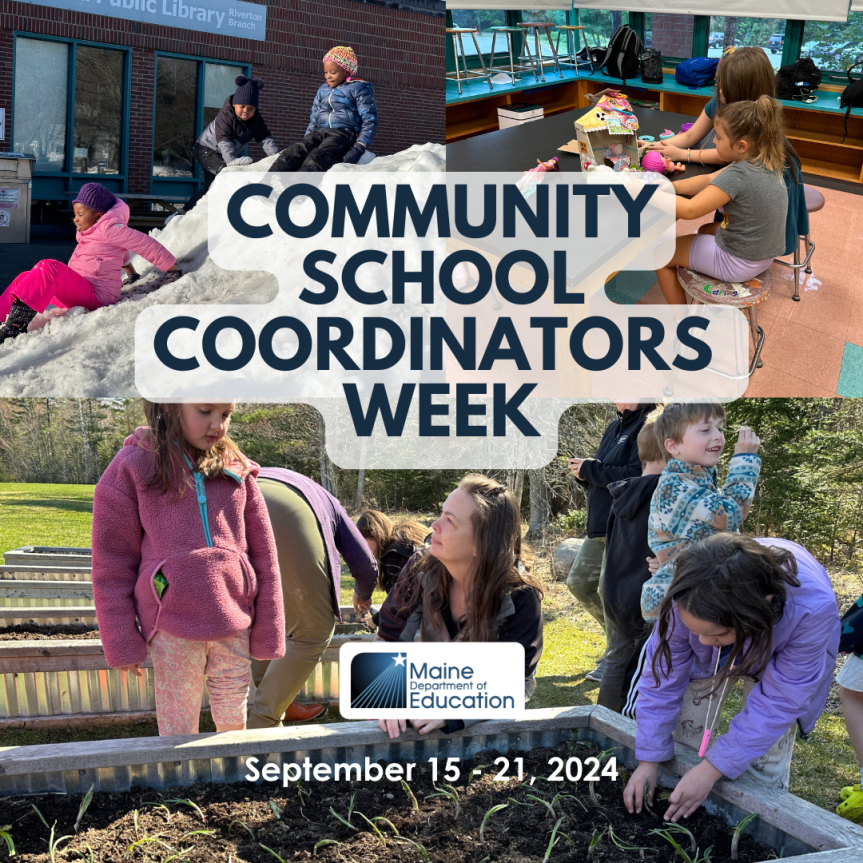






 Maine DOE Newsroom