MLTI (Maine Learning Technology Initiative) would like to encourage students to collaborate and share the creative work taking place in their schools – with that in mind MLTI will be hosting a T-shirt Design Competition.
A panel of judges will choose a winning design. The winning design will be printed on t-shirts that will be worn by everyone at the 19th Annual MLTI Student Conference, which will be held on Thursday, May 26th virtually over Zoom.
MLTI Launches Space2Connect! is the theme for the 19th annual MLTI Student Conference. The intent of the conference theme is to reflect the many interpretations of space and connection as they relate to Maine students and their use of technology. Primary events at the conference will address concepts such as outer space and astronomy and the power of technology to enhance science. In addition, a student’s design might explore how technology connects us in physical and virtual spaces or other concepts that arise from the Space2Connect theme.
For more information or answers to questions, please contact: Brandi Cota, Project Manager, Maine Learning Technology Initiative Brandi.M.Cota@Maine.Gov.
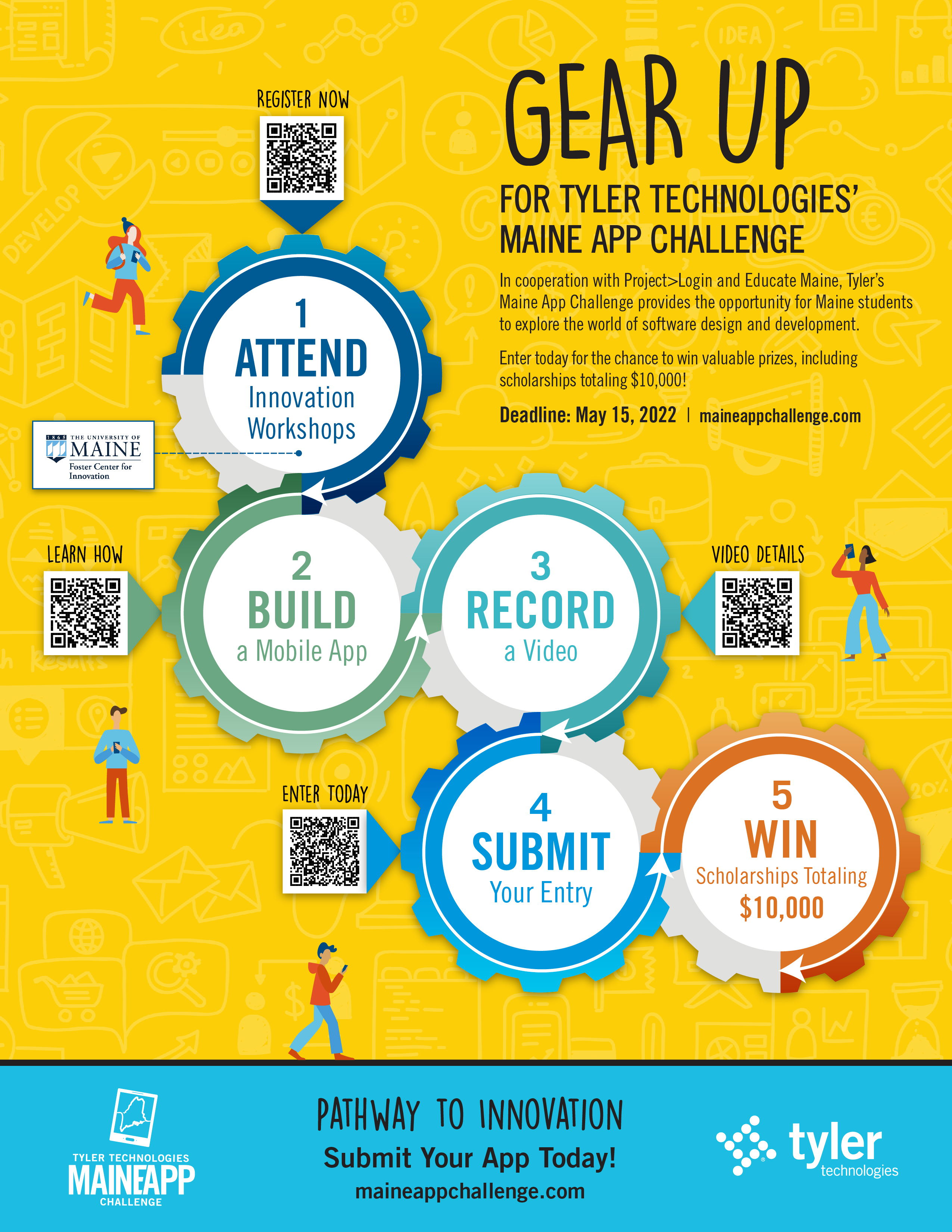
Are you a student who’s interested in app design? Or a teacher looking for ways to get your students more involved with innovative processes? Consider signing up for the Maine App Challenge! Since 2015, the Maine App Challenge has provided Maine students with the opportunity to delve into the technology sector of app design and development. The Maine App Challenge is open to middle and high school students age 13+. Submissions give students a chance to win scholarships and other prizes.
To help support the development of the skills needed to be successful, The Maine App Challenge is offering free innovation workshops through the University of Maine’s Foster Center for Innovation.
The Maine App Challenge is accepting submissions now through May 15, 2022.
are located in one (or more) of the following counties where no awards were made in the first application round: Sagadahoc, York, Piscataquis, Aroostook, Somerset, Washington, Oxford, Waldo, Knox, Lincoln, Androscoggin, Franklin, and Kennebec.
do not currently offer computer science learning opportunities;
serve socioeconomically disadvantaged school districts;
prioritize student populations traditionally underrepresented in computer science;
demonstrate a commitment to pursuing high-quality educator professional development that emphasizes integration of computer science into other course work and curricula or establishes or expands access to courses that offer college credit and other certificates of value, or both; and
collaborate or partner with other entities, including but not limited to other local education agencies, the business community, nonprofit organizations and private entities.
The fall application window opens Friday, January 28th, 2022 and closes February 11th, 2022. Applications will be reviewed in the order in which they are received. All applicants will be notified of their application status within two weeks of the application deadline.
There is no limit to the grant amount awarded per applicant; however, funds will be dispersed equitably across all applications based on county and throughout PK-12.
Have questions? Want to learn more? We are hosting three informational sessions, January 31st, February 2nd, and February 8th.
In celebration of CSEd week and another successful year championing computer science education in Maine, we asked teachers and students to share their experiences with us. Click on the video to hear what they had to say! #MaineTeachesCS
Interested in learning more about computer science education in Maine? Want to get involved? Check out our website to explore ways that Maine is expanding access to and participation in computer science education. For more information, contact Emma-Marie Banks, Computer Science Specialist at emma-marie.banks@maine.gov.
Next week (Dec. 6th-12th) is National Computer Science Education Week. To help teachers and parents get prepared, we’ve put together an infographic with some great ways to get students involved in CSEdWeek events, activities, and initiatives. We are encouraging all schools in Maine to participate in CSEdWeek. Be on the lookout next week for additional resources, events, and updates each day and don’t forget to share the awesome work you are doing to support Maine students in learning computer science! @mdoenews #CSEdWeek #CSEverywhere #MaineTeachesCS.
Click on the infographic to learn more and to explore ways to get involved during CSEdWeek.
For more information on computer science education, contact Emma-Marie Banks at Emma-Marie.Banks@maine.gov.
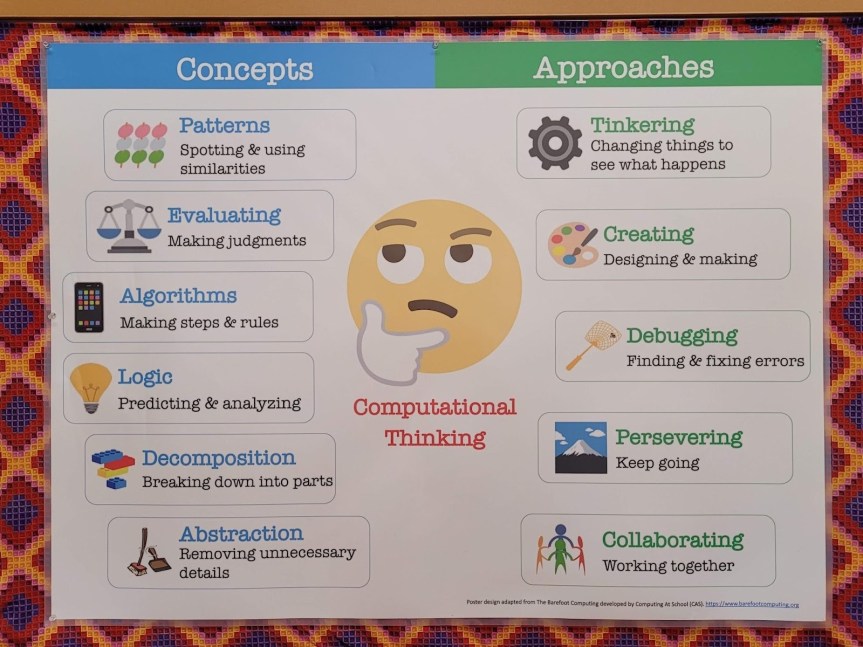
Pictured: Poster in Mr. Kumpa’s room connecting computer science tasks to classroom concepts.
Computer science isn’t so scary, just ask Bob Kumpa’s 8th-grade science students at Brewer Community School in Central Maine. As a precursor to a physics unit, students integrated computer science skills into class by programming an Edison Bot to navigate a maze of their creation.
Students drew any design they desired on a poster with the expectation that they would then program an Edison Bot to navigate through the design. Mr. Kumpa also required the Bot perform actions like going in reverse, spinning, and turning. There was no lack of creativity as students designed themed tracks such as Chutes and Ladders, Super Mario, trick-or-treating, passing on a soccer pitch and even one where the Bot travels the digestive system.
Students Julia Spencer (left) and Delaney McDonough (right) draft out their ice cream maze
Student designs a Mario themed maze
Student designs a Chutes and Ladders’ theme
A finished product of a Candyland themed maze
Eighth grader, Julia Rall, who also programmed her Bot to perform the Star Wars theme song, says the creativity aspect is her favorite. She wasn’t intimidated about the computer science, saying, “I feel like we’ve made it pretty easy. It’s just a lot of kinks that you have to work out.”
Students programmed their Bot either with Block or Python coding included in the program EdScratch. To navigate their design, some students elected to conduct the trial and error method, or, like project partners Julia Spencer and Delaney McDonough, some attempted to precisely measure out the distance and angles ahead of time. Delaney said that she and Julia felt that was the best way to do it because “that way we didn’t have to [unnecessarily] keep doing it over and over again.”
Kumpa told us the experience of perseverance via debugging does not happen by chance, but rather was one of the fundamental parts of the activity. It is those types of skills he hopes will translate to other sciences and other subjects, which is the main reason why he used the Edison Bots in the first place.
The Bots were supplied in 2018 from a grant through the Research in STEM Education (RiSE Center) at the University of Maine, in conjunction with their Maine STEM Partnership division, for a three-year study looking at the impact of computer science. Kumpa, who has done extensive work with the RiSE Center over the past 12 years, described the goal of the study to see if “teaching computer science will improve the learning of other sciences.”
Besides Brewer, there are 18 other schools involved in the study across the state. While Kumpa is focused on connecting computer science to physics, other schools have the option of also integrating computer science into life science or earth science.
Should this study prove fruitful, Kumpa said the hope will be to “allocate dollars towards moving computer science to the younger grades.” Bringing students more exposure to computer science provides not only regular experience with problem solving and critical thinking, but also an opportunity to shake off the intimidating stigma of computer science.
For further information about the Edison Bots or the RiSE Center, please feel free to reach out to Bob Kumpa at rkumpa@breweredu.org.
Monday Dec. 7th kicks off the start of Computer Science Education Week, 2020! Join the computer science community in celebrating computer science in education. Whether you’re new to the world of computer science or have been involved since its inception, you’ll find many interesting events and activities that are ongoing throughout the week.
Computer Science Education Week began in 2009 to encourage and increase participation and offerings of computer science in education. CS Education Week’s 2020 focus is social justice. To learn more about computer science in education, and social justice in computer science education, check out the Computer Science Education Week website and explore the #CSEdWeek2020 and the #CSforSocialJustice hashtags on social media.
Events & Activities
The CS Education Week kick off happens Monday, Dec. 7th at 1p.m. ET. After that, there are various events hosted throughout the week. For more information about the schedule of events and to register, check out the #CSEdWeek events page.
Follow @mdoenews on Twitter and Maine Department of Education on Facebook for #CSEdWeek posts throughout the week.
Use the #CSEdWeek and #CSforSocialJustice hashtags to share and engage with the computer science community.
Check out the #CSEdWeek2020Photos challenge on social media to see what teachers are doing in their classrooms during #CSEdWeek2020.
Interested in learning more about CS in Education? Check out #CSforAll #CSforGood #CS4Maine #ComputerScience
For more information contact Emma-Marie Banks, Secondary Digital Learning & Computer Science Specialist for the Maine Department of Education at emma-marie.banks@maine.gov.
Resilient even amidst a pandemic, the computer science education community is continuing to grow and expand computer science opportunities throughout Maine. Many partners including the Maine Computer Science Teachers Association (CSTA), Maine Department of Education, Maine Mathematics and Science Alliance (MMSA), Educate Maine, and others are working together to make sure that computer science education is available to Maine students throughout the state. Check out these upcoming computer science learning opportunities for students and educators below!
Virtual Family Code Nights
Date/Time: Various Dates, November 2nd through December 9th
In the past three years, more than 100 Maine schools and community organizations have hosted Family Code Nights. These events have brought together nearly 3,000 children and parents to learn how to code side-by-side. Now, the makers of Family Code Night have started a program called CS is Elementary.
It’s simple and free for Maine elementary schools to get involved. Visit Maine Mathematics and Science Alliance’s Family Code Night Host site to learn more – https://mmsa.org/familycodenight/
CS Connected
Date/Time: Wednesdays, 12pm
A weekly virtual series for college students, produced by Project>Login & UMaine’s School of Computing and Information Sciences. Check out CS Connected on Eventbrite to register for upcoming sessions.
CS Educator Happy Hour
Date/Time: Thursdays, 5pm
Are you teaching computer science or interested in doing so in the future? Join a virtual Zoom gathering of the Maine Computer Science educator community to engage in themed informal interactions. Email angela@educatemaine.org for the link to join!
CodeHS
Date/Time: November 12th, 4:30pm
Join a one-hour workshop for middle school teachers on JavaScript using Intro to Programming with Karel the Dog.
Would you like to see your computer science events and news listed in a computer science release? Are you doing something new and exciting with computer science that you want to share with the rest of the community? Reach out to Emma-Marie Banks, Computer Science Specialist at the Maine Department of Education. emma-marie.banks@maine.gov
Next week, children and their parents will come together to learn how to code. It’s Computer Science Education Week (December 4-8), and 75 sites across Maine will host Family Code Nights. Specially designed for elementary-aged students, these events use Hour of Code puzzles that introduce programming principles through fun games.
While many schools do Hour of Code, Scratch, and other web-based computer science activities, Family Code Night is unique. It was started in the San Francisco Bay area by a parent of an elementary student. He saw the importance of involving parents in the activities because they can advocate for their children to continue learning to code after the event is done. Maine has many opportunities for youth to explore coding, including summer camps, app challenges and family events. You can find them on the STEM Resource Bank at steminme.org.
Volunteers at Family Code Nights include teachers, librarians, parents and other community members. Many sites are enlisting the help of teens who have experience with coding. Family Code Night provides an event kit that includes everything needed to plan and host the event, so leaders do not need to be experts at coding to run a successful evening!
Family Code Night is a national movement supported in Maine by The Reach Center, a program of Maine Mathematics & Science Alliance. Visit mmsa.org/familycodenight to see a list of sites hosting events, which includes schools, libraries or community organizations representing each county.
For more information contact Maine Department of Education Science and Technology Content Specialist, Shari Templeton at Shari.Templeton@maine.gov or (207) 624-6880.
The awareness initiative will involve thousands of Maine students, trying their hand at computer programming and competing in robotics competitions
AUGUSTA – Maine Governor Paul R. LePage and Acting Education Commissioner Jim Rier are recognizing the important role computer science has in the state’s classrooms and growing economy.