Pre-K for ME, K for ME, and 1st Grade for ME Program Overviews and Summer Training Opportunities

Since 2018, the Maine Department of Education (DOE) has adapted and piloted open-source Pre-k and Kindergarten instructional programs based on the Boston Public School’s evidence-based Focus on K1 and Focus on K2 curricula.  Pre-K for ME was launched in 2019.  K for ME was launched in 2021.  1st Grade for ME is being piloted in Maine classrooms this year and will be made available for the 2023-2024 school year. These programs focus on the whole child, are interdisciplinary, and are developmentally appropriate.  They are also aligned to Maine’s learning standards.  While Maine schools are responsible for the purchase of the materials that support use of the programs, the programs can be accessed at no cost via the Maine DOE’s website. 

Informational overviews of each of program will be provided in the coming weeks.  The overview sessions will be recorded and posted for anyone unable to attend the live sessions. The overview sessions will share the basic program structure and review the materials needed to implement the program.  If unfamiliar with the programs, attending the overview (or watching the recording) is highly recommended. 

Overview Session Registration Links: 

Educators/schools/programs interested in utilizing Pre-K for ME, K for ME and/or 1st Grade for ME in the coming year may take advantage of 2-day initial trainings scheduled for this summer.  These trainings are provided at no cost to promote understanding of program design and to support successful program implementation.  School administrators are strongly encouraged to attend the trainings with their Pre-K, Kindergarten and/or first grade teachers.  Special educators, education technicians, and instructional coaches/curriculum leaders who work with pre-k, kindergarten and first grade teachers are also encouraged to attend. 

This year’s training opportunities will be held in person from 8:30 a.m. to 3:30 p.m. during the week of July 31st-August 4th. The locations and break down of dates for the specific programs are being finalized and will be available soon. For teachers learning the K for ME and 1st Grade for ME programs, an additional training day will occur on June 28 from 8:30-3:30 (location TBD).  Registration for these trainings should be completed by principals/educators with one registration on behalf of their school/program.  Details about how to prepare for the trainings and the training locations will be provided via email after registrations are received. Registrations for the 2-day training for each instructional program should be received by May 26, 2023. 

Summer Training Registration Links: 

For additional information about Pre-K for ME, contact Nicole.Madore@maine.gov, and for K for ME and 1st Grade for ME, contact Leeann.Larsen@maine.gov. 


Transition to Kindergarten Train the Trainer Opportunity 

The Maine Department of Education’s Early Learning Team is happy to announce the next step in the Transition to Kindergarten training series.  In 2022, the Transition to Kindergarten module series and facilitator guide focused on building community-wide understanding of kindergarten readiness and the impact of high-quality transition practices on children, families, schools, and communities was released.  This 4-part series, as well as several other useful resources related to kindergarten transitions, can be found on the Transitioning to Kindergarten webpages 

The next installment in the Transitions to Kindergarten series is a Train the Trainer opportunity built to support and guide individuals who can facilitate community-based kindergarten transition teams to use the tools and activities within the Transition to Kindergarten module series.  The goal of the series modules is to build understanding and implementation of high-quality, year-round transition practices for all stakeholders to ensure children’s successful transition into their Kindergarten year.   

If you, or someone you know, could benefit from participating in this training which will prepare participants to guide communities in forming Kindergarten transition teams and transitions plans, please register for this exciting and free two-session training. 

  • Session #1 will be held on Wednesday, March 15, 2023, from 2:00 p.m. to 4:00 pm. 
  • Session #2 will be held on Tuesday, March 21, 2023, from 2:00 p.m. to 4:00 p.m. 
  • Once you register, a link will be sent to your email; this will be the same link for both sessions 

Click here to Register for both sessions. 

For more information and any questions, please reach to Marcy Whitcomb, Public Pre-K Consultant at Marcy.r.whitcomb@maine.gov. 


Education Commissioner Pender Makin Kicks Off Annual Read to ME Challenge by Reading to Sanford Pre-K Students 

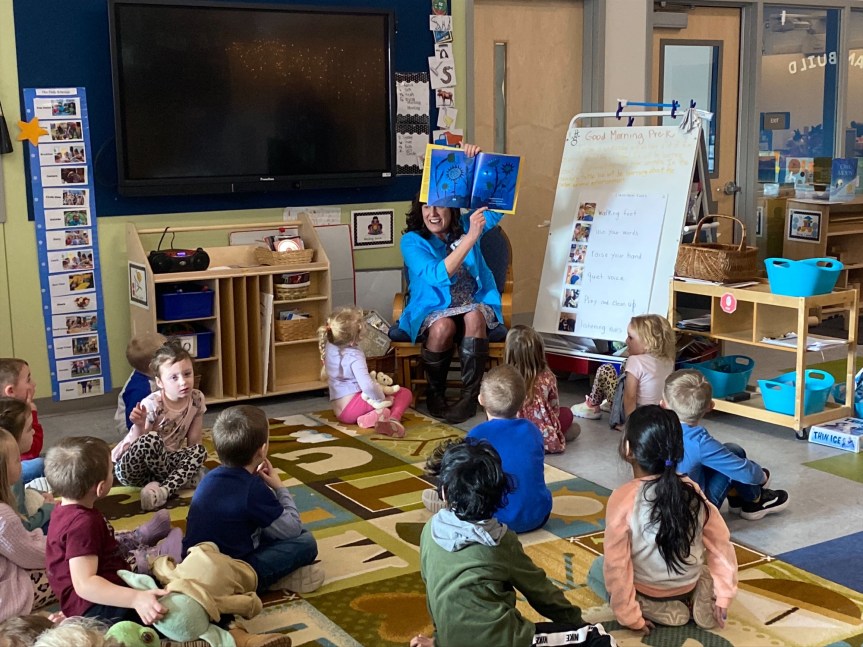
Maine Education Commissioner Pender Makin kicked off the state’s Read to ME Challenge at Sanford Regional Technical Center by reading If Only… to a group of spirited pre-k students. This is the eighth year that the Maine Department of Education is collaborating with schools, parents and communities on this month-long public awareness campaign to promote the importance of literacy for all of Maine’s students, regardless of age. You can watch video of Makin kicking off the challenge here.

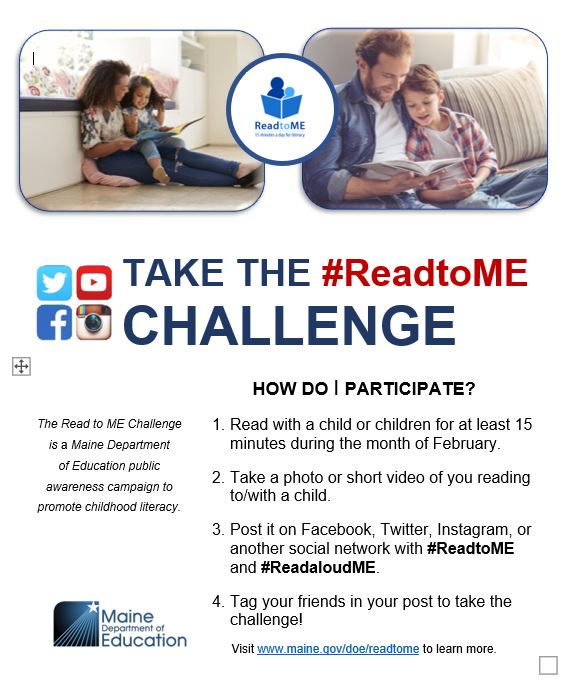
The Read to ME Challenge encourages adults to read to children for 15 minutes, capture that moment via a photo or a video, and then post it to social media and challenge others to do the same using the hashtag #ReadtoME.

Makin also spent time talking with students who are part of Sanford Regional Technical Center’s early childhood education program. Students in the program split their time between their own classroom and interacting with children in the pre-k classroom. Sanford was also able to expand to full day pre-k this year after receiving a grant through the Maine Jobs and Recovery Plan.

“The Read to ME Challenge is about creating a love of reading with children and promoting literacy across our state—and it’s fun,” said Maine Education Commissioner Pender Makin. “Not only did I get to read to an amazing group of pre-k students today, but I had the wonderful opportunity to talk with high school students who are working hard to become future educators through this amazing early childhood education program at Sanford Regional Technical Center.”

The simple act of reading aloud to a child 15 minutes a day for five years results in 27,375 minutes of language exposure, which can put children on the path to high literacy achievement and helps them build knowledge and vocabulary. Research demonstrates a number of benefits to reading to children, from birth through their childhoods and even teenage years, including modeling reading as an enjoyable lifelong activity, stimulating brain development, reducing stress and anxiety, building knowledge of the world, and helping develop the skills necessary to succeed in their lives.

Schools and community organizations can find a toolkit and resources on the Department of Education website and the Department will be sharing videos, photos, and updates from the challenge all month long on social media.

Participants in the challenge are reminded to use the hashtag #ReadtoME and to tag the Maine DOE at @mdoenews on Twitter, @MaineDepartmentofEducation1 on Facebook, and @mainedepted on Instagram.

See who Commissioner Makin Challenged!

Seeking Writing Teams and Targeted Reviewers for Update of the Maine Early Learning and Development Standards

The Maine Early Learning and Development Standards (MELDS) are the state’s learning standards for children ages three-five. Building from the Infant Toddler MELDS (IT MELDS) and bridging developmental expectations to the Maine Learning Results (MLRs), the MELDS inform all early childhood professionals about the typically developing expectations of young children as well as curriculum and assessment practices.

The MELDS Steering Committee is now accepting applications from individuals interested in being part of the review process to serve as participants on one of the writing teams, or as a targeted reviewer.  The Steering Committee is seeking professionals in the field of Early Care and Education that work or have worked with or on behalf of children. Prospective participants must apply  no later than February 21, 2023.

To understand the details of participation, please read the following Frequently Asked Questions (FAQ):

Q: What are the Maine Early Learning Development Standards (MELDS)?

A: Early Learning and Development Standards describe the concepts and skills children develop and learn along the developmental continuum from birth to kindergarten entry. Their purpose is to support the development and well-being of young children and to foster their learning.

The standards promote the understanding of early learning and development, provide a comprehensive and coherent set of early childhood educational expectations for children’s development and learning, and guide the design and implementation of curriculum, assessment, and instructional practices with young children.

Maine’s Early Learning and Development Standards (MELDS) serve as a guide for state and local early childhood educators’ efforts to improve practice and programs for young children during their preschool years.  The Infant/Toddler MELDS is a companion tool for ages birth-36 months.

Q: Who should consider participating?

A: In order to develop an evidence-based set of standards, we are seeking a diverse population of professionals from the Early Care and Education (ECE) field:

  • Child Care and School Administrators
  • Child Care Health Consultants
  • Child Care Providers and staff of all licensed programs (family, small facility, facility, nursery school, out of school time programs)
  • Child Care Providers and staff from licensed exempt programs
  • Early educators within the school setting (Pre-K through 3rd grade)
  • Ed Techs
  • English to Speakers of Other Languages (ESOL) Professionals
  • Head Start staff
  • Higher education professionals and their students within or specializing in the ECE/ECS field
  • Individuals that provide professional development to the Early Care and Education field
  • Parents, Guardians, Caregivers, or Family Members
  • Special Education Teachers / Specialists
  • Student and School Support Specialists: Speech, Occupational and Physical Therapists, School Counselors, School Social Workers, Interventionists, Title I staff
  • Other professionals serving families of young children

Q: What are writing teams and what is the time commitment?

A: Each of the domains of development will need a team of professionals to review content for relevance and alignment to current research in order for the MELDS to provide early childhood educators with guidance as they design inclusive environments, shape curriculum, lead professional development initiatives, build intentionality into teaching practice, engage families, and support children’s learning at home.  The domains include:

  • Social and Emotional Development
    • Goal Areas: Trust and emotional security, self-regulation; sense of self, self-awareness, and self-concept, relationships with adults, relationships with children
  • Approaches to Learning
    • Goal Areas: Engagement and persistence, initiative and curiosity, creativity
  • Early Language and Literacy
    • Goal Areas: Language comprehension (receptive language), language expression (Expressive/productive communication), emergent literacy
  • Physical Development and Health
    • Goal Areas: Perceptual development, gross motor (large muscle), fine motor (small muscle), self-help and adaptive skills
  • Cognitive Development
    • Goal Areas: exploration and inquiry, concept development and working memory, reflection and problem-solving, mathematical thinking, scientific reasoning, social studies learning

In addition to the domains of development, there are additional sections of the document that will need review.  Those sections include:

  • Introduction, History, Key Components of Early Learning Standards,
  • Purpose Statement and Potential Users, Guiding Principles and Universal Design for Learning
  • Introduction to the Stages of Development Ages 3-5

Time Commitment: The facilitator(s) for each writing team will determine the time necessary for both whole group and individual review. Participants should expect this to be no more than two hours per week. Writing teams will convene in March and work through June.

Q: What are targeted reviewers and what is the time commitment?

A:  Targeted reviewers will review the updated sections provided to them and offer structured feedback. Targeted reviewers will begin review once the initial updates have been made to provide feedback to the Steering Committee.

The time commitment will be less for targeted reviewers than writing team participants, however the  window for review and feedback will be shorter and more time sensitive (approximate document turnaround time of two weeks).

Q: What will I earn in exchange for my time and expertise?

A: Not only will individuals be afforded an opportunity to participate in furthering the field of Early Care and Education, but each participant will also be awarded contact hours at the completion of the writing team cycle based on attendance and at the discretion of the team leader.

Contact hours may be used for furthering education, documentation of professional development experiences, or for continuing education credits (CEUs) and/or training hour conversion.

Q: Why is periodic updating of learning and development standards important?

A: Research in the field of early care and education is constantly evolving.  A regular process of updating early learning and development standards helps to ensure their validity and alignment with other sets of standards across the birth to grade 12 spans.  The updated MELDS will result in a child-centered tool that will inform program development, instruction, assessment, policy decisions, and professional learning for early care and education efforts across Maine.

Q: What is the overall timeline for the MELDS revision?

A: MELDS revision began in the Fall of 2022 with the creation of the Steering Committee. This group has been meeting regularly to discuss the current format of Maine’s MELDS as well as to review feedback from the field, other states’ Early Learning and Development Standards and national research trends/findings. The remaining work is set to unfold on the following timeline:

  • January-February 2023: Recruit writing team members and targeted reviewers
  • February 2023: Assign Steering Committee members and teams to review the current standards
  • March-June 2023: Teams will work to review terminology, assure alignment to Maine’s Infant/Toddler MELDS and to the Maine Learning Results, and review for readability, diversity, inclusion and ease of use
  • July-August 2023: A final version will be translated and introduced to the field for further use

Thank you for time and consideration. If you have any questions, please contact the Department of Education’s Early Childhood Specialist, Nicole.Madore@maine.gov or the Office of Child and Family Services First4ME Program Manager, Megan.Swanson@maine.gov

Read to ME Challenge Kicks Off This Week

The Maine Department of Education (DOE) is pleased to announce that Commissioner Pender Makin will kick off the 8th annual Read to ME Challenge on Wednesday, February 1, 2023. You can watch a live stream of the event on the Maine DOE YouTube Channel.

The Read to ME Challenge is a month-long public awareness campaign held in February to promote childhood literacy in Maine. The challenge is an opportunity to promote children’s literacy growth by reading aloud to one or more children for at least 15 minutes. Part of the challenge is capturing the moment via a photo or video and then posting it on social media (with the hashtag #ReadtoME and tag the Maine DOE at @mdoenews on Twitter and @MaineDepartmentofEducation1 on Facebook! Keep watching the Maine DOE social media sites to see who has accepted the challenge of sharing the joy of reading with a child.

The Read to ME Challenge will run for the month of February, leading up to Read Across America Day on March 2, 2023. Learn more about the Read to ME Challenge on the Maine DOE Website. If you have a school or community organization that plans on participating in this challenge, please let us know by signing up at this link.

Download a promotional flyer here (PDF).

For more information, contact Dee Saucier (danielle.m.saucier@maine.gov), Inclusive Education Literacy Specialist for the Maine DOE Office of Special Services and Inclusive Education.

Third Round of Grant Funds Available to Support the Expansion of Public Pre-Ks 

As part of the Maine Jobs and Recovery Plan, Governor Mills allocated $10 million of the federal American Rescue Plan Act (ARPA) funds appropriated for Maine for public pre-k infrastructure to increase the number of 4-year-olds enrolled in public pre-k across the state. For 2022-24 school years, 28 School Administrative Units (SAUs) were awarded funding to expand or start new Pre-K programs.

The Maine DOE is excited to add an additional round of public pre-k expansion funding for school year 2023-24.

Currently, public Pre-K in Maine is not universally available for all 4-year-olds. While the cognitive and social-emotional benefits of high-quality pre-k are well documented, there are a variety of factors that contribute to the ability of SAUs to offer public pre-k and the extent to which they can enroll all eligible 4-year-olds from interested families. This funding will help expand pre-k opportunities across Maine.

Maine SAUs interested in starting or expanding public pre-k are encouraged to apply for funding through the Pre-K Expansion Request for Applications (RFA). SAUs will be able to use the funding, in combination with Essential Programs and Services allocations, to start new pre-k programs, add additional pre-k classrooms to already existing programming, and/or expand existing programs from part-day/part-week to full-day/full-week programs. Funding may also support public pre-k programming through partnerships between SAUs and community providers.

A timeline for the RFA process is provided below.

  • January 5, 2023–RFA released
  • January 20, 2023—RFA submission deadline

All questions about the Pre-K Expansion RFA should be submitted to the Pre-K Expansion Grant Coordinator identified on the Grant RFPs and RFAs webpage.

Additional questions regarding this announcement should be directed to:
Pre-K RFA Coordinator, jane.kirsling@maine.gov.

Celebrating Playful Learning in Pre-K Expansion Classrooms

Laughter and rich conversations fill the air as teachers join students in purposeful play in Pre-K Expansion Grant classrooms across the State. Play based learning promotes engagement, curiosity and creativity.  When teachers join children in their play they can scaffold learning opportunities, model language, introduce complex vocabulary and prompt deeper thinking through effective questioning.  Play provides an opportunity for social learning and the development of executive functioning skills.  In play, both the heart and the mind of the child are nurtured, reducing behavioral issues and supporting wellbeing while building the skills they need to be successful in school and beyond.

Pre-K children engage in a variety of different types of play in centers or interest areas in their classroom.  Real-life imaginary play is incorporated into the dramatic play and building areas in Appleton’s new Pre-K classroom.  This type of play allows children to think beyond the confines of their classroom and use their imaginations as they explore ways to use the materials they have to represent what they see in their minds. This type of play not only fosters creativity, but it also lays the foundation for symbolic representation with letters and numerals.

Creativity and problem solving are integral parts of play in the art area.  Children in the Greenville Pre-K classroom use art materials to express themselves and create projects based on a story their teacher has read to them.  Concepts of color, shape, texture, and position are built through conversations about their work.     Teachers support children in developing important problem-solving skills when they join children in their play, and help to build growth mindsets by letting children try out their own ideas, and by encouraging them to try again if they are not successful.

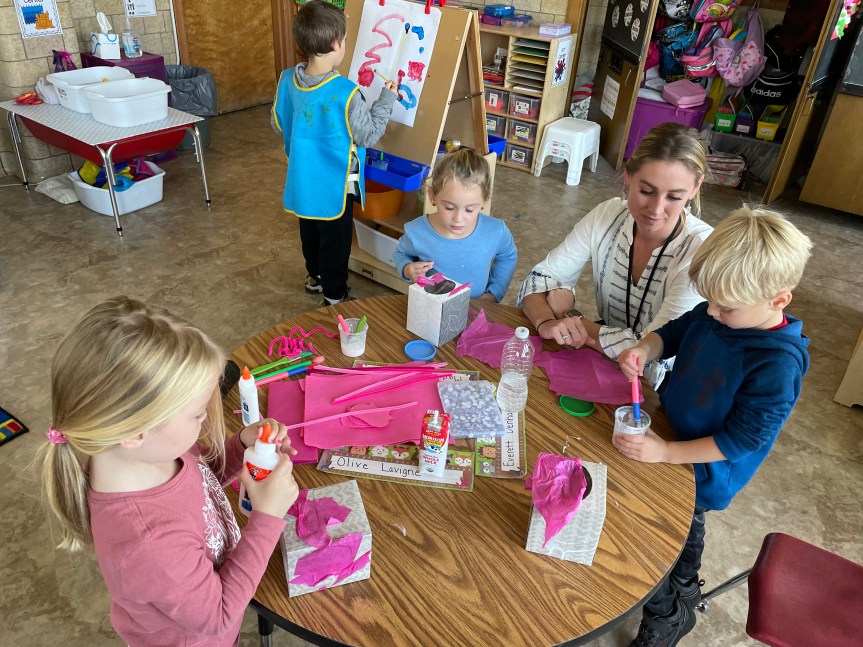
Education Technician, Erin Denham, supports Pre-K children as they problem solve how to attach the curly pipe cleaner tails to their pig pinata.

Teachers do a lot of work behind the scenes to make play purposeful.  They carefully plan centers and other learning activities around central themes and make intentional connections between the activities to help children see the purpose in what they are doing.  While there is always a place for intentional instruction, Pre-K teachers work to bring playful elements to their lessons.

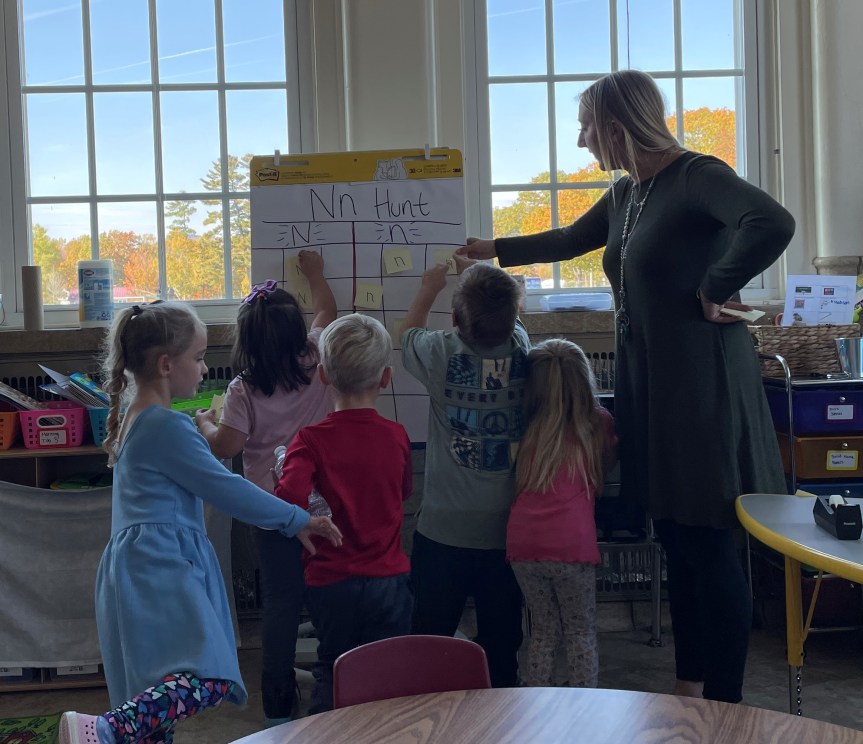
Greenville teacher, Allison Boulier, builds letter identification skills by having her class go on a letter hunt.
Teacher, Monica Jodrey from Cave Hill School in RSU 24 integrated science, math, fine motor and language development into a pumpkin exploration that kept her whole class engaged for the afternoon

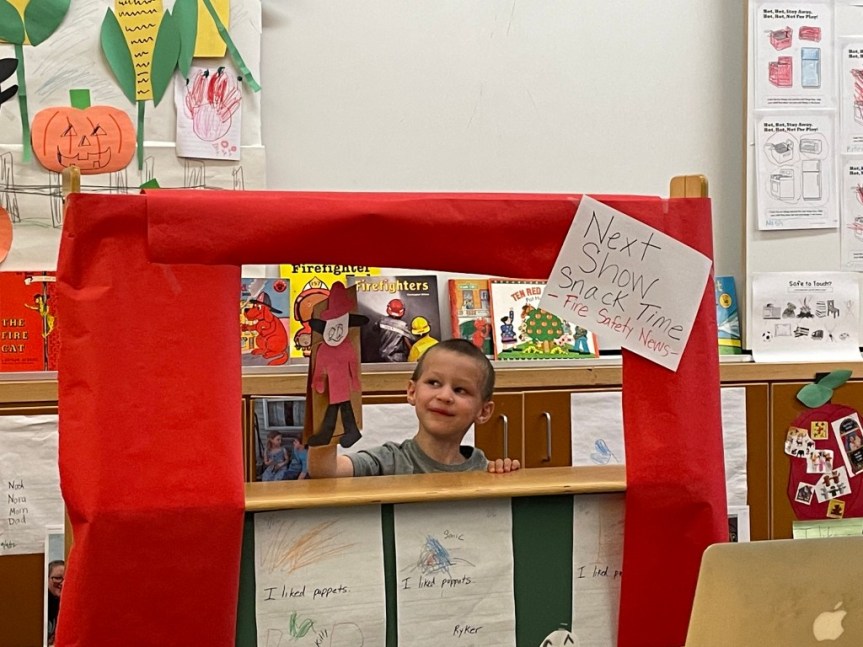
Pre-K classrooms are busy places.  Play affords the opportunity to support learning across all domains and can even make “down time” a productive learning opportunity.  Pre-K teacher, Marion Freehill, from Peninsula School in RSU 24, captured the enthusiasm her class had for their fire fighter puppets.  You can also see the work her students have created to reflect on their play during centers time.  Capturing their thoughts in writing helps them to see their ideas as important and is the first stage in them seeing themselves as writers.

Pre-K students enjoy putting on a puppet show at snack time each day.

If you wonder about the value of children spending most of their day playing in our Pre-k classrooms, don’t worry!  In the words of Maria Montessori, “Play is the work of the child”.  Even the American Academy of Pediatrics agrees.  In 2018 they released a clinical report advising that doctors write prescriptions for play.  In the report they said, “Play is not frivolous; it is brain building” and lauded play as being fundamentally important to learning problem solving, collaboration and creativity.   But perhaps Lenore Skenazy, president of the non-profit Let Grow which promotes childhood independence and resiliency, put it best, “Play turns out to be so stunningly essential to childhood it’s like love, sunshine and broccoli all juiced together”.

The classrooms included in this article are all beneficiaries of the Maine Jobs and Recovery Plan’s Pre-K Expansion Grant.  The grant supports districts beginning new Pre-K classrooms or expanding the hours or number of days they serve students in existing programs.  Ten districts across the state were recipients in the first round of grants.  Round two awards will be announced soon.

If you have questions or would like more information about Public Pre-K, the Pre-K Expansion Grant or the importance of play in early education, please contact Sue Gallant Maine DOE Pre-K Expansion Consultant at Sue.Gallant@maine.gov and/or Nicole Madore Maine DOE Early Childhood Specialist at Nicole.Madore@maine.gov.

Public Pre-K and Partnership Open Office Hours Scheduled

The Maine Department of Education (DOE) Early Learning Team is pleased to offer Open Office Hours focusing on technical assistance for public pre-k.  These office hours will feature Marcy Whitcomb, Public Pre-K Consultant and Sue Gallant, Public Pre-K Expansion Consultant.

Sessions are meant to be a time for educators, pre-k coordinators and administrators to come together to ask questions, celebrate successes and/or work through problems of practice in public pre-k that educators, administrators, and partnership programs may be experiencing. Office hours are offered as part of the Maine DOE’s Pre-K Technical Assistance program and are meant for your use and discussion; you can join for the full hour, or just a part; for each session or only when you have a question.

Sessions after the first session will not be predetermined but will be an open conversation driven by the topics brought from the field.  Our first session will focus on celebrations and problems of practice from the first months in the classroom.

Sessions will be held every first and third Thursday of the month, from 3:00 to 4:00 p.m., on the following schedule:

November 17th
December 1st 15th
January 5th 19th
February 2nd 16th
March 2nd 16th
April 6th 20th
May 4th 18th
June 1st 15th

Please use and save the following Zoom link and password to access each meeting (the meeting link will be the same for each office hour session):

Join Zoom Meeting
https://mainestate.zoom.us/j/82733636260?pwd=VUd5eklsaHRIaEEzeldhazJDSWw2dz09

Meeting ID: 827 3363 6260
Passcode: MePreK22!
One tap mobile
+13017158592,,82733636260# US (Washington DC)
+13092053325,,82733636260# US

To submit a topic or question prior to a session and for more information please email Marcy Whitcomb, Public Pre-K Consultant, at: Marcy.r.whitcomb@maine.gov


Update of the Maine Early Learning and Development Standards

The Maine Early Learning and Development Standards (MELDS) are the state’s learning standards for children ages three-five. Building from the Infant Toddler MELDS (IT MELDS) and bridging developmental expectations to the Maine Learning Results (MLRs), the MELDS inform all early childhood professionals about the typically developing expectations of young children as well as curriculum and assessment practices.

Over the past few years, the IT MELDS and MLRs have been updated. In order to ensure alignment across the sets of standards, it is time to update the MELDS which were last updated in 2015.

To guide the update process, a steering committee of early childhood professionals from around Maine has been formed and is interested in collecting feedback about the current version of the MELDS.   All interested early care and education stakeholders (e.g., childcare providers, parents, teachers, ed techs, administrators) are encouraged to complete this feedback survey no later than November 6, 2022. Input will inform the next steps in the updating process.

In he new year, early care and education stakeholders will be encouraged to consider contributing their expertise to writing teams that will assist with the updating process.  The goal is to have the MELDS update completed by July 2023.

If you have any questions, please contact the Department of Education’s Early Childhood Specialist, Nicole.Madore@maine.gov or the Office of Child and Family Services Child Care Services Program Manager, Crystal.Arbour@maine.gov


Things Are Falling Into Place In Public Pre-K Expansion Classrooms

Autumn has arrived bringing crisp air and beautiful foliage.  As the colorful leaves drift down, things are falling into place in Pre-K expansion classrooms across ten Maine school districts.  This fall 17 new classrooms opened and five others moved from part day to full day programming through a grant offered by the Maine Department of Education.   Funded through the Maine Jobs and Recovery Plan, the grant expands access to high-quality Pre-K programming and provides relief to families struggling to find childcare.

Grant funds have supported districts with renovating spaces, purchasing furniture and materials to create engaging learning spaces, meeting transportation needs, and ensuring a skilled workforce to serve Pre-K students.  Over the past few months, teachers and administrators have been busy attending training, setting up classrooms, meeting families and working with partner agencies to ensure a smooth start to the school year.  The little faces below show that their hard work has more than paid off.

Students at Newburgh Center in RSU 22 enjoy playful learning during Centers time.  RSU 22 has relocated their Newburg and Winterport classrooms to the Newburg Center, expanded to full day, full week programming and added a third classroom to expand access in their community.

Abraham Lincoln School in Bangor has expanded their pre-k from part day to full day in a beautiful space set up to spark the imaginations of young learners.

Downeast School in Bangor

Downeast School in Bangor has expanded to a full day program and has added a new classroom as well.  Here the teachers join students to support learning through play.

Students build their language skills through story time and conversations around the table during meals in Limestone’s new pre-k classroom.   Limestone collaborates with Aroostook County Community Action Head Start to provide rich learning opportunities and comprehensive services to students and families in their program.

The Maine DOE is pleased to announce a second round of public pre-k expansion grant funding available for the 2023-24 school year.  The submission deadline is rapidly approaching (October 14, 2022). To learn more please visit the Pre-K Expansion Grants page of the Maine DOE website.

For more information, contact Sue Gallant, Pre-K Expansion Consultant (Sue.Gallant@maine.gov) or Nicole Madore, Early Childhood Specialist (Nicole.Madore@maine.gov).