This year’s annual statewide Early Childhood Education Conference, Connecting Early Childhood Education; Birth through Eight Across the State has been organized through a collaboration of early learning partners, including the Maine Department of Education (DOE). The conference will be held on October 28th and 29th at the Cross Center in Bangor.
Breakout sessions for Pre-Kindergarten through 3rd grade educators will include a wide range of topics that focus on trauma informed practices as well as practical tools for supporting diversity, equity, inclusion and belonging to foster communities. Other sessions will offer support on social-emotional learning through literacy and language, mindful leadership, building bridges with child care programs to ease the transition to Kindergarten, the power of play, early intervention for dyslexia, math for all learners and engaging with families. Speakers and presenters will focus on best practices in early learning for all those working with children from birth through early elementary years.
Information about sponsorship and/or exhibitor opportunities can be accessed here.
Come for one day or come for both! Cost of attendance is $100.00 per person per day and will include a continental breakfast, lunch, a keynote address each day, over 50 breakout sessions from which to choose, an exhibitor hall, networking opportunities and chances to connect with peers.
Click on the green button that says Tickets and a pop-up window will open.
This registration process will secure you a ticket to one or two days of the 2022 Statewide ECE Conference. Participants will select breakout sessions for the conference at a later date.
Please contact the Maine Association for the Education of Young Children with any questions or concerns related to registration by emailing info@maineaeyc.org or by calling 207-747-2490.
For other questions, contact Maine DOE’s Early Childhood Specialist, Nicole Madore at nicole.madore@maine.gov.
Applications for the Leading Early Learning Series will be accepted through July 5. School administrators who support the PreK to Grade 3 span are strongly encouraged to explore this dynamic professional learning opportunity.
Leading Early Learning—A Professional Learning Series for Elementary School Administrators
“Participating in the series has helped me to look at the decisions we make about our instructional programming and school community through the lens of early learning and what is developmentally appropriate for our youngest learners.” – Quote from Cohort 1 participant
As Maine elementary schools have added preschool programming and are promoting whole child approaches across the Pre-K -Grade 3 span, elementary principals have requested professional learning to support their work as educational leaders. The Maine Department of Education and several Maine educational organizations (listed below) have collaborated to design an exciting professional learning series to address identified needs and support professional growth. The Leading Early Learning series was piloted with 16 administrators in 2021-22 and we are pleased to announce the second cohort for this series will launch during the 2022-23 school year.
The series will not only provide participants with opportunity to deepen their knowledge of early learning pedagogy and best practices related to supporting students and teachers across Pre-K-3, but it will also provide a professional learning network, opportunity to design a concept for an implementation project, and be supported through facilitated discussions. Participants will engage in a variety of modes of learning, from asynchronous modules to professional learning communities to attendance at a statewide early learning conference.
If this opportunity interests you, please review the details for the series in the informational guide. A link to apply for the series is included in the informational guide. The series will support up to 25 participants. Applications will be received through July 5, 2022. Once spaces are filled, a waiting list will be generated.
For additional information, please contact Lee Anne Larsen, Director of Early Learning at Maine DOE, leeann.larsen@maine.gov.
Leading Early Learning Partner Organizations
Maine Department of Education
Maine Roads to Quality Professional Development Network
Maine Association for the Education of Young Children
UMaine Center for Community Inclusion and Disability Studies
As the school year comes to a close we are happy to announce that the Read to Ride Summer Reading Challenge is once again being supported by the Freemasons of Maine for the 7th year. All students in grades K-8 who complete a summer reading goal of at least 500 minutes are eligible for a school drawing. Each school is then able to submit 2 names of school level winners to be put into a state level drawing for a free bike and helmet. Last year 32 bikes and helmets were awarded to students across the state. If you are interested in registering your school for the challenge please complete this form. For additional resources such as a summer reading passport and parent information please visit the Read to Ride Challenge website.
“Participating in the series has helped me to look at the decisions we make about our instructional programming and school community through the lens of early learning and what is developmentally appropriate for our youngest learners.” – Quote from Cohort 1 participant
As Maine elementary schools have added preschool programming and are promoting whole child approaches across the Pre-K -Grade 3 span, elementary principals have requested professional learning to support their work as educational leaders. The Maine Department of Education and several Maine educational organizations (listed below) have collaborated to design an exciting professional learning series to address identified needs and support professional growth. The Leading Early Learning series was piloted with 16 administrators in 2021-22 and we are pleased to announce the second cohort for this series will launch during the 2022-23 school year.
The series will not only provide participants with opportunity to deepen their knowledge of early learning pedagogy and best practices related to supporting students and teachers across Pre-K-3, but it will also provide a professional learning network, opportunity to design a concept for an implementation project, and be supported through facilitated discussions. Participants will engage in a variety of modes of learning, from asynchronous modules to professional learning communities to attendance at a statewide early learning conference.
If this opportunity interests you, please review the details for the series in the informational guide. A link to apply for the series is included in the informational guide. The series will support up to 25 participants. Applications will be received through July 5, 2022. Once spaces are filled, a waiting list will be generated.
For additional information, please contact Lee Anne Larsen, Director of Early Learning at Maine DOE, leeann.larsen@maine.gov.
Leading Early Learning Partner Organizations
Maine Department of Education
Maine Roads to Quality Professional Development Network
Maine Association for the Education of Young Children
UMaine Center for Community Inclusion and Disability Studies
Interested in starting or expanding public pre-k in your school administrative unit during the 2023-24 school year? If so, the Maine DOE’s Early Learning Team invites you to attend an informational session regarding a Pre-K Expansion Grant opportunity that will be available later this year.
Pre-K Expansion Grant Funding Informational Session Date: June 23, 2022
Time: 2:00pm – 3:00pm Description: To review the grant opportunity and anticipated requirements. Register here
Twelve Maine School Administrative Units (SAUs) were awarded Pre-K Expansion grants totaling $2.2 million for start-up or expansion of pre-k programming during the 2022-23 school year. The Pre-K Expansion grants, authorized through Maine’s Jobs and Recovery Plan (American Rescue Plan Act allocation), provide funds to the Department of Education to support SAUs with start-up activities necessary to establish new or expanded public prekindergarten programs to address the inequities in availability of early education opportunities resulting from the COVID pandemic. Households with young children have been disproportionately impacted by the pandemic. This project directly addresses this harm by supporting schools to overcome barriers that are preventing them from starting and expanding public pre-k and to transition from part-time to full-time programming, thus increasing the number of young children in high-quality prekindergarten. A greater availability of full-time prekindergarten slots will support parents with young children to work and prepare young children for success in kindergarten and beyond.
Round two of pre-K expansion grant funding will be released to applicants in the late summer/early fall of 2022. Funding for this round will amount to approximately seven million dollars for Pre-K expansion in school year 2023-2024. Interested SAUs should monitor the DOE Newsroom as well as the Division of Procurement Services site for release of the next RFA.
Since 2018, the Maine Department of Education has adapted and piloted open-source Pre-k and Kindergarten programs based on the Boston Public School’s evidence-based Focus on K1 and Focus on K2 curricula. Pre-K for ME was launched in 2019. K for ME was launched in 2021. These programs focus on the whole child and are interdisciplinary and developmentally appropriate. They are also aligned to Maine’s learning standards. While Maine schools are responsible for the purchase of the materials that support the programs, the programs can be accessed at no cost via the Maine DOE’s website. Informational overviews for each of the programs available through the following links:
Educators/schools/programs interested in utilizing Pre-K for ME and/or K for ME in the coming year may want to take advantage of 2-day initial trainings scheduled for August 1 and 2, 2022. These trainings are provided to promote understanding of program design and to support successful program implementation. School administrators are strongly encouraged to attend the trainings with their Pre-K and/or Kindergarten teachers. This year’s training opportunities will be held in-person in the Augusta area. Registration for these trainings should be completed at the school/program level. Principals and educators should complete one registration on behalf of their school/program. Details about location of and how to prepare for the trainings and the materials needed to support the programs will be provided via email after registrations are received. Registrations for the 2-day training should be received by June 30, 2022.
As part of the Maine Department of Education’s (DOE) efforts to adapt and offer open-source, interdisciplinary, whole student instructional programming for the early elementary grades, the Maine DOE is considering a pilot to work on adaptation of a grade 1 program during the 2022-23 school year. To date, the Maine DOE has piloted, adapted, and posted the Pre-K for ME and K for ME instructional programs, both of which are based on the Boston Public Schools’ Focus programs. In order to continue providing aligned programming into the early elementary grades, the Maine DOE is interested in piloting Boston’s Focus on First program and working with pilot educators to make adaptations/enhancements specific to Maine.
If you are a grade 1 teacher interested in being part of a pilot, please consult with your building principal and consider attending an overview session on May 2, 2022 from 3:30-4:30 p.m. Details about the Focus on First program, initial planning for a possible pilot during the 2022-23 school year, and the expected responsibilities of school participants and the DOE in the pilot process will be shared. Time for questions will also be provided. If interested, please complete this form and a link to the May 2nd session will be provided as the date approaches. The May 2 session will be recorded and a link to the recording will be shared, so if interested, complete the form even if you are unable to attend.
Please contact Lee Anne Larsen, Early Learning Team Coordinator, at Leeann.Larsen@maine.gov with any questions.
Every year, the National Association for the Education of Young Children (NAEYC) hosts Week of the Young Child. This year the celebration will occur from April 2nd through April 8th. Members of the Early Learning Team at the Department of Education are sharing a video each day highlighting early childhood educators across Maine enhancing high-quality experiences for young children ages birth through eight. Each day’s video is focusing on NAEYC’s theme of the day. Today is Family Friday!
Today’s video highlighting music in early childhood settings can be found here:
You can find the daily videos and resources posted on our Early Childhood Professional Learning and Resources page here.
Thank you to those who have contributed to the videos and photos. We enjoy highlighting your work and sharing your commitment to young children with our colleagues throughout Maine.
Throughout the week, be sure to share additional photos and ideas using #WOYC2022 and #MEWOYC2022.
Any questions regarding the Week of the Young Child can be directed to our Early Childhood Specialist at Nicole.Madore@maine.gov.
As part of the Maine Department of Education’s celebration of the National Association for the Education of Young Children’s Week of the Young Child, Commissioner Pender Makin visited pre-k and kindergarten classrooms at Oxford Elementary School.
The Week of the Young Child provides an opportunity to shine a light on the importance of early learning and to focus attention on the needs of young children, their teachers, families, and communities.
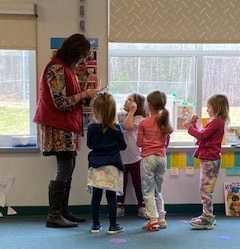
During Makin’s visit, Pre-K students were exploring concepts related to shadows and reflections in centers they could self-select, which included activities such as testing how light can pass through materials, experimenting with materials to see which produce reflections and which do not, and creating pieces of artwork using materials with reflective properties.
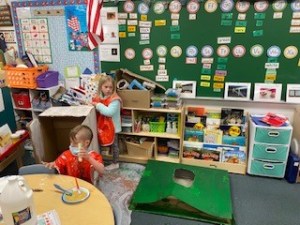
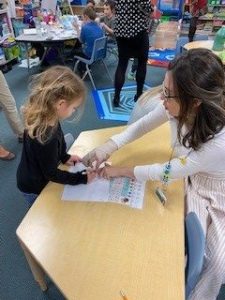
In Kindergarten classrooms, children were engaged in a unit of study focused on construction in which they were reading and discussing books related to the topic, exploring engineering concepts through hands-on activities, and working as a classroom community to design a building project that could benefit their community. In one Kindergarten class, students were designing a hotel for homeless families that included a dog park.
Pre-K and Kindergarten classrooms in the Oxford Hills School System utilize whole student, interdisciplinary instructional programs that the Maine DOE, in collaboration with Maine educators, have adapted for Maine using work originally developed by the Boston Public School System. Both instructional programs are content rich (aligned to Maine’s learning standards) and are designed around opportunity for structured play.
Oxford Elementary’s Literacy Coach, Kim Desjardins pointed out, “When we ask adults what they remember from their Kindergarten experience, most will reply they remember ‘playing’ with blocks or ‘playing’ in the kitchen. The word play is a powerful word that has been lost in our Kindergarten curriculum for many years. Young children are born to play and interact with each other. K For ME encourages students to inquire about the world, participate in deep conversations to problem solve and work with others to develop social skills. Our students love to come to school and learn!”
The Pre-K for ME and K for ME programs are open source and are used in a growing number of Maine schools, including Oxford Hills where Kindergarten teachers were part of a 2-year pilot that helped inform adaptation of the program for use by other Maine schools.
Oxford Elementary Principal, Tiffany Karnes, shared, “It is such a joy to go into a Kindergarten or Pre-K classroom and hear the conversations students are having with each other as they engage in their center work. Whether it is in the dramatic play area or the block area, students are using their imaginations and incorporating the vocabulary they have learned. They are building wolf dens when they are learning about animal habitats or dressing up as characters from a book that they have heard during read-aloud and acting out their story. The level of oral language and increase in vocabulary that we are seeing far exceeds anything we have seen in the past.
Principal Karnes elaborated, “The K for ME curriculum has been a game-changer for our kindergarten students and teachers. Prior to implementing K for ME, our kindergarten students were struggling with behaviors and were not making the academic progress we wanted. Students were coming from a play-based Pre-K for ME classroom into a traditional kindergarten classroom and the seat time, the lack of structured play and other academic demands were very stressful for both students and teachers. Once we started to implement K for ME, we saw increased engagement, improved language development, and higher academic achievement. Students and teachers were happier, and parents commented on how impressed they were with all that their children were learning.”
For more information about the Maine Department of Education’s early learning efforts, including Pre-K for ME and K for ME, contact Lee Anne Larsen, Early Learning Team Coordinator at leeann.larsen@maine.gov.
Pictured: A student retells a story from the PreK for ME instructional program. Sequencing and retelling the events of the story supports literacy skill development while working to program the bot, edit the code, and reprogramming the bot.
April 2nd – 10th is National Robotics Week, a time to focus attention on this exciting, interdisciplinary component of computer science. In Maine public schools, robotics comes to life in a variety of ways. From our high school students participating in robotic competitions, down to the youngest elementary student programming robots to follow a sequence, robotics is a grassroots effort that can be found in many schools, some of whom will be spotlighted throughout this week. National Robotics Week, dating back to 2009, has a simple mission – “to inspire students in robotics and STEM-related fields and to share the excitement of robotics with audiences of all ages.”
If someone went to observe robots being used in a Pre-K classroom, they would likely see a pair of students working together, either in decided roles or in turns, programming the robot to complete a specific task. Students actively engage as they lean in to push buttons and watch intently as the robot moves around a mat. They are not sitting back and passively watching a screen. “Students will tell me ‘the Bee-Bot isn’t doing what I told it to.’ This is when they learn that the robots don’t have brains and will only do what you tell it to,” says Audra Leland, a Pre-K teacher at the Eddington School. “We work through frustration and learn perseverance.”
Audra was a second-grade teacher at the Enfield Station School when she began using a Bee-Bot that she acquired from the Perloff Family Foundation. She continued to use it with kindergarteners and first graders and created new mats that aligned with the different age levels and classroom content. Some examples of content she used on the mats are: the alphabet, numbers, colors, shapes, nursey rhymes, classmates’ names, and a Thanksgiving Day game called “Now and Then.” When she changed schools and shifted to Pre-K, Audra continued with Bee-Bots in her classroom and added Coding Critters.
Melissa Brown, a Pre-K teacher at the Line Elementary School in Newfield, received two robots, the Bee-Bot and the Sphero-mini, through he Maine Department of Education’s Pre-K for ME curriculum pilot.
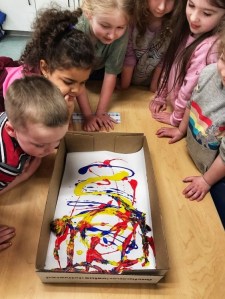
“After reading The Snowy Day from the PreK for ME instructional program, children design a sequence of steps to make tracks on paper and then with the Sphero. Creating a collaborative painting with Sphero not only fosters community within the overall classroom culture but also engages the students in the process of algorithmic thinking, computational processes, and debugging to find and fix errors within the program.” – Melissa Brown
The technology components of the Pre-K for ME curriculum were developed by Dr. Donna Karno of the University of Maine at Farmington, who has long been advocating for technology integration in early childhood education. “Less than 50 percent of early education teachers are currently using technology in their classrooms, in part because of the stigma associated with screen time and children, and in part because of their discomfort and lack of knowledge with setting programs up,” says Dr. Karno. All three educators acknowledge that incorporating these robots and computer science align with much of the skill-building that happens in the early elementary classroom.
Audra Leland’s strategy for starting is to do “unplugged activities” that do not involve any electronics at all. “We start by moving our bodies, following directions. Once they understand that every movement is told and that is what they must do, we take out the Bee-Bots.” This sort of approach to initiating students to computer science is common at the elementary and even middle level. The robots have their value as learning tools, but “the excitement and joy the children show when I take out [the robots] is one reason that I continue to integrate the tools in our learning,” according to Melissa Brown.
While both Pre-K teachers recognize their peers’ unfamiliarity with computer science concepts, they are quick to point out the overlap that exists. Melissa says, “for example, children in our Pre-K classrooms are recognizing and creating patterns with manipulatives, sequencing the events of a story in their literacy work, or sharing social problems and working together to find solutions. Robots simply add another dimension to this work.”




 The Week of the Young Child provides an opportunity to shine a light on the importance of early learning and to focus attention on the needs of young children, their teachers, families, and communities.
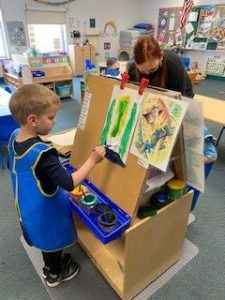 Pre-K and Kindergarten classrooms in the Oxford Hills School System utilize whole student, interdisciplinary instructional programs that the Maine DOE, in collaboration with Maine educators, have adapted for Maine using work originally developed by the Boston Public School System. Both instructional programs are content rich (aligned to Maine’s learning standards) and are designed around opportunity for structured play.
 Oxford Elementary Principal, Tiffany Karnes, shared, “It is such a joy to go into a Kindergarten or Pre-K classroom and hear the conversations students are having with each other as they engage in their center work. Whether it is in the dramatic play area or the block area, students are using their imaginations and incorporating the vocabulary they have learned. They are building wolf dens when they are learning about animal habitats or dressing up as characters from a book that they have heard during read-aloud and acting out their story. The level of oral language and increase in vocabulary that we are seeing far exceeds anything we have seen in the past.
 For more information about the Maine Department of Education’s early learning efforts, including Pre-K for ME and K for ME, contact Lee Anne Larsen, Early Learning Team Coordinator at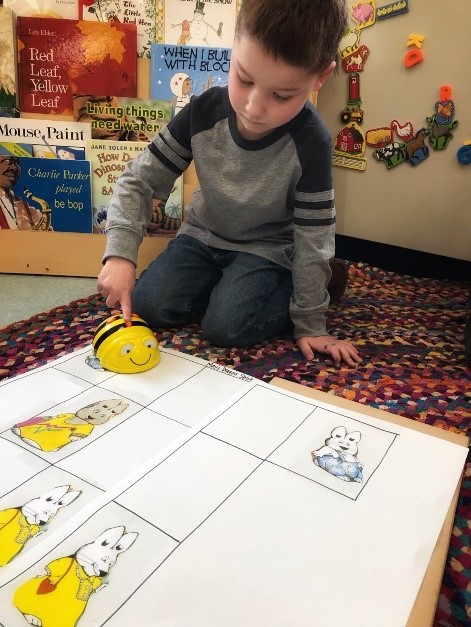
 Maine DOE Newsroom