Growth Celebrated and Knowledge Shared as MoMEntum Literacy Pilot Wraps Up

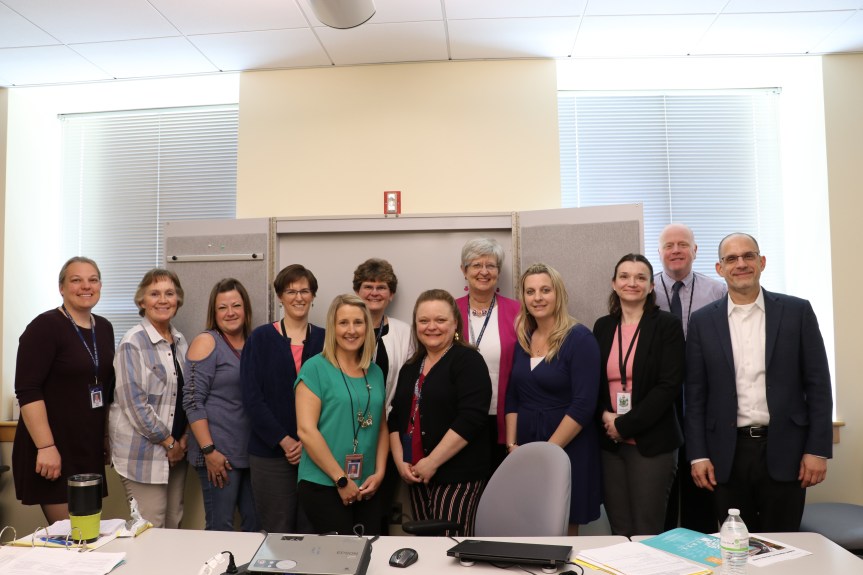
Kindergarten through 3rd grade teachers from across the state gathered this month for a final event that served as the culmination of two and a half years of work by 1500 students, 100 teachers, 9 schools, and 6 literacy coaches. Momentum, a K-3 literacy pilot program designed to improve the literacy achievement of students, came to a close with a professional learning event and an opportunity to reflect on the knowledge and growth experienced by its participants.

Deployed in January 2018, the MoMEntum pilot program provided 9 schools with iPad devices from Apple, Inc. and research-based curriculum resources along with targeted professional learning and coaching to help them improve not only the reading levels of their young students, but also to engage them in a meaningful integration of literacy across other content areas using technology. Additionally, and somewhat uniquely, the pilot also provided schools with the tools to measure how well students were responding to the new learning style.

Teachers received intensive professional learning on specific software applications that individualized student learning, and provided a platform to share student progress with their parents or guardians. Trained literacy coaches worked within each school along with locally grown professional learning communities (PLC) that met monthly (or more) to share practices, evaluate their work and progress, and seek ways to improve.

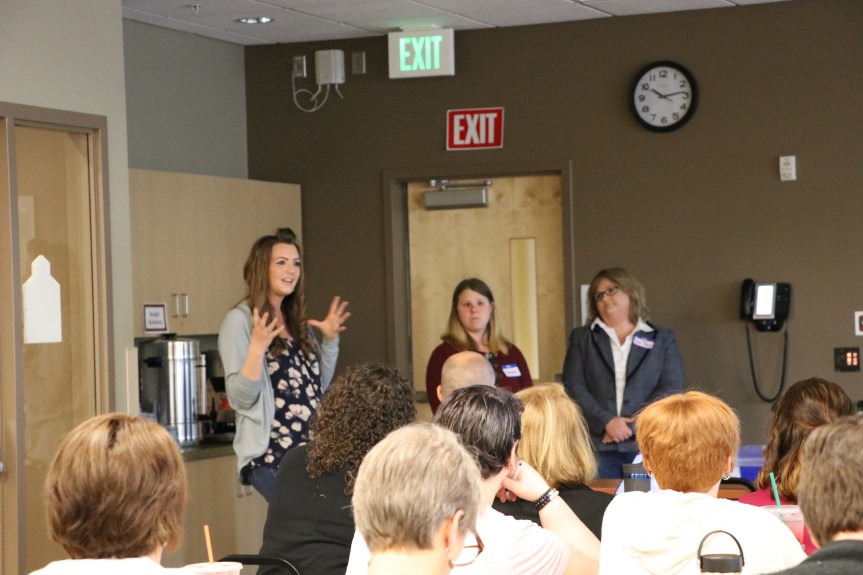
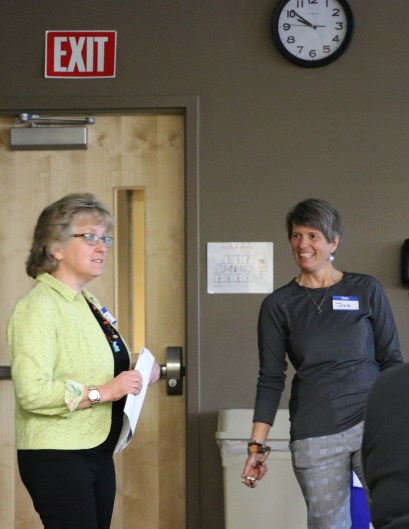
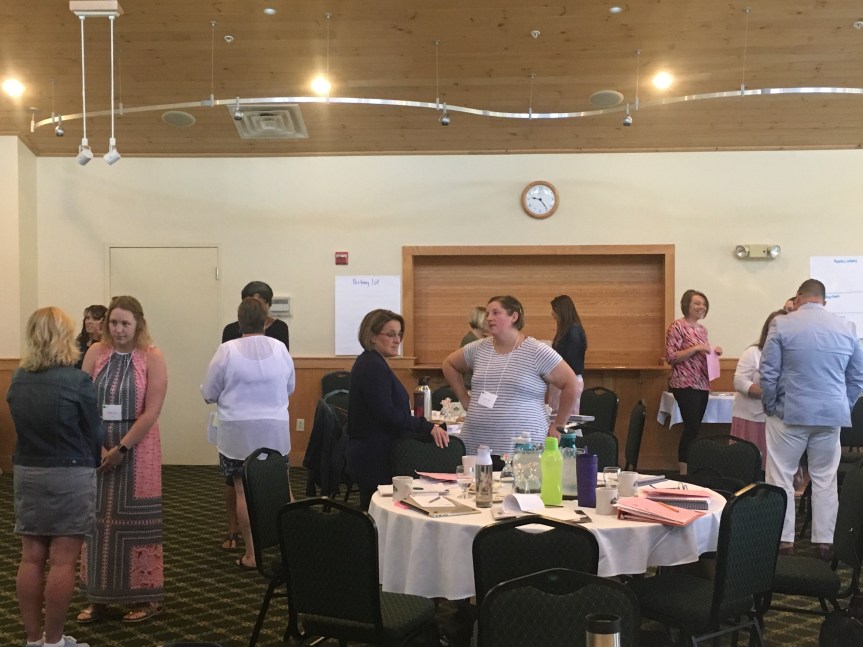
room of educators sitting at tables listening to speakerAt the closing event were an array of teacher-lead professional learning sessions about classroom management and curriculum practice. For example, Lindsey Davis, a 1st Grade Teacher from Leroy H. Smith School in RSU 22, lead a session about how to engage students in Close Reading lessons that utilize integrated and relevant content. Heather Gray and Danielle Afari, teachers from Dirigo Elementary School in RSU 56, lead an informative and entertaining session about ways to glean student progress based on data and assessment in the classroom.
Teachers and administrators also had the opportunity to work on sustainability plans to keep their work from the MoMEntum pilot going in their schools by establishing school level and individual goals to help continue their integrated literacy work.

Kathy Jacobs, a 1st grade teacher who is moving into a special education role at China Primary School, a participating school from the pilot, said that she has definitely, “seen growth in the students” during the pilot program and that no matter what happens now that the program has come to a close, she will apply some of the things she has learned into her teaching practices going forward.

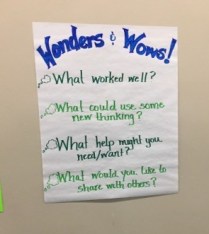
Wonders & wows posterThere was also an opportunity for teachers and administrators to share their “Wonders & Wows” as a way to evaluate the work and progress and highlight areas for future collaborative work.
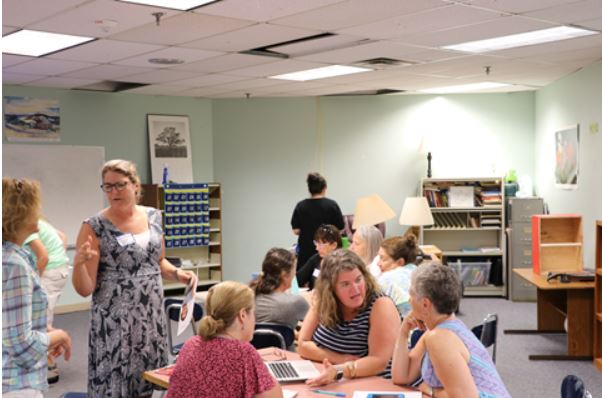
“I learned as much from the teachers as I hope they learned from me,” said Literacy Coach Heidi Goodwin, a Distinguished Educator on loan from MSAD 54 who worked directly with the Maine DOE on the pilot program. “They [teachers] were great thinking partners,” she reflected. There were 6 educators total that served as coaches for the program. Along with Heidi were, Kayanne Nadeau, on loan from MSAD 27; Liz Wakem, on loan from RSU 71; Lisa Sleight, a retired Maine educator; Li Gowell, a retired Maine educator; and Dee Saucier, a Maine DOE staff member.

“This was not just a great learning opportunity for the schools involved but for the Department as well,” said Lee Anne Larsen, Maine DOE Early Learning Team Coordinator who has been involved in the administration of the MoMEntum pilot from its inception.  Reflecting on the valuable lessons learned during the pilot, Lee Anne remarked that the most notable were about ways to effectively use technology in the classroom, and methods of meaningfully integrating literacy into other content areas. “It will definitely inform our future work at the Department,” she added.

While the full pilot program and everything that came along with it was only deployed in 9 schools initially, the professional learning resources are available, completely free, to all schools on the Maine DOE Website, along with help and support from Maine DOE staff members Lee Anne Larson and Dee Saucier who both helped administer the pilot program. For further information please reach out to them at Leeann.Larsen@maine.gov and/or Danielle.M.Saucier@maine.gov.


Maine Teachers Engage in “K for ME” Curriculum Pilot Training

In Augusta, kindergarten teachers and their administrators from five Maine school districts participated in three days of training for the K for ME pilot, a research-based, discipline integrated, whole child curriculum for kindergarten.

Principals and teachers volunteered to implement this curriculum, based on the Boston Public Schools kindergarten program, to help tailor it for Maine’s children and school communities. Melissa Luc, consultant from the Boston Public Schools, facilitated the training and is working with participants from schools and Department to oversee the revisions.

During the 2018-19 school year, the Maine DOE piloted the PreK for ME curriculum in 14 preschool classrooms – the curriculum will soon be posted as an open source on the DOE website. K for ME expands upon this work by creating a vertical alignment for students building on concepts and content they learned in prek. K for ME will also be an open-source curriculum available on the Maine DOE website as a resource for districts after the pilot year.

For more information ,contact Lee Anne Larsen at leeann.larsen@maine.gov or 624-6628.

Maine Teachers Learn About the Benefits of Technology in Elementary School Classrooms

This article was written by Simon Handelman, a Maine DOE Intern from the Margaret Chase Smith Policy Institute.

Imagine how surprising it was seeing my own mother sitting in a classroom at Casco Bay High School, on a Friday morning in August. Allow me to clarify, I was not surprised to see her attending the professional learning class there; she is an extremely dedicated teacher. All I mean is it was serendipitous to see her on a day I might have otherwise stayed in Augusta at the Department of Education. My mother, Ellen Handelman, is the art teacher at Harrison Lyseth Elementary School in Portland. She, like so many other enthusiastic Maine teachers, is spending her last weeks of  summer vacation attending professional learning classes, one after another. I do not believe she has had so much homework since college. 

We were at Casco Bay High School that day for the same reasons. A session was being taught by former Cushing Community School teacher Beth Heidemann, and philanthropist David Perloff. They were underscoring the benefits of technology in elementary school classrooms. For my mother, the highlight of that day was a winning a 3D printer for her very own classroom. When I asked her to express her excitement about the printer, she said “my students can witness (in real time) how science, technology, engineering, and math combine with art to create usable objects which pair form and function.” 

Casco Bay PL Session1
Teachers at Casco Bay PL Session use downtime to network and catch up with friends.

My mother is constantly developing methods to display for her students the foundational importance of art education. She firmly believes “everyone is an artist,” and I agree. In fact, that same mantra of was repeated again and again at Casco Bay that day. Heidemann’s company Go2Science, which she founded with scientist Curtis Bentley, allows kindergarten through second grade students to travel virtually around the world, investigating hypotheses for a representative group of scientists. Heidemann’s message: “everyone is a scientist.”  

Casco Bay PL Session2
Teachers at Casco Bay PL Session Listening to a Presenter

Perloff’s Perloff Family Foundation, which donated the printer my mother won, believes all young students are equipped to learn about complicated technology, if given the chance. His foundation provided three hundred fifty 3D printers to Maine public schools, and the Maine Medical Center Children’s Hospital. Perloff believes “everyone is an engineer.” 

Other elementary school teachers in attendance raved about occasions in their own classrooms when young students expressed high level critical thinking. In one case a teacher told the group that her kindergarten class was able to fix the internet for a substitute teacher, using only verbal directions (for safety reasons).  

As the summer months come to a close, teachers across the state are eager to return to their students. There are many fantastic professional learning opportunities available in Maine, and many more dedicated teachers prepared to become the best they can possibly be.   

RSU 57 Prek Teachers Train Fellow Educators on Research-based Prek Practice

Prek teachers Melissa Brown, Jessie Carlson, Morgan Gallagher and Sarah Smith from RSU 57 provided training recently for new teachers ready to implement the PreK for ME program in the coming school year.

Prek for ME is a curriculum program based on the Boston Public School’s open source curriculum. Last year, 14 prek classroom teachers, including the 4 from RSU 57, were part of the pilot program that was successfully conducted last year assisting participants in improving their prek classroom instruction. RSU 57 saw great results in this research-based, whole child/multi-domain program.

Excited and eager to help bring their experience and expertise to others, the four RSU 57 teachers co-trained with some assistance from Sue Reed, Early Childhood Specialist from Maine DOE who is leading the efforts to adapt the Prek for ME curriculum for Maine.

The evaluations from the program help to illustrate its success:

“This was a super training!  I appreciated the balance between presentation and hands on with the teachers.” 

“Teachers who have used the program are very helpful!” 

The prek teachers from RSU 57 invited participants to visit their classrooms and to contact them with any questions.  The Prek for ME program will be available on the Maine DOE website by the end of August.

Reduced Rate Access and Training for Pk-3rd Grade Teachers Using Teaching Strategies Gold®

The Maine Department of Education (DOE) has finalized a contract with Teaching Strategies to support the use of their Gold® assessment tool in elementary grade (Pk-3) classrooms.

Teaching Strategies Gold® is an authentic formative assessment tool that aligns to Maine’s Early Learning and Development Standards for PreK and Maine’s College and Career Ready Standards for kindergarten through 3rd grade. Teachers observe and document evidence of student skills as part of authentic instruction.  Data collected through this assessment is captured in an online platform.

Public schools will be able to access a reduced per student rate of $15.95 for the 2019-20 school year. Schools may apply for this reduced rate here. Use of Teaching Strategies Gold® is an option for use as part of a school or district’s local assessment system.  It is not a state required assessment.

In addition to the reduced rate, the Maine DOE is hosting a two-day training on August 19th and 20th for teachers and administrators who are new to using this assessment.  The training will be held at the Maine State Library located at 230 State St. Augusta, Maine. Training will cover the research behind Gold® and how to access the online platform. Educators will also have time to navigate the tool and practice observation skills of individual student development. Administrators new to the tool are encouraged to attend day one (8/19/2019). Training is limited to 30 participants and will be offered on a first come, first served basis. Registration will automatically close once it has reached 30 participants.

Registration for all participants is now open through August 16, 2019.

Click here for more information about Teaching Strategies Gold®,

For questions, contact Nicole Madore at 624-6677 or  Nicole.madore@maine.gov


Lincoln Elementary School Goes Above and Beyond to Keep Students Engaged in Reading During the Summer

This spring, Augusta School Department’s Lincoln Elementary School recorded videos of each of their teachers and staff members reading a book out loud and then posted it to their school Facebook page for students, parents, and families to enjoy. This effort was part of a read-a-thon initiative to keep kids engaged with reading and literacy activities over their week-long vacation in April.

With 25 videos posted over April break and hundreds of views by students and their families, they decided to expand the effort into the summer months and include community members as guest readers. “We have made an effort to post at least one video every day this summer,” said Lincoln Elementary School Principal Heather Gauthier. “Between June 14th and August 28th when school is back in session, we will have done over 75 videos, many of them with 200+ views on Facebook and YouTube, and positive engagement from parents and community members.”

Their guest readers include everyone from teachers, school administrators, staff, and education technicians to police officers, school board members, local authors, former students, local government officials, and even Maine DOE’s very own Lee Anne Larson, Early Learning Team Coordinator.

“We have received a lot of great feedback from community members who have been engaged and parents who have benefited from the videos,” said Heather. “One parent told us that she puts the videos on while she cooks dinner so that the kids can watch and listen to books while she is busy cooking.”

What started as an effort to keep students reading over the summer months has turned into a summer reading activity that has been successful in engaging students, parents, and community members alike.

Heather says that they plan to keep the guest reading videos going for as long as they can and hopes that people keep enjoying and watching them. Check out the Lincoln Elementary School Department’s videos on YouTube. Find Lincoln Elementary School Department on Facebook.

This article was written by Rachel Paling, Maine DOE Communications and Outreach Manager in collaboration with Lincoln Elementary School Principal, Heather Gauthier. If you have story ideas for the Maine DOE’s Maine Schools Sharing Success campaign, contact Rachel at rachel.paling@maine.gov.

Public Preschool Annual Report due July 31, 2019

In the event that you missed the announcement of the Public Preschool Annual Report, this is a friendly reminder that the report is now available  and due to the Department of Education no later than close of business on July 31, 2019.  All public preschool programs are required to complete the Public Preschool Annual Report.

If you accidentally submit the report before finalizing, please email Nicole Madore for a link to access and continue your work.

A preview of the report can be found here.

Before you start the survey, the following information will be useful to have available:

  • Information related to staff turnover
  • Program operation:
    • Hours/day
    • Days/week
    • Any major changes to the program including but not limited to:
      • partners
      • curriculum
      • location
  • Successes/challenges experienced over the course of the year
  • Student attendance-
    • percentages for Free & Reduced Lunch
    • chronic absenteeism
    • transient students
  • Student’s identified for additional support:
    • English Learners- screening process
    • Individualized Education Plan (IEP) information including but not limited to:
      • referrals
      • active identifications
      • no longer qualify
  • Student growth in all learning domains

Any questions should be directed to Nicole Madore at Nicole.madore@maine.gov  or 624-6677.


Public Preschool Annual Report Due July 31, 2019

We are grateful to our school districts who are addressing the need for public preschool programming in their communities, and we are committed to fostering partnerships and increasing early intervention and educational opportunities for our youngest learners. As you are likely aware, all public preschool programs are required to complete the Public Preschool Annual Report. We have shortened the report for ease of use, and the Department of Education will refer to the data collected throughout the year to help inform policy, determine professional development needs, and provide follow up information or support.

The Public Preschool Annual report is now available  and is due to the Department no later than close of business on July 31, 2019.

Before you start the survey, it will be useful to have the following information readily available:

  • Information related to staff turnover
  • Program operation:
    • Number of hours per day
    • Number of days per week
    • Any major changes to the program, including, but not limited to:
      • partners
      • curriculum
      • location
    • Successes/challenges experienced over the course of the year
    • Student attendance-
      • number economically disadvantaged
      • number chronic absenteeism
      • transient students
    • Students identified for additional support:
      • English Learners- screening process
      • Individualized Education Plan (IEP) information including but not limited to:
        • referrals
        • IDEA eligibility identification
        • no longer qualify
      • Student growth in all learning domains

For further information or questions, please contact Nicole Madore at Nicole.madore@maine.gov  or 624-6677.

Successes Shared by Districts at Closing Event of 4-Year Preschool Expansion Grant

(Pictured: Kindergarten teacher Heidi Sturgeon, pre-k teacher Olesia Pazdro, and Curriculum Director Suzanne Day from MSAD 55- Sacopee Valley, talk to the audience about their goals for their Birth – Third Grade Action Plan.)

The Maine Department of Education hosted a closing event of the 4-year Preschool Expansion Grant (PEG) that was awarded to Maine DOE in December 2014 by the US Department of Education.  Eighteen states were awarded grants to support local school districts in the development of new preschool classrooms, and to expand access to high-quality, full-day pre-k programs for children whose families were at or below 200%  Federal Poverty Level.

Maine used the grant to launch and expand pre-k programs for 13 districts in Maine, 8 of which used the opportunity to partner with local Head Start programs. The districts included RSU 12, RSU 13, MSAD 17, RSU 23, SAD 37, SAD 44, RSU 55, RSU 74, Cornville Regional Charter School, Cherryfield, Lewiston (Longley Elementary), Millinocket, Vassalboro. The 13 districts were chosen for their percentage of students with an economic disadvantage and willingness and availability to embark on the effort.

The grant allowed these districts to add or expand their pre-k classroom spaces and resources, hire and train needed teachers in using evidence based curricula and instructional practices, align appropriate assessment of pre-k students with kindergarten assessments, develop a plan for kindergarten transition, and form a community literacy team, all as part of a long-term “Birth to Third Grade plan” that aligns with the districts’ strategic goals. The grant implementation was supported by grant coordinators at each of the participating districts, and trained coaches, all of whom were former Maine educators.

A cross-section of state employees from Maine DOE, Department of Health and Human Services (DHHS) and Child Development Services (CDS) worked collaboratively on this project,  with facilitation provided by the Education Development Center (EDC).

IMG_0229
(Left to right) Sarah Adkins, Kathryn Zwicker, Nena Cunningham, Karen Bergeron, Nicole Madore, Lee Anne Larsen, Dee Saucier, Sue Reed, Crystal Arbour, Jessica Nixon, Rich Meserve, David Jacobson.

Three years into the 4-year grant, tremendous improvements in child outcomes were celebrated, including:

  • 76%-86% of children moved out of the high-risk identification in all developmental domains
  • 76%-96% of children moved out of high-risk identification in literacy skills (predictive of kindergarten success)
  • 53% of children moved out of high-risk identification in the Peabody Picture Vocabulary Test, which assesses receptive language and is a predictor of later reading success

The end of the year event was an opportunity for each of the participating districts to present their Birth to Third plans to their peers and to reflect on their successes, lessons learned, and plans moving forward.

IMG_0196_cropped
RSU 12 Curriculum Coordinator, Deb Taylor (right) and Southern Kennebec Child Development Center Head Start Director Cristina Salois (left) shared details of their  action plan with the full audience which included a “ghost walk” to each pre-k classroom across the district’s 4 elementary schools. This was an opportunity for pre-k teachers to share and collaborate on environmental design and instructional practices and learn from one another.

The gathering included presentations by each participating district, who all began by sharing varied and often-times unique community challenges. For example, while some experienced a lack of licensed child care providers to connect with and engage families early on, another had migrant families with students in and out of school frequently. There were many other unique community characteristics shared, yet all of the districts had the common challenge of a high percentage of families facing economic disadvantage.

The common areas of focus for each Birth to Third Grade action plan included a focus on quality, shared teaching and learning practices, family engagement starting before children enter pre-k, a focus on positive transitions from pre-k to kindergarten, social emotional learning and trauma informed teaching.

The closing event was a successful day of presenting, idea sharing, and collaboration by early childhood educators from across the state who will now be able to continue their research based, and collaborative birth to third grade plans for district-wide success and beyond.


Still Time to Register for 4th Annual Read to Ride Summer Reading Challenge

(Pictured: Display from Turner Primary for Read to Ride)

Summer vacation is a welcome break from the daily school routine for children and parents alike, but the summer months can be detrimental to students’ learning if young minds do not remain active. Summer learning loss is a well-documented phenomenon, particularly with respect to reading achievement.  Students can lose up to three months of reading progress during the summer if they don’t keep reading.  When combined across a child’s PK-8 school career, this can result in 1-2 years of lost reading progress.

Fortunately, the summer slide can be prevented or greatly reduced when students continue to read on a regular basis. By encouraging children to read for enjoyment from a variety of resources and to explore topics of interest, they continue to practice applying the skills they have learned, build their vocabulary, and widen their knowledge of the world.  For students who are not yet reading independently, or just beginning to read, reading to and with parents is equally beneficial.

Once again this year, the Maine Department of Education is collaborating with the Freemasons of Maine to sponsor the Read to Ride Summer Reading Challenge for students in grades PK-8.  The Maine Freemasons have generously donated 48 bikes with helmets as prizes for the Read to Ride Summer Reading Challenge.  During the first three years of this initiative, thousands of Maine children completed the challenge of reading 500 minutes during the summer vacation.  Maine DOE hopes to see this number grow even higher during the summer of 2019.

Any school with students in the PK-8 grade span may register to participate. Participating schools will collect documentation from students who have completed the challenge. They will hold school level drawings to select two students (one boy and one girl) whose names will be entered into the state level drawing to be held on September 25, 2019.   Schools are encouraged to participate in this challenge, to coordinate it with any other summer reading challenges/programs they offer, and to consider soliciting their own local level prizes for students who complete the challenge.  Find details and the link to register your school at the Read to Ride Challenge website.

Questions may be directed to Maine DOE’s Elementary Literacy Specialist, Danielle Saucier at danielle.m.saucier@maine.gov.