Invitation to Opportunities Related to a Kindergarten Entry Inventory  

In 2022, the Maine Department of Education (DOE), in partnership with the Maine Department of Health and Human Services (DHHS), was awarded the Preschool Development Renewal Grant B-5. This three year, $8,000,000/year grant supports early care and educational programming for our youngest students. The Maine DOE, in collaboration with Maine DHHS, is exploring strategies to help support transitions from early childhood settings into kindergarten settings.

One of the many projects included in the grant is the development of a Kindergarten Entry Inventory (KEI). A KEI is a tool administered in the beginning of kindergarten to help teachers gather information about children’s development across a range of domains so that teachers can be responsive to children’s learning.  Additionally, data aggregated from KEIs can help strengthen Maine’s early care and education system by identifying areas of steady growth and continuous improvement.

If you are a Maine Kindergarten Teacher, Early Childhood Administrator, Curriculum Director or Instructional Specialist/Coach, the Maine DOE invites you to engage in the design of a Kindergarten Entry Inventory (KEI). Your expertise and perspective are needed in the following areas:

  • Consider applying for membership in the KEI Advisory Team. The goals of this group are to determine the key purposes of a KEI, review research and successful implementation practices, and identify constructs within each domain to assess. Services on this committee will include a stipend. Responsibilities include, but are not limited to, attendance at monthly virtual meetings as well as 2 in-person meetings per year. School administrative unit leaders and early childhood educators are welcome to complete the application linked below. Applications for this position are being accepted through May 10th.
  • Consider applying for a Kindergarten Entry Implementation Specialist position. The goal of these positions is to pilot various domain specific inventory strategies and to provide feedback to the Advisory Group. Services for this position will include a stipend. Responsibilities include, but are not limited to, testing inventory strategies with students, offering timely feedback and attendance at periodic in-person and virtual trainings/meetings. All Kindergarten teachers are welcome to complete the application linked below. Applications for these positions are being accepted through May 10th.

Application for KEI Advisory Team can be found here

Application for KEI Implementation Specialist can be found here.

  • Communication about selections for the KEI Advisory Team and for the KEI Implementation Specialist positions will be made by May 24th. The KEI Advisory Team will begin meeting in early June and the Implementation Specialists will begin in the summer (date TBD).
  • Additionally, in the near future, School Administrators and Kindergarten Teachers will be invited to complete a survey regarding KEI implementation practices in their school administrative unit. The survey will gather information such as domains assessed, materials used, timelines, professional development and reporting.

For questions or additional information regarding the KEI design and pilot, please reach out to Karen Mathieu, Maine DOE Kindergarten Entry Inventory Specialist, at karen.mathieu@maine.gov.

REMINDER: Register Now for Early Childhood Summer Regional Summit Events With Mini Grant Opportunity

The Maine Department of Health and Human Services (DHHS), in partnership with the Maine Department of Education (DOE), was awarded a Preschool Development Renewal Grant (PDG) from the US Department of Health and Human Services in December of 2022. With this three-year grant, the state is implementing initiatives to build greater infrastructure and capacity to create a more coordinated, efficient, and high-quality mixed delivery system for children ages birth to eight and their families. The plan builds upon successful cross-agency work to ensure that all children enter Kindergarten prepared to succeed and are well supported during the early elementary years.

Included in this grant is the opportunity for a summer summit series in 2024 and 2025 to support communities in their local system alignment and coordination for early childhood care and education programming from birth through the early elementary years.  Teams accepted to participate in the summit will also be awarded $800 mini grants to support their efforts in developing and implementing action plans to address an identified early care and education need in their communities.

The goals of the Early Childhood Summit include:

  • Fostering community level coordination and collaboration across the mixed-delivery early care and education system, which includes child care programs, head start and elementary schools, to improve alignment and transitions for children and families.
  • Strengthening understanding of evidence-based practices that are critical to leverage across the birth-grade 3 span in order to promote whole child development.
  • Supporting community-based planning and implementation efforts through mini-grants and ongoing technical assistance support.

What will the summit structure be like? 

The content of the summit will include a variety of keynote addresses and workshop sessions connected to the goals outlined previously.  Topics will include promoting inclusionary practices and addressing challenging behaviors, promoting play as a foundational learning strategy,  and promoting smooth transitions from early childhood education programs into public schools for children and families.  Time will also be provided for teams to work collaboratively on action planning.

When will the summits be held? 

The 1-day summits will be held in two regions (see dates/locations below).  Teams will apply to attend in one of the two locations.  The summits will run from 8:30 a.m.- 4:00 p.m.

  • Thursday, July 11, 2024, Keeley’s Banquet Center, 178 Warren Avenue, Portland, Maine
  • Tuesday, July 16, 2024, Jeff’s Catering & Event Center, 15 Event Center Way, Brewer, Maine

What are the requirements of participation for all team members?

All team members will be expected to participate in the professional development and technical assistance components outlined below.

The components include: Projected timeline:
One check in meeting prior to the July 2024 Summit   June 2024
Attendance and participation at Summer Summit July 2024   July 11 or 16, 2024
Bi-annual consult with the Departments (1/2)   Fall 2024
Bi-annual consult with the Departments (2/2)   Winter 2025
Attendance and participation at Summer Summit in July 2025   July 2025


What is the composition of teams?

Teams may have up to five members.  There must be at least:

  • one public early elementary school educator and
  • one child care provider/educator represented (family child care and/or child care center) on the team.

The additional three members may include but are not limited to:

  • Representative of the local business community
  • Parent of a child using early childhood services
  • School Administrator
  • Home Visitor
  • Mental health care provider
  • Head Start Representative
  • Health care provider
  • Community librarian
  • Representative of an organization that supports workforce development
  • Provider of services under the federal Individuals with Disabilities Education Act, Part B or Part C
  • Provider of professional development to early care and education professionals
  • A faculty member of a career and technical center or higher education institution specializing in early childhood, if available

How will the mini grants work?

Each team will receive an eight-hundred-dollar ($800) grant to support their action planning and implementation work over the first year. Another min-grant will be available following successful completion of the first year and participation in 2025 summit.

To apply: 

Complete the application found here (Word Doc) and return all documents electronically by April 30, 2024 to Andrea Faurot at Andrea.Faurot@maine.gov.

All team members must sign an agreement ensuring team participation.

For additional information, please reach out to Renee Reilly, Maine DOE PDG Manager at Renee.A.Reilly@maine.gov or Andrea Faurot, OCFS PDG Manager at Andrea.Faurot@maine.gov.

Inclusive Classroom Book Study for Maine Early Care and Education Professionals (serving Birth-Grade 3)

The Maine Department of Education (DOE) has partnered with Maine Roads to Quality Professional Development Network and the Maine Department of Health and Human Services (DHHS) Office of Child and Family Services to offer a no-cost book study for Maine early care and education professionals (serving children birth-Grade 3) interested in creating more inclusive classrooms.

In the early childhood classroom, inclusion means that all children, regardless of their individual characteristics, have equitable access to educational opportunities and environments where they are equally safe, valued, and respected.  Early care and education programs that prioritize inclusion benefit everyone, including children, teachers, parents, and communities.

This book study is one of the professional growth opportunities available at no cost to Maine early care and education professionals as part of the Maine Inclusion Initiative funded through Maine’s Preschool Development Renewal Grant. Participants in the book study will read and reflect on Inclusion Includes Us: Building Bridges and Removing Barriers in Early Childhood Classrooms (Huber, 2023). The book study will occur over a 6-week span, meeting weekly for 75 minutes. Three 6-week sessions are being offered as options (see schedule below).

This professional learning opportunity is open to all early care and education professionals from public and private preschool schools, early elementary schools, childcare centers, and family childcare providers.

Session Options

Session 1:
May 13 – June 24 (no session May 27th)
Mondays 5:45 – 7:00

Session 2:
Aug 13 – Sept 17
Tuesdays   3:45-5:00

Session 3:
October 16-Nov 20
Wednesdays 12-1

To apply to be part of one of the above book study sessions, please fill out the following form found at this link: Inclusion Book Club. Space is limited, so please complete the application by April 30, 2024.   Applications will be processed, and participants will be notified by May 3rd. Books will be shipped to participants and contact hours will be provided for the time in the book study.

If you have questions or need additional information, please reach out to Nicole Madore, Maine DOE Early Childhood Specialist at Nicole.Madore@maine.gov or Renee Reilly, Maine DOE PDG Manager at Renee.A.Reilly@maine.gov.

Week of the Young Child: Family Friday

Every family is unique.  Every family knows their children best. Families are a child’s first and most important teachers.  Having a strong partnership with the caregivers, parents, and family members of the children in your setting is very important in being able to support them to meet their full potential. Elevating family voice, honoring lived experiences and empowering families in offering solutions from family guided needs for child care and educational experiences that are child-centered all aid a whole family approach to early care and education.  Collaborative and strengths-based engagement, partnership and communication through early childhood professionals, school settings and families build positive and goal-oriented support networks for each of Maine’s earliest learners.

Statewide programs that support family engagement:

Maine’s Head Start State Collaboration Office (HSSCO) is located in the Department of Education as part of the Early Learning Team and is funded through a federal grant from the Office of Head Start, Administration for Children and Families, U.S. Department of Health and Human Services. More information on our eleven Head Start Grantees and three Tribal Head Start Programs can be found here.

Child Care Affordability Program (CCAP) : helps eligible families pay for a portion of child care costs during the time the parent/guardian is working, going to school, or participating in a job training program. CCAP is also available for eligible families where the adult(s) are retired (as defined by the SSA). Apply today by submitting an application available on the CCAP website.

McKinney Vento is a federal Homeless Assistance Act. This law helps students whose housing situations are impacting their education. All students are guaranteed the right to a free, appropriate, public education. More information and who to contact for help can be found on the Maine DOE’s School and Student Supports team site.

WYOC 2024 Raffle Winner: The growing years child care in Saco

Week of the Young Child: Work Together Wednesday

Working together is vital to a young child’s development as they navigate their place in their natural environments and the world they live in. Teaching through collaborative activities showcases essential life skills such as responsibility, teamwork, communication, and independence.  However, the young children in your classroom aren’t the only ones who succeed when everyone works together.  The adults and care givers in young children’s lives must also work and collaborate to plan how we—as citizens of a community, of a state, and of a nation—will better meet the needs of all young children.  Today, we highlight a few statewide examples of working together with a shared goal of all Maine children entering school prepared to succeed, and support for our earliest learners.

Statewide programs that support cross-agency and community collaboration:

  • Public PreK Partnerships are just one way that communities across Maine are meeting the demand for high-quality public Pre-K programming. When a public school, licensed community provider and/or a local Head Start team up to provide this service, the opportunities are endless! Each entity brings a different experience and expertise to the table that all children and their families will benefit from. Whether the partnership operates in a school building or a local community setting, families are provided with options and can make educational decisions based on the unique needs of their family. The need for partnerships is growing as we work to enroll as many eligible students in Pre-K programs as possible. The Early Learning Team at the Maine DOE is ready to offer support and answer your questions now.
  • First4ME is a three-year, community responsive pilot project funded by the Child Care Block Grant through the Office of Child and Family Services. With four pilot sites across the state, each convened by a non-profit has four goals: 1. To increase successful early learning transitions for children regardless of risk factors leading up to kindergarten entry, 2. Increase sustained, high-quality child care and early childhood education across the mixed delivery system, 3. Develop a coordinated system of support both statewide and local for families, providers, schools, and communities and 4. Strengthen the consistent continuity of care for families birth to school aged with community support to all participants. Through the support of a community coach and a community coalition, First4ME seeks to connect child care providers, school districts, community members, families, local service providers and the community at large to strengthen the bridge to the school setting and empower families through a two generational (2 Gen) approach.
  • Community schools are designed to serve the needs of their students, families and communities using a whole student approach. Schools partner with community-based organizations to help provide access to resources, such as physical and mental health care, nutrition and dental services, to prioritize the well-being of students and families. Community schools share common features that support student learning and healthy development and are anchored in four established pillars of the community school movement; 1. Integrated Student Supports, Expanded and Enriched Learning Time, 3. Active Family Engagement, and 4. Collaborative Leadership. Community Schools promote a culture of trust, respect and collaboration between students, staff, parents, and the broader community. In Maine, the Community School approach was first recognized by Maine Legislature in 2015 through the passing of public Law 20-A MRSA and Chapter 333. Currently, there are three schools in Maine who are implementing community school strategies with funding support from the DOE
  • First 10 Community Schools are a special type of Community School that implements a two-generational approach to improving equity and well-being for children from birth through the elementary years. Maine currently has three First 10 Pilot sites.  School leaders and educators in these sites are collaborating with families, community care & education providers, state agency partners, and non-profit organizations to build a support network with the school as the hub for parent education, early learning opportunities, comprehensive supports, and social connection.  Play & Learn events for preschool age children, robust transition plans to support families and children, and intentional connections with community providers to develop shared professional learning opportunities to improve quality and support alignment across this age span.  Maine looks forward to bringing on several new pilot sites in the 2024-25 school year.
  • Maine’s Early Childhood Consultation Partnership (ECCP®) joins mental health consultants directly with child care providers, educators, and families of children (ages 0-8) to support children’s behavioral, social, and emotional well-being. ECCP® increases the capacity of those caring for young children by identifying and implementing strategies through an evidenced-based, intensive, time-limited consultation model. Child care providers, educators, and caregivers receive support while growing their skills to effectively manage challenging behaviors, allowing children to remain and thrive in their early childhood program or child care.  Consultation can support individual children, entire classrooms, or family child care provider programs. Services are confidential and provided at no cost to providers or families. Find out more about ECCP® at our website or contact us by email: dhhs@maine.gov or phone 207-624-7991.
  • MRTQ PDN in Partnership with CCIDS: The University of Maine Center for Community Inclusion and Disability Studies (CCIDS), Maine’s University Center for Excellence in Developmental Disabilities (UCEDD), brings together the resources of the university and Maine communities to enhance the quality of life for individuals with developmental disabilities and their families. Our statewide mission is met through interdisciplinary educationresearch and evaluationcommunity engagement, and disseminationof state-of-the-art information that reflect the guiding principles of inclusion, diversity, universal design and access, and social justice. To assure a statewide focus, CCIDS collaborates with, and works to enhance, existing networks throughout Maine; including networks that serve people in rural communities and other unserved and underserved populations, such as culturally and linguistically diverse populations. View a listing of our current projects and initiatives here.

 WYOC 2024 Raffle Winner: Head Start York County Commun

Related articles:

Week of the Young Child: Artsy Thursday

Incorporating the Arts into programming can help children develop creativity, social skills and fine muscles with open-ended art projects where they can make choices.  There is also a deep benefit to educators to infuse the arts into a child’s day.  This allows early childhood educators to observe children with their peers in order to assess all areas of development. As an early childhood educator, you are a valuable resource.  You are a vital support to families and the young children you care for and educate.  Having a well rooted understanding of child development, observation tools as well as understanding the options available for early screening and intervention can empower families to seek the support they need if there is a concern.  Early intervention services are most effective when provided earlier in life and can change a child’s developmental path to improve outcomes for children, families, and communities.

Statewide programs that support child development:

  • Maine Early Learning and Development Standards (MELDS) are available digitally for educators who serve children birth through kindergarten. You can access the Infant/Toddler MELDS and the Preschool MELDS online. A new and improved version of the Preschool MELDS will be available this Spring! Be on the lookout for more information on its release through the Maine DOE, Maine Office of Child and Family Services and Maine Roads to Quality. For school-aged educators, you can access the Maine Learning Results (MLRs) here.
  • Help Me Grow is a central access point designed to connect families to information and services about child development and community resources. In partnership with 211 Maine, caregivers and providers can contact Help Me Grow for additional support. Help Me Grow will listen, link families to services, and provide follow-up to both caregivers and referral sources. Visit Help Me Grow Maine for more information.

WYOC 2024 Raffle Winner: Little Friends Nursery School & Child Care Center in Benton

Related articles:

Week of the Young Child: Tasty Tuesday

Today’s Week of the Young Child theme is Tasty Tuesday. We’ll take this opportunity to highlight childhood nutrition and the importance of consistent and healthy meals because after all, a hungry child cannot learn. And don’t forget to read below to find out today’s public Pre-K raffle winner!

The state of Maine has a number of programs that support the health and well-being of Maine’s youngest learners. Each of these programs helps fight hunger and obesity by reimbursing organizations such as schools, child care centers, family child care programs, and after-school programs for providing healthy meals to children.

So, how can you encourage healthy habits in your setting? Here are some ideas from Mabel Yu, Associate Editor at the National Association for the Education of Young Children (2017).

  • Introduce the child to a variety of foods.
  • Discuss where various foods come from. Grocery shop together. Visit farms, farmers markets, and orchards, if possible, to speak directly to farmers.
  • Cook together! The child can stir, add ingredients and spices, roll dough, etc. Introduce new or “unusual” foods slowly and in different ways (e.g. raw onions in a salad don’t taste like caramelized onions in a taco).
  • Show flexibility. Model trying new things and refrain from acting negatively towards foods you don’t prefer.
  • Read together. Discover how specific foods relate to different cultures, practice funny food rhymes, or learn about nutrients.

Statewide programs that support childhood nutrition:

  • Maine Department of Education Child Nutrition Team Programs include:
    • National School Lunch Program (NSLP)
    • Child and Adult Care Food Program (CACFP)
    • Afterschool Snack Service
    • Breakfast Programs
    • Culinary Classroom
    • Farm & Sea to School
    • Fresh Fruit & Vegetable Program (FFVP)
    • Summer Food Service Program (SFSP)
  • NAPSACC, a FREE online tool to help child care programs give children a healthy start. For programs serving children birth to age 5, the tool provides self-assessments, action planning, a library of tips and materials, and training videos to support children’s healthy habits through practices, policies, and environments. The self-assessment tools are easy to complete and lead to goal setting and action planning. The tool is flexible, can be customized to your programs, and is easy to use. The videos can be watched by all staff and count toward licensing requirements for training hours. Go NAPSACC covers seven topics areas: Child Nutrition, Breastfeeding & Infant Feeding, Farm to ECE, Oral Health, Infant & Child Physical Activity, Outdoor Play & Learning and Screen Time.  Additionally, Go NAPSACC’s Self-Assessments and Action Planning can help your program meet Standard 7 of Rising Stars for ME: Health, Safety, Nutrition, and Physical Activity.  Want to learn more, visit the Go NAPSACC website. Interested in a Go NAPSACC account? Fill out the Go NAPSACC account request form or contact Karen Bergeron at bergeron@maine.edu or 207-653-5090.
  • If your program serves older children, check out Let’s Go! 5-2-1-0. Let’s Go! is a community engagement initiative that partners with schools, school nutrition programs, early care and education programs, and out-of-school programs to help create spaces where the healthy choice is the easy choice across Maine and Carroll County, NH. The Let’s Go! program is flexible and can be easily woven into your organization, whether you’re running an in-home day care or part of a large center. Using the Let’s Go! Self-Assessment, we will help you assess your program environment and set a goals to support creating and sustaining a healthy environment. Let’s Go! provides tools, resources and trainings based on your program strengths and areas for growth focused on healthy eating and physical activity. For more information, check out Let’s Go! Maine or email letsgo@mainehealth.org

WOYC 2024 Raffle Winner for Tasty Tuesday is: RSU 3

Congratulations!

Related articles:

Week of the Young Child: Music Monday

We want to thank you for joining us in celebrating the Week of the Young Child! This is a national event promoting the importance of high-quality early learning sponsored by the National Association for the Education of Young Children (NAEYC).  This year the Maine Department of Education and the  Department of Health and Human Services, Office of Child and Family Services have teamed up to support early childhood educators across the state to join the celebration and promote the vital work they do every day in their child care programs and Pre-K through 3rd grade elementary school classrooms. This year’s goal is to help elevate the importance of high-quality early learning and care for the greater community through positive stories and photos showing high-quality practices and strategies to build positive relationships and a sense of community. We’re excited to share the positive impact Maine’s early educators are making with the children and families in your program or classroom!

Each day will focus on a theme related to whole child development and playful learning. As Fred Rogers wisely said, “Play is often talked about as if it were a relief from serious learning. But, for children, play is serious learning. Play is really the work of childhood.” When focusing on the whole student, ensuring the early childhood years are filled with opportunities for play fosters growth across all domains of development including creative arts.

For Music Monday, let’s focus on creative expression which allows a young child to engage in their own imagination. It offers them an opportunity to express themselves in ways that are unique to them and to form an appreciation for the unique expressions of others. Fostering creativity in young children allows them to explore, examine and reflect upon their own individual form of creative expression. Providing experiences such as music, movement, dance, dramatic play, and experimentation with a variety of art media, allows a child to explore the different dimensions of the creative arts. An early educator who promotes these experiences and builds upon these skills not only supports young children’s creative efforts but also reinforces language, understanding, and appreciation of the arts.

In addition to celebrating each theme throughout the week, we’ll also share statewide programs that support whole child development and playful learning:

  • The Maine Department of Education offers free access to instructional programs for children in grades Pre-K through grade 1 which focus on whole child development and incorporate play-based experiences through daily, literacy rich lessons that build on developmentally appropriate practices and science-based concepts.
  • Maine Roads to Quality Professional Development Network (MRTQ-PDN) offers Relationship Based Technical Assistance based on the standards in Maine’s Quality Rating and Improvement System: Rising Stars for ME and supports ECE professional’s desire to enhance the quality of care for young children, including whole child development and playful learning. Offerings include:
    • Consultation– Collaborative partnership between you and a District Coordinator that supports positive solutions, develops a plan with action steps to meet goals, and deepens professional learning.  This can be done through a phone/email, warm line, and/or virtual and on site consultation.
    • Peer-to-Peer Networks– Facilitated groups where you make connections with others and expand your professional learning and development.  Participant driven Community of practice (CoP) or a Professional Learning Community (PLC) focused on a specific topic.  To learn more about the MRTQ PDN Technical Assistance team, explore these resources: District Coordinator Coverage Map and MRTQ PDN TA System
  • Maine Early Childhood Outdoor Network is an inclusive statewide network made up of early childhood stakeholders that works to connect the Maine early childhood community to each other with resources to support outdoor and nature-based learning experiences that prioritize the full scope of children’s development.

Be on the lookout this week for winners of Maine’s Week of the Young Child Raffle brought to you by partnership between the Maine Department of Education, Maine Department of Health and Human Service’s Office of Child and Family Services, Maine Roads to Quality Professional Development Network, Maine Association of Educating Young Children, and Family Child Care Association of Maine.

Celebrating Early Childhood Education Day at the State House

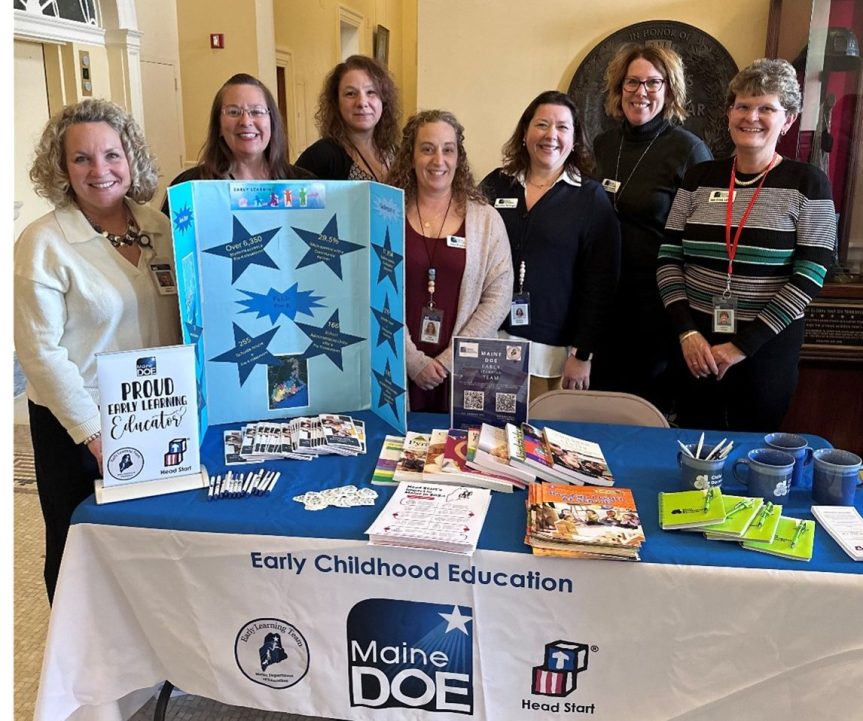
Staff from Maine’s Department of Education’s (DOE) Early Learning Team and Child Development Services gathered with several other Early Childhood agencies, organizations, and programs in the Hall of Flags at the Maine State House in Augusta on Thursday, March 21st for the annual Early Childhood Day at the Hall of Flags.

The event allowed early childhood educators, families, and advocates to unite to celebrate and elevate the need for high-quality early care and education (ECE) opportunities and the importance of a strong ECE workforce in Maine.

Maine DOE Early Learning Team and members of Child Development Services (pictured above) took part in the event by sharing resources and facilitating a session related to public pre-k partnerships.

For more information and resources on early learning in Maine, visit:


Maine Department of Education Ramping Up for Kindergarten Entry Inventory Project

Calling all Maine kindergarten teachers, administrators, and curriculum directors! Are you interested in exploring strategies to help support transitions from early childhood settings into a Kindergarten setting? If so, you may be interested in engaging in an upcoming project the Maine Department of Education (DOE) is launching related to the design of a Kindergarten Entry Inventory (KEI).

A KEI is a tool administered in the beginning of Kindergarten to help teachers gather information about children’s development across a range of domains so that teachers can be responsive to children’s learning.  Additionally, data aggregated from KEIs can help strengthen Maine’s early care and education system by identifying areas of steady growth and continuous improvement.

In 2022, the Maine Department of Education (DOE), in partnership with the Department of Health and Human Services (DHHS), was awarded the Preschool Development Renewal Grant B-5. This three-year, $8,000,000/year grant supports early care and educational programming for our youngest students. One of the many projects included in the grant is the development of a KEI.

If you are an early childhood educator or school administrator serving these grade levels, please be on the lookout for an upcoming survey later this spring. The survey will gather multiple points of information including current assessment practices utilized as part of children’s transition into, and journey through, kindergarten. The survey will also gather educators’ thoughts about the design of a KEI and questions they may have. Additionally, the survey will offer an opportunity to recruit for educator involvement by either serving on a KEI Advisory Team or by being a Kindergarten Entry Implementation Team Member.

Keep watching your emails. More details and information will follow soon.

For questions, please reach out to Karen Mathieu, Maine DOE Kindergarten Entry Inventory Specialist, at karen.mathieu@maine.gov .