Public Pre-K Partnership Pilot Grant Request for Applications (RFA) 

Maine’s Preschool Development Renewal Grant is supporting the Maine Department of Education in offering grant funding to school administrative units (SAUs) to increase the number of eligible 4-year-olds attending high-quality public Pre-Kindergarten (Pre-K) programming through partnerships with licensed community providers (center-based and family child care) during the 24-25 school year.

In order to realize its goal of achieving universal access for students to public Pre-K, the State is supporting SAUs in increasing the number of partnerships with licensed community-based providers (e.g., center based and family child care) to ensure equitable access to high-quality early care and education, especially for our most vulnerable children.

Partnerships with licensed community-based providers support SAUs to achieve full-day/full-week programming for children and to meet the needs of working families while increasing their offering of Public Pre-K.

The Public Pre-K Partnership Pilot Grant RFA will provide funding to support new partnerships with either a licensed center based provider or a licensed family child care provider.

The timeline for the RFA process is as follows:

  • March 22, 2024-RFA Released
  • April 8, 2024—Question Submission Deadline
  • April 25, 2024- RFA Submission Deadline

All questions about the Pre-K Partnership Pilot Grant RFA should be submitted to the Pre-K Partnership Pilot Grant Coordinator identified on the Grant RFPs and RFAs webpage.

Any additional questions about this opportunity may be directed to Michelle Belanger, Pre-K Partnership Specialist, Michelle.Belanger@maine.gov.

(Registration Deadline Extended) Maine DOE and DHHS to Offer Early Childhood Summer Regional Summit Events With Mini Grant Opportunity

The Maine Department of Health and Human Services (DHHS), in partnership with the Maine Department of Education (DOE), was awarded a Preschool Development Renewal Grant (PDG) from the US Department of Health and Human Services in December of 2022. With this three-year grant, the state is implementing initiatives to build greater infrastructure and capacity to create a more coordinated, efficient, and high-quality mixed delivery system for children ages birth to eight and their families. The plan builds upon successful cross-agency work to ensure that all children enter Kindergarten prepared to succeed and are well supported during the early elementary years.

Included in this grant is the opportunity for a summer summit series in 2024 and 2025 to support communities in their local system alignment and coordination for early childhood care and education programming from birth through the early elementary years.  Teams accepted to participate in the summit will also be awarded $800 mini grants to support their efforts in developing and implementing action plans to address an identified early care and education need in their communities.

The goals of the Early Childhood Summit include:

  • Fostering community level coordination and collaboration across the mixed-delivery early care and education system, which includes child care programs, head start and elementary schools, to improve alignment and transitions for children and families.
  • Strengthening understanding of evidence-based practices that are critical to leverage across the birth-grade 3 span in order to promote whole child development.
  • Supporting community-based planning and implementation efforts through mini-grants and ongoing technical assistance support.

What will the summit structure be like? 

The content of the summit will include a variety of keynote addresses and workshop sessions connected to the goals outlined previously.  Topics will include promoting inclusionary practices and addressing challenging behaviors, promoting play as a foundational learning strategy,  and promoting smooth transitions from early childhood education programs into public schools for children and families.  Time will also be provided for teams to work collaboratively on action planning.

When will the summits be held? 

The 1-day summits will be held in two regions (see dates/locations below).  Teams will apply to attend in one of the two locations.  The summits will run from 8:30 a.m.- 4:00 p.m.

  • Thursday, July 11, 2024, Keeley’s Banquet Center, 178 Warren Avenue, Portland, Maine
  • Tuesday, July 16, 2024, Jeff’s Catering & Event Center, 15 Event Center Way, Brewer, Maine

What are the requirements of participation for all team members?

All team members will be expected to participate in the professional development and technical assistance components outlined below.

The components include: Projected timeline:
One check in meeting prior to the July 2024 Summit   June 2024
Attendance and participation at Summer Summit July 2024   July 11 or 16, 2024
Bi-annual consult with the Departments (1/2)   Fall 2024
Bi-annual consult with the Departments (2/2)   Winter 2025
Attendance and participation at Summer Summit in July 2025   July 2025


What is the composition of teams?

Teams may have up to five members.  There must be at least:

  • one public early elementary school educator and
  • one child care provider/educator represented (family child care and/or child care center) on the team.

The additional three members may include but are not limited to:

  • Representative of the local business community
  • Parent of a child using early childhood services
  • School Administrator
  • Home Visitor
  • Mental health care provider
  • Head Start Representative
  • Health care provider
  • Community librarian
  • Representative of an organization that supports workforce development
  • Provider of services under the federal Individuals with Disabilities Education Act, Part B or Part C
  • Provider of professional development to early care and education professionals
  • A faculty member of a career and technical center or higher education institution specializing in early childhood, if available

How will the mini grants work?

Each team will receive an eight-hundred-dollar ($800) grant to support their action planning and implementation work over the first year. Another min-grant will be available following successful completion of the first year and participation in 2025 summit.

To apply: 

Complete the application found here (Word Doc) and return all documents electronically by May 20, 2024 to Andrea Faurot at Andrea.Faurot@maine.gov.

All team members must sign an agreement ensuring team participation.

For additional information, please reach out to Renee Reilly, Maine DOE PDG Manager at Renee.A.Reilly@maine.gov or Andrea Faurot, OCFS PDG Manager at Andrea.Faurot@maine.gov.

Information for Celebrating The Week of the Young Child April 6th – 12th

The Week of the Young Child is a national event promoting the importance of high-quality early learning sponsored by the National Association for the Education of Young Children (NAEYC).  This year the Maine Department of Education and the Office of Child and Family Services are teaming up to support early childhood educators across the state to join the celebration and promote the vital work they do every day in their child care programs and Pre-K through 3rd grade elementary school classrooms.

The event takes place during the Week of April 6th – 12th with a kickoff on Saturday and interdisciplinary daily themes for the following week.

We hope that you will join us in celebrating the Week of the Young Child! To help elevate the importance of high-quality early learning and care for the great community,  please share photos through this form to show how your early learning program/classroom celebrates the Week of the Young Child by utilizing high-quality practices and strategies to build positive relationships and a sense of community in your early care and education setting.

We can’t wait to see the positive impact Maine’s early educators are making with the children and families in your program or classroom! To celebrate your efforts, we will be running a raffle for each day of the week. Your name will be entered once for every submission you make on the link above and the winner each day will receive a package of SWAG with items provided from the Office of Child and Family Services, the Early Learning Team at the Department of education, Maine Roads to Quality and the Maine Association for the Education of Young Children!

Don’t forget to mark your calendar for Early Childhood Education (ECE) Day at the State House on Thursday, March 21, 2024.  This is an opportunity for early childhood educators, families, and ECE supporters to work together to elevate the need for high-quality early care and education opportunities and for the importance of a strong ECE workforce.  Join us to celebrate the successes and call attention to the ongoing needs.  For more information visit the events section of the MaineAEYC website.

If you have questions or would like more information on the Week of the Young Child, please reach out to one of the members of the Early Learning Team and/or a member of the Office of Child and Family Services listed below.

Early Childhood Specialist, Nicole.Madore@maine.gov

Family and Community Engagement Program Manager, Megan.Swanson@maine.gov

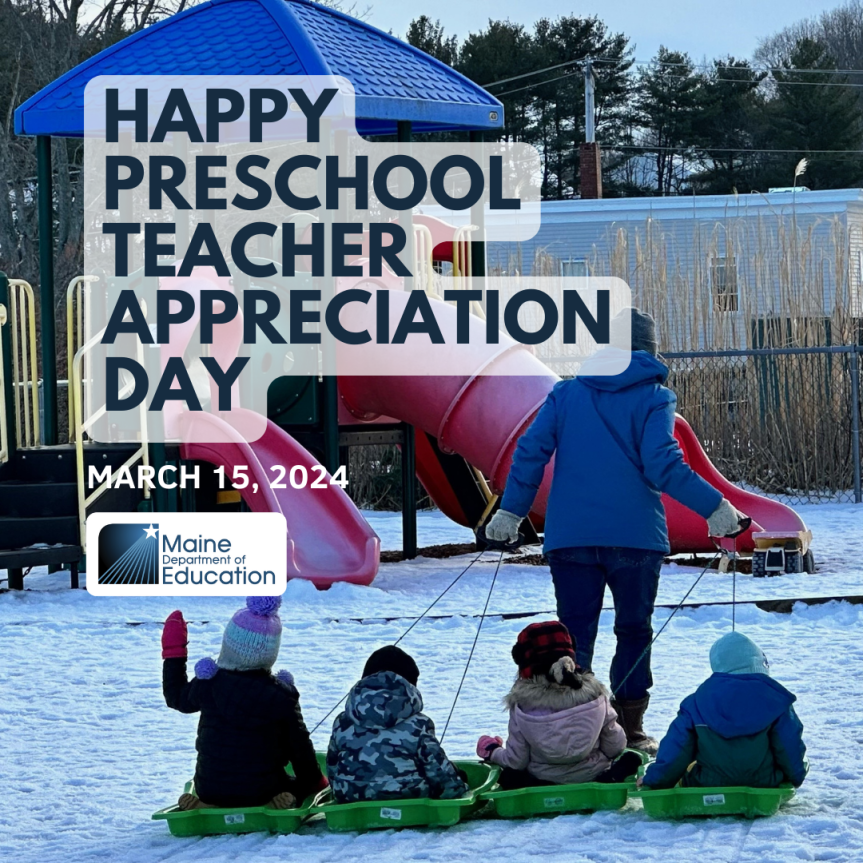
Celebrating National Preschool Teacher Appreciation Day on March 15, 2024

Preschool education is the essential foundation in a child’s developmental and educational journey. Neuroscience has demonstrated that the greatest period of brain development occurs in the preschool years, making high-quality experiences during this time pivotal for supporting life-long learning.  The Maine Department of Education (DOE) is proud to celebrate National Preschool Teacher Appreciation Day on March 15, 2024, honoring Maine’s amazing public preschool programs and especially the backbone of these high-quality programs which are teachers themselves.

In Maine, preschool represents a lot of different programs funded by the state and federal government including Maine’s Child Development Services (CDS), which provides special education services to preschool and school-aged children through a network of nine regional sites, in addition to Head Start, a federal program that promotes the school readiness of children from low-income families with currently 11 programs across the state, as well as the 255 schools in over 165 school administrative units throughout Maine enrolling students in Maine’s amazing public pre-K programs.

“In preschool, children are beginning to develop their identities as lifelong learners, to love school, and to be curious,” said a pre-K teacher at Brunswick School Department. “They become curious about themselves, curious about each other, and curious about the world. Being the first stop in a child’s educational journey is part of the magic of being a preschool teacher.”

Maine is fortunate to have such a robust system for preschool children that is growing larger and stronger every year. The strength of these programs and the very reason they are successful is because of the preschool teachers and their dedication to meeting the needs of Maine children and their families.  The return on investment in early education is larger than investments made in adolescence and adulthood, making the impact of preschool educators even more significant.

Here are what some of Maine’s preschool program coordinators had to say about their preschool teachers:

“Our preschool teachers are consistent and caring with the children at the CDS Preschools,” said Heather West, one of Maine’s Child Development Coordinators. “The kids light up when they see their teachers at arrival time, and it shows how important they’ve become to each other. You can tell that the teachers truly care about each child and family they work with!”

“SKCDC is so grateful to have an amazing team of early educators,” said Southern Kennebec Child Development Corporation (a Head Start program) Agency Director Cristina Salois. “They bring joy to their work, and children benefit from exploring, experimenting, and discovering indoors and out!”

Child Development Services Coordinator Deb Mullis shared what a parent told her recently, “My child lights up when we pull into the parking lot, and she sees her teacher ready to greet her.”

“Our children have been making tremendous progress toward their IEP [individualized education plan] goals due to the hard work and consistency of the teachers,” added West. “It wouldn’t be possible without the preschool teachers!”

Here are some pictures from preschool programs across Maine:

Pre-K Partnership Pilot Grant Informational Session

Is your school administrative unit (SAU) interested in starting or expanding public Pre-K with a community partner for the upcoming 2024-25 school year?  If so, the Maine DOE’s Early Learning Team invites you to attend an informational session regarding a Pre-K Partnership Pilot Grant opportunity we anticipate releasing this Spring.

Pre-K Partnership Pilot Grant Informational Session

  • Date: March 13, 2024
  • Time: 2:00 pm – 3:00 pm
  • Description: To review the grant and pilot opportunity and anticipated requirements.
  • Register here

Through funding provided by Maine’s Preschool Development Renewal Grant, the Maine Department of Education intends to conduct a pilot to provide grant funding to School Administrative Units (SAUs) to increase the number of eligible 4-year-olds attending high-quality public Pre-Kindergarten (Pre-K) programming in licensed community partner settings (center-based and family child care). To realize its goal of reaching universal access to public Pre-K, the state will need to increase the number of partnerships with licensed community-based providers (e.g., center-based and family child care) to ensure equitable access to high-quality early care and education, especially for our most vulnerable children.

Applicant SAUs awarded these grant funds will be required to partner with licensed community-based providers (e.g., center-based and family child care) to provide either full-day/full week or half-day/full week Pre-K programming. For this pilot, Head Start partnerships will not be considered.  A partnership is characterized by meaningful involvement in the planning, developing, and delivering of the proposed program for students and families.

The informational session will be recorded in case an interested entity isn’t able to attend. Following the informational session, interested SAUs/community partners should monitor the DOE Newsroom and the Division of Procurement Services site for the release of the RFA.

Questions may be directed to Michelle Belanger, Pre-K Partnership Specialist at michelle.belanger@maine.gov.

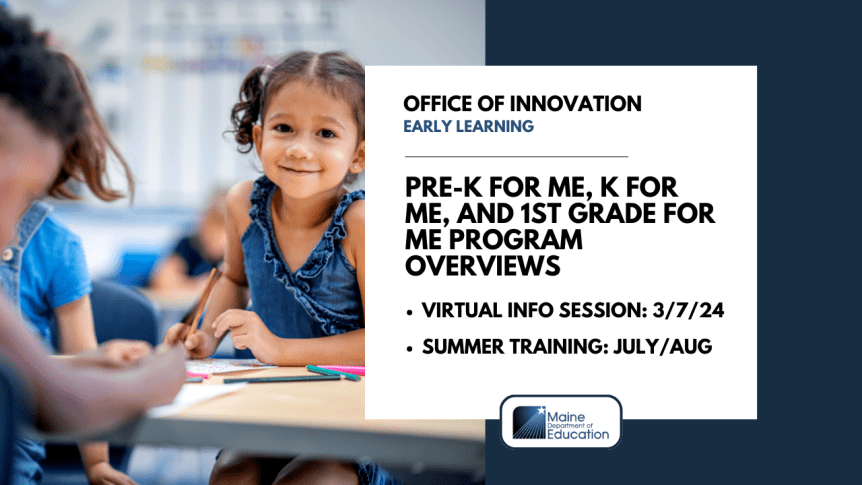
Pre-K for ME, K for ME, and 1st Grade for ME Program Overviews and Summer Training Opportunities

Since 2018, the Maine Department of Education (DOE) has adapted and piloted open-source instructional programs for early elementary grades based on the Boston Public School’s evidence-based Focus Curricula.  Pre-K for ME was launched in 2019,  K for ME was launched in 2021, and 1st Grade for ME was launched in 2023. 2nd Grade for ME is being piloted in Maine classrooms next year and will be made available for the 2025-2026 school year. These developmentally appropriate learning programs are interdisciplinary and align with Maine’s learning standards. While Maine schools are responsible for the purchase of classroom materials that support the use of these programs, lesson plans, outlines and other supporting documents can be accessed at no cost via the Maine DOE’s website.

An informational overview of the programs will be provided on March 7 from 3:30-4:30. The overview session will be recorded and posted for anyone unable to attend the live session. The overview session will share the basic program structures and review the materials needed to implement the programs.  If unfamiliar with the programs, attending the overview (or watching the recording) is highly recommended.

Overview Session on March 7th,  3:30-4:30 – Register here.

Educators/schools/programs interested in utilizing Pre-K for ME, K for ME and/or 1st Grade for ME in the coming year may take advantage of initial trainings scheduled this summer.  These trainings are provided at no cost to promote understanding of program design and to support successful program implementation.  School administrators are strongly encouraged to attend the trainings with their Pre-K, Kindergarten and/or first grade teachers.  Special educators, education technicians, and instructional coaches/curriculum leaders who work with pre-k, kindergarten and first grade teachers are also encouraged to attend. There is no cost to attend summer trainings.

This year’s training opportunities will be held in person from approximately 8:30 a.m. to 3:30 p.m. 2-day trainings are provided for each program.

  • Pre-K for ME– During the week of 7/29-8/2 (exact dates and location TBD)
  • K for ME– July 29th and 30th in the Augusta/Waterville area (exact location TBD)
  • 1st Grade for ME– July 31st and August 1st in the Augusta/Waterville area (exact location TBD)

For teachers learning the K for ME and 1st Grade for ME programs, an additional training day will occur on Wednesday, June 26th from 8:30 to 3:30 (location TBD).  Registration for these trainings should be completed by principals/educators with one registration on behalf of their school/program per grade.  Details about how to prepare for the trainings and the training locations will be provided via email after registrations are received. Registrations for the 2-day training for each instructional program should be received by May 24, 2024.

The Summer Training Registration Link is now open. Please submit a separate response for each grade level in which you are registering educators: Pre-K for ME, K for ME, and/or 1st Grade for ME.

For additional information about Pre-K for ME, contact Marcy.r.Whitcomb@maine.gov and for K for ME and 1st Grade for ME, contact Leeann.Larsen@maine.gov or Nicole.Madore@maine.gov.

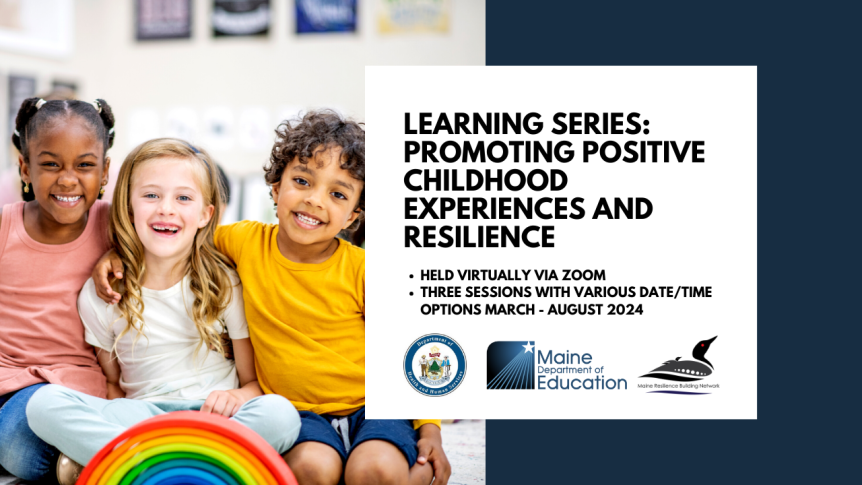
Learning Series for Supporting Children, Families, and Communities to Thrive: Promoting Positive Childhood Experiences and Resilience

The Maine Department of Education’s (DOE) Early Learning Team and Maine Department of Health and Human Services (DHHS) Office of Child and Family Services, in partnership with The Maine Resilience Building Network, are excited to announce a professional learning opportunity for childcare and public-school educators working with children from birth to 8 years old. Supporting Children, Families, and Communities to Thrive: Promoting Positive Childhood Experiences and Resilience will bring together early care and education practitioners working across the birth to grade 3 span to participate in professional learning programs during 2024-2025. These free virtual (via Zoom) opportunities are funded through Maine’s Preschool Development Renewal Grant.  Two contact hours are available for each session.

Review these descriptions of each session’s content:

The Impact of Experience: How Adverse Childhood Experiences (ACEs) and Positive Childhood Experiences (PCEs) Impact Healthy Child Development (Part I)

Join this training to gain a comprehensive understanding of how both adverse and positive childhood experiences sculpt the foundation of individual development and uncover the transformative potential of PCEs in nurturing the children with whom you work.

Learning Objectives:

  • Grasp the nuances of early brain development influenced by ACEs and PCEs
  • Gain insights into ACEs and PCEs and how PCEs can nurture healthy development
  • Learn cognitive reframing techniques to focus on protective factors and strengths

A Framework for Implementing Positive Childhood Experiences to Support Healthy Child Development (Part II)

Join this training to learn the framework for promoting positive childhood experiences and support healthy childhood development through the lens of relationships, environment, engagement, and emotional growth. Attendance at Part 1 is strongly encouraged but not required to attend this training.

Learning Objectives:

  • Summarize the way positive and negative experiences impact brain development
  • Employ practical strategies for fostering positive environments in educational and caregiving settings
  • Gain insights into creating safe, stimulating, and inclusive spaces that encourage exploration, creativity, and positive interactions

Addressing Compassion Fatigue and Resilience Strategies in Educators and Caregivers

Join this training to explore stress impact and address compassion fatigue by developing strategies that promote resilience and reconnect you with the “why ” of your work.

Learning Objectives:

  • Help participants identify how stress presents to them
  • Understand the signs and symptoms of compassion fatigue
  • Develop 5 personal and professional resilience strategies that address compassion fatigue and foster wellbeing

Participants may choose to register for one, two or all three trainings in any order between March-August 2024. It is recommended, but not required, that participants register for Part I and Part II in sequence.

Session Title Dates Offered Registration Link
 

The Impact of Experience: How Adverse Childhood Experiences and Positive Childhood Experiences Impact Healthy Child Development (Part I)

Monday, 3/04/24
3:00-5:00 PM
https://maineresilience.org/event-5616732
Tuesday, 4/9/24
6:00-8:00 PM
https://maineresilience.org/event-5616738
Wednesday, 5/08/24
3:00-5:00 PM
https://maineresilience.org/event-5616745
Monday, 6/03/24
6:00-8:00 PM
 https://maineresilience.org/event-5616755
Monday, 8/05/24
9:00-11:00 AM
https://maineresilience.org/event-5616800
 

A Framework for Implementing Positive Childhood Experiences to Support Healthy Child Development (Part II)

Monday, 3/11/24
3:00-5:00 PM
https://maineresilience.org/event-5617531
Tuesday, 4/23/24
6:00-8:00 PM
https://maineresilience.org/event-5617532
Wednesday, 5/15/24
3:00-5:00 PM
https://maineresilience.org/event-5617534
Monday, 6/10/24
6:00-8:00 PM
https://maineresilience.org/event-5617536
Monday, 8/12/24
9:00-11:00 AM
https://maineresilience.org/event-5617537
 

Addressing Compassion Fatigue and Resilience Strategies in Educators and Caregivers

Monday, 3/18/24
3:00-5:00 PM
https://maineresilience.org/event-5617542
Tuesday, 4/30/24
6:00-8:00 PM
https://maineresilience.org/event-5583415
Wednesday, 5/22/24
3:00-5:00 PM
https://maineresilience.org/event-5617548
Monday, 6/24/24
6:00-8:00 PM
https://maineresilience.org/event-5617550
Monday, 8/19/24
9:00-11:00 AM
https://maineresilience.org/event-5617551

Pilot Opportunity for ‘2nd Grade for ME’ Instructional Program

As part of the Maine Department of Education’s (DOE) efforts to adapt and offer open-source, interdisciplinary, Whole Student instructional programming for the early elementary grades, the Maine DOE will be conducting a pilot for its 2nd Grade for ME program during the 2024-25 school year. To date, the Maine DOE has piloted, adapted, and posted the Pre-K for ME,  K for ME and 1st Grade for ME instructional programs, all of which are based on the Boston Public Schools’ Focus programs.  Participation in the pilot will provide pilot teachers with the materials and ongoing professional learning needed to implement the program. The process will also encourage pilot teachers to test and suggest adaptations/enhancements specific for Maine.

If you are a grade 2 teacher interested in being part of the pilot, please consult with your building principal and consider attending an overview session. Principals and curriculum leaders are also encouraged to attend. Details about the 2nd Grade for ME program, the pilot timeline, and the responsibilities of school participants and the DOE in the pilot process will be shared. Time for questions will also be provided.

2nd Grade for ME Overview Session
February 29 from 3:30-4:30 p.m.
Register here

The February 29 session will be recorded and a link to the recording will be shared with anyone who registers but is unable to attend.

Please contact Lee Anne Larsen, Early Learning Team Coordinator (Leeann.Larsen@maine.gov) with any questions.

First 10 Community Schools Request for Applications (RFA # 202312243)

The Maine Department of Education (DOE) is accepting applications from school administrative units (SAUs) and Education in the Unorganized Territory (EUT) to be part of a 3-year First 10 Community School pilot project funded through Maine’s Preschool Development Grant.  Developed by Education Development Center, First 10 Community Schools bring together school systems, early childhood programs, and community partners/agencies to improve care and education for young children and their families throughout the first 10 years of children’s lives.  This model works to improve teaching and learning, deepen partnerships with families, and provide comprehensive services for children and families.   

Through this opportunity, pilot sites will be supported in developing and implementing First 10 Community School models.  To learn more about the model and the pilot opportunity, interested applicants are encouraged to view this recorded First 10 Community School information session.  Additional information about First 10 Community Schools can be found on the Maine Department of Education’s First 10 webpage and on Education Development Center’s First 10 webpage.  

Eligible schools that are interested in the First 10 Community School grant opportunity may access the application through the First 10 Community School Request for Applications (RFA)

A timeline for the RFA process is provided below. 

  • December 18, 2023–RFA released 
  • January 4, 2024—RFA question submission deadline 
  • February 1, 2024—RFA submission deadline 

All questions about the First 10 Community School RFA should be submitted to the First 10 Community School Grant Coordinator identified on the Grant RFPs and RFAs webpage. 

Additional questions regarding this announcement should be directed to:
Lee Anne Larsen, Director of Early Learning, Leeann.Larsen@maine.gov 


First 10 Community School Informational Session

Has your elementary school and its community partners been interested in collaborating to support children and families in your community? Have you wondered about the positive outcomes such partnerships can afford? If so, the First 10 Community School model may be just such an opportunity to consider.  Join the Maine Department of Education for an informational session to:

  • learn more about the First 10 Community School model,
  • consider being part of an ongoing First 10 Community School pilot, and
  • obtain answers to questions you have about the model.

An informational session will be held on December 14 from 3:30-4:30 p.m. A link to register for the session can be found below. The session will be recorded and shared if you are unable to attend the live presentation.

Developed by Education Development Center, First 10 Community Schools bring together school systems, early childhood programs, and community partners/agencies to improve care and education for young children and their families throughout the first 10 years of children’s lives.  This model works to improve teaching and learning, deepen partnerships with families, and provide comprehensive services for children and families.  Typical First 10 practices include, but are not limited to:

  • fostering engagement of families with schools and community partners,
  • providing play and learn groups linked to elementary schools,
  • coordinating connections to health and social services,
  • connecting child care providers with elementary schools,
  • improving the quality of early childhood programs,
  • coordinating the transition to kindergarten,
  • conducting joint professional learning among early childhood, pre-k and elementary teachers, and
  • aligning and improving elementary grade curriculum and instruction.

Information about First 10 Community Schools can be found on the Maine Department of Education’s First 10 webpage and on Education Development Center’s First 10 webpage.  For more information, reach out to Lee Anne Larsen, Director of Early Learning, at leeann.larsen@maine.gov or Sue Gallant, First 10 Community School Consultant, at Sue.Gallant@maine.gov.