Workshops to support SAT

The Maine Department of Education and College Board are pleased to provide Maine educators with three opportunities to learn more about the updated SAT and tools available to inform instruction. College Board will present its annual Fall Counselor Workshop to share updates, tools, tips and resources to support students as they move along the college and career path.

Maine DOE and College Board will present half day workshops for administrators to explore tools that inform instruction and curriculum. Maine DOE and College Board will also present full day workshops for teachers to better understand SAT data, analysis tools, and instructional responses relative to implementing Maine’s ELA and math standards.

 Annual Fall Counselor Workshops, Presented by the College Board

The College Board will present Annual Fall Counselor Workshop in five locations. These sessions will focus on enhancements to programs and changes to protocols in ordering and administering the SAT Suite of Assessments. Sessions begin at 8:30 and will end at 11:00.

Date Site City Registration
Sept.12 University of Maine at Presque Isle Presque Isle UMPI
Sept. 13 University of Southern Maine Portland USM
Sept. 19 Husson University Bangor HUSSON
Sept. 20 University of Maine Farmington Farmington UMF
Sept. 26 Thomas College Waterville THOMAS

Do More With Your SAT Scores! Presented by The Maine Department of Education and College Board

Making meaning of assessment data is a critical component of providing support for teachers, for students, and for families. Perhaps the most powerful tool available to teachers is the Question Analysis tool. This digital tool includes every question on the annual common form and allows sorting by a variety of options. In this session, we will explore methods of making effective use of the College Board’s Assessment Reporting for K12 Educators.  Sessions will begin at noon and end at 2:30. Please plan lunch on your own as lunch will not be provided.

You will need a user name and password for the K12 Score Reports portal at College Board.

(Please note that you must register even if you have already registered for the morning session)

Date Site City Registration
Sept.12 University of Maine at Presque Isle Presque Isle UMPI
Sept. 13 University of Southern Maine Portland USM
Sept. 19 Husson University Bangor HUSSON
Sept. 26 Thomas College Waterville THOMAS

SAT: Standards, Instruction, and Responding to SAT Data

During full day workshops, teachers will take a deep dive into either ELA (Evidence-based Reading and Writing along with the essay) or math to better understand how the SAT measures our learning standards, how to use data from the SAT results to inform instruction, and what instructional moves reflect the deeper learning necessary to demonstrate achievement on the Updated SAT.  Participants in this day-long workshop will learn about the updated SAT and how to use the system of supports to benefit student learning and teacher instructional strategies.

  • The ELA (ERW) session will include strategies for identifying instructional priorities based on data, a deeper understanding of the standards and how they are assessed, and an exploration of essay data and instructional strategies for on-demand writing.
  • The participants in the math session will identify common errors and misconceptions in student responses and will experience instructional strategies to support student learning.

Participants will have to register for either ELA or math sessions for the full day.  Schools are encouraged to send teams consisting of content teacher leaders at grades 9/10 and 11/12 as well as a building administrator or curriculum coordinator.

Please note that you will have to enter each person separately.

Date Site City Registration
10/17/2017 University of Maine at Farmington Farmington UMF
10/18/2017 University of Southern Maine Portland USM
10/20/2017 Black Bear Inn & Conference Center Orono BLACK BEAR INN
11/14/2017 University of Maine at Presque Isle Presque Isle UMPI


For more information about these workshops, contact Michele.r.mailhot@maine.gov, math specialist, or morgan.dunton@maine.gov, ELA specialist.


Join the Read to Ride Summer Reading Challenge

If you are like many teachers and parents at this time of year, you are celebrating the growth students have made as learners but wondering if that growth will be maintained over the summer months. Keeping young minds stimulated during summer vacation is so important to maintaining learning gains and one of the best ways for students to keep their minds active is through regular reading.

The Read to Ride Summer Reading Challenge provides any opportunity to motivate students to read this summer. The Maine Department of Education is collaborating with the Freemasons of Maine to sponsor this contest for students in grades PK-8. The Maine Freemasons have generously donated 48 bikes with helmets as prizes for the Read to Ride Summer Reading Challenge.

Any school serving students in grades PK-8 may register by June 16, 2017 to participate. Students who read (or are read to if they are not yet reading) at least 500 minutes during summer vacation will be eligible for their school level drawing. Participating schools will document which students have completed the challenge and hold a drawing to select two students (one boy and one girl) to enter into the state level drawing to be held on September 22, 2017. Schools are encouraged participate and to coordinate this opportunity with any other summer reading challenges/programs they offer. Details about the Read to Ride Summer Reading Challenge and about how to register your school can be found at: http://www.maine.gov/doe/literacy-for-me/summer-literacy.html.

Questions may be directed to Maine DOE’s Literacy Specialist Lee Anne Larsen at leeann.larsen@maine.gov.

PRIORITY NOTICE: Maine DOE announces change in English learner reclassifications

Maine DOE has changed English learner reclassifications to Overall Composite Proficiency Level Score of 5 or greater on ACCESS 2.0.

Maine recently received its 2016-17 ACCESS 2.0 for ELLs scores and many of our English learners scored at proficiency levels lower than expected. This is because of a process that established new expectations for what scale score students must achieve in order to reach each proficiency level.

WIDA explains as follows: “The changes to students’ ACCESS for ELLs 2.0 proficiency level scores reflect the increased language demands of college and career readiness standards. WIDA raised the bar for language proficiency and students needed to showcase higher language skills in 2016–2017 to achieve the same proficiency level scores (1.0–6.0) in previous years. This is the result of a process to determine the student performance required for each proficiency level through a series of decisions made for each grade level by expert panels of teachers as well as district and state English language learner administrators.”

The following bullets are intended to clarify what has changed and what has not:

  • The ACCESS for ELLs 2.0 test questions did not get more difficult.
  • The scoring of the ACCESS for ELLs 2.0 domains did not change.
  • The same performance on the ACCESS for ELLs 2.0 in 2015-16 and in 2016-17 would also result in the same scale score.
  • The only change is in the scale score required to achieve each proficiency level (1-6).
  • At each level, in 2016-17, the student needed to achieve a higher scale score to reach a given proficiency level.
  • In other words, the same performance in 2015-16 and in 2016-17 would result in the same scale score, but the proficiency level score would be higher in 2015-16 than in 2016-17.
  • If parents or teachers want to know if a child’s English language proficiency improved from 2015-16 to 2016-17, they should compare the scale scores across the two years, but not the proficiency level scores.

The exit criterion in Maine has always been rigorous. We are currently the only state that requires a 6.0 proficiency score on the overall composite. After looking at our 2016-17 data, it is apparent that the 6.0 exit criterion is too high given the new cutscores for proficiency levels. We have therefore changed Maine’s exit criteria to a 5.0 proficiency level score. The 5.0 proficiency level in 2016-17 is similar to the 6.0 proficiency level in earlier years.

You may find the following materials helpful:

Direct questions about ACCESS for ELLs 2.0 and the educational or English language acquisition services for English learners to Nancy Mullins, Maine DOE ESL/Bilingual Programs, at nancy.mullins@maine.gov (207) 624-6788.

Read to Ride Summer Reading Challenge

Summer vacation is a welcome break from the daily school routine for children and parents alike, but the summer months can be a significant interruption to students’ learning if young minds are not kept active while school is out of session. Summer learning loss is a well-documented phenomenon, particularly with respect to reading achievement. Students can lose up to three months of reading progress during the summer. When all of the summers in a child’s PK-8 school career are combined, this can result in 1-2 years of lost reading progress.

Fortunately, preventing the summer slide can be greatly reduced when students continue to read on a regular basis. When children are encouraged to read from a variety of resources for fun and the pleasure of learning, they continue to practice applying the skills they have learned, build their vocabulary and widen their knowledge of the world. For students who are not yet reading independently or just beginning to read, reading to and with them is equally beneficial.

In an effort to promote summer reading, the Maine Department of Education is collaborating with the Freemasons of Maine to sponsor the Read to Ride Summer Reading Challenge for students in grades PK-8. The 18,000 Freemasons of Maine are pleased to expand their popular statewide Bikes for Books student reading incentive program to now encourage children to read during the summer. The Bikes for Books program provides over 2,000 bikes to Maine schoolchildren each year to promote literacy. The Maine Freemasons have generously donated 48 bikes with helmets as prizes for the Read to Ride Summer Reading Challenge.

To earn a chance to be entered into the State level drawing, students must meet the challenge of reading at least 500 minutes during the summer vacation period. Any school with students in the PK-8 grade span may register to participate. Participating schools will collect documentation of students who have completed the challenge. They will hold school level drawings to select two students (one boy and one girl) whose names will be entered into the state level drawing to be held on September 22, 2017.  Schools are encouraged to participate in this challenge, to coordinate it with any other summer reading challenges/programs they offer and to consider soliciting their own local level prizes for students who complete the challenge. Details about the Read to Ride Challenge and about how principals can register schools can be found at: http://www.maine.gov/doe/literacy-for-me/summer-literacy.html. Please forward this information to your school principal to make them aware of this opportunity.

Questions may be directed to Maine DOE’s Literacy Specialist, Lee Anne Larsen, through email (leeann.larsen@maine.gov) or phone (624-6628).

Webinar about Maine: 2017 ACCESS for ELLs 2.0 Score Changes

Maine: 2017 ACCESS for ELLs 2.0 Score Changes Webinar
Wednesday, March 29, 2017 at 3:00 pm

Event address for attendees

During the webinar WIDA will discuss the anticipated ACCESS for ELLs 2.0 score changes.

In 2017, you may notice a change to your students’ ACCESS for ELLs 2.0 proficiency level scores: some students’ scores may go down; and fewer students may exit program support.

Earlier this month, WIDA held webinars detailing expected changes to ACCESS for ELLs 2.0 scores in 2017, to explain the reasons for anticipated changes in students’ scores as well as suggestions for how to communicate with students and families, other educators, and administrators about how it might impact them. These two webinars were recorded and posted to the WIDA website.

During the March 29th webinar, WIDA will briefly summarize the key information shared on these earlier webinars. Participants in the March 29, 2017, webinar will have ample opportunity to ask questions of either WIDA or their state representative(s). The Maine March 29, 2017, webinar will also be recorded and posted on  https://www.wida.us/membership/states/Maine.aspx

For more information about the score changes visit https://www.wida.us/Assessment/ACCESS%202.0/proficiency.aspx

Direct questions about educational or English language acquisition services for English learners to ESL/Bilingual Programs, Nancy Mullins at nancy.mullins@maine.gov (207) 624-6788.

Take the ‘Read to ME Challenge’

Augusta – Maine’s First Lady launched the Read to ME Challenge today at the Blaine House. Reflecting on how she and her husband, Governor Paul LePage, raised their children by reading to them and exploring the world through reading, Mrs. LePage shared, “I knew that when a child learns to read, there is nothing they can’t learn, imagine, or accomplish in life.”

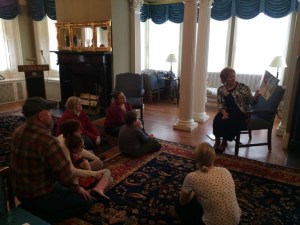
First Lady Ann LePage reads to military children as she kicks off Maine's Read To Me Challenge
First Lady Ann LePage reads to children of military families as she kicks off Maine’s Read To Me Challenge

Reading to children of military families, the First Lady shared two books, Groovy Joe: Ice Cream and Dinosaurs and Baxter in the Blaine House, with her captive audience. Once the children studied the brilliant illustrations of the Blaine House, they were offered the chance to explore and see some of the rooms depicted in the story book. First Lady LePage challenged Brigadier General Douglas Farnum of the Maine National Guard.

Baxter in the Blaine House

The Maine DOE’s Read to ME Challenge runs through March 2, Read Across America Day. Maine DOE Literacy Specialist Lee Anne Larsen wants the momentum to last all month long. “Our goal is to promote the critical importance of reading to and with children from birth through their childhoods. When children are read to regularly, their vocabulary grows, they build knowledge of the world, they stimulate their imaginations, and they discover how words communicate ideas.”

The challenge is simple. Read with a child for at least 15 minutes, capture a photo or video, post it on social media with the hash tags #ReadtoME or #ReadaloudME, and nominate others to do the same. Creative ways of completing the challenge are encouraged – for example, read to a child using FaceTime or Skype. If preferred, you can complete the challenge by listening to audiobooks with a child.

“The enthusiasm has been building since before the launch with schools, libraries and other organizations planning innovative ways of promoting the challenge. All Mainers are encouraged to get involved,” said Larsen.

You can reach Lee Anne Larsen at leeann.larsen@maine.gov to learn more about Maine DOE’s Read to ME Challenge. Go ahead, take the challenge!

Maine DOE Prepares for Year 2 of Read to ME Challenge Campaign

During February of 2016, the Maine Department of Education’s Literacy for ME  initiative organized and promoted the Read to ME Challenge.  This simple but powerful campaign challenged adults to read to children for 15 minutes, to capture that reading episode via a photo and then post it on social media to challenge others to do the same.  Over 100 Maine schools, community literacy teams and other literacy-related organizations partnered in the 2016 campaign and the Maine DOE is hoping that many more organizations will partner in the 2017 campaign scheduled to kick off the first week of February.

Reading aloud to children is one of the most cost effective and highly beneficial methods of building children’s literate abilities.  The simple act of reading aloud to a child 15 minutes a day for five years results in 27,375 minutes of language exposure which can put children on the path to high literacy achievement.  Reading aloud exposes children to the world around them, helps them see reading as an enjoyable and valuable activity and often strengthens bonds with trusted adults.

We invite your school or organization to join the challenge and to encourage community members to do the same.  The collective voice of many key partners, leaders and those in respected positions will send a clear message about the vital importance reading to children plays in the social and economic well-being of Maine.  Maine DOE also encourages partners to be creative and to use this opportunity to enhance ongoing literacy education outreach efforts.

If your organization is willing and able to promote the Read to ME Challenge, please follow this link to provide us with your contact information: Read to ME Challenge Partner 2017Read to ME Challenge resources, including a guidance document, public service announcements, fliers and a list of engaging ways to incorporate the challenge will be available online in mid-December.

School officials and organizations with inquiries about participating in the Read to ME Challenge should contact Lee Anne Larsen at leeann.larsen@maine.gov or 624-6628.

State Assessment Results for 2015-16 Now Publicly Available

Augusta – The Maine Department of Education today released state assessment results for the 2015-2016 school year.

“We are confident in this year’s test results, and hope parents, teachers, administrators, and other interested parties will value and utilize the data gathered through the assessment process,” said Dr. Charlene Tucker, Maine DOE’s Assessment and Accountability Team Coordinator.

The public may access the results at https://lms.backpack.education/public/maine.

Key results include:

  • Assessment participation improved substantially in 2015-16.
  • 50.58% of Maine’s test takers scored At State Expectations (Level 3) or Above State Expectations (Level 4) in English language arts/literacy.
  • 38.31% of Maine’s test takers scored At State Expectations (Level 3) or Above State Expectations (Level 4) in mathematics.
  • 60.97% of Maine’s test takers scored At State Expectations (Level 3) or Above State Expectations (Level 4) in science.

For ELA/literacy and mathematics, 2015-16 is a new baseline year and should not be compared to previous years when different assessments were administered.  Based on changes made during the 127th Maine Legislature, the state used a new assessment partner to administer a different state assessment of English language arts/literacy and mathematics in 2015-16.

The new assessments adopted for 2015-2016, eMPowerME (grades 3-8) and SAT (3rd year high school), measure Maine’s college and readiness standards established in 2011. The eMPowerME assessment was delivered by computer.

Results were released later this year than initially planned due to the time necessary to establish achievement levels and process data for brand new assessments, as well as the time it takes to build a new reporting platform. Maine will use the same assessments and the same reporting system for the 2016-17 year and it is planned for results to be available in the summer of 2017.

Further detailed information on the results is available below.

_______________________________________________________
2015-16 Statewide Results for English Language Arts/Literacy

The general ELA/literacy assessment, eMPowerME, was taken by most students in grades 3-8.  Most students in the third year of high school were assessed using the SAT, which has been adopted as Maine’s ELA/literacy high school assessment.  Students with the most significant cognitive disabilities were assessed on the Multi-State Alternate Assessment (MSAA).  More information about the ELA/literacy assessments can be found here:  http://maine.gov/doe/assessment/math-ela/home.html.

2015-16 Participation (ELA/Literacy)
Of the 93,554  students eligible to participate in state assessment of ELA/literacy, 91,208 participated.  The participation rate of 97.49% is an improvement over the 2014-15 participation rate of 89.92%.  Participation is summarized here:

Eligible to Participate 93,554
Participated General (eMPowerME) 77,443
Participated General (SAT) 12,534
Participated Alternate (MSAA) 1,231
Total Participants 91,208
Participation Rate 97.49%
Percent of Participants Who Took Alternate 1.35%

2015-16 Performance (ELA/Literacy)

  Participants Well Below State Expectations Below State Expectations At State Expectations Above State Expectations
  Number Number Percent Number Percent Number Percent Number Percent
eMPowerME 77,443 15,656 20.22% 23,779 30.71% 25,346 32.73% 12,662 16.35%
SAT 12,534 2,731 21.79% 2,342 18.69% 5,820 46.43% 1,641 13.09%
MSAA 1,231 345 28.03% 217 17.63% 372 30.22% 297 24.13%
TOTAL 91,208 18,732 20.54% 26,338 28.88% 31,538 34.58% 14,600 16.01%

The Maine Assessment & Accountability Reporting System (MAARS) provides additional information about the 2015-16 ELA/literacy assessment results for each school and each district, as well as for student subgroups.

MAARS is publicly accessible at:  https://lms.backpack.education/public/maine.

2015-16 Statewide Results for Mathematics

The general mathematics assessment, eMPowerME, was taken by most students in grades 3-8.  Most students in the third year of high school were assessed using the SAT.  Students with the most significant cognitive disabilities were assessed on the Multi-State Alternate Assessment (MSAA).  More information about the mathematics assessments can be found here:  http://maine.gov/doe/assessment/math-ela/home.html.

Participation (Mathematics)
Of the 93,915 students eligible to participate in state assessment of mathematics, 91,541 participated.  The participation rate of 97.47% is an improvement over the 2014-15 participation rate of 89.53%.  Participation is summarized here:

Eligible to Participate 93,915
Participated General (eMPowerME) 77,741
Participated General (SAT) 12,567
Participated Alternate (MSAA) 1,233
Total Participants 91,541
Participation Rate 97.47%
Percent of Participants Who Took Alternate 1.35%

Performance (Mathematics)

  Participants Well Below State Expectations Below State Expectations At State Expectations Above State Expectations
  Number Number Percent Number Percent Number Percent Number Percent
eMPowerME 77,741 20,678 26.60% 27,049 34.79% 22,207 28.56% 7,807 10.04%
SAT 12,567 3,292 26.20% 4,885 38.87% 3,370 26.82% 1,020 8.12%
MSAA 1,233 321 26.03% 248 20.11% 367 29.76% 297 24.09%
TOTAL 91,541 24,291 26.54% 32,182 35.15% 25,944 28.34% 9,124 9.97%

The Maine Assessment & Accountability Reporting System (MAARS) provides additional information about the 2015-16 mathematics assessment results for each school and each district, as well as for student subgroups.  MAARS is publicly accessible at:  https://lms.backpack.education/public/maine.

2015-16 Statewide Results for Science

The general science assessment, MEA Science, was taken by most students in grades 3-8 and in the third year of high school. The science assessment in grades 5, 8 and the third year of high school remained unchanged for 2015-16.  The Maine Educational Assessment (MEA) for science and its alternate for students with the most significant cognitive disabilities, Personalized Alternate Assessment Portfolio (PAAP), have both assessed the progress of Maine’s students in science for many years.

More information about the science assessments can be found here:  http://maine.gov/doe/assessment/science/index.html.

Participation (Science)
Of the 40,423 students eligible to participate in state assessment of science, 38,568 participated.  The participation rate of 95.41% is an improvement over the 2014-15 participation rate of 90.36%.  Participation is summarized here:

Eligible to Participate 40,423
Participated General (MEA Science) 38,107
Participated Alternate (PAAP) 461
Total Participants 38,568
Participation Rate 95.41%
Percent of Participants Who Took Alternate 1.19%

Performance (Science)

  Participants Well Below State Expectations Below State Expectations At State Expectations Above State Expectations
  Number Number Percent Number Percent Number Percent Number Percent
MEA Science 38,107 4,831 12.68% 10,022 26.30% 19,018 49.91% 4,236 11.12%
PAAP 461 74 16.05% 125 27.11% 215 46.64% 47 10.20%
TOTAL 38,568 4,905 12.72% 10,147 26.31% 19,233 49.87% 4,283 11.10%

The Maine Assessment & Accountability Reporting System (MAARS) provides additional information about the 2015-16 science assessment results for each school and each district, as well as for student subgroups.

MAARS is publicly accessible at:  https://lms.backpack.education/public/maine.

Comparing 2015-16 Results to Previous Years

  • For mathematics and ELA/literacy at grades 3-8, direct comparisons should not be made across years. While every effort was made to ensure that the 2015-16 achievement levels are at a similar level of rigor to that of the 2014-15 Smarter Balanced assessment, the tests are different in many ways, and it is unpredictable how different features of the assessments may have impacted the performance of different populations of students.
  • At the high school level, there is no comparability between the 2015-16 SAT results and the 2014-15 Smarter Balanced results.  First, the group of high school students tested in 2014-15 was seriously impacted by an opt-out trend, which was resolved in 2015-16.  Second, Maine’s SAT achievement levels were determined by a collaborative process with other states that also used the SAT as their statewide assessment in 2015-16.  Utilizing several sources of data, including the input of educators from each state, the consensus across states was to use the College Board’s College and Career Readiness Benchmark as the cut score to define the threshold between Level 2 (Below State Expectations) and Level 3 (At State Expectations).  The scores of 530 in mathematics and 480 in ELA/literacy (Evidence-Based Reading and Writing) are benchmarks that the College Board has determined predict success in college as follows:
    • Students with an SAT Math section score that meets or exceeds the benchmark have a 75 percent chance of earning at least a C in first-semester, credit-bearing college courses in algebra, statistics, pre-calculus, or calculus.
    • Students with an SAT Evidence-Based Reading and Writing (ERW) section score that meets or exceeds the benchmark have a 75 percent chance of earning at least a C in first-semester, credit-bearing college courses in history, literature, social sciences, or writing classes.
  • Science results (both PAAP and MEA Science) are fully comparable to years past.  MEA Science results over time follow:
Science Trends:  Percentage of Students Scoring at Level 3 or 4
Year Grade 5 Grade 8 3rd Year High School
2008-09 55.83% 61.99% 41.00%
2009-10 63.82% 71.83% 41.00%
2010-11 64.59% 70.82% 44.00%
2011-12 62.50% 72.10% 44.41%
2012-13 69.54% 69.98% 41.03%
2013-14 62.86% 73.12% 43.77%
2014-15 64.89% 71.06% 43.00%
2015-16 62.88% 72.97% 46.59%

Conclusions

  • Assessment participation improved substantially in 2015-16.  Science participation increased from 90.36% in 2014-15 to 95.41% in 2015-16.  ELA/literacy participation improved from 89.92% in 2014-15 to 97.49% in 2015-16.  Mathematics participation improved from 89.53% in 2014-15 to 97.47% in 2015-16.  Based on federal and state expectations, we strive for 95% participation in our assessment.
  •  For ELA/literacy and mathematics, 2015-16 is a new baseline year and should not be compared to previous years when different assessments were administered.
  • Alternate assessments are intended for students with the most significant cognitive disabilities.  The 2015-2016 alternate assessment for Maine students with the most significant cognitive disabilities, Multi-State Alternate Assessment (MSAA), was the same assessment administered in 2014-15, known then as the National Center and State Collaborative (NCSC). Under the Every Student Succeeds Act, the state is expected keep participation in alternate assessment to no more than 1.0% of the students assessed beginning with the 2016-17 assessment administration.  Maine’s 2015-16 percentages of 1.19% in science, 1.35% in mathematics, and 1.35% in ELA/literacy exceed the limit under ESSA.  The Maine DOE has provided increased training in the proper identification of students who are eligible for participation in alternate asssessments in order to improve that rate in 2015-16.
  • 50.58% of Maine’s test takers scored At State Expectations (Level 3) or Above State Expectations (Level 4) in English language arts/literacy.  This is a new baseline from which we will measure the growth of Maine’s students.
  • 38.31% of Maine’s test takers scored At State Expectations (Level 3) or Above State Expectations (Level 4) in mathematics.  This is a new baseline from which we will measure the growth of Maine’s students.
  • 60.97% of Maine’s test takers scored At State Expectations (Level 3) or Above State Expectations (Level 4) in science.  This is essentially the same as the 61% who scored at Level 3 or 4 in 2014-15.
  • The Every Student Succeeds Act (ESSA) of 2015 provides an opportunity for Maine to rethink how supports to schools are determined and how to provide supports that are proportional to district and/or school needs. The Maine DOE is currently working with a diverse group of stakeholders to design a new accountability/school review system.  Further information regarding this process can be located at: http://maine.gov/doe/essa.
  • The data in this report is assessment data which includes all tested students.  It is not intended for accountability purposes.  Accountability reporting will follow.

Questions
Media inquiries: jamie.e.logan@maine.gov.

General assessments (eMPowerME, SAT, MEA Science):  nancy.godfrey@maine.gov

Alternate assessments (MSAA, PAAP):  sue.nay@maine.gov

Assessment policy:  charlene.tucker@maine.gov

Navigating MAARS system:  varun.motay@maine.gov

Poetry Out Loud registration open

Maine high schools are invited to register for Poetry Out Loud, a nationwide program that encourages youth to learn about poetry through memorization and recitation while helping students master public speaking skills, build self-confidence and learn about their literary heritage.

Continue reading “Poetry Out Loud registration open”