Integrating Literacy Through Map-Making with David Sobel

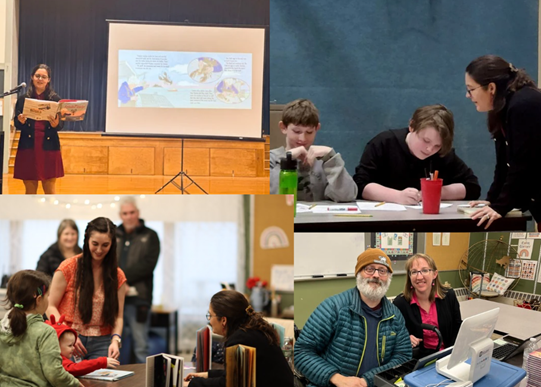
The Interdisciplinary Instruction team in the Maine Department of Education’s (DOE) Office of Teaching and Learning is excited to welcome David Sobel, educator and author of Mapmaking with Children, to Maine on Friday, Nov. 8 for an all-day workshop exploring the connections between map-making and literacy.

Map-making builds and strengthens the cognitive frameworks of reading, writing, and communicating by using symbols, structures, and perspectives analogous to grammar, punctuation, and composition. Whether mapping the relationships of their family members or the landmarks in their neighborhood, kids use maps to bring order to their world, create meaning out of their experiences, and share their knowledge with others.

This workshop will run from 9 a.m. to 3 p.m. at The Steele House in Rockland, Maine. It is free to all Maine educators. Limited in-person spots are available and will be filled, as people sign up. People can also participate virtually via Zoom, and the workshop will be recorded and shared with educators. Contact hours are available to participants.

To register for this event, please use this link.

If you have any questions about this workshop, please contact Kathy Bertini at Kathy.Bertini@maine.gov or Heather Martin at Heather.Martin@maine.gov.

This workshop is the second of four presented by the Interdisciplinary Team on the topic of Integrating Literacy through Applied Learning. All events are available in person and virtually. The remaining workshops are listed below:

December 12, 2024, 8 a.m.-noon: “Integrating Literacy through Background Knowledge” with Josie Cameron at the Wells Conference Center, 169 Hilltop Rd., Orono. Use this registration link to spend the day learning with Josie Cameron.

January 15, 2025, 8 a.m.-noon: “Integrating Literacy through Applied Science” with Katie Coppens at the Curtis Memorial Library, 23 Pleasant St., Brunswick. Use this registration link to spend the day learning with Katie Coppens.


Integrated Literacy Resources for Maine Educators

Literacy has been at the forefront of discussions in education across our state. We are a state filled with creative, engaging, and highly skilled educators – many of whom are actively harnessing new knowledge from evidence-based research to reshape the way their classrooms work and how students interact with their learning.

The Maine Department of Education’s (DOE) Office of Teaching and Learning’s Interdisciplinary Team is excited to continue to support educators with resources to support the integration of literacy across the curriculum.

On the new integrated literacy website, you can:

  • Find new professional development opportunities around Maine,
  • Discover new articles, books, and podcasts on literacy,
  • See what projects are happening in classrooms right now – and share the exciting work you are doing as well, and
  • Register to join in on office hours with Maine DOE staff and your fellow teachers:

Join the excitement and be a part of the conversation with your fellow educators about incorporating effective, evidence-based literacy supports in their classrooms.

To learn more about what other literacy connections the Interdisciplinary Instruction team has to offer, please contact Heather Martin at heather.martin@maine.gov.

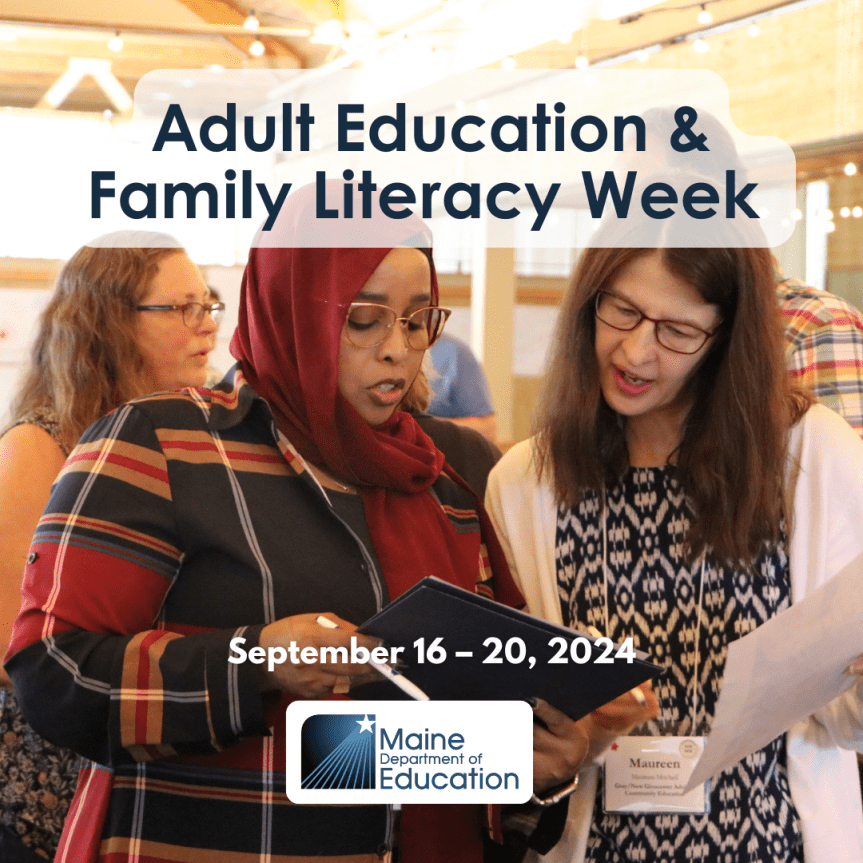
Celebrating Adult Education Family Literacy Week

Governor Mills has proclaimed September 16 – 20 as Adult Education and Family Literacy Week! Last year, Maine’s Adult Education programs helped over 12,900 students train for a career, earn their high school credentials, prepare for college, and learn English. Located statewide, over 65 adult education programs are part of the public education system and assist adult learners with their next educational and career steps.

Read more about the impact of Maine’s adult education programs:

Workforce

Maine Adult Education is helping fill the gaps in the workforce with collaborative and creative efforts with community partners and employers. From renewable energy and healthcare to commercial driving, adult education programs offer affordable workforce training that lead to certifications and credentials. Last year, Maine’s adult education programs awarded 2,600 certifications in high-demand industries. Read about Portland Adult Education’s Renewable Energy Program

English Language Acquisition

Maine’s adult education programs worked with over 6,000 multilingual learners last year, helping them strengthen their English skills, assisting them with training for jobs and college, and helping them prepare for US citizenship. Check out South Portland Adult Education’s Customer Service English Class

HiSET- Maine’s High School Equivalency Test

Did you know almost 1,000 Maine adults earned their high school credentials through Maine adult education last year? Maine adults can earn their high school equivalency (HiSET®) or high school diploma for free through adult education. Search the Maine Adult Education Class Search, or look for Adult education programs near you.

Maine College Career Access (MCCA)  

Did you know over 1,700 adults accessed Maine’s adult education programs to advance their career and college ready skills through the Maine College and Career Access program? Adult education can help adults get ready for college and career through advising, career exploration, college navigation, academic and digital skill building, and more. Learn about Lewiston’s Maine College Career Access Program.

To learn more about Adult Education programs in Maine, visit the Maine Department of Education website, or contact an Adult education program near you.

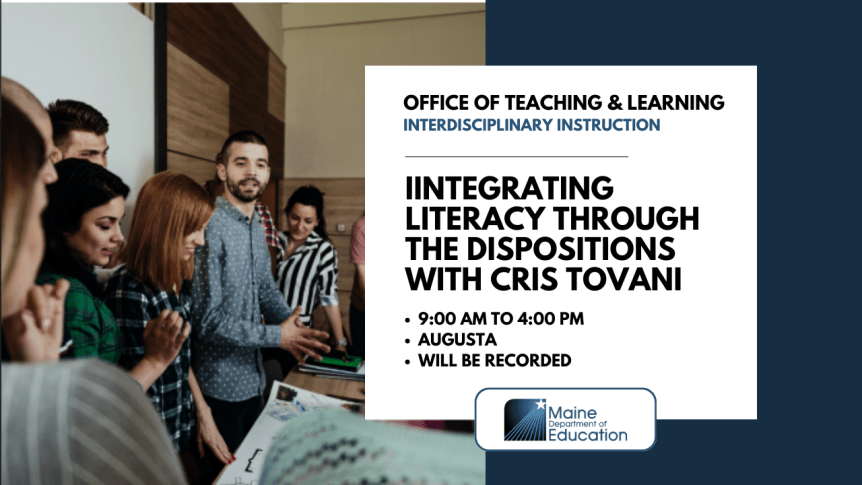
Integrating Literacy through the Dispositions with Cris Tovani

The Interdisciplinary Instruction team from the Maine Department of Education’s Office of Teaching and Learning is excited to bring educator and author Cris Tovani to Maine on October 7th for an all-day workshop that explores ways to engage, excite, and “hook” reluctant learners in building their literacy skills and mastery.

Through the lens of student dispositions, Tovani has discovered ways around the various “masks” some students wear and created opportunities for those students to engage with their own learning in vibrant and authentic ways.

At the conclusion of this workshop, participants will be able to:

  • describe what full engagement looks like and discuss the importance of engagement in literacy competence,
  • provide reasons for students to read, write, and discuss,
  • model for students how to monitor and repair meaning when reading complex text, and
  • state how these discrete tasks, methods, and skills build literacy proficiency.

The workshop will run from 9:00 AM to 4:00 PM at Camp Chamberlain in Augusta, Maine, and is free to all Maine educators. Limited in-person spots are available and will be filled as people sign up. Participants can also participate virtually through Zoom, and the workshop will be recorded and shared with educators. Contact hours are available to participants.

To register for this event, please use this registration link.

If you have any questions about this workshop, please contact Kathy Bertini at Kathy.Bertini@maine.gov or  Heather Martin at Heather.Martin@maine.gov

This workshop is one of four (4) presented by the Interdisciplinary Team on the topic of Integrating Literacy through Applied Learning. All events are available in person and virtually.

November 8, 2024, 9 AM – 3 PM: “Integrating Literacy through Mapmaking” with David Sobel at The Steele House, 639 Main St., Rockland.  Use this registration link to spend the day learning with David Sobel.

December 12, 2024, 8:00 AM—12:00 PM: “Integrating Literacy through Background Knowledge” with Josie Cameron. Wells Conference Center, 169 Hilltop Road, Orono Use this registration link to spend the day learning with Josie Cameron

January 15, 2025,  8 am – 12 noon: “Integrating Literacy through Applied Science with Katie Coppens at the Curtis Memorial Library, 23 Pleasant St., Brunswick. Use this registration link to spend the day learning with Katie Coppens


Integrating Literacy through Applied Learning Workshops

The Maine Department of Education (DOE) Interdisciplinary Instruction Team in the Office of Teaching and Learning is pleased to announce a series of four (4) upcoming workshops on Integrating Literacy through Applied Learning. Registration is free of charge to all Maine educators. Contact hours are available, and all workshops are offered both in person (space is limited) and virtually. Participants will receive additional guidance through monthly Professional Learning Communities (PLCs) hosted by the Maine Department of Education to support the application of new learning in the classroom. All workshops and follow-up sessions will be recorded and posted for future viewing. Interested participants may register using the links in the descriptions.

These workshops provide teachers with both a theoretical understanding of emerging research on Whole Child and literacy instruction and practical strategies to apply in their classrooms. By recognizing literacy as a cross-disciplinary skill, the sessions help educators integrate foundational literacy elements (phonics, phonemic awareness, fluency, vocabulary, and comprehension) into their teaching. This holistic approach aims to enhance students’ literacy skills and boost their confidence in learning across all subjects.

October 7, 2024: “Integrating Literacy through the Dispositions” with Cris Tovani

Monday, 9 am – 4 pm, Camp Chamberlain, 23 Blue Star Ave., Augusta

Use this registration link to spend the day learning with Cris Tovani.

“Even the best reading strategy in the world won’t work if the students are disengaged.” Join educator and author Cris Tovani (Why Do I Have to Read This?) for an all-day workshop to explore ways to engage and excite reluctant readers and learners. Participants in this workshop will gain both insight and practical tools to describe what full engagement looks like, plan so that students are engaged in the work, provide reasons for students to read, write, and discuss, and model how to monitor and repair meaning when reading complex text to promote literacy.

November 8, 2024: “Integrating Literacy through Mapmaking” with David Sobel

Friday, 9 am – 3 pm, The Steele House, 639 Main St., Rockland

Use this registration link to spend the day learning with David Sobel.

“In the beginning, children’s maps represent their experiences of beauty, secrecy, adventure, and comfort. With these effective endeavors as a foundation, I then gradually start to focus on scale, location, direction, and geographic relationships.” Analogous to the foundational skills of reading and writing, mapmaking is a deeply human way for a child to order and make meaning from their world and strengthen literacy. Join acclaimed educator and author David Sobel (Mapmaking with Children) for this hands-on workshop exploring maps and cognitive processes.

December 12, 2024: “Integrating Literacy through Background Knowledge” with Josie Cameron

Thursday, 8 am – 12 noon, Wells Conference Center, 169 Hilltop Road, Orono, ME 04469

Use this registration link to spend the day learning with Josie Cameron.

“Students often tell me they have NO IDEA what to write about! When we dig into place-based writing, they’re surprised to find story ideas hidden right in front of their eyes!” Background knowledge, the information and wisdom acquired through our own lived experiences, has in the past been overlooked. However, as research reveals more about the ways in which students learn, it is gaining recognition as a fundamental element in students’ comprehension and ability to make meaning from text – foundational skills to literacy. Join Josie Cameron, Maine author and educator (Not All Heroes, Maybe a Mermaid) as we explore the importance of background knowledge, and how to harness it for learning!

January 15, 2025: “Integrating Literacy through Applied Science with Katie Coppens

Wednesday, 8 am – 12 noon, Curtis Memorial Library, 23 Pleasant St., Brunswick 

Use this registration link to spend the day learning with Katie Coppens.

“Integrating science and literacy engages students while enhancing their scientific knowledge and improving their writing skills! Not only that, but it’s fun and a great way to see students’ interests through built in voice and choice!” Learn strategies on integrating science and literacy from Maine teacher and author Katie Coppens (The Acadia Files, What do Black Holes Eat for Dinner?,  Geometry is Easy as Pie). Focus will be on strategies to integrate fiction and nonfiction reading and writing in science, thereby gaining proficiency in literacy, with an emphasis on differentiation. Models and rubrics will be provided. Everyone will leave with ideas for implementation in their own classroom.

If you have any questions about this workshop, please contact Kathy Bertini at Kathy.Bertini@maine.gov or Heather Martin at Heather.Martin@maine.gov

Participants are welcome to join for one, all four, or whatever fits their schedule!


Leveling Up Literacy in Maine: Free Self-Paced Modules for Maine Educators this Summer

*Limited Time – Educator Stipends Available for Modules Completed Prior to August 23, 2024.

  • Are you a Maine educator seeking to better understand evidence-based literacy practices and how science can inform your ability to teach children to read and write?
  • Are you interested in engaging professional learning to build your expertise and support recertification requirements?
  • Does earning a stipend for completing professional learning appeal to you?
  • Would you like to engage in professional learning on your own time from the comfort of your home?

If you answered yes to any of these questions, the Maine Department of Education’s (DOE) Literacy Module Opportunity may be a perfect fit.  The Maine DOE is pleased to announce a free professional development opportunity for Maine educators working in Kindergarten–Grade 5 regular and special education settings.  These self-paced, asynchronous, evidence-based literacy modules will be available to educators from June 12, 2024 to June 11, 2025.

The Maine DOE has contracted with AIM Institute© for Learning & Research to offer free access to AIM Steps to Literacy Modules at no cost to Maine Educators. AIM Steps to Literacy modules, which can be taken individually or in course bundles, are fully asynchronous online courses focused on a variety of evidence-based literacy topics. Each Steps to Literacy module provides teachers with engaging learning opportunities organized in a “learn, practice, apply” introductory cycle, and contains teaching techniques, videos, and printable resources to develop participants’ knowledge and their transfer of new techniques into classroom practice.  The available modules include:

  • Module 1: Overview of the Science of Reading (9 contact hours)
  • Module 2: Phonological Awareness (7 contact hours)
  • Module 3: Decoding & Spelling (7 contact hours)
  • Module 4: Vocabulary (4 contact hours)
  • Module 5: Language Comprehension & Written Expression (11 contact hours)
  • Module 6: Demystifying Dyslexia (3 contact hours)
  • Module 7: Growing Proficient Readers: Dr. Ehri’s Phases of Development (4 contact hours)
  • Module 8: Specialized Reading Knowledge Bundle: English Learners (10 contact hours)

Eligible educators must be employed in a Maine school and have a school email address. Participants may complete multiple modules, however it is only possible to sign up for one module at a time. Access to additional modules is not available until verified completion of the prior module. Educators wishing to bundle modules to earn micro-credentials from the AIM Institute© for Learning & Research and Credentials Unlimited will be required to pay any additional fees.

Maine educators who complete modules by midnight on August 23, 2024 will be eligible to receive a stipend of $25/hour per the number of contact hours awarded for each completed module.

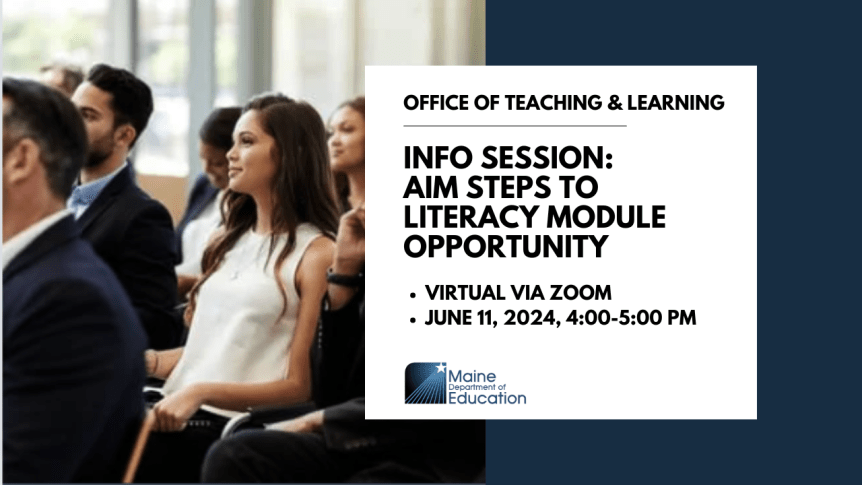
There will be an informational session on June 11, 2024 from 4:00-5:00 to provide an overview of module content, form and function, registration, and the stipend process. Please register at this link.

For additional information and access to the module registration form, please visit the Maine DOE AIM Literacy Module landing page. If you have additional questions please contact Inclusive Education Literacy Specialist & Dyslexia Coordinator, Dee Saucier, danielle.m.saucier@maine.gov.

This opportunity was created with Federal Emergency Relief Funding and is a part of Maine’s Whole Student Pandemic Response. Please visit the Maine Department of Education website to learn more about Maine’s Whole Student Pandemic Response.

Hancock Grammar School Hosts a Literacy Night at Sea

“How will you top this next year?” one family asked as they left the Hancock Grammar School’s Family Literacy Night recently.

On March 27th, Title 1 staff from Hancock Grammar School (HGS), Renee Clark and Yasmin Beal,  hosted an over-the-top (under-the-sea) literacy event that gathered 400 students, family members, and community members. Considering HGS has about 170 students, that is a pretty good haul!

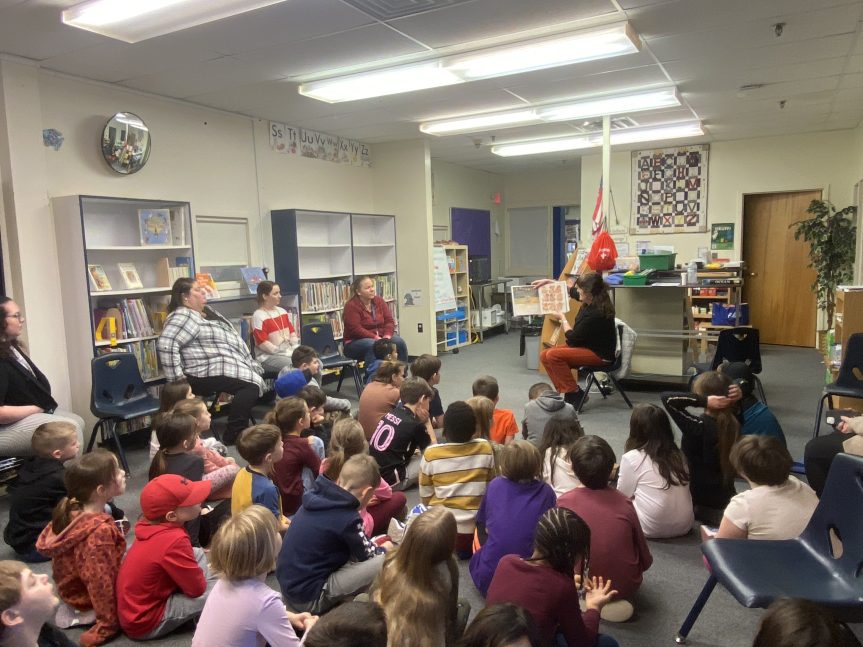
The day began with Alexandra Hinrichs, an award-winning author from Bangor, visiting the school to read her book The Lobster Lady.  The book tells the story of Virginia Oliver, who is still lobstering at 103 years old.  Oliver was featured in a Boston Globe story that quickly became a meme. One student said, “I have never met a published author.”  By meeting published authors, students can see that writing and telling their essential stories is a future path for them.

After reading her book, Hinrichs spent the day helping students write their own stories from special memories and dreams of becoming future authors.  Another student shared, “I enjoyed learning how you became an author!” Later, during the Literacy Night event, the Briar Patch Bookstore in Bangor brought several copies of Hinrichs’ book.  Ms. Hinichs generously stayed for the event to sign them and talk with families.  The Briar Patch also donated several copies of the book to students who could not attend the after-school event.

Background knowledge is a critical component of good literacy instruction. With that in mind, the Title 1 team organized several events to support and engage their budding readers and authors.  In addition to talking with the author, the community showed up in a big way to teach students about lobstering and ocean life.

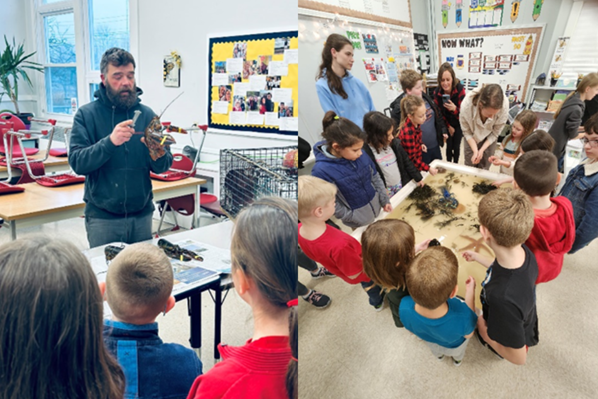
As a sternwomen, Virginia Oliver bands and measures lobsters. She also figures out which ones are bearing or females laying eggs and determines which lobsters to throw back and which are keepers.  This is how the lobstering community works to make their industry sustainable.  To give the students that experience, the school got a few lobsters.  Lobsterman Cameron Hardison brought a trap and equipment to band and measure lobsters. He taught students how to measure lobsters and figure out if the lobsters were male or female.  Students were even able to practice measuring and banding lobsters!  One student commented, “I enjoyed the lobster education and learning how to band and measure lobsters.”

literacy night

When Virginia Oliver hauls a trap, she sees a lot of other sea life. The Downeast Institute, based on Beals Island, showed up with an incredible touch tank. Students could touch and learn about lobsters, seaweed, starfish, and crabs.  The Downeast Institute even brought a very rare blue lobster!  HGS teachers were on hand to help students handle the creatures with care and provide support for those students who needed a little extra encouragement. As always, the teachers go the extra mile for their students!

The Family Literacy Night was extra special for the Thomas family. Pete Thomas, the great-grandfather of one of the students, loves to do woodworking. He made wooden lobster boat ornaments for students to take home as a souvenir. On display, Mr. Thomas brought a blue ribbon small wooden lobster boat that he made. There were three generations of the Thomas family participating that night, which is pretty amazing!

literacy night

Once students looked at mini-versions of lobster boats, it was time to get aboard the real deal. Roger and Lance Kennedy and Jenna Colby came with their lobster boat, the F/V Break N’ Even. Students learned important vocabulary like F/V, which stands for Fishing Vessel.  Students went over the boat from stem to stern. The Kennedys and Colby showed students the different parts of a trap, their buoys, and how to haul traps from the ocean.  It gave the students a real sense of Virginia’s job.

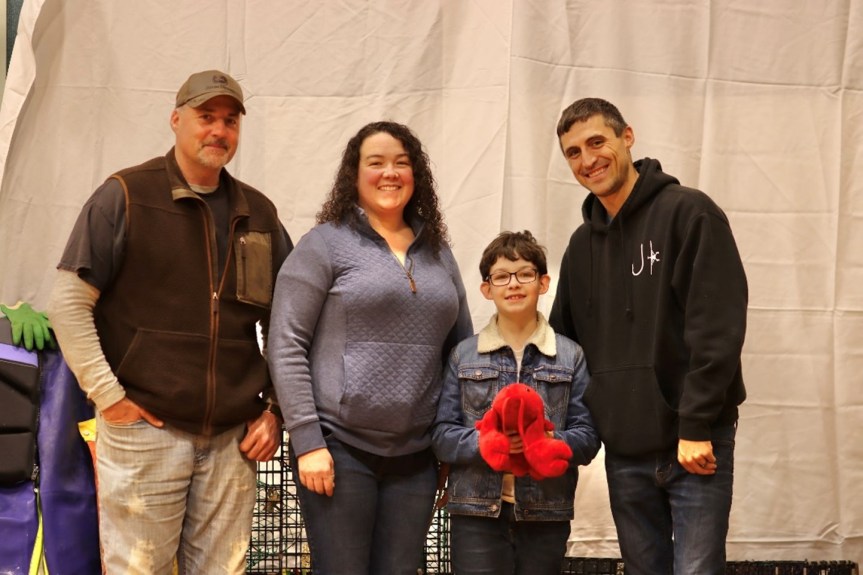
Virginia isn’t the only person famous for lobstering. Jacob Knowles is a fifth-generation lobsterman and social media celebrity who has about 1.6 million followers on YouTube.  That’s as many followers as the entire population of Maine! Jacob came to family literacy night to meet with families and share some of his fishing knowledge with everyone.  Students commented “It was an epic night!!”

After such an amazing night of literacy, learning, and lobster, it was time to head home.

One family shared, “I love all the fun new things you all are doing at school! Sounds so engaging and fun for the students and staff.”

Another family said, “Thank you for a great evening. The boys had a good time. We ended our evening with books from the book fair and a book from the author! The Black Sheep food truck, thanks for the grub was nice to not make supper!”

Everyone agreed this Family Literacy Night was a keeper!

Commissioner Makin Kicks Off Read to ME Challenge at Jameson Elementary School in Old Orchard Beach

The Read to ME Challenge Promotes Literacy by Encouraging Adults to Read to Children for At Least 15 Minutes, Challenge Others

Maine Education Commissioner Pender Makin kicked off Maine’s Read to ME Challenge today by reading Manolo & the Unicorn to second graders at Jameson Elementary School in Old Orchard Beach. The students enthusiastically responded to Makin’s call for them to join the Read to ME challenge themselves and read to an adult or younger child in their lives. They also discussed their favorite books and who the students plan to read to.

The Read to ME Challenge encourages adults to read to children for 15 minutes, capture that moment via a photo or a video, and then post it to social media and challenge others to do the same using the hashtag #ReadtoME. This is the ninth year that the Maine Department of Education (DOE) is collaborating with community organizations and schools on this month-long public awareness campaign to promote the importance of literacy for all of Maine’s students, regardless of age. The DOE will highlight Read to ME Challenge events throughout February through Read Across America Day.

“This is about sharing the love and joy of reading. When you’re able to read together, it creates shared human experiences that transcend everything else that is happening in our electronic world. When you hear the words, and those words create the colors and the shapes in your mind, you can create a whole different world and it’s a very magical and beautiful thing for kids. Reading just 15 minutes a day can help create a lifelong habit for children,” said Commissioner Makin.

The simple act of reading aloud to a child 15 minutes a day for five years results in 27,375 minutes of language exposure, which can put children on the path to high literacy achievement and helps them build knowledge and vocabulary. Research demonstrates a number of benefits to reading to children, from birth through their childhoods and even teenage years, including modeling reading as an enjoyable lifelong activity, stimulating brain development, reducing stress and anxiety, building knowledge of the world, and helping develop the skills necessary to succeed in their lives.

The Maine DOE recently launched $10 million in literacy grants for schools to build the capacity of year-long, core literacy instruction for all students and support core literacy instructional components based on the science of reading, including phonics, phonemic awareness, fluency, vocabulary, and comprehension.

Schools and community organizations can find a toolkit and resources on the Department of Education website and the Department will be sharing videos, photos, and updates from the challenge all month long on social media. Participants in the challenge are reminded to use the hashtag #ReadtoME and to tag the Maine DOE at @MaineDepartmentofEducation1 on Facebook, and @mainedepted on Instagram.

Media Release: Mills Administration Announces $10 Million in Literacy Grants for Maine Schools 

Grants Support the Development, Expansion, and Enhancement of Evidence-Based Core Literacy Instruction and Targeted Interventions for Maine Students 

The Mills Administration announced a $10 million literacy grant opportunity for schools to support the development, expansion, and enhancement of evidence-based core literacy instruction and targeted interventions for Maine students. These literacy grants through the Maine Department of Education (DOE) are intended to build the capacity of year-long, core literacy instruction for all students and support core literacy instructional components, including phonics, phonemic awareness, fluency, vocabulary, and comprehension.

Grant funds can be used by schools to compensate educators for participating in evidence-based literacy professional learning opportunities and internal instruction and program review processes, for professional learning opportunities on evidence-based literacy practices, to train instructional coaches, and to purchase evidence-based literacy materials.

       “Literacy is a foundational skill that enables students to thrive in school, work, life, and as citizens in our democracy. This investment in literacy will help schools and educators provide all students in Maine with evidence-based core literacy instruction and interventions. It’s an investment in the future of our state,” said Maine Education Commissioner Pender Makin.  

The grants were developed following the work by a Maine DOE workgroup of literacy specialists to analyze early literacy programs in Maine to understand better which assessment measures, programs, resources, evidence-based practices, and educator supports have yielded strong student growth. The Maine DOE workgroup created recommendations, which were provided to the Maine Legislature in December 2022. This $10 million grant initiative was designed out of LD 1526, which was passed by the Legislature and signed by the Governor, to increase student reading proficiency in Maine.

       “The literacy grant the DOE is providing is giving schools the opportunity to participate in the much needed and requested professional development around the science of reading. These funds will allow us to provide vital training in this area and the opportunity to purchase classroom materials for literacy instruction. In RSU14, this means we can train more staff than we budgeted for using local funds. We are grateful to have this opportunity to support our staff,” said Christine Hesler, Director of Curriculum for RSU14.

       “The Maine DOE literacy grant is a great opportunity for many districts to reach their goal of all students becoming readers. Through providing professional development, purchasing additional resources and materials that are focused on research-based literacy strategies, this goal is attainable.  These funds will supplement the financial investment districts already commit to literacy instruction,” said Deb McIntyre, Executive Director of the Maine Curriculum Leaders Association.

The grants also build off extensive efforts by the Mills Administration to strengthen child literacy skills in Maine, including investing $10 million through the Governor’s Maine Jobs and Recovery Plan to create and expand pre-k programs across Maine. In 2022, the Maine DOE released, Literacy for ME 2.0, a revamped state literacy plan grounded in research-based literacy practices and organized around key components central to building comprehensive literacy programs.

Recognizing the vital importance of foundational literacy development and in response to school system inquiries related to early literacy program development, the Maine DOE and a team of Maine educators and educational partners, developed guidance to support School Administrative Units in designing and implementing systematic and explicit early literacy instruction. This guidance is designed as a supportive tool for early elementary educators, administrators, and literacy leadership teams to reflect on current practices and to potentially adjust educational design to support high-quality and evidence-based early literacy learning for all PreK to Grade 3 students. The Maine DOE also provides interdisciplinary instructional programming and resources around literacy for pre-K, kindergarten, and first grade.

The Maine DOE has obtained a preschool development grant through the federal government to support   professional learning in birth through grade three literacy practices grounded in science and the Department is working to secure access to on-demand literacy modules that cover a wide variety of literacy content grounded in science for elementary educators, including content related to brain development, instructional practices connected to the essential components of reading and writing, dyslexia, and multilingual learners.

Last month, the Mills administration expanded the state’s partnership with Dolly Parton’s Imagination Library, with 4,500 eligible Maine children currently receiving free, high-quality, age-appropriate books through the program. The Maine DOE recently announced a partnership with I’m Your Neighbor Books to provide Welcoming Libraries to 16 schools across Maine, with each library containing 60 books featuring stories of immigrant families and the diversity of America. The Maine DOE also hosts the Read to ME Challenge every February to encourage adults to read aloud to children and Read to Ride Summer, a contest that qualifies students who read at least 500 minutes over the summer a chance to win one of 48 donated bikes and helmets.

The DOE has also created several literacy-related educator groups, for educators and education organizations across Maine to share and develop resources and guide the state’s literacy work, including the State Literacy Team, Maine Association for Improving Literacy (MAIL) Network, State Dyslexia Advisory Group, Screening Project & Dyslexia Plan, and the Higher Education Pre-Service Literacy Faculty Group. These groups also share information, facilitate text studies, and offer training related to dyslexia awareness, the Science of Reading, the neuroscience of the reading brain, systematic and evidence-based Tier I instruction to lower special education referral rates, support for striving readers, alignment and collaboration between general and special education for IDEA, and inclusive literacy instruction for students identified as having specific learning disabilities.

Literacy grants will be allocated to school administrative units (SAUS) and Education in Unorganized Territory (EUT) schools based on a formula model and the Maine DOE will be contacting SAUs & EUT directly through the Grants4ME platform with more information about their participation in the literacy grant program. Federal emergency relief funding was used to support these grants.

Get Ready to Read: Maine DOE Preparing for 9th Annual Read to ME Challenge

For the 9th consecutive year, the Maine Department of Education (DOE) will collaborate with community organizations and schools to promote the Read to ME Challenge, a month-long public awareness campaign held during February across Maine.

The Read to ME Challenge is intended to bolster enjoyment in reading and to support children’s literacy growth by challenging adults to read to and/or with children for at least 15 minutes during the month of February. Challenge readers are invited to capture the moment via a photo or a video and post it on social media platforms such as Facebook, Instagram, and X/Twitter with the hashtag #ReadtoME.  They are also encouraged to continue the impact by challenging social media friends to read to children and spread the impact across the state. Maine DOE encourages you to tag us on social media posts by including a X/Twitter tag at @mdoenews, a Facebook tag @MaineDepartmentofEducation1, and/or an Instagram tag @mainedepted.

While anyone can participate in the Read to ME Challenge, this initiative offers a wonderful opportunity for schools, child cares, libraries, and many other community organizations to plan engaging strategies for completing the challenge and demonstrating commitment to reading to children. In the past there have been a variety of student and adult groups that have organized impactful reading events. These include college and high school sports teams, civic organizations, library programs, recreation departments, and educational organizations.

The Read to ME Challenge will run for the month of February, leading up to Read Across America Day on March 2, 2024. Learn more about the Read to ME Challenge on the Maine DOE Website and be looking for more details about the kick-off soon.

For questions about the Read to ME Challenge, contact Leeann.Larsen@maine.gov, Maine DOE Director of Early Learning. To share your reading photos and videos with the Maine DOE tag us on social media and we will share your post!