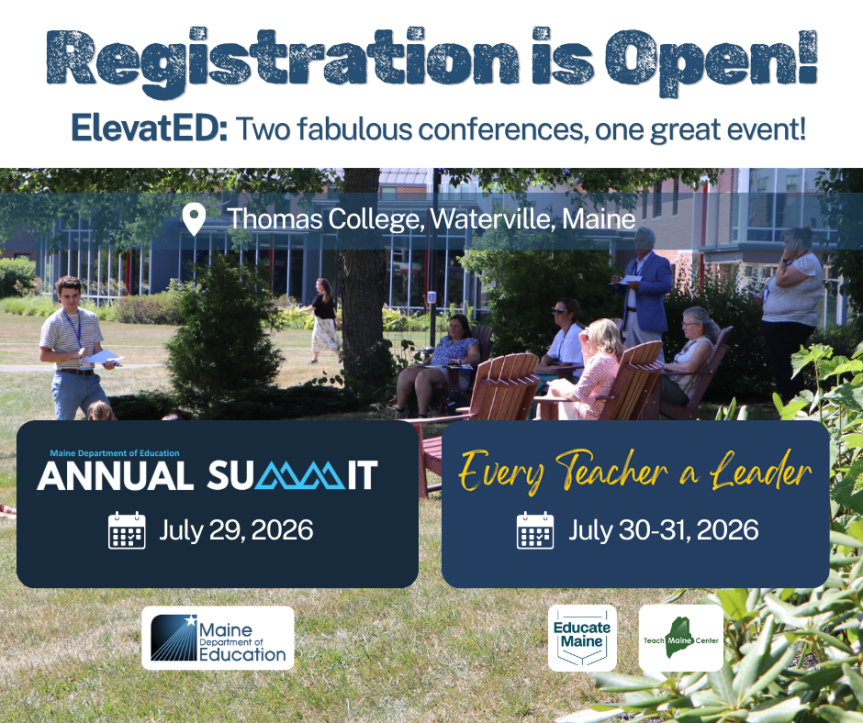
Registration is now open for the summer 2026 “ElevatED” professional learning experience! Through a partnership between the Maine Department of Education (DOE) and Educate Maine/the Teach Maine Center, this event is bringing together the 2026 Maine DOE Annual Summit and the second annual Every Teacher a Leader Conference for three days of collaboration, inspiration, and high-quality professional learning for Maine’s education workforce.
ElevatED will take place at Thomas College (180 West River Road, Waterville, ME 04901) from July 29-31, 2026. The Maine DOE Annual Summit on Day 1 (July 29) is tailored to meet the needs of Maine’s education workforce, including school staff, educators, school safety professionals, and building and instructional leaders. The Every Teacher a Leader Conference on Days 2 and 3 (July 30 and 31) features teacher-led sessions designed specifically for classroom teachers.
Individuals interested in attending may register for one or both ElevatED opportunities. Please note that spots are limited and will be granted on a first-come, first-served basis.
As spring arrives across Maine, bringing longer days and renewed energy to classrooms, the Maine Department of Education (DOE) Office of Teaching and Learning is inviting educators to participate in a new professional learning opportunity focused on multi-genre storytelling, literacy, and the rich histories of local communities.
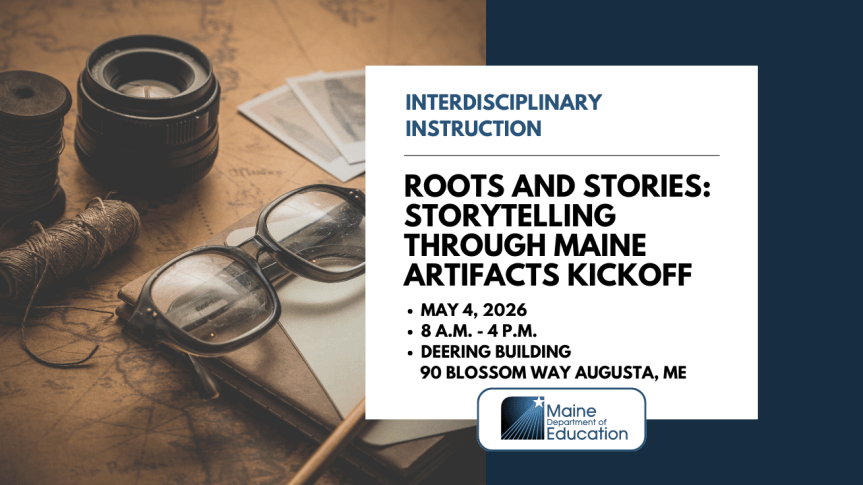
Roots and Stories: Storytelling through Maine Artifacts is designed to support teachers in transforming local artifacts, such as photographs, tools, letters, works of art, and everyday objects, into powerful learning experiences for students. By engaging with these artifacts, students can uncover the stories of their communities while strengthening literacy and making meaningful interdisciplinary connections.
During this six-week cohort experience, up to 50 Maine educators will collaborate with experts from the Maine Humanities Council and the Maine DOE Interdisciplinary Instruction Team to explore how artifacts can spark inquiry, storytelling, and creativity in the classroom. Participants will engage in strategies that support literacy across content areas, research and listening skills, and the role of storytelling in learning. They will also examine artistic approaches to narrative expression through the visual and performing arts. Educators will be supported in designing classroom experiences in which students create multi-genre products that bring community stories to life through creative expression.
This professional learning opportunity will begin with a one-day, in-person kickoff event on Monday, May 4, from 8 a.m. to 4 p.m. at the Deering Building in Augusta. That session will be followed by five virtual sessions, during which educators will continue developing and refining their classroom projects. That schedule is as follows:
May 5, 2026, from 3:30-4:30 p.m.: How to Select an Artifact/Helping Students Select an Artifact that Has Meaning OR Using VPA Models as Anchor Tests (via Zoom)
May 12, 2026, from 3:30-4:30 p.m.: Handling When History Gets Hard (via Zoom)
May 19, 2026, from 3:30-4:30 p.m.: Tuning Protocols – Working with Humanities Experts to Understand and Relate the Stories of Our Communities (via Zoom)
May 26, 2026, from 3:30-4:30 p.m.: Tuning Protocols – Working with Humanities Experts to Explore Various Ways of Presenting Creative Student Outcomes (via Zoom)
Date TBD – Wrap-Up and Celebration of Creative Work in the Humanities
Sessions will be recorded and made available on the Maine DOE learning management system EnGiNE.
Participation is free, but enrollment is limited to 50 educators statewide. Educators who complete this experience will receive 20 contact hours. Those interested in participating should please register using this link.
With questions or for additional information, please contact Maine DOE Interdisciplinary Instruction Specialist Geoff Wingard at Geoffrey.Wingard@maine.gov.
This project is supported through Title IV, Part A funds from the U.S. Department of Education. The total award for this project is $33,780.40 ,of which 30% is federally funded and directly attributed to project implementation. The contents of this program are those of the author(s) and do not necessarily represent the official views of, nor an endorsement by, the U.S. Department of Education or the U.S. Government.
During the summer of 2026, the Maine Department of Education (DOE) will once again offer comprehensive training on the use of its For ME instructional programs. The Maine DOE has adapted and piloted these programs for early elementary grades (pre-K through grade 2), based on the Boston Public Schools’ evidence-based Focus Curriculum. These open-source, developmentally appropriate programs are interdisciplinary and align with Maine’s learning standards.
While schools are responsible for purchasing the materials necessary to implement the For ME instructional programs, lesson plans and additional instructional resources are available at no cost through the Maine DOE website. The Maine DOE also provides initial professional learning to support effective implementation.
An informational overview of the For ME instructional programs was shared earlier this winter, and a recording is available here.
The session introduces the program structure, reviews required materials for implementation and outlines available training opportunities. Educators and school leaders who are unfamiliar with the For ME instructional programs are strongly encouraged to view the recording.
Summer Training Opportunities
Educators, administrators, and early learning program staff interested in implementing the For ME instructional programs during the 2026-2027 school year, at any grade level from pre-K through grade 2, are encouraged to participate in the initial implementation trainings offered in the summer of 2026.
These trainings are designed to deepen participants’ understanding of program design and support successful implementation. School administrators are strongly encouraged to attend alongside their pre-K, kindergarten, first-grade, and/or second-grade teachers. Special education educators, education technicians, instructional coaches, and curriculum leaders who support pre-K through grade 2 educators are also encouraged to participate.
There is no cost to attend these trainings.
Training Format and Schedule
All trainings will be held in person from approximately 8:30 a.m. to 3:30 p.m.Participants should plan to attend all required days for their respective grade-level training.
Pre-K for ME: Two-day training at a location still to be determined (week of July 27-30, 2026; specific dates forthcoming)
K for ME: Three-day training at Randall Student Center, University of Maine at Augusta (June 24, July 27, and July 28, 2026)
1st and 2nd Grades for ME: Three-day training at Randall Student Center, University of Maine at Augusta (June 24, July 29, and July 30, 2026)
Registration Information
Schools interested in registering educators for these trainings should have a principal or instructional leader complete the training registration form on behalf of all participants from their school(s) by May 11, 2026. The form allows schools to enroll educators in the Pre-K, Kindergarten, 1st Grade, and/or 2nd Grade For ME trainings.
Following the close of registration, participants will receive registration confirmation, as well as final training locations and preparation details.
K for ME, 1st Grade for ME, or 2nd Grade for ME: Lee Anne Larsen, Maine DOE Early Learning Team Director, at Leeann.Larsen@maine.gov or Nicole Madore, Maine DOE Early Childhood Specialist, at Nicole.Madore@maine.gov.
State Activities funds received from the U.S. Department of Education (ED) support the implementation of this project. The project has an award totaling $50,000 of which 50% is federally funded and directly attributed to project implementation. The contents are those of the author(s) and do not necessarily represent the official views of, nor an endorsement by, ED or the U.S. government.
The Maine Association for Pupil Transportation (MAPT), a statewide professional organization dedicated to supporting student transportation across Maine, is hosting its 2026 regional conferences in April and June.
These events provide high-quality professional development, hands-on training, networking opportunities, and skills competitions for transportation professionals from across Maine. Each MAPT regional conference features a full day of targeted training sessions and skills events, designed to promote safety, leadership, and operational excellence in student transportation. These events bring together transportation staff from various school administrative units (SAUs) statewide to strengthen best practices, enhance collaboration, and recognize professional achievement.
Event Dates/Regions:
April 21, 2026 – RSU 57 (Massabesic High School, 88 West Road, Waterboro, ME 04087)
April 22, 2026 – RSU 3 (Mount View Middle and High School, 577 Mount View Road, Thorndike, ME 04986)
April 23, 2026 – Mt. Blue Regional School District (Mt. Blue High School, 129 Seamon Road, Farmington, ME 04938)
June 23, 2026 – MSAD 27 (Fort Kent Community High School, 84 Pleasant Street, Fort Kent, ME 04743)
June 25, 2026 – AOS 96 (Machias Memorial High School, 1 Bulldog Lane, Machias, ME 04654)
For each MAPT regional conference, the agenda will include a 7:30-8 a.m. check-in, with coffee, breakfast, and lunch provided throughout the day. Each conference will end with an awards ceremony at 2 p.m.
The following sessions will be available for participants at each conference:
Drivers’ Skills Competition: This is a high-energy, hands-on competition where drivers demonstrate precision, safety, and professionalism behind the wheel. Participants navigate real-world scenarios that sharpen skills, build confidence, and celebrate excellence in student transportation.
Secure It All – Hands-On Securement Training: This interactive training is focused on proper use and installation of school bus securement systems. Participants will practice correct techniques to ensure students and equipment are safely secured every time—because details matter.
From Mirrors to Mindset: Safety starts with awareness. This session goes beyond mirror adjustment to focus on defensive driving, situational awareness, and the professional mindset required to transport students safely and confidently each day.
Operational Readiness and School Bus Egress (Simulated Smoke): This powerful, real-world simulation prepares transportation professionals for emergency situations. Participants will experience bus evacuation procedures under simulated smoke conditions to strengthen response time, teamwork, and crisis readiness.
Round Table for Directors: This collaborative leadership session is designed specifically for transportation directors. Engage in strategic discussion, share challenges and solutions, and explore innovative practices shaping the future of school transportation.
Open Forum – Moderated Discussion for Drivers, Bus Monitors, and Mechanics: A guided conversation provides frontline professionals the opportunity to share concerns, challenges, and ideas. This open dialogue encourages problem-solving, strengthens communication, and ensures every voice in transportation is heard.
MAPT remains committed to partnering with the Maine Department of Education (DOE), SAUs, and school leaders to ensure Maine’s student transportation teams are always driven by safety. These regional conferences are free to all Maine school bus drivers and transportation directors, reinforcing MAPT’s mission to make professional growth accessible statewide.
To register to attend any of the MAPT regional conferences, please visit MAPT | Conferences. Those with questions may contact Mitzii Smith at 207-222-4927.
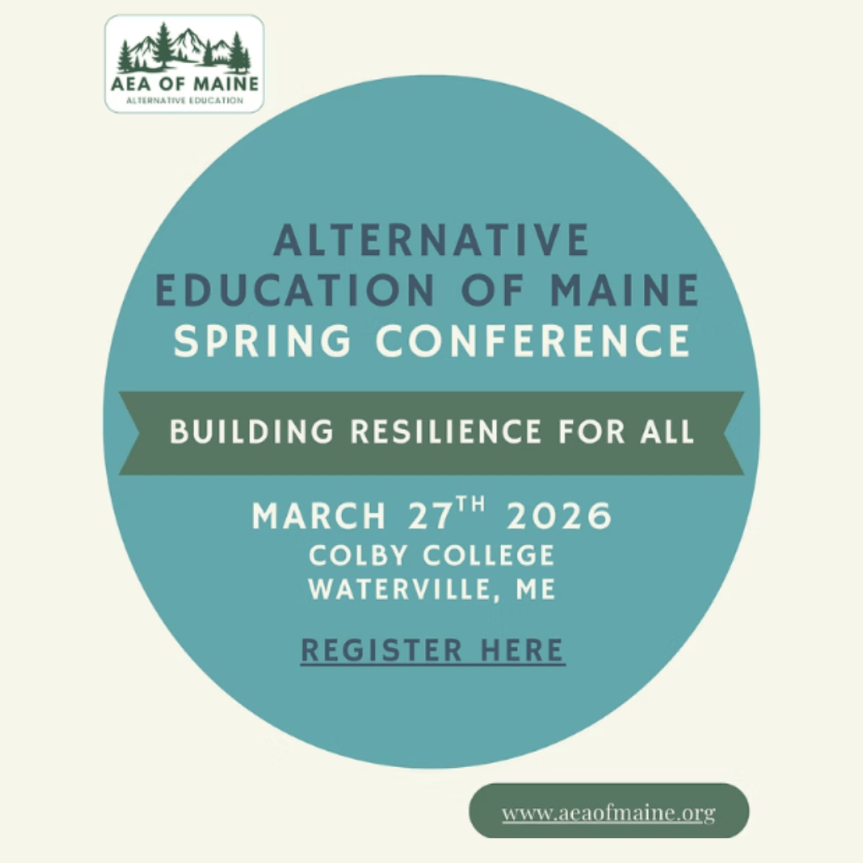
The Alternative Education Association (AEA) of Maine has announced that its spring conference will be held on Friday, March 27, 2026, at Colby College in Waterville from 8 a.m. to 3 p.m., with the theme “Building Resilience for All.”
This event represents an opportunity to learn, share, and connect with fellow educators committed to student success through alternative pathways. The 2026 Spring AEA Conference will have presentations including, but not limited to:
Artificial Intelligence (AI) and Alternative Education
Resonance Language (Empathy for Everyone)
Restorative Practices
From Awareness to Action: Strengthening Trauma-Informed Practice in Your Classroom
Substance Abuse (Peer Support) from SEED (Students Empowered to End Dependence)
Sustaining the Helpers: Practical Tools for Burnout and Compassion Fatigue
Beyond the High School Model: Redefining Middle School Alternative Education
In anticipation of this event, the AEA Conference committee shared: “We are beyond excited to host our Spring AEA conference! This is a special time for alternative educators and school staff to come together, build meaningful connections, and learn from one another’s experiences. Our goal is for you to leave feeling rejuvenated, inspired, and equipped to finish the school year strong. We have incredible presenters and a dedicated focus on supporting your wellness. We can’t wait to learn, grow, and recharge together!”
2026 Spring AEA Conference Information
Cost: $75 per person (which includes a provided lunch). Please note: If more than two members from your school administrative unit (SAU) attend the conference, the cost is reduced to $50 per person. Additionally, if you attended the 2025 Fall AEA Conference and submitted payment for both the Fall 2025 and Spring 2026 conferences, please contact an AEA Conference committee member (listed below) to verify your payment.
Date/Time: Friday, March 27, 2026, from 8 a.m. to 3 p.m.
Location: Colby College Diamond Building (4000 Mayflower Hill Drive, Waterville, ME, 04901). Parking is in the Lunder House parking lot. This is a campus map.
Continuing Education Units (CEUs): AEA will provide CEUs for those attending with full-day participation.
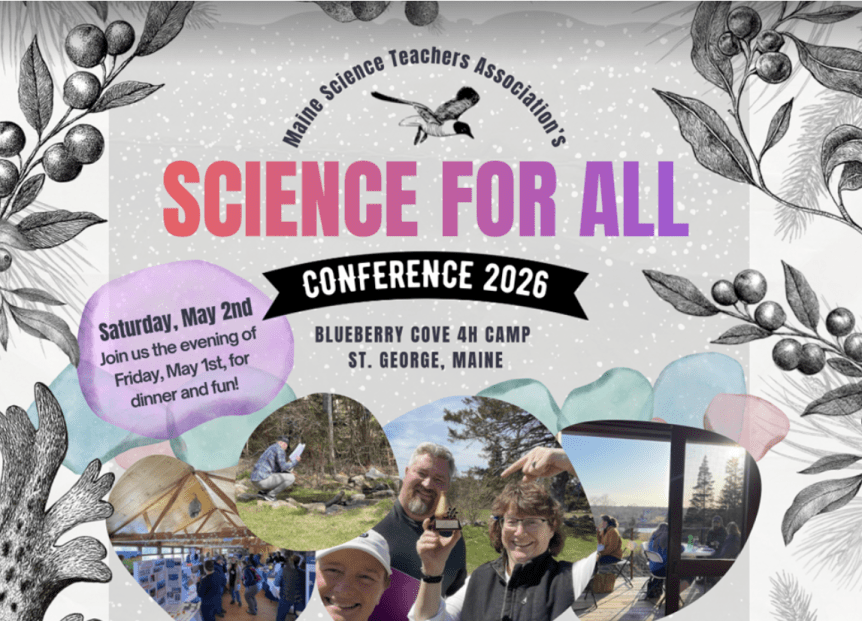
The Maine Science Teachers Association will host its biannual conference, “Science for All,” the weekend of May 1 and 2, 2026, bringing together science educators from across the state for collaboration, professional learning, and inspiration.
The conference will kick off Friday evening, May 1, 2026, at 5 p.m. at Blueberry Cove 4H Camp and Learning Centers in St. George with dinner, networking, and activities. The full-day program on Saturday, May 2, 2026, from 8 a.m.-4 p.m. includes an array of interactive breakout sessions catered to Maine educators.
With more than 25 sessions scheduled, the conference offers a diverse range of topics designed to support high-quality, inclusive science instruction for all students. Featured sessions include:
3D Printed Smart Greenhouses with Lynn Hanna, science teacher at Conners Emerson School.
Integrating Machine Learning with the Study of Puffins in Maine with Dr. Jacob Sagrans and Dr. Jan Mokros of Tumblehome, Inc., alongside Presidential Awards for Excellence in Mathematics and Science Teaching (PAEMST) awardees Diana Allen and Tonya Prentice.
Weaving in Climate and Data through Connected Learning Ecosystems with Robin Lea, learning specialist with the Gulf of Maine Research Institute, and Alexandra Ryan, science teacher at Boothbay Regiol High School.
Sessions will highlight innovative classroom strategies, emerging technologies, environmental research, and interdisciplinary approaches that engage students in meaningful scientific inquiry.
Participants can earn eight contact hours for attending the conference. Educators are encouraged to register by March 15, 2026, to take advantage of early-bird rates available for both individuals and districts.
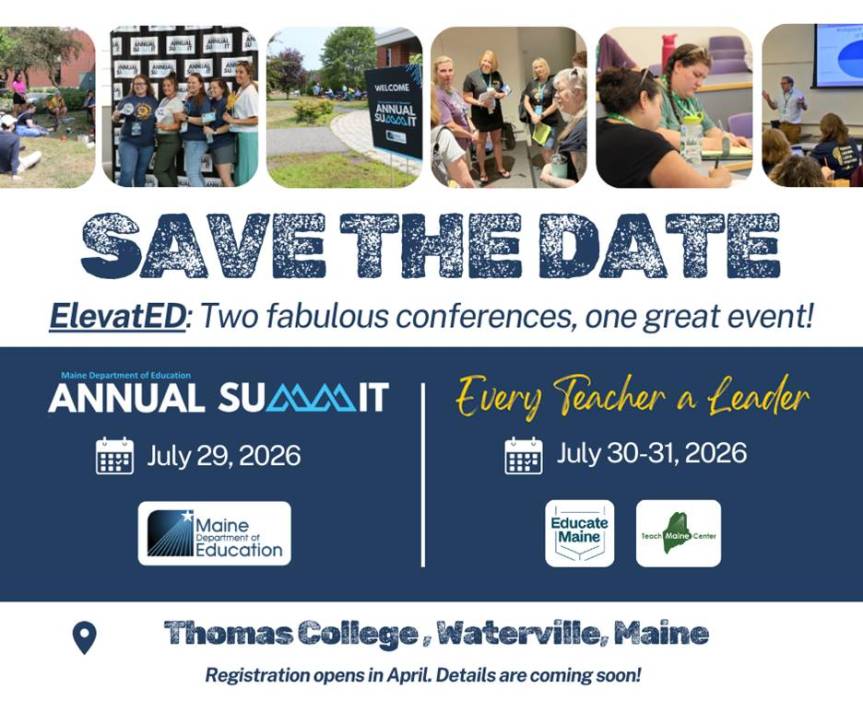
The Maine Department of Education (DOE) is excited to be partnering with Educate Maine and the Teach Maine Center this summer to bring together two impactful statewide events into one powerful “ElevatED” professional learning experience!
The 2026 Maine DOE Annual Summit and the second annual Every Teacher a Leader Conference will be held consecutively at Thomas College in Waterville, allowing for three days of collaboration, inspiration, and high-quality professional learning for Maine’s education workforce.
Event Dates and Location
Maine DOE Annual Summit: July 29, 2026
Every Teacher a Leader Conference: July 30-31, 2026
Thomas College, Waterville, ME (180 West River Road, Waterville, ME 04901)
Day 1, the Maine DOE Annual Summit, is tailored to meet the needs of Maine’s education workforce, including school staff, educators, school safety professionals, and building and instructional leaders, offering opportunities to connect, exchange ideas, and access the tools, resources, and professional learning needed for the upcoming school year. Days 2 and 3, the Every Teacher a Leader Conference, feature teacher-led sessions, spotlighting outstanding educators from across Maine, designed specifically for classroom teachers.
We look forward to welcoming educators, school leaders, and partners from across the state for this exciting collaboration. Registration opens in April; stay tuned for more details!
Maine educators, this is your final opportunity to participate in this year’s statewide professional learning series hosted by the Maine Department of Education (DOE)!
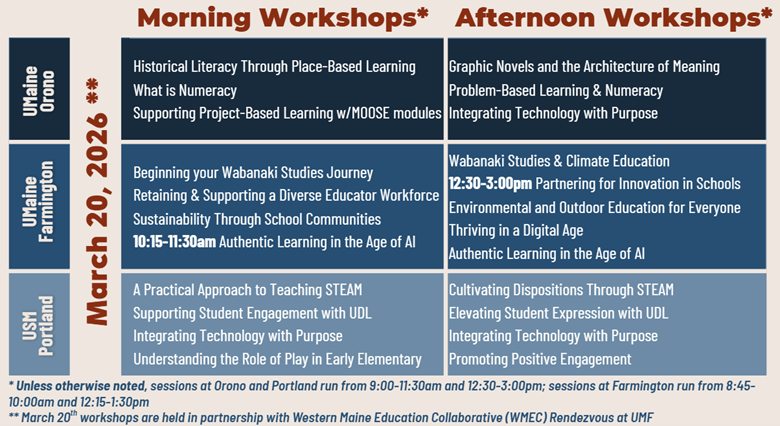
The Maine DOE Office of Teaching and Learning and Office of Innovation invite teachers, ed techs, administrators, and pre-service teachers to join the final professional learning day of the 2025-2026 school year on Friday, March 20, 2026.
In partnership with the University of Maine System, this free, high-quality professional learning experience is made possible through a collaboration with the University of Maine at Orono (UMaine), the University of Maine at Farmington (UMF), and the University of Southern Maine (USM). The Maine DOE is grateful to these institutions for helping make accessible, regionally grounded professional learning available to educators across Maine.
Participants may attend in person at UMaine or USM or virtually via livestream from anywhere in Maine.
All participants are eligible for contact hours, and recordings will be available for asynchronous viewing following the event.
Please register today! Registration can be accessed on the Maine DOE website or in the event brochure, which includes the session descriptions.
Planning to attend in person? Each workshop session offers an interactive experience with limited seating (50 participants per session). Registration is required, so early sign-up is encouraged.
Prefer to participate remotely? Virtual attendance offers unlimited access statewide.
Come as you are. Learn in ways that work for you. Connect with educators across Maine in a welcoming professional learning community grounded in equity, innovation, and real-world learning.
With questions or for more information, please contact Beth Lambert, Maine DOE Chief Teaching and Learning Officer, at beth.lambert@maine.gov.
A partnership note: March 20 workshops at UMF are held in partnership with the Western Maine Education Collaborative (WMEC) “Rendezvous.” Only members of WMEC may attend these sessions in person.
Are you looking to deepen your understanding of evidence-based instructional practices for multilingual learners? Would dedicated time to collaborate with colleagues, reflect on practice, and translate research into actionable strategies for your classroom, school, or school administrative unit (SAU) be valuable?
If so, consider joining a five-part professional learning series designed for Maine educators and centered on the book, Unlocking Multilingual Learners’ Potential: Strategies for Making Content Accessible. The series is developed and facilitated by Maine Department of Education (DOE) Teacher Leader Fellow Rebecca Carey, with book author and national expert Diane Staehr Fenner joining select sessions.
Each participant will receive a copy of the book and explore high-impact instructional practices that support multilingual learners’ academic success, engagement, and sense of belonging. Sessions emphasize asset-based approaches, language development, and equitable access to rigorous content across subject areas. They will include structured learning, grounded in the text and current research; facilitated discussions and collaborative activities; time for instructional planning and integration; and opportunities for application, feedback, and resource sharing.
Intended Audience
ESOL (English for Speakers of Other Languages) teachers and specialists
General education teachers across grade levels and content areas
Instructional coaches
School and SAU administrators
Any educators supporting multilingual learners
Schedule
Sessions will be held virtually via Zoom from 3:30-5 p.m. on:
March 16, 2026 (featuring author Diane Staehr Fenner)
April 2, 2026
April 30, 2026
May 14, 2026 (featuring author Diane Staehr Fenner)
June 2, 2026
Complimentary books will be provided to the first 45 registrants who commit to attending all five sessions, as full participation is required to receive a copy. Additional participants are welcome to join and may purchase the book independently. Participants may earn 10 total contact hours, including 7.5 hours of live participation and 2.5 hours of supplemental work.
The Teacher Leader Fellows program is a part of the Maine Department of Education (DOE) Office of Teaching and Learning. For more information about this opportunity, please contact Jane Armstrong, Maine DOE State ESOL Specialist, at jane.armstrong@maine.gov.
The Early Learning Team within the Maine Department of Education (DOE) Office of Teaching and Learning, in partnership with the Maine Department of Health and Human Services (DHHS) Office of Child and Family Services, is offering a joint professional learning opportunity, designed to strengthen community-centered mixed-delivery systems.
The landscape of early childhood education in Maine is evolving. The continued expansion of public pre-K programs, along with recent legislation transitioning Free and Appropriate Public Education (FAPE) responsibilities for children ages three to five from Child Development Services (CDS) to public schools, underscore the growing need for a strong, coordinated mixed-delivery system. This kind of system—one that intentionally connects public schools and community-based early care and education providers—helps all children have equitable access to high-quality early learning opportunities from birth through the early elementary years.
Building and sustaining a mixed-delivery system requires communities to move beyond siloed approaches and work collaboratively across schools, Head Start programs, private centers, and family child care homes. Together, partners can expand access, respond to diverse family needs, and create more seamless experiences for young children and the adults who support them.
Community of Practice
Early childhood administrators and educators from both public schools and community-based programs are invited to participate in a three-session Community of Practice (CoP) to help establish the relationships and shared understanding needed to strengthen local systems. Through this CoP, participants will:
Explore the benefits of high-quality early childhood education delivered through mixed-delivery systems.
Learn how mixed-delivery models support children, families, and communities.
Examine examples of successful approaches currently being implemented across Maine.
CoP sessions will be offered at two different times to support participation across the early childhood ecosystem:
Option 1: 12:30-1:30 p.m. on Tuesdays, March 17, 24, and 31, 2026
Option 2: 3:30-4:30 p.m. on Wednesdays, March 18, 25, and April 1, 2026
Interested individuals should complete the CoP registration form, which will remain open through March 13, 2026, and will help organizers understand participant backgrounds and questions related to mixed-delivery systems.
Early Learning Solutions Lab Mini-Grant
Community teams that complete the three CoP sessions will also be eligible to apply for an Early Learning Solutions Lab mini-grant. The Solutions Lab provides continued shared learning, targeted technical assistance, and funding to support the implementation of activities that strengthen local mixed-delivery systems. This work requires close collaboration between school administrative units (SAUs), community-based early care and education providers, and organizations that serve children and families.
Solutions Lab participants will meet monthly from May through December 2026 and may also engage in individualized coaching sessions, as needed. Reimbursement will be provided for related travel and participation in meetings outside of contracted hours.
Each participating community will form an Early Learning Solutions Team, responsible for developing and implementing a coordinated plan that supports children, families, and educators in the community. Once plans are finalized, teams will be eligible to receive additional funding to support the implementation of planned activities through December 2026.
With questions or for additional information, please contact Sue Gallant, Maine DOE Early Childhood School-Community Specialist, at Sue.Gallant@maine.gov or Michelle Belanger, Maine DOE Pre-K Partnership Specialist, at Michelle.Belanger@maine.gov.
This opportunity is funded through Maine’s Preschool Development Grant (PDG). Funds received from the U.S. Department of Health and Human Services Administration for Children and Families support the full implementation of this project. The total award is $1,933,007, of which 100% is federally funded. The contents are those of the author(s) and do not necessarily represent the official views of, nor an endorsement by, the Administration for Children and Families or the federal government.





 Maine DOE Newsroom