The Maine Department of Education (DOE) has opened registration for the second year of the American Ancestors genealogical inquiry workshop for grade 4-8 teachers and administrators. This program trains teachers to use inquiry-based lessons incorporating authentic methodologies professional genealogists use. Lessons guide students through conducting family history research, thinking like a historian, honing their research skills using primary sources, and exploring case studies of important local and national people. Go beyond family trees and help students make real-world personal connections to history. In addition to the genealogy inquiry curriculum, there will be a focus on providing resources to support African American studies.
Two one-day workshops are available with an optional virtual professional learning community throughout the 2024-2025 school year.
Option 1: August 5th – in-person or virtual (no cost)
Option 2: August 6th – in-person at the Educators Summit (Educators Summit registration required)
For more information about this program, please get in touch with Jaime Beal, Maine DOE Interdisciplinary Instruction Specialist, at jaime.beal@maine.gov
Are you interested in exploring critical issues impacting early care and education? Are you wondering how you could work more collaboratively within your community to connect early childhood partners (e.g., childcare, schools, community-based organizations, etc.)? Are you eager to connect with other early childhood educators and consider ways of strengthening the early care and education mixed-delivery system in your community?
Consider attending the Early Childhood Summer Summit on Thursday, July 11, 2024, at Keeley’s Banquet Center, 178 Warren Avenue, Portland, Maine. The summit will run from 9:00 a.m. to 3:30 p.m. Lunch will be provided. Attending is no cost, and up to 60 individuals can be accommodated. CEUs will be made available to anyone attending the summit.
The goals of the Early Childhood Summit include:
To improve alignment and transitions for children and families, foster community-level coordination and collaboration across the mixed-delivery early care and education system, which includes childcare programs, Head Start, and elementary schools.
Strengthen understanding of evidence-based practices that are critical to leverage across the birth-grade 3 span to promote whole child development.
Supporting community-based planning and implementation efforts through mini-grants and ongoing technical assistance support.
What will the summit structure be like?
The summit is funded through Maine’s Preschool Development Renewal Grant. It is jointly sponsored by the Maine Department of Education and the Office of Child and Family Services in Maine’s Department of Human Services. Individuals may register to attend independently but are encouraged to come with a colleague interested in building community collaborations. The summit’s content will include various keynote addresses and workshop sessions connected to the goals outlined previously. Topics will include promoting inclusionary practices, addressing challenging behaviors, promoting play as a foundational learning strategy, and promoting smooth transitions from early childhood education programs into public schools for children and families. Time will also be provided for attendees to work with each other and presenters to develop plans for building collaborative early childhood community teams.
What are the next steps for attendees after attending the Early Childhood Summer Summit?
Individual 2024 Early Childhood Summer Summit attendees will be encouraged to build a community team during the 2024-25 school year. They will be given preference for attending the 2025 ECE Summer Summit. Teams that attend the 2025 summit will receive $800 mini-grants to implement action plans. Details about team building will be shared at the summit.
To apply: Complete the application by June 14, 2024. Each individual who plans to attend should complete the registration form. A field is included in the application to note if you plan to attend with a colleague so that we can group you at the summit.
For additional information, please contact Renee Reilly, Maine DOE PDG Manager, at Renee.A.Reilly@maine.gov or Andrea Faurot, OCFS PDG Manager, at Andrea.Faurot@maine.gov.
Mark your calendars! Registration for the Data Summer Training is currently open! Trainings are scheduled at varying locations across the state from July 29th to August 1st and August 12th to August 15th. This year’s training will focus on reporting resource updates, guidance for data reporting best practices, and assistance with student enrollment. We look forward to providing this opportunity to meet with school administrative units to network and collaborate.
Please Save a Seat for a specific location after initial registration is complete.
Registration will close on Friday, July 26th. If you have any questions about this year’s Summer Training, please get in touch with Alexandra.Cookson@maine.gov or call 207-446-3897
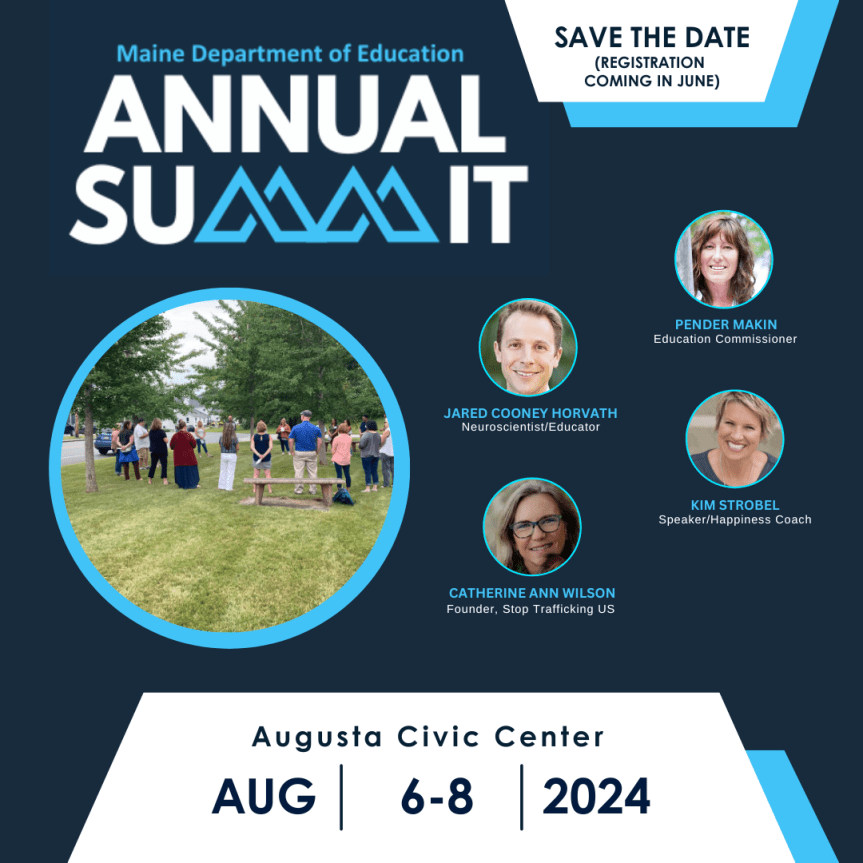
The Maine Department of Education (DOE) is excited to announce that its Annual Summit is scheduled for August 6th through 8th at Augusta Civic Center. This year’s theme is Supporting the Whole Student & Community.
The event features keynote speakers Pender Makin, Maine Education Commissioner; Jared Cooney Horvath, a Neuroscientist and Educator; Kim Strobel, a motivational speaker and Happiness Coach; and Catherine Ann Wilson, the founder of Stop Trafficking US, along with over 150 presentations and professional learning opportunities for everyone working in Maine’s school communities.
Build your knowledge base on a host of topics related to education and school safety, connect with colleagues, and get the high-quality professional learning, tools, and resources you need from the 2024 Maine DOE Annual Summit.
Registration is expected to open in early June! While we are busy preparing an exciting agenda and activities for this event, find updated information and more to come on the Maine DOE Annual Summit event page.
The Maine Department of Education (DOE) is accepting applications from school administrative units (SAUs) and Education in the Unorganized Territory (EUT) to be part of a 3-year First 10 Community School pilot project funded through Maine’s Preschool Development Grant. Developed by Education Develop Center (EDC), First 10 Community Schools bring together school systems, early childhood programs, and community partners/agencies to improve care and education for young children and their families throughout the first 10 years of children’s lives. This model works to improve teaching and learning, deepen partnerships with families, and provide comprehensive services for children and families.
Through this opportunity, pilot sites will be supported in developing and implementing First 10 Community School models. To learn more about the model and the pilot opportunity, interested applicants are encouraged to view this recorded First 10 Community School information session.
All questions about the First 10 Community School RFA should be submitted to the First 10 Community School Grant Coordinator identified on the Grant RFPs and RFAs webpage.
Additional questions regarding this announcement should be directed to:
Lee Anne Larsen, Maine Department of Education Director of Early Learning, leeann.larsen@maine.gov.
Keith Morin loves watching students grow academically and socially; it’s one of the perks of his very busy job as RSU 18 Assistant Superintendent and Chief Academic Officer. He also loves watching the impact that RSU 18 staff make on students beyond academics, serving as mentors, role models, and sources of guidance and support.
That is why many people find the field of education as fulfilling as they do. And to nurture academic aspirations and cultivate a positive school community, everyone needs to feel safe.
As a school administrator serving the communities of Belgrade, China, Oakland, Rome, and Sidney, Morin knows how incredibly important it is to be knowledgeable and experienced in all aspects of education, especially in today’s fast-paced and ever-changing society. That includes school safety.
“My goals in participating in the school safety specialist program are simple; to enhance my skill set in providing guidance to a platform and culture where students and staff feel safe to attend school,” explains Morin.
Morin finished the Maine Department of Education (DOE) School Safety Specialist course in February of 2023 to help him better understand school safety and its complexities. Maine DOE’s Maine School Safety Center offers the 8-week course every month. It is provided asynchronously through Eastern Maine Community College (EMCC) and the Federal Emergency Management Agency (FEMA).
Since taking the course, RSU 18 has been hosting annual tabletop exercises for its staff, which include scenarios of real events, where they discuss their emergency plans and responses. They are also implementing student support resources such as the Second Step Program, a social emotional learning program, and Netsmartz, an online safety education program, delivered by RSU 18 district social workers and school resource officers.
RSU 18 is also implementing quarterly school safety committee meetings that include staff members from all departments and stakeholder groups, and they are hosting after-action meetings where RSU 18 staff can refine its safety practices.
Morin has also led RSU 18 efforts to expand partnerships with local law enforcement by hiring a third resource officer to build relationships with students and families. He also states that his district has hired a district safety officer to align safety practices before, during, and after school.
“In addition to making safety improvements identified throughout our consistent school safety review, we are now working on enhancing our already strengthened cybersecurity system,” added Morin. “We continue looking to build on our successes and improve areas to provide an academic environment that is safe and enjoyable.”
The School Safety Specialist course is a program of the Maine DOE’s Maine School Safety Center and is available at no cost to Maine schools. Cohorts start at the beginning of every month and complete in 8 weeks. All work is done asynchronously through Eastern Maine Community College (EMCC) and the Federal Emergency Management Agency (FEMA) and takes approximately 20-25 hours to complete.
For more information, visit theMaine DOE website, fill out aninterest form, or reach out to Maine DOE School Safety Training Coordinator Wendy Robichaud at Wendy.Robichaud@maine.gov.
Members of the Maine Department of Education Office of School and Student Supports serve on St. Joseph College’s advisory board for the Well-Being for Educators Summer Institute and will be present at the Summit to offer information and professional learning.
_______________________________________________
The Wellbeing for Educators Summer Institute is designed to engage educators and school administrators in active learning about wellbeing and healthy living, including self-care and professional growth constructed around the multiple dimensions of well-being. The Institute will be held at the lakeside campus of St. Joseph College on Sebago Lake in Standish, Maine. Participants are invited to enjoy the many opportunities to engage with the outdoors on our lakefront and beach as well as walk our woodland trails on campus throughout the week’s scheduled activities!
The content of the workshops are relevant and customized for educators and administrators of all levels, from early elementary through college. If you are looking for ways to explore personal wellbeing and cultivate lessons and curriculum materials guided by trauma-informed research and healing-centered engagement, explore these themes during this Summer Institute. Or if you are a school leader looking for ways to support your school staff in promoting a culture of wellbeing, this week-long institute will actively explore what that can look like in one’s personal and professional life.
The scheduled program allows time for self-care, outdoor activities, and self-selected activities for physical movement, along with a series of focused 15-minute, 75-minute, and intensive 2-hour workshop presentations. Each day has a focused theme therefore participants can enjoy the full five-day experience or choose specific days.
Monday, July 15 – Personal Wellbeing and Self-Care Indoors and Outside (focused theme)
Tuesday, July 16 – Planning for Wellbeing: Curriculum and Leadership (focused theme)
Wednesday, July 17 – Wellbeing in the Classroom and School Culture (focused theme)
Thursday, July 18 – Pondering the Wellbeing of the Education Profession and Developing a Plan for Wellness (focused theme)
Friday, July 19 – Emerging Technologies and Imaginative Learning: Social Emotional Wellbeing as Learners and Educators (focused theme)
Some of the most memorable experiences students have occur outside the classroom on field trips. This webinar hosted by Civics Teacher Leader Fellow Jessica Graham and Humanities Teacher Leader Fellows Dorie Tripp and Jim St. Pierre, will cover an array of beneficial field trips around Maine. This webinar will cover not only the field trips, but how to organize them and how to find grants that will pay for them. We hope you will attend and offer your own ideas for meaningful field trips.
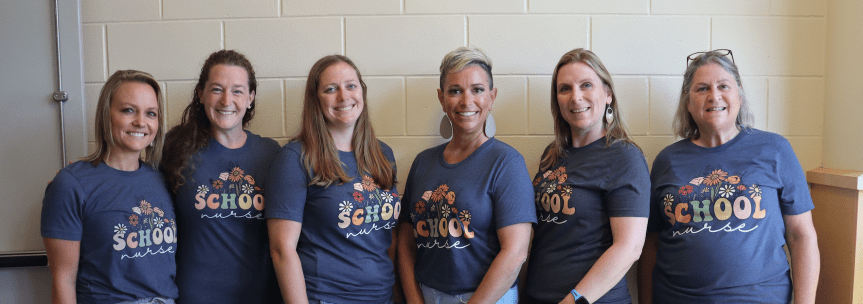
As the state of emergency brought on by the COVID-19 pandemic gradually quelled, the Mt Blue Regional School District nurse team could finally catch their breath and refocus on the projects they had put on hold amidst the crisis.
“As COVID was winding down and we were getting back into our normal routines, it was hard to believe it was really over. We had been living with these high-stress levels for so long that it took a while to adjust mentally to our pre-COVID routines.” Janneke Strickland, BSN, RN, NCSN, RSU 9 Lead Nurse and Cascade Brook School nurse in Farmington, remembers, “But once things settled, it felt good to have time to devote energy to newer projects.”
One of those projects was a concerted effort to increase the number of district staff members certified in cardiopulmonary resuscitation/automated external defibrillator (CPR/AED). This endeavor, conceived as a group initiative for the 21/22 school year, resonated deeply with the nurses, who were driven by a shared commitment to enhancing the safety and well-being of their school community.
The team started by conducting polls in each Mt. Blue school building. The results painted a stark picture: a mere four to five percent of staff were certified in CPR/AED in each location. Undeterred by the challenge, the Mt. Blue Nurse team set their sights on an ambitious target – to ensure that at least 10% of staff were CPR/AED trained by the end of 2023.
A Mt. Blue school nurse works on one of the CPR manikins purchased through Newhouse.
With their objectives clear, the nurse team strategically formulated a budget request for the 22/23 school year. This proposal encompassed provisions for CPR training kits and an AED trainer, essential tools needed to equip staff with life-saving skills.
Taking charge of the initiative, Kathryn Clement, a dedicated member of the nurse team and a Nationally Certified School Nurse, spearheaded efforts to explore avenues for Mt. Blue nurses to become certified as Basic life-saving instructors. “Over the summer, the majority of Mt. Blue nurses and some other Maine School nurses trained with Angie Newhouse of Newhouse Training,” explained Clement. “There were lots of moving pieces and a collaborative effort to provide training to our staff.” Through Newhouse, they also found and purchased the feedback CPR manikins they need to train educators.
Next, leveraging the support of the Mt. Blue administration, the nurse team forged a partnership with Franklin County Adult and Community Education. Through the Harold Alfond grant funding coordinated by their Adult Ed partner, the nurses were able to extend CPR/AED classes to staff members at no cost, eliminating barriers to participation.
As the prospect of teaching classes loomed, a few nurses grappled with apprehension. “The apprehension came from being new to teaching BLS and working with larger groups,” explained Strickland, “Usually, nurses teach one-on-one with students or families, so we aren’t used to teaching large groups.”
However, the Mt. Blue Nurse team rallied together, opting to co-teach sessions, honing their skills and fostering confidence. Gradually, their trepidation gave way to assurance, buoyed by the team’s collective expertise. By the end of the school year, Mt. Blue’s nurses not only met their target of 10% CPR/AED certification among staff but surpassed it, with 15% of staff becoming CPR/AED certified. Thanks to this team of dedicated educators, Mt. Blue was safer than ever.
“We have so many tools at our disposal, like defibrillators, out in the public, and it is nice to know our staff now know how to use them,” says Clement. “Now, more people in the public are comfortable administering
From the National Association of School Nurses
emergency response care.”
However, the Mt. Blue nurse team knew their mission for safer schools was far from over. Buoyed by the success of their endeavors, the nurses continue to offer classes to staff members, spurred by an overwhelming interest from the community. Their commitment to the well-being of the Mt. Blue community remains unwavering, underscoring the pivotal role nurses have in nurturing a culture of safety and preparedness within schools.
“School nurses occupy a unique space where education and healthcare converge. There are myriad aspects to this special type of nursing!” says Strickland. “Under guidance from the School Nursing Practice Framework (NASN, 2024) and the Maine
DOE, we strive to collaborate with families, school staff, administration, and the wider community to support the health and safety of our students. This approach, as research demonstrates, leads to improved academic achievement.”
School nurses are the backbone of our schools, keeping students healthy and safe. They deserve to be celebrated every day, but especially today on National School Nurse Day. Celebrate National School Nurse Day today by taking time to thank the school nurses in your community.
The Office of Special Services and Inclusive Education invites you to join us in the first two webinars in our “Inclusive Education Webinar Series” presented by Dr. Kate Macleod, an innovative inclusive educator, researcher, author, and assistant professor of special education at the University of Maine Farmington.
May 22nd : The Way to Inclusion: How We Create Schools Where Every Student Belongs
Grounded in the work of Dr. Kate MacLeod’s latest book, The Way to Inclusion: How Leaders Create Schools Where Every Student Belongs (ASCD, 2023) this webinar will take participants through theinclusive school change process – from creating an inclusive vision, to identifying current successes and barriers to inclusion, reimagining roles of existing staff, and everything in between. Participants will leave with research-based ideas, practical resources, and advice from leaders who are implementing inclusive change in their schools and districts.





 Maine DOE Newsroom