Community Schools Informational Session

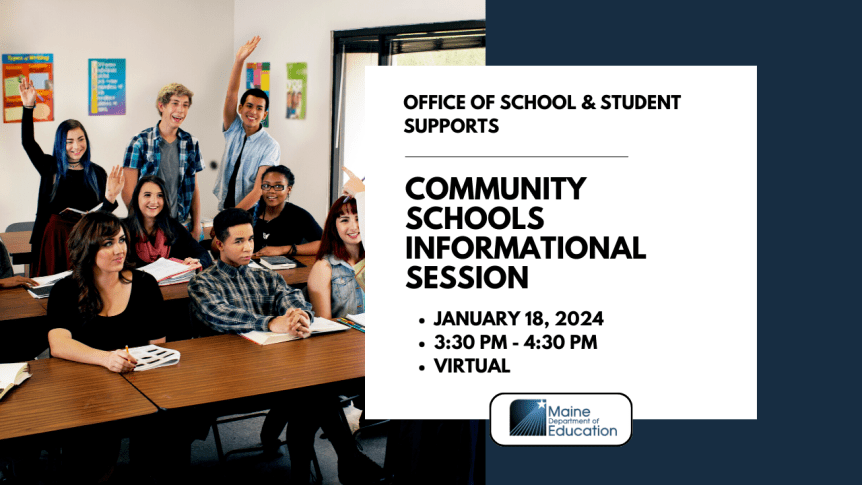
Is your school or district interested in learning about how schools can partner with families and community-based organizations to provide supports so that every child has access to what they need to reach their full potential? Have you considered becoming a Community School?  In many communities throughout Maine, not all families have access to healthy food, stable housing, vision care, or dental health services their children need. The impact of these challenges doesn’t stop when students step into the classroom.  Community Schools work with families and community-based organizations as partners to provide comprehensive supports and opportunities to meet the needs and interests of students and families.

Informational Session

  • January 18 Registration – 3:30 – 4:30 Register HERE
  • Join the Maine Department of Education for a Community Schools informational session to learn more about Community Schools – the benefits and the steps toward implementation.
  • The session will be recorded and shared if you are unable to attend the live presentation.

Community Schools: Background

The Community School model was first recognized by Maine Legislative Action of the First Regular Session of the 127th Legislature, in Public Law 2015, chapter 267, which authorized the Department of Education to fund a limited number of community schools.

According to the National Coalition of Community Schools, community schools create the conditions necessary for students to thrive by focusing attention, time, and resources on a shared vision for student, school, and community success. Its integrated focus on academics, health and social services, youth and community development and community engagement lead to improved student learning, stronger families, and healthier communities. The community school strategy transforms a school into a place where educators, local community members, families, and students work together to strengthen conditions for student learning and healthy development. As partners, they organize in- and out-of-school resources, supports, and opportunities so that young people thrive.

Community schools vary in the programs they offer and the way they operate, depending on their local context. What makes community schools unique is the combination of four key features – or pillars- that together create the conditions necessary for students to thrive. The pillars are as follows:

  1. Integrated student support.
  2. Expanded learning time and opportunities
  3. Family and community engagement
  4. Collaborative leadership and practices

Information about Community Schools can be found on the Maine Department of Education’s Community School webpage at https://www.maine.gov/doe/schools/safeschools/communityschools. For more information, reach out to Julie Smyth, Director of School and Student Supports at Julie.a.smyth@maine.gov or Ann Hanna, Community School Consultant, at ann.c.hanna@maine.gov


MaineCare in Education Bootcamp

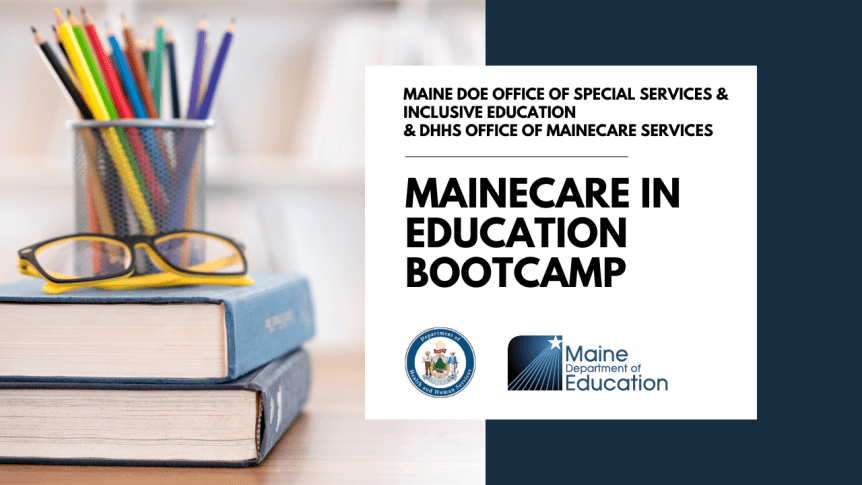
Please join the Maine Department of Education (DOE) and Maine Department of Health and Human Services (DHHS) Office of MaineCare Services for MaineCare in Education Bootcamp. This one day workshop is presented in a hybrid format with in-person and virtual opportunities on February 9th and 16th from 10 – 2 pm at the DHHS Building located at 109 Capital Street in Augusta. In person attendance is limited to 40. Light refreshments and coffee will be served. Lunch will be on your own.

Topics covered will include:

  • MaineCare basics
  • MaineCare covered service
  • reimbursement opportunities
  • IEP documentation
  • day treatment support
  • transportation
  • interpreter services
  • nursing services
  • how to start billing
  • MaineCare SEED
  • EPS School health-related services
  • technical assistance opportunities

Intended Audience: SAUs, SPPS, anyone accessing Maine CARE in schools

For questions or more information contact Amanda Castner at Amanda.castner@maine.gov.

Webinar: Culturally Responsive Practices in Special Education

The Maine Department of Education (DOE) Office of Special Services and Inclusive Education and its partners at Maine Access to Inclusive Education Resources (MAIER) invite you to join Penn State University’s Dr. Jonte’ C. Taylor (JT), for a webinar on Culturally Responsive Practices in Special Education. This LIVE session will provide well-structured content on different pedagogies and how teaching and learning can be conducted by developing strategies that promote environmental characteristics and principles for students with disabilities in inclusive settings.

Participants will learn the importance of developing cultural practices in special education and how to provide intensive support for students regardless of dis/ability. The session will help the participant to develop action points and strategies necessary for incorporating cultural practices into the teaching and learning process.

  • The webinar will be held on Tuesday, January 23rd from 4:00 – 5:00 pm via Zoom (a link will be provided to you once you register)
  • Register here NOTE: This webinar will NOT be recorded, you need to attend to see the webinar.

Dr. Jonte’ C. Taylor (JT) is an Associate Professor of Special Education in the Department of Educational Psychology, Counseling, and Special Education in the College of Education at Penn State University. He taught for approximately 10 years with various populations from PreK to Adults in settings ranging from inclusive classrooms to residential treatment facilities. His research interests include science education for students with disabilities, evaluating innovative classroom practices, and bullying issues for students with Autism, Learning Disabilities, and Emotional/Behavioral Disorders.  His most recent publication Mixtape Volume 1: Culturally Sustaining Practices Within MTSS Featuring the Everlasting Mission of Student Engagement was published this year.

NOTE: There are additional learning options regarding this topic from MAIER. MAIER has 5 hours of free, online/asynchronous learning modules from Dr. Taylor HERE. You can take these online learning modules before or after the webinar. You can get UMaine contact hours for these online learning modules once you complete the modules and an evaluation.

For additional information contact Sarah Howorth at sarah.howorth@maine.edu

Book Study: Asynchronous Cognitive Science

Cognitive science can offer educators an understanding of how students learn so they can apply it to their practice. Interacting with cognitive science  can be challenging though. If you are interested in learning more about cognitive science in a simple yet informative way, this book study is for you.

The book, “Why Don’t Students Like School,” by Daniel T Willingham is an education-focused dive into the cognitive science of how students learn. This 11-week asynchronous book study will allow participants to reflect on their current practice while discovering and applying new knowledge. A free copy of the book will be mailed to your school, and each participant can receive up to 17 contact hours. The book study starts on January 22, 2024.

To join, click this Book Study link and fill out the form. Please email any questions to erik.wade@maine.gov.

Two-Day Workshop: Inclusive Teaching Practices and Learning

This event is open to all school personnel.

The Maine Department of Education (DOE) is hosting its third training opportunity focused on learning around diversity, equity, inclusion, and justice (DEIJ), and the impact that increasing understanding of DEIJ can have on teaching practices, instructional strategies, and classroom management in every discipline area.

Think about the following:

  • Have you looked at your curriculum and teaching practices with a lens of inclusion?
  • Are your materials representative of all students and their families?
  • Are your practices and use of language inclusive of all students and families?
  • Is there any evidence of diversity, inclusion, equity and justice?

If you answered not sure or no to any of the questions, this training is a great place to start.  The 2-day interactive training will focus on understanding foundational concepts in DEIJ, along with reviewing a process to conduct a deep dive into curriculum, instructional strategies, and classroom management processes.  Following the 2-day training, we will hold Community of Practice virtual sessions during the school year to reflect on DEIJ implementation in your classroom.  Access to technical assistance from our trainers and Maine DOE specialists will also be available during this time.

Dr. Sarah Benes (she, her, hers) will return to lead the training and is our consultant for this initiative.  Sarah is an assistant professor at Southern Connecticut State University in health education and physical education.  In addition, she is the co-owner of Lighthouse Wellness & Health Education Consulting and the current president of SHAPE America.  We are also pleased to have a cadre of Maine physical education and health education teacher leaders co-training for the workshop.

Event Details: 

  • Capital Area Technical Center, Augusta
  • Wednesday, February 7, and Thursday, February 8
  • 8:00 am-3:00 pm each day
  • The fee for this training is ONLY $50 (the fee assists with the cost of food).  All other expenses are covered by the Maine DOE.

Register by clicking on this link or going to the Maine DOE Professional Event Calendar at this link.

Financial Assistance: There are five-$150 scholarships available to help with substitute pay, mileage and lodging to support attendance.  The form to apply for a scholarship is here.

Email susan.berry@maine.gov or carolyn.gross@maine.gov with questions or before registering if using a PO for payment.

Registration is Now Open for the 2024 Maine School Winter Wellness Summit, Give Roots to Wellness!

By mid-school year school personnel are ready for a pick me up that provides information, experiences, resources, and tools to care for one’s self and others. The Maine Department of Education, Office of School and Student Supports, Employee Health Promotion and Wellness Program is pleased to be able to offer the 2024 Maine School Winter Wellness Summit, Give Roots to Wellness! School leaders and employees from across the State are invited to register for this event.

Thursday, January 25 and Friday, January 26
The Samoset Resort in Rockport

This event is open to individuals and teams in schools interested in worksite health promotion and wellness as well as community members supporting schools.

The goal of the Winter Wellness Summit is to inspire and empower participants to take care of their personal health, and to create healthier, more supportive, and safer school environments for all. The Summit agenda supports the promotion of health improvement to enhance well-being and academic achievement.

This year’s agenda includes three educational and inspirational keynote presentations, engaging workshops on personal wellness practices and positive and healthier school environments, worksite wellness program planning, and network opportunities with colleagues and professionals from across the State who value health promotion and wellness.

The cost of the two-day event is $150/person for early bird (through December 22nd) and $175/person for standard registration (after December 22nd) inclusive of five meals. Accommodations are on your own, but we have secured a block of rooms at an excellent rate below the State per diem rates! All the details can be found on the Winter Wellness Summit webpage.

See the agenda.

Register for the Summit and get more info here.

Direct questions to susan.berry@maine.gov.

Mt. View High School Educators are Leveraging Maine DOE’s ConCEPT Pilot Program to Help Meet their Academic Needs

The Maine Department of Education (DOE) Interdisciplinary Instruction Team is offering a pilot program developed by listening to educators’ needs and creating the opportunity for them to choose their professional learning adventure. In an effort to make this program available to more schools and educators across Maine, we are sharing some examples of the ways that Mt. View High School educators are using ConCEPT to meet their unique needs:

  • Using Executive Functioning for the SAT – SAT prep courses tend to focus on filling in gaps in learning and practicing how to take the test, but educators at Mt. View High School are taking a different approach. Along with filling in conceptual gaps in math and English, students will be working to understand how to take a test from an executive functioning perspective. By teaching students how to utilize working memory, plan and prioritize the test, organize their time, and reflect, educators can prepare students academically and cognitively for the test.
  • Developing Student Disposition – Another team will be working to support student engagement and social development through student dispositions. All students can use practice with dispositions like responsibility, communication, or self-reflection, but this program aims to create groups of students that can focus on dispositions that need improvement.
  • Ownership and Place-based Learning – A group of educators is looking to help students see a connection between taking ownership of their classroom space and the environment. By focusing on empathy, a sense of place, student voice, and reflection, these educators want to support students to see how the skills they use to take care of the small space they use every day can be transferred to the outside world, specifically Maine’s environment.
  • Applying Academic Concepts to Real-world Problems – A group of math, science, and English teachers are working to create an interdisciplinary, dual-credit engineering class. Through student-focused inquiry in the form of genius hours, students will apply academic concepts to real-world problems. This interdisciplinary class will be designed to cover high school credit requirements in multiple subject areas and as a college credit through the University of Maine.

These programs are supported through the ConCEPT pilot program through the Maine Department of Education. Mt. View educators are excited about this program because it allows them to meet with educators they rarely work with, the professional learning “caters to the needs of educators and students,” and they “feel the support of the DOE.”

If you are interested in learning more about ConCEPT, please visit the ConCEPT web page or e-mail Maine DOE Interdisciplinary Instruction Team Coordinator Kathy Bertini at Kathy.bertini@maine.org


Nominations Open for Exceptional English Language Arts and Literacy Teachers; MCELA Conference Set for March 2024

The Maine Council for English Language Arts (MCELA), an affiliate of the National Council of Teachers of English, has announced the Claudette and John Brassil Distinguished Educator Award.  The purpose of this award is to recognize exceptional English language arts and literacy teachers who have demonstrated excellence in teaching, contributed to the profession, and shown a commitment to the community.

The award is open for nominations until 12/10 to learn more and make a nomination visit MCELA’s nominations webpage.

Mark your calendars for the MCELA Annual Conference, on March 29, 2024
at Holiday Inn By the Bay Portland, Maine. To learn more about the conference visit the MCELA website here.

For further information about these opportunities reach out to The Maine Council for English Language Arts (MCELA)

Maine DHHS to Offer “WhyTry” Training to Anyone Working with Directly with Children and Their Families

The Maine Department of Education’s Partners at the Maine Department of Health and Human Services (DHHS) Office of Child and Family Services are excited to bring additional “WhyTry” training to those working directly with children and their families.

The WhyTry training program is an evidence-based, flexible toolkit, along with structured, interactive modalities to improve one’s ability to engage, motivate, and build resilience and a growth mindset in children within a variety of settings and age groups. The WhyTry Program uses a multi-sensory approach incorporating music, movement, art, and video to engage and motivate children.  This unique approach engages children to understand relationships, relevance, and resilience to build positive social skills known as the three R’s. Tools can be utilized with unmotivated children individually or in group settings.

If you work with children who are experiencing adversity, trauma, health, or behavioral challenges, the WhyTry training program is a great resource to add to your toolbox.

Eligible participants will receive full access to the WhyTry training to become a certified WhyTry Facilitator with full access to the WhyTry curriculum.  This fun and engaging training overviews resources, lessons, and competencies along with facilitator guidance to effectively use the program.  Eligible participants will receive access to the digital toolkit and fidelity tools. A certificate of completion will be provided upon course completion.  This is a great opportunity to add a very valuable resource at no cost to you or your agency!

Training is available to Children’s Crisis Providers, Community Mental Health Agencies, Childcare Providers, and all School Personnel.

Check out the video below to learn more:

WhyTry Toolkit Demo short.mp4 from WhyTry Videos on Vimeo.

The online training will be via ZOOM from 9:00 am-1:00 pm each day. Please click on one of the following upcoming training dates to register:

Seats are very limited for each date. Registrants are encouraged to register as soon as possible to guarantee an opportunity to receive this free training.

Please direct any questions about Why Try and this training opportunity to Ellie.Larrabee@maine.gov .

Maine DOE and DHHS to Review Foster Care Guidelines and Connect District Points of Contact with SAU Points of Contact – November 30th

For the past several years the Maine Department of Education (DOE) has shared information to with school administrative units (SAUs’) Foster Care Points of Contact.  This year, Maine DOE and the Maine Department of Health and Human Services (DHHS) are adding a new twist to the yearly presentation – DHHS’s Office of Child and Family Services (OCFS) regional Foster Care Points of Contact will be included in the presentation and will have breakout sessions to provide an opportunity for regions to connect and to communicate current reality and concerns.  For example, the SAU Foster Care Points of Contact in York County will have an opportunity to connect with the DHHS’s Office of Child and Family Services (OCFS) District 1 Point of Contact (POC) in a small breakout group conversation.

The backstory: The Every Student Succeeds Act was signed on Dec. 10, 2015, and amended the Elementary and Secondary Education Act of 1965 (ESEA). The ESSA contains provisions related to protections for children in foster care and requires the Maine DOE and school districts to collaborate with the OCFS to ensure educational stability for children in foster care.  Join Office of School and Student Supports Director Julie Smyth and Regional Associate Director of Child Welfare Services Jean Leonard on Thursday, November 30th  via Zoom for a 3:30 Annual Foster Care Training for POCs.

Ocfs foster care points of contact

The goal of ESSA is for children in foster care to experience minimal disruption in their education as a result of being placed in foster care and that they are given the same opportunities to develop the necessary skills to be successful as children who are not in foster care.

Under ESSA the Maine DOE and OCFS must work together to ensure:

  • A child in foster care will enroll or remain enrolled in the child’s school of origin, unless a determination is made that it is not in the child’s best interest to attend that school.
  • If a determination is made that is not in the child’s best interest to remain in the school of origin, the child will immediately be enrolled in a new school, even if the child and/or his or her guardians are unable to produce records normally required for enrollment; and
  • The child’s new school must immediately contact the school of origin to obtain relevant records.

Register in advance for this meeting:  Meeting Registration Link

After registering, you will receive a confirmation email containing information about joining the meeting on November 30th.

For questions, please contact Julie Smyth, Director of the Office of School and Student Supports – at 207.592.0949 or julie.a.smyth@maine.gov .