Join MAIER and Maine’s Department of Education’s Amelia Lyons for a webinar on the McKinney-Vento program. This session will provide an overview of the act that allows each state to provide a program to assist students with their rights when they are experiencing unstable housing situations. Participants will learn about student rights including the rights to immediate school enrollment even when records not present, remaining in the school of origin, if in the student’s best interest, receiving transportation to and from the school of origin, and receiving support for academic success. Amelia Lyons will go over the McKinney-Vento Act, common misconceptions of the program requirements and ways educators and family members can help youth receive these services so that every student can have an opportunity for academic success. Registration is free but required.
When/Where: Online Zoom meeting (link provided once you register). Tuesday, May 30th, 3:30 – 4:30 pm
Come to the webinar (register here) and get your questions asked, but if you miss it, this webinar will be recorded and made available on the MAIER website within a few weeks after the event.
Contact hours are available. For more information please reach out to Anica Miller Rushing anica.miller.rushing@maine.edu.
Applications are now open to all willing and qualified public schools who would like to become a BARR (Building Assets, Reducing Risks) school. Click here to apply. Using American Rescue Plan, state reservation funds, the Maine Department of Education (DOE) will cover all costs of implementing the program for schools new to BARR, and all costs of continued implementation support to existing BARR schools. Additionally, the DOE will provide travel reimbursement and educator stipends associated with participation in the program. Applications are due by May 26, 2023.
BARR was developed over 20 years ago by a high school counselor who felt ineffective because more than 40 percent of her 9th grade students were failing at least one core course and were at risk for not graduating on time. She learned from her school’s principal that this was not just her high school’s problem, but it reflected a troubling national trend. Using strategies from the fields of business and medicine, Executive Director Angela Jerabek created the BARR model and implemented it in the fall of 1998. By spring 1999, 9th grade student failure rate had decreased from 44% the previous year to 20%. Teachers worked together and knew each student – not just from an academic perspective, but from a personal perspective – their interests, strengths, hopes, and dreams.
Careful implementation and evaluation continued for over 20 years, all with the same findings – students passed more classes, pursued more advanced courses, and graduated on time. The focus of BARR is not just for some students, but all students. Teachers reported increased collaboration, satisfaction, and their ability to use data effectively. School culture and climate was improved. Today, BARR operates in over 250 schools throughout the nation and works in all grade levels, K-12, including in dozens of schools here in Maine.
“There is no question that BARR has had a positive impact on the students and staff at Sacopee Valley Middle School. We are intervening with students earlier, our meetings are more efficient, and most importantly, our relationships are stronger. Honestly, I couldn’t imagine our school without BARR. It is not a flavor of the month intervention — it is now part of our fabric and is here to stay,” said Amy Vacchiano, counselor and BARR Coordinator at Sacopee Valley Middle School.
The BARR system uses eight interlocking strategies that build intentional relationships (staff to staff, staff to student, and student to student) and utilizes real-time data to enable schools to achieve concrete academic, social, and emotional outcomes for each and every student. To learn more about BARR visit: https://barrcenter.org/about-barr/barr-model/.
To be eligible, a school must meet one of the following:
Join Beth Lambert, Acting Chief Innovation Officer and Director of Innovative Teaching and Learning at the Maine DOE to learn more about this opportunity to implement the BARR system in your school(s). We’ll also be joined by Rob Metz and Jennifer Fox from the BARR Center who will provide an overview of BARR and other Maine educators who are excited to share their experiences and the impact it has had on their schools:
Jennifer Mull-Brooks, Principal, Congin Elementary School
Greg Henderson, School Counselor and BARR Coordinator, Mt. Blue High School
Shelly Lajoie, Counselor and BARR Coordinator, Noble High School
The Maine DOE is accepting applications for a pilot program with the American Ancestors/New England Historic Genealogical Society. Help students think like a historian and learn how to trace families back in time. Receive inquiry-based lessons that incorporate authentic methodologies used by professional genealogists. Lessons guide students through conducting family history research, and students will hone their research skills using primary sources and case studies from local Native American and African American history. Go beyond family trees and help students make real-world, personal connections to history.
Lesson Plans that Support Students to:
Plan and carry out research
Analyze and evaluate genealogical sources
Draw conclusions and support claims with evidence
Provide guided practice with primary sources (census records, vital records, photographs, etc.)
Case Studies
Martin Luther King, Jr.
Figures and events from Maine Indigenous and African American history
Inclusive Teaching Strategies
Make genealogy accessible to all students
Navigate sensitive topics with students
Address common misconceptions about genealogy
This year-long pilot begins with an in-person workshop in June. During the 2023-2024 school year, the American Ancestors/New England Historic Genealogical Society will provide two virtual sessions to support teachers using these resources in their classrooms. Additionally, the DOE will conduct a monthly virtual PLC to provide a space for teachers to collaborate.
The ESEA Demographics Report will be opening on May 15th. In preparation for this report the MDOE Data Team will be hosting a webinar on May 2nd specific to reporting requirements for this collection.
No registration is required to join. The Join Live event link below will be active on the date and time indicated by the webinar.
The webinar will be recorded and posted to the Webinars page on the Helpdesk Website. It may take a few days to get the recording posted, however, it will be available as soon as possible.
If this webinar is canceled, there will be a notice posted on the Helpdesk Website at the top of the page.
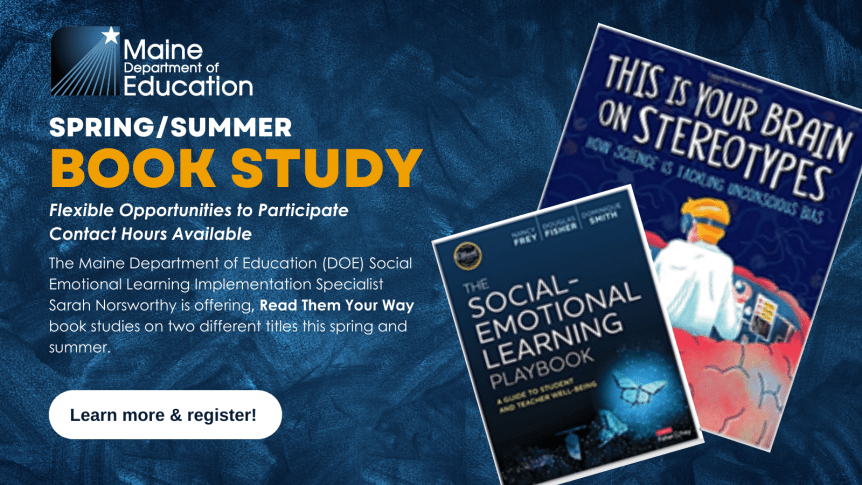
The Maine Department of Education (DOE) Social Emotional Learning Implementation Specialist, Sarah Norsworthy is offering, Read Them Your Way book studies on two different titles this spring and summer.
The Social Emotional Playbook, written by Douglas Fisher, Nancy Frey and Dominque Smith is described by publisher Corwin as an “interactive playbook (which) provides the language, moves and evidence-based advice you need to nurture social and emotional learning in yourself, your students and your school.” The book is divided into six modules. This text is designed for educators.
This Is Your Brain On Stereotypes written by Tanya Lloyd Kyi and illustrated by Drew Shannon is described by publisher Kids Can Press as being, “an essential overview of the science behind stereotypes, from why our brains form them to how recognizing them can help us be less biased…This timely and hopeful book addresses the issues of discrimination, racism, sexism, ableism, and homophobia and offers concrete suggestions on how to make change. It uses scientific inquiry and loads of relatable and interesting examples to explore these uncomfortable topics in age-appropriate ways. Chapters, sidebars, and colorful illustrations break the text into manageable chunks. Besides the many ways this book could be used to inspire frank and in-depth discussions on the importance of addressing stereotypes and bias, it also links to many science and social studies curriculum topics. Backmatter includes an extensive list of sources, suggestions for further reading and an index.” This text is designed for educators and is recommended for students 11 and up.
Read Them Your Way
Choose to organize a professional community read. Maine DOE facilitation of a live, interactive, inquiry based discussion is available. Discussions of The Social Emotional Learning Playbook would be facilitated over six weeks, one week per module. Discussions of This Is Your Brain On Stereotypes would be facilitated over one session.
Read individually, at your own pace, and post your thinking on a shared jamboard with other education professionals across Maine. Comment on the thoughts of others w/ MDOE moderation.
Read on your own and join in a live discussion.
One session LIVE, interactive, inquiry based discussions of The Social Emotional Learning Playbook will be hosted by the MDOE at 4pm on 6/1, 6/29, 7/20 & 8/17. Register here. Breakout groups will be by module, as engagement allows.
One session LIVE, interactive, inquiry based discussions of This Is Your Brain On Stereotypes will occur at 4pm on 5/31, 6/28, 7/19 and 8/16. Register here. Breakout groups will be used depending on engagement.
Contact hours are available for all opportunities.
Maine Access to Inclusive Education Resources (MAIER), a collaborative between the Maine Department of Education (DOE) Office of Special Services and Inclusive Education and the University of Maine, has a variety of professional learning opportunities for the field and is pleased to announce a new series of co-teaching supports for inclusive classrooms and schools.
Co-teaching is being implemented in schools across the nation to address the needs of all students in classrooms with the goal of creating more inclusive environments. Co-teaching involves having a general education teacher and special service provider (e.g., special education teacher, Title I teacher, ELL specialist, speech/language pathologist) collaboratively planning, teaching, and assessing to ensure success of all students.
Dr. Wendy Murawski, national expert and author on co-teaching and CEO of 2Teach, has created Co-Teaching Modules for Maine. These modules, titled Co-Teaching 101, provide professional learning for Maine educators addressing co-teaching, planning, and assessing learning options for your classrooms and school. These asynchronous modules may be found at https://umaine.edu/maier/co-planning-101/.
Additionally, MAIER is providing a Co-TeachingCommunity of Practice facilitated and supported by MAIER’s Research Associate, Dr. Anica Miller Rushing, and 2Teach’s Dr. Melissa Jenkins. The purpose of this CoP is to increase both general and special educators’ ability to use co-teaching to improve inclusion practices. The CoP starts meeting in May and you may register at https://docs.google.com/forms/d/e/1FAIpQLSc4HBkVmuPIiJ3eaqoT0kj11ZcfaMJop9DfrvWpeG6OdYKzoA/viewform.
Contact hours are available. To learn more about this programming, please contact Anica Miller Rushing at anica.miller.rushing@maine.edu.
This year the data team will be hosting a series of webinars to cover end of year reports. All webinars will be on Tuesdays at 10am, no registration is required to join. The Join Live event links below will be active on the date and time indicated for each webinar.
After each webinar, the recordings will be posted to the Webinars and Presentations page on the Helpdesk Website. It may take a few days to get the recordings posted, however they will be available as soon as possible.
If a webinar is cancelled, there will be a notice posted on the Helpdesk Website at the top of the page.
Homeless Data Entry Webinar:
April 25 @ 11am <-Please note the time of this webinar is 11am.
Arts Integration, A Trip to Town Hall, STEAM Powered Makers Learning from Success, and Dig into MOOSE are the professional development topics that our Teacher Leader Fellows will be offering during the week of April 24-27, 2023. These sessions will be delivered live over Zoom and then archived on our website. Please click on the registration links below to join!
Dig into MOOSE: What Impact Do Invasive Species Have on Our Environment?: This session will be an exploration into the MOOSE module while bringing in other resources and materials with connections to the theme of invasive species. As we explore the additional resources, we will be paying specific attention to how this topic can be explored through different lenses of STEAM. Offered April 24, 2023,at 5pm. REGISTER HERE.
A Trip to Town Hall: This session will provide guidance in how to plan a meaningful visit to your local town or city hall for any grade level. Local government sites are an often-overlooked opportunity to get students thinking about themselves as decision-makers. We’ll discuss how to work with students and local officials to plan a fun and educational experience. Offered April 25, 2023 at 6pm. REGISTER HERE.
Arts Integration: In this session we’ll discuss strategies, opportunities, and resources to support arts integration across contents. Offered April 26, 2023. REGISTER HERE.
STEAM Powered Makers Learning from Success: This session will begin our ongoing effort to expand our definition of STEAM. On this trip we will start Learning from Success, understanding how Teamwork (collaboration) and video tools are used to establish roles to use on all STEAM courses. Offered April 27, 2023. REGISTER HERE.
This event is open to all school personnel as it does not just apply to HE & PE.
This is the second offering of the Heath Education (HE) & Physical Education (PE) Inclusive Teaching Practices Professional Learning Opportunity. Here is a little more about the workshop:
Have you taken a look at your curriculum and teaching practices with the lens of inclusion?
Are your materials representative of all students and their families?
Are your practices and the language you use inclusive of all your students and their families?
Do you know what to look for?
The Maine Department of Education (DOE) Health Education & Physical Education Program is hosting a second training opportunity focused on learning about diversity, equity and inclusion (DEI) and the impact better understanding what it means has on teaching practices within HE & PE…or any discipline! This 2-day interactive training will focus on understanding foundational concepts in DEI then review a tool and process for conducting a deep dive into curriculum, instructional strategies and classroom management practices. Following the 2-days of training, virtual Community of Practice sessions for conversations and technical assistance will be held. Please note, educators outside of the HE & PE disciplines are more than welcome to attend and all will find great benefit!
We are excited to again have the fabulous Dr. Sarah Benes (she, her, hers), as our trainer and consultant on this initiative. Sarah is an assistant professor at Southern Connecticut State University in health education and physical education, co-owner of Lighthouse Wellness and Health Education Consulting, and SHAPE America President. We are pleased to also have Maine HE & PE Teacher Leaders co-training with us this spring.
Event Details: Friday, May 5 and Thursday, May 11 at Thomas College in Waterville from 8:00 a.m. – 3 p.m. each day. The fee for this training is ONLY $45* to assist in covering the cost of food and facility. All other expenses are funded by the Maine DOE.
Register Now – Attendees must commit to both days of this training.
Email susan.berry@maine.gov with questions or before registering if using a PO for the discount code to bypass the credit card payment.
The Maine Department of Education (DOE) launched Maine’s Teacher Leader Fellows today with an inaugural class of five extraordinary educators from across the state. Waterville Senior High School social studies teacher Jessica Graham, Fryeburg Academy national-board certified teacher James St. Pierre, Nokomis Regional Middle School Integrated Technology teacher Keith Kelley, Mattanawcook Academy mathematics teacher Sarah Krause, and national-board certified music teacher Dorie Tripp will work with Maine DOE staff to support Maine’s educators in cross-cutting, interdisciplinary concepts of civics, STEAM, and humanities.
The Teacher Leader Fellows will provide educators across Maine with weekly updates on resources and materials, host monthly professional learning opportunities, and maintain webpages with rich and informative content. To receive weekly communications and monthly professional learning around civics, STEAM, and/or humanities concepts, click here.
“Taking on this new position offers so many opportunities to engage with exactly what I love about teaching—meeting other educators, making connections with community partners, and celebrating community centered student learning. I truly believe that building strong communities and educating engaged citizens is the core mission of schools, and that civic learning happens in every grade and every content area. I am so excited to help connect, celebrate, and create with educators and learners around Maine,” said Waterville Senior High School social studies teacher Jessica Graham.
“Being a teacher leader means connecting and helping others connect. It means gathering the ideas and experiences of the teachers in the state and sharing them in manageable, practical, and efficient ways. We have such a great array of professionals whose knowledge can elevate all students, so to be one of the leaders bringing them together is a privilege,” said Fryeburg Academy national-board certified teacher James St. Pierre.
“To be a teacher you need to know the material and your students. A great teacher never stops learning and the best learning is done by teaching others. I hope, with the other Teacher Leader Fellows, to help educate others and myself until STEAM pours out of all of our classrooms,” said Nokomis Regional Middle School Integrated Technology teacher Keith Kelley.
“As a STEAM Teacher Leader Fellow, I hope to help spread important information and opportunities to the other STEAM educators in Maine. I plan to regularly provide teachers with some meaningful STEAM lessons and activities that can be incorporated into their classrooms. Additionally, as a teacher of mathematics and a fan of the arts, I would like to help others see the beauty in the world of STEAM,” said Mattanawcook Academy mathematics teacher Sarah Krause.
“I’m delighted to be working with the DOE to support Maine teachers! I look forward to working with other educators to learn, collaborate, and to create unique learning opportunities for our students,” said national-board certified music teacher Dorie Tripp.
Meet Maine’s Teacher Leader Fellows
Jessica Graham
Jessica Graham is a high school social studies teacher at Waterville Senior High School. She serves as the National Honor Society advisor and Trivia Club advisor and on the district curriculum committee. After working in museum education around the state of Maine for a decade, Jessica transitioned to classroom teaching six years ago and relishes the opportunity to build lasting relationships with students. She is passionate about civics education conceived broadly: helping students practice community in the classroom and in the wider world through conversation, action, and applied knowledge of decision-making processes. Her background in museum work leads her to approach content in an interdisciplinary and experiential way. Her greatest honor as a teacher was receiving Waterville’s annual staff Renaissance Award, a recognition bestowed by the student body.
In her free time Jessica is pursuing a PhD in history from the University of Maine, volunteers as a Girl Scout leader, and enjoys slowly converting her suburban yard into a garden retreat full of native plants and pollinator habitat.
James St. Pierre
James St. Pierre is a national board-certified teacher with thirty years of teaching experience at Fryeburg Academy where he has taught courses in English and biology and served as English department chair. In addition to his work at the secondary level, he also holds the position of Lecturer at both Granite State College and White Mountains Community College, where he has taught as an adjunct for two decades. He holds a master’s degree in English Literature from Middlebury College and has presented at state and regional conferences regarding the medium of comics. He is married with two sons and enjoys making comics in his free time.
Keith Kelley
A Maine educator for more than 33 years, Keith Kelley is currently teaching Integrated Technology. Having taught Language Arts, Social Studies and serving as the School Librarian, he is now teaching IT at Nokomis Regional Middle School. His students make Robots, Skateboards, 3D print, and build Guitars. He earned his bachelor’s and master’s degrees in Education at UMaine. He has coached soccer, track, and various tech camps. In his free time, he enjoys riding around in his classic mustang with his wife and dogs.
Sarah Krause
Sarah Krause is a graduate from the University of Maine with a B.S. in Secondary Education, a B.A. in Mathematics & Statistics, and a Minor in Zoology.
Currently, she is in her twelfth year of classroom experience with AP Calculus, Precalculus, and AP Computer Science Principles as the bulk of her teaching schedule over the years. Other teaching experiences include: Algebra 1 & 2, Geometry, Math Problem Solving, Linear Algebra, Advanced Topics in Mathematics (and elective that explored advanced precalculus topics). Next year she will be adding Intro to Digital Art & Design into her course load.
Sarah is currently teaching at Mattanawcook Academy in Lincoln, Maine, where she also juggles a handful of other roles in the building. Some of those other positions include Math Team Coach, National Honor Society Advisor, Senior Class Advisor, Mentor Teacher, Mathematics Department Head, Technology Team Member, and Cohort/PLC Leader.
Sarah, is in the beginning stages of being part of the #MaineTeachesCS program as a Computer Science Integration (CSI) Educator, and back in 2019, she was a member of the Maine DOE: Mathematics Standards Writing Team.
Moving forward, Sarah is excited to be part of the Maine DOE in this new role as a Teacher Leadership STEAM Fellow with her other teammates in the Office of Innovation.
Dorie Tripp
Dorie Tripp is a national board-certified music teacher with 14 years’ experience teaching elementary music in Maine public schools. Over the years, it has been her mission to promote music instruction that is developmentally appropriate, inclusive, diverse, and engaging. In her quest to do this, she has taken on many roles as a learner and leader. Dorie spent two terms as Vice President of the Maine Music Educators Association, contributed to the Maine Arts Leadership Initiative as a Design Team member, was an active member of the Maine Learning Results writing team for the Visual and Performing Arts, and co-hosted a series of PD sessions for educators during the Covid 19 pandemic. In 2021, she was awarded the MMEA Music Educator of the Year Award. In this next step of her journey, Dorie is looking forward to working with the Maine DOE. She’s excited to practice, share, and support unique learning opportunities for Maine students and educators!
To receive weekly communications and monthly professional learning around civics, STEAM, and/or humanities concepts, click here.
For more information about this or other innovative programs at the Maine Department of Education, contact, Beth Lambert, Acting Chief Innovation Officer and Director of Innovative Teaching and Learning, at beth.lambert@maine.gov.