Windsor Students Thrive Through Technology

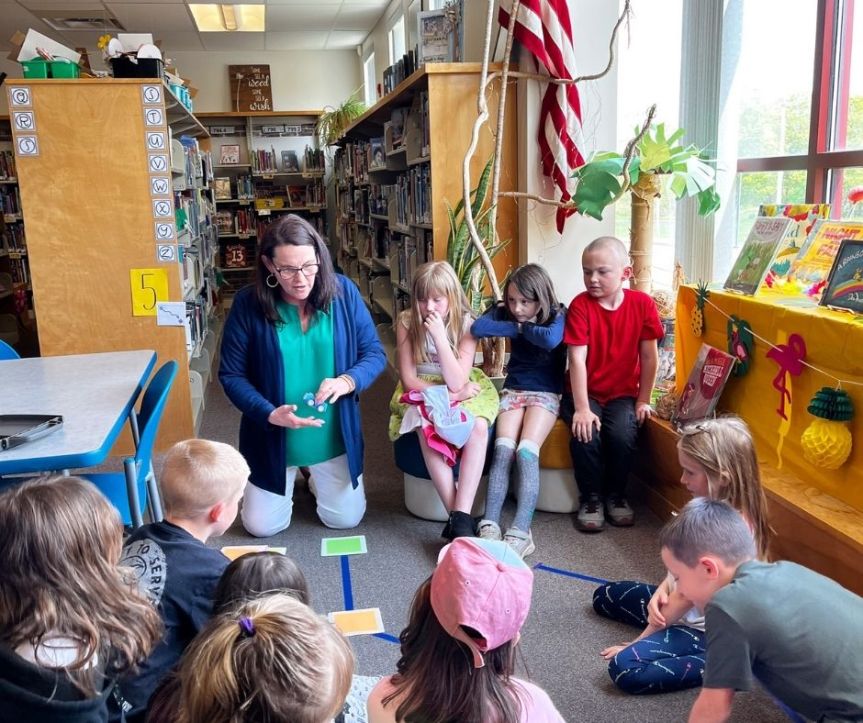
(Students use colored cards to tell robotic cars where to go.)

At Windsor Elementary and Middle School, students are passionate about innovation, and their librarian, Kristel Anuszewski, uses the mobile computer science labs funded by the Maine Department of Education (DOE) to support that passion. Anuszewski, Kennebec County’s 2024 Teacher of the Year, is the Librarian and STEM Educator for Windsor’s Learning Commons. On a Friday in late May, the Maine DOE visited as she taught coding skills to a first-grade class using indi cars from the Maine DOE’s Mobile Computer Science Lab program.

In 2022, the Maine DOE offered a grant for educators to apply for one of three mobile labs. Anuszewski chose the robotics and programming lab, with the other options being augmented and virtual reality and coding and hardware.

“We wanted to create a space where kids can be creative, they can be innovative, they can explore, and they can engineer,” said Anuszewski. The cart came with three learning tools for students: Sphero Indi Cars, Sphero BOLTs, and Merge Cubes.

Anuszewski used the Mobile Computer Science Labs to transform the library into a vibrant hub for innovation.

“I feel like it went from gray to this burst of color,” said Windsor Principal Heather Wilson. “She pulls out of the students different things that they’re interested in and shows them how technology can enhance that.”

At Windsor, the Learning Commons is designed to blend technology and traditional library lessons seamlessly. Anuszewski was brought on in 2019 to build out and run the program.

“We had this vision of it being called the Learning Commons and not the library because we wanted it to be more than books,” Wilson said. “We wanted it to be about technology, STEM, innovation, and fun. Before Kristal and the [Mobile Computer Science Labs], we viewed technology as one kind of tool, but it wasn’t interactive with the kids. Now, it’s a vibrant, interactive space that sparks creativity and engagement.”

Now, Learning Commons is bursting with color and sound. The moment students walk through the door, they are filled with curiosity. When Anuszewski tells her first-grade class about the day’s assignment, using the Lab’s indi cars for a lesson about Summer, the room fills with cheers.

“Kristel is an astoundingly intuitive teacher when it comes to building instruction around the STEM,” says Anuszewski’s teaching assistant, Ed Frankonis. “Students have developed immense teambuilding skills with each other thanks to the challenges presented by the coding-teaching technology tools.”
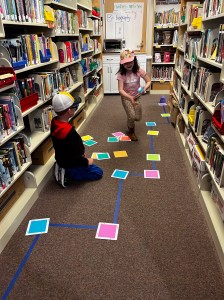
Students enthusiastically engage with Anuszewski’s indi Car assignment.

The indi cars Anuszewski used for the day’s lesson provide a hands-on coding experience using a built-in color sensor and interactive color-coded tiles. For more advanced learning, students can progress to simplified block coding options. In Anuszewski’s first-grade class, they stick to the color sensors.

“Students start out really young, with the directional coding, like the indi cars, and essentially, it’s, here’s where you’re starting, here’s where you’re ending, and what directions do you have to give your robot to be able to get them to where they need to be. So, it’s all about processing and logic,” explains Anuszewski. “Having [the Mobile Computer Science Labs] creates more opportunities. I never had anything that was color coded before, and for the kids who are still learning their lefts and rights, the colors help them flush out those concepts, all the while they are doing directional coding.”

For Pre-K through fifth grade, Anuszewski meets with each class twice a week, once for a traditional library lesson and then again for a STEM lesson. She ties these lessons together with a theme. Her Friday first graders have been learning about seasons, specifically summer. Earlier in the week, they read the book “Stuck” by Oliver Jeffers, a story about a boy whose kite is stuck in a tree and his attempts to knock it loose by throwing more objects up into the tree until it is full of stuck objects. For their following technology lesson, they are strategizing how to move their indi cars down a track to a summer object, like the ones from “Stuck.” To do so, they will have to use indi’s colored cards to tell the robot where to go.

The students pair off, each assigned to a specific section of the library where Anuszewski has laid masking tape tracks for them to lead their cars down. Frankonis goes to each group and lays out their special summer object at the end of the masking tape track.

“It’s hard, but it’s really fun,” said Nevada, one of Anuszewski’s first graders.

“You have to figure out what color to use,” explained another student named Landon. “Sometimes I get it wrong. I try again, though.”

Anuszewski teaches Windsor students up to eighth grade. Older students have more autonomy when it comes to the Learning Commons.

“So my middle school curriculum is very different from a traditional curriculum. I have what is called choice boards, so at the beginning of every month, I present between 12 and 14 choices for students in the areas of reading, technology, coding, engineering, and maker space,” explains Anuszewski. “So, within those headings are four different choices, at least, for students to be able to choose from. They pick the one area that they want to study for the month. There are clickable links that will take students to different places online, whether it’s instruction or the actual site, and they explore the subject independently and kind of prep themselves to be able to be successful with their choice.”

Every year, Anuszewski selects a team of middle school students to attend the Maine DOE’s Maine Learning Technology Initiative (MLTI) Student Conference at the University of Maine Orono (UMaine). She selects students who have shown an aptitude or particular interest in tech. This year, one of her Windsor Middle School students, Emry Michaels St. Ong, won a $1,000 scholarship for UMaine at the conference for a game design challenge.

“I got a scholarship to the University of Maine in Orono at the MLTI conference. I was playing an online game called Bloxels, and I won for creating a character based on one of my favorite teachers,” explained St. Ong.

For those unfamiliar, Bloxels is a game-building platform where players can create games their peers can play.

“At the conference, we would go to different blocks. In the Bloxel block, the presenter told us how to go in and make characters, then gave us time to play around with it,” continued St. Ong. “There was a competition for best character. I didn’t think I was going to win it at all. But Mr. Ed here in the library told us that you never know, just take your chance and you can get it. So, I submitted my character and won one of the scholarships.”
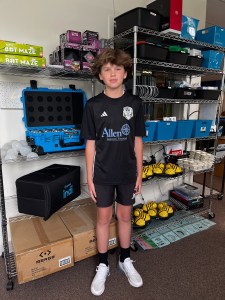
St. Ong stands in front of the Windsor’ Mobile Computer Science Labs.

Anuszewski mentions that game design is very popular for a lot of kids.

“They get to do it in the library during learning commons time,” she said. “But to be able to hear from another presenter, to be able to have that kind of college experience with someone who’s not your teacher is really, really cool for them.”

That being said, St. Ong credits Anuszewski with giving him the tools he needed to win: “She teaches you a lot of stuff that will not just help you in school but help you wherever you go. She has taught us to use our imaginations and to be creative.”

Regarding coding, St. Ong was able to learn more about himself as a learner by using the robots from the Mobile Computer Science Carts.

“I’ve learned I’m a visual learner, and I like to go off on my own to code,” St. Ong explained. His class uses the Sphero Bolt bots. Students like St. Ong will code the bot to move about a room independently. “I’ll code a [Sphero Bolt] a little bit, see where it ends up, and then I’ll use what I learned to change it. I love learning hands-on like that.”

Through programs like the Mobile Computer Science labs, educators like Anuszewski have the means to empower students to engage with technology from a young age, building skills that they will use for the rest of their lives.

“I don’t want kids to ever be afraid of technology. I feel like immersing them in the technology is one way to do that,” says Anuszewski. “If they want to seek a career, technology is going to be a part of that. I don’t ever want them to feel like they don’t understand tech or not pursue something they want because they’re too afraid of what they don’t know. I never want them to be scared to try something.”

The Mobile Computer Science Labs are a part of Maine Teaches CS and were purchased with Federal Emergency Relief Funding. Maine Teaches CS is a part of Maine’s Whole Student Pandemic Response. Discover more of the DOE’s innovative programming at Maine’s Whole Student Pandemic Response page on the Maine DOE website.
Want to share your own federally funded success story? Tell us all about it through our convenient form by tapping or clicking here!

Media Release: Nokomis Computer Science Teachers Featured on Maine DOE Podcast What Holds Us Together

Commissioner Makin Speaks With Kern and Keith Kelley About How They Integrate Hands-On Computer Science Education Across Grade Levels and Content Areas

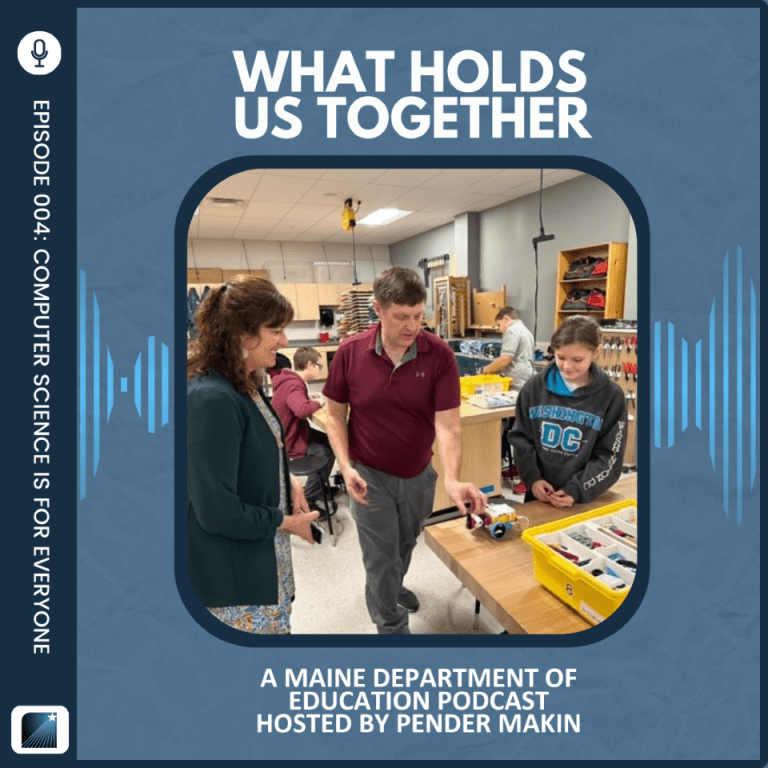
In the latest episode of her What Holds Us Together podcast, Maine Education Commissioner Pender Makin speaks with Keith and Kern Kelley, brothers and computer science teachers at Nokomis Regional Middle and High School, about Maine’s efforts to integrate computer science education at all grade levels and with all content areas. They talk about how hands-on, real-world computer science education teaches students about technology and computer science as well as strengthening their ability to work in teams, troubleshoot, communicate effectively, lead, and pursue creative passions. You can listen here.

“These are two brothers who are educators integrating really exciting hands-on, real-world computer science education, innovation, and technology with their students. I’ve been to visit their classrooms and have seen the work that they’ve been doing with their students and how much engagement there is. I was so impressed, I wanted to share some of what they’re doing with all of you,” said Makin in the podcast opening.

The three discussed how computer science education has real-world applications across all content areas and areas of life.

“I was a librarian and a language arts teacher, so I’ve come from a different way to get to this. It’s not separate, it’s part of. Language arts teachers are doing coding. When you’re teaching kids you have to use a period, you have to use a comma, you have to be grammatical, and there’s a reason and structure to it, then you get into building a game or a sequence of coding and there’s structure, it’s the same thing. If you’re doing computer science and learning coding, you’re learning a language,” said Keith Kelley, Innovative Technology Teacher at Nokomis Regional Middle School.

He continued, “We do asynchronous grouping, so one kid is building code and he or she has 2 other groupmates and they have to communicate digitally with each other through screen captures and stuff like that. That’s what you do in the real world, we’re virtually meeting all the time. When my kids are doing basic coding they’re learning pre-algebra, they’re learning sequencing, but also they’re learning troubleshooting which translates to everything. It’s not a separate thing, it’s part of what’s already out there. If you’re in math you’re doing numbers, but you are doing language. You’re in science and doing labs and troubleshooting, but you’re doing language.”

Kern Kelley, Director of Technology Integration for the district, described how he began integrating computer science education with different content areas across the high school.

“I’d ask the kids what they’re doing [for a specific teacher] and say ok, for me you’re going to do that same project but you’re going to do it this way—we’re going to do a virtual reality world for that book project you have to do. The kids would do it and bring it to the teachers and almost 100 percent of the time [the teachers] say that’s great, next time let’s make that as an offering,” said Kern Kelley.

Makin described how that approach is setting Maine apart as a computer science education leader.

“That really sets this apart from what I see across the nation in terms of really rote programmatic learning coding for the sake of learning coding. You both take it to that next level where it’s really learning coding to do an important thing that is relevant, whatever that might be,” said Makin.

“There’s elegant coding. Just like in writing you have basic writing then you get to the point where now I’m not writing for writing sake or to get information across I’m trying to make something prose or poetry. The same thing happens with technology and the coding. You go from writing basic coding to make it function to making it function efficiently or elegantly through elegant design,” said Keith Kelley.

They also discussed how this continuum of computer science education that students experience through their school careers develops the leadership and teaching skills of students. High school students can participate in SLAM, developing weekly live shows to teach other students how to create something using a free online tool. Once a month the students also go on the road for a SLAM Show and teach sessions to younger students to get them engaged and excited about computer science.

“As much as we can have students as part of the solution and include them in that process of learning and get opportunities to teach and learn from that experience…and then the idea is those kids get so excited about learning from high school kids about these cool tech topics, that’s usually enough impetus where we can now talk to the teachers afterward [about doing more]. Now we’ve broken the ice and they know how to use these things and have all these ideas,” said Kern Kelley.

Through the Governor’s Emergency Education Relief Fund, the Maine Department of Education (DOE) provided every Maine public school with a free mobile computer science lab to ensure that every student, pre-K through grade 12, has access to interdisciplinary, project-based computer science education with real-world applications.

The DOE has a comprehensive computer science education plan guided by seven key principles: authentic and project-based instruction, computer science as a prek-12 learning continuum, equitable and inclusive access, educator-produced professional learning and statewide sharing, integrated applied learning, educator-informed policy and state planning, and computational thinking as a foundation. You can read more about Maine’s computer science education framework here.

What Holds Us Together is a monthly podcast produced by the Maine DOE and hosted by Makin to highlight the voices of educators, students, and school employees across Maine. Listen to this and all the episodes of What Holds Us Together on Apple and Spotify.

Computer Science Mobile Lab – Training Webinars and Support Resources

Join us during Computer Science Education (CS Ed) Week for FREE virtual training for the mobile computer science labs! We’re excited to announce that we’ll be hosting webinars throughout next week to help folks get started with their lab equipment. These will be vendor-provided trainings and will cover the basics of unboxing, configuring, and getting started. Webinars will be live and recorded. Recordings will be posted to the website once they become available.

Additionally, we’ve put together a webpage to provide immediate resources and support for each mobile lab option. These resources offer some quick access information to help get going with the equipment

To check out these resources, learn more about the webinars, and to register, click here. You’ll see the mobile lab options and can find quick start resources as well as the registration links for the webinars.

If you have questions or would like additional information, please reach out to Maine DOE’s Computer Science Specialist, Emma-Marie Banks at emma-marie.banks@maine.gov

Media Release: Governor Mills Announces New Initiative to Bring Mobile Computer Science Labs to All Maine Schools

Governor Janet Mills today announced the launch of a new Maine Department of Education (DOE) initiative that will provide every Maine public school with a free mobile computer science lab. The effort, funded through the Governor’s Emergency Education Relief Fund, will enable all Maine students to access high-quality learning experiences that provide real-word training in robotics, programming, augmented and virtual reality, coding, and hardware.

In July, Governor Mills joined governors from across the country in signing a bipartisan national compact on computer science education. As part of the agreement unveiled at the National Governors Association’s Summer Meeting in Portland, all 50 governors pledged to work to expand K-12 computer science education options in their states. The DOE has a comprehensive computer science education plan guided by seven key principles.

“Our economy increasingly depends on workers with training in computer science. This initiative will ensure that students across our state are prepared to succeed in the jobs of the future,” said Governor Janet Mills. “My administration will continue to make sure that all Maine students have a chance to acquire digital literacy skills.”

“Maine is leading the nation by providing equipment to our schools statewide to ensure that every student has a meaningful computer science education with real-world applications,” said Pender Makin, Commissioner of the Maine Department of Education. “These mobile computer science labs will provide every student in Maine, across all grade levels and subject areas, with learning experiences that prepare them for future success.”

“This opportunity from the Mills administration and the Maine Department of Education is a game-changer for the students of Maine. For the first time, all Maine kids will have equal access to a high-quality computer science curriculum and tools in their schools. I am incredibly happy to see that equity is the centerpiece of this new initiative and cannot wait to see what happens next,” said Computer Science Teachers Association (CSTA) Maine Chapter President and 8th Grade Computer Science Teacher Sean Wasson.

Schools will be able to order one of three mobile lab options: Robotics and Programming, Augmented and Virtual Reality, and Coding and Hardware. Each lab contains computer science equipment valued at $5,000 and is designed to be integrated into any content area and skill level. Additionally, the initiative will make available professional learning opportunities for educators tailored to each computer science topic area.

The Maine Department of Education is reaching out to Maine superintendents with detailed information about how to secure mobile labs for schools in their district. More information about each program area can be found on the Maine Department of Education website.