Scholarship Opportunities Available for Maine School Counselors and School Social Workers

The Maine Department of Education (DOE) recognizes the importance of supporting student mental health. Data from the U.S Center for Disease Control and the Maine Integrated Youth Health Survey reflect increased student mental health needs.

In 2023, Maine DOE received a five-year Expanding Access in School Environments (EASE) grant to increase school-based mental health staff and services in Maine schools. The Maine DOE will spend the next year providing opportunities to the current workforce of school counselors and school social workers to build upon their expertise and to promote evidence-based practices in Maine schools. This emphasis on school-based mental health workforce development strengthens the quality of mental health services in schools.

The following scholarship opportunities are being presented to school counselors and school social workers working in Maine schools:

  • With the goal of increasing the number of school counselors benefiting from access to their professional communities, Maine school counselors (up to 31) will be given scholarship opportunities to obtain full membership in the American School Counselor Association (ASCA). This membership opportunity will connect more Maine school counselors with their professional community, providing access to additional networking, training, evidence-based practice resources, and research. Eligible ASCA members will also be able to pursue national school counselor certification through ASCA. Once the application is created, it will be distributed through a Maine DOE school-based mental health listserv.
  • With the goal of increasing the number of nationally certified school counselors (ASCA) supporting Maine schools, the Maine DOE will provide scholarships to qualified school counselors (up to 10) to participate in the ASCA national certification process. At this time, ASCA has reported that Maine does not have any ASCA national certified school counselors working in Maine schools. Once the application is created, it will be distributed through a Maine DOE school-based mental health listserv.
  • With the goal of increasing the number of school social workers benefiting from access to their professional communities, Maine school social workers (up to 31) will be given scholarship opportunities to obtain full membership in the School Social Work Association of America (SSWAA). This membership opportunity will connect Maine school social workers with their professional community, providing access to additional professional networking, training, evidence-based practice resources, and research. Eligible members will also be able to pursue advanced national certification through the SSWAA National Certified School Social Work process. Once the application is created, it will be distributed through a Maine DOE school-based mental health listserv.
  • With the goal of increasing the number of nationally certified school social workers (SSWAA) supporting Maine schools, the Maine DOE will provide scholarships to qualified school social workers (up to 10) to participate in the SSWAA National Certified School Social Work process. This advanced national certification process requires applicants to link their school practices with the national school social work practice model. This funding support may result in a 1000% increase in National Certified School Social Workers in Maine schools and place Maine among the national leaders in national school social work certification. Once the application is created, it will be distributed through a Maine DOE school-based mental health listserv.

To be eligible for these opportunities, school counselors and school social workers must meet the eligibility requirements for each individual activity, be employed as a school counselor or school social worker in a Maine school, hold 075 certification from the Maine Department of Education (school counselors), or hold a valid social work license from the Maine Social Work Licensing Board (school social workers). Interested school counselors and school social workers must use the forthcoming application to request access to these scholarship opportunities. Each of these opportunities will be provided on a first come, first serve basis.

For more information, contact kenneth.a.rautiola@maine.gov.

Maine Learning Technology Initiative (MLTI) Opens Spring Application for Teaching and Learning Technology Grant #TeachWithTech

The Maine Department of Education (DOE) Maine Learning through Technology Initiative (MLTI) is pleased to announce the release of the spring application of the #TeachWithTech grant. This grant is available to all MLTI school districts to provide supplemental technology and related professional learning to support innovative teaching and learning with technology. This program aims to provide funding opportunities to educators who want to bring technology into their schools in ways that are innovative, impactful, and intriguing.

A few examples of eligible technology include:

  • 3D Printing
  • Video Production Equipment
  • Audio / Podcasting Equipment
  • Robotics & Coding Kits
  • Drones
  • Digital Microscopes & Doc Cameras
  • Specialized cameras (GoPro, 360, etc.)
  • And so much more!

This grant is designed to offer supplemental technology that is not already provided through the MLTI program; device applications will not be considered. Instead, districts are encouraged to think about innovative learning through technology and submit an application to invest in technology that will create transformative learning experiences for students and supplement the devices already provided through MLTI.

Priority will be given to applicants who:

  • Focus on the greatest student impact.
  • Serve socioeconomically disadvantaged school districts.
  • Prioritize student populations traditionally underrepresented in technology.
  • Demonstrate a commitment to pursuing high-quality teaching and learning through technology.
  • Show a commitment to effective implementation and long-term success.

We’ve streamlined the application and reporting process to create more ease every step of the way. Applications will be reviewed as they come in and awardees will be notified once the evaluation is complete.

Interested, but not sure where to start? Register for a Q&A session, check out our FAQ, and connect with the Maine DOE’s Learning Through Technology team to learn more.

Register for a Q&A session via the links in the “Important Dates” section below.

Important Dates

  • Friday, January 30th; Application Window Opens
  • Tuesday, February 13th, 2024, 3pm; Q&A Session #1
  • Thursday, February 29th, 2024, 8am; Q&A Session #2
  • Tuesday March 12th, 2024, 3:00pm; Q&A Session #3
  • Friday, April 30th, 2024; Application Window Closes
  • July 1st, 2024; Grant Awardees Contract Begin

Click here to access the #TeachWithTech FAQ.

Click here to review the application and apply!

Have questions? Want more information? Contact the Learning Through Technology team at doe-ltt@maine.gov

Two Request for Proposals Now Open for Workforce Innovation and Opportunity Act (WIOA) Grant Funding

The Maine Department of Education (DOE) is pleased to announce the release of two requests for proposals (RFP) as required by the Workforce Innovation and Opportunity Act (WIOA), to award multi-year funding to eligible agencies for the provision of WIOA Title II Adult Education and Family Literacy Act (AEFLA) 231 services and the provision of WIOA Title II Adult Education and Family Literacy Act (AEFLA) Section 243, Integrated English Literacy and Civics Education/Integrated Education and Training (IELCE).

It is the purpose of Maine Adult Education under WIOA to provide adult education and literacy services that align with the goals in the State of Maine Unified Plan and encourage the growth of educational opportunities and, where applicable, to ensure career, citizenship, and college readiness for all Maine adults (Maine Education and School Statutes 20-A, 8601).

Signed into law in 2014, the Workforce Innovation and Opportunity Act (WIOA) requires the alignment of workforce, education, and economic development systems to support access to high-quality, comprehensive, and accessible workforce services for all individuals, including those with significant barriers to employment. Title II of WIOA retains and expands the purposes of the Adult Education and Family Literacy Act (AEFLA), which aims to help adults, including immigrants, acquire the skills and knowledge necessary to obtain employment, become full partners in the educational development of their children, improve economic opportunities for their family, and aid in the transition to postsecondary education and training.

The request for proposal (RFP), which includes information regarding eligibility, program requirements, and more, is available here.

Below is the anticipated timeline for the Department’s current AEFLA grant competitions:

Timeline AEFLA 231
(Link to RFP here: 202312252)
AEFLA 243 (IELCE)
(Link to RPF here: 202401001)
RFP Released to Public January 23, 2024 January 17,2024
Bidders Conference February 5, 2024 n/a
Deadline for Submission of Questions in Response to RFP February 9, 2024 January 25, 2024
Proposal Deadline March 7, 2024 February 29, 2024
Grant Award Notifications May 2024 May 2024
Grant Award Start Date July 2024 July 2024

Please be advised that the dates above are subject to change. Interested organizations must consult the RFP document for the most accurate dates and deadlines regarding this opportunity.

For more information on AEFLA 231 and 243 , contact State Adult Education Director Megan Dichter at megan.dichter@maine.gov.

Media Release: Maine DOE Awards $300,000 in Climate Education Professional Development Grants 

Grants Allow Maine Schools to Partner with Climate and Environmental Community Organizations to Strengthen Climate Education for Students 

The Maine Department of Education (DOE) awarded $300,000 in climate education professional development grants to support partnerships between 14 school administrative units (SAUs), schools, and community organizations to strengthen climate education opportunities for students across Maine.

Grant funding will allow educators to learn from experts and organizations that have created, sustained, and grown outdoor and environmental education opportunities and programs that are tailored to their local region’s assets and needs. Educators will be able to bring what they’ve learned back to their classrooms and schools to expand innovative and engaging climate education opportunities to more Maine students.

“These grants provide Maine educators and schools with the tools, resources, and partnerships they need to provide students with engaging, hands-on climate and environmental education. From the mountains to the coast, Maine has enormous natural resources for students to explore and learn from so they can be effective environmental stewards and leaders,” said Maine Education Commissioner Pender Makin. 

School Union 93, Central High School in Corinth, Fryeburg Academy, Greenville Consolidated School, Saco, Biddeford and Dayton Schools, RSU 12, and Vinalhaven and North Haven Schools all received grants in this first round of funding. They plan to engage in the following programming:

  • All five schools in School Union 93 will partner with Maine TREE and the Woodlawn Museum this spring on interdisciplinary climate education instruction, a district-wide climate education plan, and professional learning about Project Learning Tree for Pre-K through 8th grade students.

  • Central High School will partner with Hirundo Wildlife Refuge to run professional development programming on Pushaw Stream. Teachers will learn about forest ecology, macroinvertebrate sampling, as well as receiving Educational Trip Leaders and Wilderness First Aid certifications. These will all be combined to enable Central High School teachers to guide students on and around the Pushaw Stream waterways.

  • Fryeburg Academy will partner with a wide range of community-based organizations throughout the Western Maine Region and New Hampshire, with teachers working with partners individually and in small groups to design projects and curriculum for students in and out of the classroom.

  • Greenville Consolidated School will partner with the Rural Aspirations Project to create elementary and middle school place-based science maps, align their curriculum, and design middle school climate intensive units.

  • Saco, Biddeford, and Dayton Schools will collaborate with the Ecology School, with one cohort of teachers meeting virtually during the spring to cover climate change-specific content areas and align them with the curriculum and a teacher institute in June that will bring together teachers from all three schools to cover climate change content and design curriculum for the fall.

  • Sheepscot Valley RSU 12 educators will participate in a three-day professional development workshop with community partner Friends of Cobbossee Watershed. Educators will adapt and align existing watershed-specific curriculum with school standards and develop a rich foundation of region- and lake-specific environmental and climate content knowledge for use in the classroom.

  • Teaching Resilience: Professional Development for Climate Curricula is a program Vinalhaven and North Haven Schools have designed with community partner Hurricane Island Center for Science and Leadership. This program will build teacher capacity and curriculum for both schools to engage meaningfully with local community partners on student projects.

“Teachers of School Union 93 are excited to collaborate with community partners to develop and deliver a professional development program to educate teachers on climate change, its impact on the environment and surrounding peninsula, and how to instruct students to explore climate-related topics. This work will result in a Union-wide climate education plan that will serve as an everlasting resource for the schools on the peninsula,” said Dawn McLaughlin, Assistant Superintendent of School Union 93.  

“Maine (TREE) is ecstatic to work with School Union 93 to bring climate and forest-based education to schools on the Blue Hill Peninsula. This collaboration between the School Union, Maine TREE, and Woodlawn Museum will provide a long-lasting impact on the students in the region and provide a model for how to develop regionally designed climate education programming for students in rural parts of Maine,” said Logan Johnson, Executive Director of the Maine Timber Research & Environmental Education Foundation (Maine TREE).

“Although educational research shows that an interdisciplinary and project-based approach offers many advantages, especially when it comes to the study of global issues such as climate change, there are significant challenges to meaningful implementation in the classroom, coordination across the faculty, and engagement with the community. At Fryeburg Academy we immediately recognized the value of this grant for closing some of those gaps,” said Dylan Harry, Director of Outdoor Learning and Research Center at Fryeburg Academy. 

“Teaching students about the environment that they live in is vital. Part of that teaching comes in the form of climate education.  Climate changes greatly impact each and every one of us in one way or another. Having the opportunity for hands-on, experiential learning brings these issues to the forefront for students. I am excited to work with a team of local experts, both environmental and educational, on designing a curriculum that brings more awareness of Climate Change and its impact on our lakes, ponds, and rivers to the students,” said Jana Diket, Middle School Teacher at Windsor Middle School.

“The Friends of the Cobbossee Watershed is really pleased to be partnering with RSU 12 and the Maine State YMCA Camp on this Climate Education Professional Development.  With the challenges we are experiencing due to the effects of climate change, we are excited to bring together educators from across the region to form a network for ideas and best practices. Utilizing the watershed lands and waters as the classroom brings the power of experiential and hands-on teaching pedagogy into the hands of the teachers on the front lines,” said Tom Mullin, Executive Director of Friends of Cobbossee Watershed. 

“RSU 64 in Corinth is excited and grateful to have received funding to provide professional development to our staff through the Climate Change Grant offered by Maine DOE.  We will be holding training in Wilderness First Aid and for the certification as an Educational Trip Leader for up to 20 of our staff and from RSU 34 as well. This is a critical need for us because we have a very active outdoor community in our towns and we want to capitalize on those interests by opening the door to water-based activities for students,” said Dr. Rad Mayfield, Principal of Central High School.  

“The Climate Education Professional Development Partnership offers our schools an amazing opportunity for teacher collaboration and student learning.  Vinalhaven School, North Haven School, and the Hurricane Island Center for Science and Leadership will all work together, thanks to the financial support from the [Maine DOE] Office of Innovation. I look forward to seeing the project implementation in the coming months,” said Monte Selby, Superintendent of Vinalhaven School.

Maine continues to be a leader in outdoor learning and climate education. The Maine DOE’s Rethinking Responsive Education Ventures (RREV) initiative, funded through a $16.9 million federal grant, has supported the expansion of outdoor education classrooms, programs, professional learning, partnerships, and spaces across the state. Schools across Maine utilized federal relief funding to expand outdoor learning spaces and programs. Governor Mills’ Maine Outdoor Learning Initiative has provided thousands of Maine middle and high school students with coastal and inland forestry learning and career exploration opportunities during the summer. The Maine DOE recently hired a Climate Education Specialist to support and expand this work with educators, schools, and community partners across the state. You can learn more about the Maine DOE’s climate and outdoor education work here.

The grant initiative was designed out of LD 1902, which was passed by the Legislature in 2022 and signed by the Governor to establish a pilot program to encourage climate education in Maine public schools. Priority was given to communities historically underserved by climate education, socioeconomically disadvantaged communities, and interdisciplinary, place-based, and project-based learning activities. A second climate education RFA will be announced early in 2024.


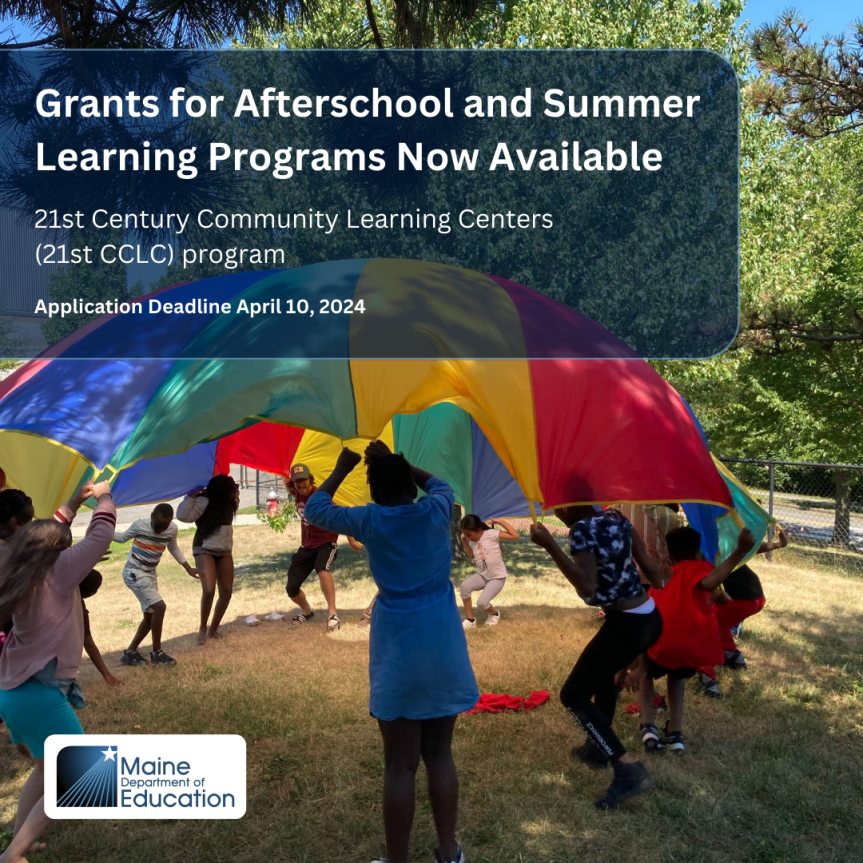
Grants for Afterschool and Summer Learning Programs Now Available, Application Deadline April 10, 2024

The Maine Department of Education (DOE) is pleased to announce the release of a request for proposals (RFP) seeking bids from organizations interested in implementing comprehensive afterschool and summer learning programs in 2024-2025. It is anticipated that roughly $3.5 million will be available to issue grant awards this spring.

Authorized under Title IV, Part B of the Elementary and Secondary Education Act, as amended by the Every Student Succeeds Act (ESSA) Act of 2015, the 21st Century Community Learning Centers (21st CCLC) program provides competitive grant funding to support before-school, after school, and summer learning programs that focus on improving the academic performance of students in Pre-Kindergarten through grade 12.

The primary purpose of the 21st CCLC program is to provide funding for school and community partnerships that establish or expand community learning center programs. These programs provide students in high-need, economically disadvantaged communities with academic tutoring and enrichment opportunities designed to complement their school-day academic program. In addition, these programs can provide a broad array of additional support services related to overall student health and well-being.

Local 21st CCLC programs – which can be located in elementary schools, secondary schools or similarly accessible community facilities – provide high-quality support services to students during non-school hours. As such, these programs also support working parents and families by providing safe, supportive learning environments for students at times when school is not normally in session.

The request for proposal (RFP), which includes information regarding eligibility, program requirements, and more, is available here. An informational webinar for this RFP will also be posted to the Department’s application website on January 24, 2024. It is strongly recommended that interested organizations view this presentation, in its entirety, before submitting a proposal for 21st CCLC program funding.

Below is the anticipated timeline for the Department’s current 21st CCLC grant competition:

  • January 9, 2024—RFP Released to Public
  • January 24, 2024—Informational Webinar Posted Online
  • February 7, 2024—Deadline for Submission of Questions in Response to RFP
  • February 21, 2024—Interested Organizations Submit Intent to Apply Form
  • April 10, 2024—Proposal Deadline
  • April 2024—Formal Peer Review of Proposals
  • May 2024—Grant Award Notifications
  • July 1, 2024—Grant Award Start Date

Please be advised that the dates above are subject to change. Interested organizations must consult the RFP document for the most accurate dates and deadlines regarding this opportunity.

For more information on the 21st Century Community Learning Centers (21st CCLC) Program, contact State Coordinator, Travis Doughty, at travis.w.doughty@maine.gov.

First 10 Community Schools Request for Applications (RFA # 202312243)

The Maine Department of Education (DOE) is accepting applications from school administrative units (SAUs) and Education in the Unorganized Territory (EUT) to be part of a 3-year First 10 Community School pilot project funded through Maine’s Preschool Development Grant.  Developed by Education Development Center, First 10 Community Schools bring together school systems, early childhood programs, and community partners/agencies to improve care and education for young children and their families throughout the first 10 years of children’s lives.  This model works to improve teaching and learning, deepen partnerships with families, and provide comprehensive services for children and families.   

Through this opportunity, pilot sites will be supported in developing and implementing First 10 Community School models.  To learn more about the model and the pilot opportunity, interested applicants are encouraged to view this recorded First 10 Community School information session.  Additional information about First 10 Community Schools can be found on the Maine Department of Education’s First 10 webpage and on Education Development Center’s First 10 webpage.  

Eligible schools that are interested in the First 10 Community School grant opportunity may access the application through the First 10 Community School Request for Applications (RFA)

A timeline for the RFA process is provided below. 

  • December 18, 2023–RFA released 
  • January 4, 2024—RFA question submission deadline 
  • February 1, 2024—RFA submission deadline 

All questions about the First 10 Community School RFA should be submitted to the First 10 Community School Grant Coordinator identified on the Grant RFPs and RFAs webpage. 

Additional questions regarding this announcement should be directed to:
Lee Anne Larsen, Director of Early Learning, Leeann.Larsen@maine.gov 


Apply Today for the 2024 Maine Outdoor Learning Initiative. Applications Due By January 12

Apply Now! Schools and community-based organizations can now apply for the 2024 Maine Outdoor Learning Initiative grants through the Maine Department of Education (DOE). These grants support hands-on, engaging, interdisciplinary outdoor learning and career exploration opportunities that connect students with Maine’s amazing natural environments and landscapes.

Created by Governor Mills, the Maine Outdoor Learning Initiative has included thousands of students throughout the state in its Coastal Ecology and Inland Forestry Programs over the last two years. Read about past programs here: Maine Outdoor Learning Initiative: Past Programs | Department of Education.
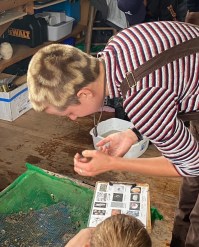
The Maine DOE is excited to build on these successes to reach more students in this expanded program. The 2024 Maine Outdoor Learning Initiative Request for Applications (RFA, also known as grants) is available here: Grant RFPs and RFAs | Division of Procurement Services (maine.gov).  See RFA 202311223. 

Schools, private and nonprofit organizations, municipal Parks and Recreation Departments that are current members of the Maine Recreation and Park Association, and public libraries can apply.  In this sense, “schools” include school administrative Units (SAUs), Career and Technical Education (CTE) Centers or Regions, Education in Unorganized Territories (EUTs), charter schools, and approved private schools located in Maine.  See the RFA for explicit information and definitions on eligibility and allowable uses of funding. 

Grant awards will range from $25,000 to $999,999 with a total of $2,000,000 available. The 2024 Maine Outdoor Learning Initiative grant requires a marketing and outreach plan for reaching students from disadvantaged backgrounds as well as an emphasis on Maine DOE’s Whole Student Framework 

This funding can potentially be used to facilitate outdoor learning programs before, during, or after school; on weekends; during school breaks and/or over the summer. Applications will also be considered for schools and organizations who wish to use the funding to enhance or expand existing outdoor programming. Grants are expected to be awarded in the early spring. All programing must be completed by September 1, 2024. 

This 2024 Maine Outdoor Learning Initiative opportunity is funded in its entirety by the American Rescue Plan Elementary and Secondary School Emergency Relief (ARP ESSER) fund. Learn more about the Maine Outdoor Learning Initiative 

Open for Additional Applicants: Comprehensive Electronic Health Record Pilot Grant Program Request for Applications (RFA #202305111)

The Maine Department of Education (DOE) is accepting applications from school administrative units (SAUs), publicly supported secondary schools, and Education in the Unorganized Territory (EUT) who meet eligibility requirements stated in RFA# 202305111 as an ongoing open application period.

Using American Rescue Plan, state reservation funds, the Maine Department of Education (DOE) will cover costs of implementing a comprehensive electronic health record of up to $6000 which includes a nominal stipend for an SAU designated electronic health record champion. This widespread pilot aims to show that maintaining an electronic health record is beneficial to both local schools and the State of Maine as it will increase the efficiency of services provided, decrease the burden of reporting health data, allow for data-informed decisions and policy, and increase revenue possibilities with MaineCare.

Proposals submitted that meet the requirements will be accepted on a first come, first served basis until funds are no longer available or by May 31, 2024.

Eligible school administrative units that are interested in the Comprehensive Electronic Health Record Pilot Grant Program opportunity may access the application and the previously released question/answer document through the Grant RFPs and RFAs webpage.

All questions about the Comprehensive Electronic Health Record Pilot RFA should be submitted to the Grant Coordinator: Emily Poland, Office of School and Student Supports, Emily.Poland@Maine.gov


2024 Maine Outdoor Learning Initiative (MOLI) Grant Information Sessions

Start your scope of work now! The Maine Department of Education (DOE) will soon be seeking applications for the next round of Maine Outdoor Learning Initiative grants.  These grants support hands-on, engaging, interdisciplinary outdoor learning and career exploration opportunities that connect students with Maine’s amazing natural bounty. See a Newsroom story about 2023 Maine Outdoor Learning Initiative Grants.

With massive expansions in eligibility, this funding can potentially be used to facilitate outdoor learning programs before, during, or after school; on weekends; during school breaks and/or over the summer. The Request for Applications (RFA) is slated to be published December 1, 2023.

Join Maine DOE staff for a series of open office hours in November to learn more about the application process and how your organization can maximize this opportunity for students.   Make sure you sign up for these Open Office Hours sessions.  After the RFA is published on the State website, the Maine DOE will not be able to field questions outside of the formal Procurement process.

Join the Maine DOE Open Office Hours to brainstorm how your school or organization can take advantage of this one-time federal funding.

The significant expansion of the eligibility rules beyond non-profits to include most local education providers, makes many schools in Maine eligible for this funding.  For 2024, schools, private and nonprofit organizations, municipal Parks and Recreation Departments that are current members of the Maine Recreation and Park Association, and public libraries can apply.  In this sense, “schools” include charter schools, Career and Technical Education (CTE) Centers or Regions, Education in Unorganized Territories (EUTs), approved private schools located in Maine, and school administrative Units (SAU). Applications will also be considered for schools and organizations who wish to use the funding to enhance or expand existing outdoor programming.

The Maine DOE expects more than 60 applications. In 2023 our non-profit partners reached 1,500+ students. In expanding the eligibility and length of the 2024 grant, we expect to reach 2,500+ students with meaningful outdoor educational experiences.

The Maine Outdoor Learning Initiative was created by Governor Mills in 2022 to connect Maine’s young people to the outdoors through engaging summer learning opportunities. The initiative has grown each year in scope and the number of students served. Click here to learn about the 2022 and 2023 Maine Outdoor Learning Initiative programs. The initiative is supported through Federal Emergency Relief Funding.


Semester of Service $1,500 Grants to Support Youth Action

Maine youth have shown they want to take action on things that matter in their community. That is why Volunteer Maine, the state service commission, is offering $1,500 mini-grants to support youth-led projects through its Semester of Service grant program. Applications are due on or before November 2, 2023.

Youth groups in schools, faith communities, service organizations, and nonprofits are eligible to apply and participate. The Semester of Service begins on Martin Luther King Day of Service in January 2024 and ends with National Youth Service Day in April 2024. Proposals that tackle issues related to climate, mental or physical health, and housing are encouraged.“Youth-led” means individuals 17 or younger take the lead in all aspects of the initiative (research, decision-making, design, implementation). Advisors over 18 years old are resources and process facilitators. Youth-leadership is critical because it develops young people’s knowledge, skills and confidence to be catalysts for positive change within their communities.Participating youth groups are asked to learn what Dr. King meant by the “Beloved Community” and reflect on what their actions can contribute to making it a reality in their locale. “The Beloved Community” is a term first coined in the early 20th Century by the philosopher-theologian Josiah Royce, b1855 – d1916. For Dr. King, the Beloved Community was not an altruistic goal but rather a realistic, achievable goal. It could be attained by people working together to end poverty, hunger, homelessness, racism, prejudice, violence, bullying, and other conditions that divide or weaken a community.

Proposals for youth-led projects will be accepted from organizations with youth programs or youth constituents, 17 years old or younger, that are Maine public or private nonprofits, state/county/local units of government, higher ed institutions, faith-based organizations, Indigenous communities, and local schools.

Regardless of the type of youth group, the legal applicant must have an employer identification number (EIN) or taxpayer identification number (TIN) and, if selected, accept responsibility for signing the grant agreement, accounting for grant funds, and submitting a report on the outcomes of the project. Awards will not be made to individuals.

Application instructions and additional information can be found here.

For more information contact Maryalice Crofton, Executive Director of Volunteer Maine at (207) 624-7792 or maryalice.crofton@maine.gov.

About Volunteer Maine
Volunteer Maine, the Maine Commission for Community Service, builds capacity and sustainability in Maine’s volunteer sector by funding service programs, developing volunteer managers and service-learning practitioners, raising awareness of the scope and the impact of the volunteer sector, and encouraging an ethic of service.