Maine DOE and Maine Chapter of the American Academy of Pediatrics Launch Asynchronous School Health Webinar Series

The Maine Department of Education (DOE) Coordinated School Health Team is excited to announce the launch of the School Health Webinar Series, presented in partnership with the Maine Chapter of the American Academy of Pediatrics (AAP). This series is designed for Maine school health professionals, pediatricians, school health advisors, and others working to support student health and well-being.

This asynchronous educational series begins on December 1, 2025, with a new installment released each month through April of 2026. All sessions and materials can be viewed at the participant’s convenience and will remain available as enduring content through December of 2028. Up to five Continuing Medical Education (CME)/Continuing Education (CE) credits are available—one per session. Sessions include:

  • The Digital Dilemma: Supporting Youth Mental Health in an AI-Driven World
  • Supporting Self-Management in Diabetes
  • Tuberculosis 101
  • School Vaccine Requirements: What They Are, Why They Matter, and How to Implement Them in Challenging Times
  • Autism Spectrum Disorders: Challenges, Strengths, and Strategies in the Educational Setting

For more information, including learning objectives for each session, please visit this link. With further questions, please contact Maine DOE School Nurse Consultant Emily Poland at Emily.Poland@maine.gov.

Registration Open for the 2026 Maine School Winter Wellness Summit

The Maine Department of Education (DOE) Employee Health Promotion and Wellness Program is pleased to be hosting the 2026 Maine School Winter Wellness Summit on Thursday, January 29 and Friday, January 30 at the Samoset Resort in Rockport. This year’s theme is, “Finding Strength Through Hope.”

This event aims to educate, inspire, and empower participants. When adults working in a school district have positive attitudes and feel healthy and well, it enhances their ability to do their jobs. This is true for all roles within a school administrative unit (SAU)—including all central office employees, nutrition and transportation workers, educators, health service providers, administrative assistants, school board members, and any others who perform the day-to-day functions that help a school to operate and fulfill its mission for the students and adults within the school community.

As such, the 2026 Winter Wellness Summit is open to all school- and district-wide teams, individuals, and community members who are interested in and support the health and well-being of school employees, students, and the environments where they work, learn, and thrive. School employees from across the state are invited to register and join their colleagues at this event.

Highlights of the 2026 Winter Wellness Summit include:

  • Two educational and inspirational keynotes focused on hope and resilience through self-care.
  • Plenary sessions on building skills for successful wellness programs.
  • Engaging workshops on strategies for personal wellness and positive school environments.
  • Interactive and immersive wellness activities, exhibits, and sharing opportunities.
  • Wellness-focused networking opportunities.

These strategies and tools can be applied to both individual health routines and broader, school-wide wellness programs. Research indicates that workplace health promotion programs have demonstrated success in improving productivity, lowering absenteeism, and enhancing overall school climate and culture. In a school environment, this directly fosters healthier, safer, and more supportive settings where both students and staff can excel.

Past attendees have shared the following testimonials:

  • “The Wellness Summit is a great opportunity for your staff. It offers activities and information that can be immediately shared with teams and the full building staff. It is an incredible opportunity for personal goals and learning, as well as team goals and learning… The summit highlights and emphasizes the need for wellness and self-care that is often overlooked as we take care of others. There are amazing strategies and opportunities presented, practiced, and shared. [It’s] one of my favorite conferences!”
  • “This was my first Wellness Summit, and truthfully, I cannot wait for next year! From the upbeat positive atmosphere to the organizing team, the hotel, the activities—there was something for everyone. I took away so many great ideas, and after discussing with the other people who attended, we all had different experiences to share, which was incredible. The keynote speakers were captivating, and I thoroughly enjoyed how we were interactive with other people from around the state. It was nice to make connections and hear about all the different tips, tricks, and tools other districts use to implement wellness.”
  • “I have never attended a wellness summit before but will not miss any in the future. I learned so much about ways to keep myself healthy and left with several great ideas to bring back to our staff and students. It was one of the most energizing, joy-filled experiences I’ve ever had in my educational career!”

Registration information, including pricing for the two-day event—which includes five meals—is available on the new 2026 Winter Wellness Summit website, where you’ll also find a full agenda, lodging options, and a link to a scholarship application. Please note that accommodation is the responsibility of individuals or groups; however, a block of rooms has been secured at an excellent rate, with limited suites added this year.

With questions and for further information, please contact Maine DOE Health Education and Health Promotion Consultant Susan Berry at susan.berry@maine.gov or Maine DOE School Nurse Regional Liaison Angie Buker at angie.buker@maine.gov.

The Employee Health Promotion and Wellness Program is part of the Maine DOE Office of School and Student Supports.

New Evaluation Tool Available to Support Professional Growth of School Nurses

School nursing is a complex and evolving specialty that plays a vital role in student health and academic success. To support the professional growth and evaluation of school nurses, the Maine Department of Education (DOE) has developed a resource that school administrators may find helpful as a complement to local performance and development processes.

The Maine School Nurse Evaluation Tool: School Nurse Competencies and Evaluation is now available as an optional guide for school administrators, school nurse supervisors, and school nurses to use in part or in full. In addition to its use as a comprehensive evaluation tool designed for school nurses, this instrument may also be utilized to guide goal setting by focusing on school nursing standards or objectives. It is aligned with the National Association of School Nurses’ (NASN) School Nursing Practice Framework™ and adapted from the Tennessee Department of Education’s School Nurse Competencies & Evaluation guide.

As outlined on the Maine DOE Educator Performance & Development webpage, a comprehensive approach for performance and development is essential to ensuring that Maine schools have quality teachers and leaders, including school nurses. The implementation of Performance Evaluation and Professional Growth (PEPG) systems places a premium on developing viable processes that identify, maximize, support, and maintain excellence among teachers and principals. This can and should extend to all other support staff, too. By utilizing tools such as this, school nurses can be evaluated on their professional nursing practice based on established national standards.   

Further information about school health services and school nursing practice—including many resources—is available on the Maine DOE website. With questions, please contact Emily Poland, Maine DOE School Nurse Consultant, at emily.poland@maine.gov.

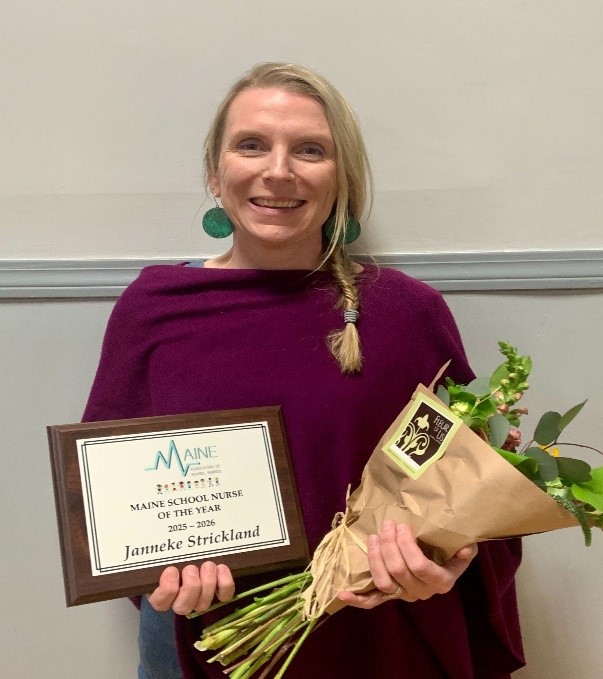
Janneke Strickland of RSU 9 Named the 2025-2026 Maine School Nurse of the Year

The Maine Association of School Nurses (MASN) is proud to recognize Janneke Strickland of RSU 9’s Cascade Brook School as the 2025-2026 Maine School Nurse of the Year.

This annual award recognizes an outstanding Maine school nurse for their contributions to the school and community that they serve. This honor is awarded to an individual who demonstrates leadership in six areas of practice: care provision, program management, health education, professional development, community involvement, and research.

Janneke Strickland began her nursing career as a clinical nurse at Barbara Bush Children’s Hospital in Portland, where she provided direct, evidence-based patient care to pediatric patients ranging in age from newborn to 20 years old. She then transitioned to labor, postpartum, and delivery nursing at Redington-Fairview General Hospital in Skowhegan, where she provided nursing care and education to her patients, including one-to-one support for laboring mothers.

After 18 years of working in the hospital setting, Strickland made the transition to school nursing and joined the Mount Blue Regional School District (RSU 9). Since becoming a school nurse, she has made a remarkable impact on both her school and the wider district. Her colleagues describe her as “exemplifying the heart of school nursing in every aspect of her work,” and as someone whose “outstanding work ethic is evident in her consistent willingness to go above and beyond in her role.”

As a result of her strong clinical skills and leadership, Strickland became District Nurse Coordinator just two years after joining RSU 9. In this role, she oversees health services across seven schools, supporting more than 2,000 students and mentoring a team of school nurses. Her superintendent praises her “forward thinking in policy development, health procedures, and maintenance and safety,” adding that her dedication ensures that “our health-related policies and services are current, comprehensive, and aligned with best practices in school nursing.”

Strickland’s work with students is equally impactful. She helps to teach health education classes at Cascade Brook School, offers interactive lessons on germs and illness prevention for third graders, and supported the development of an updated Human Growth and Development curriculum for fifth-grade students. Her efforts ensure consistent, age-appropriate health education across the district.

Strickland’s leadership extends beyond the classroom through major programs and policy initiatives. She co-wrote the successful grant application for the district’s electronic health record system, bringing valuable technology and efficiency to school health offices. She also collaborated on policies to train middle and high school students in CPR/AED use and Narcan administration, empowering students to respond in emergencies.

Strickland’s care for students reaches deep into the community. She has established partnerships with local organizations to provide essential items, such as clothing and weekend meals, to families in need. As her principal noted: “She is the driving force behind our weekend backpack program, tirelessly organizing the provision of nutritious meals for students who may face food insecurity outside of school hours.” Strickland also works with the Healthy Community Coalition to implement the CATCH My Breath anti-tobacco vaping program in elementary schools, addressing a growing health concern among youth.

Whether developing district policy, teaching students, or connecting families to community resources, Strickland’s unwavering commitment to health and learning shines through in everything she does. In the words of her principal: “She embodies the true spirit of school nursing.”

For more information about the award, visit the MASN website. With questions about the Maine School Nurse of the Year award, please contact MASN.

Suicide Prevention and Awareness Resources

As Maine schools get into the swing of the 2025-2026 school year, the Maine Department of Education (DOE) and the Maine Department of Health and Human Services Center for Disease Control and Prevention (CDC) would like to share available resources to recognize, address, and support youth mental health.

Data from the 2023 Maine Integrated Youth Health Survey (MIYHS) shows that, among other outcomes, more than one in six Maine high school students reported seriously considering suicide in the past 12 months. Similar data is available for middle school students. A new infographic from MIYHS summarizes this data.  

There are proven strategies that can support youth mental health and prevent suicide. Ensuring that students feel like they matter in their community, have a trusted adult they can talk to, and know that people at their school care about them can decrease the likelihood that a young person considers suicide or experiences other mental health challenges.

The Maine DOE and CDC have resources to support and assist school personnel in connecting with students. The graphics, resources, and materials included below are intended to help spread messages of hope, help, and strength throughout the year. Please consider sharing these materials and resources widely within your school and community networks.

Campaigns and Shareable Graphics

  • The Maine CDC is currently running the Filter Out the Noise youth suicide prevention campaign, designed to help young people recognize and remove negative influences or “noise” from their lives. It offers self-care tips, guidance on recognizing suicide warning signs, and encourages help-seeking behaviors. Visit the campaign website for more information or contact TSUP.DHHS@maine.gov for posters or other shareable videos, graphics, and content for social media from the Filter Out the Noise campaign.
  • The Substance Abuse and Mental Health Services Administration (SAMHSA) released a Suicide Prevention Awareness Month Toolkit with free messaging, downloadable graphics, and videos designed for a variety of audiences including youth. These resources can be used throughout the year.
  • 988 Maine has a variety of resources, and the 988 Lifeline is operational for anyone who calls. Additionally, although the 988 “Press 3” option for a direct line to LGBTQ+ youth support no longer exists, The Trevor Project provides 24/7, year-round, confidential, and free crisis support for LGBTQ+ youth. To access this support, text “Start” to 678-678, call 1-866-488-7386, or click here.


Physical Resources and Materials

  • The Maine Prevention Store is a year-round, one-stop shop for free prevention-related resources. The site provides bookmarks, self-care cards, and other resources specific to suicide prevention and support after a suicide loss.
  • Training for school personnel on Suicide Prevention and Awareness Student Lessons will be available from the Maine DOE and partners later in the school year.
  • NAMI Maine (Maine’s affiliate of the National Alliance on Mental Illness) offers suicide awareness, prevention, intervention, and protocol training for school personnel throughout the year through a contract with the Maine CDC. Visit the NAMI Maine Events Calendar to learn more.

For more information to support suicide prevention and awareness, please contact Mary Caron of the Maine CDC Injury Prevention Program at mary.caron@maine.gov, or Maine DOE Health Education and Health Promotion Consultant Susan Berry at susan.berry@maine.gov, or Maine DOE Climate Culture Resilience Team Coordinator Bear Shea at w.bear.shea@maine.gov.

PRIORITY NOTICE: New Opioid Overdose Management Toolkit and Naloxone Education Course Available for Schools

The Maine Department of Education (DOE) is proud to announce the launch of a new, comprehensive Toolkit for Opioid Overdose Management and Naloxone Education in Schools, developed to support educators, school health personnel, and administrators in implementing effective overdose prevention strategies across the state’s school systems.

This resource includes evidence-based guidance on recognizing and managing an overdose, as well as educational materials to support those responsible for teaching overdose response in school settings. In addition to reviewing the Toolkit, educators can learn more about how to engage students in this critical topic by completing the Naloxone Education Course. This free, asynchronous, online course is designed to enhance educators’ knowledge and skills for delivering age-appropriate, accurate overdose prevention education.

This initiative reflects the Maine DOE’s continued commitment to student health, safety, and wellness by providing schools with the tools they need to address the ongoing opioid crisis in developmentally appropriate, evidence-based, and school-centered ways.

This toolkit was developed in alignment with LD 772, An Act To Permit Naloxone Possession, Prescription, Administration, and Distribution in Public and Private Schools and LD 1315, An Act to Require Public Schools to Offer Training for Secondary Students on the Administration of Naloxone Hydrochloride, which mandate the development of guidelines related to naloxone administration and education in schools and outline standards for classroom instruction. This initiative is consistent with broader efforts at both the state and national levels to expand access to life-saving interventions and to equip school communities with knowledge and resources to respond to emergencies.

About the Toolkit and Course
The Toolkit for Opioid Overdose Management and Naloxone Education in Schools includes:

  • Sample policies and procedures
  • Student training resources
  • Guidance on safe storage and administration of naloxone
  • Links to state-level technical assistance

The online Naloxone Education Course provides:

  • Flexible, asynchronous, online professional development
  • Scenario-based learning for responding to a suspected overdose
  • Instructions on the administration of nasal naloxone
  • Legal and ethical considerations for school staff

Implementation and Access
The Toolkit and Course are available to all schools statewide through the following links:

Schools are encouraged to review these materials and integrate them into existing emergency preparedness, school health, and student support frameworks.

This initiative was made possible through a collaboration between the Maine DOE Office of School and Student Supports, Maine Department of Health and Human Services (DHHS), Maine DHHS Office of Behavioral Health, and MaineGeneral Medical Center, as well as local educational and health partners.  

Additional resources to support student and staff education, as well as policy development, can be found on the Maine DOE Coordinated School Health Emergency Care webpage.

For further information and questions, please contact Maine DOE School Nurse Specialist Tammy Diaz at tammy.diaz@maine.gov.

Support for SAUs in Adopting Seizure Action Plans to Protect the Health and Safety of Students

During the first session of the 132nd Maine Legislature, Resolve 2025, Chapter 72 was passed. This resolve directs the Maine Department of Education (DOE) to communicate to school administrative units (SAUs) and private schools the importance of adopting Seizure Action Plans. It also directs the Maine DOE to provide information and assistance, if requested.

Why This Matters
According to estimates from the U.S. Centers for Disease Control and Prevention, in 2022, there were approximately 456,000 children under the age of 17 in the U.S. that had epilepsy, a brain disorder that causes seizures. Seizure Action Plans are personalized documents that outline how to recognize, respond to, and care for students experiencing seizures. They are critical tools for fostering safe learning environments for those with a known seizure disorder. Having staff trained in recognizing seizures and seizure first aid can increase the safety and health outcomes of those with known seizure disorders, as well as those who may have a seizure for the first time while at school. This effort aligns closely with the Maine DOE’s commitment to provide guidelines on the provision of school health services.

Guidance and Resources from the Maine DOE
To support schools in implementing Seizure Action Plans, the Maine DOE has compiled a suite of resources as part of its Chronic Conditions Management materials:

How Schools Can Engage

  1. Review the Maine DOE’s Seizure and Epilepsy Resource Guide and implement tailored action plans for students with a known diagnosis, using the sample Seizure Interview tool or a similar tool to inform individualized health plans.
     
  2. Adopt protocols to ensure best practices in training, emergency response, and ongoing monitoring. Free, on-demand training is available through the Epilepsy Foundation for school personnel and school nurses to help them better care for students with seizure disorders.  
     
  3. Contact your School Nurse Regional Liaison for direct technical assistance, if desired:
Nick Oyler BSN, RN, NCSN 
nicholas.oyler@maine.gov
207-592-3536
Northern/Eastern: Aroostook, Hancock, Penobscot, Piscataquis, Washington
Angie Buker MSN, RN, NCSN
angie.buker@maine.gov
207-215-5460   
Central: Kennebec, Knox, Lincoln, Sagadahoc, Somerset, Waldo
Nicole Furlong MSN, RN, NCSN
nicole.furlong@maine.gov
207-592-2518
Western: Androscoggin, Franklin, Oxford
Lori Huot BSN, RN, NCSN
lori.hout@maine.gov
207-530-0374
Southern: Cumberland, York

Through this targeted communication to support SAUs and private schools in adopting Seizure Action Plans and accessing existing training resources, the Maine DOE continues its commitment to ensuring student and school safety, health, and wellbeing. The Coordinated School Health Team within the Office of School and Student Supports stands ready to assist schools in measures that strengthen preparedness, empower educators and staff, and—most importantly—protect students who live with seizure disorders.

Please contact DOESchoolandStudentSupports@Maine.gov with any questions.

New Guide on Best Practice Primary Prevention Resources and Lessons Available for Maine Health Educators

Maine health educators can now access the new Best Practice Primary Prevention Resources and Lessons for Health Educators Guide in the Maine Prevention Store. This product is available as a free digital download and contains linked information to primary prevention programs, as well as lessons about individual topic areas.

To access this resource, you must “add to cart” and provide some basic information, but there will be no charge.

The Maine Centers for Disease Control and Prevention’s (CDC) Tobacco and Substance Use Prevention and Control Program and the Maine Department of Education (DOE) have partnered to create this repository of evidence-based resources and lessons to support health teachers in delivering current, accurate, and best practice primary prevention education for alcohol, tobacco/nicotine, and other substances. This is not an all-compassing list but rather a helpful start to supporting Maine’s health educators.

The Best Practice Primary Prevention Resources and Lessons for Health Educators Guide identifies the associated National Consensus for School Health Education standards that align with each resource. The information contained therein follows the Substance Abuse and Mental Health Services Administration’s Strategic Prevention Framework and is intended to be integrated as a component of a robust health education curriculum.

For more information, please contact Stephanie.Tucker@Maine.gov or Susan.Berry@Maine.gov.

Maine DOE Staff Contribute to Journal of School Nursing

Maine Department of Education (DOE) School Nurse Consultant Emily Poland, MPH, RN, NCSN, and School Nurse Specialist Sarah DeCato, MSN, RN, NCSN, in collaboration with nurse colleagues across the nation, recently co-authored an article titled, “Exploring Innovative U.S. School Health Delivery Models: A Narrative Review”. This literature review identifies several different school health delivery models that exist today, as well as a need for continued research and growth in innovation to best meet the ever-evolving health needs of students.

This article will be published in the Journal of School Nursing in February of 2025, and it has already been published online.

This partnership was part of a larger project completed in 2023, when the Maine DOE commissioned an environmental scan and state assessment of school health services to gain a deeper understanding of the state of these services. The purpose of this project is to describe school health services, examine innovative models and infrastructures that facilitate Medicaid billing, and provide recommendations for a three- to five–year plan to strengthen school health services.

To complete this project, the Maine DOE contracted with the Center for School Health Innovation & Quality, which is housed in the Public Health National Center for Innovations, a nonprofit organization that is part of the Public Health Accreditation Board.

The environmental scan and summary sheet can be viewed here:

Maine DOE Highlights Expanding Health Resource Access to Multilingual Families in Maine

In alignment with supporting a culture of innovation and continuous improvement, new tools have been created for school nurses.  This newest project directly reflects the advocacy and care our Maine school nurses possess, further strengthening our public health infrastructure.

A sample welcome letter from the health office for any new family in a school community was created, which contains an annual health form and medication authorization form, as well as interview forms for asthma, diabetes, and seizures. These tools have been translated into Maine’s top nine languages and are now available on the Maine Department of Education (DOE) Coordinated School Health webpage entitled Sample Forms.

School nurses are part of welcoming new families into our schools and communities; therefore, this spring, the Maine DOE school nurse regional liaison Lori Huot, BSN, RN, Nationally Certified School Nurse (NCSN) extended a warm invitation to the nurses she serves in Cumberland and York County to attend the monthly office hours hosted by the Maine DOE English to Speakers of Other Languages (ESOL) Specialist Jane Armstrong. This multidisciplinary collaboration uncovered the need for more health-centered, culturally responsive, readily available, and translated tools to provide equity through language access, resulting in these updated resources.

The Maine DOE extends a special thank you to the Maine school nurses who participated in this collaboration.

Maine DOE’s Office of Innovation and the Office of School and Student Support collaborate to host monthly ESOL (English to Speakers of Other Languages) office hours. These sessions are open to all school personnel and aim to provide optimal support for ESOL educators and guidance on assisting multilingual learners and their families.

Maine continues to embrace and enroll multilingual students and families statewide, witnessing a 15% increase in student count from 2023 to 2024. Jane Armstrong, State ESOL Specialist, highlights that roughly 63% of Maine’s 206 school administrative units have enrolled multilingual learners.

For the latest data, please visit the  Multilingual Learner Data Dashboard.

The Office of School and Student Supports has many resources for school staff to improve school services. Guidelines and Resources for School Health Services center on providing culturally responsive, evidence-based care that improves overall health.

Contact DOESchoolandStudentSupports@Maine.gov with any questions, comments, or needs.