NEW Online Course: Assessing Your School Site

The following opportunity is being provided by the REMS TA Center, a partner of the U.S. Department of Education, Office of Safe and Supportive Schools.

Is your school or school district looking to examine the safety, security, accessibility, and emergency preparedness of its building and grounds? Do your ongoing assessments include a site assessment? To support K-12 school safety teams in conducting site assessments, the U.S. Department of Education, Office of Safe and Supportive Schools and its REMS TA Center are pleased to provide a NEW online course: Assessing Your School Site.

This 30- to 45-minute free online course aims to help K-12 school (public and nonpublic) personnel, school district administrators and staff, state/regional education agency personnel, and their partners develop a greater understanding of site assessments and how to examine the safety, security, emergency management, and preparedness of K-12 buildings and grounds. This online course uses an engaging visual format and interactive features, such as learning activities and quizzes, to help you learn about

  • Site assessments, including their purpose and their role in the planning process, how frequently they should be conducted, by whom they should be conducted, and the process for conducting them.
  • Building design principles that guide site assessments, such as Crime Prevention Through Environmental Design and Universal Design.
  • Data from site assessments and how they can be used to inform your school emergency operations plan and safety, security, emergency management, and preparedness programs.
  • Tools that are available to support you with this important work.

Get more information and take the course here.

If you have any questions or need additional assistance, please contact the REMS TA CENTER at 1-855-781-REMS [7367] or via email at info@remstacenter.org or contact the Maine School Safety Center.

Developing Emergency Operations Plans (EOPs) K-12

Don’t miss your chance to register for next week’s emergency operations plan (EOP) development training brought to you by the Maine School Safety Center and the Readiness and Emergency Management for Schools (REMS) Technical Assistance (TA) Center.

Download the detailed flyer here (PDF)

When: Tuesday, April 12, 2022 Time: 10:30 a.m. to 1:00 p.m. ET
Cost: NO CHARGE
Register here (Registration for this event closes on Friday, April 8, 2022, at 5:00 p.m.)

With this training, an expert team will provide an overview of the recommended six-step planning process to create a high-quality school EOP, which includes the following:

Step 1: Forming a Collaborative Planning Team
Step 2: Understanding the Situation
Step 3: Determining Goals and Objectives
Step 4: Plan Development
Step 5: Plan Preparation, Review, and Approval
Step 6: Plan Implementation and Maintenance

WEBINAR: Resilience Strategies for Educators: Techniques for Self-Care and Peer Support

Resilience Strategies for Educators (RSE): Techniques for Self-Care and Peer Support Train-the-Educator (TtE) Virtual Training by Request (VTBR) is a virtual learning opportunity coming up for caregivers in schools and school districts to better understand, and teach others, resilience strategies following emergency events.

The REMS TA Center is excited to offer the NEW Resilience Strategies for Educators: Techniques for Self-Care and Peer Support (RSE) Train-the-Educator (TtE) Virtual Training by Request (VTBR) created in partnership with the U.S. Department of Education’s Office of Safe and Supportive Schools (OSSS). This dynamic and interactive half-day-long training is designed to assist caregivers in schools and school districts to better understand resilience and self-care strategies following natural disasters and other emergency events.

Participants will gain the knowledge and hands-on skills needed to implement the five components of Psychological First Aid — listen, protect, connect, model, and teach, as well as awareness about compassion fatigue, and how to build a self-care plan.

Pre- and -post training activities will provide guidance on how this training is relevant to emergency operations planning and assist with the implementation of what is learned.

TRAINING DETAILS
When: Tuesday, April 26, 2022
Time: 10:30 a.m. to 2:30 p.m. ET
Cost: NO CHARGE
Register here. (Registration for this event closes on Friday, April 22, 2022 at 5:00 p.m.)

TRAINING DESCRIPTION
As part of a comprehensive school emergency operations plan, it is important for schools and school districts to understand how to prevent, protect against, mitigate, respond to, and recover from critical incidents, including social, emotional, and behavioral recovery. The training is designed to provide educators and school staff with a better understanding of resilience strategies that can be used to increase their ability to work more effectively with individuals impacted by stress, loss, and trauma brought on by community or family violence, natural and man-made disasters and economic hardship.

WHO SHOULD ATTEND?
The training is applicable in areas that have been impacted by traumatic events and/or natural disasters, as well as those that have not recently experienced a traumatic event(s). The intended audiences for this training include, but are not limited to:

• School counselors and psychologists
• School social workers and nurses
• Administrators, educators, and support staff
• School Resource Officers
• Community partners such as local mental/behavioral health practitioners

For more information and questions reach out to REMS directly at info@remstacenter.org or contact Maine School Safety Center (MSSC) staff Melissa Condon at melissa.a.condon@maine.gov.

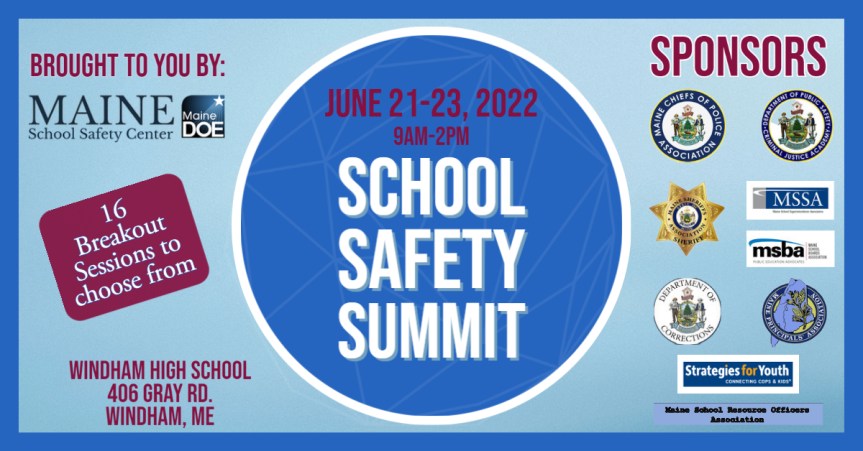
SAVE THE DATE: School Safety Summit – June 21-23

Save the date for the first School Safety Summit hosted by the Maine Department of Education’s (DOE) Maine School Safety Center (MSSC).

Windham High School & virtually on Zoom
June 21-23
9:00 am – 3:00 pm

There will be classes and breakout sessions designed for school administrators, staff, school board, and social workers, as well as JCCOs, SROs, Police Officers, front line supervisors, and administrators.

For more information, contact Rob Susi, Maine DOE MSSC School Safety & Security Manager at robert.w.susi@maine.gov.

Considerations for Schools Supporting Observances During School Year- Ramadan Begins

Other than the Christian observance of Christmas, Maine school calendars do not currently include days off from school for religious holidays. As a result, those of other faiths must navigate their observances around the expectations of schools – including expectations regarding attendance and participation – which may conflict with the traditions of the observance. To assist schools in understanding the timing, traditions, and possible impacts of some religious holidays, the Maine Department of Education has shared a calendar and considerations for major religious observances that may occur during the school year.

Islam is the second most populous religion in the world, and Maine is home to many Muslim families. Maine Department of Education would like to provide some general information about Ramadan and Eid-al-Fitr to schools, so they can support their Muslim students and community members as they enjoy this very special time of year.

Ramadan is a month-long fast observed by Muslims around the world. Fasting during Ramadan is one of the five pillars of Islam. To wish someone a happy Ramadan, you can say “Ramadan Kareem” or “Ramadan Mubarak.”

This year, in the United States, Ramadan will start around April 1st. The official beginning and end of the month of Ramadan will not be announced until the sighting of the new moon. Since the Islamic lunar calendar year is about 11 days shorter than the Gregorian calendar, Ramadan happens about 11 days earlier each year.

During Ramadan, most Muslims fast (i.e., consume no food or water) from dawn to dusk. Many Muslims also pray more frequently, recite the Quran (Islamic book) and make special efforts to be kind, generous, and compassionate. This is a joyous time of year, and each Iftar (post-sunset meal to break the fast) is a celebrated opportunity to gather with friends and family. Muslims may also wake before dawn to eat Suhoor (a pre-dawn meal), which helps give them energy to endure the day’s fast. (Iftar and Suhoor timings can be found here.) For some Muslims, the typical patterns of sleep are shifted so that more waking hours occur during the night, which can make it difficult to wake up early and stay alert during the day.

After Ramadan, Eid-al-Fitr (the festival of breaking the fast) is a three-day celebration with feasts and gatherings of families. This is an extremely important and cheerful time of year for Muslims, and students will likely be absent for all or part of the three days. Children often receive a new outfit or a small amount of money as a gift from their family for the holiday. To wish someone a happy Eid, you can say, “Eid Saeed” or “Eid Mubarak.”

Here are a few tips for supporting students during Ramadan and Eid-al-Fitr.

Learn about Ramadan and Eid-al-Fitr.

There are many resources available online that can help you understand how and why Ramadan is observed. Keep in mind that practices may vary depending on culture, so your students and their families are the best sources of information about their Ramadan traditions. Here are a couple of articles that give a general overview.

Encourage cultural sensitivity for all school community members.

Fasting can have many physical and mental effects, such as fatigue, lack of concentration, and irritability. For your students, your understanding and support can help ensure that they continue to learn and make the most out of their time at school while fasting. Teachers, school nurses, sports coaches, bus drivers, cafeteria staff, and all other staff who interact with students will need to know how fasting can affect students.

Talking with staff and students about Ramadan and Eid-al-Fitr helps encourage an atmosphere of cultural awareness and sensitivity for the whole school community. Sensitivity towards fasting students includes avoiding consuming food and beverages in front of them whenever possible. Consider holding any celebrations that include food, such as awards banquets, after Iftar (breaking fast at sunset).

Ask students and their families how you can best support them.

Some schools may choose to offer a place for students to go during lunchtime, alternative options for physical education, or dedicated prayer spaces. Schools may also avoid scheduling assessments or other required activities during Eid-al-Fitr, when students are likely to be absent. The best way to ensure that your school is a supportive, culturally-aware learning environment is to involve students, families, and other community members in planning and policy creation. Check out these two articles for some practical ideas that may benefit fasting students.

Have a clear, well-communicated policy on tardies and absences.

Maine’s statute on excused absences is Title 20-A, Section §3272. It states that an absence is excused when it is for “observance of a recognized religious holiday when the observance is required during the regular school day and the absence has prior approval.” Fasting during Ramadan is a required religious observance, and the physical and mental demands of fasting may cause students’ tardies and absences to increase. Eid-al-Fitr celebrations are also religious observances. Districts will need to share clear expectations for attendance with students and families. It is highly recommended to develop these expectations in collaboration with your community members, recognizing that interpretation and translation may be necessary to ensure meaningful communication.

Reminder: Register NOW for Conducting K-12 Site Assessments with SITE ASSESS Train-the-Educator

Don’t miss your chance to register for next week’s training brought to you by the Maine School Safety Center and the Readiness and Emergency Management for Schools (REMS) Technical Assistance (TA) Center. Registration closes Friday, April 1st.

This dynamic and interactive 2.5-hour training is designed to assist school districts and schools with conducting site assessments and using SITE ASSESS, the REMS TA Center’s free and secure mobile app that allows personnel to walk around a building and grounds, and examine their safety, security, accessibility, and emergency preparedness.

TRAINING DETAILS

When: Tuesday, April 5, 2022
Time: 10:30 a.m. to 1:00 p.m. ET
Cost: NO CHARGE
Register here
Download the flier here

For more information, contact info@remstacenter.org.

Launch of Online Training from the Children’s Safety Partnership

With Child Abuse Prevention Month coming up in April, the Maine Department of Education (DOE) is helping to spread the word about a new way to access the Children’s Safety Partnership (CSP) training, “Understanding and Responding to Child Sexual Abuse”.

The pandemic has changed everyone’s ability to gather and train together in-person. Recognizing that all school personnel are required to take the one-hour training, “Understanding and Responding to Child Sexual Abuse” every four years, the Children’s Safety Partnership, a program of the Maine Coalition Against Sexual Assault, has developed a completely online version of “Understanding and Responding to Child Sexual Abuse”.

The preference for this training is still that it be in-person, if possible.  However, the hope is that this online course version will provide opportunities for school personnel who may not otherwise have access to the training to be able to complete it and to be in compliance.

The training and all supplemental materials are available on the Children’s Safety Partnership website for all educators who have previously taken the training of trainers with the CSP.  Access is intended to be a support for those responsible for delivering and/or ensuring the training is completed.  Those who have not completed a training of trainers but would like to access the materials can reach out to their local sexual assault support center prevention educators to learn more. This course was designed using the Teachable platform.  It provides a road map of the content, while also offering the option to start and stop whenever is convenient for the participant.

If training facilitators have questions when delivering or monitoring the training, they should contact their local sexual assault support center prevention educators!

Webinar: Understanding the Role of Information Technology Specialists in Supporting School Safety Before, During, and After an Emergency

The U.S. Department of Education, Office of Elementary and Secondary Education, Office of Safe and Supportive Schools and its Readiness and Emergency Management for Schools (REMS) Technical Assistance (TA) Center will host a Webinar on Wednesday, April 6, 2022, from 3:00 p.m. to 4:00 p.m. ET. This Webinar will highlight the role of information technology (IT) specialists in supporting school safety efforts at the local and state levels.

The objectives of this 60-minute Webinar are to:

  • Highlight the role of IT specialists in supporting school safety efforts at the local and state levels.
  • Demonstrate the importance of developing a collaborative planning team to support emergency operations plan development, as outlined in Step 1 of the six-step planning process detailed in the Guide for Developing High-Quality School Emergency Operations Plans.
  • Discuss the role that IT specialists play in supporting the National Preparedness System mission areas — prevention, protection, mitigation, response, and recovery — as well as their role in the before, during, and after phases of a potential emergency.
  • Share resources to assist IT specialists in collaborating with and supporting school safety efforts at the local and state levels.

Register on the REMS TA Center Website to participate in the Webinar

Presenters:

U.S. Department of Education, Student Privacy Policy Office, Privacy Technical Assistance Center (PTAC)

  • Ross Lemke, PTAC Director
  • Mike Tassey, Data Security Advisor

Rialto Unified School District

  • Alex Rodriguez, Emergency Operations Specialist

REMS TA Center

  • Candace Ferguson, Training & Technical Assistance Senior Research Associate

Questions About the Event?

Contact the REMS TA Center Help Desk at 1-855-781-REMS [7367] or info@remstacenter.org from 9:00 a.m. to 5:00 p.m. ET, Monday through Friday.

Can’t make the live event? This Webinar will be archived on the REMS TA Center Website within 7 business days.

Conducting K-12 Site Assessments With SITE ASSESS Train-the-Educator (TtE)

The Readiness and Emergency Management for Schools (REMS) Technical Assistance (TA) Center will offer a new Conducting K-12 Site Assessments With SITE ASSESS training session on April 5. This dynamic and interactive 2.5-hour training is designed to assist school districts and schools with conducting site assessments and using SITE ASSESS, the REMS TA Center’s free and secure mobile app that allows personnel to walk around a building and grounds, and examine their safety, security, accessibility, and emergency preparedness. This Virtual Training by Request (VTBR) opportunity is being offered in partnership with the U.S. Department of Education’s Office of Safe and Supportive Schools (OSSS).

When: Tuesday, April 5, 2022
Time: 10:30 a.m. to 1:00 p.m. ET
Cost: NO CHARGE
Register here (registration for this event closes on Friday, April 1, 2022 at 5:00 p.m.)

This training is intended to provide participants with an introduction to site assessments, including their purpose; who should serve on a site assessment team; how site assessments support school preparedness activities; how data from site assessments are incorporated into the planning process put forth in the Guide for Developing High-Quality School Emergency Operations; and key topics such as Crime Prevention Through Environmental Design. This training also provides an overview of SITE ASSESS, including how it was developed by the REMS TA Center, some of its key features, and how to use it collaboratively.

Audience

The intended audiences for this training are those who serve on an emergency operations plan planning team and/or a site assessment team including, but not limited to:

  • School district and school administrators, educators, facilities staff, food management and cafeteria staff, transportation staff, security staff, school nurse, athletic department staff, and support staff; and
  • Community partners, such as law enforcement, including school resource officers, fire officials, and Emergency Medical Services personnel.

Training Objectives

The aim of this training is to help participants be able to:

  • Understand the purpose of a site assessment and its
    importance in school preparedness;
  • Conduct a site assessment using the SITE ASSESS
    mobile app; and
  • Use SITE ASSESS to identify areas of improvement in
    education facilities.

For more information, contact the REMS TA Center 1-855-781-REMS [7367] or info@remstacenter.org.

Developing Emergency Operations Plans (EOPs) K-12 101 Train-the-Educator (TtE)

Learn important Federal guidance on school emergency management planning through a new 2.5 hour training on April 12. This Virtual Training by Request (VTBR) opportunity is being offered by the Readiness and Emergency Management for Schools (REMS) Technical Assistance (TA) Center, on behalf of the U.S. Department of Education’s Office of Safe and Supportive Schools (OSSS).

Each school day, our nation’s schools are entrusted to provide a safe and healthy learning environment for approximately 55 million elementary and secondary school students in public and nonpublic schools. In June 2013, the Obama Administration released the Guide for Developing High-Quality School Emergency Operations Plans (School Guide) which provides an overview of Federal guidance on school emergency management planning.

The School Guide, produced by the U.S. Departments of Education; Justice, led by the Federal Bureau of Investigation; Homeland Security, led by the Federal Emergency Management Agency; and Health and Human Services, incorporates lessons learned from events, like the school shooting in Newtown and the tornadoes in Oklahoma, as well as years of emergency planning work by the Federal government, to present a recommended process, important content elements, and key considerations for school emergency operations plan (EOP) development.

In collaboration with their local government and community partners, schools can take steps to plan for these potential emergencies through the creation of a high-quality school EOP. With this training, an expert team will provide an overview of the recommended six-step planning process to create a high-quality school EOP, which includes the following:

Step 1: Forming a Collaborative Planning Team
Step 2: Understanding the Situation
Step 3: Determining Goals and Objectives
Step 4: Plan Development
Step 5: Plan Preparation, Review, and Approval
Step 6: Plan Implementation and Maintenance

Pre- and -post training activities will provide guidance on how this training is relevant to emergency operations planning and assist with the implementation of what is learned.

The intended audiences for this training include, but are not limited to: those interested in creating, revising, or enhancing school EOPs; school staff who serve, or will serve, on their school or school district’s EOP planning team; and other interested community stakeholders, including first responders, emergency medical services personnel, law enforcement, and others.

When: Tuesday, April 12, 2022
Time: 10:30 a.m. to 1:00 p.m. ET
Cost: NO CHARGE
Register here (Registration for this event closes on Friday, April 8, 2022, at 5:00 p.m.)

For more information contact The REMS TA Center 1-855-781-REMS [7367] or info@remstacenter.org.