Powerful Practices Professional Learning Community (PLC) Sessions: Reflection

Want to develop a reflective practice and need some support? Although many educators know reflection is important, it can be challenging to carve out the time to do it.  This workshop series provides teachers with the resources and time to start (or restart) reflecting on their practice.   

During these sessions, teachers will select a problem of practice to focus on and have time to reflect, collaborate with other teachers, and make an action plan.  As a result, educators will have the necessary time and tools to develop their reflective practice. 

Intended Audience: PK-12 Teachers 

To accommodate a variety of schedules, we are offering two sessions.  Please register for one session. 

Session 1 

September 19, 26, October 3, 10 

3:00 – 3:45 PM

Register here 

Session 2 

September 21, 28, October 5, 12 

3:45 – 4:30 PM 

Register here 

For more information on these workshops, please contact Jaime Beal, Interdisciplinary Instruction Specialist at jaime.beal@maine.gov 

The Maine DOE encourages all schools and districts across the State of Maine to learn more about interdisciplinary instruction on our website or by contacting the Interdisciplinary Instruction Team Coordinator at Kathy.bertini@maine.gov 

Professional Learning Series: Conceptual Classrooms & Educational Programs for Teachers

The Maine Department of Education (DOE) Interdisciplinary Instruction (II) Team is excited to introduce “Conceptual Classrooms & Educational Programs for Teachers” (ConCEPT), an innovative initiative aimed at enhancing your teaching practices and student engagement through concept-based inquiry strategies. Grounded in evidence-based research, this program offers a comprehensive learning experience that will equip you with valuable tools and knowledge to transform your classroom approach.

What does ConCEPT offer?

  • Connection to Research: Discover evidence-based strategies and practices that support effective concept-based inquiry in the classroom.
  • Mapping and Planning: Learn how to design curriculum and instruction using concept-based frameworks, empowering your students’ learning journey.
  • Collaboration: Engage in collaborative activities and discussions with fellow educators, fostering a community of shared ideas and experiences.
  • Sustainable Change Leadership: Acquire leadership skills to drive sustainable educational change in your school community.
  • Customization: Tailor your learning experience to suit your team’s unique pathway, ensuring maximum impact on your teaching practices.

Why should you participate in ConCEPT?

  • Enhanced Curriculum Design: Develop concept-based inquiry curriculum and instruction design skills that align with the latest educational standards.
  • Strengthened Pedagogical and Content Knowledge: Deepen your understanding of both pedagogy and content across various subject areas.
  • Active Learning Strategies: Discover dynamic and engaging active learning strategies to invigorate your classroom environment.
  • Take Away Ideas and Materials: Gain valuable resources, ideas, and materials to enrich your teaching practices.
  • Integrated SEL Strategies: Learn how to integrate Social-Emotional Learning (SEL) effective strategies to create a nurturing and inclusive classroom atmosphere.
  • Learning from National Experts: Benefit from the expertise of renowned national educators who will guide and inspire you throughout the program.

Who is ConCEPT designed for?

ConCEPT is open to teams of 3-6 members from K-12 schools. Participants may include Classroom Teachers, Instructional Coaches, Curriculum Coordinators, and other Administrators (Superintendent/Principal). Teams must include at least one Classroom Teacher and at least one Administrator (e.g., Coach, Coordinator, building/district Supervisor, etc.). The rest of the team may be made up of any combination of participants.

Program Details:

  • Cost: Participation in ConCEPT is entirely free!
  • Contact Hours: You can earn up to 24 contact hours during the program.
  • Reimbursement: Districts/schools are eligible for reimbursement of costs associated with planning, such as substitutes or after-contract hours, up to $5000.
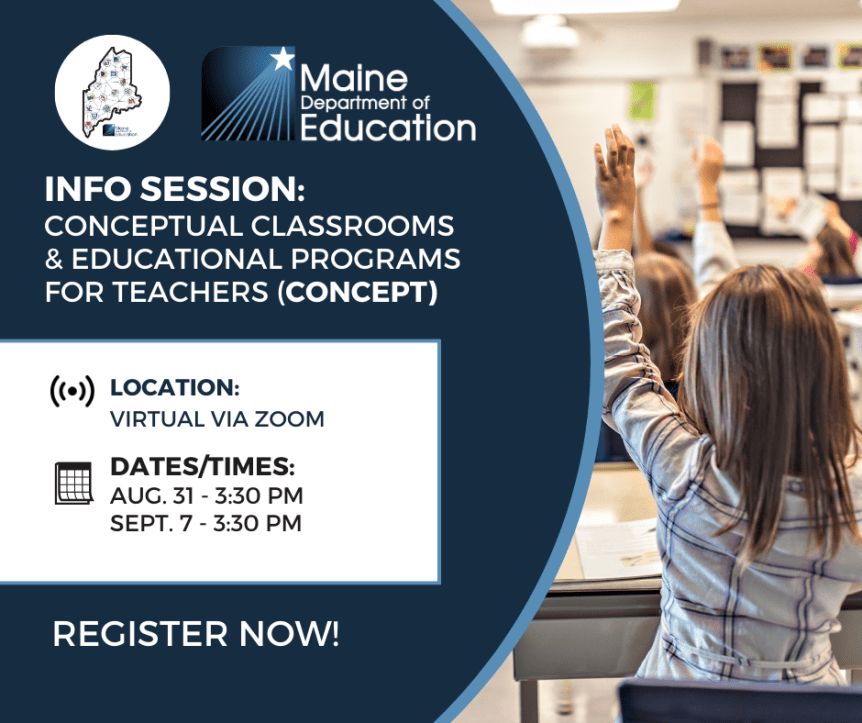
  • The II team will be offering a series of informational webinars dedicated to providing comprehensive insights into the ConCEPT pilot program. These live webinars are scheduled to take place during the last week of August and will be recorded for accessibility throughout September.
  • The application period will be open throughout the entire month of September.

Join us in this exciting educational journey that will empower you to create enriching concept-based learning experiences for your students. We look forward to seeing you continue to thrive as educators and positively impact your classrooms and school communities.

We look forward to sharing further details about the webinar schedule and registration process soon. Stay tuned for updates on our website and social media channels.  School administrators and educators are encouraged to visit the Maine DOE Interdisciplinary Instruction team’s website during the month of September to access the application form and learn more about the selection criteria and ConCEPT pilot program requirements. Don’t miss the chance to part of a transformative educational pilot that will support positive change

For further information or to enroll in the ConCEPT program, please contact Kathy Bertini, the Interdisciplinary Instruction Team Coordinator, at (207) 816-0294 or kathy.bertini@maine.gov. You can also visit the Maine DOE website for additional details.

Unraveling Roots: Cultivating Genealogy as an Instructive Journey

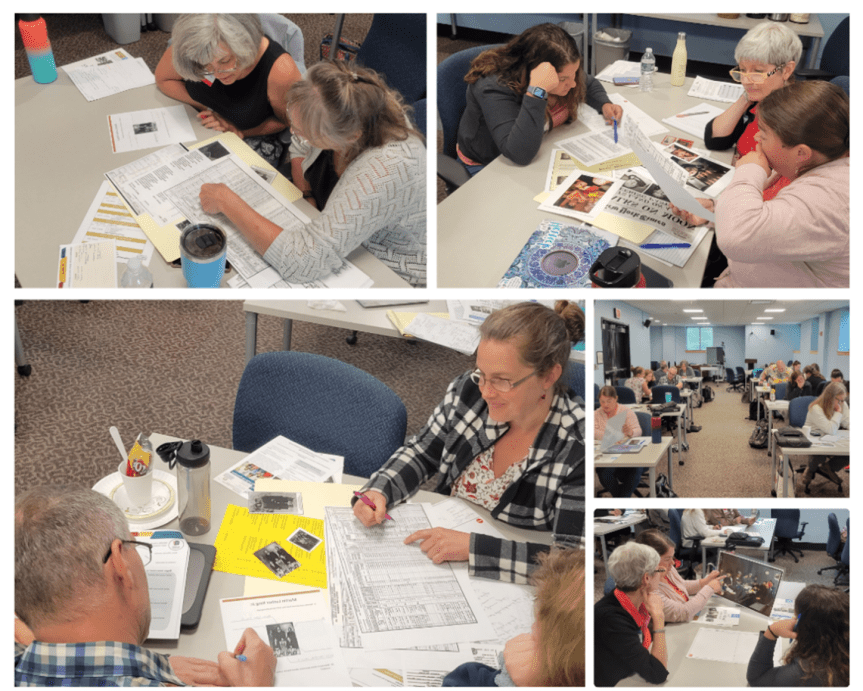
At the end of June, a group of teachers met to learn about using genealogy to teach inclusive history with Dustin Axe, the Youth Genealogy Curriculum Coordinator with the New England Historic Genealogical Society (NEHGS).  This workshop kicked off the American Ancestors pilot that supports teacher planning for inclusive historical inquiry projects using genealogy.  During the next school year, teachers in this pilot program will participate in monthly virtual meetings to deepen their understanding of this work and to collaborate with each other. Twice a year, teachers will meet with NEHGS in one-on-one meetings that are personalized to their instructional needs.  There will also be a monthly professional learning community led by the Maine Department of Education for teachers to collaborate and share their work.

As many teachers know, teaching genealogy can be challenging.  By focusing instruction on critical research and thinking skills, teachers learned how to empower students to make personal connections to history by connecting to the process of historical inquiry instead of the product.  As one teacher commented, “I loved all the resources available online for schools and the multiple levels of scaffolding that were available. [Dustin] did an excellent job at making this accessible to all learners regardless of their circumstances, but also gave us a framework for research/investigations that can be applied to any topic.” According to NEHGS, research finds that genealogy can help students’ well-being and connect them to their communities when it is done well.  The free resources from NEHGS support high-quality genealogical practices.

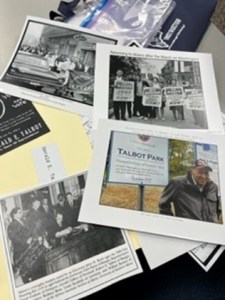
One strategy to make genealogy more accessible is to look at the lives of other people, particularly those who have impacted their community. NEHGS developed several case studies of key figures in American history, as well as important Mainers, like Gerald Talbot and Samantha Smith. Rooted in inquiry-based practices, the skills and processes learned by doing genealogical research can help students learn about important events for communities that place more value on the collective. In this way, many of the resources provided by NEHGS can help teachers develop inclusive lessons that can meet the requirements of state mandates regarding Wabanaki and African-American studies and the history of genocide including the Holocaust.  “I had not considered using genealogy with my students, but I now see that it can be a good way to connect to my students and for them to connect with history,” remarked a teacher after the workshop.

For more information about the American Ancestors program, check out www.AmericanAncestors.org/Family-History-Curriculum or contact Dustin Axe at dustin.axe@nehgs.org

The Maine DOE encourages all schools and districts across the State of Maine to learn more about interdisciplinary instruction on our website or by contacting the Interdisciplinary Instruction Team Coordinator at Kathy.bertini@maine.gov


Subscribe to the Maine DOE Interdisciplinary Instruction Newsletter 

Are you looking for ways to enhance your instructional practices and transfer your students’ learning to the next level? Look no further.

The Maine Department of Education (DOE) Interdisciplinary Instruction team has created a monthly newsletter that you can subscribe to. This newsletter will highlight innovative interdisciplinary classroom resources and upcoming professional learning opportunities.

To subscribe, click the link below, fill in your contact information, and click “Interdisciplinary Instruction” in the “Subscribe me to” section where you will also find an array of other content-specific newsletters you can subscribe to. When the Interdisciplinary Instruction Team publishes a new newsletter, it will automatically arrive in your inbox.

Subscribe here (Please note that if you are already subscribed to Maine DOE publications like the Maine DOE Update or other newsletters we publish, when you submit your information you will be redirected to update your preferences.)

For further information or questions, reach out the Maine DOE’s Interdisciplinary Instruction Team by contacting Kathy Bertini at kathy.bertini@maine.gov.


Reminder: BARR Information Sessions Wednesday and Thursday

Join the Maine DOE to learn more about a funding opportunity for Maine schools to become BARR (Building Assets, Reducing Risks) schools. 

Using American Rescue Plan, state reservation funds, the Maine Department of Education (DOE) will cover all costs of implementing the program for schools new to BARR, and all costs of continued implementation support to existing BARR schools. Additionally, the DOE will provide travel reimbursement and educator stipends associated with participation in the program.  Applications are due by May 26, 2023. Click here to apply.

Sign up for an informational session on: 

Wednesday, May 17, 2023 | 4:00 ET | REGISTER 

or  

Thursday, May 18, 2023 | 4:00 ET | REGISTER 

Join Beth Lambert, Acting Chief Innovation Officer and Director of Innovative Teaching and Learning at the Maine DOE to learn more about this opportunity to implement the BARR system in your school(s). We’ll also be joined by Rob Metz and Jennifer Fox from the BARR Center who will provide an overview of BARR and other Maine educators who are excited to share their experiences and the impact it has had on their schools: 

  • Jennifer Mull-Brooks, Principal, Congin Elementary School 
  • Greg Henderson, School Counselor and BARR Coordinator, Mt. Blue High School 
  • Shelly Lajoie, Counselor and BARR Coordinator, Noble High School 
  • Josh Tripp, Principal, Bucksport High School 

You can also read more about the BARR program here.

BARR was developed over 20 years ago by a high school counselor who felt ineffective because more than 40 percent of her 9th grade students were failing at least one core course and were at risk for not graduating on time. She learned from her school’s principal that this was not just her high school’s problem, but it reflected a troubling national trend. Using strategies from the fields of business and medicine, Executive Director Angela Jerabek created the BARR model and implemented it in the fall of 1998. By spring 1999, 9th grade student failure rate had decreased from 44% the previous year to 20%. Teachers worked together and knew each student – not just from an academic perspective, but from a personal perspective – their interests, strengths, hopes, and dreams. 

Careful implementation and evaluation continued for over 20 years, all with the same findings – students passed more classes, pursued more advanced courses, and graduated on time. The focus of BARR is not just for some students, but all students. Teachers reported increased collaboration, satisfaction, and their ability to use data effectively. School culture and climate was improved. Today, BARR operates in over 250 schools throughout the nation and works in all grade levels, K-12, including in dozens of schools here in Maine.   

“There is no question that BARR has had a positive impact on the students and staff at Sacopee Valley Middle School. We are intervening with students earlier, our meetings are more efficient, and most importantly, our relationships are stronger. Honestly, I couldn’t imagine our school without BARR. It is not a flavor of the month intervention — it is now part of our fabric and is here to stay,” said Amy Vacchiano, counselor and BARR Coordinator at Sacopee Valley Middle School. 

The BARR system uses eight interlocking strategies that build intentional relationships (staff to staff, staff to student, and student to student) and utilizes real-time data to enable schools to achieve concrete academic, social, and emotional outcomes for each and every student. To learn more about BARR visit: https://barrcenter.org/about-barr/barr-model/. 

To be eligible, a school must meet one of the following: 

Learn more about BARR at http://www.barrcenter.org. 

Maine DOE Announces Funding Opportunity for Maine Public Schools to Become BARR Schools

Applications are now open to all willing and qualified public schools who would like to become a BARR (Building Assets, Reducing Risks) school. Click here to apply. Using American Rescue Plan, state reservation funds, the Maine Department of Education (DOE) will cover all costs of implementing the program for schools new to BARR, and all costs of continued implementation support to existing BARR schools. Additionally, the DOE will provide travel reimbursement and educator stipends associated with participation in the program.  Applications are due by May 26, 2023. 

BARR was developed over 20 years ago by a high school counselor who felt ineffective because more than 40 percent of her 9th grade students were failing at least one core course and were at risk for not graduating on time. She learned from her school’s principal that this was not just her high school’s problem, but it reflected a troubling national trend. Using strategies from the fields of business and medicine, Executive Director Angela Jerabek created the BARR model and implemented it in the fall of 1998. By spring 1999, 9th grade student failure rate had decreased from 44% the previous year to 20%. Teachers worked together and knew each student – not just from an academic perspective, but from a personal perspective – their interests, strengths, hopes, and dreams. 

Careful implementation and evaluation continued for over 20 years, all with the same findings – students passed more classes, pursued more advanced courses, and graduated on time. The focus of BARR is not just for some students, but all students. Teachers reported increased collaboration, satisfaction, and their ability to use data effectively. School culture and climate was improved. Today, BARR operates in over 250 schools throughout the nation and works in all grade levels, K-12, including in dozens of schools here in Maine.   

“There is no question that BARR has had a positive impact on the students and staff at Sacopee Valley Middle School. We are intervening with students earlier, our meetings are more efficient, and most importantly, our relationships are stronger. Honestly, I couldn’t imagine our school without BARR. It is not a flavor of the month intervention — it is now part of our fabric and is here to stay,” said Amy Vacchiano, counselor and BARR Coordinator at Sacopee Valley Middle School. 

The BARR system uses eight interlocking strategies that build intentional relationships (staff to staff, staff to student, and student to student) and utilizes real-time data to enable schools to achieve concrete academic, social, and emotional outcomes for each and every student. To learn more about BARR visit: https://barrcenter.org/about-barr/barr-model/. 

To be eligible, a school must meet one of the following: 

Sign up for an informational session on: 

Wednesday, May 17, 2023 | 4:00 ET | REGISTER 

or  

Thursday, May 18, 2023 | 4:00 ET | REGISTER 

Join Beth Lambert, Acting Chief Innovation Officer and Director of Innovative Teaching and Learning at the Maine DOE to learn more about this opportunity to implement the BARR system in your school(s). We’ll also be joined by Rob Metz and Jennifer Fox from the BARR Center who will provide an overview of BARR and other Maine educators who are excited to share their experiences and the impact it has had on their schools: 

  • Jennifer Mull-Brooks, Principal, Congin Elementary School 
  • Greg Henderson, School Counselor and BARR Coordinator, Mt. Blue High School 
  • Shelly Lajoie, Counselor and BARR Coordinator, Noble High School 
  • Josh Tripp, Principal, Bucksport High School 

Learn more about BARR at http://www.barrcenter.org. 

Riot Refurb: A Device Repair Lab

(Pictured: Intro to Computer Science students repair broken equipment with the purpose of donating them to people in need.  Photo credit: Julie York) 

What is the best way to learn about computer hardware? Look inside!  That is exactly what Julie York’s students did in their Intro to Computer Science course while also contributing to their community.  During their Device Repair Lab, these students gained valuable computer science and career knowledge and skills while rebuilding devices, like iPads, Chromebooks, and MacBooks. While some devices are sold at a discounted price, others are donated to organizations and people in need.  Any funds from the sales go back into the program to purchase chargers and materials.  To date, students have repaired over 200 devices. 

As anyone with device problems could attest to, students needed patience and persistence, as well as concentration as they performed the challenging and delicate work of device repair.  Students learned valuable computer science skills, such as disassembling devices, reassembling them, and diagnosing problems.  They also had to use computational thinking to identify the problem and how to fix it, develop efficient procedures for cleaning devices, and deduce patterns in computer issues to streamline their work.  As one student said, “I found the whole process very interesting.”  Another one said, “This is something I could do in the future.”   

Julie York Classroom Computer Science
Photo Credit: Julie York

Beyond the computer science skills they developed, students also learned valuable career skills like leadership and collaboration.  As one student put it, “I think that teamwork was the most important skill for the success of this lab because I think that everything is better when it’s done as a team.”  This student went on to say that without leadership “the group I was helping would’ve been in a mess.”  Students also incorporated art and communication skills as they designed flyers, made video ads, and wrote repair reports.    

Many students in Julie’s class are multilingual learners.  She scaffolded their language development by providing instructions in their primary language and opportunities to read, speak, and listen in English.  While they were developing their English skills, students were also able to learn the computer science material, and develop important career and leadership skills.  

The Riot Refurb program has gotten positive feedback from community members.  One person who received refurbished equipment shared, “Thank you so much for doing this. I have 4 kiddos, so this is a big help for my family!”  Another student, who got a laptop, talked about how he would use his new device to edit videos.  Through this project-based program, students can themselves as changemakers in both their school community and beyond.  

While the class is now learning about coding, they are still looking to connect with people and organizations in need of devices.  Click here for more information about this program. 

The Maine DOE encourages all schools and districts across the State of Maine to learn more about interdisciplinary instruction on our website or by contacting our Interdisciplinary Instruction Team Coordinator at Kathy.bertini@maine.gov 

Curriculum Leader of the Year and Instructional Coach of the Year Nominations Open

The Maine Curriculum Leaders Association (MCLA) is now accepting nominations for the Curriculum Leader of the Year and the Instructional Coach of the Year. Nominations close on April 28, 2023 and you can find more details on the nominating process below.

The Curriculum Leader of the Year:

  1. Has successfully served as a curriculum leader (designated curriculum director, assistant superintendent, or teacher leader) in public education for at least five years.
  2. Is an MCLA member at the time of nomination.
  3. Is a proven champion of curriculum, instruction, and assessment policies and practices that enhance learning both within and outside the district, who also promotes and provides opportunities to learn and to share learning and develops partnerships and networks with other districts and organizations to support learning.

Nomination Process:

Send a nomination letter describing how the nominee is a champion of learning (criteria 3 above) both in and outside the district to the CLOY selection committee. Provide details about how the nominee’s curriculum, instruction, and assessment leadership impacts teachers and students in the district and the nominee’s leadership activities outside the district.

Please include email and phone contact information for you and your nominee. Send recommendation letters to: MCLA CLOY Selection Committee and email as a pdf or Google document to director@mainecla.org.

The Instructional Coach of the Year:

  1. Has successfully served as an instructional coach (working at least .5 time as a designated coach) in public education for at least two years.
  2. Is an MCLA Coaching Co-Op member at the time of nomination.
  3. Is a leader who promotes instructional quality through learner-centered coaching practices: modeling effective instructional practices, working with teachers to make evidence-based decisions, actively working to promote coaching, encouraging, and promoting reflection for teachers, focusing on collaboration and student growth.

Nomination Process:

Send a nomination letter describing how the nominee is a highly effective, student-centered instructional coach to the ICOY Selection Committee. Provide details about the structure and organization of the nominee’s coaching program/practices and how it impacts student learning and the school /district culture and community.  Send nomination letters to: MCLA ICOY Selection Committee and email as a pdf or Google document to director@mainecla.org

Get Daily Bites of Info on Interdisciplinary Instruction and Project-Based Learning!

Every month the Maine Department of Education’s (DOE) Interdisciplinary Instruction Team will provide innovative daily bites of professional learning that focus on interdisciplinary instruction and project-based learning.  Each day members of the Interdisciplinary Instruction team will post on the Interdisciplinary Instruction home page and on Maine DOE social media sites with explanations, ideas, and examples of interdisciplinary instruction. 

You can access this wealth of information by checking in daily with the Interdisciplinary Instruction home page or by following the Maine DOE on Facebook, Twitter, and Instagram. 

For more information, contact Jaime Beal at jaime.beal@maine.gov or Erik Wade at erik.wade@maine.gov  

WEBINAR: Getting Started with Interdisciplinary Instruction

The Maine Department of Education (DOE) invites educators to participate in a webinar focusing on how to get started with interdisciplinary instruction.  The goal of this session is to give educators a sense of the planning process.  Although not required, educators are encouraged to come with an idea in mind.

This 60-minute workshop-style webinar will

  • Give a brief overview of what interdisciplinary instruction is and how it supports students and educators
  • Cover how to write a driving question, create a project or product, and align learning activities to MELDS/MLR standards
  • Give practical tips to get started with interdisciplinary instruction in your classroom

Additional virtual PLCs will begin in October and November for those educators who wish to continue their work.  Attendance at this workshop will not be required for the PLCs.

When: Tuesday, September 13, 2022. 3-4

Where: Register HERE to receive the Zoom link

The workshop will be facilitated by Jaime Beal, Interdisciplinary Instruction Specialist. If you have any questions, contact Jaime at jaime.beal@maine.gov.