Applications Open for MOOSE Instructional Designers

Do you want the space to create innovative curriculum? Are you looking for a community of educators who are passionate about meaningful, interdisciplinary education? Do you want to expand your impact outside your classroom/school? If this sounds like you, the Maine Department of Education (DOE) is currently looking for dynamic, creative, and collaborative educators to join the MOOSE Team!

Now in its third year, Maine’s Online Opportunities for Sustained Education (MOOSE) platform continues to grow. Last year, we added PreK-12 Learning Progressions to our already robust bank of MOOSE modules – created by Maine teachers for Maine students. These modules center on interdisciplinary, project-based learning experiences that are accessible, inclusive, and available for free online.

This year, MOOSE continues with new Learning Progression topics as well as an Iteration & Improvement Team that will cycle back through existing content, augmenting existing functionality and ensuring even greater accessibility.

Learning Progression Teams will be set up in a single creation session with two phases (Designers are committing to the year-long process due to the connected nature of the phases).

  • Phase 1 (Sept 19 – Jan 13): Training and orientation begins the week of September 19th with full learning progressions created by January 13th.
  • Phase 2 (Jan 17 – May 19): Creation of teacher materials begins the week of January 17th and completes by May 19th. During this time, Designers will create teacher materials for the modules they just created AND for two additional existing modules from the MOOSE library.

The Iteration & Improvement Team will similarly have two stipend phases but these Designers will work from an individual matrix with a set of modules they must successfully address within each phase (Sept-Jan and Jan-May).

We are looking for Maine educators including, but not limited to, teachers, curriculum leaders, and representatives from Maine educational community organizations (e.g., museums, libraries, educational centers, etc.) interested in creating content for learning progressions in Applied Ethics, Data Science, and Cyber Security. Additional learning progressions will support topics outlined in LD 1664: African-American History & Culture and Wabanaki History & Culture. These learning progressions will be developed in conjunction with members of each of those communities and will require educators to be committed to a deeply collaborative process. The final team will be made up of individuals who are willing to work on the Iteration & Improvement of existing MOOSE modules (must have prior experience working on a MOOSE team in Year 1 or 2).

You do not need to have expertise in the topic area you are interested in or a strong background in technology, just a commitment to learning. Our work benefits from having a diverse range of perspectives and experiences (e.g., grades, disciplines, training, etc.) represented on each team. We value your years of experience as Maine educators and your willingness to embrace creativity and innovation. Each topic will be supported by a full-time Team Leader and dedicated Module Coach to help Designers through the process. You can learn more about MOOSE and our plans for Year 3 on the MOOSE website.

When you are ready to apply you can access the application here. Applications close August 26th.

If you are interested in applying but still have questions, the MOOSE team will be holding a Q&A session via Zoom on Thursday, August 18th from 3-4pm.

For more information about MOOSE please contact Project Manager Jenn Page, jennifer.page@maine.gov.

MEDIA RELEASE: Maine Department of Education Releases Teach Maine Plan to Develop, Support, and Sustain a Robust Education Workforce

The Maine Department of Education released the Teach Maine Plan, a comprehensive roadmap to develop, support, and sustain a robust educator workforce in the state. Unveiled during Teacher Appreciation Week, the Teach Maine Plan and new website provide a set of strategies and actions to inspire a talented and diverse future educator workforce, and to support and develop Maine’s current educator workforce.

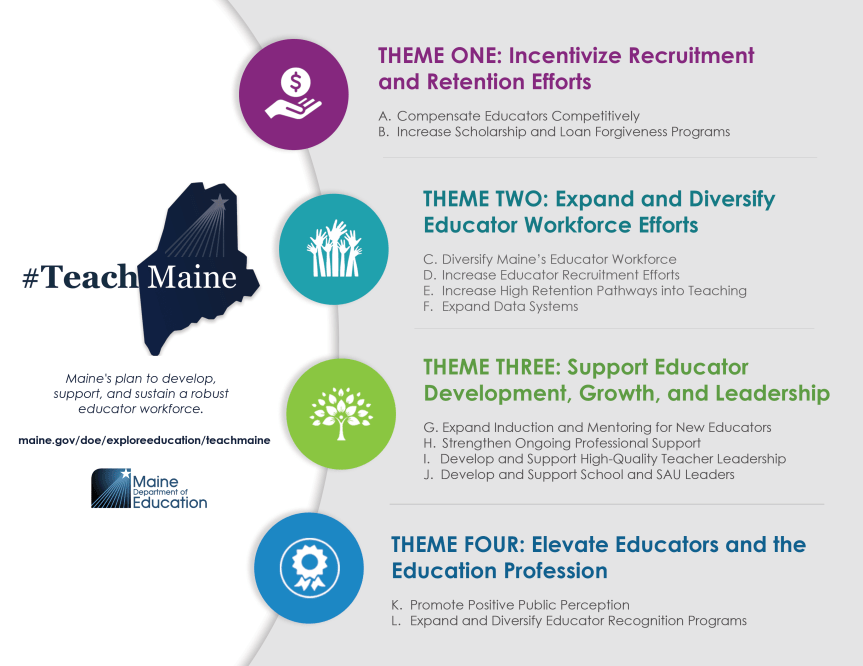
The Teach Maine Plan is organized around four key themes: incentivize recruitment and retention efforts; expand and diversify educator workforce efforts; support educator development, growth, and leadership; and elevate educators and the education profession. While the Teach Maine Plan has multiple themes, strategies, and actions, they are interdependent and not designed to be implemented in isolation.

“The Maine Department of Education is committed to developing, supporting, and sustaining a vibrant and diverse education workforce, and honoring the expertise and leadership of Maine’s education professionals,” said Maine Education Commissioner Pender Makin. “Maine’s educators give it their all each and every day to teach, inspire, and nurture their students, and the Teach Maine Plan provides the resources and supports they need to keep doing what they do best while also attracting more amazing educators into our schools. I want to thank the many educators and stakeholders who contributed to this effort and we look forward to collaborating on moving this plan into action.”

The report is the result of contributions by education stakeholders throughout Maine, who provided feedback via multiple channels, including regional Think Tanks, focus groups, surveys, organizational meetings, and informal conversations. Additionally, the Department of Education convened an Educator Talent Committee, a core group of internal and external stakeholders, to share their experiences, look at research and trends, and to make recommendations on how to address Maine’s educator shortage.

“Teach Maine provides a blueprint that will help to develop, attract, and retain quality educators that the children in Maine deserve. The future of Maine’s economy is grounded in providing our students with a diverse and rigorous educational experience. Teach Maine will provide the foundation to ensure that Maine students graduate with the passion, knowledge, and skills to be productive members of the world they will lead,” said Maine School Superintendents Association Executive Director Eileen King.

“The themes of the Teach Maine Plan hit upon key issues to ensure that our system of public education in Maine will continue to be strong. Recognizing, respecting, and rewarding our educators for the vital work they do every day is critical to providing the education our students deserve,” said Maine Education Association President Grace Leavitt.

“We are very excited to see the impact that Teach Maine will have on our profession. By having a stronger emphasis on recruitment, and then providing mentoring and ongoing support that educators and educational leaders need, will only help keep high quality professionals in education. This is what our students deserve,” said Maine Principals’ Association Executive Director Dr. Holly Blair.  

“Teachers are the most important element in ensuring Maine has a well-educated citizenry that is essential for our future workforce and democracy. These strategies will help strengthen the teaching profession in Maine,” said Educator Talent Committee member and University of Southern Maine Chair and Associate Professor of Teacher Education Dr. Flynn Ross. 
The first theme of the Teach Maine Plan, incentivize recruitment and retention efforts, focuses on compensating educators competitively; providing financial incentives for high-needs subjects and locations; providing financial incentives for teacher expertise and teacher leadership; encouraging alternative compensation strategies, including housing, transportation, childcare, creative use of time, and sabbaticals; increasing scholarship and loan forgiveness programs; expanding service loan forgiveness and tax incentive programs; and increasing awareness of funding sources.

Research shows that low salary scales continue to negatively impact the educator pipeline, as well as the retention of practicing teachers. Compared to college-educated professionals in other fields, beginning teachers earn about 20 percent less, with the gap widening to 30 percent by mid-career. While the Mills administration made a significant step in addressing overall teacher compensation to guarantee a minimum salary of $40,000, more must be done to make working in education a financially sustainable career.

The second theme, diversify and expand educator workforce efforts, includes strategies to recruit, prepare, and hire racially, ethnically, and linguistically diverse educators; retain diverse educators by addressing the policies and practices of structural racism; increase educator recruitment efforts; reduce costs; increase marketing for active recruitment of educators; increase high retention pathways into teaching such as teacher residencies, grow your own, and education career pathways starting in high school; promote teacher residencies for high-need School Administrative Units (SAUs) and content areas; promote additional dual certification programs for high-needs content areas; grow your own education technician and community college partnerships; and education career pathways in high school/CTE schools.

Building an educator workforce that reflects the racial, ethnic, and linguistic diversity of the student population has been shown to have positive impacts on student achievement. Research has shown that matching teacher racial identity with student identity can improve academic achievement, high school graduation rates, and college enrollment rates. And all students who have had teachers of diverse races or cultural backgrounds are better prepared for success in a global world.

The report finds that to make progress towards recruitment and retention initiatives, Maine needs a comprehensive and transparent data collection and management system. The strategy to expand data systems includes actions to characterize the current educator population in greater detail; determine educator needs geographically in Maine; create a statewide job board; and collect SAU-level data such as exit interviews and surveys.

Theme three, support educator development, growth, and leadership, includes strategies to expand induction and mentoring for new educators; strengthen state and SAU supports for mentoring and induction; scaffolded induction with time to learn, including not just orientation and access to mentors but also access to coaches, common planning time with mentors, and resource allocation to support success; establish a network of new educators for peer support; strengthen ongoing professional support through professional learning opportunities at the school, SAU, regional, and state level; develop and support high-quality teacher leadership; and develop and support well-qualified school and SAU leaders.

The support that new educators are given throughout their pre-service career and first few years of teaching has a direct impact on their retention as career educators. Key elements of high-quality induction strongly associated with reduced rates of teacher turnover include assigning mentors from the same field, common planning time and opportunities to collaborate with teachers in the same subject area, and being part of an external network of teachers.

Theme four, elevate educators and the education profession, includes strategies and actions to promote the positive public perception of public education and the education workforce, and expand and diversify educator recognition programs. To recruit and retain a vibrant educator workforce and make teaching an attractive profession also requires strengthening public perception and confidence in Maine schools and demonstrating appreciation for educators not just during teacher appreciation week, but every week of the year.

MEDIA RELEASE: Maine Department of Education Partners With SPIRIT SERIES to Engage 12,500 Students In Story-Based Social Emotional Learning and Literacy Program

The Maine Department of Education has partnered with SPIRIT SERIES to bring its acclaimed interdisciplinary, story-based social-emotional learning and literacy programs to 12,500 students across Maine. This effort, made possible through federal relief funds, will provide a 100 percent scholarship to participating schools during the 2022-23 school year. Funding is also included for professional development opportunities, so that educators can further integrate the SERIES’ programming into their classrooms.

SPIRIT SERIES empowers students to strive for academic excellence as they learn and practice positive core values and develop leadership, critical thinking, and relationship skills while expressing themselves in highly engaging project-based learning. The program mentors students as they think deeply about their lives and experiences, organize those thoughts into a written personal story, and then record them as videos for classmates, family, and their school community.

The immersive learning opportunities offered by SPIRIT SERIES provide schools with a classroom-proven way to support the very real needs of students impacted by the pandemic, specifically in the realm of social and emotional learning and interpersonal and intrapersonal communication skills. Maine schools will have access to three SPIRIT SERIES programs: SpiritCorps—21st Century literacy and storytelling intensives for 7th to 10th graders; SpiritSeries—drama-based literacy and character education interventions for 4th to 7th graders; and SpiritWorks—professional development workshops for educators.

“We’re excited to partner with SPIRIT SERIES to offer this immersive, interdisciplinary experience to schools and students across Maine,” said Education Commissioner Pender Makin. “The SERIES provides students with the ability to develop and share their personal stories and build meaningful connections with one another and their communities. That’s really important given how the pandemic made that kind of connection difficult.”

SPIRIT SERIES has successfully delivered programming in Maine since 2014, already serving over 6,000 students in more than 20 partner schools statewide. “After working with schools in Maine for the past eight years, we are excited to partner with the Department of Education to bring our programming to all corners of the state,” said Kent Pierce, SPIRIT SERIES New England Executive Director. “Using the power of story, the SERIES inspires self-discovery and reflection around character attributes that are key to personal growth and civic-mindedness.”

“Every student, regardless of their writing proficiency level, was engaged and they were engaged from the onset. Because this age group is often inward looking, they’re very concerned about themselves—so right away they were hooked on the process,” said Aaron Filieo at Cape Elizabeth Middle School. “We have standards around writing development and writing structure. Writing and presenting these SpiritCorps stories checked those boxes and then some.”

For schools that would like to learn more about this exciting opportunity, please contact the Department of Education through this interest form.

Supporting Interdisciplinary Instruction in Maine Schools  

The Maine Department of Education (DOE) is committed to a whole student approach to teaching and learning that develops healthy, safe, engaged, supported, challenged, and prepared students. Meaningful learning that is project-based, integrated, and has application to the real world is essential to the whole student approach, and the Department is enhancing our support to the field around interdisciplinary instructional practices and an educator-leader model.  A dynamic team of Interdisciplinary Instruction Specialists – formerly DOE content specialists – has been brought together at the Department to lead this exciting, transformational work that builds on their deep content knowledge.   

The Department’s Interdisciplinary Instruction team will support the field in exploring interdisciplinary and project-based approaches to teaching and learning.  By offering professional learning opportunities that support the quality teaching and learning already present in Maine’s schools, these specialists will support Maine schools’ targeted efforts to expand varied and innovative learning experiences and environments for all students, and to remove barriers. These opportunities, combined with targeted resources, will support schools across the state in exploring new and exciting ways of engaging the whole student and preparing each for success in their lives.   

Interdisciplinary instruction relies on multiple content areas working together to develop student knowledge, problem-solving skills, self-confidence, self-efficacy and a passion for learning, while supporting students’ various learning styles, diverse backgrounds, interests, talents, and values. By focusing on providing interdisciplinary and project-based learning opportunities, student engagement in learning increases, student-centered learning becomes the norm, and students build critical thinking skills and problem-solving strategies. 

The Department wants to honor and elevate the expertise in the field, and will be inviting educators and education organizations to share their expertise with one another to expand opportunities and collaborate statewide. To support this effort, the Department has a new suite of webpages with information and resources, and the Interdisciplinary Instruction Specialists have started hosting a series of office hours to collaborate and discuss how the Department can best support innovative teaching and learning practices.   

Check the Department’s Professional Development Calendar for the schedule of those office hours. Soon, the Specialists will begin offering professional learning opportunities related to interdisciplinary and project-based learning, and these offerings will be both synchronous and asynchronous. 

For more information, please contact Jason Anderson, Interdisciplinary Instruction Team Coordinator, at jason.anderson@maine.gov. 

Maine DOE and Holocaust and Human Rights Center (HHRC) of Maine Announce New Project-Based Lessons Now Available to Maine Educators

The Maine Department of Education (DOE) and the Holocaust and Human Rights Center (HHRC) of Maine have partnered to support the many educators working to develop robust and relevant, project-based learning content for the MOOSE (Maine Online Opportunities for Sustained Education) platform. Educators have developed online, PreK-12 learning modules that examine the history of genocide and the Holocaust using an interdisciplinary, project-based approach. The modules are intended to be used by students and educators at every grade level, and includes age-appropriate material to help students learn about the events of the holocaust and associated themes and concepts.  

Teachers, leaders, and experts from all over Maine recently gathered at the Holocaust and Human Rights Center of Maine (HHRC) on the campus of University of Augusta, to recognize the six months of collaboration and support, insight, and hard work of all involved. 

MOOSE was initially designed in response to the pandemic as a way for learning to continue whether students were home, in their classrooms, or otherwise.  With support from hundreds of educators from every county in Maine, over 300 learning modules were created and published for free online use.  MOOSE has evolved to be a model for high quality, interdisciplinary teaching and learning, addressing important issues identified by state and education leaders.  

HHRC Educational Coordinator, Erica Nadelhaft, advised and supported the team with resources, and cultural and emotional support.   

Team Leader, Joanna Martel, praised Content Creators for their work, “Our team worked hard to convey a difficult topic to all students and the partnership with HHRC has been critical to making it all happen.  It is not only the amazing product they have produced but also the tools they have gained and will take back to use in their classrooms that’s exciting to see. The experience of this project has been something we won’t forget and the relationships built between HHRC, DOE, and educators all over the state will last a long time.”   

Art Educator Bridges Divide Between Remote and In-person Students Through Digital Communications Artist Showcase

13 Series of 7’s 

A Remote Digital Communications Artist Showcase

An educator reflection written by Melanie Crowe, Visual Arts Educator at Hampden Academy.

This school year has presented some unique challenges, engaging students who are remote with the in person school community has been a central focus for me as an educator. The journey to find ways to showcase remote student work and learning has created wonderful collaborations between departments and spaces here at Hampden Academy. Working in conjunction with Leslie Rosenblatt, HA’s Library Media Specialist, she and I have found a way to bridge the spatial divide between the remote students and the in person students. Using the Library’s garage as a “gallery” space, the quarter 3 remote Digital Communications students created a movie of their digital photography that will be on presentation for the month of February.

Students in the Digital Communications course curated their work and selected, what they believed to be, their most visually engaging and compositionally successful photographs. Over the course of the semester, students in the remote Digital Communications course learned how to use their cameras on their phones like a digital SLR camera. They learned how to manipulate and control settings beyond the typical point and shoot of a phone camera. Students focused on how to manipulate and change their depth of focus, shutter speed, and ways to enhance their work using photo editing software on the web.

The students chose their best seven works from the quarter, used vocaroo (a web based voice recorder) to record an artist statement reflection. The video is shown during the day on a loop at HA for those interested to view during their study hall or during their visit to the library. This opportunity provides students in the building a way to hear and see the work created by students who are learning remotely. We hope that students will engage with the work and enjoy the works created by their peers.

Future collaborations are in the makings to showcase more of the amazing artwork our students create here at Hampden Academy. The featured thirteen student photographers are: Nikyla Bidler, Graceann Brinkworth, Madison Burns, Owen Cross, Isaac Cruz, Rebecca Demmons, Ryan Dudley, Tesa Kneeland, Gabriella Moore, Sophia Pereira, Sara Reynolds, Cameron Robichaud, and Zachary Robichaud.

Maine Forum on Outdoor Learning

December 2nd, 2020, 3:00 – 4:15pm: Join the Nature Based Education Consortium and other Maine co-hosts to hear from Maine schools about their experience of Outdoor Learning this fall and beyond, and share about your own challenges and solutions. Learn from the Maine Department of Education about the new $17 million ‘Rethinking Remote Education Ventures’ (RREV) grant program. Connect with other schools and organizations who are building support for life-changing outdoor learning opportunities in Maine. Build your network, gain new resources, and be inspired!

Participation is free and registration required.

Co-hosted by Maine Science Teachers Association, Maine Environmental Education Association, University of Maine at Farmington, Maine Department of Education, Inside/Outside Network – Antioch University, Cathance River Education Alliance, Center for an Ecology Based Economy, Chewonki, Environmental Living and Learning for Maine Students, Juniper Hill School, Kennebunkport Climate Initiative, Maine Audubon, Maine Mathematics and Science Alliance, Maine Outdoor Coalition, Maine Outdoor School, Teens to Trails, The Ecology School, The Nature Conservancy, White Pine Programs, WinterKids


Learning Facilitator Program- Great Resource for Schools, Free for Trainees!

In order to be responsive to critical staff shortages in Maine schools as a result of the pandemic, Governor Mills created additional flexibilities and opportunities for educators in Executive Order #7. Based on the Executive Order, the Maine Department of Education, in collaboration with Maine Community College System and Eastern Maine Community College, has developed the Learning Facilitator Program, a fast-track training program for paraprofessional level educators to expand, strengthen and support a high quality educator workforce.

The program, which is offered at no cost to the participants, is completed in two phases in one academic year with the ongoing support of Eastern Maine Community College faculty.

  • A week-long 3-credit course “boot camp” with foundational elements of classroom management and school culture. Additionally, the core boot camp curriculum includes training in COVID readiness, bloodborne pathogens, suicide awareness and prevention, mandated reporter training, and fingerprint clearance in order to address both substitute teacher and long-term support staff preparedness.
  • The second phase of the program consists of a combination of online work, professional learning community meetings, and a structured teaching apprenticeship (315 hours).

Upon completion of the 3-credit course “boot camp,” participants will have the foundational skills necessary to fill short- and long-term substitute educator roles, as well as all paraprofessional positions. They can support instruction and provide guidance to learners in the classroom under the supervision of a mentor teacher or teaching team. Mentor teachers or teaching teams may be working remotely or in-person. Special coding for Learning Facilitators has been created within NEO for schools, so that subsidy will not be impacted.

Educators who complete all elements of the Learning Facilitator Program, as outlined above, will qualify for an Educational Technician III certification.

For more information related to the program, please visit the EMMC website, here.

Priority Notice: Maine DOE seeks public comment on waiving requirement that 21st CCLC programs operate only during non-school hours

In response to the unprecedented obstacles schools, teachers, students, and their families are facing amid the COVID-19 pandemic, the U.S. Department of Education (USDOE) has offered an additional waiver to state education agencies, pursuant to section 4201(b)(1)(A) of the Elementary and Secondary Education Act of 1965 (ESEA).  Under Title IV, Part B of the ESEA, section 4201(b)(1)(A) requiring that 21st Century Community Learning Centers (21st CCLC) programs operate only during non-school hours or periods when school is not in session.  If granted, this waiver would allow 21st CCLC program providers in Maine to temporarily operate with greater flexibilities to better meet the needs to students and families during the 2020-2021 school year.

This waiver would grant the Maine Department of Education (DOE) temporary authority to permit its 21st CCLC programs to provide supplemental services when school is in session, but students are not receiving in-person instruction.  For example, it would be permitted that a teacher provides additional 21st CCLC-funded academic supports for a group of students during a remote learning day when those students are not otherwise engaged in facilitated instruction with their classroom teacher.

The Maine DOE continues to work diligently to support Maine’s schools and educational communities as the 2020-2021 school year begins.  Given the hybrid instructional approaches many schools have adopted this year, students may benefit from dedicated staff and enhanced resources to help with remote lessons, independent work, and other enrichment opportunities during the portion of the week when remote lessons learning is occurring.  It is for reasons such as these that the Maine DOE has chosen to pursue this waiver.

As part of the statutory requirements for seeking this waiver, the Maine DOE must solicit and respond to public comment on its waiver request as well as provide evidence of the available comment period.  This 15-day public comment period shall begin on September 29, 2020 and conclude on October 14, 2020.

Comments may be submitted to: travis.w.doughty@maine.gov

MEDIA RELEASE: College Board Releases Free Parent Resources for Upcoming AP Exams

The College Board has released the new AP® Exam (Advanced Placement) schedule, which includes optional free, online AP classes and take-at-home AP Exams to support the challenges that students and families are facing because of the coronavirus pandemic. In addition, the Collage Board is also offering the opportunity for families to apply for help securing an internet connection and a device in order to take the exams.

Advanced Placement (AP), a program implemented by the College Board, allows high schoolers to take high school courses that can earn them college credit and/or qualify them for more advanced classes when they begin college. Many of Maine’s high schoolers were amid AP classes when they transitioned to remote learning. In a response to this drastic change in learning, the College Board has released additional resources for families and educators.

It is recommended by the College Board that parents and teachers whose students are planning on taking any of the AP exams take the weeks of April 13 and April 20th to help students work through the remaining course content and/or encourage them to participate in the live online classes and review sessions. Find them here: FREE AP Online Classes and Review Sessions

In addition, the College Board has also asked parents to let students know about the technology they’ll need to take the AP tests and to contact the College Board by April 24 if they need devices or connectivity. Here is where you can find information about getting internet connection and devices for AP exams: Information about getting Internet or a Device for AP Classes and Exams

You can find more information about the AP exams and the College Board’s response to the coronavirus on their website. In addition to the parent resources, College Board is also offering a listing of webinars among other resources for AP educators to help answer questions about the upcoming tests.