Starting October 21, 2025, the Maine Department of Education (DOE) Office of Teaching and Learning invites educators to explore the Question Formulation Technique (QFT), developed by the Right Question Institute.
In education, answers matter, but the ability to ask the right questions builds critical thinking and fosters deep learning. The QFT is a practical and structured method for generating, refining, and using questions to drive learning.
This free professional learning opportunity will be available through EnGiNE, the Maine DOE’s online learning platform. Participants will progress through two online modules per week for approximately four weeks, engaging with readings, asynchronous videos, and discussion prompts. The experience concludes with the design of a lesson using the QFT.
Educators who wish to delve further into the QFT can join an optional virtual learning community, with support available on Tuesdays and Thursdays from 3:30 to 4:30 p.m. These sessions provide opportunities to practice the QFT collaboratively, share ideas, and apply it in authentic contexts.
Please complete this form to register for the QFT EnGiNE course. Registration will close on October 20, 2025. Following registration, an email with instructions on how to set up an EnGiNE account will be sent to the email address submitted in the registration.
Together, we will connect the QFT with object-based learning and deep conceptual thinking, equipping educators with powerful strategies to spark curiosity and inquiry in their classrooms. Course participants can earn up to 12 contact hours.
For more information, please contact Maine DOE Interdisciplinary Instruction Specialist Heather Martin at Heather.Martin@maine.gov.
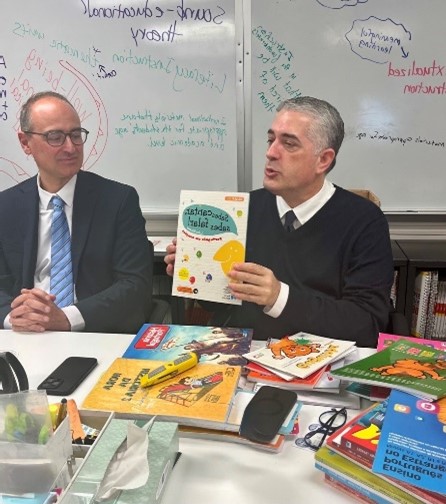
As a new season of learning unfolds, Maine classrooms are building on the strength of global connections. Through community celebrations, exchanges, and new language resources, students and educators are experiencing how language and culture are assets for learning.
In Lewiston, Portuguese cultural brokers and educators are partnering with the Maine Department of Education (DOE) and Portugal’s education leaders to bring free, high-quality resources into classrooms—work extending from Maine’s international agreement with Portugal. Teachers are accessing digital materials from Porto Editora that support Portuguese as a foreign, second, and heritage language. Additionally, local feedback has provided a reminder that implementation support matters: Since few classrooms in Maine have Portuguese-speaking teachers, educators may need guidance about how to use these materials effectively. The Maine DOE continues to coordinate practical “how-to” supports and warm introductions, so resources are usable in everyday instruction.
Maine educators are also connecting through events that celebrate language and culture. The Taipei Economic and Cultural Office in Boston hosts Taiwan’s 114th National Day Celebration on October 3. A week later, teachers will gather at Husson University for the Maine Chinese Language Conference, an annual convening organized with the Bangor Chinese School/Chinese Language and Culture Center of Maine (CLCCM) that offers professional learning and continuing education units (CEUs).
Maine students continue to benefit from opportunities in German. At Cony High School—one of only 14 U.S. schools in PASCH (Schools: Partners for the Future), a global initiative of the German Federal Foreign Office via the Goethe-Institut—two students head to Estes Park, Colorado for an immersion weekend and competition with peers from across the Americas. Each summer, two Cony students also receive full scholarships for a three-week course in Germany, and this November, Goethe-Institut representatives will visit campus to share additional pathways, including study abroad.
“As a PASCH school, Cony has access to unique global connections, cutting-edge teaching resources, and annual teacher training that elevate German instruction,” Deb Backman, German teacher at Cony Middle and High School in Augusta, and 2025 Kennebec County Teacher of the Year, said. “Students build real language fluency and cross-cultural understanding, with many chances to use their skills inside and outside the classroom.”
Maine’s collaboration with the Académie de Nantes (France) supports classroom-to-classroom exchanges and educator partnerships that give students real audiences for their language skills. Those supports exist today but are underutilized; the Académie is actively seeking conversations with Maine educators about how to increase participation and make these opportunities easier to access.
“The supports are in place, and we want to hear directly from Maine educators about what would make participation easier and more impactful for their students,” Maine DOE Director of Strategic Partnerships Ayesha Hall said. “Districts can connect with partner contacts on the Global Partners Network webpage, and I’m glad to make a warm introduction, when helpful.”
Together, these stories show that Maine schools are not just teaching languages; they are building bridges. By investing in multilingual pathways and international partnerships—and by listening to local feedback that improves access and use—schools across the state foster the curiosity, respect, and collaboration skills students need to thrive in a connected world.
A next step for educators and administrators: On October 20, 2025, from 3:30 to 4:30 p.m., the Maine DOE hosts the next session of the Multilingual/Multicultural Connections Webinar Series—a virtual session for educators and district leaders who want practical ways to translate international partnerships into classroom learning and schoolwide engagement. Please register here, if you are interested in attending.
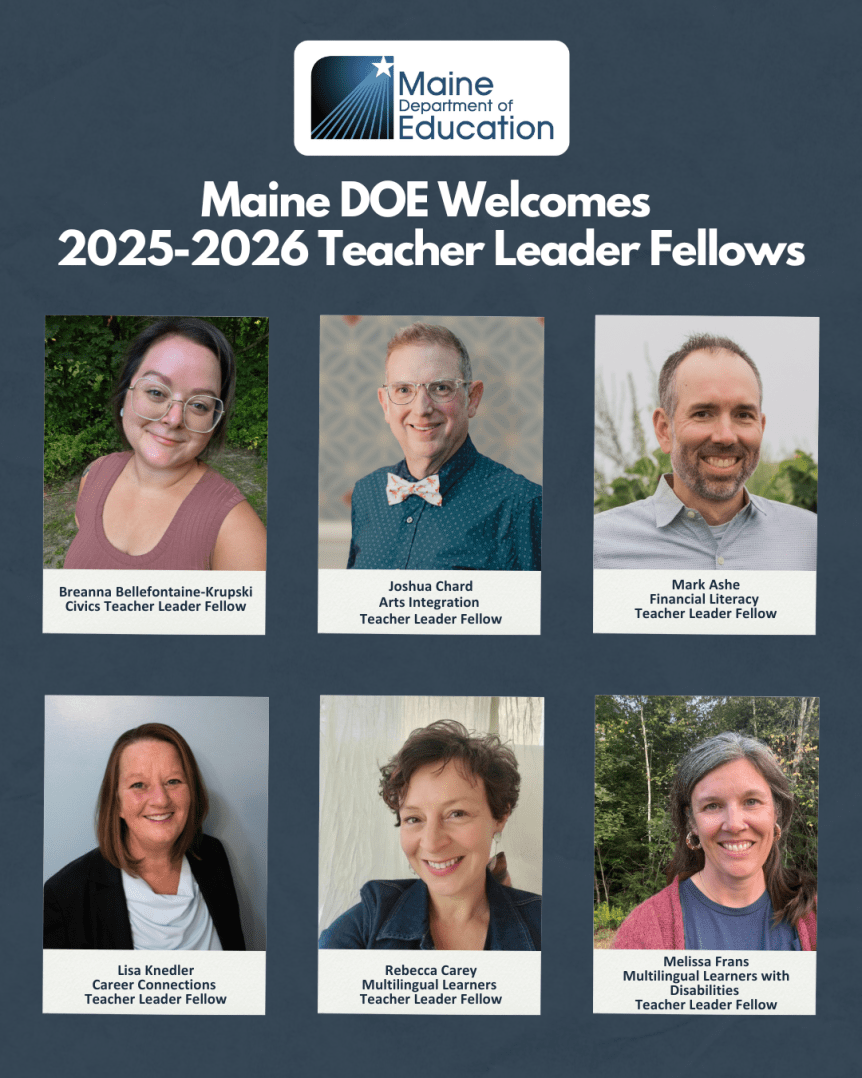
The Maine Department of Education (DOE) Office of Teaching and Learning is proud to welcome the 2025-2026 Teacher Leader Fellows. These exceptional educators bring diverse expertise and passion to their work, helping to strengthen teaching and learning across the state. Each Fellow will engage educators in their focus area, curate resources, and provide professional learning opportunities that expand access, equity, and excellence in Maine classrooms.
We are excited to introduce this year’s cohort:
Breanna Bellefontaine-Krupski Civics Teacher Leader Fellow Scarborough High School Teacher
Breanna Bellefontaine-Krupski, known to her students as Mrs. B-K, returns for a second year as the Civics Teacher Leader Fellow. A lifelong Mainer, she has spent 14 years teaching civics, including at Scarborough High School and in rural schools across the state. Along the way, she earned National Board Certification in Social Studies, participated in the 2019 Maine Teacher Leader Cohort, and collaborated with civic organizations nationwide.
Most recently, Bellefontaine-Krupski served as a Constitutional Fellow with the National Constitution Center and continues to serve on their Teacher Advisory Board while also working as a Teacher Ambassador for Retro Report Education.
In her second year as a Fellow, she plans to gather a monthly cohort of civics teachers, share a newsletter of resources and opportunities, and deepen connections across the Maine civics world.
Joshua Chard Arts Integration Teacher Leader Fellow East End Community School Teacher
Joshua Chard, the 2024 Maine Teacher of the Year, returns for a second year as the Arts Integration Teacher Leader Fellow. A second-grade teacher at East End Community School in Portland, Joshua has spent 33 years in education. His work is rooted in culturally responsive teaching and the belief that joyful relationships are at the heart of student learning.
Joshua’s classroom is very diverse, with students speaking more than a dozen home languages. He emphasizes equity, student voice, and the arts as tools to help students thrive and to anchor schools as vital parts of their communities.
Beyond the classroom, Joshua is an accomplished theater director who uses stories to build empathy and expand understanding. Above all, he describes himself as a joyful teacher who loves the fresh start each September and the chance to help children discover their voices.
Mark Ashe Financial Literacy Teacher Leader Fellow Cape Elizabeth High School Teacher
Mark Ashe, a social studies teacher at Cape Elizabeth High School, is the 2025-2026 Financial Literacy Teacher Leader Fellow. With 21 years in Maine classrooms and a background in Economics and Social Studies Education, Ashe connects personal finance to broader issues of justice and democracy. He helps students to see how topics like compound interest or student debt intersect with systemic inequities and national policy.
Ashe also runs a financial planning and investment advisory firm, bringing real-world expertise into his teaching on business, investing, and financial planning. He looks forward to continuing his mission of promoting financial literacy as a foundation for equity and civic engagement.
Outside of teaching, Ashe enjoys traveling and watching sports with his wife and two sons.
Lisa Knedler Career Connections Teacher Leader Fellow Gray-New Gloucester High School Teacher
Lisa Knedler, a Career Explorations Teacher and International Baccalaureate Coordinator at Gray-New Gloucester High School, is the 2025-2026 Career Connections Teacher Leader Fellow. Knedler’s passion for student aspirations has shaped her career, from serving as Maine’s first College and Career Access Coordinator to designing career pathways and events like “Career Day” and “Curious about College.”
Currently teaching an Early College Career Exploration course through the University of Maine, Knedler equips students to align their interests and goals with career plans while earning transferable credit. She looks forward to creating resources grounded in Maine’s Life and Career Ready standards and collaborating with educators, career organizations, and employers to expand opportunities statewide.
Rebecca Carey Multilingual Learners Teacher Leader Fellow English Speakers of Other Languages (ESOL) Teacher/Coordinator, RSU 3
Rebecca Carey returns for a second year as a Teacher Leader Fellow, continuing her work with Early Learning educators and leaders. Last year, she focused on culturally and linguistically responsive programming and helped to develop tools to welcome families and guide instructional planning.
As the 2025-2026 Multilingual Learners Teacher Leader Fellow, Carey will collaborate with the Maine DOE’s ESOL team to support multitiered systems of support (MTSS) for multilingual learners. Her focus will include creating family-facing documents that educators can share with culturally and linguistically diverse families, as well as curating resources that help teachers to plan intentionally for their multilingual learners.
Melissa Frans Multilingual Learners with Disabilities Teacher Leader Fellow Special Education Multilingual Coordinator, Portland Public Schools
Melissa Frans returns for a second year, continuing her focus on supporting educators of dual-identified multilingual learners with disabilities. Through her leadership last year, a professional learning community explored strategies for integrating Individual Language Acquisition Plans (ILAP) with Individualized Education Programs (IEP).
This year as the 2025-2026 Multilingual Learners with Disabilities Teacher Leader Fellow, Frans will expand on that work by enhancing instructional practices and building interdisciplinary collaboration so that all students—especially those at the intersection of language acquisition and disability—have equitable access to learning.
Together, these six Fellows bring expertise, creativity, and passion to the Maine DOE’s work. Their leadership will provide educators with tools, resources, and opportunities to strengthen teaching and learning across our state.
Please join us in welcoming the 2025-2026 Teacher Leader Fellows!
Attention, Maine civics and government educators! Join Maine Department of Education (DOE) Teacher Leader Fellow Breanna Bellefontaine-Krupski for a monthly civics professional learning community (PLC) group that will launch in October.
The Civics PLC is open to all civics educators in Maine, from elementary through high school. Meetings will be held on the third Thursday of each month at 4 p.m. via Zoom.
Goals of the PLC:
Connect with civics educators across Maine to share ideas, feedback, and strategies.
Discuss the needs of civic education at all grade levels.
Partner with Maine civic organizations to build classroom-to-community connections.
Explore opportunities for professional development in civics-related fields.
Earn up to seven contact hours (one hour per meeting).
Please sign up here. Registration is limited to 30 teachers. Monthly attendance is encouraged but not required. Registration will close on Friday, October 10, 2025.
Meeting dates:
October 16, 2025
November 20, 2025
December 18, 2025
January 15, 2026
*no meeting in February*
March 12, 2026 *second Thursday of the month*
April 16, 2026
May 21, 2026
This is the second year that Breanna Bellefontaine-Krupski has served as the Maine DOE Civics Teacher Leader Fellow. Having participated in civics-focused PLCs in the past, she has gained some of the best professional development and classroom strategies from like-minded peers across the country. She looks forward to leading this group during the 2025-2026 school year!
For further information or questions, please contact Breanna Bellefontaine-Krupski at breanna.krupski@maine.gov.
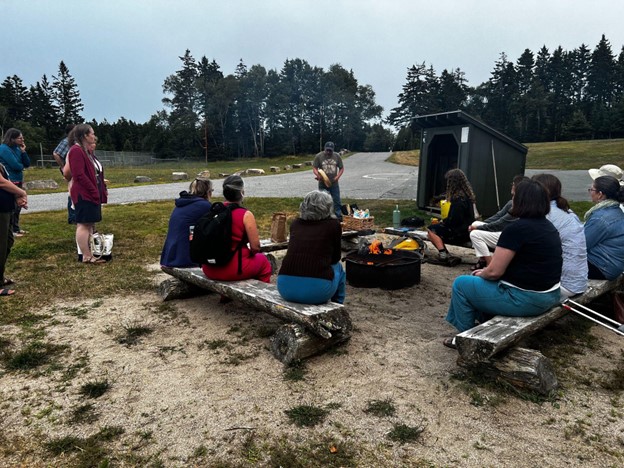
On a warm August evening, Maine teachers gathered around a campfire, as Chris Sockalexis, Panawahpskek (Penobscot) Nation Tribal Historic Preservation Officer, played drums, sang, and shared the importance of music in Wabanaki culture. His words offered a powerful close to the first day of the “Celebrating Rural Maine” summer colloquium, hosted by the Maine Department of Education (DOE) Interdisciplinary Instruction Team and the National Council for History Education (NCHE).
The colloquium marked the capstone of a yearlong professional development program supported by the Library of Congress’ Teaching with Primary Sources (TPS) Partner Program. Over the past year, participating educators have explored the use of primary sources, the Question Formulation Technique, and Maine’s geographical history—from the Wabanaki origin stories to the present day.
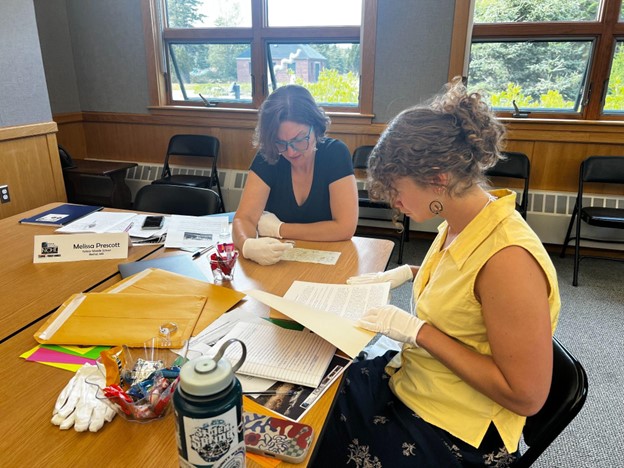
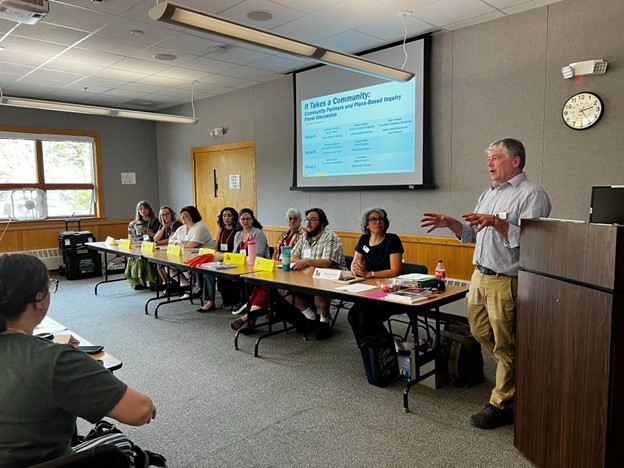
Held at the Schoodic Institute in Winter Harbor, this two-day event brought teachers, presenters, and community partners together in a retreat-like setting. Educators immersed themselves in Maine-based primary sources—documents, maps, photographs, and artifacts—and practiced strategies for helping students to analyze and question them.
“It was wonderful to be immersed, away from other distractions,” Jaime Beal, the district librarian in MSAD 40, reflected.
The goal of “Celebrating Rural Maine” is to provide teachers with professional learning, planning time, and community support to design place-based projects that connect students with their local history and environment. This fall, teachers will implement these projects in their classrooms and communities. The resulting work will be shared both on the Maine DOE’s Interdisciplinary Instruction website and the NCHE website, broadening the impact of these local stories.
Some of the highlights of the colloquium included:
A keynote by NCHE director Jessica Ellison, who highlighted the “superpowers” of primary sources by reconstructing the life of an ordinary farmer during the Great Depression.
A session with Dr. Debra Reid of The Henry Ford, who guided teachers through a historical mystery involving Rachel Carson’s eating habits, illustrating how primary sources can answer unexpected questions.
A session with Javaha Ross and Trey Smith of the Philadelphia Writing Project, who engaged participants in civically focused argument writing using child labor sources, encouraging teachers to explore the nuances of debate.
The “It Takes a Community” panel, which featured land trusts, museums, and other cultural and educational partners who support place-based inquiry.
Support from Acadia National Park rangers and volunteers, who showcased the region’s landscapes, wildlife, and local World War II history.
This fall, teachers and their community partners will bring these place-based projects to life, helping students across Maine to deepen their connection to the history, culture, and environment of the places they call home.
The Maine DOE Interdisciplinary Instruction Team is part of the Office of Teaching and Learning. To find more interdisciplinary resources and opportunities, please click here or contact Erik Wade, Maine DOE Interdisciplinary Instruction Specialist, at erik.wade@maine.gov.
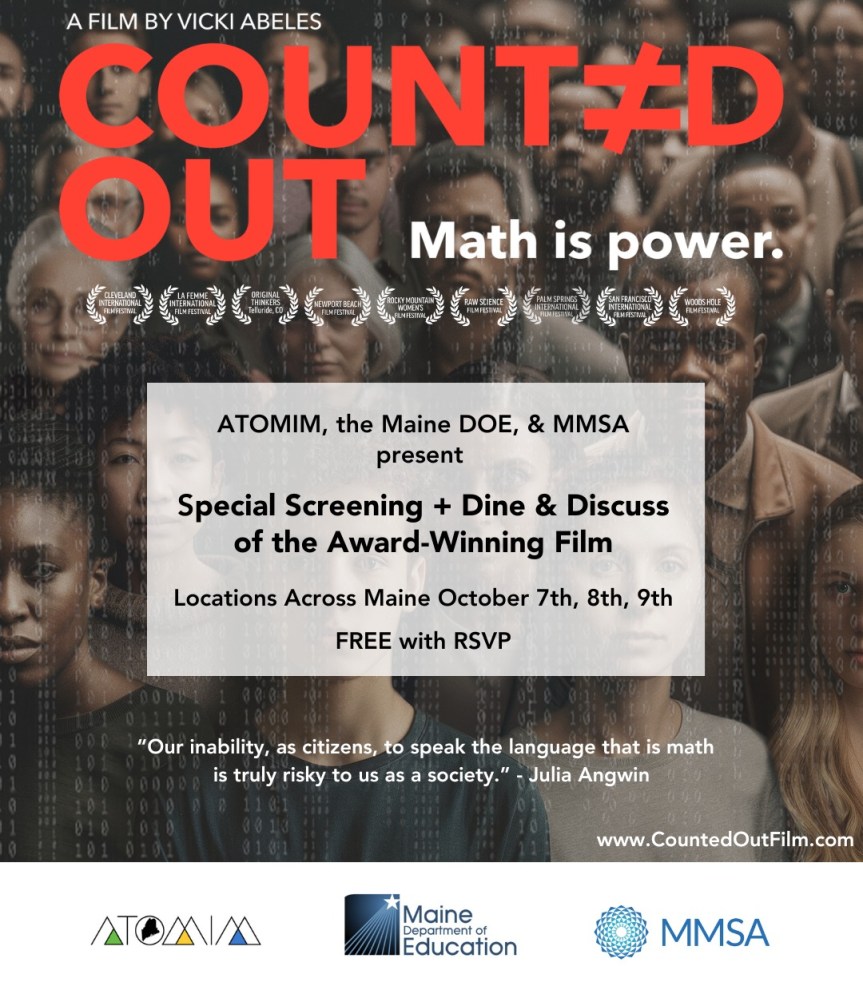
This October, the Maine Department of Education (DOE), in partnership with the Association of Teachers of Mathematics in Maine (ATOMIM) and the Maine Mathematics and Science Alliance (MMSA), invites educators and school leaders to a series of free, in-person events across the state to watch the film “Counted Out” and participate in a dine-and-discuss event with fellow educators.
These engaging evenings include a screening of the award-winning documentary “Counted Out,” a casual meal, and guided small-group discussions. Together, participants will reflect on how math instruction can either empower or exclude—and how we can make math education more inclusive, relevant, and equitable for all Maine learners.
About the Film
“Counted Out” explores the biggest crises of our time—political polarization, racial and economic inequity, public health, and climate change—through an unexpected lens: math. The film challenges educators to consider how math can be both a gatekeeper and a gateway, and how rethinking its role in society can lead to transformational change in education and beyond.
Event Details
Dates/Locations:
October 7: Deer Isle, Freeport, North Berwick
October 8: Gardiner
October 9: Brewer, Caribou, South Paris, Thorndike
Time: 5 to 8 p.m.
Audience: Maine educators and school leaders
Contact Hours: 3 hours awarded
Cost: FREE (includes dinner)
Registration Deadline: September 30, 2025
An RSVP is required! Space is limited at each site, so please register using the links below.
Tuesday, October 7, 2025
Deer Isle/Hancock and Washington Counties REACH Performing Arts Center, Deer Isle-Stonington Elementary School 249 North Deer Isle Road, Deer Isle, ME 04627
South Paris/Oxford, Androscoggin, Franklin, and Somerset Counties Oxford Hills Comprehensive High School Auditorium 256 Main Street, South Paris, ME 04281
Contact: Courtney Pierce at courtney.pierce@atomim.org
Explore how math connects to social justice, civic engagement, and real-world problem solving.
Discuss how to reduce math anxiety and promote mathematical confidence.
Connect with other educators and leaders across regions.
Walk away with actionable ideas for reimagining math instruction.
Registration is open now through September 30! Each event is limited in size, and seats are filling fast. Secure your spot today and join this statewide conversation about math, equity, and educational transformation.
Stay connected with the Maine Department of Education! Sign up to receive our weekly Maine DOE Update—featuring all the latest announcements and newsroom articles—as well as several content-focused newsletters tailored to your interests. Already subscribed? No problem! The system will recognize your information and let you update your subscription preferences: Subscribe here.
Maine educators, you are invited to a statewide professional learning experience hosted by the Maine Department of Education (DOE)!
Mark your calendars! The Maine DOE Office of Teaching and Learning and Office of Innovation are excited to invite all educators, ed techs, administrators, and pre-service educators to three full days of free, high-quality professional development in the 2025-2026 school year.
In partnership with the University of Maine System, this statewide professional learning initiative is made possible through a valued collaboration with the University of Maine at Orono (UMaine), the University of Maine at Farmington (UMF), and the University of Southern Maine (USM). We are grateful to these institutions for opening their doors to educators across the state. Their partnership ensures that our shared commitment to accessible, high-quality, and regionally grounded professional learning is available to every educator, whether attending in person or joining online.
No matter your role in public education—whether you’re an early childhood educator, a STEM enthusiast, a literacy coach, a pre-service teacher, or someone looking to deepen their practice in inclusive education—there’s something for you. These engaging workshops are crafted by Maine DOE staff and designed to inspire, energize, and equip you with tools to meet the needs of today’s learners.
2025-2026 Statewide Professional Learning Dates:
Friday, October 10, 2025
Friday, January 16, 2026
Friday, March 20, 2026
You can attend in-person at one of the University of Maine System campuses (UMaine, UMF, USM) or join remotely via live stream from anywhere in the state. There is also an option to catch up on-demand after the fact. All participants will be eligible for contact hours.
These learning days are scheduled to align with many school administrative unit’s’ dedicated professional development days. You can register for all three events or just one or two.
Each day is structured as follows:
Morning Workshop: 9-11:30 a.m.
Lunch Break: 11:30 a.m.-12:30 p.m. (on your own)
Afternoon Workshop: 12:30-–3 p.m.
Planning to join us on campus? Each session offers an interactive, in-person experience, with just 50 seats available per workshop session. Registration is required, so please be sure to reserve your spot early to participate onsite. Prefer to learn from your own space? The online option offers unlimited registration, and you can join live from anywhere in the state! Can’t attend live? Don’t worry; asynchronous recordings will be available, so you can access content when it works for you.
Topics include:
Play-based and early childhood assessment
Wabanaki Studies integration
STEAM and numeracy
Literacy through graphic novels
UDL (Universal Design for Learning) and MTSS (Multi-Tiered System of Supports) frameworks
Let’s grow together! Come as you are. Learn in the ways that work for you. Connect with educators from across the state in a welcoming space that prioritizes equity, innovation, and real-world learning.
For questions or more information, please contact Beth Lambert, Maine DOE Chief Teaching and Learning Officer, at beth.lambert@maine.gov.
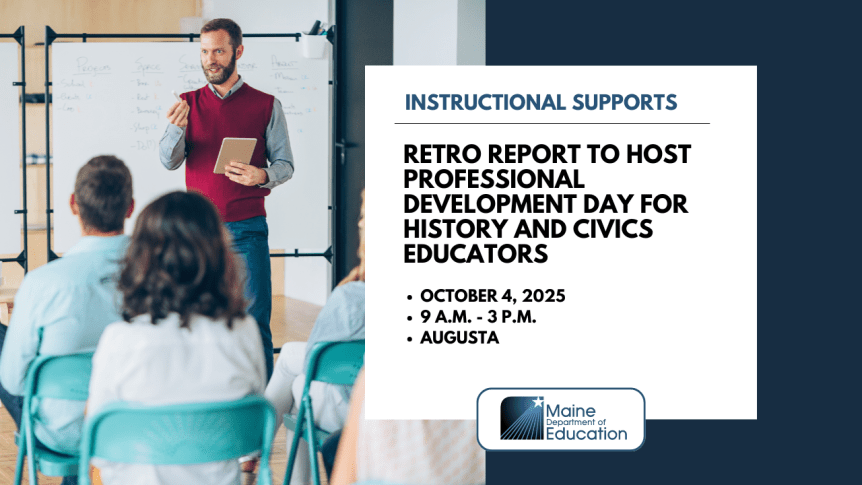
The Maine Department of Education (DOE) is partnering with Retro Report to host a unique day of professional development for educators on Saturday, October 4, 2025, from 9 a.m. to 3 p.m. in Augusta.
This event will showcase a new resource collection funded in part by a Teaching with Primary Sources grant from the Library of Congress. This collection features 25 short films spanning post-Reconstruction U.S. history, each paired with a curated primary source pack and scaffolded writing outlines to support diverse learners.
Designed especially for middle and high school teachers of U.S. history and civics/government, as well as educators supporting special education students in these courses, the training promises practical classroom resources and collaborative learning opportunities.
Participants will receive a $150 stipend (upon completion of the post-professional development survey), as well as coffee and a catered lunch. Attendees are encouraged to bring a charged laptop and an eagerness to engage with high-quality instructional materials.
Registration is limited to the first 25 educators who sign up. Please register here.
For further information or questions, please contact Beth Lambert, Maine DOE Chief Teaching and Learning Officer, at beth.lambert@maine.gov.
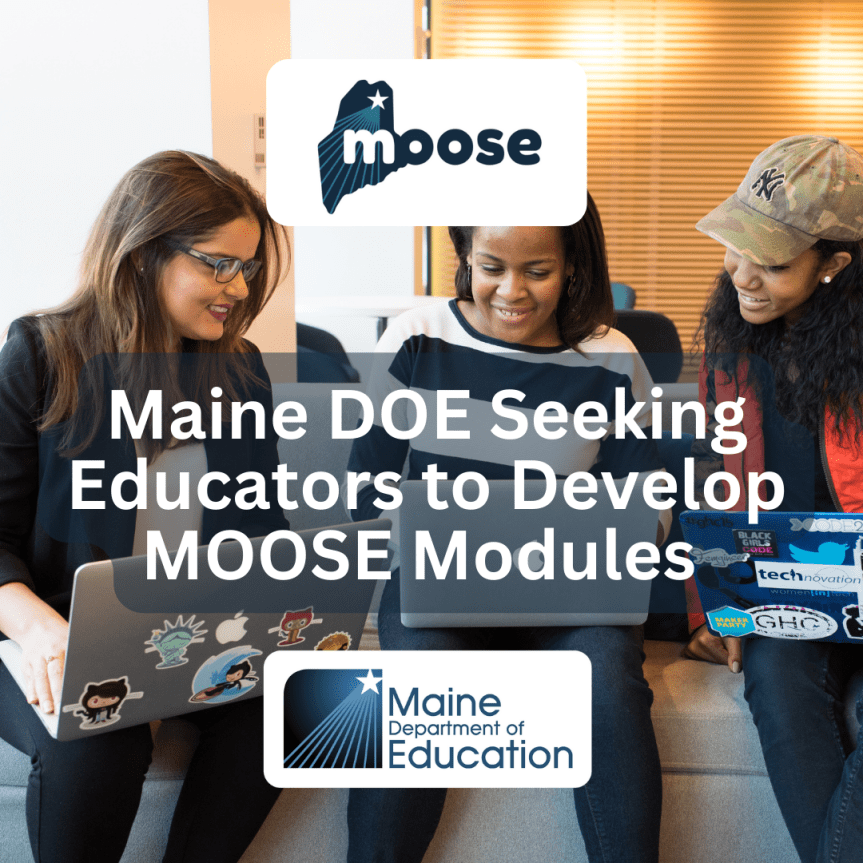
The Maine Department of Education (DOE) is currently seeking educators to develop interdisciplinary MOOSE Modules that will align with and provide real-world context for Maine Learning Results standards and existing Maine DOE resources.
Maine’s Online Open-Source Education (MOOSE) platform provides free, interdisciplinary, project-based learning materials created by Maine teachers for Maine pre-K through grade 12 students. The Maine DOE is constantly expanding MOOSE content to meet educator needs and provide resources that highlight ongoing and emerging initiatives of the Maine DOE.
The Maine DOE is seeking a variety of Maine educators (e.g., teachers, curriculum leaders, museum educators, librarians, etc.) to develop educational material for the MOOSE platform. Applicants must be available for weekly meetings and able to dedicate 3-6 hours outside of those meetings to creating materials. Interdisciplinary cohorts will be formed for educators around topics that span across the preK-12 spectrum. Within cohorts, smaller teams will create modules between September 15 and January 23 under the guidance of the MOOSE Specialists.
If you are interested in applying but still have questions, please contact Maine DOE MOOSE Project Supervisor Jennifer Page (jennifer.page@maine.gov). The MOOSE Team will hold a recorded information session on Monday, August 25, at 4 p.m. The recording will be directly mailed to all registrants and will be posted on the Maine DOE website. Registration can be found here.
Applications can be found here and are due by Monday, September 1. Applicants will be notified of their acceptance for the program by Wednesday, September 3, and will attend their first meeting on Monday, September 15. Compensation for a fully developed, approved, and published module by January 23, 2026, is $3,000, with no partial or late payments available.
For further questions and information, please contact Maine DOE MOOSE Project Supervisor Jennifer Page at jennifer.page@maine.gov.
The Maine Department of Education (DOE) is currently seeking educators to pilot MOOSE Modules and Wabanaki Studies Educator Guides with their classrooms this fall.
Maine’s Online Open-Source Education (MOOSE) platform provides free, interdisciplinary, project-based learning materials, created by Maine teachers, for Maine preK-12 students. Feedback on the modules themselves and their usability is vitally important, as we are constantly improving existing modules and applying lessons learned to new creations. In addition to the modules themselves, extensive Wabanaki Studies Educator Guides have been developed and are ready to be piloted for feedback. Educators may apply to pilot any combination of modules and/or educator guides in their classroom.
The Maine DOE is now seeking educators interested in using these materials in their classroom with five (5) or more students and providing feedback about the experience. Educators must choose their own module(s)/guide(s) to pilot and justify their decision in their application. Stipends will be provided for feedback on up to two modules and/or guides ($500 per module/guide) that have been piloted, with additional funds provided for deidentified student work and/or reflections ($50 each per module/guide). All required elements must be completed by January 23, 2026.
If you are interested in applying but still have questions, please contact MOOSE Project Manager Jennifer Page (jennifer.page@maine.gov) and/or Wabanaki Studies Specialist Brianne Lolar (brianne.lolar@maine.gov). The MOOSE Team will hold a recorded information session on Tuesday, August 26th, at 4 p.m. The recording will be directly mailed to all registrants and posted on the Maine DOE website. Registration can be found here.
If you are ready to apply, you can find applications here. Applications for the Fall 2025 session are due by Monday, September 1, 2025. Applicants will be notified of their acceptance for the program by Friday, September 5, 2025, and modules/guides may be piloted any time after Monday, September 15, 2025.
For further information or questions, please contact Maine DOE MOOSE Project Manager Jennifer Page at jennifer.page@maine.gov and/or Maine DOE Wabanaki Studies Specialist Brianne Lolar at brianne.lolar@maine.gov.







 Maine DOE Newsroom