Afterhours Zoom Sessions Available for the Celebrating Rural Maine Project

The Maine Department of Education’s (DOE) Interdisciplinary Instruction team is excited to announce three Afterhours Sessions for the Celebrating Rural Maine project, presented in partnership with the National Council for History Education (NCHE). These interactive sessions will feature guest speakers and educators exploring three topics related to this year’s theme: Geography of the Place We Now Call Maine. These sessions are open to all Maine educators.

Event details:

  • January 9, 3:30 – 4:30 p.m.: Bri Lolar, Maine DOE Wabanaki Specialist, discusses intellectual property and primary sources. Register here.
  • January 21, 3:30 – 4:30 p.m.: Learn more about rural representation in primary sources with Dr. Deb Reid of the Henry Ford Museum and Dr. Pam Riney-Kehrberg of Iowa State University. Register here.
  • February 6, 3:30 – 4:30 p.m.: Explore how primary sources can support and bridge content areas. Register here.

Who should attend: pre-K-12 educators and administrators, museum educators, and librarians

The Celebrating Rural Maine project is a free, three-part professional learning series designed to help rural educators explore Maine’s history through an interdisciplinary lens. By connecting history with broader disciplines, the program focuses on the Library of Congress’ rural interdisciplinary collections and other resources, situating Maine’s local stories within the larger human experience. Participants will receive support in designing and implementing community-connected projects that bring value to rural students and their communities.

This series includes online asynchronous, online synchronous, and site-based learning opportunities, all offered at no cost, providing a unique opportunity to deepen understanding of Maine’s past and future, while fostering meaningful connections between students and their rural communities.

The Interdisciplinary Instruction team is part of the Maine DOE’s Office of Teaching and Learning. For more information, please contact Maine DOE Interdisciplinary Instruction Specialist Jaime Beal at jaime.beal@maine.gov or NCHE Program Manager Regina Holland at regina@ncheteach.org

This opportunity is funded through the Library of Congress’ Teaching with Primary Sources program and is presented in partnership with the National Council for History Education.

Educators Invited to Register for Continuation of Maine Solutionaries Project

The Maine Department of Education’s (DOE) Interdisciplinary Instruction team works with educators throughout the state to deliver high-quality professional development that is both relevant and useful. In a continuation of the Interdisciplinary Instruction team’s partnership with the Institute for Humane Education, the Maine Solutionaries Project will extend through the winter for educators interested in supporting their students in applying their learning.

This innovative project offers Maine educators a unique opportunity to participate in a customized version of the Institute for Humane Education’s Solutionary Micro-credential Program. Educators who register for the Maine Solutionaries Project join statewide educator cohorts focused on specific topics of interest. Participation is free, and participating educators are eligible to receive a $1,000 stipend and 30 contact hours upon completion of the program.

The winter cohorts will combine traditional Solutionary programming with a fresh emphasis on cross-curricula literacy integration, featuring targeted strategies and insights from literacy specialists.

  • Cohorts A through D will focus on the traditional Solutionary framework and highlight:
    • Climate Change (Cohort A)
    • Human Rights and Equity (Cohort B)
    • Water Quality (Cohort C)
    • Food Waste (Cohort D)
  • Cohorts E and F will blend the traditional Solutionary program with literacy integration throughout all content areas and will include literacy experts Cris Tovani and Kellie Smith.
    • Cohort E: available to any educator who teaches grades 4 through 8
    • Cohort F: available to any educator who teaches grades 9 and higher

For kickoff information, including Zoom session dates and times, and to register, please visit the Maine Solutionaries Project website. There, you can also learn more about this collaboration. Spots are limited and filling quickly, so don’t delay!

The Interdisciplinary Instruction team is part of the Maine DOE Office of Teaching and Learning. For more information about this project, please contact Interdisciplinary Instruction team members Kathy Bertini at kathy.bertini@maine.gov or Erik Wade at erik.wade@maine.gov.

Integrating Literacy through Applied Science Workshop with Katie Coppens

A number of studies on literacy have concluded that students who engage with texts on specific topics, particularly social studies and science, make greater advances in reading skills and comprehension compared to those who work solely with texts focused on reading.

To support educators with literacy integration, the Maine Department of Education’s (DOE) Interdisciplinary Instruction team is hosting a workshop on Integrating Literacy through Applied Science with educator and author Katie Coppens. This event is scheduled for Wednesday, January 15, 2025, from 8 a.m. to noon at the Curtis Memorial Library in Brunswick.

Participants in this workshop will explore, discuss, and engage with:

  • The role of applied science in literacy.
  • The role of applied science in interest and in comprehension (or “meaning-making.”)
  • How applied science helps a student gain or transfer new knowledge.
  • Ways this support can be incorporated into their classrooms and future learning.

Limited in-person spots are available and will be filled on a first-come, first-served basis. Participants may also join virtually through Zoom, and the workshop will be recorded and shared with educators. Contact hours are available to participants. To register for this event, please use this registration link.

The Interdisciplinary Instruction team is part of the Maine DOE Office of Teaching and Learning. If you have any questions about this workshop, please contact Interdisciplinary Instruction team members Kathy Bertini at Kathy.Bertini@maine.gov or Heather Martin at Heather.Martin@maine.gov.

Maine DOE Seeking Educators to Pilot MOOSE Modules and Wabanaki Studies Educator Guides

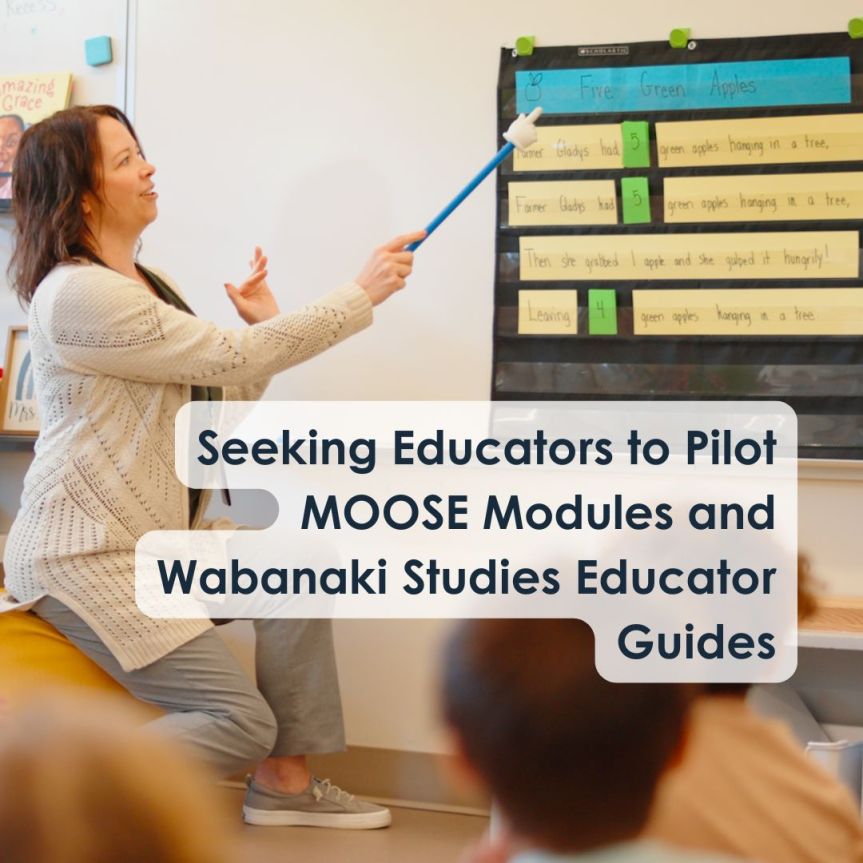
The Maine Department of Education (DOE) is currently looking for educators to pilot MOOSE Modules and Wabanaki Studies Educator Guides in their classrooms this spring.

Maine’s Online Open-Source Education (MOOSE) platform provides free, interdisciplinary, project-based learning materials created by Maine teachers for Maine pre-K through grade 12 students. Feedback on the modules themselves and their usability is essential, as the Maine DOE is constantly working to improve existing modules and apply lessons learned to new creations.

In addition to these modules, the Maine DOE has developed extensive Wabanaki Studies Educator Guides, which are also ready to be piloted for feedback. Educators may apply to pilot any combination of modules and/or educator guides in their classroom.

The Maine DOE is looking for Maine educators with classroom sizes of five (5) or more students who are interested in using these materials and providing feedback about their experience. Educators must choose the module(s)/guide(s) they would like to pilot and justify their decision in their application. Stipends will be provided for feedback on up to two modules and/or guides ($500 per module/guide) that have been piloted, with additional funds provided for de-identified student work and/or reflections ($50 each per module/guide). All required elements must be completed by June 22, 2025.

If you are interested in applying but still have questions, please contact Maine DOE MOOSE Project Manager Jennifer Page (jennifer.page@maine.gov) and/or Maine DOE Wabanaki Studies Specialist Brianne Lolar (brianne.lolar@maine.gov).

Applications can be found here. Those for the spring session are due by Sunday, January 12, 2025. Applicants will be notified of their acceptance for the program by Friday, January 17, and modules/guides may be piloted any time after Monday, January 27.

Maine Educators Discover Connections Between Literacy and Mapmaking with Author David Sobel

Educators from across the state recently met at The Steel House in Rockland — and online via Zoom — for “Integrating Literacy through Mapmaking” with David Sobel, author of Mapmaking with Children, and Jennifer Kramer, Social Studies Coach for the Windham Southeast Supervisory Union in Brattleboro, Vermont.

During this full-day workshop, participants explored the concepts of place, belonging, and geographic representation. Sobel led the group through his research, showing that across the globe and across cultures, children develop perspectives on place and sense of area at roughly-identical age-related milestones. It’s insight that has proven to be particularly illuminating, as educators work on comprehension.

“This was one of the best workshops I have ever taken!” noted Laurie Chaisson, an art teacher at Narraganset Elementary School. “I particularly appreciated David’s developmental stages of mapmaking. This was the missing piece for me!”

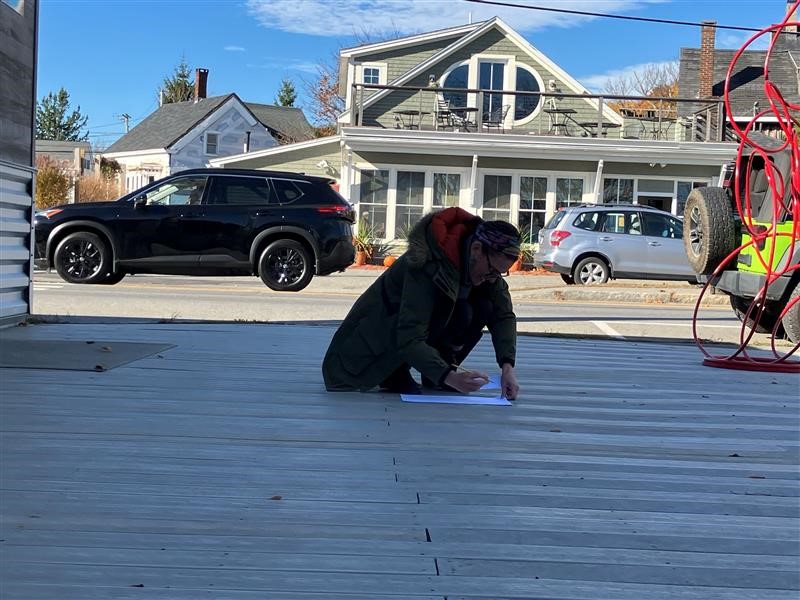
Workshop participants also reviewed projects on sound maps, smell maps, treasure maps, and other forms of depicting space. The group worked with and created rebus puzzles, as well as treasure maps, and then they were set loose upon the outside campus of The Steel House to hide their “treasures,” handing off their maps and key rebus to other teams to solve. The activity was both engaging and educational, and many commented on how it brought back the joy of learning.

“It wasn’t long before I became an enthusiastic participant! It was so much fun and really inspiring,” Susan Jones from RSU 40 said.

Kramer led the group through several projects she has completed with schools, both as a classroom teacher and as a curriculum coordinator. She brought forth deeper-thinking concepts while connecting them to practical, replicable classroom projects, including the creation of an “exploding map,” a type of map similar to a pop-up book. It unfolds three-dimensionally to show details and information on a place-in-history map.

“What kid wouldn’t want to make an ‘exploding map’? Bravo! This is what learning should be!” Chaisson said.

Central to the conversation were the concepts of play in learning, cross-curricular comprehension, and the alignment in the thinking process between mapmaking and literacy skills. Inherent in each is coding, vocabulary, navigation of materials (fluency), and making meaning. Just as with mastering the skill of reading, these elements in mapmaking are co-mingled and build upon each other.

“This was a really fun and useful session,” Mark Sparks, a social studies teacher at Winthrop Middle School said.

This workshop was the second in a series of four on the topic of Integrating Literacy hosted by the Maine Department of Education’s (DOE) Interdisciplinary Instruction team. All four workshops are offered both in-person and online.

During workshops, participants get the opportunity to ask questions, engage with material, and share their work. In addition to the “day of” experience, recordings of the workshops are made available for later viewing on the Maine DOE’s EnGiNE platform. Contact hours are available for all who participate.

Future events in this series include:

  • December 12, from 8 a.m. – noon: Integrating Literacy through Background Knowledge with Josie Cameron at the University of Maine at Orono. Use this link to register.
  • January 15, from 8 a.m. – noon: Integrating Literacy through Applied Science with Katie Coppens at Curtis Memorial Library in Brunswick. Use this link to register.

If you have any questions about this workshop series, please contact Kathy Bertini at Kathy.Bertini@maine.gov or Heather Martin at Heather.Martin@maine.gov.

RESCHEDULED: Integrating Literacy through Background Knowledge Workshop with Josie Cameron

The Interdisciplinary Instruction team at the Maine Department of Education’s (DOE) Office of Teaching and Learning is excited to present a half-day workshop with educator and author Josie Cameron.

The Integrating Literacy through Background Knowledge workshop has been rescheduled for April 7, 8:00 a.m. to noon, at the Wells Conference Center at the University of Maine at Orono.

A 2020 study published in Reading Psychology found that preexisting knowledge is “foundational to increasing competency in reading” and that teaching from a foundation of what students already know is key to advancing their learning.

In this workshop, participants will explore, discuss, and engage with:

  • The role of preexisting or background knowledge in literacy development.
  • How background knowledge supports comprehension and meaning making.
  • How background knowledge facilitates the transfer of new information.
  • Practical strategies for incorporating background knowledge into classroom instruction.

This workshop is free to all Maine educators. In-person spots are limited and will be filled on a first-come, first-served basis. Participants can also join virtually via Zoom. This session will be recorded and shared with educators following the event, and four contact hours will be available to participants. To register for this event, please use this registration link.

If you have any questions about this workshop, please contact Kathy Bertini at Kathy.Bertini@maine.gov or Heather Martin at Heather.Martin@maine.gov.

This workshop is the third of four workshops presented by the Maine DOE Interdisciplinary Team on the topic of Integrating Literacy through Applied Learning. All events are available in-person and virtually.


Massabesic Middle School Students Focus on Renewable Energy Through Interdisciplinary Class

Seventh-graders at Massabesic Middle School recently held a debate about renewable energy sources as part of an interdisciplinary class project. This is part of a new program after six teachers at the school—two at each grade level—transitioned from roles as content teachers in areas like science, math, and English Language Arts to Interdisciplinary Studies teachers. Now, they teach interdisciplinary, student-centered units based on the United Nations’ Sustainable Development Goals.

Erik Wade, Maine Department of Education (DOE) Interdisciplinary Instruction Specialist, has been serving as a resource to teachers who are trailblazing this new educational path in Maine.

“Massabesic has taken the idea of student-centered learning and run with it,” Wade said. “The school has restructured its teams, so that every student has a year-long opportunity to engage in authentic inquiry projects.”

As part of this new model, seventh-grade Interdisciplinary Studies teachers Michelle Turner and Christian (Bailey) Daigle created a teaching unit on sustainable energy sources, focused on practical ways that Massabesic Middle School itself could transition to using more of this kind of energy. Turner and Daigle divided each of their three classes into two groups per class and tasked them with choosing, researching, and building an argument about why a specific type of sustainable energy could be used to power the school.

While most groups chose solar panels or wind turbines, one group chose geothermal energy, and another chose biomass. They then presented their debates in front of an audience, including Maine DOE Director of Green Schools Glenn Cummings and co-founder of Maine-based ReVision Energy Phil Coupe. The pair listened to students’ opening arguments and provided feedback, giving them more information about the renewable energy sources they were researching and a few tidbits of information about renewable energy in general in Maine and its current use.

“Does anyone know of any schools in Maine that currently use solar panels?” Coupe asked after one of the opening arguments. That question led to a fruitful discussion, including some on-the-fly research about districts like Mt. Blue Regional School District (RSU 9), Camden Rockport Schools (Five Town CSD), and Gorham School District, which all currently use various sources of renewable energy to power their school buildings.

Cummings asked the students if they had considered how Massabesic in particular would use a renewable energy source. He asked where the school would put a wind turbine or solar panels, and whether the students had considered connecting to a local turbine farm in Maine. Again, this sparked conversation and further questions among students.

Following the debate, students had an opportunity to come back together to revisit their arguments and do some additional research to formulate rebuttals. They then presented and shared their rebuttals and closing statements with one another during class.

To close out the lesson, the teachers followed up with an end-of-unit discussion, during which students could discuss, after hearing the debates, what they think is the best option for Massabesic Middle School is and why.

“Much of their feedback revolved around the fact that they didn’t know where energy came from, how current practices can be harmful, and the abundance of alternative sources that are starting to be used both globally and locally,” Turner explained.

While these seventh graders have only just begun to scrape the surface with their research on renewable energy, they have been given an opportunity to engage in a real-world issue that will inevitably be a part of their future—a future in which their help and knowledge could bring solutions to our state and beyond.

A growing number of schools across Maine are embracing Interdisciplinary Instruction, including cross-content projects and restructuring of teacher roles, similar to Massabesic Middle School. The flexibility allows Massabesic students to drive their learning based on their interests and has enabled Interdisciplinary Studies teachers to develop projects and ideas that apply standards from multiple disciplines without a set curriculum.

“We feel incredibly fortunate that we get to engage our students in such a unique way, allowing for authentic learning experiences that align with both their interests and our own,” Turner said. “Designing and building our curriculum around relevant topics and real-life problems is truly a wonderful opportunity.”

Check out a short video about the project on Maine DOE social media sites:

To learn more about Interdisciplinary Instruction, visit the Maine DOE website. For further questions and resources, please contact Maine DOE Interdisciplinary Instruction Specialist Erik Wade at erik.wade@maine.gov.

Webinar: Civics Education and Community Connections with the League of Women Voters

How can civics educators inspire students to engage in real civic action? How can we make civic involvement feel relevant and accessible in our students’ daily lives and local communities?

Join Breanna Bellefontaine-Krupski, Maine Department of Education Civics Teacher Leader Fellow in the Office of Teaching and Learning, and Allyson Gardner, Director of Maine Students Vote and League of Women Voters member, for a dynamic conversation on November 19. Together, they will explore the work of the League of Women Voters, Maine Students Vote, and new community ally programs that connect schools with civically-active community members.

Participants can expect to leave the webinar with valuable resources, including website links, newsletters, and practical insight on how these organizations are empowering young people to become active citizens.

Don’t miss this opportunity! Join us on Tuesday, November 19, at 3:45 p.m.

Join here. (There is no need to register for the webinar in advance.)

For further information or questions, please reach out to Maine DOE Civics Teacher Leader Fellow Breanna Bellefontaine-Krupski at breanna.krupski@maine.gov.

Boosting Content Knowledge with Readers’ Theater: Creating Engaging, Leveled Texts Using AI

Join Maine Department of Education (DOE) Arts Integration Teacher Leader Fellow Joshua Chard for an insightful webinar on leveraging readers’ theater to build reading fluency and increase content knowledge in the classroom. This session is perfect for educators looking to incorporate expressive reading to improve students’ oral fluency, comprehension, and confidence.

This session will also highlight how artificial intelligence (AI) can be used to create scripts tailored to various reading levels, ensuring that all students are engaged and challenged appropriately. Teachers will gain practical tips for implementing readers’ theater and utilizing AI tools to customize materials. By the end of the session, attendees will be equipped with dynamic strategies to support diverse learners through engaging, leveled texts.

This webinar is ideal for educators who are new to using AI in the classroom. Don’t miss this opportunity to enhance your teaching toolkit!

For further information or questions, please contact Maine DOE Arts Integration Teacher Leader Fellow Joshua Chard at joshua.chard@maine.gov.


Informational Webinar About the Celebrating Rural Maine Project

Join the Maine Department of Education’s (DOE) Office of Teaching and Learning Interdisciplinary Instruction team for a 60-minute informational webinar about the Celebrating Rural Maine project. It’s scheduled for Wednesday, Nov. 13 from 3:30-4:30 p.m. via Zoom. Educators from grades pre-K-12 are welcome to attend.

The Celebrating Rural Maine project aims to engage rural teachers in a deep examination of Maine’s history with an interdisciplinary place-based approach. The goals of this three-part professional learning series are to:

  • Connect teachers with the Library of Congress’ rural interdisciplinary collections and other supporting organizations to situate local narratives in the larger human experience.
  • Support teachers in the design and implementation of works of public value that connect rural students to their community.

The theme for the first year of this project, slated to run from December of 2024 through the fall of 2025, is “The Geography of the Place We Now Call Maine”. Educators who participate will have an opportunity to connect with content experts, master teachers, and colleagues to explore Wabanaki and African American studies, outdoor learning and innovative teaching models, and climate education. Regina Holland, project manager at the National Council for History Education, will be a guest speaker.

Please click here to register for the Nov. 13 webinar. If you cannot make the live webinar, it will be recorded and posted to the Celebrating Rural Maine project webpage.

This series is hosted by the Maine DOE in partnership with the National Council for History Education. It is funded through the Library of Congress’ Teaching with Primary Sources (TPS) program.

For more details about the Celebrating Rural Maine project, please contact Maine DOE Interdisciplinary Instruction Specialist Jaime Beal at jaime.beal@maine.gov.

About the Teaching with Primary Sources Program

Since 2006, the Library of Congress has awarded Teaching with Primary Sources (TPS) grants to build a nationwide network of organizations that deliver educational programming and create teaching materials and tools based on the Library’s digitized primary sources and other online resources. Each year, members of this network, called the TPS Consortium, support tens of thousands of learners to build knowledge, engagement, and critical thinking skills with items from the Library’s collections.