RESCHEDULED: Integrating Literacy through Background Knowledge Workshop with Josie Cameron

The Interdisciplinary Instruction team at the Maine Department of Education’s (DOE) Office of Teaching and Learning is excited to present a half-day workshop with educator and author Josie Cameron.

The Integrating Literacy through Background Knowledge workshop has been rescheduled for April 7, 8:00 a.m. to noon, at the Wells Conference Center at the University of Maine at Orono.

A 2020 study published in Reading Psychology found that preexisting knowledge is “foundational to increasing competency in reading” and that teaching from a foundation of what students already know is key to advancing their learning.

In this workshop, participants will explore, discuss, and engage with:

  • The role of preexisting or background knowledge in literacy development.
  • How background knowledge supports comprehension and meaning making.
  • How background knowledge facilitates the transfer of new information.
  • Practical strategies for incorporating background knowledge into classroom instruction.

This workshop is free to all Maine educators. In-person spots are limited and will be filled on a first-come, first-served basis. Participants can also join virtually via Zoom. This session will be recorded and shared with educators following the event, and four contact hours will be available to participants. To register for this event, please use this registration link.

If you have any questions about this workshop, please contact Kathy Bertini at Kathy.Bertini@maine.gov or Heather Martin at Heather.Martin@maine.gov.

This workshop is the third of four workshops presented by the Maine DOE Interdisciplinary Team on the topic of Integrating Literacy through Applied Learning. All events are available in-person and virtually.


Massabesic Middle School Students Focus on Renewable Energy Through Interdisciplinary Class

Seventh-graders at Massabesic Middle School recently held a debate about renewable energy sources as part of an interdisciplinary class project. This is part of a new program after six teachers at the school—two at each grade level—transitioned from roles as content teachers in areas like science, math, and English Language Arts to Interdisciplinary Studies teachers. Now, they teach interdisciplinary, student-centered units based on the United Nations’ Sustainable Development Goals.

Erik Wade, Maine Department of Education (DOE) Interdisciplinary Instruction Specialist, has been serving as a resource to teachers who are trailblazing this new educational path in Maine.

“Massabesic has taken the idea of student-centered learning and run with it,” Wade said. “The school has restructured its teams, so that every student has a year-long opportunity to engage in authentic inquiry projects.”

As part of this new model, seventh-grade Interdisciplinary Studies teachers Michelle Turner and Christian (Bailey) Daigle created a teaching unit on sustainable energy sources, focused on practical ways that Massabesic Middle School itself could transition to using more of this kind of energy. Turner and Daigle divided each of their three classes into two groups per class and tasked them with choosing, researching, and building an argument about why a specific type of sustainable energy could be used to power the school.

While most groups chose solar panels or wind turbines, one group chose geothermal energy, and another chose biomass. They then presented their debates in front of an audience, including Maine DOE Director of Green Schools Glenn Cummings and co-founder of Maine-based ReVision Energy Phil Coupe. The pair listened to students’ opening arguments and provided feedback, giving them more information about the renewable energy sources they were researching and a few tidbits of information about renewable energy in general in Maine and its current use.

“Does anyone know of any schools in Maine that currently use solar panels?” Coupe asked after one of the opening arguments. That question led to a fruitful discussion, including some on-the-fly research about districts like Mt. Blue Regional School District (RSU 9), Camden Rockport Schools (Five Town CSD), and Gorham School District, which all currently use various sources of renewable energy to power their school buildings.

Cummings asked the students if they had considered how Massabesic in particular would use a renewable energy source. He asked where the school would put a wind turbine or solar panels, and whether the students had considered connecting to a local turbine farm in Maine. Again, this sparked conversation and further questions among students.

Following the debate, students had an opportunity to come back together to revisit their arguments and do some additional research to formulate rebuttals. They then presented and shared their rebuttals and closing statements with one another during class.

To close out the lesson, the teachers followed up with an end-of-unit discussion, during which students could discuss, after hearing the debates, what they think is the best option for Massabesic Middle School is and why.

“Much of their feedback revolved around the fact that they didn’t know where energy came from, how current practices can be harmful, and the abundance of alternative sources that are starting to be used both globally and locally,” Turner explained.

While these seventh graders have only just begun to scrape the surface with their research on renewable energy, they have been given an opportunity to engage in a real-world issue that will inevitably be a part of their future—a future in which their help and knowledge could bring solutions to our state and beyond.

A growing number of schools across Maine are embracing Interdisciplinary Instruction, including cross-content projects and restructuring of teacher roles, similar to Massabesic Middle School. The flexibility allows Massabesic students to drive their learning based on their interests and has enabled Interdisciplinary Studies teachers to develop projects and ideas that apply standards from multiple disciplines without a set curriculum.

“We feel incredibly fortunate that we get to engage our students in such a unique way, allowing for authentic learning experiences that align with both their interests and our own,” Turner said. “Designing and building our curriculum around relevant topics and real-life problems is truly a wonderful opportunity.”

Check out a short video about the project on Maine DOE social media sites:

To learn more about Interdisciplinary Instruction, visit the Maine DOE website. For further questions and resources, please contact Maine DOE Interdisciplinary Instruction Specialist Erik Wade at erik.wade@maine.gov.

Webinar: Civics Education and Community Connections with the League of Women Voters

How can civics educators inspire students to engage in real civic action? How can we make civic involvement feel relevant and accessible in our students’ daily lives and local communities?

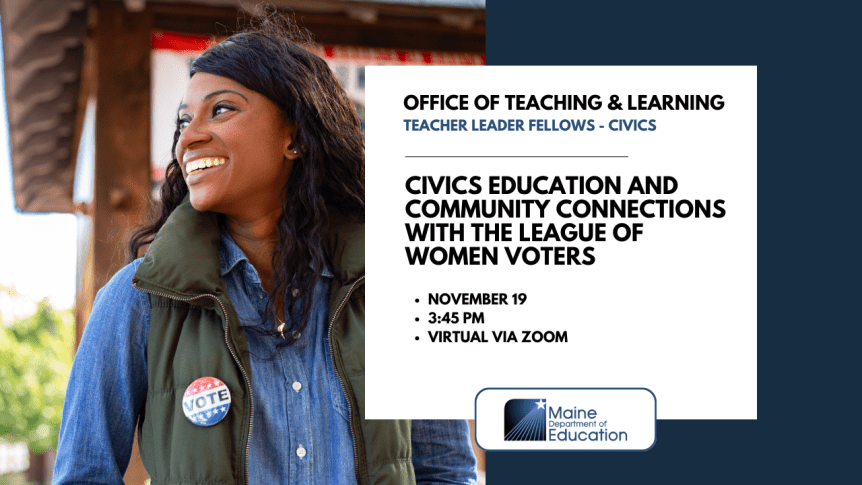
Join Breanna Bellefontaine-Krupski, Maine Department of Education Civics Teacher Leader Fellow in the Office of Teaching and Learning, and Allyson Gardner, Director of Maine Students Vote and League of Women Voters member, for a dynamic conversation on November 19. Together, they will explore the work of the League of Women Voters, Maine Students Vote, and new community ally programs that connect schools with civically-active community members.

Participants can expect to leave the webinar with valuable resources, including website links, newsletters, and practical insight on how these organizations are empowering young people to become active citizens.

Don’t miss this opportunity! Join us on Tuesday, November 19, at 3:45 p.m.

Join here. (There is no need to register for the webinar in advance.)

For further information or questions, please reach out to Maine DOE Civics Teacher Leader Fellow Breanna Bellefontaine-Krupski at breanna.krupski@maine.gov.

Boosting Content Knowledge with Readers’ Theater: Creating Engaging, Leveled Texts Using AI

Join Maine Department of Education (DOE) Arts Integration Teacher Leader Fellow Joshua Chard for an insightful webinar on leveraging readers’ theater to build reading fluency and increase content knowledge in the classroom. This session is perfect for educators looking to incorporate expressive reading to improve students’ oral fluency, comprehension, and confidence.

This session will also highlight how artificial intelligence (AI) can be used to create scripts tailored to various reading levels, ensuring that all students are engaged and challenged appropriately. Teachers will gain practical tips for implementing readers’ theater and utilizing AI tools to customize materials. By the end of the session, attendees will be equipped with dynamic strategies to support diverse learners through engaging, leveled texts.

This webinar is ideal for educators who are new to using AI in the classroom. Don’t miss this opportunity to enhance your teaching toolkit!

For further information or questions, please contact Maine DOE Arts Integration Teacher Leader Fellow Joshua Chard at joshua.chard@maine.gov.


Informational Webinar About the Celebrating Rural Maine Project

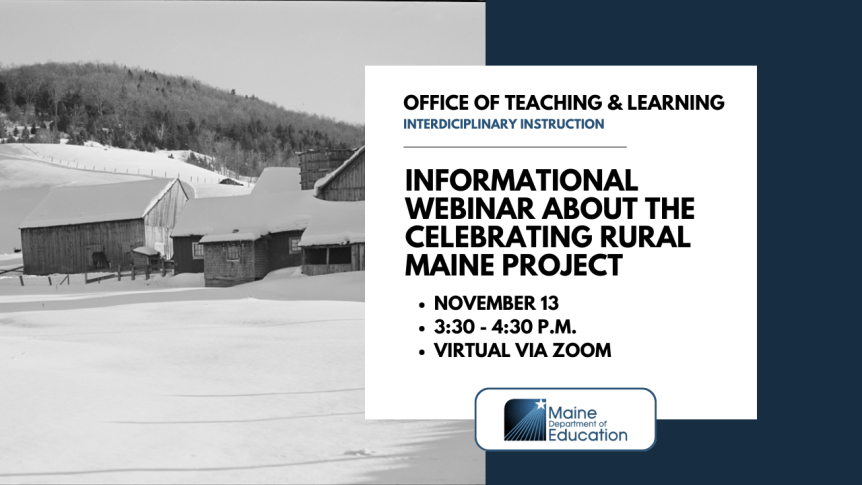
Join the Maine Department of Education’s (DOE) Office of Teaching and Learning Interdisciplinary Instruction team for a 60-minute informational webinar about the Celebrating Rural Maine project. It’s scheduled for Wednesday, Nov. 13 from 3:30-4:30 p.m. via Zoom. Educators from grades pre-K-12 are welcome to attend.

The Celebrating Rural Maine project aims to engage rural teachers in a deep examination of Maine’s history with an interdisciplinary place-based approach. The goals of this three-part professional learning series are to:

  • Connect teachers with the Library of Congress’ rural interdisciplinary collections and other supporting organizations to situate local narratives in the larger human experience.
  • Support teachers in the design and implementation of works of public value that connect rural students to their community.

The theme for the first year of this project, slated to run from December of 2024 through the fall of 2025, is “The Geography of the Place We Now Call Maine”. Educators who participate will have an opportunity to connect with content experts, master teachers, and colleagues to explore Wabanaki and African American studies, outdoor learning and innovative teaching models, and climate education. Regina Holland, project manager at the National Council for History Education, will be a guest speaker.

Please click here to register for the Nov. 13 webinar. If you cannot make the live webinar, it will be recorded and posted to the Celebrating Rural Maine project webpage.

This series is hosted by the Maine DOE in partnership with the National Council for History Education. It is funded through the Library of Congress’ Teaching with Primary Sources (TPS) program.

For more details about the Celebrating Rural Maine project, please contact Maine DOE Interdisciplinary Instruction Specialist Jaime Beal at jaime.beal@maine.gov.

About the Teaching with Primary Sources Program

Since 2006, the Library of Congress has awarded Teaching with Primary Sources (TPS) grants to build a nationwide network of organizations that deliver educational programming and create teaching materials and tools based on the Library’s digitized primary sources and other online resources. Each year, members of this network, called the TPS Consortium, support tens of thousands of learners to build knowledge, engagement, and critical thinking skills with items from the Library’s collections.

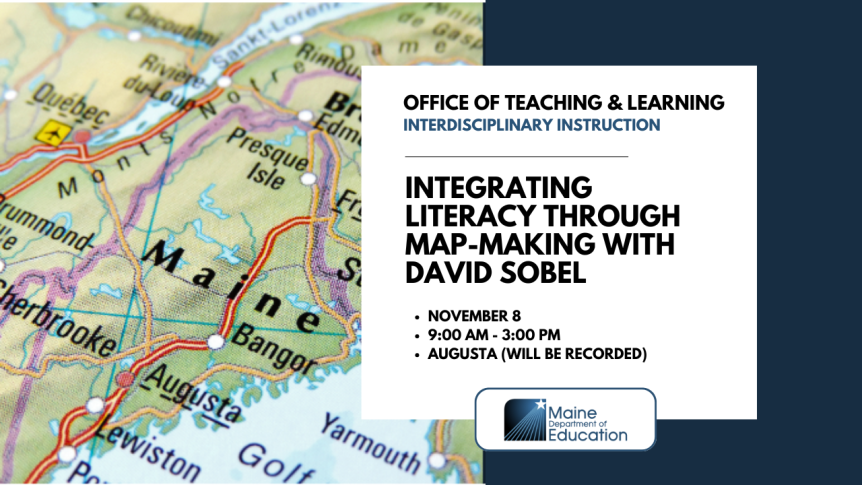
Integrating Literacy Through Map-Making with David Sobel

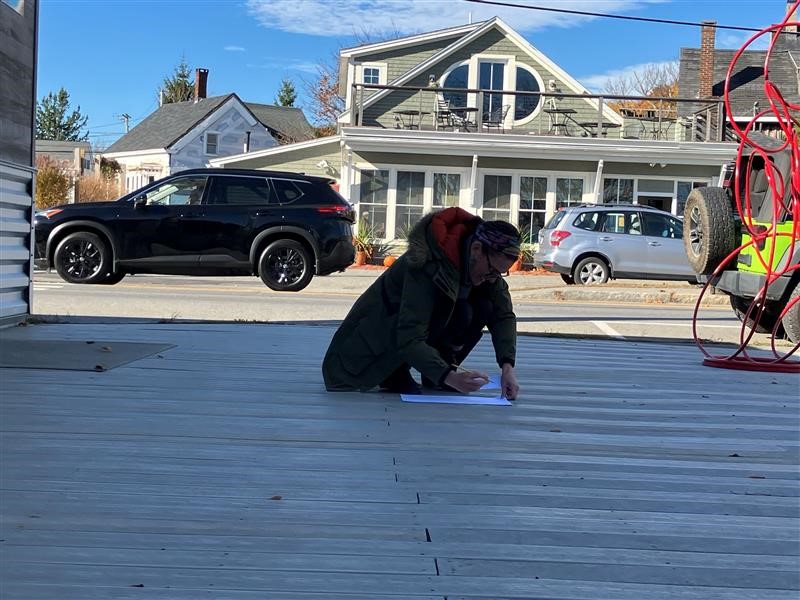
The Interdisciplinary Instruction team in the Maine Department of Education’s (DOE) Office of Teaching and Learning is excited to welcome David Sobel, educator and author of Mapmaking with Children, to Maine on Friday, Nov. 8 for an all-day workshop exploring the connections between map-making and literacy.

Map-making builds and strengthens the cognitive frameworks of reading, writing, and communicating by using symbols, structures, and perspectives analogous to grammar, punctuation, and composition. Whether mapping the relationships of their family members or the landmarks in their neighborhood, kids use maps to bring order to their world, create meaning out of their experiences, and share their knowledge with others.

This workshop will run from 9 a.m. to 3 p.m. at The Steele House in Rockland, Maine. It is free to all Maine educators. Limited in-person spots are available and will be filled, as people sign up. People can also participate virtually via Zoom, and the workshop will be recorded and shared with educators. Contact hours are available to participants.

To register for this event, please use this link.

If you have any questions about this workshop, please contact Kathy Bertini at Kathy.Bertini@maine.gov or Heather Martin at Heather.Martin@maine.gov.

This workshop is the second of four presented by the Interdisciplinary Team on the topic of Integrating Literacy through Applied Learning. All events are available in person and virtually. The remaining workshops are listed below:

December 12, 2024, 8 a.m.-noon: “Integrating Literacy through Background Knowledge” with Josie Cameron at the Wells Conference Center, 169 Hilltop Rd., Orono. Use this registration link to spend the day learning with Josie Cameron.

January 15, 2025, 8 a.m.-noon: “Integrating Literacy through Applied Science” with Katie Coppens at the Curtis Memorial Library, 23 Pleasant St., Brunswick. Use this registration link to spend the day learning with Katie Coppens.


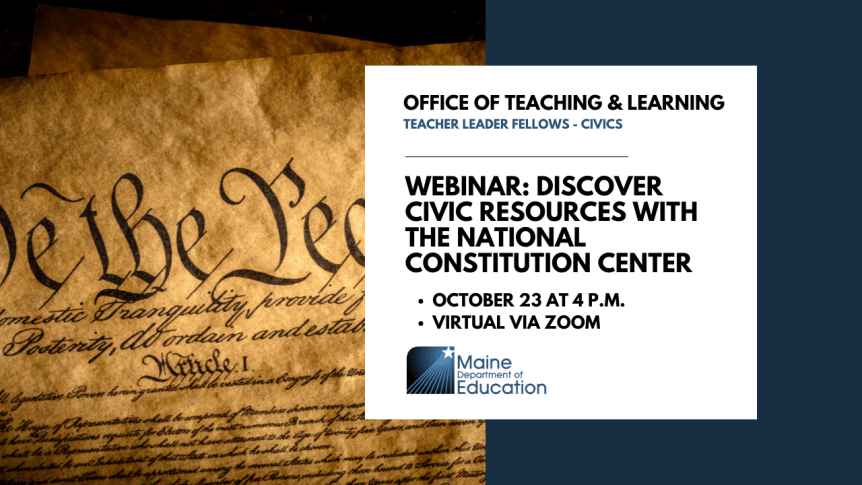
Join Maine DOE Civics Teacher Leader Fellow for a Q&A Session with the National Constitution Center!

Join Breanna Bellefontaine-Krupski, the Maine Department of Education (DOE) Civics Teacher Leader Fellow, in the Office of Teaching and Learning, as she hosts the National Constitution Center’s Education Team in a webinar exploring resources the Constitution Center has available for civics teachers.

The session is geared toward middle and high school civics teachers in Maine. The team at the National Constitution Center will highlight available resources on civil dialogue, elections, and opportunities for teachers to invite experts digitally into their classrooms via their Scholar Exchange Programs. The National Constitution Center is a non-partisan organization dedicated to helping teachers educate students about government by providing them with rich resources about our constitutional founding and the three branches.

Please join us on Wednesday, October 23 at 4 p.m.. The link to join can be found here (no need to register in advance).

For further information, reach out to Breanna Bellefontaine-Krupski at breanna.krupski@maine.gov.


Maine Department of Education Launches Math Pathways Toolkit to Support Student Success

The Maine Department of Education (DOE) is excited to announce the launch of the Math Pathways Toolkit, a comprehensive resource designed to enhance mathematical learning and decision-making for students, educators, and families across the state.

The Math Pathways Toolkit provides clear guidance on various pathways for students, allowing them to choose the right courses based on their individual needs and future goals. This toolkit is an essential component of the Maine DOE’s commitment to ensuring that every student has access to high-quality math education.

Key features of the Math Pathways Toolkit include:

  • Student Decision-Making Resources: A dedicated section that helps students and families understand the different math pathways available to them, empowering informed decisions about course selection. Learn more here.
  • Implementation Guides for Educators: Comprehensive resources for educators to effectively implement the Math Pathways in their classrooms, ensuring that all students receive personalized and relevant math instruction. Explore the implementation resources.
  • Support for Educators: Tailored materials and best practices aimed at helping educators enhance their teaching strategies and foster a supportive learning environment. Access educator resources.
  • Statewide Commitment: The toolkit reflects the Maine Department of Education’s dedication to providing a consistent and high-quality math education across the state, aligning with Maine’s educational goals and standards. Discover Maine’s commitment.

“The launch of the Math Pathways Toolkit is a significant step toward improving math education in Maine,” said Beth Lambert, Chief Teaching and Learning Officer at the Maine Department of Education. “By offering clear pathways and resources, we are empowering students and educators to work together in achieving mathematical proficiency and confidence.”

The Math Pathways Toolkit is now available on the Maine DOE’s website, providing a user-friendly platform for all stakeholders to access these resources. To explore the toolkit and start utilizing its features, visit the Math Pathways page.

If you have questions about this or other Teaching and Learning Initiatives of the Maine DOE, please contact Beth Lambert, Chief Teaching and Learning Officer, at beth.lambert@maine.gov.


Webinar: Arts Integration in Schools – Enhancing Cognitive Development and Social-Emotional Learning

Join Maine Department of Education Arts Integration Teacher Fellow Joshua Chard in the Office of Teaching and Learning for this 45-minute webinar, “Arts Integration in Schools –  Enhancing Cognitive Development and Social-Emotional Learning,” designed for all PreK-12 teachers.

The Webinar will explore how integrating the arts into core subjects supports cognitive growth and social-emotional learning (SEL). Attendees will learn about the neuroscience behind arts integration, its impact on memory, attention, and executive functioning, and how the arts foster student empathy, self-awareness, and collaboration. Case studies and practical examples from music, visual arts, and drama will demonstrate real-world applications. The webinar will conclude with best practices for implementing arts integration and strategies for addressing diverse learning needs.

Please join us Monday, October 28, from 4:15 to 5:15 p.m. The link to join the Webinar can be found here (no need to register in advance).

For further information, reach out to Joshua Chard at joshua.chard@maine.gov.

Maine DOE Awarded Funding for Interdisciplinary Civic Inquiry Projects

The Maine Department of Education (DOE) has received $99,149 from the Library of Congress’ Teaching with Primary Sources program to support the “Celebrating Rural Maine: Civic Inquiry Place-Based” project. This initiative, in partnership with the National Council for History Education (NCHE), aims to empower rural teachers to explore Maine’s history through an interdisciplinary approach.

The Celebrating Rural Maine project aims to engage rural teachers in a deep examination of Maine’s history using an interdisciplinary lens by:

  • Connecting teachers with the Library of Congress’s rural collections to place local narratives within broader historical contexts,
  • Assisting teachers in creating community-focused public projects that engage rural students and
  • Offering no-cost professional development opportunities, including online and site-based sessions.

Who can attend?

  • Eligibility: Any PreK-12 educator in Maine is welcome.
  • Content Areas: All subjects are encouraged to participate.

Program Structure

This program is modeled after NCHE’s successful Rural Experience in America project. Past projects include:

For Year 1, the theme is “The Geography of Maine.” The three-part professional development series will include:

Part A: Using Primary Sources & Questions

  • Focus on primary sources and questioning techniques.
  • Includes optional after-school virtual workshops.
  • Format: Asynchronous Virtual.
  • Contact Hours: 12.
  • Timeline: December-February

Part B: Connecting Experts & Educators

  • 3-part virtual synchronous series with experts and master teachers discussing Maine geography from various perspectives.
  • Format: Synchronous Virtual
  • Contact Hours: 15
  • Timeline: March-May

Part C: Civic Place-Based Inquiry Projects

  • A summer institute for teachers and community partners to design civic inquiry projects, with coaching for implementation in Fall 2025.
  • Stipends available for time and materials
  • Format: In-person & virtual coaching
  • Contact Hours: 17
  • Timeline: Summer & Fall 2025

Register here.

About the Teaching with Primary Sources Program

Since 2006, the Library of Congress has funded Teaching with Primary Sources (TPS) grants to enhance educational programming based on its digitized primary sources. The TPS Consortium fosters critical thinking and engagement among thousands of learners each year.

For more details about the Celebrating Rural Maine project or to register, please visit the Maine DOE website or contact Maine DOE Interdisciplinary Instruction Specialist Jaime Beal at jaime.beal@maine.gov.