The Maine Department of Education (DOE) is excited to announce the launch of the Math Pathways Toolkit, a comprehensive resource designed to enhance mathematical learning and decision-making for students, educators, and families across the state.
The Math Pathways Toolkit provides clear guidance on various pathways for students, allowing them to choose the right courses based on their individual needs and future goals. This toolkit is an essential component of the Maine DOE’s commitment to ensuring that every student has access to high-quality math education.
Key features of the Math Pathways Toolkit include:
Student Decision-Making Resources: A dedicated section that helps students and families understand the different math pathways available to them, empowering informed decisions about course selection. Learn more here.
Implementation Guides for Educators: Comprehensive resources for educators to effectively implement the Math Pathways in their classrooms, ensuring that all students receive personalized and relevant math instruction. Explore the implementation resources.
Support for Educators: Tailored materials and best practices aimed at helping educators enhance their teaching strategies and foster a supportive learning environment. Access educator resources.
Statewide Commitment: The toolkit reflects the Maine Department of Education’s dedication to providing a consistent and high-quality math education across the state, aligning with Maine’s educational goals and standards. Discover Maine’s commitment.
“The launch of the Math Pathways Toolkit is a significant step toward improving math education in Maine,” said Beth Lambert, Chief Teaching and Learning Officer at the Maine Department of Education. “By offering clear pathways and resources, we are empowering students and educators to work together in achieving mathematical proficiency and confidence.”
The Math Pathways Toolkit is now available on the Maine DOE’s website, providing a user-friendly platform for all stakeholders to access these resources. To explore the toolkit and start utilizing its features, visit the Math Pathways page.
If you have questions about this or other Teaching and Learning Initiatives of the Maine DOE, please contact Beth Lambert, Chief Teaching and Learning Officer, at beth.lambert@maine.gov.
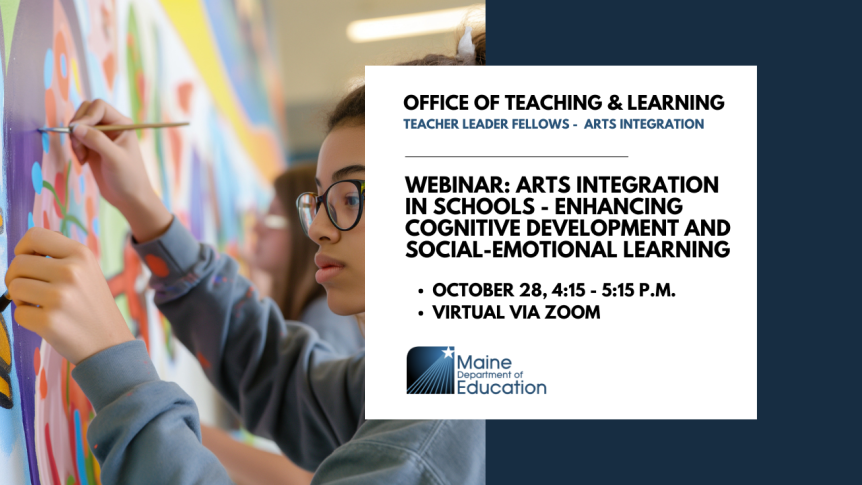
Join Maine Department of Education Arts Integration Teacher Fellow Joshua Chard in the Office of Teaching and Learning for this 45-minute webinar, “Arts Integration in Schools – Enhancing Cognitive Development and Social-Emotional Learning,” designed for all PreK-12 teachers.
The Webinar will explore how integrating the arts into core subjects supports cognitive growth and social-emotional learning (SEL). Attendees will learn about the neuroscience behind arts integration, its impact on memory, attention, and executive functioning, and how the arts foster student empathy, self-awareness, and collaboration. Case studies and practical examples from music, visual arts, and drama will demonstrate real-world applications. The webinar will conclude with best practices for implementing arts integration and strategies for addressing diverse learning needs.
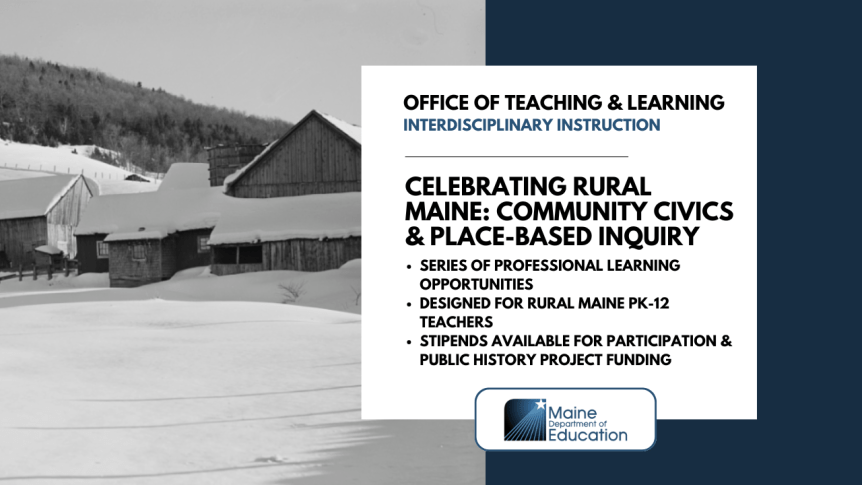
The Maine Department of Education (DOE) has received $99,149 from the Library of Congress’ Teaching with Primary Sources program to support the “Celebrating Rural Maine: Civic Inquiry Place-Based” project. This initiative, in partnership with the National Council for History Education (NCHE), aims to empower rural teachers to explore Maine’s history through an interdisciplinary approach.
The Celebrating Rural Maine project aims to engage rural teachers in a deep examination of Maine’s history using an interdisciplinary lens by:
Connecting teachers with the Library of Congress’s rural collections to place local narratives within broader historical contexts,
Assisting teachers in creating community-focused public projects that engage rural students and
Offering no-cost professional development opportunities, including online and site-based sessions.
Who can attend?
Eligibility: Any PreK-12 educator in Maine is welcome.
Content Areas: All subjects are encouraged to participate.
Since 2006, the Library of Congress has funded Teaching with Primary Sources (TPS) grants to enhance educational programming based on its digitized primary sources. The TPS Consortium fosters critical thinking and engagement among thousands of learners each year.
For more details about the Celebrating Rural Maine project or to register, please visit the Maine DOE website or contact Maine DOE Interdisciplinary Instruction Specialist Jaime Beal at jaime.beal@maine.gov.
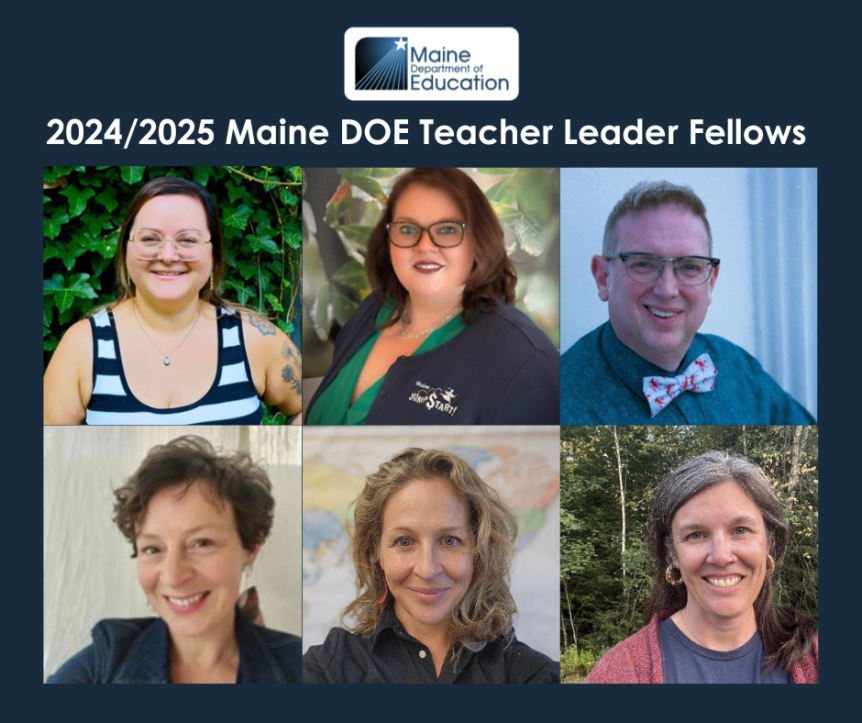
The Maine Department of Education (DOE) has welcomed its 2024/25 Teacher Leader Fellows. The new class of six extraordinary educators are from across the state and bring expertise in civics, personal finance, integrated arts, and multilingual learning, specifically with newcomers, as well as multilingual learners with disabilities.
Please help us welcome Breanna Bellefontaine-Krupski from Scarborough High School, Joshua Chard the 2024 Maine Teacher of the Year, Samantha Drost from Caribou High School, Rebecca Carey from RSU 3, Jenny Lunt from South Portland Middle School, and Melissa Frans from Portland Public Schools!
The civics, art, and/or personal finance Teacher Leader Fellows will provide educators across Maine with integrated resources and materials, host professional learning opportunities, and maintain webpages with rich and informative content. To receive weekly communications and monthly professional learning around civics, art, and/or personal finance, click here (Select a subscription to – “Integrate THIS – 2024/25 Teacher Leader Fellows Newsletter”)
Also, be on the lookout for curated resources and materials, integrated professional learning opportunities, and facilitated responsive communities of practice, all designed for educators working with elementary and secondary newcomers and multilingual learners with disabilities, PreK-12. Visit the Maine DOE Multilingual Learner website to learn more!
For more information about this or other innovative teaching and learning programs at the Maine Department of Education, contact, Beth Lambert, Chief Teaching and Learning Officer, at beth.lambert@maine.gov.
Meet the 2024/25 Teacher Leader Fellows
Breanna Bellefontaine-Krupski
Breanna Bellefontaine-Krupski
Maine DOE Civics Teacher Leader Fellow
Scarborough High School Civics teacher
“I am ecstatic to be in this new position at the Office of Teaching and Learning to share some of my favorite civic resources with fellow Maine government teachers, professional development opportunities, and potential community connections. Let’s support Maine teachers in ways to engage and integrate robust civic educational resources and opportunities into their classrooms,” said Breanna Bellefontaine-Krupski, Civics Teacher Leader Fellow.
Breanna Bellefontaine-Krupski, or Mrs.B-K as students call her, is the 24/25 Civics Teacher Leader at the Maine Department of Education’s Office of Teaching and Learning. Civic education is her passion, and she has had the privilege of doing it for the last 14 years! Breanna is a lifelong Mainer and lives in Southern Maine with her lovely family. She teaches at Scarborough High School and has worked at two rural schools in Maine. In recent years, she has served as part of a Maine Teacher Leader Cohort in 2019, earned National Board Certification in Social Studies, and worked with several civic organizations to expand her ability to deliver a positive educational experience to her students. Breanna is also a 2022-24 Constitutional Fellow with the National Constitution Center, a member of their Teacher Advisory Board, and an ambassador for Retro Report Education. Breanna is thrilled to be in this new position at the Office of Teaching and Learning to share her favorite civic resources with fellow Maine government teachers, professional development opportunities, and potential community connections. Let’s support Maine teachers in ways to engage and integrate robust civic educational resources and opportunities into their classrooms!
Questions or thoughts on Maine Civic’s resources? Email Breanna and get the conversation started! breanna.krupski@maine.gov
Joshua Chard
Joshua Chard Maine DOE Arts Integration Teacher Leader Fellow Teacher at East End Community School, Drama Director at Deering High School in Portland, 2024 Maine Teacher of the Year
“My approach to designing and implementing curriculum for young learners always starts through a culturally responsive lens. I believe in the power of joyful relationships, which are at the heart of everything I do in my classroom. Arts Integration encourages students to become more engaged and creative, making connections that stick with them,” said Joshua Chard, Maine DOE Arts Integration Teacher Leader Fellow.
Joshua Chard, the 2024 Maine Teacher of the Year, is a second—and third-grade looping teacher at East End Community School and the winter and spring drama director at Deering High School in Portland. He is excited to serve as the Teacher Leadership Fellow for Arts Integration through the Maine Department of Education. Chard is deeply inspired by the honor of lifting and celebrating his diverse learners.
Chard holds a Bachelor of Science degree in Elementary Education with a concentration in theater from the University of Southern Maine, a Master of Science degree in Education with a K-6 Literacy focus from the University of New England, and a certificate in K-6 Standards-Based Mathematics from the American College of Education. He is also certified as a K-12 teacher of English to speakers of other languages.
Chard is proud to teach at two of the most culturally diverse schools north of Boston. During his 33-year career, he has been an educational technician, has taught fourth and fifth grade, and has been a mathematics instructional coach. He has passionately dedicated his entire career to working in high-needs urban schools and is excited to have a platform to share the fantastic work there. Chard is genuinely enthusiastic about the possibilities of arts integration in our classrooms. Blending music, drama, dance and movement, and visual arts with core subjects brings learning to life in vibrant ways. According to Chard, “Arts Integration encourages students to become more engaged and creative, making connections that stick with them.”
Outside of school, Chard is an actor and director who participates in local theater. He also loves exploring Maine’s beaches and lighthouses with his husband and their grandsons.
Questions or thoughts on Maine Arts Integration resources? Email Joshua! Let’s get the conversation started! joshua.chard@maine.gov
Samantha Drost
Samantha Drost
Maine DOE Personal Finance Teacher Leader Fellow Caribou High School Consumer Economics Teacher
“ Join me this year in exploring free resources, free professional development, and fun lessons for all ages as we embark on this money adventure together! Let’s inspire the next generation of savvy savers,” says Samantha Drost, Personal Finance Teacher Leader Fellow.
Samantha Drost, is the new Personal Finance Teacher Leader Fellow for the Maine Department of Education’s Office of Teaching and Learning. She is excited to bring you a dynamic approach to financial education. As the 2019-20 Maine Jump$tart Teacher of the Year, she is passionate about making personal finance both engaging and accessible. Samantha loves creating a lively space in her classroom at Caribou High School, where students don’t just learn—they play through gamification! With the help of her favorite resource, Next Gen Personal Finance (NGPF), she has transformed traditional lessons into real-life experiences. Whether it’s budgeting, investing, or understanding credit, students get hands-on practice in a safe and fun environment, learning to make smart financial choices every day.
Samantha’s personal finance teaching journey began in 2018 at a Next Gen Personal Finance FinCamp and Jump$tart National Educator Training, where she found her “family” of personal finance teachers. She hopes to inspire you like those events inspired her by bringing hands-on, real-world practice to your classroom. al Finance resources? Email Samantha! Let’s get the conversation started! samantha.drost@maine.gov
Rebecca Carey
Rebecca Carey
Maine DOE Multilingual Learner (ML) Teacher Leader Fellow: Elementary Newcomer
ESOL Teacher/Coordinator, RSU 3
“I am enthusiastic about this opportunity to support educators throughout our state as a Maine DOE Teacher Leader Fellow in the ESOL and Multilingual Learning Office. I am honored to work with the other talented and deeply knowledgeable Teacher Leader Fellows as we collaborate to offer timely, meaningful, and supportive professional learning and resources. My passion lies in honoring student assets and meaningfully supporting the rights of students and their families. I truly look forward to this work together,” said Rebecca Cary, Multilingual Learner Teacher Leader Fellow.
Rebecca Carey has 25 years of experience working with multilingual learners in Maine. She has worked as a PreK-12 ESOL Teacher, ESOL Coordinator, Freelance ESOL Consultant, and as a Maine DOE ESOL Consultant. Currently, Rebecca serves as the Maine Virtual Teams Facilitator for the ExcEL Leadership Academy and as the ESOL Lead Teacher and ESOL Coordinator in RSU 3. She is excited to work collaboratively to support students and families and to build systems and structures that support family engagement, cultural attunement, equity, and student success. Rebecca is honored to be serving Maine educators and our multilingual students, as well as collaborating with amazing colleagues through the Teacher Leader Fellows role.
Questions or thoughts about supporting newcomers at the elementary level? Email Rebecca! Let’s get the conversation started! Rebecca.carey@maine.gov
Jenny Lunt
Jenny Lunt
Maine DOE Multilingual Learner (ML) Teacher Leader Fellow: Secondary Newcomer
ESOL Teacher, South Portland Middle School
“I’m so excited to be part of this new type of support for working with multilingual students and families. It is an honor to help respond to the shifts popping up in schools around the state. As an educator, my passion is finding new ways to be culturally and linguistically responsive and asset-focused. As a student advocate, I’ve been lucky to be part of the journeys of many students – from newly arrived students to multilingual students who are now serving on school boards in their communities. In this new TLF role, I’m excited to share my own learning that has come from years of facing challenges and collecting wisdom from colleagues, students, and families. I’m also thrilled to be able to do this work to serve folks in Maine – a place I adore and feel grateful to be,” said Jenny Lunt, Multilingual Learner Teacher Leader Fellow.
Jenny has been an ESOL teacher in the Portland area for more than 15 years and has taught 5th through 12th grades. She is currently working as a 7th and 8th grade ESOL teacher at South Portland Middle School. Jenny earned a Bachelor of Arts from Barnard College in Political Science and a Master’s Degree in Teaching from University of Southern Maine as a recipient of the Maine Education Association’s Scholarship Program for Teacher Preparation Programs. She is passionate about supporting an asset-based approach for all MLs and engagement with families.
Questions or thoughts about supporting newcomers at the secondary level? Email Jenny! Let’s get the conversation started! Jennifer.Lunt@maine.gov
Melissa Frans
Melissa Frans
Maine DOE Multilingual Learner (ML) Teacher Leader Fellow: Multilingual Learners with Disabilities
Special Education Multilingual Coordinator, Portland Public Schools
“I am excited to support educational professionals across Maine who are working with multilingual learners with disabilities. Navigating the intersection of multilingualism, multiculturalism, and disability can be complex and benefits from a team of people learning and working together. I look forward to collaborating and expanding our professional capacity through understanding the legal rights of our students and how to holistically support their instructional needs with a focus on a strengths-based approach,” said Melissa Frans, Multilingual Learner Teacher Leader Fellow.
Melissa Frans works in the Portland Public Schools as the Special Education Multilingual Coordinator. Her role focuses on implementing systems and structures to support dual-identified multilingual students with disabilities through guidance and collaboration with educators and families. She has her Certificate of Advanced Study in TESOL, Masters in Special Education and is certified to teach in those subject areas as well as general elementary education. She has worked in public education for two decades as an ESOL teacher and special education ed tech and has worked in Portland for eighteen of those years. She serves on the MEA Committee of Human and Civil Rights and Social Justice and is passionate about disability justice and equitable learning opportunities for multilingual and multicultural students. In her free time, she enjoys traveling and spending time outdoors with her family, working in her garden, and walking in the woods with her dog.
Questions or thoughts about supporting multilingual learners with disabilities? Email Melissa! Let’s get the conversation started! Melissa.Frans@maine.gov
Literacy has been at the forefront of discussions in education across our state. We are a state filled with creative, engaging, and highly skilled educators – many of whom are actively harnessing new knowledge from evidence-based research to reshape the way their classrooms work and how students interact with their learning.
The Maine Department of Education’s (DOE) Office of Teaching and Learning’s Interdisciplinary Team is excited to continue to support educators with resources to support the integration of literacy across the curriculum.
Join the excitement and be a part of the conversation with your fellow educators about incorporating effective, evidence-based literacy supports in their classrooms.
To learn more about what other literacy connections the Interdisciplinary Instruction team has to offer, please contact Heather Martin at heather.martin@maine.gov.
The Interdisciplinary Instruction team from the Maine Department of Education’s Office of Teaching and Learning is excited to bring educator and author Cris Tovani to Maine on October 7th for an all-day workshop that explores ways to engage, excite, and “hook” reluctant learners in building their literacy skills and mastery.
Through the lens of student dispositions, Tovani has discovered ways around the various “masks” some students wear and created opportunities for those students to engage with their own learning in vibrant and authentic ways.
At the conclusion of this workshop, participants will be able to:
describe what full engagement looks like and discuss the importance of engagement in literacy competence,
provide reasons for students to read, write, and discuss,
model for students how to monitor and repair meaning when reading complex text, and
state how these discrete tasks, methods, and skills build literacy proficiency.
The workshop will run from 9:00 AM to 4:00 PM at Camp Chamberlain in Augusta, Maine, and is free to all Maine educators. Limited in-person spots are available and will be filled as people sign up. Participants can also participate virtually through Zoom, and the workshop will be recorded and shared with educators. Contact hours are available to participants.
This workshop is one of four (4) presented by the Interdisciplinary Team on the topic of Integrating Literacy through Applied Learning. All events are available in person and virtually.
November 8, 2024, 9 AM – 3 PM: “Integrating Literacy through Mapmaking” with David Sobel at The Steele House, 639 Main St., Rockland. Use this registration link to spend the day learning with David Sobel.
December 12, 2024, 8:00 AM—12:00 PM: “Integrating Literacy through Background Knowledge” with Josie Cameron. Wells Conference Center, 169 Hilltop Road, Orono Use this registration link to spend the day learning with Josie Cameron
January 15, 2025, 8 am – 12 noon: “Integrating Literacy through Applied Science with Katie Coppens at the Curtis Memorial Library, 23 Pleasant St., Brunswick. Use this registration link to spend the day learning with Katie Coppens
The Maine Department of Education (DOE) Interdisciplinary Instruction Team in the Office of Teaching and Learning is pleased to announce a series of four (4) upcoming workshops on Integrating Literacy through Applied Learning. Registration is free of charge to all Maine educators. Contact hours are available, and all workshops are offered both in person (space is limited) and virtually. Participants will receive additional guidance through monthly Professional Learning Communities (PLCs) hosted by the Maine Department of Education to support the application of new learning in the classroom. All workshops and follow-up sessions will be recorded and posted for future viewing. Interested participants may register using the links in the descriptions.
These workshops provide teachers with both a theoretical understanding of emerging research on Whole Child and literacy instruction and practical strategies to apply in their classrooms. By recognizing literacy as a cross-disciplinary skill, the sessions help educators integrate foundational literacy elements (phonics, phonemic awareness, fluency, vocabulary, and comprehension) into their teaching. This holistic approach aims to enhance students’ literacy skills and boost their confidence in learning across all subjects.
October 7, 2024: “Integrating Literacy through the Dispositions” with Cris Tovani
Monday, 9 am – 4 pm, Camp Chamberlain, 23 Blue Star Ave., Augusta
Use this registration link to spend the day learning with Cris Tovani.
“Even the best reading strategy in the world won’t work if the students are disengaged.” Join educator and author Cris Tovani (Why Do I Have to Read This?) for an all-day workshop to explore ways to engage and excite reluctant readers and learners. Participants in this workshop will gain both insight and practical tools to describe what full engagement looks like, plan so that students are engaged in the work, provide reasons for students to read, write, and discuss, and model how to monitor and repair meaning when reading complex text to promote literacy.
November 8, 2024: “Integrating Literacy through Mapmaking” with David Sobel
Friday, 9 am – 3 pm, The Steele House, 639 Main St., Rockland
Use this registration link to spend the day learning with David Sobel.
“In the beginning, children’s maps represent their experiences of beauty, secrecy, adventure, and comfort. With these effective endeavors as a foundation, I then gradually start to focus on scale, location, direction, and geographic relationships.” Analogous to the foundational skills of reading and writing, mapmaking is a deeply human way for a child to order and make meaning from their world and strengthen literacy. Join acclaimed educator and author David Sobel (Mapmaking with Children) for this hands-on workshop exploring maps and cognitive processes.
December 12, 2024: “Integrating Literacy through Background Knowledge” with Josie Cameron
Thursday, 8 am – 12 noon, Wells Conference Center, 169 Hilltop Road, Orono, ME 04469
Use this registration link to spend the day learning with Josie Cameron.
“Students often tell me they have NO IDEA what to write about! When we dig into place-based writing, they’re surprised to find story ideas hidden right in front of their eyes!” Background knowledge, the information and wisdom acquired through our own lived experiences, has in the past been overlooked. However, as research reveals more about the ways in which students learn, it is gaining recognition as a fundamental element in students’ comprehension and ability to make meaning from text – foundational skills to literacy. Join Josie Cameron, Maine author and educator (Not All Heroes, Maybe a Mermaid) as we explore the importance of background knowledge, and how to harness it for learning!
January 15, 2025: “Integrating Literacy through Applied Science with Katie Coppens
Wednesday, 8 am – 12 noon, Curtis Memorial Library, 23 Pleasant St., Brunswick
Use this registration link to spend the day learning with Katie Coppens.
“Integrating science and literacy engages students while enhancing their scientific knowledge and improving their writing skills! Not only that, but it’s fun and a great way to see students’ interests through built in voice and choice!” Learn strategies on integrating science and literacy from Maine teacher and author Katie Coppens (The Acadia Files, What do Black Holes Eat for Dinner?, Geometry is Easy as Pie). Focus will be on strategies to integrate fiction and nonfiction reading and writing in science, thereby gaining proficiency in literacy, with an emphasis on differentiation. Models and rubrics will be provided. Everyone will leave with ideas for implementation in their own classroom.
Do you want to explore and implement innovative instructional materials this fall? Are you interested in expanding your impact outside your classroom/school? Would you like support in incorporating Wabanaki Studies into your curriculum? The Maine Department of Education (DOE) is currently seeking educators to pilot MOOSE Modules and Educator Resources and would love to have your class participate!
Maine’s Online Open-Source Education (MOOSE) platform provides free, interdisciplinary, project-based learning materials created by Maine teachers for Maine PreK-12 students. Feedback on the modules themselves and their usability is vitally important as we constantly improve existing modules and apply the feedback to new creations. In addition to the modules themselves, extensive Wabanaki Studies Educator Resources have been developed and are ready to be piloted for feedback. Educators may apply to pilot any combination of modules and/or educator guides in their classroom.
We are looking for Maine educators interested in using these materials in their classroom with five (5) or more students and providing feedback about the experience. You get to decide the module(s)/guide(s) you want to pilot based on what works best for you and your students. You can choose from over 350 modules, including modules in dedicated learning progressions, such as Wabanaki Studies, and 18 Wabanaki Studies educator guides. Stipends will be provided for up to two modules and/or guides ($500 each) that you have piloted and provided feedback on. All required elements must be completed by January 19, 2025.
If you are interested in applying but still have questions, representatives from Maine DOE will be holding a Q&A session via Zoom on Wednesday, September 18th from 3:30 – 4:30 pm. Registration for the Q&A session can be found here. The session will be recorded and sent to anyone who registers, even if they aren’t able to make it in person. Questions can be submitted ahead of time to be answered in the session. For more information or to submit questions, please contact MOOSE Project Manager Jennifer Page (jennifer.page@maine.gov) and/or Wabanaki Studies Specialist, Brianne Lolar (brianne.lolar@maine.gov).
If you are ready to apply applications can be found here. Applications for the fall session are due by Sunday, September 22nd, 2024.
The Maine Department of Education (DOE) Interdisciplinary Instruction Team is partnering with the Institute for Human Education to continue the Maine Solutionaries Project through the fall to educators interested in supporting students in applying their learning. This exciting project will provide an opportunity for educators in Maine to take a custom version of the Solutionary Micro-credential Program and participate in state-wide educator cohorts that focus on individual topics of interest. Not only will educators be able to participate at no cost, but they will also be eligible to earn a $1400.00 stipend upon completion of the program.
To participate in the first cohort, educators must attend a one-day in-person workshop at the Brunswick Hotel on Thursday, September 19th, followed by four one-hour group Zoom meetings plus a 1:1 Zoom meeting with the cohort facilitator or coach between Zoom meetings 3 and 4. In between the Zoom meetings, participating teachers will complete and submit work on the Learning Board. We understand that travel can be a concern, so we want to assure you that all travel expenses (mileage, lodging the night before if 2+ hours away, breakfast/lunch) are covered — those who complete the micro-credential by November 18th are eligible to earn a $1400.00 stipend.
To participate in the second cohort, educators must attend four in-person workshops in Brunswick Hotel on Thursday & Friday, October 24 & 25, and Thursday & Friday, Nov 7 & 8. There will be no Zoom meetings; all work will be done in person. Travel expenses are covered (mileage, lodging if 1+ hours away for 4 nights, and breakfast/lunch for both sessions). Participants must attend all four days — those who complete the micro-credential by November 18th get a $1400.00 stipend.
We understand how challenging it can be for educators to take time away from their classrooms to attend a four-day institute. However, this unique opportunity will equip you with a comprehensive plan to implement Maine Solutionaries within your classroom, enhancing both your teaching practices and your students’ learning experiences.
Spots are filling quickly, so visit the Maine Solutionaries Project website to learn more about this collaboration, view an informational webinar, or register for the project.
The Maine Department of Education (DOE) Interdisciplinary Instruction Team is hosting two asynchronous professional learning courses called Question, Reflect, Repeat:Introduction to the Question Formulation Technique.
The Question Formulation Technique is a powerful strategy to help students and adults ask their own questions, advocate for themselves, and participate in decision-making processes.
There will be two asynchronous sessions running from:







 Maine DOE Newsroom