Maine DOE ConCEPT Pilot Spotlight: A Transformative Professional Learning Journey

This year has been transformative for Leslie Denton, the seventh-grade English Language Arts (ELA) teacher at Mt. View Middle School in Thorndike. Leslie’s professional learning journey, marked by a commitment to the principles of Universal Design for Learning (UDL), was significantly influenced by her attendance at a ConCEPT Professional Development conference hosted by the Maine Department of Education. The conference, featuring renowned educator Katie Novak, equipped Leslie with valuable skills and strategies that she diligently implemented.

“My professional learning journey this year has centered on embracing and implementing UDL principles to create a more inclusive, engaging, and effective learning environment for my seventh-grade ELA students,” she shared.

The journey has brought several significant takeaways, notably the communication of clear learning targets. By breaking down these targets into student-friendly terms and clearly defining expectations, students gain a concrete understanding of each lesson’s objectives. This clarity fosters student focus and motivation, allowing for improved self-assessment and reflection. Additionally, incorporating goal setting into teaching practices has encouraged students to take ownership of their learning.

“I have begun to integrate regular self-assessment and peer feedback sessions, fostering a growth mindset and a culture of continuous improvement,” Leslie noted.

By diversifying assessments and allowing students to choose their preferred method of demonstrating understanding, Leslie has successfully catered to the diverse needs of their students, creating a more inclusive learning environment.

Managing the time commitment involved careful scheduling and maintaining motivation through clear, achievable goals. Leslie set aside regular, manageable blocks of time dedicated to professional development, ensuring consistency without becoming overwhelmed. By maintaining a well-organized schedule, she was able to balance lesson planning, grading, and other responsibilities efficiently. This approach allowed for professional growth without sacrificing the quality of day-to-day teaching. Additionally, setting clear goals for both professional development and classroom instruction provided a sense of purpose and direction. Celebrating small victories and reflecting on progress helped sustain momentum and reinforced the value of ongoing learning and growth.

This journey underscores the importance of continuous professional development in staying current with best practices and evolving student needs. “It is imperative as teachers that we continue to learn and grow in this profession. By embracing continuous learning, we not only enhance our own teaching effectiveness but also ensure that we are providing the best possible education for our students.”

ConCEPT is a professional learning opportunity designed by the Interdisciplinary Instruction team.  To learn more about the professional learning opportunities available to Maine educators, visit the Interdisciplinary Instruction page.


Asynchronous Course: Introduction to the Question Formulation Technique

The Maine Department of Education (DOE)  Interdisciplinary Instruction Team is hosting two summer courses called Question, Reflect, Repeat:Introduction to the Question Formulation Technique. 

The Question Formulation Technique is a powerful strategy to help students and adults ask their own questions, advocate for themselves, and participate in decision-making processes. 

There will be two asynchronous summer sessions running from:

  • July 1 – August 9
  • August 1 – September 6

To learn more and register for this course, visit the Interdisciplinary Instruction Professional Learning page.

For questions, please contact Jaime Beal, Interdisciplinary Instruction Specialist at jaime.beal@maine.gov

This opportunity is a collaboration between the Maine Online Open-Source Education (MOOSE) project and the Interdisciplinary Instruction Team. The MOOSE project is funded entirely (100%) through Federal money under the Coronavirus Response and Relief Supplemental Appropriations Act (CRRSA) and American Rescue Plan (ARP) totaling $4,598,000 for the current 2023-2024 funding cycle.

Using Genealogy to Teach Inclusive History Workshops

The Maine Department of Education (DOE) has opened registration for the second year of the American Ancestors genealogical inquiry workshop for grade 4-8 teachers and administrators.  This program trains teachers to use inquiry-based lessons incorporating authentic methodologies professional genealogists use.  Lessons guide students through conducting family history research, thinking like a historian, honing their research skills using primary sources, and exploring case studies of important local and national people.  Go beyond family trees and help students make real-world personal connections to history.  In addition to the genealogy inquiry curriculum, there will be a focus on providing resources to support African American studies.

Two one-day workshops are available with an optional virtual professional learning community throughout the 2024-2025 school year.

  • Option 1: August 5th – in-person or virtual (no cost)
  • Option 2: August 6th – in-person at the Educators Summit (Educators Summit registration required)

To learn more and register, click this link. https://www.maine.gov/doe/learning/II/genealogy

For more information about this program, please get in touch with Jaime Beal, Maine DOE Interdisciplinary Instruction Specialist, at jaime.beal@maine.gov

#TeachWithTech Grant Makes 3D Printing Accessible and Ecological at MDIRSS/AOS #91

The Mount Desert Island Regional School System’s (MDIRSS/AOS #91) Filabot Full Recycling initiative is creating new opportunities and ways of engaging in innovative educational practices in environmentally and economically conscious ways that foster interdisciplinary collaboration, improve engagement, increase student motivation, promote the growth in critical thinking skills, and stimulate thinking about ecologically sustainable practices in a high-tech world.

Funded by a $35,322 #TeachwithTech grant from the Maine Department of Education (DOE), the initiative is part of a project led by MDIRSS/AOS #91 IT Lead Luis Jones-Rodriguez, working with MDIRSS K-8 Educational Technology Lead Cindy Lambert and Pemetic Elementary School IT Integrator Mike Brzezowski, to reignite the district’s use of 3D printers for curricular purposes in ways that are more economical, ecological, and innovative. The district is one of 33 schools or school districts that received this grant.

What could be more fun and engaging than learning some of the principles of the scientific method and physics by making and launching your own rocket? While many students have done some iteration of the bottle rocket task using a plastic soda bottle and some type of launcher, students at the Pemetic Elementary School can design and create their own rockets using the school’s 3D printers, marrying curriculum, practical application, and innovation.

“The 3D printed rockets are part of science class.  This year they will do data collection on a standard ‘control’ rocket and be introduced to a few physics’ principles.  Next year they learn more about the principles governing rockets and will create a modified design to compete in either an accuracy or a distance challenge,” said Brzezowski.

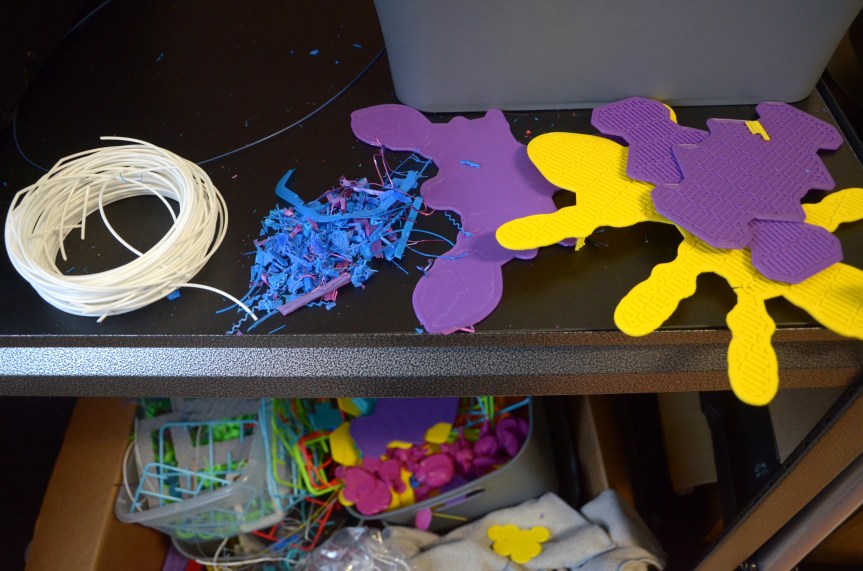
Projects like these can be exciting and interesting for teachers and students alike, but they also can be costly and wasteful. According to 3D4Create, a spool of filament will print 20-30 five- to six-inch tall models with 15-20% infill (“infill” refers to the internal structure of a printed item that gives it weight and strength). Each one kg spool can cost between $19-$32, which makes errors, a natural part of learning, and the inevitable production of waste byproducts costly. Jones-Rodriguez’s grant-funded project will allow the school district to make filament from discarded 3D printed projects otherwise destined for landfill, printing waste, and recyclable plastics that can be used in every school. The Teach with Tech grant has enabled Jones-Rodriguez to purchase the equipment needed to establish a complete recycling system that, besides producing savings in the schools’ budgets, will “also allow the kids to make mistakes” without having to worry about the cost of those errors and promote sustainable practices island-wide. The new equipment can produce recycled filament in any color and in 1.75mm and 2.85mm thicknesses.

The goal, said Jones-Rodriguez, “is that no school will buy filament whatsoever and to have a place where plastics can be recycled instead of put into a landfill.” The recycling and production process will serve all of the MDIRSS/AOS #91. Schools have recycling containers to collect commercial food-grade plastics like soda bottles and milk jugs, and Jones-Rodriguez aspires to collect materials community-wide one day. Once it is fully operational, he estimates that the district could save an estimated $1,250 a month or $15,000 a year on filament costs.

Sustainability concerns and frustration with limiting resources also were driving factors behind this project. There had been pushback and 3D printing had started to fall out of favor because “anything that is printed was not recyclable,” said Jones-Rodriguez. In 2015, there was at least one 3D printer in one of the ten schools in MDIRSS/AOS #91. By 2022-2023, the eight schools on Mount Desert Island had “maybe two each,” according to Jones-Rodriguez. Not only were four schools left out of luck, but the ones in place were old and took a long time to print. Their use had fallen because “the old ones would take a week or more” to print items for just one class because they “were prone to failure and very slow.” In the pre-COVID era, some of the district’s schools were using some printers, including MDI High School, whose Maker Space students produced “ear savers” for face masks during the COVID period. Today the district’s schools have been outfitted with new printers that can print up to a “full class’s worth” of projects in one day, he said.

While the complete recycling process is time-consuming, it will be worthwhile.  The home-grown filament project opens the door to a greater variety of items the students can create through the types of recycled plastics that are collected. “Different plastics have different uses,” he said. While filament made from food-safe plastics can be more durable, for instance, they have a low heat resistance, which can make them unsuitable for outdoor use. “Nylon from fishermen is what I’m really excited about because that’s the most durable.”  The plastic nylon used in nets and lines has higher heat resistance and is UV-resistant, making it ideal for filament that can be used for products like lampshades and outdoor furniture. “Everyone is excited that it’s making 3D printing eco-friendly,” Jones-Rodriguez said.

Ultimately the goal is to incorporate 3D printing projects across the curriculum and in different subject areas, Jones-Rodriguez said. At Pemetic Elementary School, that has already started under Brzezowski’s guidance. While the Pemetic science class is working with rockets, one of the school’s French classes is printing chocolate molds that will be used to create chocolate bars with custom wrappers. The wrappers will “have reference to French culture, history, and symbology” and once the students make and wrap the bars using the molds, they will hold a “French Chocolate Market” at Birch Bay Retirement Village, where students will be able to talk to the residents about their chocolates and French culture, and residents will be able to “purchase” the chocolates with tokens they have been given, said Brzezowski. From a French classroom to a Maker Space and then into the community, all wrapped up in a chocolate bar, what student could argue with that?

The Maine Department of Education’s TeachWithTech grant is part of the Maine Learning Technology Initiative (MLTI). The grant is awarded to MLTI schools through a formal grant process and provides supplemental technology and related professional learning to support innovative teaching and learning with technology. Learn more about the TeachWithTech Grant here.

This story was submitted by Mount Desert Island Regional School System (MDIRSS/AOS #91). To submit good news about your school to the Maine Department of Education, complete our Good News Submission form.

Virtual Reality Enhances Cultural Learning in Cony High School’s German Class

Deb Backman’s German 3 class at Cony High School in Augusta is leading the way in educational technology by integrating virtual reality (VR) into their curriculum, thanks to the Maine Department of Education’s (DOE) TeachWithTech grant.

To immerse students in German culture and language, Mrs. Backman conducted a virtual field trip using VR headsets to explore the columns of STOA 169 in Polling, Germany. This innovative approach exposed students to Germany’s rich artistic scene and provided a unique opportunity for linguistic practice and cultural exploration.

The student response to the VR experience was overwhelmingly positive. They observed the intricate designs of the columns and engaged in thoughtful discussions about their significance while honing their German language skills.

Following the virtual excursion, students participated in a hands-on activity during which they created their own interpretations of columns using paper towel rolls. This practical exercise reinforced their understanding of the architectural elements discussed during the VR journey and encouraged creative expression.

Mrs. Backman observed a notable increase in student engagement and comprehension following the VR field trip and subsequent activity. Students demonstrated a deeper appreciation for art and culture and an enhanced ability to articulate their observations and interpretations in German.

Integrating VR technology into the classroom exemplifies Cony High School’s commitment to providing innovative and immersive learning experiences that empower students to broaden their horizons, develop cultural competency, and strengthen their language proficiency in an engaging and impactful manner.

The Maine Department of Education’s TeachWithTech grant is part of the Maine Learning Technology Initiative (MLTI). The grant is awarded to MLTI schools through a formal grant process and provides supplemental technology and related professional learning to support innovative teaching and learning with technology. Learn more about the TeachWithTech Grant here.

This story was submitted by Cony High School, Augusta School Department. To submit good news about your school to the Maine Department of Education, complete our Good News Submission form.
Webinar: Fabulous Field Trips in Maine

Some of the most memorable experiences students have occur outside the classroom on field trips. This webinar hosted by Civics Teacher Leader Fellow Jessica Graham and Humanities Teacher Leader Fellows Dorie Tripp and Jim St. Pierre, will cover an array of beneficial field trips around Maine. This webinar will cover not only the field trips, but how to organize them and how to find grants that will pay for them. We hope you will attend and offer your own ideas for meaningful field trips.

For further information, reach our to Maine DOE Humanities Teacher Fellows – James St. Pierre James.St.Pierre.@maine.gov, Dorie Tripp Dorie.Tripp@maine.gov, or Jessica Graham Jessica.Graham@maine.gov.


Register Now for Maine Solutionaries Project, a No-cost, Micro-credential Program with Stipend

The Maine Department of Education (DOE) Interdisciplinary Instruction Team is partnering with the Institute for Human Education to bring the Maine Solutionaries Project to educators interested in supporting students in applying their learning.

This exciting project will provide an opportunity for educators in Maine to take a custom version of the Solutionary Micro-credential Program and participate in state-wide educator cohorts that focus on climate change, water quality, plastics pollution, human rights and equity, or another topic of interest. Not only will educators be able to participate at no cost, but they will also be eligible to receive a $1000.00 stipend upon completion of the program.

Spots are filling quickly, so to learn more about this collaboration, view an informational webinar, or register for the project, visit the Maine Solutionaries Project website.

Sphero Robots Support Playful Learning in RSU 40

RSU 40 staff are finding ways to use robotic technology, funded by the Maine Department of Education’s (DOE)  Maine Teaches CS Initiative, to support interdisciplinary learning across grade levels. The school’s acquisition of Sphero Bolts and Indi cars is making learning experiences playful and engaging for both students and educators.

Holly Doe, Director of Technology for RSU 40, applied for the grant last school year to foster experiential learning through technology for even the youngest students. Sphero Indi cars introduce coding at the simplest level using color tiles to tell the robot what to do. While this is an ideal tool for younger students, it is also great for older students when the goal is not coding itself but supporting other learning outcomes.

By leveraging robotic technology, students in RSU 40 are exploring new ways to retell—or tell—stories.

Students in grades 1-3 used Sphero Indi cars to retell stories they had read in class while seniors in Spanish IV wrote their own stories in the foreign language and crafted narrated films using the Indi cars.

In the elementary classrooms, the robots foster natural collaboration as pairs of students work together to plan a path of color tiles that represent their story summary. Crafting a simple costume for the Indi car and scenery or other characters to be placed along the car’s path engages students’ creativity and requires students to consider symbolic representations. The simple, flexible lesson quickly adapts to accommodate students’ and teachers’ needs.

At the high school, the ease of using the Indi cars allows students to combine story mapping with other technology. Students film the cars in front of a green screen and use Canva’s AI image generator to create backgrounds for their movies which they then narrate in Spanish.

Recently, Heather Webster, RSU 40’s technology instructional coach, shared her experiences using Sphero Indi robots in elementary ELA classrooms and high school Spanish classrooms at the Maine Council for English Language Arts spring conference. Participants were introduced to Indi cars, watched video clips of RSU 40 students engaging in the lessons, and then had the opportunity to try the activity themselves, working collaboratively with their tablemates to retell a familiar story. They left the conference session with a concrete example of how technology like the Sphero robots can support cross-curricular lessons and boost the playful spirit in a classroom.

(Maine Council for English Language Arts spring conference photos curtesy of Katie Kelley Photography)

The Computer Science Mobile Labs Grant has enabled RSU 40 to uniquely support playful learning. Robotic technology has enhanced students’ collaborative skills and their understanding of symbolic representation. Encouraging a playful approach to learning, this technology has increased student engagement and has inspired educators to rethink traditional teaching methods. The immersive learning experiences enabled by Sphero Indi and Bolt robots are set to shape the educational landscape at RSU 40 for years to come. Maine leads the nation in providing interdisciplinary computer science education to all Maine schools at all grade levels.

This story was provided by RSU 40. If you would like to submit good news from your school, fill out our good news submission form.)

Educational Resources for Earth Day Participation

This year, Earth Day recognition falls on the first day back from April vacation. Embrace the energy of the return to school by having students participate in an Earth Day activity in your classroom, school, or community.

The Maine Department of Education’s (DOE) Interdisciplinary Instruction team has created an Earth Day 2024 website with curated resources for incorporating Earth Day activities and lessons into the classroom.

If you want more information, a specific resource, or a thought partner, please contact Erik Wade at erik.wade@maine.gov.

Hancock Grammar School Hosts a Literacy Night at Sea

“How will you top this next year?” one family asked as they left the Hancock Grammar School’s Family Literacy Night recently.

On March 27th, Title 1 staff from Hancock Grammar School (HGS), Renee Clark and Yasmin Beal,  hosted an over-the-top (under-the-sea) literacy event that gathered 400 students, family members, and community members. Considering HGS has about 170 students, that is a pretty good haul!

The day began with Alexandra Hinrichs, an award-winning author from Bangor, visiting the school to read her book The Lobster Lady.  The book tells the story of Virginia Oliver, who is still lobstering at 103 years old.  Oliver was featured in a Boston Globe story that quickly became a meme. One student said, “I have never met a published author.”  By meeting published authors, students can see that writing and telling their essential stories is a future path for them.

After reading her book, Hinrichs spent the day helping students write their own stories from special memories and dreams of becoming future authors.  Another student shared, “I enjoyed learning how you became an author!” Later, during the Literacy Night event, the Briar Patch Bookstore in Bangor brought several copies of Hinrichs’ book.  Ms. Hinichs generously stayed for the event to sign them and talk with families.  The Briar Patch also donated several copies of the book to students who could not attend the after-school event.

Background knowledge is a critical component of good literacy instruction. With that in mind, the Title 1 team organized several events to support and engage their budding readers and authors.  In addition to talking with the author, the community showed up in a big way to teach students about lobstering and ocean life.

As a sternwomen, Virginia Oliver bands and measures lobsters. She also figures out which ones are bearing or females laying eggs and determines which lobsters to throw back and which are keepers.  This is how the lobstering community works to make their industry sustainable.  To give the students that experience, the school got a few lobsters.  Lobsterman Cameron Hardison brought a trap and equipment to band and measure lobsters. He taught students how to measure lobsters and figure out if the lobsters were male or female.  Students were even able to practice measuring and banding lobsters!  One student commented, “I enjoyed the lobster education and learning how to band and measure lobsters.”

literacy night

When Virginia Oliver hauls a trap, she sees a lot of other sea life. The Downeast Institute, based on Beals Island, showed up with an incredible touch tank. Students could touch and learn about lobsters, seaweed, starfish, and crabs.  The Downeast Institute even brought a very rare blue lobster!  HGS teachers were on hand to help students handle the creatures with care and provide support for those students who needed a little extra encouragement. As always, the teachers go the extra mile for their students!

The Family Literacy Night was extra special for the Thomas family. Pete Thomas, the great-grandfather of one of the students, loves to do woodworking. He made wooden lobster boat ornaments for students to take home as a souvenir. On display, Mr. Thomas brought a blue ribbon small wooden lobster boat that he made. There were three generations of the Thomas family participating that night, which is pretty amazing!

literacy night

Once students looked at mini-versions of lobster boats, it was time to get aboard the real deal. Roger and Lance Kennedy and Jenna Colby came with their lobster boat, the F/V Break N’ Even. Students learned important vocabulary like F/V, which stands for Fishing Vessel.  Students went over the boat from stem to stern. The Kennedys and Colby showed students the different parts of a trap, their buoys, and how to haul traps from the ocean.  It gave the students a real sense of Virginia’s job.

Virginia isn’t the only person famous for lobstering. Jacob Knowles is a fifth-generation lobsterman and social media celebrity who has about 1.6 million followers on YouTube.  That’s as many followers as the entire population of Maine! Jacob came to family literacy night to meet with families and share some of his fishing knowledge with everyone.  Students commented “It was an epic night!!”

After such an amazing night of literacy, learning, and lobster, it was time to head home.

One family shared, “I love all the fun new things you all are doing at school! Sounds so engaging and fun for the students and staff.”

Another family said, “Thank you for a great evening. The boys had a good time. We ended our evening with books from the book fair and a book from the author! The Black Sheep food truck, thanks for the grub was nice to not make supper!”

Everyone agreed this Family Literacy Night was a keeper!