2026 MLTI Student Conference – Full STEAM Ahead: Call for Session Proposals

The Maine Department of Education (DOE) Office of Teaching and Learning is pleased to issue a call for session proposals for the 2026 MLTI Student Conference. This annual event is organized by the Maine DOE Learning Through Technology team as part of the Maine Learning Technology Initiative (MLTI). This year’s conference will be held in person on Thursday, May 21, 2026, at the University of Maine campus in Orono and is open to students in grades 5-10 from all MLTI school administrative units (SAUs).

The 2026 conference theme, “Full STEAM Ahead,” highlights the areas of science, technology, engineering, the arts, and mathematics (STEAM). While sessions are encouraged to align with this theme, it is not required. There are many possible session topics; however, all sessions should be technology-centered and may include traditional technology use, computer science, or unplugged activities.

Session Proposal Requirements

  • Platform Agnostic: Sessions should not be device-specific.
  • Free Tools and Apps: Sessions should use only free tools and applications that are accessible to all participants and, when possible, have a Student Data Privacy Agreement in place.
  • Age Appropriate: Sessions must be suitable for students in grades 5-10.

Sessions will be 60 minutes long. They should actively engage students in exploration, creation, and collaboration through technology and/or computer science. Presenters should plan to deliver their session twice, unless scheduling constraints prevent them from doing so.

Sessions may be led by educators or students. Last year, 40 students led or supported sessions, and the Maine DOE hopes to see a similarly strong level of student leadership this year. For inspiration, please review information from the 2025 event and 2024 event.

To submit a session proposal, please click here to complete the 2026 MLTI Student Conference Presentation Proposal Form. Individuals must register to present before March 20, 2026. The Learning Through Technology team will notify you about presenting by March 27, 2026.

2026 MLTI Student Conference Schedule:

  • 8:15-9 a.m.: Check-In (45 minutes)
  • 9-9:30 a.m.: Welcome and Opening (30 minutes)
  • 9:4510:45 a.m.: Session 1 for everyone (60 minutes)
  • 11 a.m.-noon: Lunch or Session 2A (60 minutes)
  • 12:15-1:15 p.m.: Lunch or Session 2B (60 minutes)
  • 1:30-2:30 p.m.: Global Session and Closing (60 minutes)

With questions, please contact the Maine DOE Learning Through Technology team at doe-ltt@maine.gov.

Blending Indigenous Knowledge and Modern Science: Maine DOE Releases “Maple Bytes” Interdisciplinary Instructional Program

The Maine Department of Education (DOE) Office of Teaching and Learning has released a new, innovative interdisciplinary instructional program called “Maple Bytes,” which provides Maine educators with the opportunity to engage students in a unique, hands-on learning experience that blends computer science, Wabanaki studies, and earth sciences.

Developed by Maine DOE Computer Science Specialist Allison Braley, Interdisciplinary Instruction Specialist Erik Wade, and Wabanaki Studies Specialist Brianne Lolar, Maple Bytes invites students to explore the rich cultural, historical, and environmental story of maple syrup. Through this instructional program, students learn about the traditional significance of maple syrup to the Wabanaki people; examine historical methods of sap collection and processing; and apply modern computer science tools to gather and analyze Earth science data related to tree health, environmental conditions, and sap yields.

The learning experience culminates with students tapping maple trees and producing their own maple syrup, connecting classroom learning to real-world practice and deepening understanding of both Indigenous knowledge systems and scientific inquiry.

Maple Bytes offers an exciting way to integrate cultural heritage, environmental science, and computational thinking,” Braley explained. “Students don’t just learn about these subjects; they experience them, collect real data, and see the results of their efforts in a meaningful, hands-on project.”

Maple Bytes reflects the true spirit of interdisciplinary learning in Maine, offering students an authentic, community-rooted experience that weaves together tradition, science, and technology.

Educators interested in using Maple Bytes in their classroom can access it through the Maine DOE Learning Through Technology webpage: Technology & Learning: Maple Bytes.

For more information or with questions about Maple Bytes, please contact Allison Braley at allison.braley@maine.gov.

Maine DOE to Host Fourth Annual Computer Science Education Showcase During Education Symposium in December

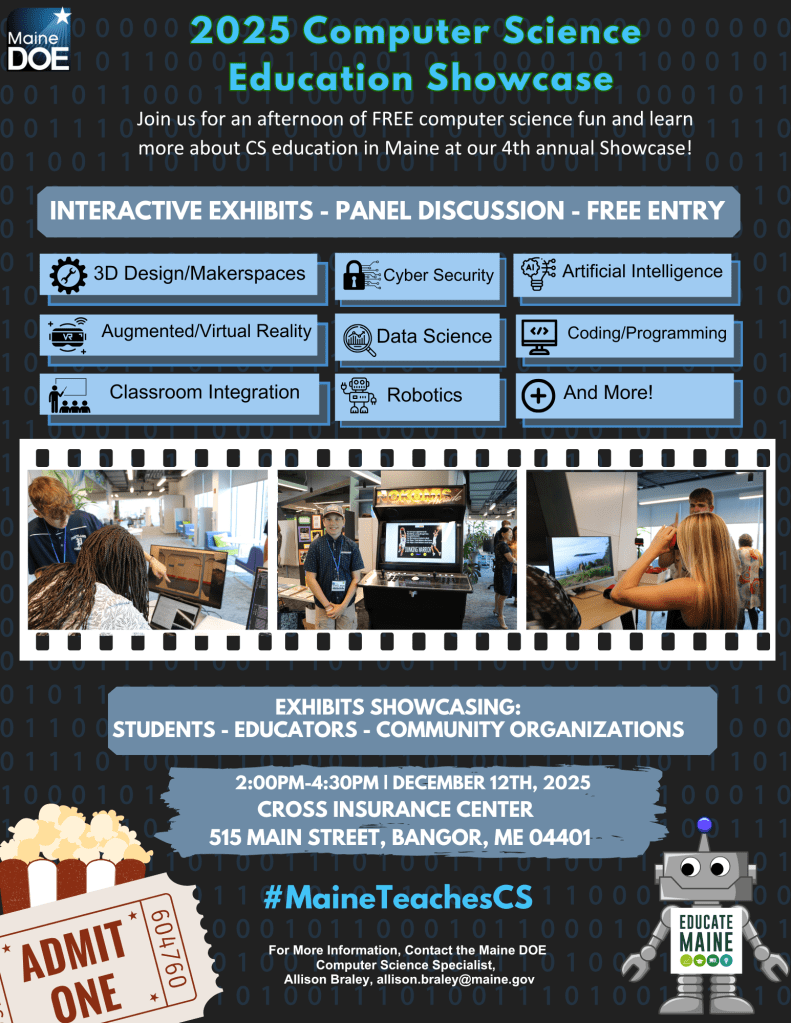
Join educators and students from across Maine for an afternoon of computer science fun at the Maine Department of Education’s (DOE) fourth annual Computer Science Education Showcase on December 12 at the Cross Insurance Center in Bangor. This event is hosted by the Maine DOE, in partnership with Educate Maine, as part of the 2025 Educate Maine Annual Education Symposium.

The 2025 Computer Science Education Showcase will celebrate the educators, students, community organizations, and partners who are expanding access to and participation in computer science across the state.

Whether you’re new to computer science, curious about how it’s taught, or looking to connect with others who share your interest in technology learning—this event is for you! Experience hands-on demonstrations, student projects, and inspiring stories from classrooms and communities around Maine.

Date: Friday, December 12, 2025
Time: 2-4:30 p.m.
Location: Cross Insurance Center (515 Main Street, Bangor, ME 04401)
Registration: This event is free! Click here to register for the 2025 Computer Science Education Showcase.

For a preview of what to expect, check out this article about the second annual Computer Science Education Showcase, which featured students and educators from 40 school administrative units (SAUs) who presented a variety of computer science education projects, including robotics, artificial intelligence (AI), 3D design, coding, augmented reality/virtual reality (AR/VR), data science, cybersecurity, and more.

For more information, please contact Maine DOE Computer Science Specialist Allison Braley at allison.braley@maine.gov.